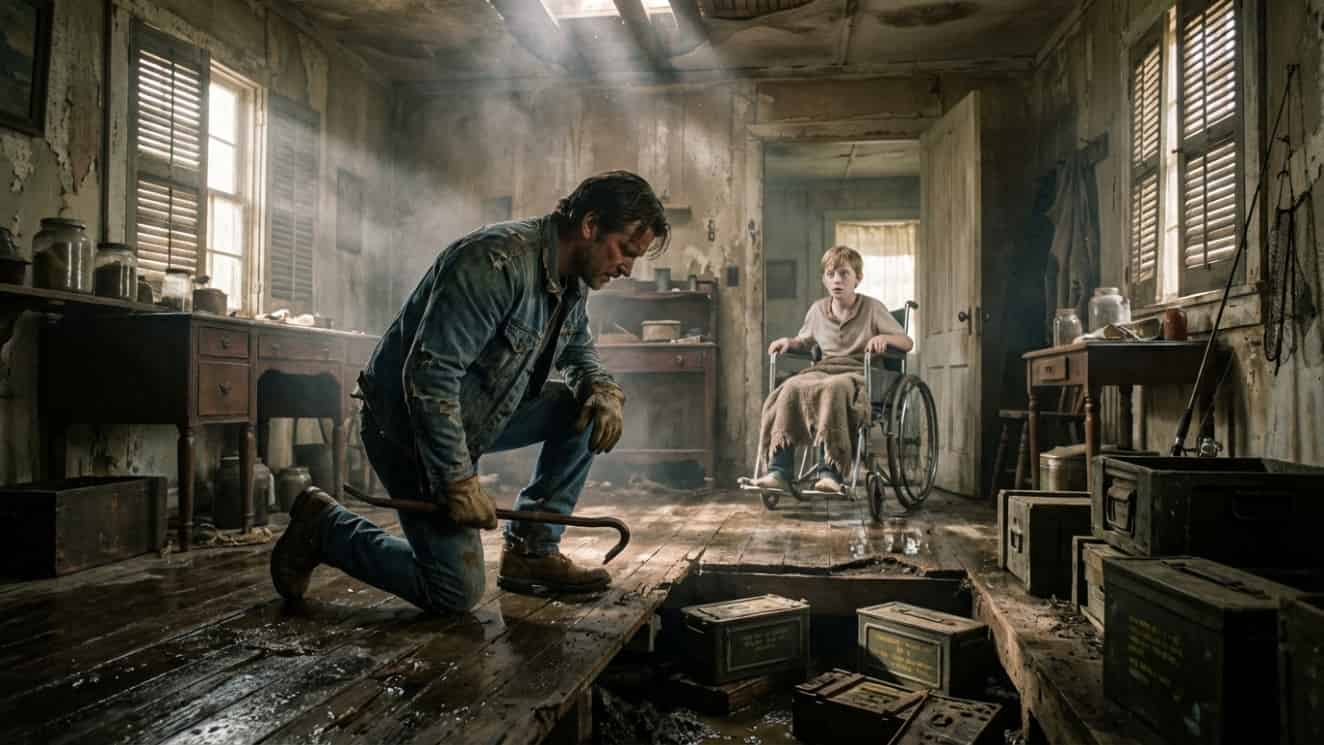
“Chapter 5: The Bayou’s Toll
The firefight was a chaotic blur of muzzle flashes and the splintering of wood. Cole’s house, his sanctuary for twenty years, was being chewed to pieces by professional-grade lead. He stayed low, moving through the mud under the porch, his old biker instincts taking over. He knew every inch of this ground. He knew where the muck was deep enough to swallow a man and where the cypress roots could trip up a charging soldier.
Miller’s men were moving in a pincer movement, three from the drive and two from the tree line. They were slow, hampered by the rising water and the thick undergrowth.
Cole popped up from behind a fallen log and fired two rounds from his .45. One of the men in the tree line went down with a gurgling cry. Cole didn’t feel a thrill. He only felt a cold, mechanical necessity.
He made it to the skiff, which was tied to the back dock. The three crates were nestled in the center, heavy and silent. He grabbed a canister of gasoline he’d stashed there.
“”Cole! Give it up!”” Miller’s voice echoed through the trees. He sounded closer now. “”You can’t win this! Think about the boy!””
“”I am thinking about him!”” Cole yelled back.
He heard the back door of the house crash open. Toby.
“”Dad! They’re inside!””
Cole’s blood turned to ice. He’d left Toby in the living room, thinking it was the safest place. He scrambled back toward the house, ignoring the bullets that whined past his ears. He crawled through the mud and up the back steps, bursting into the kitchen.
Miller was there, his gun pressed against the back of Toby’s head. Toby was trembling, his eyes locked on Cole. Two other men stood by the windows, their weapons trained on the door.
“”You should have just given us the crates, Cole,”” Miller said, his voice eerily calm. “”Now, it’s messy. And I hate messy.””
“”Let him go,”” Cole said, his voice steady despite the hammer of his heart. “”The crates are in the skiff. The keys are in the ignition. Take them and go.””
“”I’ll take them,”” Miller said. “”But I can’t leave witnesses. Not after we’ve put this much work into finding you. It’s a liability issue.””
“”He doesn’t know anything!”” Cole shouted.
“”He knows enough,”” Miller said. He looked at Toby. “”Your dad is a legend, kid. A ghost who kept a king’s ransom under his feet while his son withered away. That’s a hell of a story.””
Toby looked at Cole, and for the first time, the anger was gone. There was only a profound, heartbreaking pity. “”It’s okay, Dad,”” Toby whispered. “”Don’t give it to them.””
In that moment, Cole saw it clearly. The guns weren’t a ticket to a future. They were the anchor that had kept them both underwater for twenty years. If he gave them to Miller, the cycle of violence would just continue, fueled by the very things he’d tried to hide.
Cole looked at the woodstove. Next to it sat the flare gun he’d dropped during the scramble.
“”You’re right, Miller,”” Cole said. “”It is a hell of a story. But every story needs an ending.””
With a sudden, violent motion, Cole didn’t fire at Miller. He dove for the woodstove and kicked it over. The glowing embers spilled onto the floorboards—the boards he’d soaked in gasoline an hour before.
The floor ignited with a roar.
“”What are you doing?!”” Miller screamed, shielding his face from the sudden wall of flame.
In the confusion, Cole lunged forward, grabbing Toby’s wheelchair and pulling it toward the back door. Miller fired blindly through the smoke, the bullets hitting the ceiling.
Cole shoved Toby out onto the porch and into the water just as the living room exploded. The ammunition in the crates hadn’t been moved—only the rifles. The floorboards were packed with twenty-year-old armor-piercing rounds.
The house became a localized sun. The heat was unbearable, the sound of the cooking-off rounds sounding like a thousand hammers on an anvil.
Cole felt a searing pain in his shoulder as a stray round caught him, but he didn’t stop. He dragged Toby’s chair through the waist-deep water toward the tree line, away from the inferno.
He looked back to see the house collapsing into the swamp. Miller and his men were gone, swallowed by the fire and the secondary explosions of the munitions cache.
Cole collapsed against a cypress tree, his breath coming in ragged sobs. Toby was beside him, his face streaked with soot and tears. They watched as twenty years of secrets, guilt, and “”insurance”” burned into nothing.
Chapter 6: The Clean Debt
The aftermath was quiet. The rain returned, a soft, cleansing drizzle that hissed against the charred remains of the house. The emergency crews didn’t arrive until dawn. The floodwaters had receded just enough for a single boat to make it through the basin.
Cole sat on the muddy bank, his shoulder bandaged by Sarah, who had returned with the sheriff’s deputies. He was in handcuffs—a formality, the sheriff said, until they could figure out why there were military-grade weapons and five dead mercenaries in his yard.
Toby was being loaded into an ambulance boat. He looked small under the shock blanket, his face pale but composed.
Sarah walked over to Cole, her eyes weary. “”You’re lucky to be alive, Cole. The whole place is a crime scene.””
“”I know,”” Cole said.
“”I talked to the sheriff,”” Sarah said, lowering her voice. “”He found the remnants of the crates. Or what was left of them. He’s calling in the feds. You’re looking at some serious time, even with a self-defense plea.””
“”It’s a debt I’ve owed for a long time,”” Cole said. He looked at the smoking ruins. “”Is Toby okay?””
“”He’s stable. He needs to go to the hospital for smoke inhalation, but… Cole, something happened.”” Sarah hesitated. “”The story. The news crews are already at the landing. A local businessman saw the reports—a father who lost everything trying to protect his son from ‘gang violence.’ He’s started a fundraiser. In four hours, they’ve already raised sixty thousand dollars.””
Cole started to laugh, a dry, painful sound that turned into a cough. “”The truth is uglier than the story, Sarah.””
“”Maybe,”” she said. “”But for the first time, the story is working for you instead of against you. People want to help the ‘Swamp Hero.’ It’s enough for the surgery, Cole. Or it will be.””
Cole looked at Toby, who was watching him from the boat. The boy raised a hand—a small, tentative wave. It wasn’t a full reconciliation. The damage was still there. The memory of the guns and the lies would always be a shadow between them. But for the first time in twenty years, the floorboards were gone. There was nothing left to hide.
Two weeks later, Cole sat in a cell in the parish jail. He was wearing a thin orange jumpsuit, his hair cropped short. The lawyer provided by the state said they could probably get his sentence down to five years, given his cooperation with the federal investigation into the cartel’s recovery team.
The door buzzed open, and Toby rolled in. He looked different. His eyes were brighter, and he was wearing a clean shirt.
“”Hey, Dad,”” Toby said.
“”Hey, Tobes. How’s the prep going?””
“”The surgery is scheduled for Tuesday,”” Toby said. He looked around the sterile, grey room. “”I’m sorry you won’t be there.””
“”I’ll be there,”” Cole said. “”In spirit and all that.””
Toby nodded. He reached out and touched the glass partition. “”I went back to the house. Or what’s left of it. I found your old 500 patch in the mud. It was half-burnt.””
“”You should have left it,”” Cole said.
“”I buried it,”” Toby said. “”Deep. Under that big oak by the creek. I figured it belonged to the swamp now.””
Cole felt a lump in his throat that he couldn’t swallow. “”That’s good, Tobes. That’s where it belongs.””
“”When I walk again,”” Toby said, his voice firm, “”I’m coming to pick you up. We’re going to find a place with no floorboards. Just concrete and sunlight.””
“”I’d like that,”” Cole said.
The guard tapped on the door, signaling the end of the visit. Toby turned his chair around, but before he left, he looked back.
“”I still don’t forgive you for the guns, Dad,”” he said. “”But I’m glad you chose me.””
Cole watched his son roll out of the room. He sat in the silence of the cell, the weight of the past finally lifted. He was a man with nothing left—no house, no money, no freedom. But as he closed his eyes, he realized he could finally breathe. The air was thin, and it tasted of iron, but it was clean.
The debt was paid.”