“Chapter 5: The Reckoning in the Barn
The “”Iron Fang”” reinforcements arrived just as the moon hit its zenith.
Fifteen more bikes roared onto the property, their headlights cutting through the smoke like the eyes of predators. They didn’t come to talk. They came to finish the job.
Wraith had moved Miller and Smoke back into the barn. It was the only defensible position left. The house was a lost cause, the fuel Skall had splashed earlier finally catching and turning the structure into a towering torch.
Inside the barn, the air was thick with the scent of old hay and gun oil. Wraith was loading the last of the M16 magazines.
“”They’re surrounding us,”” Miller said. He was sitting on a bale of hay, holding Smoke’s head in his lap. The dog was shivering. “”We’re going to die in here, Wraith. Just like the clearing. We’re finally going to die in the clearing.””
“”Shut up,”” Wraith said. He checked the action on his rifle. “”We aren’t in the Highlands, Miller. We’re in Idaho. And this time, I’m not taking the fall.””
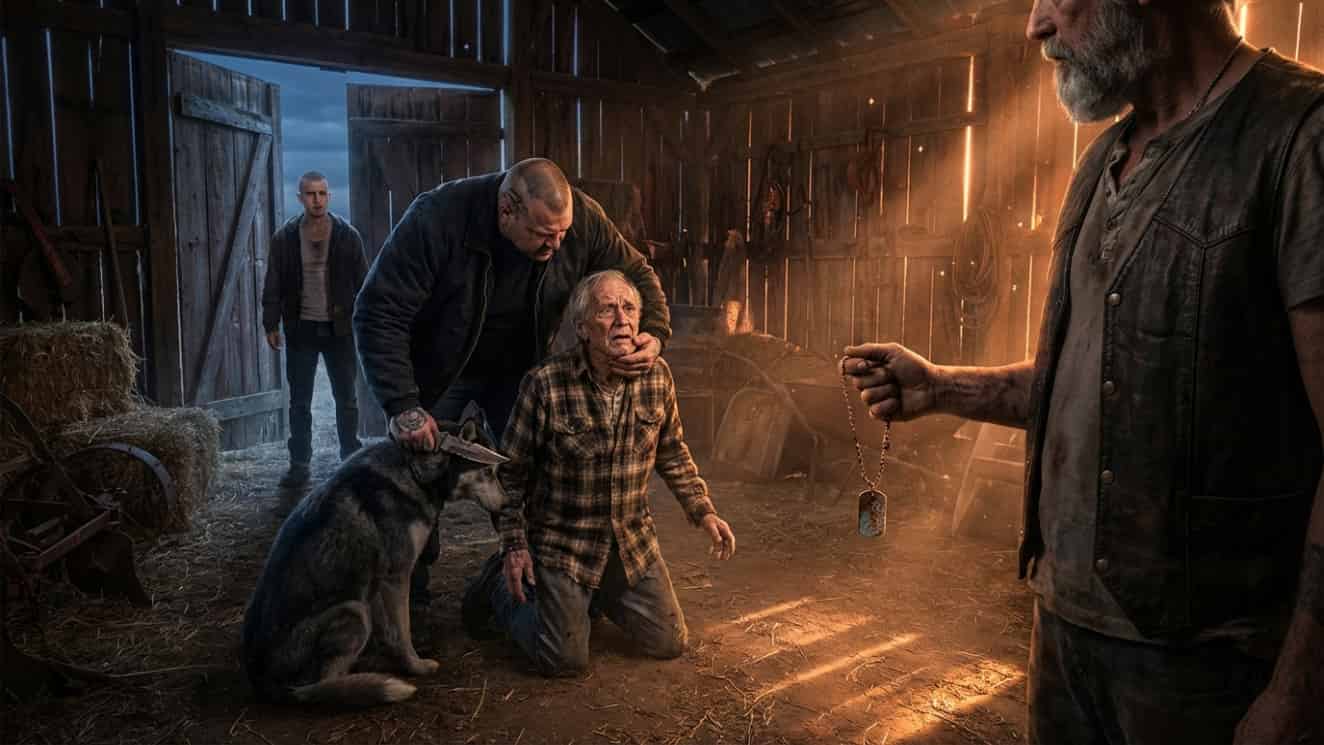
The barn door creaked open. Skall stepped in, silhouetted by the fire outside. He wasn’t alone. Six bikers stood behind him, all of them armed with shotguns and semi-auto rifles.
“”End of the road, boys,”” Skall said. He sounded tired now, the adrenaline fading into a grim, murderous resolve. “”Give me the medals. Give me the rifle. And maybe I’ll make it quick for the dog.””
Wraith stood up. He wasn’t hiding. He was standing in the center of the barn, right under the hanging hook for the hay loft.
“”The medals are in the house, Skall,”” Wraith said. “”They’re melting into slag right now. Just like your future.””
Skall growled and stepped forward, but stopped when he saw what Wraith was holding.
It was the rusted dog tag, but now Wraith had it looped over his thumb like a grenade pin.
“”You see this, Skall?”” Wraith asked. “”This is Gibson’s tag. I’ve carried it for fifty years. It’s got a notch in the side from the bullet that killed him. Miller’s bullet.””
Skall looked at Miller, who was staring at the floor, silent.
“”I don’t care about your history,”” Skall said. “”I care about this land.””
“”You don’t get the land,”” Wraith said. “”Because you don’t understand loyalty. You think it’s about patches and tattoos. But loyalty is taking a bullet for a man who doesn’t deserve it. Loyalty is keeping a secret that rots your soul just so a brother can sleep at night.””
Wraith looked at Miller. “”Tell him, Miller. Tell him the truth. For once in your miserable life, be a man.””
Miller looked up. His face was a wreck of tears and soot. He looked at Skall, then at the bikers, then finally at Wraith.
“”I shot him,”” Miller whispered. The sound was small, but it carried like a thunderclap in the quiet barn. “”I was scared… I thought he was a gook coming through the tall grass. I opened up. I killed my best friend.””
The bikers looked at each other, the “”loyalty”” they bragged about suddenly feeling very thin.
“”And Wraith…”” Miller choked out. “”Wraith told the officers it was him. He told them he gave the order. He saved me. And I let him live in a shack while I sat in this house and let people call me a hero.””
Skall sneered. “”So you’re both losers. Good to know. Now, kill ’em both.””
The bikers raised their weapons.
But they didn’t fire.
From outside, a new sound began to drown out the crackle of the fire. It wasn’t the high-pitched whine of the Fangs’ bikes. It was a deep, rhythmic thrumming. A low-frequency vibration that shook the very foundation of the barn.
It sounded like an army.
Skall turned toward the barn door, his eyes wide.
Through the smoke and the shadows, a wall of light appeared. Hundreds of headlights.
And then came the roar.
Five hundred bikes. Maybe more. They weren’t Harleys; they were beasts of burden, loaded with gear, ridden by men with gray beards and “”Ghost Division”” patches that had been pulled out of mothballs.
They didn’t stop at the gate. They rode right onto the lawn, a tidal wave of leather and steel that surrounded the Fangs before Skall could even scream an order.
At the head of the pack was an old man on a vintage Indian. He looked like he’d crawled out of a history book. He climbed off his bike, pulled a 12-gauge from a scabbard, and walked toward the barn.
“”I hear there’s a debt to be settled,”” the old man said.
Wraith smiled. It was a cold, jagged thing.
“”You’re late, Mcknight,”” Wraith said.
“”Traffic was a bitch,”” the man replied. He looked at Skall. “”You the one bothering our Sergeant?””
Skall looked around. He was outnumbered fifty to one. His “”Fangs”” were already dropping their guns, their hands in the air, their bravado evaporated.
“”This is private property!”” Skall yelled, though his voice was shaking.
“”No,”” Wraith said, stepping forward. “”This is a graveyard. And you’re standing in your own plot.””
Wraith didn’t kill Skall. He didn’t have to. He just looked at Micky, the kid who had warned him.
“”Get him out of here,”” Wraith said. “”Take his vest. Take his bike. If I ever see him in this county again, I won’t use the thumper. I’ll use my hands.””
Micky stepped forward, his face set. He walked up to Skall and ripped the “”Iron Fang”” patch right off his chest, the leather tearing with a satisfying rip.
The Fangs broke. They ran into the woods, leaving their bikes and their dignity in the dirt.
Wraith turned back to Miller.
The old man was still on the hay bale. He looked empty. The house was gone. The secret was out. The “”hero”” was dead.
“”What now?”” Miller asked.
Wraith looked at the five hundred men standing in the yard, the ghosts who had finally come home.
“”Now,”” Wraith said, “”we tell the dog he’s safe.””
Chapter 6: The Sunset on Bonner’s Ferry
The fire at the Miller farm burned through the night and into the gray, misty morning of the next day.
By noon, the “”Iron Fangs”” were gone from Idaho. Their compound had been visited by three hundred of the “”Ghosts,”” and by the time the sheriff arrived, the gates were off the hinges and the residents had fled across the state line.
The town of Bonner’s Ferry was quiet. Sarah, the librarian, sat in the town square, watching the workers take down the “”Hero of the Highlands”” plaque. She didn’t stop them. She had posted the video that morning. By noon, it had been seen by every person in the county.
There was no anger. Just a heavy, communal shame.
Out on the ridge, Wraith was packing his bags.
He wasn’t staying. The cabin was too small now. The silence was too loud.
He walked out to his Shovelhead. Miller was standing there, leaning against the fence. He looked older than seventy. He looked like he was made of ash.
Smoke was sitting at his feet, his ribs bandaged, his tail wagging tentatively.
“”Where are you going?”” Miller asked.
“”South,”” Wraith said. “”Maybe Arizona. Somewhere the wind doesn’t taste like pine and lies.””
Miller looked at the ruins of his house down the hill. “”I’m sorry, Wraith. For the clearing. For the fifty years. For everything.””
Wraith tightened the bungee cord on his bedroll. He didn’t look at Miller. “”Don’t be sorry, Miller. Being sorry is easy. Living with it… that’s the hard part. You got the dog. You got the land. But you don’t have the lie anymore. That’s the best gift I could give you.””
“”Will you come back?””
Wraith kicked the bike to life. The roar of the engine filled the mountain air, a sound of freedom and finality.
“”The Ghost Division is officially disbanded, Miller,”” Wraith said over the noise. “”There’s nothing left to come back to.””
Wraith looked up the road. The five hundred bikers were already lined up, a long, black ribbon of steel stretching toward the horizon. They were waiting for their Sergeant.
Wraith clicked the bike into gear. He looked at Smoke one last time, the dog who looked like Tripwire. He reached down and ruffled the dog’s ears.
“”Take care of the coward, Smoke,”” Wraith whispered.
He twisted the throttle.
The 500 bikes moved as one. It wasn’t a parade. It wasn’t a celebration. It was an exodus.
The sound was like a low-altitude carpet bombing, a vibration that could be felt in the floorboards of every house in Bonner’s Ferry. The townspeople stood on their porches, watching the black line of riders disappear into the setting sun.
They looked for the hero. They looked for the Lion.
But all they saw were the ghosts.
Wraith led them out of the valley, his back straight, his eyes fixed on the road ahead. The rusted dog tag was no longer in his pocket. He’d left it hanging on the fence post at the edge of the property, a small piece of metal that had finally stopped screaming.
The sun dipped below the Idaho peaks, casting long, bloody shadows across the dust.
By the time the stars came out, the road was empty. The farm was a pile of cooling embers. And for the first time since 1972, the air in the panhandle was clean.
The war was over.”