The check for fifty thousand dollars cleared three months ago, and I thought I’d finally bought Finn’s way out of the dirt. I dressed him in that silk tie, told him to keep his head down, and watched him walk into the hallowed halls of St. Jude’s Academy. I wanted a Senator, not a soldier. But the boys in those halls? They aren’t scholars. They’re predators with trust funds.
When I got the video of what they did to him—what they called a ‘tradition’—I didn’t call the police. I didn’t call a lawyer. I called five hundred brothers who have been waiting for a reason to burn a piece of the world that looks down on them. We didn’t come for a tour. We came to collect. By the time the sun goes down, St. Jude’s won’t be worried about their endowment. They’ll be worried about whether they can walk again.
Chapter 1: The Knot
The silk felt like a lie between my fingers.
It was too thin, too smooth, the kind of fabric that didn’t belong in a house that smelled like motor oil and stale coffee. I stood in the narrow hallway of our house in Oakhaven, the floorboards creaking under my boots, trying to get the knot right. Finn stood in front of me, stiff as a board, his chin tilted up so far I could see the pulse jumping in his neck. He was fourteen, but in the morning light filtering through the dusty window, he looked like a kid playing dress-up in a dead man’s clothes.
“Hold still, Finn,” I said. My voice was a low rasp, a byproduct of twenty years of shouting over the roar of a V-twin engine and breathing in the fumes of the clubhouse.
“It’s too tight, Dad,” he whispered.
“It’s supposed to be tight. It’s a tie, not a noose.”
But as I tucked the ends of the St. Jude’s Academy stripe under his collar, I knew I was lying. It was a noose. It was just a very expensive one. The tuition at St. Jude’s cost more than I made in two years of legitimate mechanical work at the shop. The rest of the money—the bulk of it—came from the “outreach” programs of the Black Leather Outlaws. It was money washed through three different shell companies, money that smelled like fear and back-alley deals, but it was green enough for the admissions office.
I stepped back, my hands dropping to my sides. I looked at my son. He was pale, with his mother’s eyes—the only part of her I hadn’t managed to lose after the cancer took her six years ago. He looked like he belonged in a courtroom, or a boardroom, or a balcony overlooking a city. He didn’t look like me. That was the point.
“You remember the rules?” I asked.
Finn nodded, his eyes fixed on my chest, right where the “REAPER” patch sat on my vest. I hadn’t taken it off yet. I wouldn’t take it off until we reached the gates. “Don’t talk about the club. Don’t talk about the shop. If they ask about the money, tell them it’s ‘private equity’.”
“And?”
“And don’t let them see you’re afraid.”
I grunted, a sound of approval that felt heavy in my gut. I reached out and squeezed his shoulder. My hand was twice the size of his, the knuckles scarred and the nails permanently stained with black grease that no soap could ever fully remove. I was a marked man, a creature of the fringe, a ghost in the machinery of a polite society that only tolerated me because I kept their toys running and their secrets buried.
“You’re better than them, Finn,” I said, and for a second, I almost believed it. “Those kids, they were born on third base. You’re the one who actually had to run the bases to get there. You study. You keep your nose clean. You become the man who writes the laws instead of the man who has to break them.”
“Are you coming to the parent mixer on Friday?” Finn asked. There was a desperate edge to the question that he couldn’t quite hide.
“I’ll be there,” I lied. I wouldn’t. I couldn’t. Me standing in a room full of hedge fund managers and legacy donors was a recipe for a disaster I couldn’t afford. But Finn needed the lie to get through the gate.
We walked out to the truck—a beat-up F-150 that looked like a jagged tooth in the mouth of the pristine St. Jude’s parking lot forty minutes later. The school was a fortress of red brick and ivy, tucked away in the rolling hills of Connecticut where the air felt thinner, like it was filtered through money. As we pulled up to the drop-off line, I saw the other cars. Range Rovers, Porsches, a Bentley with a driver who looked like he’d been carved out of ice.
I saw the way the parents looked at my truck. I saw the way the security guard adjusted his belt when I rolled down the window.
“This is it,” I said, kept the truck idling. The engine was a low, rhythmic throb that seemed to mock the silence of the campus.
Finn grabbed his duffel bag. He looked at the school, then back at me. For a split second, I saw the Reaper in him—the flicker of a cornered animal wondering if it should bite or run. Then he blinked, and he was just a boy in a blazer again.
“Thanks, Dad,” he said.
He got out of the truck and walked toward the stone steps. He didn’t look back. I watched him go until the heavy oak doors swallowed him whole. I sat there for a long time, my hands gripping the steering wheel so hard the cheap plastic groaned. My father had died in a ditch because a man in a car like those Porsches hadn’t bothered to look in his rearview mirror. No one had gone to jail. No one had paid a dime. The world was built for the people inside those oak doors, and I was going to make sure my son was one of them, even if I had to burn every bridge I ever built to do it.
I shifted the truck into gear and drove toward the clubhouse. I had a meeting with the board of the Black Leather Outlaws. We had a shipment coming in from the coast, and the “private equity” for next semester wasn’t going to earn itself.
Chapter 2: The Lion’s Den
The office of Dean Sterling smelled of old paper and arrogance.
Sterling himself was a man of sixty who looked like he’d been preserved in vinegar. He sat behind a desk that probably cost more than my first house, his hands folded neatly over a leather-bound ledger. He didn’t offer me a seat. That was his first mistake. I sat anyway, the leather of my vest creaking as I leaned back, stretching my legs out. I’d left the Harley at the bottom of the hill today, driving the truck again to maintain the “private equity” facade, but I hadn’t bothered to change out of my work clothes.
“Mr. Stone,” Sterling said, his voice clipped and precise. “It’s been a month since Finn joined us.”
“And?” I asked. I didn’t like the way he said my name. It sounded like he was trying to scrub a stain off his tongue.
“Finn is a bright boy. Exceptionally so. His grades in Latin and Calculus are the highest in his year.” Sterling paused, his eyes drifting to the tattoos peeking out from under my sleeves. “However, there is the matter of… integration.”
“Integration,” I repeated. “That’s a big word for ‘the other kids don’t like him.'”
Sterling sighed, a weary sound. “St. Jude’s is more than an academic institution, Mr. Stone. It is a community. A network. Friendships made here last a lifetime. They are the foundations of future careers. Finn, unfortunately, seems to be having trouble navigating the social hierarchies of the dormitory.”
“You mean he’s being bullied,” I said. My voice was flat. I felt the old itch in my knuckles, the one that only went away when I hit something.
“We prefer the term ‘character building transitions,'” Sterling said with a thin smile. “There have been some… incidents. Minor skirmishes. Finn has a certain—how shall I put it?—defensiveness. He doesn’t seem to understand the spirit of the traditions here.”
“What traditions?”
“The senior boys take a leadership role. They mentor the younger ones. Sometimes that mentorship involves a certain degree of physical and mental fortitude. It’s part of the St. Jude’s man. We forge steel here, Mr. Stone.”
“You forge bullies,” I corrected him. I stood up. I was a head taller than Sterling, and fifty pounds heavier, most of it muscle and bad intentions. I leaned over his desk, my shadow falling across his ledger. “Listen to me, Dean. I’m paying you a lot of money to keep my son safe. Not to ‘forge’ him. If he comes home with one bruise that he didn’t get on the athletic field, you and I are going to have a very different conversation. Do we understand each other?”
Sterling didn’t flinch, but his eyes narrowed. “Your tone is noted, Mr. Stone. But I must remind you that Finn is here on a very specific set of circumstances. Your… financial contributions are appreciated, but they do not buy you the right to dictate our culture.”
I walked out of the office before I did something that would get Finn expelled on the spot.
Outside, the quad was buzzing with students. I saw them in their groups, their voices loud and entitled. They moved with a confidence that only comes from knowing the world belongs to you. In the center of the lawn, I saw Finn. He was walking toward the library, his head down, his books clutched to his chest.
Three older boys, maybe seventeen or eighteen, stepped into his path. They were wearing varsity jackets, their hair perfectly styled. One of them—a tall, blond kid with a jawline like a Greek statue—said something that made the others laugh. He reached out and flicked Finn’s tie.
Finn didn’t move. He stood there, frozen.
I started to move toward them, my heart hammering against my ribs. But then I stopped. If I intervened now, I was the “biker dad” coming to save his kid. I’d ruin everything I’d worked for. I’d prove to everyone that Finn didn’t belong.
The blond kid laughed again and shoved Finn. It wasn’t a hard shove, just enough to make him stumble. Finn regained his balance, his face flushed red, and walked around them. He didn’t look up. He didn’t fight back.
He was doing exactly what I’d told him to do. He was being a “scholar.” He was keeping his nose clean.
And watching it made me want to vomit.
I went back to the clubhouse that night and sat in the back room with Ghost. Ghost was the club’s intelligence officer—a man who had been a signal corps specialist in the Army before he decided he liked motorcycles better than bureaucracy. He was sitting in front of a bank of monitors, his fingers flying over a keyboard.
“You look like shit, Reaper,” Ghost said without turning around.
“The school,” I said, grabbing a bottle of bourbon from the shelf. “It’s a snake pit.”
“What did you expect? You put a wolf cub in a room full of vipers. They’re gonna bite.”
“He’s not a wolf cub,” I muttered, taking a long pull of the bourbon. “I’m trying to make him something else.”
“You can dress a dog in a suit, but he’s still gonna bark when he’s scared,” Ghost said. He turned his chair around, his expression serious. “Listen, I did some digging into that school like you asked. That ‘tradition’ Sterling talked about? It’s called ‘The Kennel.’ It’s a secret society run by the legacy kids. The ones whose fathers own half the state. They’ve been doing it for fifty years. It’s not just hazing, Reaper. It’s systematic. They pick one kid every year—the ‘stray’—and they break him. Usually, it’s a scholarship kid. Someone who doesn’t have the last name to protect them.”
“Finn’s not a scholarship kid,” I said.
“No,” Ghost said softly. “But he’s the son of a guy who owns a bike shop and pays tuition in cash. To those kids, that’s worse than being poor. That’s being a pretender.”
I looked at the bottle in my hand. I thought about the blond kid flicking Finn’s tie. I thought about the fifty thousand dollars.
“Keep an eye on him, Ghost,” I said. “Use the backdoors. If anything happens, I want to know before the Dean does.”
“You got it, Boss.”
I went home to an empty house and sat in the dark. I could still feel the silk of that tie on my fingers. I realized then that I wasn’t just paying for Finn’s education. I was paying for his silence. And I wondered how much more of it he could afford.
Chapter 3: The Price of Silence
The weeks that followed were a slow-motion car crash.
Finn came home for the weekends, but he wasn’t the same kid. He was quieter, his eyes darting toward the windows whenever a car drove by. He stopped talking about his classes. He stopped talking about the future. When I asked him how things were going, he just said, “Fine, Dad,” with a voice that sounded like it was being squeezed through a straw.
I saw the marks on his wrists first.
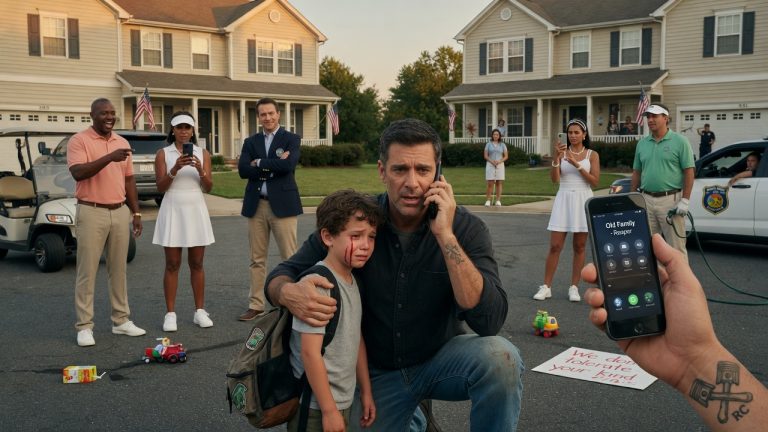
It was a Saturday morning, and he was reaching for the milk. His sleeve slid up, revealing a ring of dark purple bruises around his forearm. It looked like someone had gripped him with pliers.
“Finn,” I said, my voice dangerously low. “What is that?”
He pulled his sleeve down instantly, his face turning ashen. “Nothing. I tripped in the gym. Caught myself on the bleachers.”
“Don’t lie to me.” I stood up, the chair scraping harshly against the linoleum. I walked around the table and grabbed his arm, pulling the sleeve back up. It wasn’t just the wrist. There were burn marks on his elbow—small, circular ones. Cigarettes.
My vision went red at the edges. The room seemed to tilt. I felt the Reaper clawing at the inside of my chest, screaming for blood.
“Who did this?” I roared.
Finn flinched, his eyes filling with tears. “It doesn’t matter, Dad! If you do anything, they’ll kick me out! You said this was the only way! You said I had to stay!”
“I didn’t say you had to be a punching bag!”
“You don’t understand!” Finn shouted back, his voice cracking. “They have everything! Their dads are judges, CEOs, politicians! Julian told me that if I said a word, he’d make sure you went to jail for the money you’re using. He knows, Dad! He knows about the club! He said you’re just a criminal playing house!”
I let go of his arm. The silence that followed was heavy, suffocating. My secret—the one I’d buried under layers of paperwork and lies—wasn’t a secret at all. These kids, these seventeen-year-old monsters, had seen right through it. They didn’t just have power; they had leverage.
“I’m taking you out of there,” I said, my voice shaking. “Right now.”
“No!” Finn pleaded. “If you take me out, they win. They said the only way to earn my place is to finish the ‘Initiation.’ It’s almost over, Dad. Just two more weeks. Please. I can’t be a failure. I can’t come back here and be… be like you.”
The words hit harder than any fist ever had. Be like you.
He meant it as a fear, a nightmare. Being Jaxson Stone was a fate worse than being tortured by rich kids. I looked around our kitchen—the peeling wallpaper, the stack of bills on the counter, the smell of grease that never left. He was right. I’d spent his whole life telling him he was better than this. Now he believed me so much he was willing to let them burn him just to stay away from it.
“Go to your room, Finn,” I said quietly.
I went to the clubhouse. I didn’t drink this time. I walked straight to Ghost’s room.
“I need everything,” I said. “The ‘Kennel.’ Julian. Who is he?”
Ghost didn’t say a word. He just pulled up a file. “Julian Sterling. The Dean’s nephew. His father is the State Senator for this district. He’s the golden boy. Quarterback, valedictorian, and apparently, the Grand Master of the ‘Kennel.’ They use an old basement under the chapel. It used to be a coal cellar. They call it the ‘Dog House.'”
“Get me eyes inside,” I said.
“Reaper, that’s a felony. Federal wiretapping, trespassing—”
“I don’t give a damn about the law, Ghost. I gave a damn about my son, and look where it got him. Get me in.”
Ghost sighed and started typing. It took him four hours. He bypassed the school’s security system, hacked into the private Wi-Fi network the seniors used, and eventually, he found it. A hidden camera feed, installed by the boys themselves to record their ‘victories.’
The video was grainy, infrared, and silent.
It showed a small, damp room with stone walls. In the center, there was a large iron cage—the kind you’d use for a dangerous animal.
Finn was inside it.
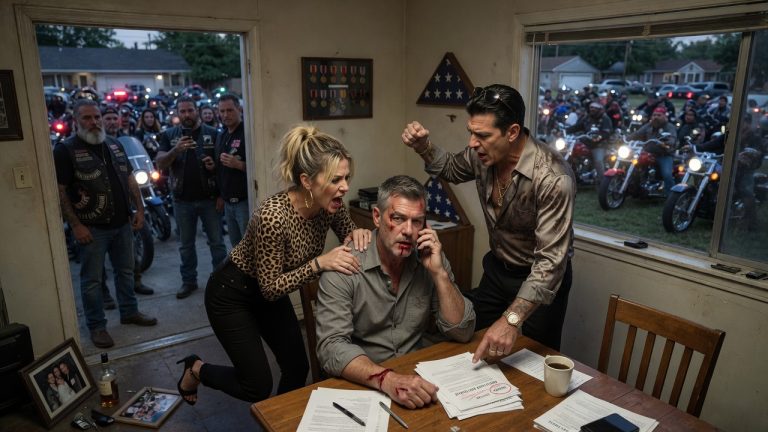
He was curled in a ball, wearing nothing but his boxers. Julian Sterling was standing outside the cage, holding a garden hose, spraying Finn with water. Two other boys were laughing, holding up their phones to record. Julian reached through the bars with a lit cigar.
I watched as my son—the boy I’d taught to tie a silk knot—screamed in silence as the ember touched his skin.
I didn’t yell. I didn’t throw anything. A cold, absolute clarity settled over me. The kind of clarity that comes when you stop trying to be a man you’re not and accept the monster you’ve always been.
“Ghost,” I said, my voice sounding like it was coming from the bottom of a grave. “Call the chapters. All of them. New York, Jersey, Pennsylvania, the local boys. I want every patch, every bike, every brother we have.”
“Reaper, that’s five hundred bikes. You’ll start a war.”
“The war already started,” I said, looking at the screen where Julian was laughing. “They just didn’t realize they were fighting me.”
Chapter 4: The Gathering of the Ghosts
The word went out over the encrypted lines. It was a “Red Alert”—a call to arms that hadn’t been used since the turf wars of the late nineties. But this wasn’t about turf. It wasn’t about drugs or money.
It was about a father.
By Monday morning, the rumble started. It began as a faint vibration in the air, a low-frequency hum that you felt in your teeth before you heard it in your ears. I stood in the parking lot of a closed-down truck stop five miles from St. Jude’s Academy.
They came in waves. First, the local crew—twenty guys I’d bled with for decades. Then the New York chapter, forty strong, their leather dusty from the ride. Then came the Pennsylvania boys, led by Big Sal, a man who looked like he’d been carved out of a mountain.
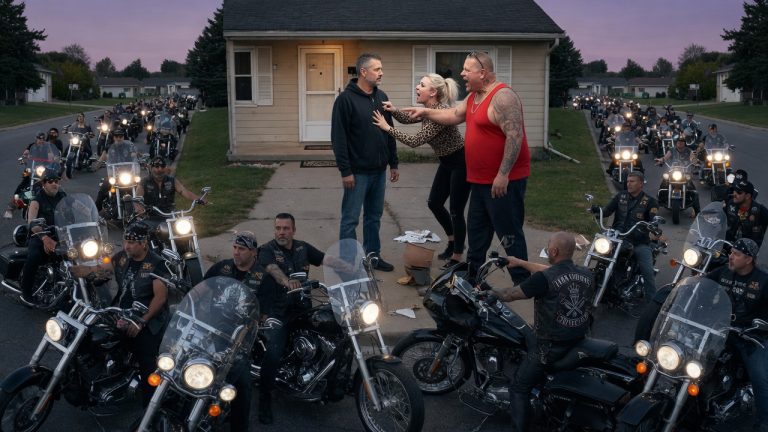
By noon, the parking lot was a sea of black leather and gleaming chrome. Five hundred motorcycles, idling in unison, creating a wall of sound that felt like a physical weight. The air was thick with the smell of unburnt fuel and leather.
I stood on the back of my truck, looking out over them. I wasn’t wearing the “private equity” suit. I was wearing my colors. My vest was open, my tattoos bare, my face set in a mask of iron.
“Brothers!” I shouted, and the roar of the engines died down to a low growl. “I asked you here today for a personal matter. Most of you know my son, Finn. You know I tried to send him away. I tried to make him something better than us.”
A murmur of agreement went through the crowd.
“I thought I could buy him a future,” I continued, my voice cracking slightly. “I thought if I paid enough, they’d treat him like a human being. But they didn’t. They treated him like a dog. They put him in a cage. They burned him for sport.”
I held up my phone, showing the still frame from the video Ghost had found. The image of Finn in the cage, small and broken.
The silence that followed was terrifying. It wasn’t the silence of peace; it was the silence of a predator before it strikes.
“The man who runs that school is protected by the law,” I said. “The kids who did this are protected by their daddies’ money. But they aren’t protected from us. We aren’t going there to kill anyone. We aren’t going there to burn it down. We’re going there to show them that the world doesn’t belong to them. We’re going there to take back what’s mine.”
Big Sal stepped forward, his boots crunching on the gravel. “What’s the play, Reaper?”
“We ride in formation,” I said. “We don’t stop for the gates. We don’t stop for the guards. We park on their lawn. We find the Dean. And we make him watch while we take the ‘stray’ home.”
I hopped down from the truck and walked to my Harley. It was a custom Softail, black as a heart, with “REAPER” etched into the fuel tank. I kicked the starter, and the engine screamed to life.
Five hundred engines followed suit. It was the sound of an earthquake.
We moved out in a double-file line that stretched for over a mile. I was at the front, with Ghost and Big Sal on my flanks. As we hit the main highway leading to the hills, the regular traffic scattered like leaves in a storm. People pulled over to the shoulder, their windows rolled up, their eyes wide with terror as the black tide rolled past.
We reached the turn-off for St. Jude’s. The road narrowed, winding through the woods. The trees seemed to lean in, the shadows lengthening as the sun began to dip toward the horizon.
The gates of the academy appeared ahead of us. Two massive wrought-iron wings, topped with gold-leafed lions. A security guard in a neat blue uniform stepped out of the booth, his hand held up in a ‘stop’ gesture.
He saw me. Then he saw the mile of leather behind me.
He didn’t even try to reach for his radio. He just turned and ran.
I didn’t slow down. I shifted into third, tucked my head, and hit the gate at forty miles an hour. The iron groaned, the lock snapped with a sound like a gunshot, and the gates swung wide, crashing into the stone pillars.
I roared onto the gravel driveway, the five hundred behind me flooding through the gap like water through a broken dam. We tore through the perfectly manicured hedges, our tires throwing up dirt and sod.
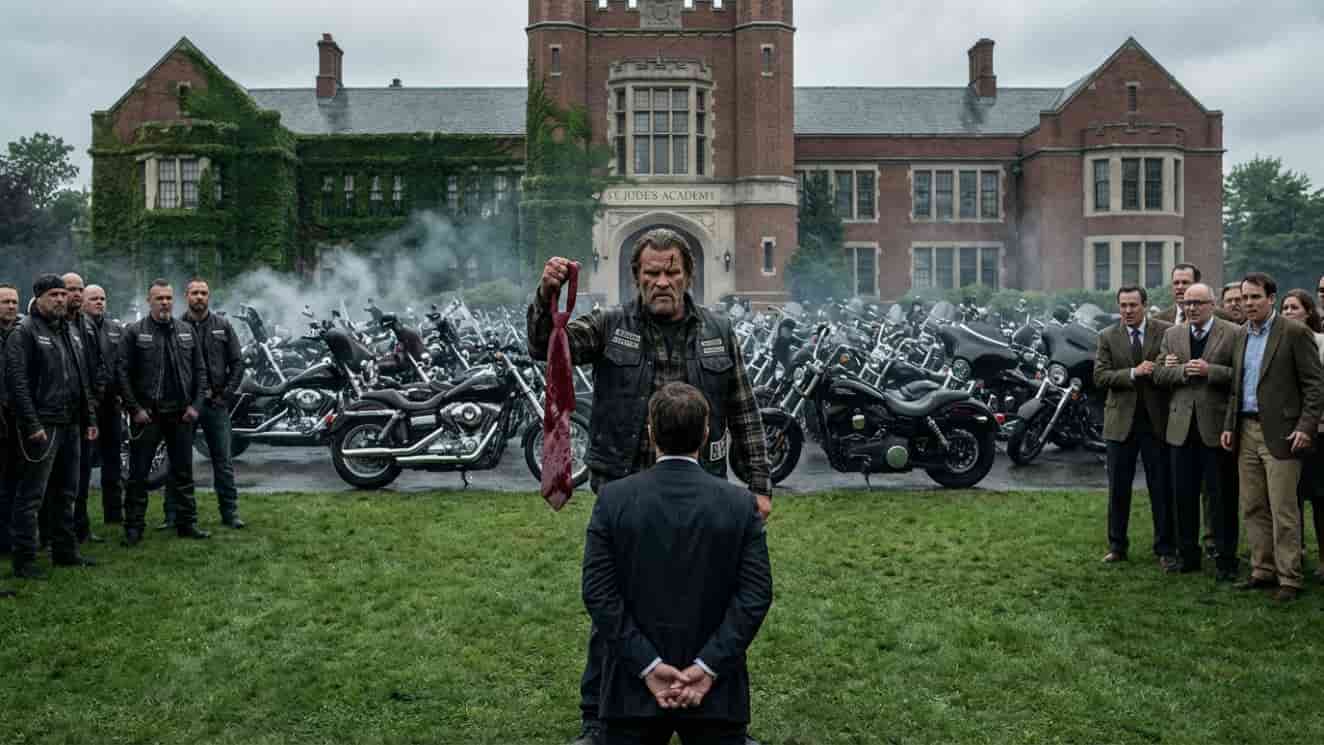
We reached the main quad—the holy of holies, the pristine lawn where the “St. Jude’s men” were forged. I skidded to a halt right in front of the chapel, the back of my bike fishtailing, carving a deep scar into the emerald grass.
One by one, the brothers pulled up around me, forming a massive, pulsing circle of steel and leather. The noise was absolute. The windows of the dormitory buildings were filled with white, terrified faces.
Dean Sterling came running out of the main hall, his tie askew, his face a mask of disbelief. He stopped at the edge of the lawn, looking at the army that had just invaded his kingdom.
I kicked the kickstand down and dismounted. I didn’t rush. I walked toward him, my boots sinking into the grass he cared so much about. In my hand, I clutched the shredded silk tie I’d found in Finn’s room that morning—the one he’d tried to hide.
The Dean looked at me, then at the five hundred men behind me, then back at me.
“Mr. Stone!” he screamed over the fading roar of the engines. “What is the meaning of this? This is private property! I’m calling the State Police!”
“Call them,” I said, stopping inches from his face. The smell of exhaust and sweat was a wall between us. “But before they get here, you and I are going for a walk to the basement of that chapel.”
I held up the silk tie. “And you’re going to help me find the dog you lost.”
Chapter 5: The Dog House
The chapel at St. Jude’s was a masterwork of Gothic revival—soaring arches, stained glass that probably cost more than a fleet of Harleys, and a silence so thick it felt like a physical weight. But as I shoved the heavy oak doors open, that silence was shattered by the rhythmic thud of five hundred pairs of engineer boots on the stone floor.
Dean Sterling was stumbling beside me, his breath coming in ragged, high-pitched gasps. He kept trying to grab my arm, his manicured fingers catching on the rough leather of my vest, but I didn’t even look at him. I was focused on the altar. Not because I was looking for God, but because Ghost had told me the stairs to the coal cellar were hidden behind the vestry.
“Mr. Stone, please,” Sterling hissed, his voice echoing off the vaulted ceiling. “This is a consecrated space. You are desecrating a century of history. Think about Finn’s future! If you do this, there is no coming back. He will be blacklisted from every preparatory school on the East Coast.”
I stopped in my tracks and turned to him. The light from a stained-glass window—showing some saint being pierced by arrows—cast a blood-red glow across Sterling’s terrified face. Behind me, Big Sal and ten of the heaviest hitters from the Newark chapter stood like statues, their shadows stretching long and jagged toward the altar.
“You think I care about a blacklist, Dean?” I asked. My voice was a low, vibrating growl that seemed to rattle the pipes of the organ. “You let seventeen-year-old boys run a torture chamber in the basement of a church. You didn’t just fail my son. You failed every kid who ever walked through those doors without a Senator for a father. The history of this place? It’s written in the blood of kids like mine. Now, open the door, or I’ll have Sal use your head as a battering ram.”
Sterling looked at Big Sal. Sal didn’t smile. He just adjusted his grip on a heavy iron wrench he’d pulled from his belt. Sterling’s knees buckled. He reached into his pocket, his hands shaking so violently he dropped his keys twice before finding the brass skeleton key for the vestry.
The door groaned as it swung open, revealing a narrow, stone-walled staircase that smelled of damp earth and something sour—the smell of old fear.
I didn’t wait for him. I took the stairs two at a time, the darkness swallowing the light from the chapel above. At the bottom, the air turned cold. A single, naked lightbulb flickered at the end of a long corridor. And then I heard it.
Laughter.
It was a sharp, entitled sound. The kind of laughter that comes from people who have never been told ‘no’ in their entire lives.
“Come on, Fido,” a voice mocked. I recognized it. Julian Sterling. “You’re not even trying. If you don’t howl louder, we’re going to have to see if the hose works better on the ‘hot’ setting.”
I hit the door at the end of the hall with the full weight of my shoulder. The frame splintered, the wood screaming as it gave way.
The room was exactly as it had been on Ghost’s screen, but the reality was a thousand times worse. The smell of wet dog and ozone hit me first. The floor was covered in an inch of standing water. In the center of the room sat the cage—a rusted, heavy-duty iron thing that looked like it had been salvaged from a municipal pound.
Finn was inside. He was shivering so hard the bars of the cage were rattling. His skin was a mottled, sickly blue, and the circular burns on his arms stood out like angry red welts.
Julian Sterling stood by the hose, a beer in one hand and a lit cigar in the other. Two other boys—both wearing St. Jude’s wrestling hoodies—were leaning against the stone wall, their phones out, recording the spectacle.
When the door blew off its hinges, they didn’t look scared. Not at first. They looked annoyed, like someone had interrupted a private club meeting.
“Who the hell are you?” Julian asked, squinting against the light from the hallway. He didn’t recognize me without the truck. He didn’t realize the Reaper had come for him.
I didn’t say a word. I walked across the room, the water splashing around my boots. Julian started to say something else, his mouth opening to deliver some polished insult, but I didn’t give him the chance. I grabbed the front of his hoodie with one hand and the back of his neck with the other, and I slammed him face-first into the stone wall.
The sound of his nose breaking was the most satisfying thing I’d heard in years.
The other two boys dropped their phones. One of them tried to bolt for the door, but Big Sal was already there, his massive frame filling the doorway like a mountain of leather. He caught the kid by the throat and lifted him six inches off the ground.
“Dad?”
The voice came from the cage. It was small, fragile, and sounded like it belonged to a much younger boy.
I let Julian slump to the floor, his face a mask of blood and shock. I turned to the cage. The lock was a heavy master-lock, the kind that would take a bolt cutter or a key. I looked at Dean Sterling, who was standing in the doorway, his eyes wide with horror.
“The key,” I said. It wasn’t a request.
Sterling fumbled with his ring, his face gray. He practically fell over himself to get to the cage. He shoved the key into the lock, his hands trembling so hard he nearly bent it. The lock clicked. The door swung open with a heavy, metallic rasp.
I reached inside and pulled my son out. He was light—so light I felt a fresh wave of fury crash over me. He’d lost weight. He’d been disappearing right in front of me, and I’d been too busy worrying about his “future” to see it.
I stripped off my leather vest—the one with the Reaper on the back—and wrapped it around his shivering shoulders. The leather was still warm from my body. Finn clung to me, his fingers digging into my forearms, his face buried in my chest. He wasn’t crying. He was past crying. He was just trying to remember how to breathe.
“I’ve got you,” I whispered into his hair. “I’ve got you, Finn. We’re going home.”
“Mr. Stone,” Julian groaned from the floor, clutching his face. “My father… you have no idea… you’re dead. You’re all dead.”
I looked down at the boy. He looked pathetic. All the power, all the prestige, all the Senator’s influence—it didn’t mean a damn thing in a cold basement with the water rising.
“Your father isn’t here, Julian,” I said, my voice eerily calm. “And by the time he gets here, I’m going to make sure the whole world knows what you do in the dark. Ghost?”
Ghost stepped out from behind Big Sal, holding a tablet. “I’ve got the local feed, the cloud backups, and the recordings from their phones, Reaper. It’s already on three different servers. If anyone tries to bury this, it goes live on every news outlet from here to California.”
Julian’s eyes went wide. For the first time, he looked like a child. A scared, caught-out child who realized that for once, his last name wasn’t a get-out-of-jail-free card.
“Let’s go,” I said, lifting Finn into my arms.
We walked out of that cellar, past the Dean who was weeping silently against the wall, past the shattered boys and the broken traditions. We climbed the stairs back into the chapel, the light of the setting sun streaming through the stained glass, turning the stone floor into a kaleidoscope of colors.
As we stepped out onto the quad, the five hundred brothers were still there. They had formed a corridor of steel, their bikes idling, a low, rhythmic thunder that shook the very foundations of the school.
I walked down the center of that corridor, carrying my son. Every man in that line—men who had been shot, stabbed, imprisoned, and forgotten by society—nodded as we passed. They weren’t looking at a “stray.” They were looking at one of their own.
Finn looked up from my shoulder, his eyes wide as he saw the sea of black leather. He saw the fire in their eyes, the loyalty in their stance. And for the first time in months, I saw a flicker of something other than fear in his expression. It was recognition.
We reached the truck. I sat Finn in the passenger seat and tucked a blanket around him. I turned to Big Sal.
“Tell the boys to hold the line,” I said. “Nobody leaves this campus until the police arrive. I want witnesses. I want the uniforms to see exactly what we found.”
“You sure, Reaper?” Sal asked. “Once the cops get here, it’s gonna get complicated.”
“It’s already complicated, Sal,” I said, looking back at the red-brick buildings of St. Jude’s. “But for the first time, I think we’re the ones holding the cards.”
Chapter 6: The Long Way Home
The sirens started about twenty minutes later—a distant, lonely wail that grew into a cacophony as a dozen State Trooper cruisers swept up the driveway. They found a scene that looked like a war zone: five hundred bikers standing in a perfect, silent formation on a lawn that cost more than most of their houses, and a Senator’s son being loaded into an ambulance with a shattered face.
I stood by my truck, my arms crossed, watching as the troopers jumped out with their weapons drawn. They were terrified. You could see it in the way they gripped their service pistols, their eyes darting between the rows of “outlaws” who hadn’t moved an inch.
A Captain stepped forward—a man named Miller who I’d had a few run-ins with back in Oakhaven. He looked at me, then at the bikes, then at the chapel.
“Stone,” Miller barked, his hand hovering over his holster. “What the hell is this? You’ve got five seconds to tell your boys to stand down before I start calling in the National Guard.”
“They are standing down, Miller,” I said, my voice steady. “We’re just here for a graduation ceremony. My son is leaving early.”
“I’ve got a kid in the back of an ambulance with a broken nose and a Dean who says you kidnapped him at wrench-point,” Miller said, stepping closer. “That’s a lot of years in Somers, Jaxson. Even for you.”
“Ask the Dean what’s in the basement of the chapel,” I said. I nodded toward Ghost, who was leaning against a cruiser, casually holding his tablet. “And then ask Captain Miller here why there’s a video of Senator Sterling’s son using a garden hose and a lit cigar on a fourteen-year-old boy in a dog cage.”
Miller froze. He looked at Ghost, then at me. He was a good cop—or at least, a cop who knew when a situation had turned into a political landmine.
“A cage?” Miller whispered.
“The ‘Dog House,’ they call it,” I said. “A tradition. Dean Sterling knew. He watched it happen. Now, you can arrest me for trespassing and a broken gate. Or you can do your job and find out why this school has a secret society that tortures its students.”
Miller stayed silent for a long time. He looked at the bikers—five hundred men who were waiting for me to give a signal. Then he looked at the chapel.
“Get your boys out of here, Stone,” Miller said, his voice low. “Now. Before the brass gets here and I lose control of the scene. I’ll take the statements. I’ll secure the basement. But if I see a single one of those bikes on this property in ten minutes, I’m opening fire.”
I nodded. It was the best deal we were going to get.
“Brothers!” I roared, the sound carrying across the quad. “Mount up! We’re done here!”
The roar of five hundred engines igniting at once was like a thunderclap. The troopers flinched, some of them nearly dropping their weapons. We moved out in perfect order, a black river of steel flowing back down the driveway, through the shattered gates, and onto the highway.
I drove the truck in the center of the pack. Finn was leaning his head against the window, watching the trees go by. He hadn’t said a word since we left the basement. The silence between us was heavy, but it wasn’t the suffocating silence from before. It was the silence of two people who had just survived a storm and were still checking their limbs for breaks.
We reached the clubhouse around midnight. The adrenaline was finally starting to fade, replaced by a bone-deep exhaustion that made my hands shake on the wheel. The brothers dispersed, heading back to their various chapters, leaving only the local crew to keep watch.
I helped Finn into the back room—the small apartment above the shop where we’d lived before I started getting “rich” enough to try to buy him a different life. I made him a bowl of soup he didn’t eat and sat with him on the edge of the bed.
“Dad?” he said, his voice barely a whisper.
“Yeah, Finn?”
“Are you going to jail?”
I looked at my hands. They were bruised, the knuckles swollen from the impact with Julian’s face. “I don’t know. Maybe. But I’d do it again. I’d do it every day for the rest of my life if it meant getting you out of that cage.”
Finn looked at me, his eyes searching mine. “I wanted to be like them. I thought… I thought if I was smart enough, and talked like them, and wore the tie… that I wouldn’t be a ‘stray’ anymore. I thought I could make you proud.”
The words cut deeper than any blade. I grabbed his shoulders, forcing him to look at me. “Finn, listen to me. I was never proud of the school. I was never proud of the tie. I was proud of you. The kid who worked on bikes with me. The kid who remembered his mother’s laugh. I tried to push you into a world that doesn’t want us, because I was too scared to let you be part of mine. That was my mistake. Not yours.”
Finn nodded slowly, a single tear finally escaping and rolling down his cheek. He reached into the pocket of my vest—the one he was still wearing—and pulled out the shredded silk tie. He looked at it for a moment, the blue and gold stripes a mockery of the night’s events.
“Can I throw it away?” he asked.
“No,” I said, taking it from him. “Keep it. As a reminder that just because someone has a fancy name and a big house doesn’t mean they aren’t a monster. And just because someone wears leather and smells like grease doesn’t mean they aren’t a man.”
I tucked him in and went downstairs to the shop. Ghost was sitting at the workbench, cleaning a pistol.
“The video’s out, Reaper,” Ghost said. “The Senator’s already issued a statement saying he’s ‘appalled’ and had no knowledge of his son’s ‘behavioral issues.’ He’s throwing Julian under the bus to save his seat.”
“And the school?”
“Board of Trustees is meeting tomorrow. Sterling is finished. They’ll probably close the place for a year to ‘rebrand.’ But the damage is done. Every parent in the state is checking their kid for cigarette burns tonight.”
I sat down on a stool, the smell of oil and old metal wrapping around me like a familiar blanket. I looked at the bike I’d been working on—a 1974 Shovelhead that needed a top-end rebuild.
“What now?” Ghost asked.
“Now,” I said, picking up a wrench. “I teach my son how to rebuild a carburetor. And then we figure out how to be Stones without the ‘private equity’.”
The sun began to rise over the industrial park, casting long, pale shadows across the shop floor. I heard the floorboards creak upstairs. A few minutes later, Finn came down the stairs. He was wearing an old, oversized “Black Leather Outlaws” t-shirt and a pair of grease-stained jeans.
He didn’t say anything. He just walked over to the Shovelhead, picked up a rag, and started cleaning the chrome.
He wasn’t a Senator. He wasn’t a scholar. He was a boy who knew the value of his own skin.
I watched him for a moment, the weight in my chest finally starting to lift. We had lost the money. We had lost the prestige. We had lost the “future” I’d dreamed of. But as I looked at the scars on his arms and the steady set of his jaw, I realized we’d found something much more important.
We’d found the truth. And in our world, the truth was the only thing that ever stayed bought.
I leaned over the engine, the cold steel of the wrench solid in my hand. “Hand me the 10mm, Finn,” I said.
He handed me the tool without a word, his fingers steady. And together, in the quiet light of the morning, we started to build something that actually belonged to us.