“Chapter 5
A week later, the humidity in Odessa had reached a breaking point. The sky was the color of a bruised plum, and the air felt thick enough to chew. Red was staying in a motel on the edge of the industrial district, a place where the walls were thin and the towels smelled of bleach and regret.
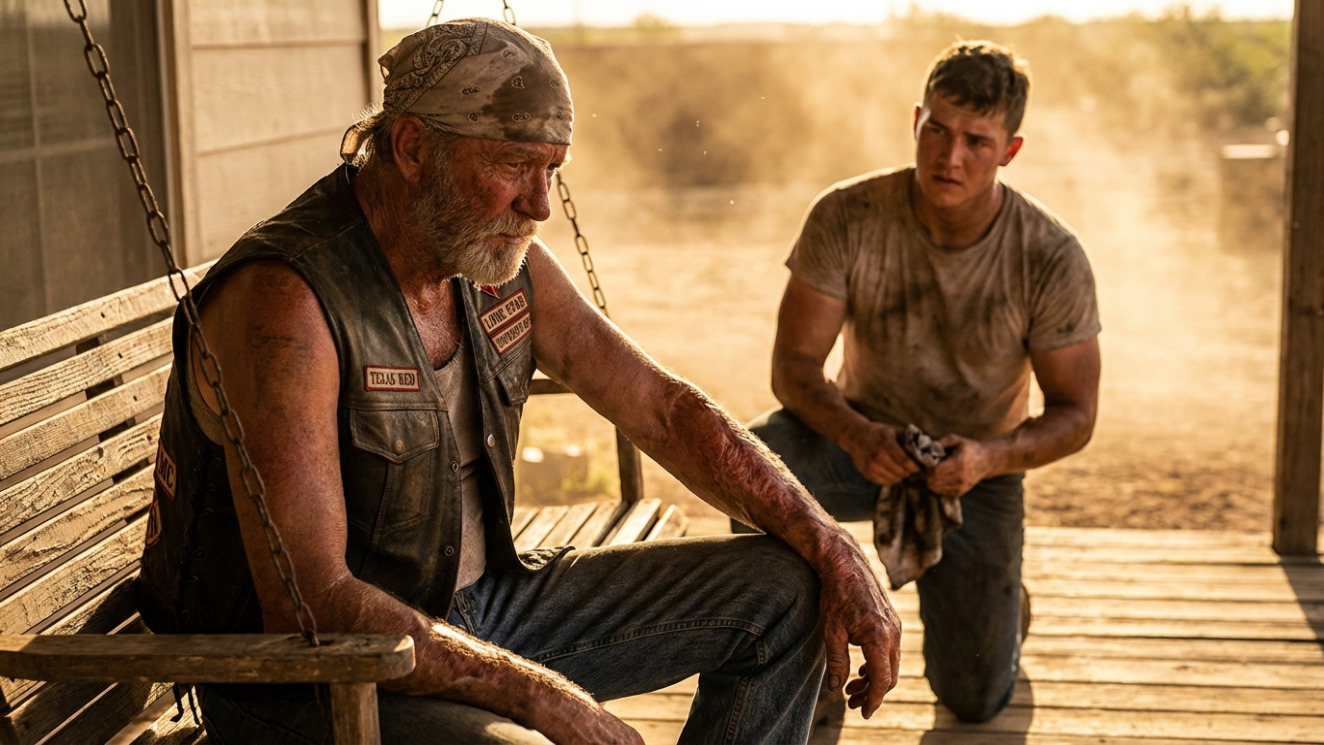
He had a job at a small independent garage, pulling engines out of wrecked sedans. It was grunt work, the kind of thing he hadn’t done since he was eighteen, but the physical labor kept his mind from wandering too far into the past. His hands were permanently stained with oil, the black grease settling into the cracks of his scarred skin.
He was finishing up for the day when a familiar silver sedan pulled into the lot. Vance got out, looking slightly less crisp than usual. The Texas heat was finally getting to him.
“”You’re a hard man to find, Callahan,”” Vance said, leaning against the doorframe of the garage.
Red didn’t look up from the winch he was greasing. “”I’m not hiding. I’m working.””
“”I have the final paperwork for the restitution,”” Vance said, holding out a folder. “”The company is taking your truck and the equity in your house. It won’t cover everything, but they’re willing to call it even.””
“”Take it,”” Red said. “”I don’t need ’em.””
Vance watched him for a moment. “”You know, I’ve been doing this for thirty years. Arson, fraud, grand larceny. Usually, when people get caught, they fight. They lie until the very end. You didn’t.””
“”I was tired of lying,”” Red said. He finally looked at Vance. “”Does it make a difference?””
“”To the company? No. To Miller’s estate? Maybe. He didn’t have any family, but the state is using the restitution money to put a proper headstone on his grave. He was buried in a pauper’s field. They’re moving him to the veterans’ cemetery next week. Turns out he served in Korea. He had a Bronze Star.””
Red felt a sharp, sudden pang of shame. He’d never known that. He’d never bothered to ask. “”He deserved better than me.””
“”Most people do,”” Vance said, not unkindly. He turned to leave, then paused. “”Your son was at the clubhouse last night. I was doing some follow-up interviews. He looks… rough, Red. Smokey has him doing the heavy lifting. Prospect work.””
“”He made his choice,”” Red said, though the words felt like ash in his mouth.
“”He’s nineteen. He doesn’t know what choices are yet. He just knows he’s angry.”” Vance got into his car and drove away, leaving Red alone in the darkening garage.
Red didn’t go back to the motel. He drove to the clubhouse. He didn’t go inside—he knew he wouldn’t be welcome—but he sat in his truck outside the fence, watching the bikes come and go.
He saw Junior. The boy was washing a line of motorcycles, his back bent, his movements slow and mechanical. He looked older than he had a week ago. There was a hardness in his face that hadn’t been there before, a bitterness that Red recognized all too well.
Smokey came out of the warehouse and said something to Junior. The boy didn’t respond, he just kept scrubbing. Smokey kicked the bucket of water over, splashing Junior’s boots. He started shouting, his face turning a dark, angry red.
Red felt his grip tighten on the steering wheel. He wanted to get out. He wanted to jump the fence and tell Smokey to go to hell. But he knew that would only make it worse for Junior. In the MC, a prospect’s father was a liability, especially a father who had betrayed the code.
He watched as Junior stood up, his fists clenched. For a second, Red thought the boy might swing. But then Junior just picked up the bucket, filled it again, and went back to work.
Red realized then that he hadn’t just lost his son’s respect; he’d handed his son over to the very monster that had consumed his own life. Junior wasn’t staying for the brotherhood. He was staying because he didn’t know who he was without the legend, even if the legend was a lie.
That night, the storm finally broke. It wasn’t a cleansing rain; it was a violent, wind-whipped deluge that turned the dust into a thick, red mud. Red sat in his motel room, watching the lightning illuminate the oil derricks on the horizon.
He thought about the fire. He thought about the way the light had looked that night—beautiful and terrifying. He realized that he’d been living in that light for twenty years, blinded by his own survival.
He stood up and went to the small desk in the room. He took a piece of motel stationery and started to write.
Junior,
I’m not writing this to ask for forgiveness. I know I don’t deserve it. I’m writing to tell you the one thing I never told you because I was too proud.
Being a hero is easy. You just have to be in the right place at the wrong time and not die. Being a man is harder. Being a man means looking at the mess you made and not trying to paint it a different color.
Don’t stay at the clubhouse because you’re angry at me. Don’t let Smokey turn you into a weapon. You have the chance to be something real. Don’t throw it away for a patch that doesn’t mean what you think it does.
I’m leaving Odessa tomorrow. I don’t know where I’m going, but I can’t stay here anymore. The garage is yours if you want it. The tools are yours.
I love you, son. Even if you never want to see me again.
He folded the paper and put it in an envelope. He drove to the garage, slipped the letter under the door, and then drove to the cemetery.
The pauper’s field was a flat, overgrown patch of land on the edge of town. He found Miller’s grave—a simple wooden stake with a number on it. The ground was soft from the rain, the mud clinging to Red’s boots.
He knelt by the grave. He didn’t pray; he didn’t know how. He just sat there in the dark, the rain soaking through his shirt.
“”I’m sorry, Danny,”” he whispered.
He stayed there until the sun came up, a ghost among the ghosts, the fire finally, truly, gone.
Chapter 6
The road out of Odessa is long and straight, a ribbon of black asphalt that cuts through the heart of the Permian Basin. Red drove with the windows down, the hot wind whipping through the cab of his truck. He didn’t have much—just a duffel bag of clothes, a few tools, and the $500 he had left in his pocket.
He was headed west, toward the mountains. He’d heard there was work in the mines near El Paso, or maybe he’d keep going until he hit the coast. It didn’t really matter. For the first time in his life, he wasn’t running toward anything. He was just moving.
He stopped at a gas station fifty miles outside of town. He was filling the tank when a bike pulled up to the pump next to him. It was a beat-up Dyna, the chrome pitted and the seat held together with duct tape.
The rider took off his helmet. It was Jax, the prospect from the clubhouse.
“”Heard you were leaving,”” Jax said, his voice cautious.
“”News travels fast,”” Red said.
“”Smokey’s pissed. He thinks you’re a coward for walking away.””
“”Smokey thinks a lot of things,”” Red said. He capped the gas tank. “”How’s the club?””
“”It’s… different,”” Jax said. He looked around to make sure no one was listening. “”A lot of the guys are talking. About what you said. About the fire. Some of ’em are wondering if Smokey knew all along.””
Red felt a small, grim satisfaction. “”Smokey’s a survivor, Jax. Just like I was. Don’t forget that.””
“”Junior left this morning,”” Jax said suddenly.
Red’s hand froze on the truck door. “”Where’d he go?””
“”Don’t know. He just packed his bags and rode out. He didn’t say a word to anyone. Smokey tried to stop him, told him he was throwing away his future. Junior just looked at him and said, ‘I’m going to find something real.'””
Red felt a surge of hope, sharp and painful. “”Did he take the truck?””
“”No. He took that old shovelhead you were working on. The one in the back of the shop. He got it running last night.””
Red climbed into his truck. He felt a lump in his throat that he couldn’t swallow. “”Thanks, Jax.””
“”Red?””
“”Yeah?””
Jax hesitated. “”The story… the part about you leading ’em through the fire. That was true, right? You really did that?””
Red looked at the boy. He saw the same hunger for a hero that he’d seen in Junior’s eyes. He could lie. He could give him that one thing to hold onto.
“”I did it,”” Red said. “”But I did it for the wrong reasons. Remember that.””
He pulled out of the gas station and headed west. He didn’t see Junior on the road, but he felt the boy’s presence in the vastness of the landscape. They were both out there now, moving through the dust, trying to find a way to live with the truth.
As the sun began to set, Red pulled over at a scenic overlook. He could see for miles—the flat plains giving way to the jagged peaks of the Guadalupe Mountains. The sky was a deep, bruised purple, the stars beginning to prick through the darkness.
He looked at his scarred arm. In the dim light, the skin looked almost smooth. He realized that the scars weren’t just a reminder of his crime; they were a reminder of his survival. He had burned, but he hadn’t been consumed.
He thought about Miller, resting in his new grave. He thought about Junior, riding into the night. He thought about the five hundred men who were still wearing his name on their backs.
He wasn’t a hero. He wasn’t a legend. He was just a man who had made a terrible mistake and spent a lifetime trying to hide it. But the hiding was over. The smoke had cleared.
He got back in the truck and started the engine. He didn’t know what was waiting for him at the end of the road, but for the first time in twenty years, he wasn’t afraid to find out.
He shifted into gear and drove into the dark, the headlights cutting a path through the dust, moving toward the only thing that was left: the truth.
The road ahead was empty, and the air was finally clear.”