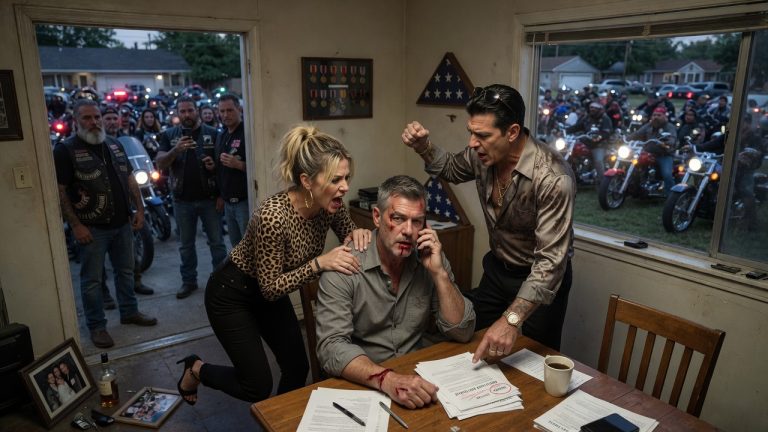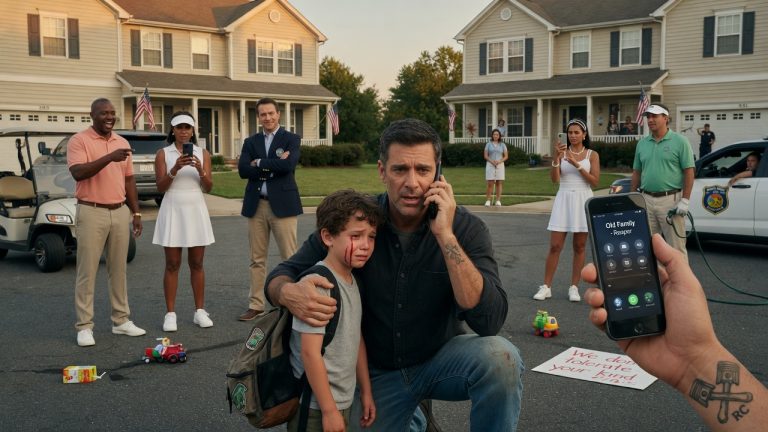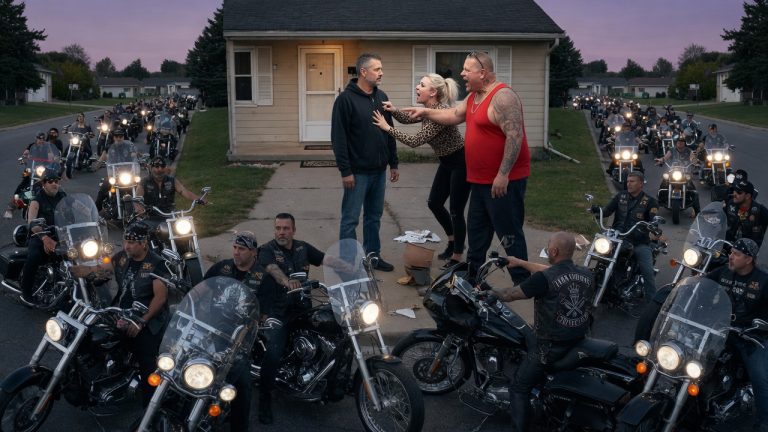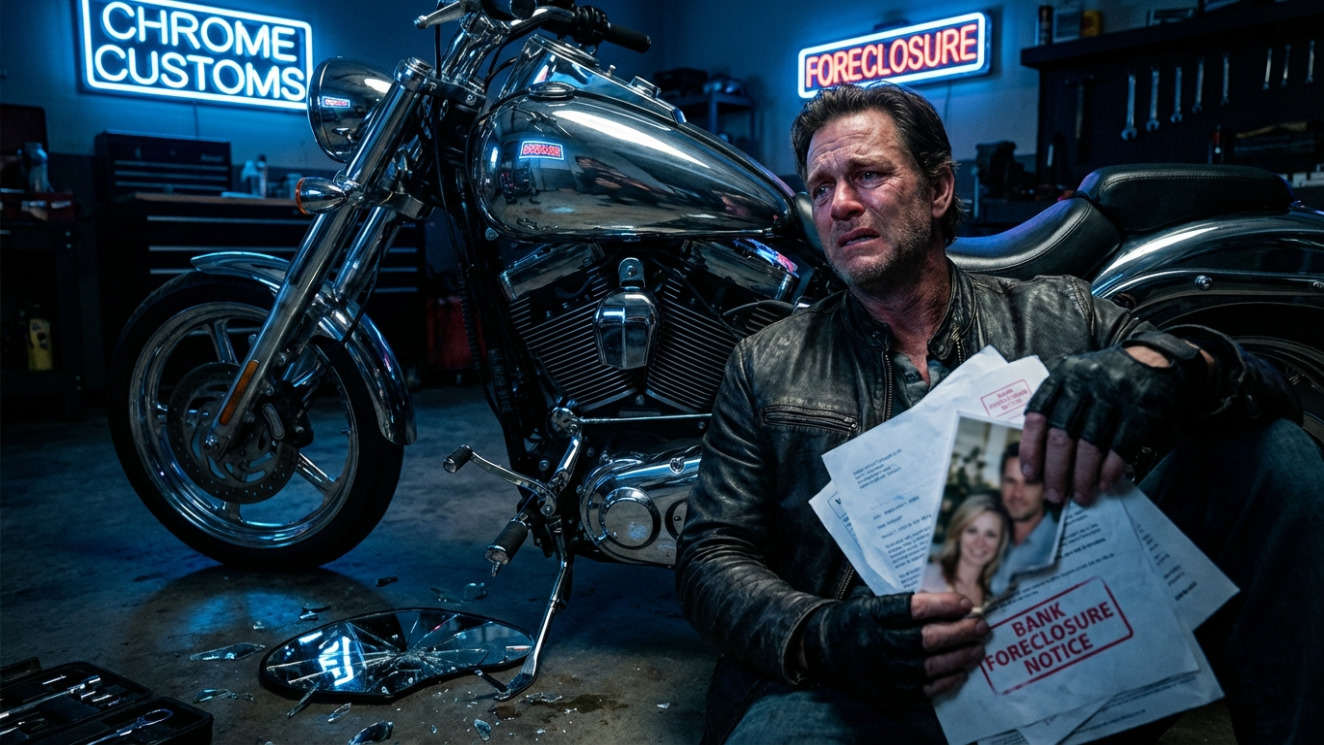
Wade Harrison was known for two things: the fastest bikes in the valley and the most beautiful wife in the suburbs. People called him “Chrome” because he kept everything polished to a mirror finish.
But mirrors are thin, and they break easy.
To give Lily the life he thought she deserved—the flower shop with the expensive awning and the eucalyptus-scented air—Wade signed away the roof over their heads. He thought he was buying a second chance. He thought he was burying the ghost of the racing career that got stolen from him years ago.
Then he saw who Lily was really talking to when the shop closed up for the night. He saw the way she looked at “Junior,” the kid who had everything Wade used to have: the speed, the sponsors, and the lack of a mortgage.
When the bank came knocking and the lies started leaking out like oil on a clean garage floor, Wade had to decide. How far do you go to keep a secret when the person you’re keeping it for doesn’t want you anymore?
Some debts can’t be paid in cash. Some are paid in blood, chrome, and the sound of a bike sliding across the asphalt at eighty miles an hour.
FULL STORY
Chapter 1: The Mirror Finish
The heat in the San Fernando Valley didn’t just sit on you; it pushed. It was a dry, aggressive weight that made the air smell like baked asphalt and dying oleander. Wade Harrison stood in his garage, the overhead fluorescent light humming a low, irritating B-flat that vibrated in his teeth. He was thirty-five, but in this light, with the gray creeping into the stubble on his jaw, he looked like a man who had been through a few more crashes than he’d officially reported.
He was polishing the primary cover of his 2018 Road Glide. It was a ritual. He used a microfiber cloth and a specific brand of compound that cost forty dollars a bottle. He didn’t just wipe it; he worked it. He chased the hazy swirls until the metal turned into a mirror. In that reflection, he could see the distorted version of his own face—the heavy brow, the eyes that always looked like they were searching for a mechanical failure, and the fading scar across his chin from a high-side in Pomona ten years ago.
“Wade? You still out there?”
The voice came from the kitchen door, muffled by the heavy fire-rated wood. It was Lily.
Wade didn’t answer immediately. He waited until the cloth made a satisfying “squeak” against the chrome. “Yeah,” he called back. “Just finishing up.”
He wasn’t finishing up. He was hiding. On the workbench, hidden under a pile of greasy rags and a half-disassembled carburetor, was a manila envelope. It had arrived three days ago. It wasn’t from a parts supplier or a bike magazine. It was from the bank. The words Notice of Default were printed in a font that felt like a punch to the solar plexus.
He had mortgaged the house. Not the whole house—just a second lien, a “bridge loan,” the banker had called it with a greasy smile. It was supposed to be a temporary fix. It was supposed to fund the build-out for Lily of the Valley, the boutique floral shop Lily had dreamed of since they were dating. He’d told her it was his savings. He’d told her that the years he spent on the pro-circuit, before the “accident” that ended his career, had left him with a healthy nest egg.
It was a lie. The racing money had been gone six months after he left the hospital. Most of it went to surgeons; the rest went to a lawyer who couldn’t prove that his rival, a kid named Miller who everyone called “The Ghost,” had clipped Wade’s clip-on handle at 140 miles per hour on purpose.
The shop had cost eighty thousand dollars to open. The rent in the new “artisan district” was four grand a month. The flowers died if they didn’t sell in three days. And Lily, God bless her, was an artist, not a bookkeeper. She gave away bouquets to “friends” who never came back. She bought expensive French ribbon and hand-blown glass vases.
Wade stood up, his knees popping. He was a big man, broad-shouldered and thick through the chest, the kind of build that made a bike look small. He wiped his hands on a rag and tucked the envelope deeper under the clutter.
He walked into the kitchen. The air conditioning hit him like a cold towel. The house was beautiful—a mid-century ranch they’d bought when the market was low. Lily was at the island, trimming the stems of some white lilies that looked like they cost more than his dinner.
“You’re late,” she said, not looking up. She wore a linen apron over a sundress. She looked like a catalog for a life Wade couldn’t actually afford.
“Bike needed work,” Wade said. It was his universal excuse.
“The shop is doing a big event tomorrow,” Lily said, her voice light but strained. “The downtown association. I need you to help me move the displays at six a.m.”
“I got a shift at the shop, Lil. We’re short-staffed.”
Wade worked as a head mechanic at a custom shop in Burbank. It paid well, but not “eighty-thousand-dollar-loan” well. He’d been taking double shifts, telling Lily it was for “expansion,” when really it was just to keep the lights on at home.
“Just once, Wade,” she said, finally looking at him. Her eyes were green, the color of moss after rain, but there was a distance in them lately. A flickering. “I’m trying to make this work. It’s my dream, remember? You said you believed in it.”
“I do believe in it,” Wade said. The words felt like lead in his mouth.
“Then show up. Please. Junior said he’d help, but he’s unreliable.”
Wade froze. The rag in his hand stopped moving. “Junior? As in… Tyler Vance?”
Lily turned back to the flowers, her movements suddenly very precise. “He’s been coming by the shop. He wants to sponsor the floral arrangements for the next regional race. He says it’s good PR for the team.”
Tyler “Junior” Vance was twenty-two years old. He was the current darling of the local racing scene. He was fast, he was rich, and he was the nephew of the man who had sabotaged Wade’s career ten years ago. He was also everything Wade was losing: young, relevant, and upwardly mobile.
“Why is he talking to you?” Wade’s voice had gone flat.
“It’s business, Wade. Don’t do the ‘tough guy’ thing. It’s just business.”
Wade didn’t say anything. He looked at the lilies on the counter. They were beautiful, but they were already starting to brown at the edges. That was the thing about flowers. They were a countdown.
The next morning, Wade didn’t show up at six a.m. He couldn’t. He had spent the night staring at the ceiling, calculating the interest rates and the dwindling balance in their joint account. Instead, he rode his bike to the shop at eight, his heart hammering against his ribs.
He didn’t park in front. He pulled into the alley behind the “artisan district,” a row of refurbished brick buildings that housed overpriced coffee and “curated” vintage clothes.
He saw Lily’s van. And parked right next to it was a Ducati Panigale V4, bright red and screaming of money. It was Junior’s bike.
Wade walked toward the back door, his boots heavy on the gravel. He stopped when he heard voices.
“It’s not just the sponsorship, Lily,” a young man’s voice said. It was smooth, confident, the kind of voice that had never had to apologize for a late payment. “I think you’re wasted in this town. You should be in the city. Big contracts. I could help you.”
“Junior, stop,” Lily said. But she was laughing. It was a light, girlish sound Wade hadn’t heard in two years.
Wade peered through the cracked back door. He saw them. They were standing near the refrigerated floral case. Junior had his hand on the door of the cooler, leaning in close to Lily. He wasn’t touching her, not quite, but he was in her space. And Lily wasn’t pulling away. She was looking at him with an expression that made Wade feel like his blood had turned to ice water.
It wasn’t just attraction. It was hope. She looked at this kid the way she used to look at Wade when he was on the podium, holding a trophy and smelling like burnt rubber and victory.
Wade backed away. He didn’t burst in. He didn’t scream. He walked back to his bike, his hands shaking so hard he could barely turn the key.
He rode. He rode out of the valley, up into the canyons where the air got thinner and the roads got tighter. He leaned the heavy Road Glide into the turns, scraping the floorboards against the pavement, sparking in the shadows of the rock walls.
He kept thinking about the envelope in the garage.
He had bought her a dream, and she was using it to host the man who represented his nightmare. He had destroyed their financial future to give her a “Lily of the Valley,” and now the valley was flooding, and she was looking for a faster boat.
He pulled over at a lookout point overlooking the sprawling, smog-choked grid of the valley. He pulled his phone out. He had a message from his boss at the shop.
Wade, bank called the shop asking for your verified income. Everything okay?
Wade didn’t reply. He stared at the screen until it went dark.
He thought about the “accident” ten years ago. He thought about how it felt to be the best, and how it felt to be the guy who fixed the bikes for the guys who were the best.
He reached into his jacket pocket and pulled out a cigarette. He didn’t smoke, not really, but he kept a pack in his saddlebag for moments like this. The match flared, bright and hot.
He wasn’t just a biker. He was a mechanic. He knew how things worked. He knew how a single loose nut could change the trajectory of a life. He knew that if you looked close enough at anything—a marriage, a business, a motorcycle—you could find the stress fracture.
And he knew exactly where Junior’s stress fracture was.
Chapter 2: The Ghost of the Track
The custom shop where Wade worked was a cavernous, grease-stained cathedral dedicated to the gods of torque and horsepower. It was called “The Iron Lung,” and it was owned by a man named Sal who had lost three fingers to a chain drive in the eighties and had the temperament of a badger.
Wade was the best mechanic Sal had. He had a “feel” for it. He could listen to a V-twin idling and tell you if the timing was off by two degrees. He could feel a shimmy in a front end that a computer couldn’t detect.
“You’re late,” Sal said, not looking up from a chopper frame he was welding. The blue arc light cast jagged shadows against the wall.
“Had some business,” Wade said. He went to his toolbox, a rolling chest that cost more than his first three cars. It was his sanctuary.
“Bank called,” Sal said, flipping up his mask. His eyes were red-rimmed and tired. “They’re doing some kind of audit on you, Chrome? You in trouble?”
“Just a refi on the house,” Wade lied. The lie felt easier this time. It was becoming a habit, like a well-worn gear. “Rates are down.”
“Don’t let it bleed into the work,” Sal warned. “I got three bikes coming in for the regional qualifiers this weekend. One of them is that Vance kid’s Panigale. He wants a full tune and a suspension tweak. Said he only wants the ‘old pro’ touching it.”
Wade’s hand paused on the drawer of his toolbox. “Junior’s bike is coming here?”
“Tonight. He’s picky. Thinks because his uncle owns the team, he’s royalty.” Sal spat into a bucket. “Do the job, Wade. I don’t care about the politics. Just make it fast.”
Wade spent the rest of the afternoon in a daze. He worked on a customer’s Sportster, cleaning out a gummed-up fuel injector, but his mind was elsewhere. He was thinking about the mortgage. He was thinking about Lily.
He remembered the day they bought the house. It was a Saturday in June. They had stood in the empty living room, the sun streaming through the windows, and Lily had hugged him so hard he could barely breathe.
“We did it, Wade,” she’d whispered. “A real home. No more trailers, no more motels. We’re safe.”
He had promised her she would always be safe. He had promised her that he would take care of everything. And he had, in the only way he knew how: by taking on a debt that was slowly crushing the life out of him.
The shop at the flower boutique wasn’t making money. It was hemorrhaging it. Wade knew because he was the one who intercepted the bills. He was the one who moved money from his 401k to cover the rent. He was the one who stayed up until 2 a.m. doing the math, trying to find a way to make it to next month.
He did it because he couldn’t bear to see the look on Lily’s face if she failed. He couldn’t bear to be the reason her dream died.
But now, the dream was being used as a staging ground for Junior.
Around 6 p.m., a trailer pulled up outside the shop. Two guys in team jackets rolled the Ducati into the bay. It was a beautiful machine—carbon fiber, titanium, and a paint job that looked like liquid fire. It was a weapon.
Junior walked in five minutes later, smelling of expensive cologne and confidence. He was wearing a leather racing suit, unzipped to the waist, revealing a lean, athletic build that hadn’t yet been broken by high-speed impacts.
“Wade,” Junior said, grinning. It was a shark’s grin. “Heard you were the man to see.”
Wade didn’t smile back. He stood by his toolbox, his arms crossed. “Sal says you want a suspension tweak.”
“Yeah. She’s chattering a bit in the mid-corner. My uncle says you were the king of the mid-corner before you… well, before you had that bad luck in Pomona.”
The mention of Pomona was like a hot needle in Wade’s ear. “Bad luck isn’t what I’d call it.”
Junior shrugged, his eyes scanning the shop. “Whatever you call it, you’re a legend, man. My uncle speaks of you often. He says you were almost as fast as he was.”
“Almost,” Wade muttered.
Junior walked over to the Ducati, running a hand over the tank. “I need her perfect for the qualifier on Saturday. Lily’s going to be there, you know. She’s doing the victory bouquets. I told her she should see what a real race looks like. Not the old-school stuff you used to do.”
The air in the shop felt thick. Wade could feel the heat rising from the back of his neck.
“Lily’s busy with the shop,” Wade said.
“She’s making time,” Junior said, looking Wade dead in the eye. “She’s a supportive woman, Wade. You’re a lucky guy. But she seems… I don’t know, stressed. Maybe she needs more than just a house and a husband who spends all night in a garage.”
Wade took a step forward, his fists clenching. Sal coughed loudly from the back of the shop.
“Wade, get to work,” Sal shouted.
Junior laughed. It was a soft, mocking sound. “See you at the track, Chrome. Make sure she’s fast.”
He turned and walked out, his boots clicking on the concrete.
Wade stood over the Ducati. It was silent, resting on its stand. It was a masterpiece of engineering. Every part was designed for one purpose: to go as fast as possible without breaking.
Wade picked up a wrench. He looked at the rear shock linkage. It was a complex system of bolts and bearings that translated the movement of the swingarm into the shock absorber. If those bolts were tight, the bike felt like it was on rails.
If they were just a little bit loose… it would feel fine at low speeds. It would even feel fine on the straights.
But when you pushed it into a high-speed corner, when the centrifugal force loaded up the rear end, the bike would start to “vague out.” The rear wheel would hunt for traction. It would feel like the bike was trying to fold itself in half. It wouldn’t necessarily crash—not if the rider was experienced. But it would scare them. It would make them back off. It would ruin their time.
And if the rider was cocky? If the rider tried to muscle through it?
Wade looked at the wrench. He thought about the foreclosure notice. He thought about Lily laughing with Junior in the back of the shop.
He thought about his own career ending in a cloud of dust and the smell of leaking coolant, while Junior’s uncle stood on the podium and toasted to “bad luck.”
Wade bent down. He didn’t think. He just moved. He loosened the primary bolt on the lower linkage. He didn’t take it off. He just backed it off two turns. Then he took a dab of blue Loctite and smeared it around the edge of the nut, making it look like it was still sealed and secured.
He did the same to the front steering damper. Just enough to create a “flat spot” in the steering.
It took five minutes.
When he was done, he stood up and wiped his hands. He felt a strange, cold clarity. He wasn’t a “pro racer” anymore. He was a mechanic. And he had just adjusted the machine to match the reality of the situation.
He stayed late at the shop that night, long after Sal had gone home. He sat in the dark, the only light coming from the streetlamps outside.
He thought about what he’d done. It wasn’t just sabotage. It was a message.
But as he sat there, the silence of the shop began to feel heavy. He thought about the old biker, Miller, who lived in a beat-up Ford Econoline behind the shop. Miller had been a champion in the seventies. Now he was a ghost who traded stories for beer and slept on a pile of oily blankets.
Wade walked outside. He found Miller sitting on a milk crate, staring at the moon.
“Evening, Wade,” Miller said, his voice like gravel in a blender.
“Hey, Miller.”
“Saw the kid’s bike in there. Shiny piece of work.”
“Too shiny,” Wade said.
Miller looked at him, his eyes milky with cataracts but still sharp. “You look like you just swallowed a mouthful of nails, son. Something wrong?”
“Just the heat,” Wade said.
“It ain’t the heat,” Miller said. He pointed to the van. “I lost everything I had to a woman and a bike. In that order. The bike broke my body, and the woman broke my spirit. Now I got a van and a milk crate. It’s a simple life, but the shadows are long.”
“I’m not like you, Miller,” Wade said, more harshly than he intended.
“No,” Miller said, nodding slowly. “You still got something to lose. That’s the dangerous part. When you’re still trying to keep the gloss on a total loss. That’s when you do the things that haunt you.”
Wade didn’t stay to listen to the rest. He got on his bike and rode home.
When he walked into the house, Lily was asleep on the sofa. There was a glass of wine on the coffee table, half-finished. Beside it was a stack of invoices for the shop.
Wade picked up the top one. It was for three thousand dollars’ worth of exotic orchids.
He looked at his wife’s face. She looked peaceful. She looked like she still believed in dreams.
He went into the garage and pulled the manila envelope out from under the rags. He sat at his workbench and began to write a letter to the bank, asking for an extension.
His hands were still covered in the oil from Junior’s bike. He tried to wipe it off, but it had worked its way deep into the creases of his skin. It wouldn’t come out.
Chapter 3: The Spark Plug
The regional qualifiers at the Willow Springs Raceway were always a circus. The air was a mix of high-octane fuel, sunscreen, and the smell of frying dough from the concessions stand. It was a place of high stakes and short tempers, where the desert wind could kick up a dust storm in ten minutes and ruin a thousand-dollar paint job.
Wade was there early. He wasn’t there as a racer; he was there as “support.” Sal had sent him to make sure the bikes they’d worked on performed. It was a professional obligation, but for Wade, it felt like walking into his own funeral.
He stood in the pits, his arms crossed, watching the mechanics work. He saw the Vance team trailer—a massive, climate-controlled rig with Junior’s face plastered on the side.
Lily was there too. She was setting up a floral display near the VIP tent. She looked out of place in her sun hat and floral dress, surrounded by grease-covered men and the roar of engines.
Wade walked over to her. “You okay with the heat?”
She looked up, startled. “Oh, Wade. Yeah. It’s… it’s a lot, isn’t it? I didn’t realize it would be this loud.”
“It’s a race track, Lil. It’s not a garden party.”
She bit her lip. “Junior said it was important for the brand. He’s been so helpful, Wade. He even introduced me to a guy who runs the concessions for the whole circuit. This could be big for the shop.”
Wade looked past her to where Junior was talking to a group of reporters. He was wearing his racing leathers, looking like a superhero. He saw Wade and winked.
“Just be careful, Lily,” Wade said. “These people… they aren’t your friends. They’re customers. There’s a difference.”
“I know the difference,” she said, her voice turning sharp. “I’m trying to save our business, Wade. While you’re hiding in the garage, I’m out here actually doing something.”
“Hiding?” Wade’s voice rose. “I’m working sixty hours a week to—”
He stopped. He couldn’t finish the sentence. He couldn’t tell her about the mortgage. Not here. Not now.
“To what?” she challenged.
“Never mind. Just do your flowers, Lily.”
He walked away, his heart pounding. He headed toward the Vance pits. Junior was getting ready for his first qualifying heat.
The Ducati was being warmed up on the stands. The sound was a rhythmic, aggressive bark. Wade watched the rear suspension. To the untrained eye, it looked perfect. But Wade saw it. Every time the mechanic blipped the throttle, the rear end settled a fraction of an inch too much. The bolt was holding, but the geometry was compromised.
Junior hopped on the bike. He looked at Wade as he pulled on his helmet. “She feels good, Chrome. Tight. Like a virgin.”
Wade felt a surge of pure, unadulterated hatred. He didn’t say a word. He just watched as Junior clicked the bike into gear and roared out toward the track entrance.
The heat began. Junior was fast. He was naturally gifted, with a fearless, aggressive style that reminded Wade of himself ten years ago. He was leaning the bike over until his knee pucks sparked against the asphalt. He was taking lines that were borderline suicidal.
But as the tires got hot and the pace increased, the bike started to react.
Wade watched from the pit wall. He had a pair of binoculars. On the long back straight, the Ducati was rock solid. But as Junior entered the “Big Bend”—a high-speed, sweeping right-hander that required absolute confidence in the rear end—the bike started to twitch.
Wade saw Junior’s body language change. He sat up a little. He shook his head. He came into the pits after three laps.
“The back end is floating,” Junior screamed over the engine. “It’s hunting! Check the tire pressure!”
The mechanics scrambled. They checked the pressure. They checked the chain tension. Everything looked fine.
“Maybe it’s just the wind,” the head mechanic said.
“It’s not the wind!” Junior yelled. “It feels like the swingarm is made of rubber!”
He looked at Wade. Wade was standing ten feet away, his face a mask of indifference.
“What did you do, old man?” Junior hissed, walking toward him.
“I did what you asked,” Wade said calmly. “I tweaked the suspension. Maybe you’re just not used to a bike that actually handles. Maybe you’re used to having your uncle fix the results.”
Junior’s face went red. “I’m going back out. And if this bike isn’t right, I’m going to make sure Sal fires you by sunset.”
He jumped back on the bike and tore out of the pits.
The next five minutes were the longest of Wade’s life. He watched the red speck of the Ducati circle the track. Junior was pushing even harder now, trying to prove that he could overcome the mechanical “glitch” through sheer bravado.
He came into the Big Bend at 130 miles per hour.
Wade saw it happen in slow motion. The bike leaned over. The rear end started to chatter. Usually, a rider would back off. But Junior didn’t. He pinned the throttle.
The bolt didn’t snap. It didn’t need to. The slight play in the linkage caused the shock to “bottom out” prematurely. The rear tire lost contact with the asphalt for a fraction of a second.
The bike “high-sided.” It whipped around like a bucking bronco, launching Junior into the air. He flew twenty feet before hitting the dirt. The Ducati tumbled after him, a chaotic mess of shattering carbon fiber and expensive metal.
The red flags went up instantly. The sirens of the ambulance cut through the sudden silence of the track.
Wade didn’t move. He stood at the pit wall, his hands gripping the metal railing so hard his knuckles were white.
He saw Lily run toward the track fence, her sun hat falling off, her face a mask of horror.
He felt a cold, hollow sensation in his chest. It wasn’t triumph. It wasn’t satisfaction. It was the realization that he had just become the person he hated most in the world.
He had become the saboteur. He had become the “bad luck.”
He walked back to the Iron Lung van. He didn’t wait to see if Junior was okay. He didn’t wait to see Lily.
He drove back to the valley in silence. The heat was still pushing.
When he got to the shop, Sal was already there, looking at his phone.
“Vance crashed,” Sal said, his voice low.
“I heard,” Wade said.
“They’re saying it was a mechanical failure. Swingarm linkage.” Sal looked at Wade. His eyes were hard. “You worked on that bike yesterday, Wade.”
“I did the suspension tweak he asked for.”
“Did you tighten the bolts, Wade?”
Wade looked at his boss. He looked at the three fingers Sal was missing. He looked at the grease on his own hands.
“I did my job,” Wade said.
“The Vance family is going to sue us into the ground,” Sal said. “And if they find out it wasn’t an accident… I can’t protect you, Wade. I won’t.”
Wade walked out. He didn’t go home. He went to the “Lily of the Valley” flower shop.
The shop was empty. The door was locked. He used his key and went inside.
The smell of the flowers was overpowering. It smelled like a funeral home. He walked to the back office and sat at Lily’s desk.
He found the ledger. He hadn’t looked at it in months. He turned the pages.
The numbers were worse than he thought. They were thousands of dollars in the red every single month. And then he saw something else.
A series of deposits. Large ones. Five thousand dollars. Ten thousand dollars.
The source was listed as “Vance Racing.”
Wade sat there in the dark, the ledger open in front of him.
The flowers weren’t a gift. They were a bribe. Or maybe they were a payoff.
He realized then that he hadn’t been the only one lying. Lily had been trying to “save” the shop too. She had been taking money from the very people who had destroyed Wade’s life.
He picked up a vase of white lilies and smashed it against the wall. The water splashed over the foreclosure notice he’d tucked into his pocket.
The gloss was gone. The total loss was here.
Chapter 4: The Skid
The aftermath of a crash is never clean. It lingers like the smell of ozone after a lightning strike.
Wade spent the next two days in a state of suspended animation. He didn’t go to work. He didn’t answer the phone. He stayed in the house, moving from room to room like a ghost.
Lily didn’t come home the night of the crash. She sent a text: Junior is in the hospital. He has a broken femur and a concussion. I’m staying with his mother. We need to talk.
Wade didn’t reply.
On the third day, the knock came. It wasn’t the bank. It was the police.
Two officers stood on his porch, looking uncomfortable in the valley heat.
“Mr. Harrison? We’re investigating the accident at Willow Springs. We have some questions about the maintenance performed on Tyler Vance’s motorcycle.”
Wade invited them in. He sat at the kitchen table and told them exactly what he’d told Sal. He’d performed a suspension tweak. He’d tightened everything to spec. If the bike failed, it was due to the extreme stress of the racing conditions.
“The team mechanics say the linkage bolt was loose,” one of the officers said. He was young, with a buzz cut and a clipboard. “They found traces of Loctite, but the bolt had backed off.”
“It happens,” Wade said, his voice steady. “Vibration at those speeds is a monster.”
They left after an hour. They didn’t arrest him, but the air in the house felt thinner.
That evening, Wade went to the hospital. He didn’t know why. Maybe he wanted to see the damage. Maybe he wanted to see if his soul was still there.
He found the room. Lily was there, sitting in a chair by the window. Junior was in the bed, his leg in traction, his face bruised and swollen. He looked small. He didn’t look like a superhero anymore.
Lily saw Wade and stood up. She walked out into the hallway, closing the door behind her.
“What are you doing here?” she whispered.
“I wanted to see him,” Wade said.
“Why? So you could finish the job?”
Wade flinched. “What is that supposed to mean?”
Lily looked at him with a cold, piercing intensity. “I saw you at the pits, Wade. I saw the way you were looking at the bike. And I know you. I know how much you hate that family.”
“He was sleeping with you, Lily,” Wade said, the words coming out like a snarl. “Don’t act like this is about a bolt.”
Lily’s face went pale. “He wasn’t sleeping with me. He was helping me. He was giving me the money to keep the shop open because you were too proud to tell me we were broke!”
“Helping you?” Wade laughed, a harsh, jagged sound. “He was buying you! And you let him!”
“I did it for us, Wade! I did it so we wouldn’t lose the house!”
“We already lost the house, Lily!” Wade shouted. He pulled the foreclosure notice from his pocket and threw it at her. “I mortgaged it a year ago to buy you that damn shop! It’s gone! Everything is gone!”
The hallway went silent. A nurse walked by, looking at them with a mixture of pity and annoyance.
Lily picked up the paper. She read it slowly, her hands trembling.
“You… you lied to me,” she whispered.
“We both lied,” Wade said.
“I lied to save a business,” Lily said, her voice breaking. “You lied and then you tried to kill a kid because you were jealous.”
“I didn’t try to kill him,” Wade said, though the words felt hollow. “I just wanted him to slow down. I wanted him to feel what it’s like to lose.”
Lily looked at him as if she were seeing him for the first time. Not as “Chrome,” the local legend. But as a broken, bitter man who had let his ghosts run the house.
“Get out,” she said.
“Lily—”
“Get out, Wade. Don’t come home. I’ll have my things moved by the end of the week.”
Wade walked out of the hospital. He felt light. He felt like he was floating.
He went to a dive bar near the tracks, a place called “The Thirsty Sprocket.” It was filled with bikers, the real kind—the ones with faded tattoos and bikes held together by zip ties and prayer.
He saw Miller sitting in a corner, a pitcher of cheap beer in front of him. Wade sat down across from him.
“You look like hell,” Miller said.
“I am hell,” Wade said.
“Heard about the kid. Heard about the shop. Rumors fly fast in this valley.”
“I lost her, Miller. I lost everything.”
Miller poured a glass of beer and pushed it toward Wade. “You didn’t lose it today, son. You lost it the day you started thinking that chrome could cover up the rot. You were so busy polishing the surface that you didn’t notice the frame was cracked.”
“I just wanted her to be happy,” Wade said, his voice choking.
“No,” Miller said. “You wanted to be the man who made her happy. There’s a difference. One is about her. The other is about your ego. And ego is a dangerous passenger on a fast bike.”
Wade drank the beer. It tasted like copper and regret.
“What do I do now?”
Miller looked at the neon sign in the window. “You do what we all do. You wait for the repo man. And then you decide if you’re going to walk, or if you’re going to find a new way to ride.”
Wade stayed at the bar until it closed. He rode back to the house, but he didn’t go inside. He slept in the garage, on a cot next to his bike.
The Road Glide sat there, its chrome still gleaming in the moonlight. It was the only thing he had left.
In the middle of the night, he got up and picked up a hammer. He looked at the primary cover he had spent hours polishing.
He swung the hammer.
The first blow left a jagged dent. The second one cracked the metal.
He kept swinging until the chrome was gone, until the metal was scarred and beaten.
Then he sat on the floor and cried. Not for the bike. Not for the money.
He cried for the man he used to be, the one who didn’t need a mirror to see who he was.