“Make a sound, you little broken machine.”
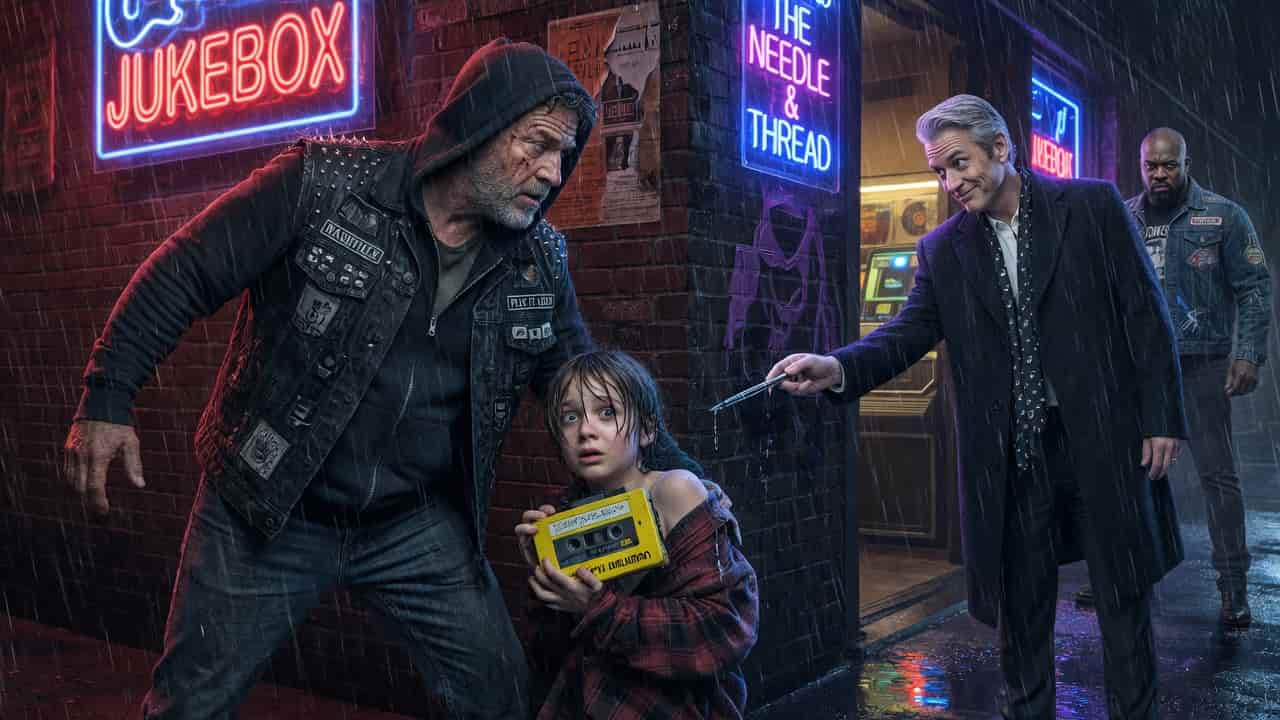
Julian leaned in, the smell of expensive cologne and old money clashing with the scent of wet asphalt and dumpster grease. He tapped his silver fountain pen against the yellow plastic of Leo’s cassette player, a rhythm that felt like a countdown.
Leo didn’t move. He couldn’t. He just huddled against the cold Nashville brick, his eyes wide and glassy, clutching that tape player like it was the only thing keeping him on the planet. He started to hum—a low, melodic vibration that didn’t use words, but carried a tune that made my chest feel like it was being crushed by a hydraulic press. It was Elena’s song. The one she never finished.
“Nothing? Just static?” Julian laughed, looking over his shoulder at the guys standing in the doorway of my club. He thought he was putting on a show. He thought the kid was just a prop for his ego.
I felt the heat rise from my boots, the kind of burn that usually ends with someone on the floor. I didn’t think about the lawsuits. I didn’t think about the fact that Julian Vance owned the rights to every note my wife ever sang. I just saw the way the kid flinched when Julian reached for the tape.
I stepped out of the dark, my hand hitting the brick wall so hard the vibration rattled Julian’s teeth. The room went silent. The rain was the only thing talking.
“Walk away, Julian,” I said, my voice sounding like gravel under a tire. “Before I forget that you’re supposed to be a civilized man.”
Julian froze, his polished shoes hovering over a puddle. He looked at me, then at the boy, then at the burly men stepping out from the bar. He knew the power in the room had just shifted, and he knew I had a secret that could ruin us both if he pushed me one inch further.
Chapter 1: The Static in the Rain
The rain in Nashville doesn’t just fall; it settles into your skin like a bad reputation. It was the kind of Tuesday night where the neon signs on Broadway looked like they were bleeding into the gutters—reds, blues, and sickly yellows smeared across the wet asphalt. I stood under the rusted awning of The Needle & Thread, my hands shoved deep into the pockets of a leather vest that had seen more miles than most people see in a lifetime.
Inside, the jukebox was playing something by Waylon Jennings, the muffled bass thumping against the brick like a steady, aching heart. Out here, in the alleyway that smelled of stale beer and damp cardboard, there was a different kind of music.
Leo was sitting on a plastic milk crate near the dumpster. He was ten, maybe eleven, though he had the kind of eyes that made you feel like he’d been around since the Prohibition. He was wearing a flannel shirt three sizes too big, the sleeves rolled up into thick cuffs. Between his small, calloused hands, he held a yellow Sony Walkman. It was scratched, the battery cover held on by a strip of black electrical tape, but he held it like it was made of solid gold.
He wasn’t talking. Leo never talked. But he was humming.
It was a low, mournful sound, a melody that bypassed the ears and went straight for the ribs. I knew that tune. I’d spent fifteen years trying to forget it, or at least bury it under enough cheap whiskey to keep it quiet. It was “The Last Highway,” the song Elena was writing the night the tour bus hit the black ice in Kentucky.
“You’re gonna catch a cold, kid,” I said, my voice sounding like a rusted gate.
Leo didn’t look up. He just kept humming, his thumb tracing the edge of the Walkman. He was in his own world, a place where the rain didn’t itch and the men in leather vests didn’t have shadows full of ghosts.
I reached into my pocket and pulled out a crumpled five-dollar bill. I walked over and dropped it into the empty coffee tin at his feet. The tin clinked, a hollow, lonely sound. Leo’s humming faltered for a second, a hitch in the breath, before he smoothed it out again.
“Johnny! We got a leak over the stage!”
I turned. Vinyl was standing in the back doorway, his massive frame blocking out the light from the bar. Vinyl had been my road captain back when we were still riding under the Iron Heart colors, back before I traded the presidency for a mortgage and a mute kid I’d found sleeping in a guitar case.
“I’m coming,” I grunted.
I looked back at Leo. He was still there, a small island of silence in a city that never stopped screaming. I hated that he knew that song. I’d burned the sheet music. I’d sold the guitars. I’d tried to erase Elena from the physical world, but here she was, vibrating in the throat of a kid who didn’t even know her name.
I stepped inside the club. The air was thick with the smell of floor wax and old smoke. The Needle & Thread wasn’t much—just a long wooden bar, a small stage that dipped in the middle, and walls covered in faded posters of legends who’d died broke. It was my life’s work, and tonight, it was literally dripping from the ceiling.
A steady stream of grey water was splashing onto the center of the stage, right where the lead singer’s mic stand usually sat.
“Get the bucket, Vinyl,” I said, rubbing my face.
“We’re gonna need more than a bucket, Johnny,” Vinyl said, his voice low. “The roof is rotting. The bank called again. They’re asking about the balloon payment.”
“I know what they’re asking,” I snapped. “I’m not deaf.”
I walked behind the bar and poured myself a finger of bourbon. I didn’t drink much these days—not since the night the world ended in a Kentucky ditch—but some nights, the air was too thin to breathe without a little help.
I thought about the night of the crash. I was supposed to be on that bus. I was the tour manager, the husband, the anchor. But I’d stayed behind in Memphis because I’d met a girl in a bar who made me forget I had a wedding ring in my pocket for three hours. While I was in a cheap motel room, Elena was screaming as the bus rolled down an embankment.
I lived because I was a piece of trash. She died because she was a star.
The front door of the club opened, letting in a gust of cold air and the sound of a luxury car idling at the curb. I didn’t have to look up to know who it was. The atmosphere in the room changed instantly—it went from a comfortable, worn-out sadness to something sharp and clinical.
Julian Vance walked in. He looked like he’d been dipped in liquid silver and polished until he shone. His charcoal overcoat was perfectly tailored, his silk scarf a subtle shade of grey that probably cost more than my first bike. He was a shark in a city full of minnows. He ran Vance Records, and he owned every master recording Elena had ever made.
He also owned the deed to the building I was standing in.
“John,” Julian said, his smile not reaching his eyes. He never called me Johnny. He thought nicknames were for people who didn’t have net worths.
“Julian,” I said, keeping the bar between us. “You’re early. The roof isn’t scheduled to collapse for another hour.”
Julian chuckled, a dry, rehearsed sound. He walked over to the stage and looked at the water splashing into the plastic bucket Vinyl had just placed there. He reached out and touched the wood of the stage, his fingers lingering on a scratch.
“It’s a shame, John. This place has history. But history doesn’t pay the property taxes.”
“I’ll have the money, Julian. You know I always find it.”
“Do you? Because the reports I’m seeing say you’re drowning. And not just from the rain.” He turned toward me, his eyes sharp. “I’m not here for the rent tonight, John. I’m here for the boy.”
My hand tightened around the bourbon glass. “Leo has nothing to do with you.”
“He has everything to do with me. I heard him outside. He was humming a melody I recognize. A melody that belongs to a song my company owns. Elena’s ‘Last Highway.’ The unfinished masterpiece.” Julian stepped closer to the bar. “Where did he hear it, John? You told me there were no tapes left. You told me the scratch tracks were destroyed in the crash.”
“They were,” I lied. The lie felt familiar, like a well-worn pair of boots. “The kid just has a good ear. He hears things.”
“He hears things that haven’t been played in twelve years?” Julian’s voice dropped. “I think you’re hiding something. And I think that boy is the key to a very lucrative posthumous release. One that would solve all your financial problems. And mine.”
“He’s a child, Julian. He’s not a paycheck.”
“He’s a goldmine,” Julian countered. “Look at this place. Look at you. You’re one bad season away from losing everything. Give me the boy for a week. Let my producers work with him. We’ll get the melody out of his head, we’ll finish the track with AI, and you can keep your little clubhouse.”
I felt the familiar heat in my chest, the biker in me wanting to vault the bar and put Julian’s teeth through his throat. But I wasn’t that man anymore. I was a man who owed a debt to a dead woman, and a man who was the only thing standing between a mute boy and a world that wanted to harvest him.
“Get out,” I said quietly.
“John, be reasonable—”
“Get out before I let Vinyl show you how we handle intruders in the MC days.”
Julian’s face hardened. He pulled his gloves on, one finger at a time. “I’ll be back, John. And next time, I won’t be asking nicely. The bank is losing patience. And so am I.”
He turned and walked out, the heavy door thudding shut behind him.
I stood there for a long time, the bourbon untouched in my hand. I looked at the stage, at the water splashing into the bucket. It felt like the whole world was leaking.
I walked to the back door and looked out into the alley. The rain had slowed to a drizzle. Leo was still there, sitting on his milk crate. He had the headphones on now, the foam pads crumbling against his ears.
I walked out and sat on the ground next to him, ignoring the dampness seeping into my jeans. Leo didn’t look at me, but he shifted slightly, making room for me on the crate if I wanted it. I stayed on the ground.
“He’s a bad man, Leo,” I said, mostly to myself. “He looks like a hero, but he’s just a man with a checkbook where his heart should be.”
Leo took off the headphones. He looked at me, his eyes dark and impossibly deep. He didn’t speak, but he reached out and touched the leather of my vest, right over the spot where the MC patch used to be. Then, he pointed to the yellow Walkman.
He pressed the ‘play’ button.
The sound was thin, full of hiss and pop, the result of a tape that had been played a thousand times too many. But through the static, I heard it.
It was Elena’s voice. She was laughing.
“Johnny, stop it, I’m recording! Okay, okay… this one is for you. Our song. Just don’t let the label hear it, okay? It’s just for us.”
Then, the acoustic guitar started. A simple, haunting progression.
My heart stopped. I’d told Julian the tapes were gone. I’d told the world the music died on that highway. But I’d kept this one. I’d found it in the glove box of my truck a week after the funeral. I’d never played it for anyone. I’d barely played it for myself.
“Where did you get that, Leo?” I whispered.
Leo didn’t answer. He just pointed to the back of the tape player, where the black electrical tape was. I peeled it back.
There, in Elena’s handwriting, were the words: For Johnny – Our Song.
Underneath it, in smaller, shaky letters, someone else had written: Property of St. Jude’s Orphanage. Patient: Leo.
The room—the alley, the city, the world—seemed to tilt. Leo wasn’t just a kid I’d found. He was a kid who had been carrying my wife’s last words for years.
“Who gave this to you?” I asked, my voice trembling.
Leo didn’t speak. He just put the headphones back on and started to hum.
He wasn’t humming the melody of the song. He was humming the harmony. The part Elena used to sing when she was leaning her head against my shoulder.
I sat there in the mud of the Nashville night, the rain falling on a biker and a boy, while the ghost of a woman sang through a broken yellow box. I knew then that Julian Vance wasn’t just coming for my club. He was coming for the last piece of my soul I had left. And I knew, with a sinking certainty, that I wasn’t going to let him have it.
Even if I had to burn the whole city down to keep him away.
Chapter 2: The Ghost of Memphis
The morning after Julian’s visit, the club felt like a tomb. The smell of the rain had been replaced by the scent of wet wood and the metallic tang of the bourbon I’d finally finished at 3:00 AM. I was sitting at the bar, staring at the yellow Walkman, when the front door creaked open.
It wasn’t Julian. It was Sully.
Sully was a man who looked like he’d been through a rock-and-roll blender. His hair was a chaotic nest of grey, his skin was like cracked leather, and his hands shook with a tremor he tried to hide by shoving them into the pockets of a stained denim jacket. He’d been the lead guitarist for Elena’s band. He was also the only person who knew exactly where I was the night the bus went off the road.
“You look like hell, Johnny,” Sully said, sliding onto a stool.
“And you look like a million bucks, Sully. Too bad it’s all in pennies.”
I pushed a cup of black coffee toward him. He took it with both hands, the steam rising around his face. He looked at the Walkman on the bar, and his eyes widened.
“Is that…?”
“The tape,” I said. “Leo had it.”
Sully’s breath hitched. “The kid? How the hell did he get it? You told me you burned everything.”
“I thought I did. I thought I’d cleared out the truck. But apparently, some of the stuff from the wreck got sent to the orphanage with the personal effects. The kid must have grabbed it.” I looked at Sully, my eyes hard. “He’s humming her songs, Sully. Not just the hits. He’s humming the stuff she was writing in the back of the bus.”
Sully took a long, slow sip of coffee. “Maybe he’s a fan.”
“He’s mute, Sully. He doesn’t listen to the radio. He listens to that tape. And he hums the harmonies. It’s like he was there.”
Sully went quiet. He looked away, staring at the empty stage. “You ever think about that night, Johnny? I mean, really think about it?”
“Every second of every day,” I said.
“I was the only one who didn’t go on the bus that night, besides you,” Sully whispered. “I took my own car because I wanted to see that girl in Louisville. We both stayed behind for the wrong reasons.”
“You stayed behind for a girl. I stayed behind for a lie.” I felt the weight of the secret pressing on my chest. “I haven’t told him, Sully. I haven’t told Leo who I am. He just thinks I’m the guy who lets him sleep in the alley.”
“Maybe that’s for the best,” Sully said. “What’s Vance want?”
“He wants the kid. He wants to use AI to finish Elena’s album using Leo as the ‘soul’ of the record. He thinks there’s fifty million dollars sitting in that kid’s head.”
Sully let out a bitter laugh. “Vance doesn’t care about soul. He cares about numbers. If he gets his hands on that kid, he’ll work him until there’s nothing left but static. You know how he is. He’s the one who pushed Elena to do that tour even when she was exhausted. He’s the one who put her on that bus.”
“And I’m the one who didn’t stop her,” I said.
I stood up and walked to the window. Outside, the morning sun was trying to break through the clouds, but it was a losing battle. The Nashville streets were waking up—the tourists in their cowboy hats, the street performers tuning their guitars, the city moving on like it didn’t remember the people it had chewed up and spat out.
I saw Leo across the street. He was standing in front of a window display at a music store, staring at a vintage Gibson Hummingbird. He looked so small against the backdrop of the city, a tiny flickering light in a hurricane.
“He needs surgery, Sully,” I said softly.
Sully looked up. “Surgery?”
“The orphanage records. I went there this morning. Leo isn’t naturally mute. He has a physical blockage in his vocal cords. A growth. It’s treatable, but it’s expensive. Fifty thousand dollars. If he gets the surgery, he might be able to speak. He might be able to sing.”
“Fifty thousand,” Sully whistled. “We don’t have fifty cents between us.”
“Julian has it,” I said.
Sully stood up, his face pale. “Johnny, don’t. Don’t even think about it. If you take Julian’s money, you’re selling that kid’s soul to the devil. You’re doing exactly what we did to Elena.”
“I’m trying to save him!” I turned on him, my voice cracking. “He’s trapped in there, Sully! He’s humming her songs because it’s the only way he can breathe! If I don’t get him that surgery, he’s going to spend his whole life as a ghost.”
“And if you give him to Julian, he’ll be a ghost in a gold cage,” Sully countered. “There’s gotta be another way.”
“There is no other way. The bank is foreclosing on Friday. I’ll be on the street. Leo will be back in the state system. And Julian will just wait until the kid is vulnerable enough to sign whatever paper he puts in front of him.”
I walked back to the bar and picked up the Walkman. I felt the cool plastic, the roughness of the tape. I thought about the woman who had recorded it. She would have wanted the kid to have a voice. She would have wanted him to be free.
“I’m going to see Julian,” I said.
“Johnny, wait—”
I didn’t wait. I grabbed my keys and walked out the door.
The ride to Julian’s office was a blur of neon and grey. I rode my old Shovelhead, the vibration of the engine a familiar comfort between my legs. I remembered riding this bike to the hospital the night Elena died. I remembered the way the wind felt like it was trying to peel the skin off my bones.
Julian’s office was in one of those glass towers that looked like they were made of frozen water. I felt like a grease stain on a silk shirt as I walked through the lobby. The receptionist looked at my leather vest and my greasy jeans like I was a bomb about to go off.
“I’m here to see Julian,” I said.
“Do you have an appointment, Mr…?”
“Just tell him Jukebox Johnny is here. He’ll see me.”
Two minutes later, I was in Julian’s office. It was a cavernous space with a panoramic view of the city. There were gold records on the walls and a grand piano in the corner that looked like it had never been played.
Julian was sitting behind a desk made of dark mahogany. He didn’t look up when I walked in. He was reading a contract, a silver pen in his hand.
“You’ve come to your senses, John,” he said, his voice smooth.
“I want a deal, Julian. But not the one you offered.”
Julian looked up then, his eyes narrowing. “I’m listening.”
“I’ll give you the tape. The original scratch tracks for ‘The Last Highway.’ It’s the only copy in existence. You can use it to finish the album. You can have the rights, the royalties, all of it.”
“And the boy?”
“The boy stays with me. You don’t touch him. You don’t record him. You don’t even say his name.”
Julian leaned back in his chair, tapping the pen against his chin. “The tape is valuable, John. But the boy… the boy is the story. A mute child who hums the lost songs of a legend? That’s marketing gold. That’s a Grammy. That’s a documentary.”
“The tape is the music, Julian! It’s her! It’s Elena!”
“Elena is dead,” Julian said coldly. “The world wants something new. They want a miracle. They want Leo.”
“I want fifty thousand dollars,” I said, my voice steady. “In cash. Today.”
Julian paused. A slow smile spread across his face. “Fifty thousand. For the surgery, I assume? I did my homework too, John. I know about the blockage.”
“Give me the money, and you get the tape. The kid stays out of it.”
Julian stood up and walked to the window. He looked out at the city he owned. “I’ll tell you what, John. I’ll give you the fifty thousand. And I’ll give you a six-month extension on the club’s mortgage.”
“And the kid?”
“The kid stays with you. For now.” Julian turned to face me. “But I want a trial session. One afternoon in the studio. Just to see what we’re working with. If the kid can’t perform, you keep the money and the tape, and we’re even. If he can… we talk about a larger arrangement.”
I felt the trap closing around me. It was a reasonable offer. It was a way to save Leo’s voice and my club. But it was the same deal I’d made a decade ago—a little bit of soul for a whole lot of security.
“One session,” I said. “That’s it.”
“One session,” Julian agreed. “Bring him tomorrow at ten. And don’t forget the tape.”
I walked out of the office, the weight of the world feeling a little lighter and a whole lot heavier at the same time. I had the money. I had a chance to save Leo. But as I rode back to the club, I couldn’t shake the feeling that I’d just signed the kid’s death warrant.
When I got back to The Needle & Thread, Leo was sitting on the stage. He was holding a tambourine, shaking it gently in time with a song only he could hear. He looked up when I walked in, and for the first time, he smiled.
It was a small, fragile thing, but it broke my heart.
“Hey, kid,” I said, sitting on the edge of the stage. “How’d you like to go to a recording studio tomorrow?”
Leo tilted his head. He looked at me with curiosity, his eyes searching mine.
“They have big microphones, Leo. And headphones that don’t fall apart. You can hum all you want.”
Leo’s smile faded. He looked at the yellow Walkman sitting on the bar, then back at me. He reached out and touched my hand, his fingers cold. He shook his head.
“It’ll be okay,” I said, though I didn’t believe it. “I’ll be right there with you. I won’t let anything happen.”
Leo didn’t look convinced. He picked up the tambourine and walked off the stage, disappearing into the back room.
I sat there in the silence of the club, the afternoon light fading into the familiar shadows of the Nashville evening. I knew I was lying to him. I knew I was using him. I was Jukebox Johnny, the man who lived because he was a coward, and now I was a man who was selling a child to pay for his sins.
I looked at the stage, at the spot where the water was still dripping into the bucket. Drip. Drip. Drip. It sounded like a clock ticking down to zero.
I picked up the bourbon bottle and poured myself a drink. I didn’t stop until the glass was full.
Chapter 3: The Sterile Room
The recording studio was a world of glass and chrome, a place where the messy reality of life was filtered through expensive cables and soundproof foam. It was located in a converted warehouse in the Gulch, the kind of area where the coffee cost six dollars and the people looked like they’d never had a hair out of place.
I walked in with Leo, my boots clunking against the polished concrete floor. Leo was wearing his oversized flannel shirt, his hands shoved deep into his pockets. He was looking around with wide, frightened eyes, his body tensed as if he expected the walls to close in on him.
Julian Vance was waiting for us in the control room. He was wearing a navy blue blazer and a white linen shirt, looking every bit the successful mogul. Beside him was a young man with a man-bun and a pair of oversized headphones, his fingers dancing across a massive mixing board.
“John, Leo, welcome,” Julian said, his voice echoing in the sterile air. “This is Marcus. He’s the best engineer in Nashville.”
Marcus gave a half-hearted wave, his eyes never leaving the screen. “Ready when you are.”
I led Leo into the vocal booth. It was a small, cramped space with a single microphone hanging from a boom arm like a silver bird of prey. The air in the booth was still and dead, the soundproofing sucking the life out of every movement.
“Just sit here, Leo,” I said, pointing to a stool. “Put these on.”
I handed him a pair of professional headphones. They were heavy and cold, a far cry from the crumbling foam of his Walkman. Leo put them on, his eyes darting toward the glass partition where Julian and Marcus were watching us.
“He looks nervous,” Julian’s voice crackled through the intercom. “Give him some music. Something familiar.”
I looked at Leo. He was trembling. I reached out and squeezed his shoulder, my hand feeling massive and clumsy against his small frame.
“It’s okay, Leo. Just hum. Like you do in the alley.”
I stepped out of the booth and joined Julian in the control room. The door hissed shut, sealing Leo in his glass cage.
“Play the tape, Marcus,” Julian said.
Marcus pressed a button, and the room was filled with the sound of Elena’s voice. It was the scratch track from “The Last Highway,” the one I’d given Julian that morning.
“Johnny, stop it, I’m recording! Okay, okay… this one is for you. Our song…”
I felt a sharp pang in my chest, a physical ache that made it hard to breathe. Hearing her voice in this room, so clear and present, felt like a violation. It was like bringing a ghost into a laboratory.
Leo’s head snapped up when he heard the music. He looked around the booth, his eyes searching for the source of the sound. He closed his eyes, and after a moment, he began to hum.
It was beautiful. Even through the professional microphones, the sound was hauntingly pure. He wasn’t just humming along; he was weaving his voice around Elena’s, creating a tapestry of sound that felt both ancient and modern.
“My God,” Marcus whispered, his fingers flying across the board. “Look at those frequencies. He’s hitting notes that shouldn’t be possible with that kind of blockage.”
Julian was leaning forward, his eyes bright with a predatory light. “He’s perfect. He’s the missing piece.”
We watched as Leo became lost in the music. The fear seemed to melt away, replaced by an intensity that was almost frightening. He was swaying on the stool, his small hands clutching the edges, his whole body vibrating with the effort of the song.
Then, the music stopped.
The silence that followed was deafening. Leo opened his eyes, the sudden lack of sound clearly jarring him. He looked at us through the glass, his expression one of confusion and dawning panic.
“That was incredible, Leo!” Julian’s voice boomed through the intercom. “Can we try it again? This time, I want you to try and push it a little more. Give me some more volume.”
Leo shook his head. He took off the headphones and stood up, his small chest heaving.
“Leo, it’s okay,” I said, stepping toward the intercom. “You did great. Just one more time.”
“No,” Julian snapped. “Don’t coddle him. He needs to understand the process. Leo, put the headphones back on. We’re going from the bridge.”
Leo backed away from the microphone, his eyes wide. He looked at me, a silent plea for help in his gaze. I felt a surge of guilt, a familiar weight that threatened to pull me under.
“Julian, he’s had enough,” I said.
“He’s barely started!” Julian turned on me, his face flush with excitement. “Do you have any idea what we just captured? That’s five million dollars in three minutes. We need the bridge. We need the outro.”
“He’s a kid, not a machine!”
“He’s an investment, John! An investment you sold me!” Julian stepped closer, his voice low and dangerous. “I gave you the money. I gave you the extension. Now, get that boy back on the stool.”
I looked through the glass. Leo was huddled in the corner of the booth, his head in his hands. He looked so small, so broken. I realized then that I was doing it again. I was letting someone else dictate the terms of a life I was supposed to protect.
“The session is over,” I said, my voice cold.
“John, don’t be a fool—”
I didn’t answer. I walked out of the control room and into the booth. I picked Leo up, his small body shaking against my chest. He buried his face in my shoulder, his tears hot against my skin.
“Let’s go, Leo,” I whispered. “We’re going home.”
I walked past Julian without a word. He was standing in the middle of the control room, his face a mask of fury.
“You’re making a mistake, John!” he shouted after us. “A fifty-thousand-dollar mistake! You think you can just walk away? I have the tape! I have the contract!”
I didn’t stop. I walked out of the building and into the bright Nashville sun. The air felt thick and heavy, like it was full of lead. I put Leo in the sidecar of my bike and started the engine. The roar of the Shovelhead was a welcome distraction from the voices in my head.
We rode back to the club in silence. When we arrived, Vinyl was waiting for us. He took one look at Leo’s face and knew everything.
“He’s okay,” I said, though I knew it wasn’t true. “He just needs some rest.”
I carried Leo into the back room and laid him on the small cot I’d set up for him. He fell asleep almost instantly, his hand still clutching the yellow Walkman.
I walked back into the main room and sat at the bar. Vinyl poured me a drink, his eyes full of concern.
“What happened, Johnny?”
“I sold him, Vinyl. I sold him to Julian Vance.”
“You did what you had to do to save him,” Vinyl said softly.
“Did I? Or did I just do what was easy?” I looked at my hands, the grease and grime of a lifetime etched into the skin. “I’m no better than Julian. I’m just a different kind of shark.”
“You’re a man who’s trying to do right by a kid who has nobody,” Vinyl countered. “That’s more than most people can say.”
“Is it?” I looked at the stage, at the empty mic stand. “Elena would hate me right now. She’d look at me and see the man who stayed in Memphis. The man who let her go on that bus alone.”
“You can’t change the past, Johnny.”
“No. but I can sure as hell ruin the future.”
I finished my drink and stood up. I walked to the window and looked out at the street. The rain was starting again, a slow, steady drizzle that felt like a judgment.
I saw a black SUV pull up to the curb. Two men in dark suits got out. They didn’t look like fans. They looked like the kind of people who did Julian Vance’s dirty work.
“Vinyl, get the guys,” I said, my voice flat. “We’re gonna have company.”
Vinyl nodded and disappeared into the back. I stood there, watching the men approach the door. I felt a strange sense of calm, a clarity that only comes when you have nothing left to lose.
I was Jukebox Johnny. I was a biker, a sinner, and a failure. But I was also the only thing standing between a boy and the dark. And tonight, the dark was going to have to fight for every inch of ground.
The door opened, and the men walked in. They were big, professional, and entirely unimpressed by the surroundings.
“Mr. Vance would like to have a word,” one of them said.
“Tell Mr. Vance I’m busy,” I replied. “I’m listening to the music.”
The man stepped forward, his hand reaching for the inside of his jacket. “He wasn’t asking.”
I didn’t wait. I lunged across the bar, my fist connecting with the man’s jaw with a satisfying crunch. The second man moved, but Vinyl was already there, his massive frame slamming into him like a freight train.
The room erupted into chaos. The sound of breaking glass and heavy thuds filled the air, a violent symphony that drowned out the rain. I felt a sharp pain in my side as someone kicked me, but I didn’t care. I was fighting for Leo. I was fighting for Elena. I was fighting for the man I used to be.
We eventually pushed them out the door, the men retreating to their SUV with bloody faces and bruised egos. I stood on the sidewalk, my chest heaving, the rain washing the blood from my knuckles.
I looked at the SUV as it sped away. I knew it wasn’t over. Julian Vance didn’t give up. He just changed his tactics.
I walked back inside and looked at the club. It was a mess—chairs overturned, glass everywhere, the smell of violence hanging in the air. But it was still my club. And Leo was still safe in the back.
For now.
I sat at the bar and picked up the yellow Walkman. I pressed ‘play.’
“Johnny, stop it, I’m recording! Okay, okay… this one is for you. Our song…”
I listened to the music, the thin, ghostly sound of a woman I’d failed. I knew what I had to do. I had to get Leo the surgery. I had to get him his voice. And then, I had to let him go.
Because the only way to save him was to make sure he never ended up like me.
Chapter 4: The Public Shame
The next night, the club was packed. It was our monthly “Open Mic Legacy” night, the one time of the month where we actually made enough money to pay the light bill. The air was thick with the smell of sweat, cheap beer, and anticipation. Every stool was taken, and the crowd was spilling out into the alley.
Leo was sitting in his usual spot near the back, his yellow Walkman tucked into his waistband. He looked tired, the events of the previous day clearly weighing on him. I’d spent the morning cleaning up the club and trying to ignore the ache in my ribs where one of Julian’s goons had landed a kick.
I was behind the bar, slinging drinks as fast as I could, when the room suddenly went quiet. The kind of quiet that happens when someone important—or someone dangerous—walks in.
It was Julian Vance. But he wasn’t alone. He was accompanied by a group of wealthy-looking investors, men in tailored suits and women in shimmering dresses who looked like they’d taken a wrong turn on their way to the country club. They were laughing, their voices loud and entitled in the dim light of the club.
Julian walked straight to the center of the room, right in front of the stage. He didn’t look at me. He looked at the crowd, a practiced smile on his face.
“Ladies and gentlemen, sorry to interrupt your evening,” Julian said, his voice carrying effortlessly. “But I have a special treat for you tonight. As many of you know, I’m the CEO of Vance Records, the home of the legendary Elena Rose.”
A murmur of recognition ran through the crowd. Elena was still a goddess in Nashville, her name spoken with a mixture of reverence and regret.
“We’re currently working on a very special project,” Julian continued. “A posthumous album that will feature Elena’s final, unfinished recordings. And tonight, I want to introduce you to the soul of that project.”
He turned and pointed toward the back of the room. Toward Leo.
“Leo, come up here, son.”
Leo froze. He looked at Julian, then at the hundreds of eyes that were now focused on him. He shrank back into his seat, his hands clutching the edges of the table.
“Come on, don’t be shy,” Julian said, his tone mocking. “Show these people what you can do. Show them the ‘miracle’ we’ve been talking about.”
I felt the heat rising in my chest. I started to move around the bar, but Vinyl put a hand on my arm.
“Wait, Johnny,” he whispered. “Don’t make it worse.”
“He’s humiliating the kid, Vinyl!”
“I know. But if you start a fight now, in front of all these witnesses, he’ll have the police here in five minutes. Let’s see what he does.”
Leo didn’t move. He was staring at the floor, his face pale and tight. The crowd was starting to murmur, some with pity, some with curiosity.
“What’s the matter, Leo?” Julian asked, walking toward him. “Cat got your tongue? Oh, that’s right. I forgot.”
He let out a short, sharp laugh that made my skin crawl. The people with him laughed too, a collective sound of cruel amusement.
“He doesn’t talk, folks,” Julian said, turning back to the room. “He’s a ‘mute.’ But he has a very special gift. He can hum the songs of dead women. Isn’t that right, Leo?”
He reached out and grabbed Leo by the arm, pulling him toward the stage. Leo struggled, his small body no match for Julian’s grip. He was forced to walk through the crowd, his head down, his oversized flannel shirt trailing on the floor.
“Julian, stop it!” I shouted, vaulting the bar.
“Stay back, John!” Julian snapped, his eyes flashing. “I’m just giving the boy a chance to shine. Isn’t that what you wanted? For him to have a voice?”
He pushed Leo onto the stage. Leo stumbled, his hands hitting the floor. He looked up at the crowd, his eyes wide with terror. The room was silent now, the only sound the steady drip of water into the bucket near the mic stand.
“Go on, Leo,” Julian sneered, leaning against the stage. “Sing for us. Hum for us. Show these people why you’re worth fifty thousand dollars.”
Leo stood up slowly. He looked at the microphone, then at the yellow Walkman in his waistband. He reached for it, his fingers trembling.
“No, no,” Julian said, snatching the Walkman from Leo’s hand. “We don’t need that old piece of junk. We want the real thing. The pure soul.”
He tossed the Walkman onto the floor. It hit the wood with a dull thud, the battery cover popping off.
Leo let out a small, strangled sound—not a word, but a cry of pure anguish. He lunged for the Walkman, but Julian stepped in front of him, blocking his path.
“Not until you sing, Leo. Just one verse. One melody.”
Leo backed away, his chest heaving. He looked at the crowd, seeing only a sea of judgmental faces. He looked at me, his eyes full of betrayal. He thought I’d let this happen. He thought I was part of it.
I felt a wave of shame so intense it made my knees weak. I’d sold the kid for a roof and a mortgage, and now I was watching him be torn apart in public.
“He’s not a jukebox, Julian!” I yelled, pushing through the crowd.
“He’s a fraud!” Julian shouted back, his face contorted with rage. “He’s just a kid with a tape recorder! He doesn’t have a gift! He’s just a broken piece of machinery!”
He turned to the crowd, his voice full of contempt. “Look at him! Look at the ‘miracle’! He’s nothing! He’s just a mute orphan who found a dead woman’s trash!”
The room was silent. Even Julian’s friends were looking uncomfortable now. The humiliation was too raw, too direct. It wasn’t marketing anymore; it was an execution.
Leo stood in the center of the stage, his head bowed. He looked like a small, broken bird. I reached the edge of the stage and climbed up, my heart pounding in my ears.
“Leo, look at me,” I said softly.
He didn’t look up. He was shaking, a fine tremor that seemed to come from his very bones.
“I’m sorry, Leo. I’m so sorry.”
I picked up the Walkman from the floor. I snapped the battery cover back on and pressed the electrical tape into place. I handed it to him, my hand steady despite the chaos inside me.
“It’s yours, Leo. Always.”
Leo took the Walkman. He looked at it, then at me. His eyes were still full of pain, but the terror was starting to recede. He clutched the yellow box to his chest and stepped off the stage, disappearing into the crowd.
I turned to face Julian. He was standing at the foot of the stage, his face pale, his breath coming in short, jagged gasps. He knew he’d gone too far. He knew he’d lost the room.
“Get out, Julian,” I said, my voice low and dangerous.
“John, I—”
“Get out! Now!”
Julian looked around at the crowd. They were staring at him with a mixture of disgust and anger. One by one, they started to turn away. The music in the room was gone, replaced by a cold, hollow silence.
Julian turned and walked out, his expensive shoes clicking against the floor. His friends followed him, their laughter replaced by a hurried, embarrassed quiet.
I stood on the stage, the light from the neon signs reflecting off the puddles on the floor. I felt a strange sense of relief, a clarity I hadn’t felt in years. I’d lost the mortgage. I’d lost the deal. I’d probably lost the club.
But I’d kept the kid.
I walked to the back of the room. Leo was sitting in his usual spot, his headphones on. He wasn’t humming. He was just sitting there, staring at the wall.
I sat down next to him and put a hand on his shoulder. He didn’t pull away, but he didn’t look at me either.
“We’re gonna be okay, Leo,” I said, though I didn’t know how. “We’ll find another way.”
Leo took off his headphones. He looked at me, and for the first time, he spoke.
It wasn’t a word. It wasn’t a song. It was a single, clear note. A high, pure sound that cut through the silence like a silver blade.
He was humming. But it wasn’t Elena’s song anymore.
It was his own.
I sat there in the quiet of the club, the rain falling on the roof, listening to the sound of a boy finding his voice in the ruins of a man’s life. I knew then that the fight wasn’t over. Julian Vance would be back. The bank would be back. The world would be back.
But as long as Leo was singing, I had a reason to keep fighting.
And for a man like Jukebox Johnny, that was more than enough.
Chapter 5: The Scab
The morning after the humiliation at the club didn’t feel like a victory. It felt like the hour after a fever breaks, when the sweat is cold and your muscles ache from a fight they didn’t even realize they were in. I spent four hours scrubbing the floor of The Needle & Thread, my knees screaming against the damp wood. I wasn’t just cleaning up the spilled beer and the broken glass from the scuffle with Julian’s goons; I was trying to scrub the memory of the look on Leo’s face when Julian called him a broken machine.
Vinyl was in the back, hammering a piece of plywood over the hole in the roof. The rhythmic thwack-thwack-thwack of the hammer was the only thing keeping the silence from becoming unbearable. Every time he hit a nail, a little bit of plaster dust drifted down from the ceiling like grey snow, settling on the bar I’d just polished.
“You’re gonna rub the finish right off that wood, Johnny,” Vinyl said, climbing down the ladder. He wiped a streak of grease across his forehead, his dark skin glistening with sweat.
“Better than letting the rot stay,” I grunted, not looking up.
“The rot ain’t in the wood. It’s in the paperwork.” Vinyl walked over and dropped a thick manila envelope on the bar. “A courier dropped this off twenty minutes ago. Before you woke up. It’s from the bank. And Julian’s lawyers.”
I stopped scrubbing. The rag in my hand was grey and heavy with dirty water. I didn’t need to open the envelope to know what was inside. The fifty thousand dollars Julian had promised was gone. The mortgage extension was a lie. I’d walked away from the deal, and now the world was coming to collect.
I sat on a barstool, my joints cracking. I opened the envelope. There it was—a Notice of Seizure. The bank was calling the entire balloon payment due in forty-eight hours. If I didn’t have a quarter of a million dollars by Thursday afternoon, the city would pad-lock the doors and I’d be on the street.
“He’s moving fast,” I said, my voice sounding flat even to my own ears.
“He’s embarrassed,” Vinyl said. “A man like Julian Vance doesn’t like being told ‘no’ in front of a room full of his peers. Especially not by a ‘greasy biker’ like you. He’s gonna burn this place down just to prove he can.”
I looked toward the back room. The door was cracked open. I could see Leo sitting on his cot, his back to me. He hadn’t put his headphones on yet. He was just staring at his hands. Since the night before, he hadn’t hummed a single note. It was like Julian had reached into his throat and stolen the music along with his dignity.
“How’s the kid?” Vinyl asked.
“He’s quiet. Too quiet.”
“He needs that surgery, Johnny. If he stays like this… if he stops humming… I don’t think there’s much left of him to save.”
“I know,” I snapped, the guilt flaring up like a fresh burn. “I know he needs it. But the money is gone, Vinyl. I blew it. I chose my pride over his voice.”
“You chose his soul over a paycheck,” Vinyl countered, leaning his heavy arms on the bar. “Don’t get it twisted. Julian wasn’t gonna give him a voice. He was gonna give him a script. There’s a difference.”
I stood up, the chair scraping harshly against the floor. I couldn’t stay in the club. The walls felt like they were leaning in, heavy with the weight of twelve years of bad decisions. I needed air. I needed to move.
“Watch him,” I said. “I’ll be back.”
I walked out the back door and hopped on the Shovelhead. I didn’t have a destination, but the bike seemed to know where to go. I rode west, away from the neon lights of Broadway and the glass towers of the Gulch, out toward the winding county roads where the trees grew thick and the air smelled like cedar and wet earth.
I ended up at a roadside diner about thirty miles outside the city—a place called Mama’s where the coffee tasted like battery acid and nobody cared if you looked like you’d just crawled out of a ditch. I sat in a corner booth, staring out the window at the passing trucks.
I thought about the night of the crash again. I always did when the pressure got too high. I thought about the girl in Memphis. Her name was Sarah. She was twenty-two, with blonde hair and a laugh that made me feel like I wasn’t forty and fading. I’d told myself I deserved a night off. I’d told myself Elena was busy with the band, that she didn’t need me.
But the truth was, I was scared of her. I was scared of how much she saw when she looked at me. She knew I was losing my grip on the MC. She knew I didn’t want the life of a tour manager. And she knew I was starting to hate the music because it took her away from me, even when she was standing right next to me.
I stayed in that motel room until the sun came up, feeling like a king. Then I turned on the news and saw the bus, crumpled like a discarded soda can in the Kentucky mud.
I’d spent twelve years trying to pay for those three hours. I’d built the club as a shrine. I’d taken in Leo as a penance. But you can’t pay a debt to a ghost with more ghosts.
“Johnny?”
I looked up. Sully was standing by the table, holding a tray with two coffees. He looked even worse than he had the day before—his eyes were bloodshot and his hands were shaking so hard the coffee was slopping over the rims of the cups.
“What are you doing here, Sully?”
“I followed you. Figured you’d end up somewhere like this.” He slid into the booth opposite me. He pushed one of the coffees toward me. “I talked to Vinyl. He told me about the bank.”
“It’s over, Sully. Julian won. He’s taking the club, and he’s gonna take the kid eventually. I got nowhere to hide him.”
Sully took a long drink of his coffee, his eyes never leaving mine. “There’s something I never told you, Johnny. About the night of the crash.”
I felt a cold prickle of dread. “I don’t want to hear it, Sully. I know what I did.”
“You know what you did. You don’t know what she did.” Sully leaned in, his voice dropping to a whisper. “Elena knew you weren’t coming that night. She knew before the bus even left the venue.”
I froze. “What are you talking about?”
“She saw you, Johnny. At the bar in Memphis. She’d gone out to get some air before the set, and she saw you through the window with that girl. She didn’t say anything. She just came back, did the show, and got on the bus.”
The world seemed to go silent. The clatter of the diner, the roar of the highway, the sound of my own breath—it all vanished.
“Why are you telling me this now?” I whispered.
“Because she left something with me. Before she got on that bus. She told me if anything ever happened, and if you ever ended up in a corner you couldn’t fight your way out of, I was supposed to give you this.”
Sully reached into his denim jacket and pulled out an old, weathered leather journal. The cover was stained with coffee and time, but I recognized it instantly. It was Elena’s lyric book. The one she’d carried everywhere.
“She said it had the ‘final answer’ in it,” Sully said, pushing the book across the table. “I didn’t open it. I was too scared of what was inside. But I think it’s time you did.”
My hands were trembling as I touched the leather. It felt warm, like it still carried the heat of her skin. I opened it to the last page.
There was no poetry. No lyrics. Just a single paragraph written in her messy, elegant script.
Johnny, I know. I’ve known for a while. And I forgive you. Not because you deserve it, but because I can’t carry the weight of your guilt and my music at the same time. The songs aren’t mine anymore, Johnny. They belong to whoever needs them. If the day comes when you have to choose between the memory of me and the life of someone who’s still breathing… choose the life. Sell the masters. Burn the club. Save the person. I’ll be waiting in the silence. Love, E.
I felt a sob rise in my throat, a jagged, painful thing that I’d been suppressing for a decade. I buried my face in my hands, the tears finally coming. She’d known. She’d known the whole time, and she’d spent her last hours alive writing me a way out.
I sat there for a long time, the journal open on the table between us. Sully didn’t say anything. He just sat there, drinking his battery-acid coffee, watching the trucks go by.
“I have to get back,” I said finally, wiping my eyes with the back of my hand.
“What are you gonna do?” Sully asked.
“I’m gonna do what she said. I’m gonna save the person.”
I rode back to the city with the journal tucked under my vest, right against my heart. The ride felt different this time. The weight wasn’t gone, but it had shifted. It was no longer a burden; it was a map.
When I got back to the club, the black SUV was parked at the curb again. Julian was standing by the door, his arms crossed over his chest. He looked like he was admiring a trophy he’d already won.
“He’s inside, John,” Julian said as I hopped off the bike. “The social workers are with him. Since you can’t provide a stable environment and the building is under seizure, the state has decided to return Leo to the system. And since I’m his primary benefactor…”
“He’s not going anywhere with you, Julian,” I said, walking toward him.
“And how are you going to stop me? You’re broke. You’re a felon. You’re a man who couldn’t even keep his wife alive.”
I stopped inches from his face. I could see the tiny pores in his expensive skin, the flicker of triumph in his eyes. I reached into my vest and pulled out the journal.
“I have her final lyrics, Julian. The ones you’ve been looking for. The ones that finish ‘The Last Highway.’”
Julian’s eyes widened. He reached for the book, but I pulled it back.
“I’ll give them to you. Every word. The full rights, the publishing, everything. You can have the ‘miracle’ album you want so badly.”
“And in exchange?”
“You pay for the surgery. Today. At the private clinic in Franklin. No AI, no recording, no strings. And you sign over the deed to this club to Vinyl. He’s the one who’s been keeping it standing anyway.”
Julian laughed, a cold, sharp sound. “That’s a lot to ask for a few lines of poetry, John.”
“It’s not just poetry, Julian. It’s the ending. And you know better than anyone that without the ending, the rest of the story is worthless.”
Julian looked at the journal, then at me. He was a businessman, and he knew a win when he saw one. He didn’t care about Leo’s voice. He cared about the legacy. He cared about the money that would pour in when the world heard Elena’s final words.
“Deal,” he said. “But I want the book now.”
“You get the book when the kid is in recovery,” I said. “Not a second before.”
I pushed past him and walked into the club. Vinyl was standing in the middle of the room, blocking two women in sensible suits from getting to the back room. Leo was sitting on the stage, clutching his Walkman so hard his knuckles were white.
“It’s okay, Vinyl,” I said. “Let them through. We’re going to the hospital.”
Leo looked at me, his eyes full of uncertainty. I walked over and knelt in front of him.
“You’re gonna get your voice back, Leo,” I whispered. “And then, you’re gonna tell the world whatever you want. You don’t owe me anything. You don’t owe her anything. Just yourself.”
Leo reached out and touched the leather of my vest. He didn’t smile, but he nodded. He stood up and took my hand, his small grip firm and steady.
As we walked out of the club, I looked back at the stage one last time. The water was still dripping into the bucket. Drip. Drip. Drip. But for the first time in twelve years, it didn’t sound like a countdown.
It sounded like a rhythm. And I was finally ready to dance to it.
Chapter 6: The Final Note
The clinic in Franklin didn’t smell like beer or wet asphalt. It smelled of ozone and lemon-scented floor wax. It was the kind of place where the silence was expensive and the doctors spoke in hushed, practiced tones.
Leo was already in the prep room, a small figure lost in a sea of white linens and high-tech monitoring equipment. I sat in the waiting area, my leather vest feeling like a suit of armor in a room full of glass. Julian Vance sat three chairs away, his legs crossed, checking his watch every five minutes. He wasn’t there out of concern; he was there to collect his prize.
“The surgery will take about three hours,” the nurse had said, her voice as smooth as a polished stone.
I looked at my hands. They were clean for the first time in years. I’d spent the morning scrubbing the grease from under my fingernails, as if I could wash away the biker and leave only the man behind. It was a lie, of course. You can’t wash away the miles. But I wanted Leo to see something steady when he woke up.
“You’re surprisingly quiet, John,” Julian said, not looking up from his phone. “I expected more… dramatics. A final stand, perhaps?”
“The stand is over, Julian. I’m just waiting for the music to start.”
“The music has already started. My team is already drafting the press release. ‘The Lost Lyrics of Elena Rose: Found in the Heart of Nashville.’ It’s going to be the biggest release of the decade.”
“I hope you enjoy it,” I said. “I hope it gives you everything you think you’re missing.”
Julian glanced at me, a flicker of something—maybe curiosity, maybe contempt—crossing his face. “And what about you? What are you going to do when the club belongs to Vinyl and the boy is gone?”
“I’m gonna ride,” I said. “There’s a lot of road I haven’t seen yet. And I think it’s time I stopped looking in the rearview mirror.”
The hours ticked by with agonizing slowness. I watched the dust motes dancing in the sunlight that streamed through the clinic’s tall windows. I thought about the first time I met Elena. It was in a dive bar in East Nashville, a place that smelled of stale cigarettes and hope. She was wearing a tattered denim jacket and playing a beat-up acoustic guitar, her voice cutting through the noise like a lighthouse in a storm.
I’d spent the rest of my life trying to keep that light for myself. I’d tried to bottle it, to protect it, to own it. And in the end, I’d nearly extinguished it.
“Mr. Miller?”
I stood up so fast my chair nearly tipped over. A doctor in a pale green scrub suit was standing in the doorway. He looked tired, but there was a faint smile on his face.
“The surgery was a success,” he said. “We removed the growth entirely. There was no permanent damage to the vocal cords. He’s in recovery now. He’ll be groggy for a few hours, and he won’t be able to speak for a few days, but the prognosis is excellent.”
I felt a wave of relief so powerful it made my head spin. I leaned against the wall, my eyes closing. He was okay. Leo was okay.
“Can I see him?”
“Briefly. He’s still waking up.”
I started toward the door, but Julian stood up, blocking my path. “The book, John. We had a deal.”
I looked at him. Really looked at him. He was a man who had everything, and yet he was so desperate for a few lines of a dead woman’s grief that he was willing to trade a child’s life for them.
I reached into my vest and pulled out the journal. I handed it to him.
Julian grabbed it with a hunger that was almost obscene. He flipped to the back page, his eyes scanning the lines I’d read in the diner. He let out a long, slow breath.
“It’s perfect,” he whispered. “It’s exactly what we needed.”
“It’s yours,” I said. “Now get out of here. This isn’t your room anymore.”
Julian didn’t argue. He tucked the journal into his briefcase and walked out of the clinic, his footsteps echoing on the marble floor. He didn’t look back. He had his ending.
I walked into the recovery room. It was dim and quiet, the only sound the rhythmic beep-beep-beep of the heart monitor. Leo was lying in the bed, his throat wrapped in white gauze. He looked so small, his pale skin translucent in the soft light.
I sat in the chair beside the bed and took his hand. It was warm and steady.
“Hey, kid,” I whispered. “You did it. You’re all clear.”
Leo’s eyelids fluttered. He looked at me, his eyes unfocused and swimming with the remnants of the anesthesia. He tried to speak, his lips moving in a silent “J.”
“Don’t,” I said, squeezing his hand. “Not yet. Save it for when it matters.”
Leo closed his eyes again, a small, tired smile touching the corners of his mouth. He looked peaceful. For the first time since I’d found him, he looked like he wasn’t carrying the weight of the world.
I stayed with him until the sun began to set, the orange light of the Nashville evening filling the room with a warm, golden glow. I thought about the road ahead. I knew I couldn’t stay in Nashville. The city was full of ghosts, and I’d finally laid the biggest one to rest.
Vinyl would take care of the club. He’d turn it into the place it was always meant to be—a home for the music, not a shrine to a tragedy. And Leo… Leo would stay with Vinyl. He’d have a voice, and a home, and a community that loved him for who he was, not what he could hum.
I was the only one who didn’t belong in the new song.
The next morning, the doctor cleared Leo to go home. We drove back to the city in my old truck, the Shovelhead strapped into the back. Leo sat in the passenger seat, staring out the window at the passing city. He was still quiet, the gauze around his throat a reminder of the price of his voice.
When we pulled up to The Needle & Thread, Vinyl was waiting on the sidewalk. He had a new sign in his hand—a simple wooden board that said The Harmony Bar.
“I like it,” I said, stepping out of the truck.
“It was Leo’s idea,” Vinyl said, nodding toward the boy. “He wrote it down on a napkin this morning.”
I looked at Leo. He was standing by the truck, looking at the club. He looked at me, then at Vinyl, and then he did something I’d never seen him do before.
He let go of the yellow Walkman.
He placed it on the hood of the truck and walked over to Vinyl. He took the big man’s hand and looked at the club. He was home.
I walked over to the truck and picked up the Walkman. It was heavy and cold, a relic of a past that was finally fading. I looked at the black electrical tape, the messy handwriting of a woman I’d loved and failed.
I walked to the dumpster in the alley and dropped it in. The sound was hollow and final.
“You’re really leaving, aren’t you?” Vinyl asked, walking over to me.
“I have to, Vinyl. You know that.”
“Where you gonna go?”
“West. Until the air smells different.” I looked at Leo, who was watching us from the doorway of the club. “Take care of him, Vinyl. He’s the best thing that ever came out of this city.”
“I will, Johnny. You know I will.”
I hopped on the Shovelhead and kicked the starter. The engine roared to life, a familiar, steady vibration that felt like a heartbeat. I looked at Leo one last time.
He raised a hand in a small, tentative wave. His lips moved, and though no sound came out, I knew what he was saying.
Thank you.
I nodded, my throat tight. I put the bike in gear and pulled away from the curb. I didn’t look back. I rode through the streets of Nashville, past the neon signs and the glass towers, past the music stores and the dive bars, out toward the open highway.
As I hit the city limits, the sun broke through the clouds, illuminating the road ahead in a brilliant, blinding white. I felt the wind on my face, the roar of the engine in my ears, and for the first time in twelve years, the silence didn’t feel like a threat.
It felt like a beginning.
I thought about Elena’s final song. I didn’t need the lyrics anymore. I didn’t need the tapes. I had the melody in my head, a simple, haunting tune that was no longer about the crash or the motel room or the guilt.
It was a song about the road. And as I opened the throttle and felt the bike surge forward, I started to hum.
It wasn’t a harmony. It wasn’t a tribute. It was just me.
And for the first time in my life, it was enough.