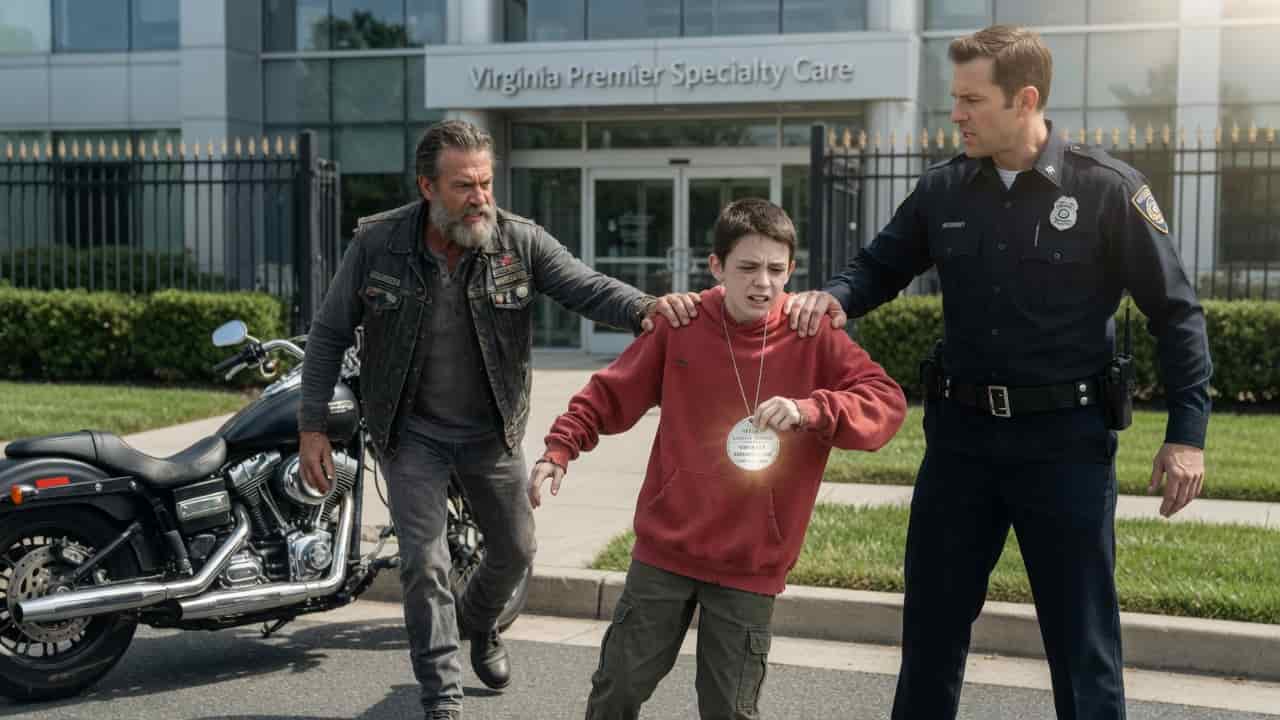
“Take your hand off the boy before I take it off your arm.”
Cane Holloway didn’t care about the private property signs or the polished glass of the clinic. He only saw the way the guard’s hand left a bruise on Joey’s thin shoulder. He saw the way the kid’s medical pendant—the only thing that might save his life—was kicked into the gravel like it was trash.
The guard sneered, looking at Cane’s grease-stained leather and the way his left leg dragged. He thought he was dealing with a broken-down biker who’d lost his way. He thought the rules of the wealthy suburb would protect him.
He was wrong.
Cane had spent ten years running from a secret that lived in a blood-stained bag under his floorboards. He’d spent ten years watching the man who betrayed him build an empire on lies. But when he saw that medical pendant in the dirt, the same one his wife had been wearing when the hospital turned her away, the running stopped.
He didn’t come for a fight. He came for the receipt. And he brought the whole club to make sure the debt was paid in full.
The guard looked past Cane’s shoulder, and that’s when his face went white. Behind the lone biker, the horizon was filled with chrome and black leather. Five hundred bikes were cutting the silence of the suburb, and they weren’t stopping for the gate.
The truth about Joey’s heart was about to come out, and Abel Holloway was going to have to look his brother in the eye for the first time in a decade.
Chapter 1: The Weight of the Gravel
The iron gates of the Oak Ridge Clinic didn’t just keep people out; they hummed with the quiet, expensive frequency of exclusion. It was the kind of place where the air felt filtered, scrubbed of the humidity and the smell of diesel that clung to the rest of Virginia.
Cane Holloway sat on his Harley, the engine idling with a low, rhythmic throb that felt like a heartbeat against his thighs. His left leg ached—a dull, grinding reminder of a night ten years ago that he usually tried to keep buried. He watched the boy, Joey, standing at the gate. Joey was too thin for his hoodie, his shoulders hunched as if he were trying to disappear inside the faded red fabric.
“He isn’t going to get in, Cane,” Stitch said, pulling up beside him. Stitch was the club’s medic, a man who could suture a wound in the back of a moving van but couldn’t do a damn thing about the bureaucratic rot of a private heart center.
“He has the pendant,” Cane said, his voice like rusted metal. “That’s supposed to be the golden ticket.”
They watched as the security guard, a man named Peterson whose uniform was too tight for his ego, stepped out of the glass-walled booth. Peterson didn’t look at Joey’s face. He looked at the boy’s dirty sneakers and the way he was trembling.
“I told you three times, kid,” Peterson’s voice carried over the idle of the bikes. “The clinic is by appointment only. This isn’t a walk-in. Go to the county hospital.”
“My mom said… she said this is where the specialist is,” Joey’s voice was small, cracking under the pressure of the afternoon heat. He held out his hand. Dangled from his fingers was a silver medical alert pendant. “I have this. It says I’m supposed to be seen.”
Peterson laughed, a sharp, ugly sound. “That’s a piece of junk, kid. Probably found it in a pawn shop. Now, move along before I call the sheriff for loitering.”
Joey didn’t move. He reached out, trying to show the engraving on the back of the silver disc. “Please. My chest hurts. It’s been hurting all morning.”
Peterson’s patience snapped. He stepped forward, his hand launching out to plant firmly on Joey’s shoulder. It wasn’t just a guide; it was a shove. Joey stumbled back, his heels catching on the decorative cobblestone of the driveway. He went down hard, his hands scraping against the gravel.
The silver pendant flew from his fingers, skittering across the pavement until it came to rest near the tire of Peterson’s shiny patrol car.
Cane didn’t think. He didn’t weigh the consequences of being a biker with a record in a zip code that smelled like old money. He kicked the kickstand down and stepped off the bike. His left leg buckled for a second, a sharp jolt of pain shooting up to his hip, but he ignored it. He walked toward the gate, his boots heavy on the asphalt.
“Hey!” Peterson yelled, seeing the leather vest and the grey beard. “Stay back from the gate!”
Cane didn’t stop. He reached Joey just as the boy was trying to push himself up, his eyes welling with the kind of shame that stays with a kid forever. Cane put a hand on Joey’s arm, steadying him.
“You okay, Joey?”
“He took it, Mr. Cane,” Joey whispered, looking at the pendant in the dirt. “He kicked it.”
Cane looked at Peterson. The guard was reaching for his belt, his chest puffed out, but his eyes were darting toward the road where Stitch and three other riders were watching.
“Pick it up,” Cane said. It wasn’t a request. It was a low-frequency threat.
“You’re trespassing,” Peterson said, though he didn’t move any closer. “I’m calling this in.”
“Pick. It. Up.” Cane took another step. The limp made his gait uneven, unpredictable. He looked like an old predator that had been wounded but still knew exactly where the throat was.
Peterson hesitated, his bravado flickering. He looked at the boy, then at the biker, then at the silver disc in the gravel. He reached down, snatched the pendant up, and tossed it toward Cane. It landed in the dirt at Cane’s feet.
Cane knelt. Every joint in his body protested, but he reached into the dust and retrieved the silver. He wiped the grit off with his thumb.
Then he saw it.
He hadn’t looked closely at the pendant when Joey’s mother had shown it to him back at the patch. He’d just seen a sick kid and a desperate woman. But now, under the harsh Virginia sun, he saw the engraving on the back.
Type O-Neg. Mitral Valve Replacement 2012. Property of S.H.
Cane’s heart didn’t just skip; it felt like it had been lanced. S.H. Sarah Holloway.
The pendant didn’t belong to Joey’s family because of a pawn shop. It belonged to them because it had been part of the “charity” distribution from the Holloway Foundation—the massive medical non-profit run by Cane’s brother, Abel.
But this wasn’t just a foundation piece. He knew the scratch on the rim. He’d made that scratch himself with a pair of pliers while trying to tighten the link for Sarah three weeks before she died.
This was her pendant. The one she’d been wearing when she’d been told there was no room in the “legit” hospital for a biker’s wife. The one that was supposed to have been buried with her.
“Cane?” Stitch was off his bike now, walking toward him. “What is it?”
Cane stood up, the pendant gripped so hard in his fist that the edges bit into his palm. He looked at the clinic—the sprawling, beautiful monument to medical excellence. Across the front, in brushed steel letters, it read: The Holloway Heart Center.
“The boy isn’t going to the county hospital,” Cane said, turning his gaze back to the terrified guard. “He’s going inside. And he’s going to see the head of the foundation.”
“Like hell he is,” Peterson said, reaching for his radio.
Cane didn’t wait for the call to go through. He turned back to his bike, his mind a sudden, violent storm of memories. The blood-stained money bag under his floorboards. The night Abel had promised to handle the hospital bills. The funeral where Abel hadn’t even shown his face.
“Stitch, get the boy on Low-boy’s truck,” Cane barked. “We’re going back to the patch.”
“We’re leaving?” Stitch asked, confused. “I thought you wanted him in there.”
“He’s going in,” Cane said, mounting his Harley and kicking the engine to life. The roar drowned out whatever Peterson was shouting into his radio. “But we aren’t going in through the front door alone. We’re going to get the rest of the family.”
He looked at Joey, who was being helped into the cab of the support truck. The boy looked smaller than ever, his face pale, his breath coming in short, ragged hitches.
Cane knew that look. He’d watched it happen to Sarah. He’d watched the light go out because the people inside the glass buildings decided that some lives weren’t worth the cost of the medicine.
“Cane, what did you see on that pendant?” Stitch asked as they pulled away, the gravel spraying from the tires.
“I saw a thief,” Cane said. “And I saw a man who’s about to pay a very old debt.”
Chapter 2: The Ghost in the Bag
The clubhouse was a converted warehouse on the edge of the swamp, a place where the humidity felt like a wet blanket and the smell of old oil was the only perfume. It was a fortress of sorts, but today it felt like a tomb.
Cane sat at the heavy oak table in the center of the room, the medical pendant sitting on the scarred wood in front of him. Joey was in the back room on a cot, Stitch monitoring his heart rate with a portable EKG that had seen better days. The steady beep… beep… was the only sound in the building.
Low-boy, a man whose name came from his height but whose temper was six feet tall, paced by the door. “We should’ve cracked that guard’s skull, Cane. We let him treat the kid like a dog.”
“Cracking a guard’s skull doesn’t fix a leaky valve, Low-boy,” Cane said without looking up.
He reached into his pocket and pulled out a heavy, weathered key. He stood up, his limp more pronounced now that the adrenaline had faded, and walked to the corner of the room. He pushed aside a stack of tires and knelt, prying up a loose floorboard.
From the dark space beneath, he pulled out a canvas gym bag. It was stiff with age, the fabric stained with something dark and brownish-red that had long since dried into the fibers.
He brought the bag to the table and unzipped it. Inside were stacks of hundred-dollar bills, bound with rotted rubber bands. And there, on top of the money, was a photograph of a woman with bright eyes and a laugh that seemed to reach through the faded gloss. Sarah.
“I haven’t opened this in ten years,” Cane whispered.
Low-boy stopped pacing. He looked at the money, then at Cane. “That’s the take from the interstate job? The one that sent you to the hospital and Sarah to the grave?”
“The job that was supposed to save her,” Cane corrected. “I did the work. I took the lead. I took the bullet in my leg. And I gave the bag to Abel. I told him, ‘Take this. Pay the doctors. Get her the surgery. I’ll go to ground.’”
Cane ran his hand over the canvas. “Abel told me the money was hijacked. He told me a rival crew hit him on the way to the hospital. He said the money was gone, and by the time he could find another way, Sarah’s heart gave out.”
“But you have the bag,” Low-boy said, his voice dropping an octave.
“I found it two years later,” Cane said. “Buried in a locker Abel had forgotten about. By then, he’d already used his ‘loss’ to claim insurance, started his first ‘legit’ medical supply company, and moved to the suburbs. He didn’t lose the money. He used it to buy his way into the world he lives in now. He traded Sarah’s life for a seat at the big table.”
Stitch walked out of the back room, his face grim. He wiped his hands on a towel. “The kid’s failing, Cane. His heart is working twice as hard as it should. If he doesn’t get that valve replaced in the next forty-eight hours, he’s gone. And the county hospital won’t touch him. They say he’s too high-risk for their equipment.”
“What about the Holloway Center?” Cane asked.
“They have the equipment,” Stitch said. “They have the only surgeon in the state who does the robotic repair Joey needs. But like that guard said, they don’t take charity. And they definitely don’t take bikers from the patch.”
Cane looked from the silver pendant to the blood-stained bag. The irony was a physical weight in his chest. The money in the bag was Sarah’s life. It was Joey’s life. And it was currently sitting in the accounts of the man who had built a “Heart Center” while his own brother’s wife died in a waiting room.
“Abel is hosting a gala tonight,” Cane said. “The ‘Heart of Gold’ dinner. A thousand dollars a plate to raise money for children just like Joey.”
Low-boy let out a harsh bark of a laugh. “You think he’s going to let us in? We’ll be arrested before we hit the parking lot.”
“He isn’t going to let us in,” Cane said, standing up and reaching for his vest. “He’s going to be forced to watch us arrive. Low-boy, get on the horn. Tell every chapter in the state. I want five hundred bikes at the crossroads by seven o’clock.”
“Cane, that’s a war,” Stitch warned. “The police, the private security… you’re asking for a bloodbath.”
“I’m asking for a receipt,” Cane said. He picked up the silver pendant and tucked it into his pocket. “Abel Holloway thinks he’s a legitimate man. He thinks he’s cleaned the blood off his hands. I’m going to show the whole world that the foundation he built is held together by the money he stole from his own family.”
He looked at the bag of money. “And I’m going to use his own greed to make him save that boy.”
“What if he says no?” Low-boy asked.
Cane looked at the door, his eyes cold and distant. “Then he finds out why they call me Cane. Because I’m the one who stayed in the field while he went to the palace. And the field is a very dangerous place for a man who’s forgotten how to fight.”
He walked back to the room where Joey was sleeping. The boy’s breathing was shallow, his chest rising and falling in a fragile, desperate rhythm. Cane sat on the edge of the bed and put his hand on Joey’s forehead.
“You’re going to be okay, kid,” he whispered. “You’re wearing Sarah’s mark now. And I don’t lose the same person twice.”
The beep… beep… of the monitor seemed to steady, as if the boy could hear him. Or perhaps, as if the ghost of Sarah was finally tired of waiting in the dark.
Chapter 3: The Surgeon and the Scum
The office of Dr. Aris Thorne was a temple of glass and expensive mahogany, tucked away in the highest floor of the Holloway Heart Center. Thorne was a man who performed miracles with a scalpel but had the bedside manner of a mortgage collector.
He looked up as the door to his office opened. He didn’t look at the face of the man walking in; he looked at the black leather, the grease under the fingernails, and the way the man moved with a hitch in his step.
“I believe my assistant told you that we are not seeing any more consultations today,” Thorne said, his voice clipped and precise.
Cane didn’t sit down. He walked to the window, looking down at the manicured gardens where white tents were being erected for the evening’s gala. “I’m not here for a consultation, Doctor. I’m here for a surgery.”
Thorne sighed, leaning back in his chair. “Mr…?”
“Holloway,” Cane said.
Thorne paused, his eyes narrowing. He looked at Cane more closely. “Any relation to the Chairman?”
“I’m the brother he tells people died in the war,” Cane said. “The one who doesn’t fit in the brochures.”
Thorne’s expression shifted from annoyance to a guarded curiosity. “Abel has never mentioned a brother. Regardless, the surgery schedule is full for the next six months. If you have a patient, you need to go through the proper channels.”
Cane pulled the EKG strips Stitch had printed out and dropped them on the mahogany desk. “Joey Vance. Eleven years old. Congenital mitral valve failure. He’s in stage four. He’s got maybe forty-eight hours.”
Thorne glanced at the strips. He tried to look away, but the professional in him couldn’t help it. His eyes lingered on the irregular peaks and valleys. “This child needs a robotic reconstruction. Immediately.”
“I know,” Cane said. “And you’re the only one who can do it.”
“It’s a quarter-million dollar procedure, Mr. Holloway,” Thorne said, pushing the strips back toward Cane. “The foundation covers three of these a year. The slots are already filled by the board of directors’ selected candidates.”
“Children of donors,” Cane said. “Kids whose parents can pay for the ‘privilege’ of being a charity case.”
“That is the way the world works,” Thorne said, his voice hardening. “I don’t make the rules. I just operate. Now, if you’ll excuse me, I have a gala to prepare for.”
Cane leaned over the desk. He didn’t yell. He didn’t threaten. He just spoke with a quiet, terrifying clarity. “My wife died because of those rules. She sat in a waiting room while Abel sold her medicine to the highest bidder. I’m not letting it happen to this boy.”
“And what do you expect me to do?” Thorne snapped. “Sneak him into an OR? Risk my license for a child from a biker patch?”
Cane reached into his vest and pulled out a single, rotted stack of hundred-dollar bills. He dropped it on the desk. It looked like trash on the expensive wood.
“That’s ten thousand dollars,” Cane said. “It’s covered in the blood of the man who shot me and the dirt of the interstate. It’s the dirtiest money you’ve ever seen. But it’s more honest than anything Abel Holloway has given you.”
Thorne looked at the money with a mixture of revulsion and fascination. “You think you can bribe me?”
“I think you’re a man who hates Abel as much as I do,” Cane said. “I’ve seen the way you look at him in the interviews. You’re the talent. He’s the salesman. He treats you like a tool in his belt.”
Cane leaned closer. “Perform the surgery tonight. While the gala is happening. While everyone is drinking champagne and talking about their ‘hearts of gold.’ You save that boy, and I’ll give you something better than money.”
“And what’s that?”
“I’ll give you the truth,” Cane said. “I’ll give you the proof that Abel Holloway has been embezzling from this foundation since the day it opened. I’ll give you the leverage to take this center away from him and run it the way it should be run.”
Thorne went still. The silence in the office was heavy, broken only by the distant sound of a hammer hitting a stake in the garden below.
“You have proof?” Thorne whispered.
“I have the ledger,” Cane lied. He didn’t have the ledger—not yet. But he knew where it was. It was in the safe in Abel’s mansion, the one he’d helped Abel install fifteen years ago when they were still brothers.
Thorne looked at the EKG strips again. He looked at the dirty money. Then he looked at Cane. “If I do this… if I get the boy into the OR… you have to ensure Abel is distracted. If he finds out before the boy is on the table, I’m ruined.”
“He’ll be distracted,” Cane said. “I’m bringing five hundred distractions to his front door.”
“You’re insane,” Thorne said, but he was reaching for his phone. “Get the boy here. Use the ambulance entrance. Ask for Nurse Miller. She’s… she owes me.”
Cane nodded. He turned to leave, but stopped at the door. “One more thing, Doctor.”
“Yes?”
“When you open that boy up… you treat him like he’s the most important person in the world. Because tonight, he is.”
Cane walked out of the office, his limp feeling lighter. He knew he’d just started a fire that might consume him, but as he reached the lobby and saw the giant portrait of Abel Holloway smiling down at the patients, he didn’t feel fear. He felt a cold, sharp hunger.
He pulled his phone out and hit speed dial. “Low-boy. It’s a go. Tell the chapters to mount up. We’re going to church.”
Chapter 4: The Heart of Gold
The sun was dipping below the horizon, painting the Virginia sky in bruised purples and oranges. At the crossroads five miles from the Holloway estate, the air was vibrating.
One bike is a noise. Ten bikes is a nuisance. Five hundred bikes is a force of nature.
Cane stood at the front of the pack, his leather vest zipped tight, the silver pendant hanging from his handlebars. He looked back at the sea of headlights. Men from three different chapters, some who hadn’t spoken in years, all gathered under the same banner.
“The kid’s at the ambulance bay,” Stitch said, pulling up beside Cane. “Thorne took him in. He’s prepping him now.”
“Then it’s time,” Cane said.
He kicked his Harley into gear and led the charge. They didn’t use the back roads. They took the main highway, a rolling thunder that sent cars pulling over to the shoulder in awe and terror. They moved like a single, massive organism, a river of chrome flowing toward the gates of the wealthy.
When they reached the Holloway estate, the security guards at the main gate didn’t even try to stop them. They saw the sheer mass of the club and simply stepped back, their faces pale in the glow of five hundred LED headlamps.
Cane didn’t slow down. He rode through the gates, over the manicured lawn, and straight toward the massive white tent where the “Heart of Gold” gala was in full swing.
Inside, the music stopped. The clinking of crystal and the hum of polite conversation died a sudden, violent death.
Cane rode his bike right up to the edge of the tent, the front tire touching the white linen carpet. He Revved the engine once—a deafening, bone-shaking roar—then killed the ignition.
Behind him, the other four hundred and ninety-nine bikes did the same. The silence that followed was heavier than the noise.
Cane stepped off his bike, his limp steady and deliberate. He walked into the tent, the smell of exhaust and road sweat clashing with the scent of expensive lilies and perfume.
At the far end of the tent, on a raised stage, stood Abel Holloway. He looked exactly like the portrait in the lobby—tan, silver-haired, dressed in a tuxedo that cost more than Cane’s motorcycle. Beside him was his wife, a woman who looked like she was made of porcelain and fear.
“Cane?” Abel’s voice was a whisper, but in the silent tent, it carried.
“Evening, Abel,” Cane said, stopping in the center of the room. A waiter dropped a tray of champagne flutes nearby. No one moved to pick them up.
“What is this?” Abel said, regaining his composure, his voice taking on that smooth, practiced authority. “You’re trespassing on private property, Cane. I should have you arrested.”
“You could try,” Cane said, gesturing to the wall of bikers standing at the edge of the tent. “But I don’t think your security is up for the overtime.”
Cane walked closer to the stage. The wealthy donors shrunk away from him, pulling their silk dresses and tailored suits aside as if his leather vest were contagious.
“I came for the boy, Abel,” Cane said.
Abel’s eyes flickered. “I don’t know what you’re talking about.”
“Joey Vance,” Cane said. “The kid your guard shoved into the dirt today. The kid whose mother you’ve been ignoring for months. He’s in your hospital right now, on your brother’s orders, getting the surgery you denied him.”
A murmur went through the crowd. Abel’s face flushed. “You’ve gone too far. You have no right to interfere with the medical decisions of this foundation.”
“I have every right,” Cane said. He reached into his pocket and pulled out the silver pendant. He held it up, the light of the chandeliers catching the tarnished silver. “Because the foundation was built on Sarah’s life. And I have the receipt.”
Abel went pale. He looked at the pendant, and for a second, the mask of the Great Philanthropist slipped. He looked like a frightened boy caught in a lie.
“That… that belongs in a museum,” Abel stammered.
“It belongs to the people you’ve been stepping on,” Cane said. He turned to the crowd, raising his voice. “You all think you’re here for charity? You think your checks are saving lives? Ask him about the 2012 interstate job. Ask him where the first million for this foundation really came from. Ask him why his own sister-in-law died in the rain while he was picking out the marble for the lobby!”
“Security!” Abel screamed. “Get him out of here!”
Four security guards moved forward, but they were instantly blocked by Low-boy and three other massive bikers. No punches were thrown. There was just a wall of muscle and denim that didn’t budge.
Cane stepped up onto the stage, forcing Abel to back up against the podium.
“You’re going to stand here, Abel,” Cane said, his voice a low, jagged blade. “You’re going to stand here and finish your speech. You’re going to tell these people how much you care about hearts. And while you’re talking, you’re going to pray. You’re going to pray that Dr. Thorne finishes that surgery and that Joey Vance wakes up.”
“Why?” Abel hissed, sweat beading on his forehead.
Cane leaned in, his face inches from his brother’s. “Because if that boy doesn’t wake up, I’m not going to the police with the ledger. I’m not going to the newspapers. I’m going to take you back to the patch, and I’m going to show you exactly how much Sarah suffered.”
Cane took the silver pendant and pinned it to the lapel of Abel’s expensive tuxedo.
“Wear it,” Cane said. “Let everyone see what your ‘Heart of Gold’ is really made of.”
Cane turned and walked off the stage. He didn’t look back. He walked through the crowd of stunned socialites, out of the tent, and back to his bike.
He sat on the Harley, his hand trembling slightly as he reached for the ignition. He looked up at the moon, clear and cold above the Virginia trees.
“I’m trying, Sarah,” he whispered. “I’m finally trying.”
He kicked the engine to life, and five hundred voices of thunder answered him.
But the real battle was just beginning. In the silent OR five miles away, a boy’s life was hanging by a robotic thread, and in the house behind him, a decade of secrets was starting to burn.
Chapter 5: The Glass Purgatory
The waiting room of the Holloway Heart Center was designed to soothe the wealthy, not to house a dozen men in grease-stained denim. The lighting was recessed and warm, the chairs were upholstered in a soft, slate-colored velvet, and the air smelled faintly of lavender and high-grade industrial disinfectant. It was a place where people waited for news while sipping artisanal water, not a place where the floorboards vibrated with the distant memory of five hundred engines.
Cane sat in a corner chair that felt too small for his frame. His left leg was extended, the knee joint throbbing with a dull, rhythmic heat. He’d spent ten years ignoring the physical cost of his past, but tonight, the cold tiles of the hospital seemed to be sucking the warmth right out of his bones.
Beside him, Stitch was hunched over, his hands clasped between his knees. The medic hadn’t spoken since they’d arrived at the ambulance bay. He was a man who understood the limits of the human body better than most, and he knew that Joey Vance was currently a series of electrical impulses being managed by a machine worth more than the entire biker patch.
“You think Thorne is actually doing it?” Low-boy asked. He was pacing the length of the room, his heavy boots making an aggressive thud-clack on the polished stone. He looked out of place, a jagged piece of rusted metal in a surgical suite.
“He’s doing it,” Cane said, though his voice lacked the certainty he wanted it to have. “He’s got a god complex and a grudge against my brother. That’s a powerful combination.”
“The cops are downstairs, Cane,” Low-boy said, stopping at the glass doors that led to the main lobby. “Three cruisers just pulled up. They aren’t coming for a tour.”
“Let them wait,” Cane said. “The paperwork for the trespassing at the gala will take an hour to file. By then, the boy will be out of the woods.”
The doors opened, and a woman in a lab coat stepped out. She wasn’t Thorne. She was younger, with sharp eyes and a weary set to her jaw. Nurse Miller. She looked at the group of bikers with a mixture of professional detachment and genuine fear.
“Mr. Holloway?” she asked, her voice hushed.
Cane stood up, his hip clicking. “How is he?”
“Dr. Thorne has initiated the bypass. The robotic arms are in place. But the damage to the mitral valve was… more extensive than the imaging showed. There’s a lot of scarring. Old scarring.”
Cane felt a cold finger of dread trace his spine. “What does that mean?”
“It means he’s been living on a failing pump for a long time,” Miller said. “He should have had this surgery three years ago. The heart muscle is tired, Mr. Holloway. It doesn’t want to restart.”
“Make it restart,” Cane said. It was a command, irrational and desperate.
“We’re doing everything we can,” she said, but her eyes drifted to the leather vest and the grey beard. “Dr. Thorne told me what you did at the gala. You realize that once this is over, the board is going to have his license? And yours is probably the last face he’ll see before the sheriff takes him.”
“If the boy lives, Thorne can have my bike and every dime in my pocket,” Cane said. “Tell him to focus on the valve.”
She nodded once and disappeared back through the double doors.
Cane sat back down, the velvet of the chair feeling like a mockery. He closed his eyes, and suddenly he was back in 2012. He was in the backseat of a stolen sedan, his hand pressed against Sarah’s chest, trying to feel the flutter of her heart through her coat. It had been raining—a cold, miserable Virginia rain that turned the roads into grease.
“Just keep breathing, Sarah,” he had whispered. “Abel’s got the money. He’s waiting at the hospital. We’re almost there.”
But Abel hadn’t been waiting. He’d been in a glass office, signing the incorporation papers for his first medical supply firm, using the money Cane had bled for as collateral for a bank loan. He’d told the hospital staff that the “biker woman” in the waiting room was a stranger, a charity case they didn’t have the resources to handle.
Cane opened his eyes. The memory was so vivid he could almost smell the wet asphalt. He looked at his hands. They were calloused, scarred, and stained with the life he’d chosen. He’d spent a decade hating Abel, but sitting in this room, he realized the deeper truth he’d been hiding from himself.
He had trusted Abel. He had handed his wife’s life over to a man he knew was a snake, simply because they shared the same blood. His grudge wasn’t just against his brother; it was against his own naivety.
The elevator at the end of the hall chimed.
Abel Holloway stepped out. He was still in his tuxedo, though the jacket was gone and his white shirt was rumpled, the sleeves rolled up. The silver medical pendant was still pinned to his lapel, glinting like a badge of shame under the fluorescent lights. Behind him stood two deputies, their hands hovering near their belts.
Abel looked at the waiting room, at the bikers, and finally at Cane. He looked older than he had an hour ago. The mask of the Great Philanthropist hadn’t just slipped; it had shattered.
“Tell the deputies to stay by the elevator, Abel,” Cane said, not moving from his chair. “If they come over here, things are going to get loud, and there’s a kid in surgery who needs it quiet.”
Abel signaled to the officers. They hesitated, then stepped back, their eyes locked on Low-boy. Abel walked toward Cane, his gait unsteady. He stopped three feet away, looking down at his brother.
“You ruined it,” Abel whispered, his voice trembling with a cocktail of rage and humiliation. “Ten years of work. The foundation, the donor base, the political connections… gone. In one night, you turned me into a joke.”
“You were always a joke, Abel,” Cane said. “You just finally had an audience that saw the punchline.”
“I saved you!” Abel hissed, leaning down. “After the interstate job, the police were looking for you. I buried the money. I told them it was stolen. I protected you from a twenty-year sentence!”
“You didn’t protect me,” Cane said, standing up slowly. He was taller than Abel, more solid. “You used me. You let Sarah die so you could have a head start. You didn’t bury the money for me; you buried it for your future.”
“She was going to die anyway!” Abel yelled, the sound echoing off the sterile walls. “She had a congenital defect, Cane! Even with the money, the odds were shit! I made a choice. I chose a legacy over a lost cause!”
The room went silent. Low-boy stepped forward, his fists clenching, but Cane held up a hand.
Cane looked at his brother—the man who had traded a woman’s breath for a building. He felt a wave of pity so profound it almost made him sick. “A lost cause. Is that what you call it when you break a promise to your own blood?”
“I’m a man of business, Cane. You wouldn’t understand.”
“I understand plenty,” Cane said. He reached out and grabbed the lapel of Abel’s shirt, pulling him close. The deputies moved, but Cane didn’t let go. “You see that pendant? That was hers. I found it in Joey’s hand today. A kid from the patch, Abel. A kid who doesn’t have a donor-class father. He was wearing my wife’s mark because your ‘charity’ gave it to him three years ago as a tax write-off, but you never bothered to check if he actually got the surgery.”
“It’s a big foundation, I can’t track every—”
“You tracked the money,” Cane interrupted. “You tracked every cent that went into your private accounts. You’re not a man of business. You’re a grave robber.”
Cane shoved him back. Abel stumbled, hitting the slate-colored chair. He sat there, breathing hard, his eyes darting around the room like a trapped animal.
“The police are going to take you, Cane,” Abel said, trying to find his voice. “The moment that kid comes out of surgery, you’re done. And Thorne is done. I’ll make sure you both rot.”
“Maybe,” Cane said. “But while I’m rotting, I’ll be thinking about the look on your face when the board of directors sees the photos I took of the ledger in your home office two years ago.”
Abel froze. “What?”
“I didn’t just find the money bag in that locker, Abel,” Cane said, leaning against the wall. “I found the key to your safe. I’ve had the proof for a long time. I was just waiting for a reason to use it that was bigger than my own anger.”
Cane looked toward the surgical doors. “Joey is that reason. If he wakes up, I might just hand that proof to the DA and take my chances. If he doesn’t… then the ledger goes to the guys waiting on their bikes outside. And they don’t care about the DA.”
Abel looked at the deputies, then back at Cane. He was realizing, finally, that his world of glass and mahogany had no defense against the man who had nothing left to lose.
For the next two hours, the waiting room was a tomb of silent tension. Abel sat in his chair, staring at the floor, his hands shaking. Cane stood by the window, watching the sunrise begin to bleed over the Virginia hills.
The silence was finally broken by the sound of the scrub room doors swinging open.
Dr. Aris Thorne walked out. He was covered in sweat, his surgical mask hanging around his neck. He looked exhausted, his face pale under the bright lights. He held a pair of bloody gloves in his hand.
He didn’t look at Abel. He walked straight to Cane.
Cane couldn’t breathe. He looked at the doctor’s eyes, searching for the truth before the words could form. He thought of Sarah. He thought of the gravel at the gate. He thought of the five hundred men waiting for a signal.
“Doctor?” Cane’s voice was barely a whisper.
Thorne took a long, shaky breath. He looked at the floor, then up at Cane. “The heart didn’t want to start. We had to shock him four times. I thought we’d lost the rhythm on the last cycle.”
Abel stood up, his face hopeful in the worst way. “Is he…?”
Thorne turned to Abel, his eyes burning with a sudden, sharp contempt. “He’s alive, Abel. No thanks to you. The valve is holding. His rhythm is stable.”
Cane felt the strength leave his legs. He sank back into the velvet chair, his head in his hands. He felt a sob rise in his throat—not for the boy, but for the ten years of poison he’d been carrying.
“He’s in recovery,” Thorne said, his voice softening as he addressed Cane. “He’s a fighter. Just like the woman whose pendant he was wearing.”
Cane looked up. “Thank you.”
“Don’t thank me yet,” Thorne said, glancing at the deputies. “The sheriff is downstairs. He’s asking for you by name.”
Cane nodded. He stood up, smoothing out his leather vest. He looked at Low-boy and Stitch. “Get back to the patch. Tell Joey’s mom. Tell the club the debt is paid.”
“We aren’t leaving you, Cane,” Low-boy said.
“Yes, you are,” Cane said. “The boy needs a ride home when he’s ready. And I’ve got some business to finish with my brother.”
He turned to Abel, who was trying to look relieved but failing. “The ledger is in a safety deposit box, Abel. My lawyer has instructions. You’re going to step down. You’re going to turn the foundation over to Thorne and a board that actually gives a damn. And you’re going to do it quietly.”
“You’re going to jail anyway!” Abel spat.
“I’ve been in jail for ten years, Abel,” Cane said, walking toward the deputies with his hands held out. “Tonight is the first time I’ve actually been free.”
As the handcuffs clicked into place, Cane looked back at the surgical doors. He could almost hear the steady, rhythmic thump-thump of a healthy heart. It was the only sound that mattered. The receipt was signed. The debt was settled. And for the first time since the rain of 2012, Cane Holloway felt like he could finally go home.
Chapter 6: The Residue of Justice
The county jail smelled of floor wax and unwashed despair, a scent Cane Holloway knew better than his own mother’s kitchen. But as he sat on the thin mattress of his cell, staring at the concrete wall, he didn’t feel the usual suffocating weight of the bars.
He’d been inside for three weeks. The charges were a laundry list of suburban nightmares: trespassing, inciting a riot, reckless endangerment, and a dozen traffic violations. But the big ones—the ones Abel had threatened—hadn’t materialized.
The door to the block buzzed, and a guard with a thick neck and a bored expression pointed at Cane. “Holloway. Visitor. Lawyer’s room.”
Cane stood up, his limp a bit more stiff after three weeks of inactivity. He walked through the narrow corridors, the sound of his boots echoing. When he entered the small, glass-partitioned room, he didn’t see a lawyer.
He saw Dr. Aris Thorne.
The doctor looked different. He wasn’t wearing a suit or a lab coat. He was in a simple flannel shirt and jeans, and the dark circles under his eyes seemed to have settled into permanent features.
“You look like hell, Doctor,” Cane said, sitting down.
“I’m running a foundation and a hospital by myself,” Thorne said, a ghost of a smile touching his lips. “It turns out Abel was doing a lot of paperwork. Most of it illegal, but still time-consuming.”
“How is the boy?” Cane asked. The only question that mattered.
“Joey is breathing on his own. He went home yesterday. His mother wanted to come see you, but I told her to stay with him. He’s got a long road of rehab, but the heart is strong. It’s… it’s a miracle, Cane. Given the state he was in.”
Cane let out a breath he felt like he’d been holding since the gala. “And the other thing?”
Thorne reached into a leather briefcase and pulled out a newspaper. He pressed it against the glass. The headline was bold and uncompromising: CHAIRMAN OF HOLLOWAY FOUNDATION STEPS DOWN AMID EMBEZZLEMENT PROBE.
“He’s gone,” Thorne said. “The board saw the records your lawyer provided. They didn’t even fight. Abel signed over his shares and his seats in exchange for a non-disclosure agreement on the more… colorful parts of his history. He’s headed for a ‘private retirement’ in Florida. He’s ruined, Cane. Socially, financially, and morally.”
Cane looked at the photo of Abel on the front page. His brother looked small, defeated. There was no victory in it, only a cold sense of completion.
“What about you?” Cane asked.
“The board appointed me interim Chairman. My first act was to scrap the donor-list requirement for the surgery slots. We’re opening a clinic in the patch next month. A real one.” Thorne paused, his eyes searching Cane’s. “The District Attorney is dropping the riot charges. They don’t want the publicity of a trial where a war hero biker saved a dying kid while the local billionaire tried to stop him. You’ll be out on time-served by Monday.”
Cane leaned back. He should have felt elated, but instead, he felt a strange, hollowed-out peace. “Monday. Good. I’ve got a bike to fix.”
“Cane,” Thorne said, his voice turning serious. “Why didn’t you do this years ago? You had the proof. You had the bag.”
Cane looked at his scarred hands. “Because I was waiting for someone to be worth the fallout. For ten years, I just wanted to hurt Abel. But hurting him wouldn’t have brought Sarah back. It wouldn’t have fixed the hole he left in the world.”
He looked up at Thorne. “Joey was the first thing that felt like an actual reason to fight. Not for revenge, but for a life. You know the difference.”
Thorne nodded. “I do now.”
The doctor stood up, picking up his briefcase. “There was one more thing. The boy’s mother… she found this in Joey’s bedside table when they were leaving. She told me to give it to you.”
Thorne held up a small plastic evidence bag. Inside was the silver medical alert pendant. It had been cleaned, the gravel scratches polished out, but the S.H. on the back was still clear and deep.
“Keep it,” Cane said.
“She wants you to have it back,” Thorne said.
“No,” Cane said, his voice firm. “I want you to hang it in the lobby of the new clinic. Not as a memorial. But as a reminder of what the price of admission is supposed to be. Tell them it’s the Heart’s Receipt.”
Thorne looked at the silver disc, then at Cane. He nodded slowly. “I’ll see you on the outside, Cane.”
Monday morning came with a pale, weak sun and the smell of freedom that always reminded Cane of rain on hot asphalt. Low-boy and Stitch were waiting at the gate, their bikes idling in a low, thunderous chorus.
Cane walked out, his limp making a rhythmic clicking on the pavement. He didn’t have his vest—it was still in an evidence locker somewhere—but he had his boots and his pride.
“You okay, boss?” Low-boy asked, tossing him a spare helmet.
“I’m fine, Low-boy,” Cane said. He mounted the bike Stitch had brought for him—his own Harley, polished and tuned until it looked brand new.
“Where to?” Stitch asked.
Cane looked toward the hills, toward the patch where a boy was waking up with a new lease on life, and then further, toward the small, quiet cemetery where the grass was finally starting to grow over a grave that had been cold for too long.
“I need to make a stop,” Cane said.
He kicked the bike into gear. The roar was a beautiful, violent thing. He led the two men out of the parking lot and toward the highway.
An hour later, Cane stood alone in the quietest corner of the county. He knelt by Sarah’s headstone, the movement slow and painful. He didn’t bring flowers. He didn’t bring a prayer.
He just reached out and touched the cold marble.
“He’s okay, Sarah,” Cane whispered. “He’s got your heart. Or close enough.”
He stayed there for a long time, the wind pulling at his grey beard, the distant sound of the highway the only company. He thought about the blood-stained bag, the gala, the glass purgatory of the hospital, and the brother he no longer had.
The residue of the last few weeks was everywhere—in his aching joints, in the legal bills he’d be paying for years, in the way the club looked at him now. It wasn’t a clean ending. There were still holes in his life that no amount of justice could fill.
But as he stood up and walked back to his bike, the limp felt less like a burden and more like a mark of a life lived. He’d spent a decade as a ghost of himself, haunted by a debt he couldn’t pay.
He climbed onto the Harley and looked back at the grave one last time.
“Debt’s settled,” he said.
He kicked the engine to life, the sound shattering the silence of the cemetery. He didn’t look back again. He rode toward the patch, toward the men who were his only family, and toward a future that was finally, for the first time in ten years, his own to write.
The road ahead was long, and the Virginia hills were steep, but for Cane Holloway, the engine was running smooth. And that was enough.