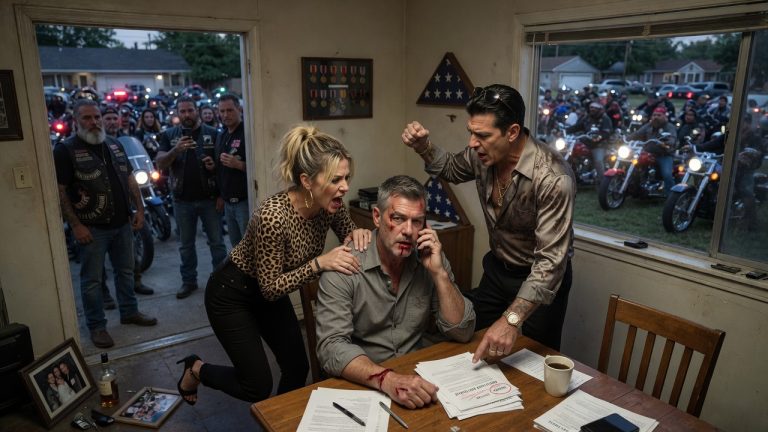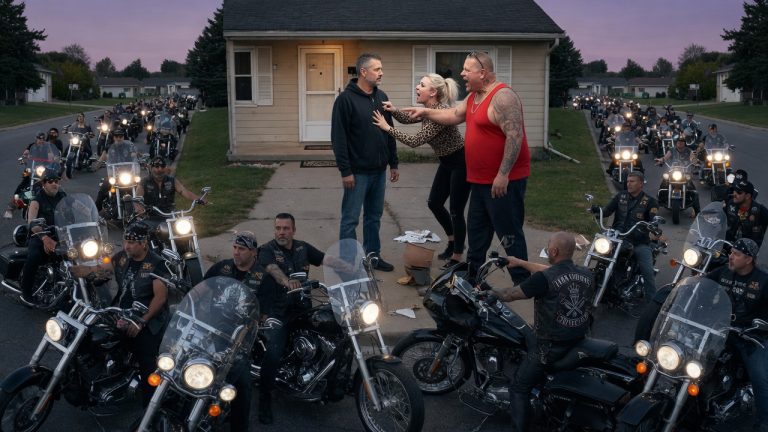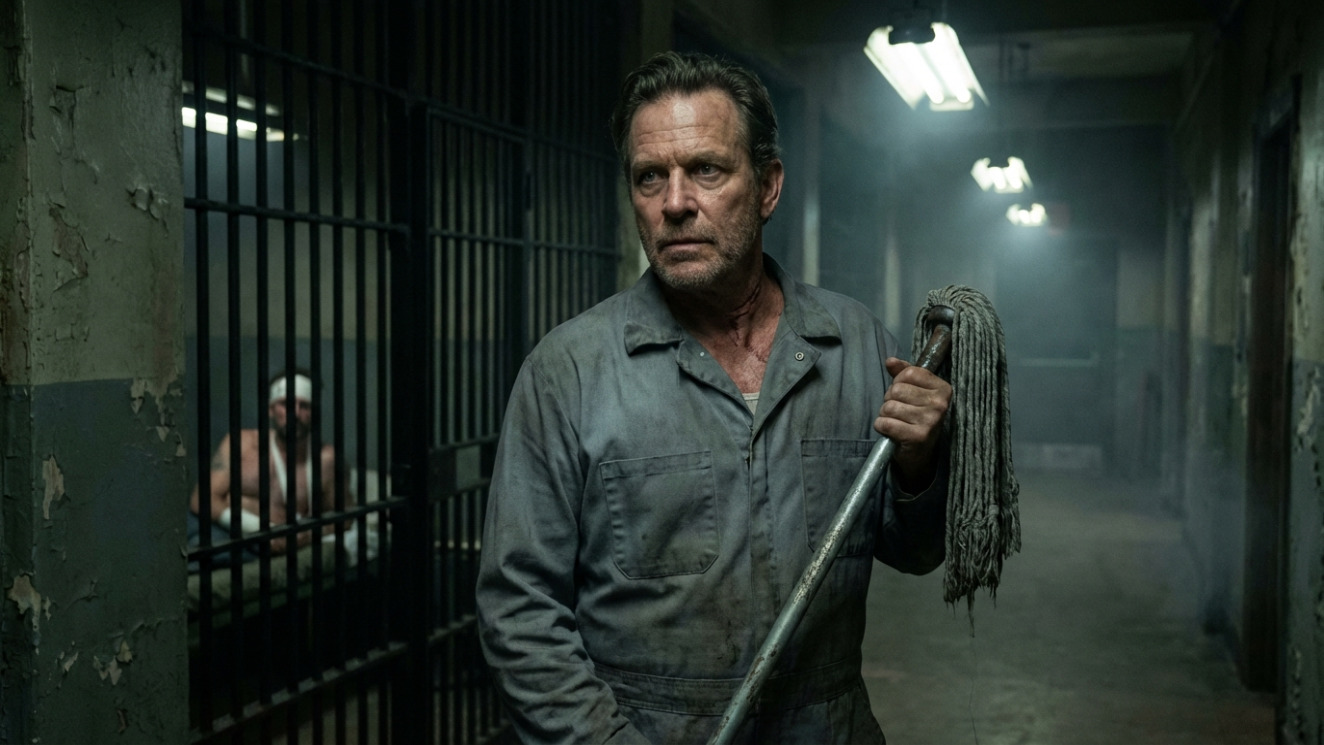
He hasn’t spoken a word in fifteen years—not since the night he held the bridge alone and lost his voice to a blade. Now, “Deacon” Cross spends his nights mopping the floors of the New Orleans Third Precinct, a ghost in a grey uniform that the cops don’t even bother to notice.
But being invisible means you see everything. You see which detectives take envelopes in the alley. You see which files get shredded. And you see when they bring in a “rat” who isn’t a rat at all, but the only brother who stayed behind to pull you off that bridge.
They think they’re going to kill Cade in a cell tonight. They think the janitor is just a broken old man with a bucket.
They’ve forgotten that the Five Hundred don’t need a voice to hear a signal. And they’re about to find out exactly how loud silence can be.
FULL STORY
Chapter 1: The Invisibility of Grey
The humidity in New Orleans didn’t just sit on you; it owned you. It was three in the morning in the Third Precinct, and the air inside the building tasted like stale coffee, floor wax, and the damp, metallic scent of the holding cells. Deacon pushed the industrial bucket down the long hallway of the Internal Affairs wing. The wheels squeaked—a rhythmic, high-pitched protest that echoed off the linoleum. Most people would have oiled the wheels. Deacon liked the noise. It told people he was coming so they had time to stop talking, or more often, time to forget he was a person.
Deacon was fifty-four, but in the harsh fluorescent light of the precinct, he looked seventy. His hair was a thinning, iron-grey mane pulled back into a tight nub at the base of his neck. His skin was the color of a cured ham, mapped with the history of a life lived outdoors and at high speeds. But it was the throat that made people look away. A thick, distorted ridge of scar tissue ran from under his left ear, dipping deep into the hollow of his neck before climbing toward the right jawline. It looked like someone had tried to unzip him and changed their mind halfway through.
He didn’t have a voice. Not a real one. If he tried to speak, what came out was a dry, wet rattle—the sound of wind moving through a graveyard. So, he stayed quiet. He’d been quiet for fifteen years.
He stopped the bucket outside Interrogation Room B. The door was heavy steel, painted a depressing shade of institutional beige, but the seal was old. Sound leaked through the bottom.
“You’re a long way from the clubhouse, Cade,” a voice said. That was Detective Vaughn. Vaughn was Internal Affairs, which meant he dressed better than the beat cops and carried himself with the smug entitlement of a man who held everyone’s pension in his pocket. “How’s the leg? I heard the boys in the bayou did a number on you before we picked you up.”
Deacon dipped his mop into the grey water and wrung it out. The mechanical clack-clack of the wringer was loud in the empty hall.
A second voice, raspy and defiant, answered. “I don’t know what you’re talking about, Vaughn. I was just out for a ride.”
Deacon froze. The mop stayed suspended over the bucket, dripping dirty water back into the pool. He knew that voice. He hadn’t heard it in over a decade, but it was etched into the marrow of his bones. Cade. Lucas Cade. The man who had stayed on the bridge at Black Bayou when the rest of the club had turned tail. The man who had dragged Deacon’s bleeding, mangled body into the tall grass while the rival crew’s headlights cut through the dark.
“You were out for a ride with a bag full of clean ledger sheets and a list of every payout made to the Fourth District,” Vaughn’s voice dropped, becoming a low, predatory purr. “The club thinks you’re a rat. They think you’re selling the books to the feds. But we both know the truth, don’t we? You weren’t going to the feds. You were coming for us.”
Deacon began to mop. He moved the cotton head in wide, rhythmic figures-eights. He kept his head down, the bill of his navy-blue cap shadowing his eyes.
The door to Room B swung open. Vaughn stepped out, adjusting his silk tie. He was a handsome man in a way that felt manufactured—perfect teeth, expensive haircut, eyes like cold glass. He almost walked right into Deacon. He stopped, his polished Oxford shoe inches from the wet linoleum.
“Watch it, Mute,” Vaughn snapped. He didn’t look at Deacon’s face. He looked at the uniform, the name tag that just said CROSS, and the bucket. To Vaughn, Deacon was a piece of furniture that occasionally moved dirt around.
Deacon didn’t move. He didn’t apologize. He just looked at Vaughn’s shoes.
“I said move the damn bucket,” Vaughn said, his voice rising. He stepped forward, deliberately planting his foot in the center of the wet patch Deacon had just cleaned, then kicked the bucket. It didn’t tip, but the water sloshed over the side, soaking Deacon’s work boots.
Vaughn’s partner, a thick-necked man named Miller, stepped out behind him. Miller was the kind of cop who enjoyed the paperwork of a beating. “Leave him, Vaughn. The old freak probably didn’t hear you. Brain’s probably as rotted as his pipes.”
Vaughn sneered, wiped a non-existent speck of dust from his sleeve, and walked toward the elevators. Miller followed, but not before leaning in close to Deacon. “I see you lurking around these doors again, Cross, I’m gonna have the Chief pull your clearance. You hear me? Scrub the floors and keep your head down.”
Deacon waited until the elevator doors hissed shut. The silence of the hallway rushed back in, heavy and suffocating. He turned his head slowly and looked at the small, reinforced glass window in the door of Room B.
Cade was sitting at the metal table. His face was a map of purple bruises. One eye was swollen shut, and his lip was split wide. He looked old. He looked tired. He looked like a man who had reached the end of a very long, very steep road.
Deacon walked to the door. He didn’t knock. He didn’t open it. He just stood there. Cade shifted in his chair, the chains on his ankles rattling. He looked toward the door, his one good eye squinting. For a second, their gazes met through the glass. Deacon saw the flicker of recognition in Cade’s expression—the sudden sharpening of the stare, the way his jaw tightened.
Deacon raised a hand, slow and deliberate. He pressed his palm against the glass. It was a gesture from a different life, a silent code they’d used when the engines were too loud for words. I see you.
Cade’s breath hitched. He started to lean forward, to say something, but the heavy footfalls of a guard coming down the hall forced Deacon to pull away. He grabbed his mop and moved toward the utility closet at the end of the wing.
Inside the closet, surrounded by the smell of bleach and industrial soap, Deacon sat on a plastic crate. His heart was hammering against his ribs like a trapped bird. He reached up and touched the scar on his throat.
Fifteen years ago, the Five Hundred—one of the oldest MCs in the South—had been his family. They weren’t just a club; they were a sovereign nation. Deacon had been the enforcer, the “Wall.” When a deal with a Colombian syndicate went sideways on a bridge outside Houma, the club had been trapped. Deacon had stayed behind to hold the line, armed with nothing but a short-barreled shotgun and a refusal to die. He’d taken a blade to the throat for his trouble.
The club had called him a hero for a week. Then he became a liability. A man who couldn’t talk couldn’t negotiate. A man who couldn’t scream couldn’t intimidate. They’d given him a “retirement” that felt a lot like an eviction.
He’d ended up here, in the bowels of the New Orleans PD, working a job that required him to be a ghost. He’d spent five years collecting scraps of information—overheard conversations, discarded memos, the way certain detectives looked at certain criminals. He had a ledger of his own, hidden in the vents of the basement locker room. He knew that Vaughn and Miller weren’t just dirty; they were the architects of a heroin pipeline that used the club’s routes.
And now they had Cade.
Cade wasn’t a rat. He was the only one who had the balls to try and clean the club’s house from the inside. He’d been trying to find the link between the MC leadership and the precinct, and he’d obviously found it.
Deacon stood up and walked to the small, cracked mirror over the utility sink. He looked at the man in the grey uniform. The man the world had discarded. He thought about the five hundred men who wore the patch. Most of them were new, young, and hungry for the myth of the outlaw. But there were still a few of the old guard left. Men who remembered the bridge. Men who remembered what loyalty actually meant before it became a slogan on a t-shirt.
He reached into his pocket and pulled out a small, battered silver coin. On one side was a bridge. On the other, the Roman numeral VCC—the Five Hundred.
He looked at the coin, then at the phone on the wall. He couldn’t speak, but he had a pager. He had a signal.
He went back out into the hall. He had four more hours of his shift. He had to be perfect. He had to be invisible. Because tonight, the janitor was going to do something more than just clean the floors. He was going to wash the whole city.
Chapter 2: The Sound of a Falling Pin
The Fourth District was where the old money lived, but the Third was where the old secrets died. Deacon spent the next two hours moving through the precinct with the practiced lethargy of a man who had no reason to hurry. He emptied trash cans in the bullpen, dodging the casual insults of the night-shift officers. He wiped down the desks of men who didn’t know his first name.
Every time he passed the IA wing, he felt the vibration in the floor—the constant, low-level thrum of the building’s mechanical heart. Or maybe it was just him.
At 5:00 AM, he made his way down to the basement. The air here was cooler, smelling of damp concrete and old paper. This was where the “Blue Ledger” lived. He went to the far corner of the evidence storage locker, a place that hadn’t been audited since the Bush administration. Behind a stack of rusted filing cabinets, he reached into the ceiling tiles.
His fingers brushed against cold leather. He pulled down a small, black notebook and a weathered biker’s vest. The leather was stiff, the “Five Hundred” patch on the back faded from black to a deep, bruised purple. He ran his thumb over the embroidery. This was his true skin. The grey uniform was just a shroud.
He opened the notebook. It was filled with dates, names, and plate numbers.
May 12: Vaughn meets ‘Spider’ at the docks. Three crates moved.
June 4: Miller deposits 12k at the credit union. No record in IA filings.
July 19: The bridge deal. Cade mentioned as ‘interference’.
Deacon had known they were coming for Cade. He just hadn’t known when. Now, the clock was ticking. If Cade stayed in that cell through the morning shift, he’d be “transferred” to the parish prison. And in New Orleans, a “transfer” for a suspected rat usually ended in a suicide by hanging or a tragic accident in the showers.
He tucked the notebook into his waistband and hid the vest back in the ceiling. As he turned to leave, a shadow blocked the doorway of the storage room.
Deacon’s hand went instinctively to the heavy brass key ring on his belt—his only weapon.
“You’re a hard man to find, Cross. Even when you’re exactly where you’re supposed to be.”
It was the Chief. Captain Arthur “Bear” Thibodeaux. He was a massive man, his skin the color of mahogany, his uniform stretched tight over a belly that spoke of decades of red beans and rice. He was three years from retirement and had the look of a man who had seen the soul of the city and found it wanting.
Deacon didn’t move. He stood in the shadows, his face a mask of nothingness.
“I saw Vaughn messing with you upstairs,” Thibodeaux said, leaning against the doorframe. He pulled a cigarette from behind his ear but didn’t light it. Smoking wasn’t allowed in the basement, but Thibodeaux didn’t care about rules he didn’t like. “He’s a prick. Always has been. But he’s a connected prick.”
Deacon tilted his head slightly. A silent question.
“Cade,” the Chief said, his voice dropping. “They brought him in tonight. IA says they’ve got him on a racketeering charge. But I saw the file, Cross. There’s no file. Just a blank folder with a signature from the Commissioner’s office.”
Deacon stepped forward into the light. He looked the Chief in the eye. Thibodeaux was one of the few people who didn’t look away from the scar.
“You think I don’t know who you are?” Thibodeaux asked, a small, sad smile touching his lips. “I was a beat cop on that bridge fifteen years ago. I was the one who called the ambulance that took you to Charity Hospital. I saw what you did. You held off six men with a broken leg and a hole in your neck.”
Deacon’s throat made a clicking sound. He tried to swallow, but it felt like sandpaper.
“Vaughn and Miller… they aren’t just cleaning up the club, Cross. They’re taking it over. They need Cade out of the way because Cade found the ledger. Not the club’s ledger. Their ledger.”
The Chief stepped closer. He reached out and put a heavy hand on Deacon’s shoulder. “I’m an old man, Deacon. I’ve got a pension and a granddaughter in Metairie. I can’t fight this from the inside. The rot goes all the way to the top. If I try to stop that transfer, I’ll be dead before breakfast.”
Deacon looked at the hand on his shoulder, then back at the Chief’s face. He saw the shame there. The weary, soul-deep exhaustion of a good man who had been outmaneuvered by evil.
“But you,” Thibodeaux whispered. “You aren’t a cop. You’re the janitor. Nobody sees the janitor.”
The Chief reached into his pocket and pulled out a key card. It was silver, marked with a red stripe. “This gets you into the server room and the electrical main. If the power goes out, the cell locks revert to manual for thirty seconds before the generators kick in. It’s a security flaw they never fixed.”
He pressed the card into Deacon’s palm.
“I’m going to go to my office and finish a bottle of bourbon,” Thibodeaux said. “I won’t see anything. I won’t hear anything. But if I were you… I’d call in some favors. I’d call in all of them.”
The Chief turned and walked away, his heavy footsteps echoing up the concrete stairs.
Deacon stood alone in the dark. He looked at the key card. He looked at the silver coin in his other hand.
He left the basement and went to the back parking lot, where the staff kept their lockers. He didn’t have a car—he rode a rusted-out Schwinn bicycle to work every day. But in the corner of the lot, under a tarp, sat an old ’94 Harley Fat Boy. It belonged to “Whisper,” the youngest mechanic in the Five Hundred. Whisper had been leaving it there for a week, supposedly for “repairs” Deacon was helping him with.
Deacon pulled back the tarp. The chrome was dull, but the engine was solid. He reached under the seat and pulled out a small, handheld radio—the kind used by truckers and bikers on long hauls.
He turned it on. The static was a comfort. He clicked the transmitter three times. Short. Short. Long.
A few seconds passed. Then, a voice cracked through the air. It was young, sharp, and filled with a nervous energy.
“Deac? Is that you?”
Deacon clicked once. Yes.
“We’ve been waiting,” Whisper said. “The word’s out. Cade didn’t make it to the safe house. The brothers are… they’re split, Deac. Half of them think he sold us out. The Young Bloods want his head.”
Deacon clicked twice. No. Then he clicked a complex pattern—a sequence they hadn’t used since the war with the Iron Cross.
“The Signal?” Whisper’s voice went hushed. “You’re calling for a Full Count? In the city? Deac, that’s suicide. The NOPD will call in the National Guard.”
Deacon didn’t respond. He didn’t need to. He clicked the pattern again, slower this time.
“Understood,” Whisper said, his voice suddenly steady. “Five hundred bikes. Silent approach. We’ll be at the perimeter by 0400. You better be ready, old man. If we’re doing this, we’re doing it all the way.”
Deacon turned off the radio. He looked up at the precinct. The lights in the windows were a sickly yellow against the pre-dawn sky. He thought about his silence. For fifteen years, he’d been a man without a word. He’d let the world define him by his injury. He’d let the club forget him. He’d let the dirty cops walk over his floors.
But silence wasn’t just the absence of sound. It was a weapon. And tonight, he was going to use it to scream.
Chapter 3: The Ghost in the Machine
The hours between 2:00 AM and 4:00 AM were the “dead zone” in the precinct. The adrenaline of the evening arrests had faded, and the morning shift hadn’t yet arrived to bring the chaos of the day. The building felt hollowed out, a shell of concrete and bad intentions.
Deacon was back on the third floor, mopping the same hallway for the third time. He was watching the clock. 3:15 AM.
Vaughn and Miller were in their office. The door was cracked open, and the smell of expensive cigars drifted out—a stark contrast to the precinct’s usual scent of burnt coffee. Deacon could hear the clink of glass. They were celebrating.
“He’s not talking,” Miller’s voice was muffled. “The bastard is just sitting there, staring at the wall.”
“It doesn’t matter,” Vaughn replied. “The paperwork is already in the system. By 6:00 AM, he’s on a bus to Angola. By 8:00 AM, he’s a statistic. Once he’s gone, we close the books on the Fourth District. The club will think the feds took him. The feds will think the club took him. It’s a clean sweep.”
Deacon moved the mop closer to the door. He wasn’t hiding anymore. He wanted to hear the details.
“What about the janitor?” Miller asked. “He was lurking outside the room earlier. I don’t like him, Vaughn. There’s something in his eyes. Like he’s judging us.”
Vaughn laughed—a sharp, unpleasant sound. “The Mute? He’s a broken-down biker with half a throat. He probably doesn’t even know what year it is. If he gets in the way, we’ll just toss him in a cell for public intoxication. Who’s going to believe him? He can’t even tell his own name.”
Deacon’s hand tightened on the mop handle. Judge. He liked that word.
He moved away from the door and headed toward the elevator. He didn’t go to the lobby. He used the Chief’s key card to access the “restricted” button. The elevator descended to the sub-basement, the level where the city’s power grid interfaced with the precinct’s internal systems.
The server room was cold—a constant, artificial winter designed to keep the machines from melting down. The hum of the cooling fans was a roar compared to the silence of the upper floors. Deacon moved with purpose now. He wasn’t a janitor anymore; he was a sapper.
He found the main breaker panel. It was a massive, grey beast of a machine, locked behind a steel mesh. He used the key card again. The lock clicked open.
Inside, the wires were a chaotic rainbow. Deacon had spent his youth stripping bikes and wiring clubhouse security systems. He knew how electricity worked. He knew that if you cut the main, the backup would kick in. But if you bridged the backup and the main before cutting them… you got a dead short. A total blackout.
He pulled a pair of heavy-duty wire cutters from his janitor’s belt—tools he’d kept sharp for years. He looked at his watch. 3:45 AM.
Fifteen minutes.
He left the server room and headed back to the basement locker area. He needed his skin. He reached into the ceiling and pulled down the leather vest. He stripped off the grey work shirt, revealing a chest covered in faded tattoos—skulls, pistons, and the names of brothers long dead. He pulled the vest on. It was tight over his broader shoulders, the leather smelling of oil and old wind.
He looked in the cracked mirror. For the first time in fifteen years, he recognized the man staring back.
He went to the gun locker—the one the Chief had “forgotten” to lock. He didn’t take a Glock or a shotgun. He took a heavy, wooden baton and a flare gun. He tucked the baton into his belt and the flare gun into the pocket of his vest.
He made his way to the back stairwell. He climbed the stairs to the roof.
New Orleans lay spread out before him, a sea of lights and shadows. To the east, the Mississippi River was a dark, shimmering ribbon. To the west, the swamp waited.
He looked down at the streets surrounding the precinct. They were empty. No cars, no pedestrians. Just the yellow glow of the streetlights.
Then, he saw it.
A single headlight appeared at the end of Basin Street. Then another. And another.
They didn’t come with the roar of a thousand engines. They came in a low, synchronized crawl. Five hundred bikes, moving in perfect formation, their engines tuned to a whisper. It was the “Silent Roll,” a tactic the club used when they didn’t want the law to know they were coming until they were already there.
The bikes began to circle the precinct. They didn’t stop. They just kept moving, a slow, rotating ring of chrome and steel. It was a siege, but a quiet one.
Deacon pulled his radio from his pocket. He clicked it once.
“We’re in position,” Whisper’s voice came through, a tense, vibrating wire of sound. “The perimeter is locked. No one gets in, no one gets out. Your move, Deac.”
Deacon looked at the clock on the roof’s utility shed. 4:00 AM.
He turned and headed back down the stairs. He didn’t use the elevator. He moved through the shadows of the stairwell, a ghost returning to haunt the living.
He reached the server room again. He stood before the breaker panel. He took a breath—a deep, rattling lungful of cold air.
He reached out and grabbed the main power lever.
One. Two. Three.
He slammed the lever down. At the same moment, he jammed the wire cutters into the backup relay.
There was a massive, blue-white flash of light. A loud CRACK like a gunshot echoed through the basement. The hum of the cooling fans died instantly.
The lights went out. Not just in the basement, but in the whole building. The emergency lights flickered for a second, then went dark as the short circuit surged through the backup system.
The precinct was plunged into total, absolute darkness.
Deacon stood in the blackness, his eyes adjusting. He didn’t need light. He knew this building by touch. He knew every squeaky floorboard, every heavy door, every hidden corner.
He began to walk toward the stairs. Above him, he could hear the first sounds of panic. Shouted orders. The frantic clicking of flashlights. The sound of heavy doors being kicked.
But outside, the rumble of the engines was finally beginning to grow. The “Silent Roll” was over. The Five Hundred were beginning to rev.
The sound was a low, guttural growl that shook the very foundations of the building. It wasn’t a roar of anger; it was a roar of presence.
Deacon reached the third floor. He stepped out of the stairwell.
In the flickering beam of a distant flashlight, he saw Vaughn and Miller standing in the hallway outside the IA wing. They looked small. They looked confused.
Deacon pulled the baton from his belt. He didn’t say a word. He didn’t have to.
The janitor was finished cleaning.
Chapter 4: The Moral Weight of Silence
The hallway was a tunnel of shadows, lit only by the frantic, dancing beams of Vaughn and Miller’s flashlights. The air felt heavy, charged with the ozone of the short circuit and the sudden, sharp scent of fear.
“What the hell is going on?” Miller shouted, his voice cracking. He was fumbling with his radio, but only static came back. “The whole grid is down. The generators didn’t kick over!”
Vaughn was calmer, but his face was pale in the harsh LED light. He had his service weapon drawn, the barrel trembling just a fraction of an inch. “It’s a hack. Or a sabotage. Get to the holding cells. We’re moving Cade now. Screw the paperwork, we’re taking him out the back way.”
They started toward the cells, their boots thudding on the floor Deacon had spent years polishing.
Deacon stepped out from the shadows of a recessed doorway. He didn’t move fast. He didn’t need to. He stood in the center of the hall, the wooden baton held loosely at his side. The light from Vaughn’s flashlight hit him square in the chest, illuminating the faded “Five Hundred” patch on his leather vest.
Vaughn froze. He blinked, his eyes widening as he realized what he was looking at. “Cross? What the hell are you doing in that… is that a club vest?”
Deacon didn’t answer. He just stared at them.
“You old freak,” Miller snarled, stepping forward. “You did this? You cut the power? You’re dead. You hear me? You’re going to rot in the hole for the rest of your miserable life.”
Miller reached for his handcuffs, but Deacon moved.
It wasn’t the movement of a janitor. It was the movement of the Wall. He stepped inside Miller’s reach, the baton coming up in a short, brutal arc. It caught Miller in the solar plexus, folding him like a piece of paper. As Miller gasped for air, Deacon grabbed him by the collar and slammed him against the wall, the back of the detective’s head hitting the plaster with a sickening thud.
Miller slumped to the floor, unconscious.
Vaughn leveled his gun at Deacon’s head. “Back off! I’ll kill you! I’ll put a bullet right between your eyes!”
Deacon didn’t back off. He took a step forward. Then another. He looked directly into the barrel of the gun. He’d stared down worse things than a dirty cop with a God complex.
“I said stay back!” Vaughn’s voice was a shrill, panicked thing now.
Outside, the roar of the bikes had reached a crescendo. The windows of the precinct were vibrating in their frames. The sound was an ocean of thunder, a physical force that seemed to be pushing against the walls of the building.
Deacon reached into his pocket and pulled out the small, black ledger—the one he’d kept hidden for five years. He held it up.
Vaughn’s eyes flicked to the notebook. “What is that?”
Deacon tossed the notebook onto the floor at Vaughn’s feet. Then, he pulled out his phone. He’d pre-typed a message. He hit play on the text-to-speech app.
A flat, robotic voice echoed in the hallway. “That is your life, Vaughn. Every kickback. Every shipment. Every name. It’s already been uploaded to the federal server in Houston. The Chief sent it ten minutes ago.”
Vaughn’s face went from pale to a sickly, grey-green. “You’re lying. The Chief is a coward. He wouldn’t—”
“The Chief is tired,” the robotic voice continued. “And I am the one who mopped your office. I’m the one you didn’t see. You should have looked at the floor, Detective. You missed the evidence.”
Vaughn’s finger tightened on the trigger. His eyes were wild, the look of a cornered animal realizing the trap has snapped shut. “It doesn’t matter. I’ll kill you, I’ll kill Cade, and I’ll burn this whole building to the ground.”
“You won’t,” another voice said.
Captain Thibodeaux stepped out of the darkness at the end of the hall. He was holding a heavy duty flashlight in one hand and his service weapon in the other. He looked old, and he looked sad, but his hand was steady as a rock.
“Put it down, Vaughn,” Thibodeaux said. “It’s over. The State Police are five minutes out. I called them myself.”
“You’re a traitor!” Vaughn screamed. “You’re one of us! You took the money!”
“I took the money to keep the precinct running when the city forgot us,” Thibodeaux said, his voice heavy with regret. “But I never killed a brother. And I never sold heroin to kids in the Ninth. You and Miller… you crossed a line I can’t ignore anymore.”
Vaughn looked at the Chief, then at Deacon, then at the unconscious Miller. He was alone. The power was out, the building was surrounded by five hundred angry bikers, and the world he had built on secrets was collapsing.
He lowered the gun. His shoulders slumped. The arrogance drained out of him, leaving nothing but a small, pathetic man in an expensive suit.
Deacon didn’t wait for the arrest. He turned and walked toward the holding cells.
He found the manual release for Cade’s cell. The heavy steel door swung open with a groan.
Cade was sitting on the bunk, his head in his hands. He looked up, his one good eye widening as he saw Deacon standing there in his leather vest.
“Deac?” Cade’s voice was a broken whisper. “Is it really you?”
Deacon stepped into the cell. He reached out and grabbed Cade’s hand, pulling him to his feet. He didn’t say anything. He couldn’t. But the grip of his hand spoke volumes.
“The bridge,” Cade said, a tear tracking through the blood on his cheek. “You came back for me.”
Deacon nodded once. He led Cade out of the cell and back down the hallway. They passed the Chief, who was zip-tying Vaughn’s hands. Thibodeaux didn’t look up. He just nodded as they passed.
They reached the lobby. The front doors were locked, but the glass was vibrating with the force of the engines outside.
Deacon looked at Cade. Then he looked at the doors.
He pulled the flare gun from his pocket. He aimed it at the ceiling and pulled the trigger.
A brilliant, blinding red light filled the lobby, reflecting off the glass and the polished floors. It was the final signal.
Deacon pushed open the front doors.
The night air of New Orleans rushed in—warm, humid, and smelling of freedom. And there, filling the street from sidewalk to sidewalk, were the Five Hundred.
They weren’t shouting. They weren’t revving their engines anymore. They were just sitting on their bikes, a silent, impenetrable wall of leather and chrome.
At the front of the pack was Whisper. He looked at Deacon, then at Cade. He raised a fist in the air.
One by one, five hundred fists went up. A silent salute.
Deacon felt a tightness in his chest—a sensation he hadn’t felt in fifteen years. It wasn’t pain. It was the feeling of a voice finally finding its way home.
He walked down the precinct steps, Cade leaning on his shoulder. They walked past the line of police cars that were finally arriving, their sirens screaming into the night.
The police didn’t stop them. They didn’t even try. The Five Hundred parted like the Red Sea, letting Deacon and Cade through.
As they reached the edge of the crowd, Deacon stopped. He looked back at the precinct—the grey building where he’d spent five years being invisible.
He took off the janitor’s name tag and dropped it into the gutter.
He didn’t need a name anymore. He had his patch. And he had his brothers.
The silence of the Five Hundred was finally broken. As one, they kicked their engines into life. The sound was a deafening, joyous roar that shook the city to its core.
Deacon climbed onto the back of Whisper’s bike. He looked at the horizon, where the first hint of dawn was beginning to bleed into the sky.
The road ahead was long, and the consequences of the night would follow them for years. But for the first time in a long time, Deacon Cross wasn’t afraid of the quiet.
He had nothing left to say. And that was exactly how it should be.