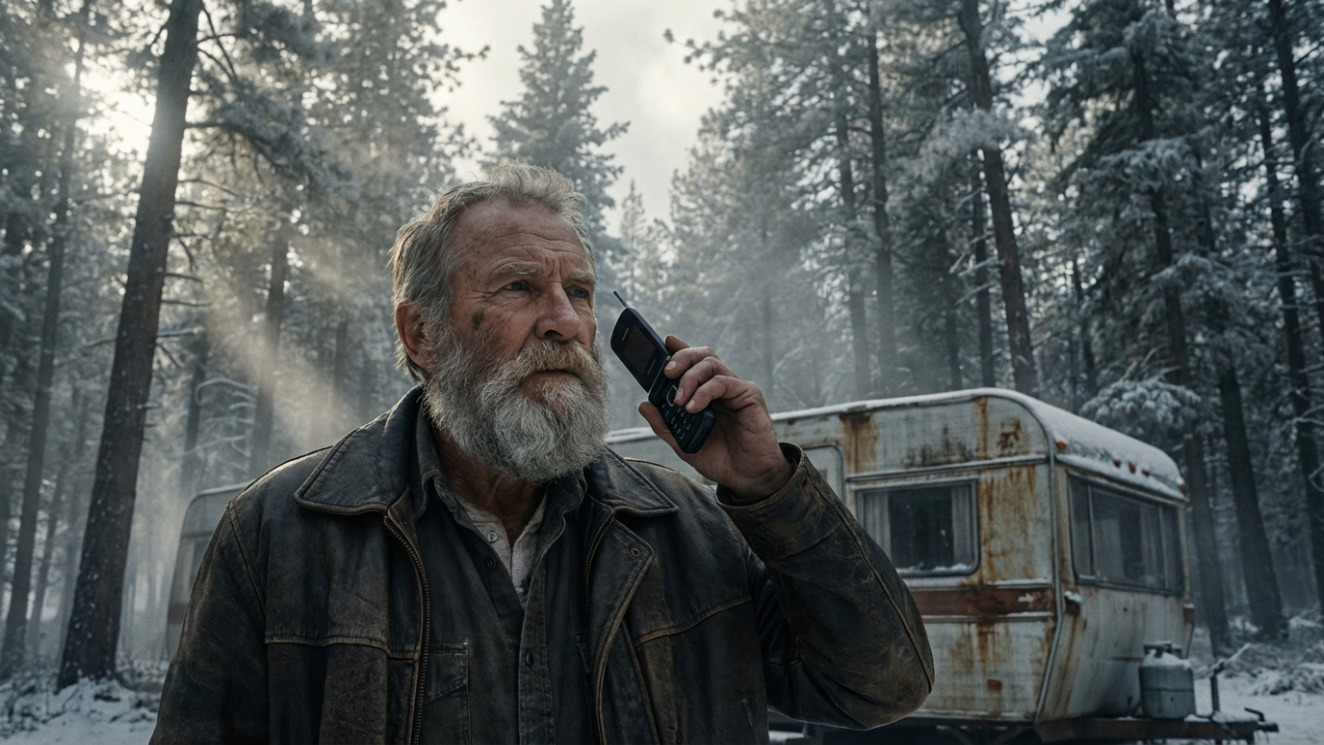
Arthur lived in a trailer that smelled like damp pine and regret. For twenty years, the “King” had been a ghost in the Michigan woods.
He let the world believe he was a monster. He let his wife hate him. He let his son grow up fueled by a blood-feud.
But the past doesn’t stay buried in the Upper Peninsula. It just freezes and waits for the thaw.
When Lancelot showed up at his door with news of a terminal diagnosis and a son gone rogue, the King had to choose.
Die a quiet coward, or call in the debt that 500 brothers owed him.
It was time to tell the truth, even if it burned the whole kingdom down.
FULL STORY
Chapter 1
The rain in the Upper Peninsula doesn’t just fall; it colonizes. It gets into the hem of your jeans, the seals of your windows, and the marrow of your bones. Arthur sat at his small laminate table, watching a single drop of water track its way down the interior of his trailer’s front window. The trailer was a 1984 Fleetwood, rusted at the seams and smelling perpetually of kerosene and old coffee. It was a far cry from the clubhouse in Detroit, or the custom-built ranch house he’d lost two decades ago.
He was seventy-two, and his hands shook when the temperature dropped below forty. He spent most of his days reading old paperback westerns and waiting for the mail, which usually consisted of utility bills he couldn’t quite pay and flyers for grocery stores thirty miles away. He was a man who had been erased by choice.
The sound of a heavy engine broke the rhythm of the rain. It wasn’t the high-pitched whine of the loggers’ Ford F-150s or the wet slap of a minivan’s tires. This was a low-frequency thrum that vibrated the floorboards of the Fleetwood. It was a V-twin, tuned rich, breathing heavy. Arthur didn’t reach for his gun—that was under the mattress, and his knees were too stiff to get there fast—but he did sit up a little straighter. He adjusted the collar of his flannel shirt, hiding the faded ink of a crown that crept up the side of his neck.
The engine cut out. A kickstand scraped gravel. Then came the heavy, rhythmic thud of boots on the metal steps of the trailer. A knock followed—three slow beats, then two fast ones. A code from a life Arthur had tried to forget.
He stood up, his hip popping with a sound like a dry branch snapping. He opened the door.
Standing in the rain was a man who looked like a heap of wet laundry and bad decisions. He was nearly as old as Arthur, wearing a leather vest that had been stretched to its limit over a beer gut, the leather cracked and grey. His beard was a wild thicket of white.
“You look like hell, Lance,” Arthur said.
“And you look like a guy waiting to die in a tin can,” Lancelot replied. His voice was like two bricks rubbing together. “You gonna let me in, or am I supposed to rust out here?”
Arthur stepped back. Lancelot entered, bringing the smell of wet leather and exhaust into the small space. He sat on the bench seat, which groaned under his weight. Arthur poured him a cup of black coffee that had been sitting on the burner since 6:00 AM.
“The Reapers took the Iron Range,” Lancelot said without preamble. “They’re running fentanyl through the high schools now. They burned out the old VFW in Marquette because the commander wouldn’t pay protection.”
“Not my problem,” Arthur said, his voice flat. “I’m a civilian, Lance. I’ve been a civilian since ’04.”
“Your son is the one who lit the match, Artie.”
Arthur felt a cold spike in his chest, sharper than the Michigan wind. He looked away, focusing on a stack of unwashed plates in the sink. “I don’t have a son. I have a widow and a grave. That’s all the family I kept.”
“Guinevere is dying,” Lancelot said.
The silence that followed was heavy, pressing in on the walls of the trailer. Arthur finally looked at him. Lancelot wasn’t the type to lie about something like that. He was a man of limited imagination and absolute loyalty.
“Cancer?” Arthur asked.
Lancelot nodded. “Same as the girl. It’s in her lungs now. She’s in the hospice ward in Sault Ste. Marie. She’s got maybe a month. Maybe less. She thinks you’re still the man who walked out on a dying kid to go play soldier for the club. She hates you with every breath she has left.”
“Let her,” Arthur whispered. “It’s easier for her that way.”
“The boy—the ‘Prince,’ as they call him—is out of control, Artie. He’s not like us. We had a code. We had rules about who we hurt. He’s just a thug with a patch. He’s dragging your name through the mud, and he’s doing it while his mother wastes away in a bed he hasn’t visited once. He says he’s ‘cleaning up the legacy.’ He’s got five hundred kids under him who think he’s a god because he’s your blood.”
Arthur gripped the edge of the table. His knuckles were white, the skin translucent over the bone. “I can’t stop him, Lance. Look at me. I’m an old man in a trailer. I don’t have a club. I don’t have a crown.”
“You have the truth,” Lancelot said, reaching into his vest. He pulled out a thick, weathered manila envelope. “And you have the 500.”
“The 500 are dead or in Jackson State,” Arthur scoffed.
“They’re waiting,” Lancelot countered. “They’re in the garages in Escanaba. They’re in the bars in Detroit. They’re in the woods. They’re old, Artie, but they’re bored. And they remember what it was like when the King was on the throne. They remember that the King never left a brother behind. They don’t know why you walked away. They think the club turned on you. They’re just waiting for someone to tell them where to ride.”
Lancelot dropped the envelope on the table. It made a heavy thud.
“That’s the evidence,” Lancelot said. “The wires. The bank statements. The proof that the Jackals blackmailed you. The proof that you took the fall and walked away to keep the feds from raiding the hospital where your daughter was dying. You didn’t choose the club over her, Artie. You chose the club’s silence to keep her breathing. But you never told Gwen. You let her think you were a monster.”
Arthur looked at the envelope. It felt like a bomb. If he opened it, the twenty years of peace he had bought with his own reputation would vanish. He had lived as a villain so his family could live in safety. He had let his wife despise him so she wouldn’t be targeted by the people he was protecting them from.
“Go home, Lance,” Arthur said.
“She’s dying, Artie. Don’t let her die thinking her husband was a coward.”
Lancelot stood up, his joints complaining. He walked to the door, then paused. “I left the bike in the shed out back. The Shovelhead. I’ve been keeping her cherry for ten years. She’s got a full tank. I’ll be at the diner in Newberry tomorrow morning. If you’re not there, I’m going to the hospice myself and I’m telling her everything. I don’t care if it ruins your ‘noble sacrifice.’ She deserves the truth.”
The door closed, and the trailer rocked as Lancelot’s bike roared back to life. Arthur sat in the dim light, the rain continuing its assault on the roof. He looked at the envelope. Then he looked at his hands. They were still shaking.
He stood up and walked to the small closet. He reached into the very back, behind a moth-eaten winter coat, and pulled out a heavy bundle wrapped in an oil-stained tarp. He laid it on the bed and unwrapped it.
It was his kutte. The black leather was stiff, the patches dusty. Across the top, the rocker read: KINGS OF THE NORTH. In the center, a skull wearing a crown. On the bottom: MICHIGAN. On the front, over the heart, was a small, rectangular patch that simply said: PRESIDENT.
He ran his fingers over the letters. He remembered the night he’d taken it off. He remembered the smell of the hospital, the sound of the ventilator, and the look of pure, cold loathing in Guinevere’s eyes when he’d told her he had to leave, that the club needed him, that he couldn’t stay for the end.
He hadn’t been going to a meeting. He’d been going to a meeting with the devil to sign away his life so the police would stay away from the ICU.
He put the vest on. It was loose now—he’d lost weight—but the weight of it still felt right. It felt like a debt.
He walked out of the trailer and into the rain. He headed for the small, lean-to shed at the edge of the clearing. Inside, under a heavy canvas cover, was a shape he hadn’t seen in a decade. He pulled the cover back.
Excalibur.
A 1974 Harley-Davidson Shovelhead. Black and chrome, stripped down, mean. Lancelot had been telling the truth—the chrome was polished, the tires were fresh. It looked like a relic from a more violent, more honest age.
Arthur swung a leg over the seat. His hip screamed, but he ignored it. He turned the key. He primed the carb. He stood on the kickstarter with all his weight.
The engine coughed. A puff of blue smoke.
He kicked again. And again.
On the fourth try, the world exploded. The Shovelhead roared to life, a rhythmic, guttural bark that echoed off the pine trees. The vibration traveled up through the seat, into his spine, into his teeth. For the first time in twenty years, the shaking in his hands stopped.
He wasn’t an old man in a trailer anymore.
He was a King, and he had a ransom to pay.
Chapter 2
The ride to Newberry was a brutal reminder that Arthur was no longer made of iron. The cold wind of the Upper Peninsula sliced through his flannel shirt, and the weight of the leather vest pulled at his stooped shoulders. Every pothole in the asphalt sent a jolt of lightning through his lower back. But as the miles clicked by on the vibrating odometer, a strange thing happened. The fog in his mind—the dull, grey lethargy of the last two decades—began to lift.
He pulled into the parking lot of the Timberline Diner at 7:00 AM. The sun was a pale, sickly disc struggling against the overcast sky. Three bikes were already there. Lancelot’s battered Road King sat next to two other machines Arthur recognized instantly: a pair of Heritage Softails, kept in the meticulous, chrome-heavy style of the old guard.
Inside, the diner smelled of bacon grease and industrial floor cleaner. In a back booth sat Lancelot, along with two other men. One was “Pops” Weaver, a man who had been seventy when Arthur was forty, now a miraculous collection of wrinkles and stubbornness. The other was “Mute” Miller, who had lost his tongue to a rival’s blade in ’92 and had been Arthur’s most trusted enforcer.
When Arthur walked in, the conversation at the counter died. The waitress, a woman in her fifties with tired eyes, paused with a coffee pot in mid-air. She saw the patches. She saw the crown. She looked at Arthur’s face—the face of a man who had seen the bottom of a grave and climbed back out—and she didn’t say a word.
Arthur slid into the booth. Lancelot pushed a plate of eggs and toast toward him.
“You look like you’ve seen a ghost,” Pops said, his voice a high-pitched wheeze.
“I am a ghost,” Arthur said. He didn’t touch the food. He looked at Mute, who gave a single, sharp nod. The loyalty in that gaze was a physical weight.
“Who else knows?” Arthur asked.
“Word is spreading,” Lancelot said. “We used the old phone trees. The guys who are still alive, anyway. There’s a lot of ’em, Artie. They’re tired of the way things are going. The Reapers… they’re making the patch look like a gang tag. They’re selling to kids. They’re hitting civilians. It’s bad for business, and it’s bad for the soul.”
“My son is leading them,” Arthur said, the words tasting like copper. “Why? I raised him to be better.”
“You didn’t raise him,” Pops said gently. “Gwen raised him. And she raised him on a diet of how much she hated you. He grew up wanting to be the man you were, but without the heart. He thinks being a King means taking whatever you want. He doesn’t understand that being a King means being the first one to bleed.”
Arthur closed his eyes. He remembered his son, Leo, as a five-year-old sitting on the tank of Excalibur, his small hands barely reaching the handlebars. He had wanted to keep the boy away from the life, but the life was a gravity well. It pulled everything in eventually.
“We need a staging ground,” Arthur said, opening his eyes. “Somewhere the Reapers won’t see us coming. Where’s the old sawmill in Munising?”
“Rotted out,” Mute wrote on a napkin, sliding it across. Grand Marais. The old airfield.
“Fine,” Arthur said. “Tell them to gather there. Three days. No colors until we’re all together. I don’t want a war on the highway.”
“What about the evidence?” Lancelot asked, nodding toward the envelope Arthur had tucked into the side pocket of his vest.
“That’s for Gwen,” Arthur said. “And for Leo. But I need to see her first. Alone.”
“The hospital is crawling with Reapers,” Lancelot warned. “Leo has guys stationed in the lobby to make sure nobody gets to her. He says it’s for her protection, but it’s really about control. He doesn’t want her talking to anyone who might tell her the truth about him.”
“I’m his father,” Arthur said. “Let them try to stop me.”
He stood up, leaving the eggs untouched. He felt a strange, cold clarity. He had spent twenty years waiting for the end, and now that it was here, he realized he wasn’t afraid. The worst thing that could happen—losing his family’s love—had already happened. Everything else was just logistics.
He rode east, toward Sault Ste. Marie. The traffic was light, mostly logging trucks that gave him a wide berth. The Shovelhead ran better the harder he pushed it, the old engine singing a song of combustion and steel.
He reached the hospital at noon. It was a sterile, brick building overlooking the cold waters of the St. Marys River. As he pulled into the lot, he saw them. Four men in modern, heavy-duty leather vests. The patches were loud—THE REAPERS. They were younger, most of them in their twenties or thirties, with the puffed-up chests of men who had never been in a fight they couldn’t win with a gun.
Arthur parked Excalibur right in front of the main entrance, in a ‘No Parking’ zone. He shut off the engine and the silence that followed was aggressive. He climbed off the bike, adjusted his vest, and walked toward the sliding glass doors.
“Hey! Gramps!” one of the bikers called out. He was a thick-necked kid with a tribal tattoo climbing his jawline. “You can’t park that antique there.”
Arthur didn’t stop. He didn’t even look at them.
The kid stepped in front of him, putting a hand on Arthur’s chest. “I’m talking to you, old man. You lost? The nursing home is three blocks over.”
Arthur stopped then. He looked down at the hand on his chest, then up at the kid’s eyes. Arthur’s eyes were the color of the Lake Superior floor—dark, cold, and holding a lot of sunken wrecks.
“Take your hand off me,” Arthur said. His voice wasn’t loud, but it had a vibration in it that made the kid’s smirk flicker.
“Or what?” the biker sneered, but his friends had stopped laughing. They were looking at Arthur’s patches. They recognized the crown. They recognized the PRESIDENT tag.
“Or I’ll remind you why your club is called the Reapers,” Arthur said. “Because you’re just the harvest. You’re not the ones holding the scythe.”
One of the other bikers, an older man with a grey ponytail, stepped forward. He looked at Arthur with a mixture of awe and fear. “Is that… is that King Arthur?”
“The one and only,” Arthur said. “Now, get out of my way. I’m going to see my wife.”
The kid with the tribal tattoo hesitated, his hand dropping. The older biker stepped back, pulling the kid with him. “Let him go, Jax. You don’t want this. Trust me.”
Arthur walked through the doors. The air inside was climate-controlled and smelled of bleach. He felt out of place, a relic of grease and smoke in a world of white tile. He found the hospice wing on the fourth floor.
At the end of a long, quiet hallway, he saw a door with a small vase of plastic flowers hanging from it. Room 412.
He paused outside. His heart, which had been steady through the confrontation outside, began to hammer against his ribs like a trapped bird. He reached for the handle, his hand shaking again. He wiped his palms on his jeans, took a breath, and pushed it open.
The room was dim. The only sound was the rhythmic hiss of an oxygen concentrator. In the bed was a woman who looked like a charcoal sketch of the Guinevere he remembered. Her hair, once a vibrant auburn, was thin and white. her skin was the color of parchment.
He walked to the side of the bed. “Gwen,” he whispered.
Her eyes flickered open. They were clouded, but when they settled on him, they sharpened with a sudden, painful intensity.
“Arthur,” she breathed. Her voice was a ghost of itself. “Did you come to tell me you’re leaving again? Is there a run? A meeting? Is someone disrespecting the crown?”
“No,” Arthur said, pulling a chair to the bedside. He took her hand. It felt like a bundle of dry sticks. “There’s no more runs, Gwen. I’m just here.”
“Go away,” she said, her eyes filling with tears that didn’t spill. “You weren’t there when Callie died. You weren’t there for twenty years. You don’t get to be here now.”
“I had to go, Gwen. I told you—”
“I know what you told me!” she snapped, a sudden burst of energy making her sit up slightly. She coughed, a wet, hacking sound that tore at Arthur’s gut. “You told me the club came first. You told me you had responsibilities. You left your daughter to die in my arms so you could go handle ‘business.'”
Arthur reached into his pocket and pulled out the envelope. He held it out to her. “Read this. Please. Just read the first page.”
“I don’t want your excuses, Arthur. I’m tired. I just want to see my daughter.”
“It’s not an excuse,” Arthur said, his voice breaking. “It’s the truth. I never left you, Gwen. I was forced out. The Jackals… they had photos. They had evidence of a hit I didn’t commit, but they could make it stick. They told me if I didn’t disappear, if I didn’t give them the territory, they’d send the feds into the hospital. They’d seize the assets. They’d take the money for Callie’s treatment. I had to make them think I was gone. I had to make the club think I’d turned. I had to protect you.”
Gwen looked at the envelope. She didn’t take it. “You’re lying. You’re just trying to make yourself feel better before I’m gone.”
“Look at the dates, Gwen,” he pleaded. “Look at the signatures. I spent twenty years in a trailer in the woods so you and Leo could have the life I promised you. I let you hate me because it was the only way to keep the target off your back.”
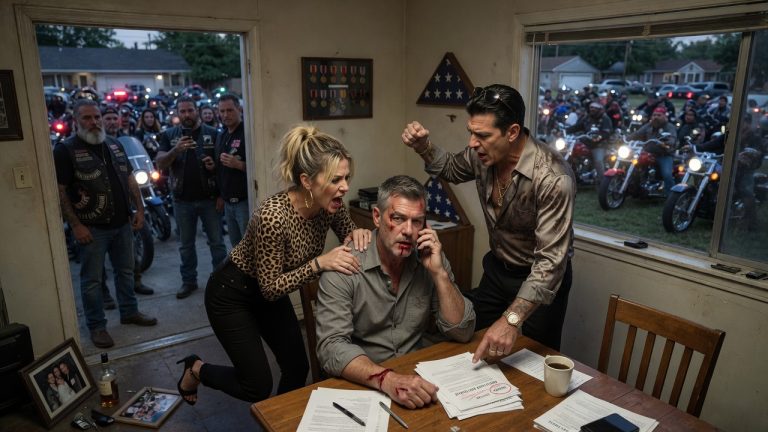
The door to the room swung open with a bang.
“Get away from her!”
Arthur turned. Standing in the doorway was a man who looked exactly like Arthur had thirty years ago, but with a darkness in his eyes that Arthur had never possessed. He wore the Reapers’ colors, his vest heavy with “1%” and “Original” patches.
“Leo,” Arthur said.
“It’s Prince,” his son spat. He walked into the room, his hand resting on the grip of a knife at his belt. “I told my guys to keep the trash out. I should have known they’d fold for a legend.”
“Leo, please,” Gwen whispered.
“Don’t talk, Ma. Save your strength,” Leo said, his eyes never leaving Arthur’s. “You’ve got a lot of nerve showing up here, old man. After what you did to her? After you turned your back on this family?”
“I never turned my back,” Arthur said, standing up. He was shorter than his son now, his spine curved by time, but he didn’t back down. “I was protecting you. Both of you.”
“Protecting us?” Leo laughed, a harsh, ugly sound. “You left us with nothing but a name people spit on. I had to build this club from the dirt. I had to show them what a real King looks like. And now you come back with some sob story? You’re pathetic.”
Leo reached out and grabbed the envelope from Arthur’s hand. He didn’t look at it. He simply ripped it in half, then again, showering the hospital floor with the shredded truth.
“There,” Leo said. “Now there’s no more stories. There’s just the reality. And the reality is, you’re an old man who’s overstayed his welcome. If I see you in this town again, I won’t just kick your bike over. I’ll bury you in the woods where nobody will find you.”
Arthur looked at the shredded paper on the floor. He looked at his wife, who had closed her eyes, her face a mask of exhaustion and grief. He looked at his son, who was flushed with the cheap power of a bully.
“You’re not a King, Leo,” Arthur said softly. “You’re just a boy playing with matches. And you’re about to find out what happens when the wind picks up.”
Arthur turned and walked out of the room. He didn’t look back. He walked down the hallway, through the lobby, and out to his bike.
Jax and the other Reapers were still there. They watched him as he kicked Excalibur to life.
“Where are you going, King?” Jax asked, his voice hushed.
Arthur looked at him. “To get my army.”
Chapter 3
The airfield at Grand Marais was nothing more than a strip of cracked concrete and a few sagging hangars, swallowed by the encroaching jack pines. It had been built for forest fire planes decades ago and then abandoned to the elements. For Arthur, it was perfect. It was a place where the world ended and the secrets began.
He arrived as the sun was setting, casting long, bloody shadows across the tarmac. Lancelot was already there, standing next to a small fire he’d built in an old oil drum.
“How was she?” Lancelot asked.
“She’s dying,” Arthur said, dismounting. He felt like his bones were made of dry glass. “And Leo is a monster. He tore up the evidence. He doesn’t want the truth. He wants the throne.”
“He’s got the throne,” Lancelot said. “But he doesn’t have the people. Not really. He has their fear. That only lasts until someone bigger shows up.”
“And you think I’m bigger?” Arthur looked at his reflection in the chrome of the bike. He saw a man who should be in a recliner, not a revolution.
“You’re not a man anymore, Artie. You’re a flag,” Lancelot said. “Look.”
He pointed toward the access road. At first, it was just a low hum, like a distant storm. Then, the lights appeared. One by one, pairs of headlights emerged from the trees, bouncing over the ruts in the gravel.
The sound grew. It wasn’t the frantic, high-pitched scream of modern sportbikes. It was the deep, rhythmic throb of American iron. Evolution and Shovelhead engines, Panheads and the occasional Knucklehead.
The first bike to pull onto the concrete was a trike, driven by a man with no legs and a beard that reached his belt. He was wearing a faded denim vest with the KINGS OF THE NORTH patch. He raised a fist as he passed Arthur.
Behind him came more. Some arrived in groups of three or four, others alone. They were men in their fifties, sixties, and seventies. They wore old leather that had been stored in attics and garages. They had grey hair, missing teeth, and scars from wars that had been forgotten by everyone but them.
By midnight, the airfield was full. Five hundred bikes.
They didn’t make much noise. There was no loud music, no celebratory gunfire. They just parked their bikes in neat rows, lit small fires, and waited. The air smelled of woodsmoke, tobacco, and the ozone of 500 cooling engines.
Arthur stood on the bed of an old flatbed truck that had been left in one of the hangars. Lancelot stood beside him. Mute Miller and Pops Weaver were there, too.
“Look at them,” Pops whispered. “The 500. Most people think we’re dead.”
“We were,” Arthur said. “We were just waiting for a reason to wake up.”
He stepped to the edge of the truck bed. He didn’t have a microphone, but the silence that fell over the airfield was so absolute that his voice carried to the very back of the crowd.
“I’m Arthur,” he said. “Most of you know me as King. Twenty years ago, I walked away. I let you believe I’d sold out. I let you believe I’d lost my nerve.”
He paused. He could see the faces of men he’d ridden with in the seventies, men who had bled for him in the eighties.
“I didn’t sell out,” Arthur said. “I took a fall to keep the feds away from our families. I lived in a trailer and ate dirt so the club could survive. But while I was gone, something changed. The club became a gang. The patch became a license to kill children and poison our own towns.”
A low growl of agreement moved through the crowd.
“My son is leading the Reapers,” Arthur continued, his voice steady. “He thinks he’s a King because he has my blood. He thinks he’s a King because he’s got a gun and a loud mouth. But being a King isn’t about power. It’s about the ransom. It’s about what you’re willing to pay to keep your people safe.”
He looked out over the sea of grey hair and leather. “I’m going to Sault Ste. Marie. I’m going to see my wife one last time, and I’m going to tell my son that his reign is over. I’m not asking you to fight. I’m not asking you to die. I’m just asking you to ride with me. I want him to see what a real brotherhood looks like. I want him to see that loyalty doesn’t have an expiration date.”
He stepped down from the truck. For a long moment, nobody moved. Then, the man on the trike—”Stumpy” Pete—reached down and hit his starter. His engine roared to life. Then another. And another.
Within a minute, the airfield was a cacophony of thunder. 500 engines idling in the dark, the exhaust rising like a collective breath.
“We leave at dawn,” Arthur told Lancelot.
Arthur spent the rest of the night walking among the bikes. He spoke to men he hadn’t seen in a generation. He heard stories of lost brothers, of failed businesses, of grandchildren and bypass surgeries. These weren’t the “outlaws” of the movies. They were mechanics, plumbers, retired teachers, and veterans. They were the backbone of a world that had moved on without them.
But they still had their bikes. And they still had their honor.
Around 3:00 AM, Arthur found himself sitting alone by a fire, looking at a small, crumpled piece of paper he’d salvaged from the hospital floor. It was a fragment of the evidence Leo had torn up. It was a bank statement, showing the transfers Arthur had made to the hospital for Callie’s care—money he’d stolen from the Jackals, money that had signed his death warrant.
“You okay, Artie?”
It was Lancelot. He sat down, his knees popping.
“I’m scared, Lance,” Arthur admitted. It was the first time he’d said it out loud in forty years. “I’m scared I’m too late. I’m scared I’m going to have to kill my own son to save what’s left of my name.”
“You won’t have to kill him,” Lancelot said. “Leo is a coward. Cowards don’t fight when the odds are even. And the odds aren’t even. He’s got five hundred kids who want to be cool. You’ve got five hundred men who have nothing left to lose. There’s a big difference.”
“I hope you’re right.”
“I’m usually not,” Lancelot grinned, showing a missing molar. “But I’m right about this. Get some sleep, King. Tomorrow’s a long ride.”
Arthur didn’t sleep. He watched the stars fade into the grey light of a Michigan morning. He watched the 500 men prepare their machines with a quiet, practiced efficiency. They checked their oil, tightened their straps, and donned their colors.
When the sun finally broke the horizon, Arthur climbed onto Excalibur. He felt a strange sense of peace. The shaking in his hands was gone completely. He was no longer a ghost.
He raised his hand. 500 engines roared in unison.
“Forward,” Arthur said.
They moved out in a double column, a black ribbon of steel and leather stretching for miles. They didn’t go fast. They didn’t weave through traffic. They stayed in formation, a disciplined, unstoppable force moving through the pine forests.
As they passed through small towns, people stopped on the sidewalks to watch. Children pointed. Old men took off their hats. It wasn’t a parade. It was a funeral procession for an era that was dying, and a resurrection for a man who had been buried alive.
They reached the outskirts of Sault Ste. Marie by noon. The word had traveled ahead of them. The police had blocked off the main drag, but when the Chief of Police—a man Arthur recognized as a kid he used to buy donuts for—saw the 500, he simply nodded and moved his cruisers aside.
“Let ’em through,” the Chief said into his radio. “They aren’t here for us.”
They rode straight to the hospital. The Reapers were waiting.
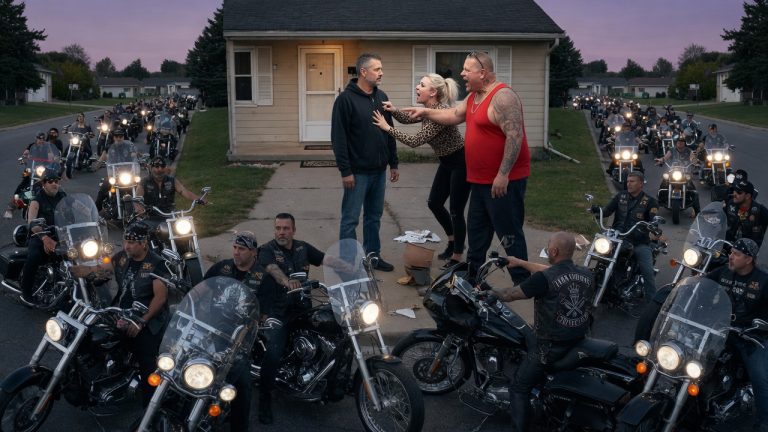
There were maybe a hundred of them, gathered in the parking lot. They had their bikes lined up like a wall, and they were holding chains, bats, and a few visible holsters. Leo stood at the front, his face pale, his eyes wide as he watched the endless line of bikes turn into the lot.
Arthur pulled Excalibur to a stop ten feet from his son. Behind him, the 500 began to circle, surrounding the Reapers in a giant, rumbling ring of iron.
Arthur shut off his engine. One by one, the 500 did the same. The silence that followed was deafening.
Arthur dismounted. He walked toward Leo, his boots clicking on the asphalt.
“I told you to stay away,” Leo said, his voice cracking. He reached for the gun at his hip.
“Touch that gun,” Lancelot said, stepping up behind Arthur with a sawed-off shotgun held casually at his side, “and you’ll be the first one we bury today.”
Leo looked around. He saw the faces of the 500. He saw men who looked like his grandfather, but with eyes that had seen things he couldn’t imagine. He saw the sheer weight of history pressing down on him.
“This is my town!” Leo screamed, though it sounded more like a plea. “This is my club!”
“It was never yours, Leo,” Arthur said. “You just borrowed it. And the bill is due.”
Chapter 4
The tension in the hospital parking lot was a physical thing, like the static before a lightning strike. The young Reapers were twitchy, their hands hovering near their belts, their eyes darting toward the silent, grey-haired wall that surrounded them. They were used to intimidation. They were used to being the scariest things in the room. They weren’t used to being outclassed by history.
Arthur ignored the Reapers. He ignored the guns. He looked only at his son.
“I’m going upstairs, Leo,” Arthur said. “I’m going to talk to your mother. And you’re going to come with me.”
“I’m not going anywhere with you,” Leo spat, but he didn’t pull the gun. His hand was trembling. The “Prince” was losing his crown in real-time, and he knew it.
“You are,” Arthur said. He stepped forward, closing the gap until he was inches from Leo’s face. “Because she needs to hear the truth. And you need to hear it, too. From me. Not from a piece of paper.”
Arthur turned his back on his son—a move of supreme confidence or supreme madness—and walked toward the hospital entrance.
“Stay here,” Leo commanded his men, though it sounded weak. “Nobody moves!”
He followed Arthur. Lancelot and Mute Miller followed them, their eyes scanning the lobby as they entered. The hospital staff had retreated behind the reception desks, watching with wide, terrified eyes.
They took the elevator in silence. The small space felt like a pressure cooker. Leo stared at the floor, his jaw tight. Arthur stared at his own reflection in the brushed steel of the doors. He looked old, yes, but he looked like a man who had finally finished a very long race.
They reached the fourth floor. The hallway was empty now, the Reapers who had been guarding it having fled to the parking lot to join their brothers.
They entered Gwen’s room.
She was awake, her breathing shallow and labored. Her eyes moved from Arthur to Leo, then back again. A small, sad smile touched her lips.
“You brought him,” she whispered.
“I brought him,” Arthur said. He sat in the chair by the bed and took her hand. Leo stood at the foot of the bed, looking like a stranger in his own family’s grief.
“Gwen,” Arthur said, his voice low and steady. “I need you to listen. I don’t have the papers anymore. Your son saw to that. But I have my word. And I have 500 men downstairs who will vouch for it.”
He told her. He told her everything. He told her about the night Callie was diagnosed, and the phone call he’d received twenty minutes later. He told her about the Jackals, the rival gang that had been working with a corrupt DA. He told her about the choice they gave him: Give them the keys to the city and disappear, or watch the feds freeze every bank account and asset the family had—including the money for the experimental treatments that were Callie’s only hope.
“I didn’t choose the club, Gwen,” Arthur said, a single tear finally escaping and tracking through the deep lines of his face. “I gave up the club. I gave up my name. I gave up you. I became a traitor in everyone’s eyes so the money would stay in that hospital account. I watched the news from a dive bar in the UP and saw you bury our daughter. I wanted to be there. God, I wanted to be there.”
Gwen was crying now, silent, racking sobs that shook her fragile frame. She looked at Leo. “He… he stayed away for us?”
Leo was shaking his head. “No. No, it’s a lie. He’s a biker. They all lie. He just wanted to save his own skin.”
“I have the ledger, Leo,” Lancelot said from the doorway. He held up a small, black book. “I’ve had it for twenty years. Arthur didn’t want me to show it. He said the secret was the only thing keeping you safe. But I think you’ve done enough damage to yourself.”
Lancelot tossed the book onto the bed. Leo didn’t touch it. Gwen did. She opened it with trembling fingers. Inside were receipts. Hand-written notes. Bank transfer confirmations. It was the accounting of a man who had sold his soul to pay for a miracle that never came.
Gwen looked up at Arthur. The cloudiness in her eyes was gone, replaced by a clarity that was both beautiful and devastating. “You fool,” she whispered. “You stubborn, stupid man. I would have lived in the trailer with you. I would have lived in the dirt.”
“I couldn’t risk it, Gwen,” Arthur said. “I couldn’t risk you.”
Leo let out a choked sound—half-sob, half-growl. He turned and bolted from the room.
“Leo!” Arthur called, but his son was gone.
“Go to him,” Gwen whispered. “He’s lost, Arthur. He’s been lost since the day you left. He thinks the only way to be loved is to be feared. Show him… show him he’s wrong.”
Arthur kissed her forehead. It was cold. “I’ll be back, Gwen. I promise.”
“I know,” she said. “I believe you now.”
Arthur walked out of the room. He felt a sense of urgency he hadn’t felt in decades. He ran to the elevator, Lancelot and Mute right behind him.
When they hit the lobby, they heard it. The sound of a single shot.
Arthur burst through the sliding doors.
The parking lot was a scene of chaos. The Reapers and the 500 were no longer standing still. They were a surging mass of leather and chrome. In the center, Leo was standing over his bike, a pistol in his hand. He hadn’t shot anyone. He had shot his own gas tank.
Gasoline was pouring onto the asphalt, the smell pungent and dangerous. Leo was holding a lighter, his thumb on the spark.
“Stay back!” Leo screamed. “I’ll burn it all! I’ll burn the whole thing down!”
The young Reapers were backing away, terrified. The 500 stayed where they were, their faces grim.
“Leo, put it down,” Arthur said, walking toward him.
“You lied to me!” Leo sobbed, the lighter flickering in his hand. “You let me become this! You let me hate you so I’d have something to build on! If you’re not the villain, then what am I? I’m just a murderer! I’m just a thug!”
“You’re my son,” Arthur said. He was twenty feet away. “And you’re a man who can make a choice. Right now. You can drop that lighter, and we can walk back inside.”
“There’s nothing left inside!”
“There’s me,” Arthur said. “And there’s 500 brothers who are waiting to see what you’re made of. Not the patch, Leo. The man.”
Arthur kept walking. Ten feet. Five feet. He was standing in the pool of gasoline now. It soaked into his boots. One spark, and they would both be gone.
“Give me the lighter, Leo,” Arthur said softly. He held out his hand.
Leo looked at the lighter. He looked at the 500 men watching him. He looked at his father—the man he’d spent his whole life trying to outrun, only to find him waiting at the finish line.
His thumb slipped. The flame went out.
Leo’s knees gave way. He fell into the gasoline, his head dropping into his hands. He wept like the child he had never been allowed to be.
Arthur reached down and pulled him up. He didn’t care about the gas. He didn’t care about the guns. He held his son, his own tears mixing with the grime on Leo’s face.
“I’ve got you,” Arthur whispered. “I’ve got you, kid.”
In the background, the 500 began to move. They didn’t attack. They didn’t cheer. They simply dismounted. One by one, they walked over to the young Reapers. They didn’t take their colors. They took their weapons. And then, they began to talk.
The war was over. The ransom had been paid.