“Chapter 5
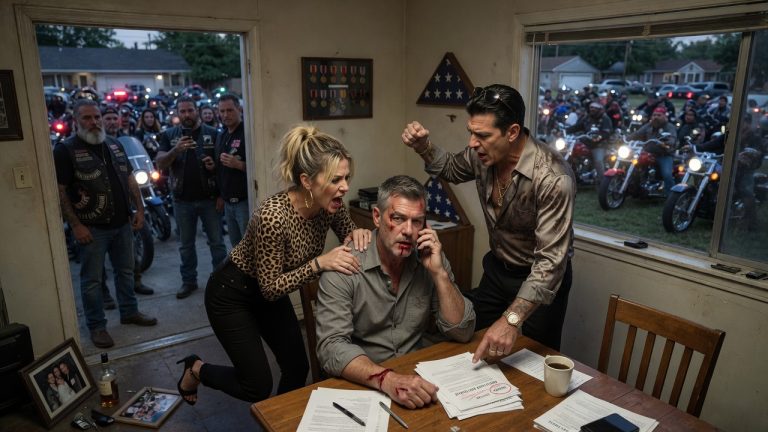
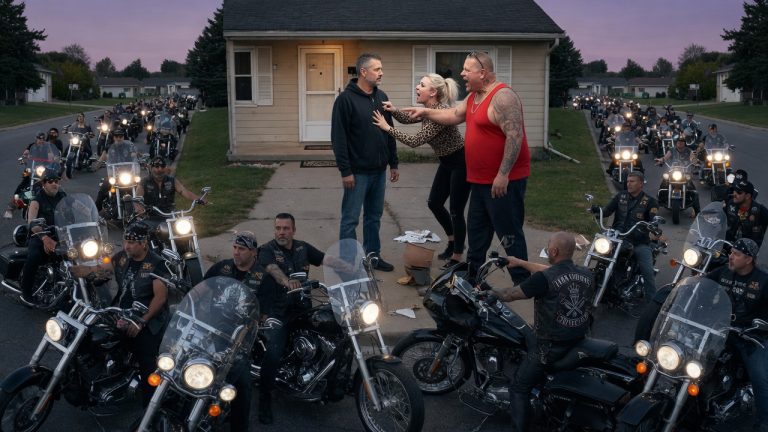
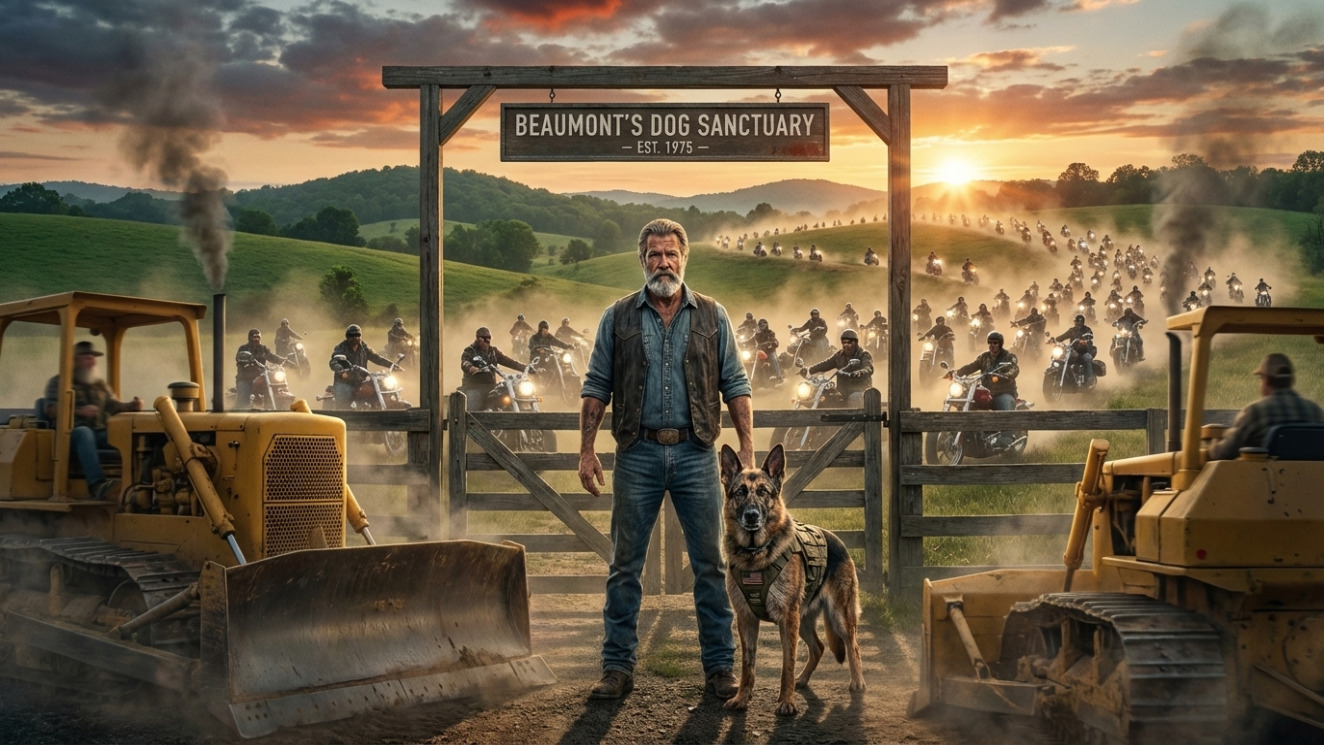
Midnight came and went with the temperature dropping into the forties. The bikers had started small fires in barrels along the road, the orange light reflecting off the chrome and the “”Iron Horse”” patches. It looked like an outlaw encampment from a century ago, transposed onto a Kentucky county road.
The dogs were restless inside. Ranger spent the night pacing the length of the living room, his claws clicking on the hardwood. Every now and then, he’d stop and stare at the door, his nose twitching at the scent of woodsmoke and gasoline.
At 3:45 A.M., the blue and red lights appeared.
They came in a slow, deliberate line. Two Sheriff’s Tahoes, followed by four white transport vans carrying the riot squad, and behind them, the massive, hulking silhouettes of two Caterpillar D9 bulldozers on flatbed trailers.
The convoy stopped fifty yards from the first line of bikes.
Sheriff Miller got out of the lead Tahoe. He didn’t have his hat on, and his hair was windblown. He stood in the glare of his own headlights, looking at the five hundred men blocking his path. Behind him, the riot squad began to file out of the vans—men in black turtle-shells with Lexan shields and long batons.
Miller walked forward until he was ten feet from Bo.
“”This is an illegal assembly, Beaumont,”” Miller shouted over the low rumble of the idling bikes. “”You’re blocking a public thoroughfare and interfering with a court-ordered easement. I’m giving you five minutes to clear the road.””
Bo didn’t move. “”This is a private driveway, Wayne. And these men are my guests. Last I checked, there wasn’t a law against having friends over for a campfire.””
“”Don’t play games with me! You’ve got five hundred felons here. I’ve got the authority to use force.””
“”Then use it,”” a voice called out from the line. It was an older biker, a man named ‘Iron’ Mike who’d been with the club since the seventies. “”But you better have enough zip-ties for all of us. And you better have a plan for when the news cameras show up and see you beating on guys whose only crime was standing in the mud.””
As if on cue, a news van from a Lexington station pulled up behind the police line. Suzy had done her job.
Miller looked back at the van, his jaw tightening. He turned back to Bo. “”You think you’re smart, don’t you? You think a few cameras are gonna stop this? Global Energy has the deed. The law is on my side.””
“”The law might be on your side,”” Bo said, stepping forward. “”But the people aren’t. And neither are those boys in the riot gear. Look at ’em, Wayne.””
Bo pointed to the men in the black shells. They were mostly young guys, local kids from the next county over. They weren’t looking at the bikers with malice; they were looking with hesitation. They knew who Bo was. They knew about the dogs. And they knew that the Iron Horse MC wasn’t a group of protesters you could just pepper-spray into submission.
Marcus Reed stepped out from behind the police line. He looked out of place in his tailored overcoat, his face pale in the strobe of the police lights. He walked up to Miller and whispered something in his ear.
Miller nodded and turned back to the riot squad. “”Loaders! Get those dozers off the trailers!””
The sound of metal on metal echoed through the valley as the ramps were dropped. The bulldozers groaned to life, their exhaust plumes thick and black in the cold air. They began to crawl down the ramps, the steel treads chewing up the asphalt.
“”Line up!”” K9 shouted.
The bikers dismounted. They didn’t pull weapons. They didn’t even raise their fists. They simply stood shoulder to shoulder, three rows deep, forming a solid wall of human bodies between the road and the sanctuary fence.
Bo stood at the very front.
The first bulldozer moved forward, its massive blade lowered to within an inch of the ground. It stopped five feet from Bo. The heat from the engine rolled over him in waves. The operator, a man in a hard hat, looked at Bo with wide, terrified eyes. He didn’t want to be the one to drive over a human being.
“”Move!”” Miller screamed. “”Drive ’em back!””
The bulldozer lurched forward another foot. The blade touched Bo’s shins. He didn’t flinch. He felt the cold steel against his jeans, the immense weight of the machine pushing against him. He planted his feet in the Kentucky mud and leaned back against the pressure.
Behind him, the bikers reached out and put their hands on the shoulders of the men in front of them. They became a single unit, a literal wall of leather.
The bulldozer’s engine roared, the governor kicking in as it met resistance. The treads spun for a second, throwing sparks against the pavement, but the machine didn’t move forward. The operator looked at Miller and shook his head. He pulled the throttle back, and the machine went to an idle.
“”I can’t do it, Sheriff,”” the driver yelled. “”I ain’t killing nobody for a gas line.””
The silence that followed was absolute.
Miller looked at Reed. Reed looked at the news camera, which was currently broadcasting the standoff live to thousands of homes across the state. The image was undeniable: a line of leather-clad men, led by a giant with a dog-sanctuary patch, standing down the power of a multi-billion dollar corporation.
“”This isn’t over,”” Reed hissed, his voice trembling with rage.
“”It is for today,”” Bo said.
But as the police began to confer, a new sound emerged from the sanctuary house. It was a long, mournful howl. It wasn’t the sound of a dog guarding its territory. It was the sound of a dog saying goodbye.
Bo’s heart sank. He turned and ran toward the house, leaving the wall behind him.
Chapter 6
The living room was quiet, save for the heavy breathing of the other dogs. Ranger was lying on his side on his favorite fleece bed. His eyes were open, but the light in them was fading fast.
Bo dropped to his knees, his massive frame shaking. “”No, Ranger. Not now. Not like this.””
Suzy was there—she’d slipped through the back woods when the police were distracted. She had her stethoscope out, but she didn’t need it. She looked at Bo and slowly shook her head.
“”His heart, Bo,”” she whispered. “”The stress. The noise. It was just too much.””
Bo reached out and took Ranger’s paw. It was cold. The dog gave one final, fluttering lick to Bo’s thumb, his tail thumping once—just once—against the floor. Then, he was still.
Bo didn’t cry. Not yet. He just sat there, holding the paw of the dog that had saved his life in a way no human ever could. He felt a hand on his shoulder. It was K9.
“”He’s gone?”” K9 asked softly.
“”He’s gone,”” Bo said.
“”The Sheriff’s asking for you. Reed’s lawyers called. They’re offering a stay of execution on the easement if we clear the road. They’re scared, Bo. The PR is killing them.””
Bo stood up. He looked at Ranger, then at the other dogs—the blind ones, the limping ones, the ones who had nowhere else to go.
“”Stay with him,”” Bo told Suzy.
He walked out onto the porch. The sun was just beginning to peek over the ridgeline, painting the mist in shades of gold and grey. The wall of leather was still there, but the men had turned around. They were looking at Bo.
Bo walked down the steps and through the line. He walked straight up to Sheriff Miller and Marcus Reed.
“”Ranger is dead,”” Bo said. His voice was quiet, but it carried in the morning air.
Miller blinked, a flicker of something like regret crossing his face. Reed, however, just checked his watch. “”I’m sorry for your loss, but the legal reality remains—””
Bo didn’t let him finish. He reached into his jacket and pulled out the leather-bound ledger. He didn’t hand it to Reed. He handed it to the news reporter who was standing nearby.
“”This is a record of five years of illegal payments made by construction companies and land developers to the Iron Horse MC,”” Bo said, his voice loud enough for the microphone to catch. “”Names, dates, and the specific ‘favors’ that were bought. Including several entries involving the Owsley County Sheriff’s department and Global Energy’s local contractors.””
Reed’s face went from pale to ghostly white. Miller reached for the book, but K9 stepped in his way, his hand resting on his belt.
“”I’m turning this over to the state attorney general,”” Bo said. “”And I’m confessing to my role in it. I’ll go to prison. I don’t care. But when the feds come to investigate these entries, they’re going to start digging. And they’re going to start with your records, Reed. And yours, Miller.””
The reporter was already flipping through the pages, her eyes widening.
“”You’re destroying yourself,”” Reed whispered. “”You’ll spend ten years in a cage.””
“”Maybe,”” Bo said. “”But the land will be a crime scene. You won’t be able to touch a blade of grass for a decade. And by the time the lawyers are done with you, Global Energy won’t be able to afford the gas to get back to Kentucky.””
Bo turned to the wall of bikers. They were looking at him with a mix of shock and respect. They knew what he’d just done. He’d burned the bridge to save the forest. He’d sacrificed his own freedom to ensure the sanctuary stayed exactly as it was: a place of peace.
“”Go home, brothers,”” Bo said. “”The wall did its job.””
One by one, the engines flared to life. The bikers didn’t celebrate. They rode out in a somber, single file, nodding to Bo as they passed. K9 was the last to leave.
“”You’re a crazy bastard, Big Bo,”” K9 said, his voice thick with emotion. “”But you’re the best man I ever knew. We’ll take care of the dogs while you’re gone. I promise.””
“”I know you will,”” Bo said.
By noon, the dozers were being loaded back onto the trailers. Reed had fled in a black town car, and Miller was sitting in his Tahoe, staring at the steering wheel, waiting for the phone call from the DA that he knew was coming.
Bo sat on his porch, Ranger’s body wrapped in an old army blanket beside him. He watched Suzy lead the other dogs out into the yard. They moved slowly, sniffing the air, sensing that the danger had passed.
He knew his time here was short. The police would be back within the hour with a different kind of warrant. But as he looked out over the rolling hills, at the Lower Forty that would now never be touched by a drill, he felt a strange, light sensation in his chest.
The weight was gone.
He hadn’t saved the dog in Kandahar. He hadn’t saved the man he used to be. But he had saved this acre of mercy. And as he felt the first cold drop of afternoon rain on his face, Bo Beaumont finally closed his eyes and breathed.”