“Explain this, Solomon. Why is our King carrying a police badge?”
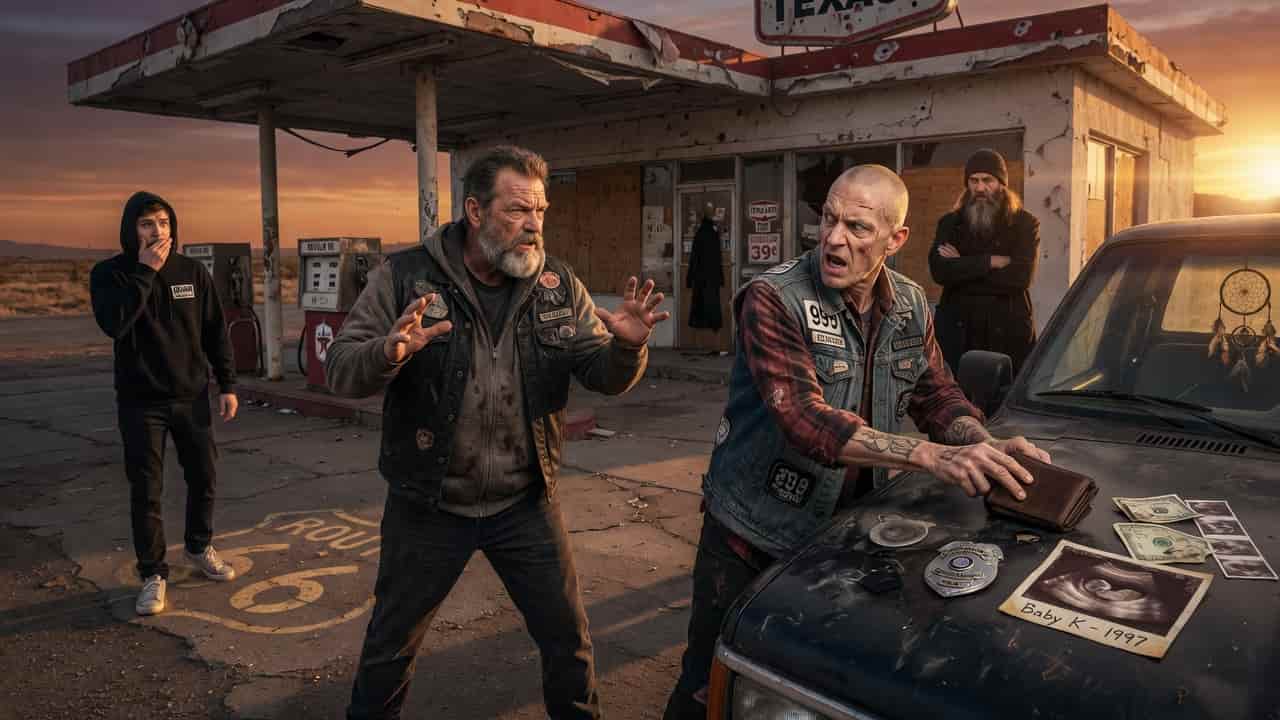
The words hit the humid air like a lead pipe. Deacon didn’t just say it; he spat it. He slammed Solomon’s old leather wallet onto the hood of the truck, and the silver shield slid out, gleaming under the flickering neon of the roadside bar.
Solomon felt the world go quiet. The sound of the idling Harleys behind him seemed to fade into a dull hum. Every eye in the 999 MC was on him now. Men he’d bled with, men he’d led for twenty years.
“It’s not mine, Deacon,” Solomon said, but his voice lacked the gravelly authority that usually kept the pack in line.
“Then why was it tucked behind a photo of a woman from a town you said you never visited?” Deacon leaned in, his face contorted with a sick kind of joy. He was finally doing it. He was breaking the King. “Why are you protecting a cop, Solomon? Why have you been sending money to a precinct in Clear Creek every month for twenty-five years?”
Preacher stepped out of the shadows, his face like a tombstone. In the 999, there was no sin greater than a badge. Solomon looked at the ultrasound photo sitting next to the shield—the secret he’d buried a lifetime ago. His son was on the other side of that badge. And now, Solomon had to choose between the boy he’d never known and the brothers who were ready to tear him apart.
Chapter 1
The leather of the saddle was the only thing that felt honest anymore. It was cracked, worn thin by thirty years of Solomon’s weight, and it smelled of old rain and neatsfoot oil. Underneath him, the Shovelhead engine vibrated with a rhythmic, mechanical ache that matched the one in his lower back.
Solomon adjusted his grip on the bars. His knuckles were swollen, the skin across them scarred and shiny from decades of holding onto things he probably should have let go of. He was fifty-five, which in the world of the 999 Biker Club, made him an ancient monument. Most men in this life didn’t make it to fifty. They went out in a smear of chrome and asphalt, or they withered away in a state-funded cell, or their hearts simply gave out under the weight of too much cheap whiskey and too many cigarettes.
He was the King. It was a title he’d earned through a thousand small cruelties and a few large ones. He was the man who kept the peace between the disparate, jagged personalities of the club. He was the one who made sure the money from the shop stayed clean enough to keep the feds at arm’s length. He was the one who lived by the Code.
But as the sun began to dip behind the jagged silhouette of the Arizona hills, painting the sky in bruises of purple and gold, Solomon felt like a fraud.
Inside the breast pocket of his vest, tucked deep behind the lining where nobody would ever think to look, was a small, rectangular weight. It wasn’t a weapon. It was a silver police badge, Case Number 4412, belonging to an Officer Ethan Vance.
Ethan Vance didn’t know Solomon existed. Or rather, he knew Solomon as the “High-Value Target” his task force had been tracking for eighteen months. Ethan didn’t know that the man he was trying to put in prison was the same man who had been anonymously paying for his mother’s chemotherapy five years ago. He didn’t know that the scholarship that had put him through the academy had been funded by a “private donor” who preferred to remain nameless.
Solomon pulled the bike into the gravel lot of “The Rusty Nut,” a dive bar that served as the unofficial headquarters for the 999 when they were on the move. The air was thick with the smell of scorched oil and the ozone of an approaching storm.
Deacon was already there. He was sitting on the tailgate of a black Silverado, a beer in one hand and a whetstone in the other. He was sharpening a folding knife, the rhythmic scritch-scritch of metal on stone cutting through the low rumble of the desert wind. Deacon was fifteen years younger than Solomon, and he spent every waking second acting like he was ten seconds away from a fight.
“You’re late, King,” Deacon said without looking up. The whetstone didn’t stop moving. “Preacher’s been inside for an hour. He’s got that look on his face. The one where he starts quoting the bylaws like they’re the Gospel.”
Solomon kicked the stand down and dismounted. His knees popped, a sharp, biting pain that he ignored. “I took the long way through the canyon. Wanted to clear my head.”
“A lot of clear air out there,” Deacon said, finally looking up. His eyes were small and dark, like two holes poked in a sheet of parchment. He had a way of looking at Solomon that felt like he was searching for a crack in the foundation. “Funny thing, though. Some of the boys saw a cruiser out near the 191 junction. Just sitting there. Waiting.”
Solomon’s heart did a slow, heavy roll in his chest. “Cops are everywhere, Deacon. It’s their job to wait.”
“Is it?” Deacon stood up, folding the knife with a sharp clack. “I heard this one wasn’t just patrolling. I heard he was waiting for someone. Someone who stopped to talk to him for ten minutes before heading back this way.”
The lie rose up in Solomon’s throat, slick and practiced. “If you’ve got something to say, Deacon, say it in front of the patch. Don’t play these games on the gravel.”
Deacon smiled. It wasn’t a friendly expression. It was the look of a predator who had found a scent. “I’m not playing games, Solomon. I’m just wondering why our leader looks so tired every time we get close to the county line. You’re the King. You should be leading the charge, not looking over your shoulder.”
Solomon stepped into the man’s space. He was still broader than Deacon, still taller. He used his bulk like a shield. “I’ve been leading this club since you were stealing bicycles, Deacon. Don’t forget who put that patch on your back.”
Deacon didn’t flinch. He just held the stare until the door of the bar creaked open and Preacher stepped out.
Preacher was the club’s Sergeant-at-Arms, but his nickname came from the fact that he used to be a youth minister before a scandal and a prison sentence had redirected his zeal toward the 999. He was a tall, skeletal man who moved with a terrifying, slow-motion grace. He wore a black beanie and a duster coat that seemed to absorb the light.
“Solomon,” Preacher said. His voice was a dry rasp. “The table is set. We have matters of the law to discuss.”
Solomon nodded, the weight of the badge in his pocket suddenly feeling like a hot coal against his ribs. He followed Preacher into the dim, smoke-choked interior of the bar.
The back room was reserved. A long, scarred oak table sat in the center, lit by a single hanging bulb that swung slightly in the draft. Six other men sat there, their faces obscured by the shadows. These were the officers. The men who decided who lived and who died within the geography of their influence.
Solomon took his seat at the head of the table. To his right was Preacher. To his left, Deacon slid into a chair, his eyes still fixed on Solomon.
“We have a leak,” Preacher began, his hands flat on the table. “Two of our shipments from the coast were intercepted in the last month. The feds knew the routes. They knew the plate numbers. This isn’t just bad luck. This is a map.”
The room went cold. In the biker world, a leak wasn’t just a business problem. It was an existential threat. It meant someone had traded their brothers for a shorter sentence or a pile of cash.
“We’ll find him,” a man named Hammer said from the far end of the table. He was a massive man with a prosthetic eye that didn’t quite track with the other one. “And when we do, we’ll make sure he understands what happens to people who forget the Code.”
“The Code is simple,” Preacher whispered. “Loyalty is the only currency. Everything else is dross. If the head is sick, the body dies. If the body is sick, we amputate.”
Deacon leaned back, his chair creaking. “Maybe the leak isn’t a map. Maybe it’s a person. Someone who’s been playing both sides for a long time. Someone who has a reason to keep the law happy.”
Solomon felt the sweat beginning to prickle at his hairline. He thought of Ethan—of the way the boy looked in his graduation photo, so much like the woman Solomon had left behind in that dusty Oklahoma town twenty-six years ago. He’d left her because the club was his life. He’d left her because he was a coward who chose the crown over the girl.
He had spent twenty-five years trying to atone for that cowardice by protecting the boy from the shadows. He’d used club money to pay off Ethan’s mother’s debts. He’d used club influence to keep the local gangs away from the kid’s neighborhood. And when Ethan became a cop, Solomon had used his position to make sure the boy’s arrests were always “clean,” even if it meant sacrificing a few low-level prospects to keep the heat off.
It was a house of cards, and the wind was picking up.
“What are you saying, Deacon?” Solomon asked, his voice steady.
“I’m saying,” Deacon said, his voice dropping to a low, dangerous purr, “that I found something in the trash behind the clubhouse last week. A receipt for a cashier’s check. Sent to a woman named Sarah Vance. I did a little digging. Turns out Sarah Vance passed away five years ago, but her son is still very much alive. He’s a detective now. Working organized crime.”
The silence that followed was heavy, suffocating. Solomon could feel the eyes of every man at the table turning toward him.
“I don’t know who that is,” Solomon said. The lie felt like ash in his mouth.
“Funny,” Deacon said, reaching into his pocket. He didn’t pull out the wallet yet. He pulled out a small, crumpled piece of paper—the receipt. He flicked it onto the table. “Because the signature on the bottom looks a whole lot like yours, Solomon. Or at least, the version of your name you use on the legal documents for the shop.”
Preacher picked up the paper, his eyes scanning the faded ink. He looked at Solomon, and for a second, Solomon saw a flash of something like pity in the older man’s eyes.
“Is this true, Solomon?” Preacher asked. “Are you funding the family of a lawman?”
“It’s an old debt,” Solomon said, his mind racing. “A woman I knew before the patch. I was helping her out. I didn’t know about the son. I didn’t know he was a cop.”
“Ignorance isn’t an excuse in the 999,” Hammer growled.
“He’s lying,” Deacon said, standing up. “He knows exactly who the kid is. He’s been protecting him. That raid last month? The one where we lost the warehouse? I saw Solomon signal the boys to stand down when the lead officer came through the door. I thought he was just being cautious. Now I know he was making sure his little boy didn’t get a scratch on him.”
Solomon felt the rage flare up, hot and blinding. He stood up, knocking his chair back. “You watch your mouth, Deacon! You’re talking to your King!”
“I’m talking to a man who’s traded our safety for a bastard’s life!” Deacon shouted back.
Preacher slammed his fist on the table. The sound was like a gunshot. “Enough! This will be settled according to the bylaws. Solomon, you will surrender your wallet and your phone for inspection. Now.”
Solomon froze. The badge was in his vest, but his wallet—the one Deacon had seen him carrying earlier—contained the photo. The one photo he had of Sarah, holding a baby Ethan. It was his only proof that he had ever been loved.
He reached into his pocket, his fingers trembling. He knew he couldn’t refuse. To refuse was a confession. But to hand it over was a death sentence.
He pulled the wallet out and laid it on the table.
Preacher reached for it, but Deacon was faster. He snatched the leather from the table and stepped back, a feral grin on his face.
“Let’s see what the King keeps close to his heart,” Deacon sneered.
Solomon lunged for him, but Hammer and another biker grabbed his arms, pinning him back. Solomon struggled, his boots scraping against the floorboards, but he was outnumbered and outmatched by the younger men.
“Let go of me!” Solomon roared.
Deacon flipped the wallet open. He began to pull out the contents: a few hundreds, a driver’s license, a library card. And then, his fingers found the hidden flap.
He pulled out the ultrasound photo, the paper yellowed and brittle.
“An ultrasound?” Deacon laughed, showing it to the room. “What, is the King getting sentimental? Or is this the moment he realized he’d sired a rat?”
He reached in again. His fingers snagged on something cold. Something metal.
Solomon’s heart stopped. He’d forgotten. He’d moved the badge from his vest to his wallet when he was changing clothes at the shop that morning. He’d meant to hide it in the safe. He’d simply… forgotten.
Deacon pulled the silver badge out. He held it up to the light, the shield gleaming with a cruel, mocking brightness.
“Well, well, well,” Deacon said, his voice dripping with venom. “Look at what we have here. A badge. Case 4412.”
The room went deathly still. Even the sound of the wind outside seemed to vanish.
Preacher stood up, his face as pale as a ghost’s. He looked at the badge, then at Solomon. The judgment in his eyes was absolute.
“Solomon,” Preacher said, his voice barely a whisper. “What have you done?”
Solomon stopped struggling. He slumped into the grip of the men holding him, his head bowing. The weight he’d been carrying for twenty-five years had finally crushed him.
“He’s a traitor,” Deacon said, his voice rising in triumph. “He’s been working with them all along. He’s been feeding us to the wolves to keep his pup safe.”
“I never gave them anything!” Solomon yelled, but it was too late. The truth didn’t matter anymore. Only the image did.
Deacon walked over to the small wood-burning stove in the corner of the room. He kicked the door open, revealing the glowing orange embers inside.
“You love this badge so much, Solomon?” Deacon asked. “Let’s see how much it’s worth when it’s melting.”
He tossed the wallet into the fire. The leather hissed and began to curl, the smell of burning skin filling the room.
“No!” Solomon screamed, but Hammer shoved him back into his chair.
Deacon held the badge over the flames, the silver reflecting the orange glow. “This isn’t just a piece of metal. This is your soul, Solomon. And tonight, we’re going to watch it burn.”
He dropped the badge into the center of the coals and slammed the stove door shut.
Solomon sat in the chair, the light of the single bulb swaying above him. He looked around the room—at the men he’d called brothers, at the man who had been his best friend, and at the man who was about to take everything from him.
He wasn’t the King anymore. He was just a man with a secret that was finally out. And in the 999, secrets didn’t just hurt. They ended you.
Chapter 2
The drive back to the main clubhouse in the wake of the confrontation at The Rusty Nut was a funeral procession without a casket. Solomon rode in the center of the pack, but the formation had changed. Usually, he was the point of the spear. Now, he was surrounded. Deacon rode to his left, his eyes fixed on the road but his body tensed like a coiled spring. Behind him, Hammer and the others followed, their engines a low, threatening growl that seemed to vibrate in Solomon’s very marrow.
The night air was cold, biting through the layers of his hoodie and leather. It felt like the desert was trying to reclaim him, to scour the skin from his bones and leave him as just another bleached skeleton in the sand.
They reached the clubhouse—a sprawling, fortified compound on the outskirts of a dying town called Gila Bend—just as the first grey light of dawn began to bleed over the horizon. The chain-link fence, topped with concertina wire, groaned as the gate was swung open by a sleepy prospect who stood at attention as the bikes roared past.
Solomon killed his engine in the center of the yard. The silence that followed was louder than the bikes.
“Get him inside,” Preacher commanded. He hadn’t spoken since the bar. He climbed off his bike with the stiff, deliberate movements of a man who was carrying a heavy burden.
They didn’t lead him to the bar area or the common room where the younger members were usually crashed out on couches. They led him to “The Box”—a soundproofed room in the basement used for interrogations and “disciplinary actions.”
It was a small room, concrete-walled and smelling of damp and old copper. A single metal chair sat bolted to the floor in the center.
“Sit,” Deacon said, shoving Solomon toward the chair.
Solomon sat. He didn’t have the energy to fight anymore. He felt a strange, hollowed-out kind of peace. The lie was gone. The weight was off his shoulders, even if it had been replaced by a noose.
Preacher stood in the corner, his face in shadow. Deacon stood in front of Solomon, pacing like a caged wolf.
“Let’s talk about Clear Creek,” Deacon said. “Let’s talk about Sarah.”
Solomon looked up. Mentioning her name in this room felt like a sacrilege. “She had nothing to do with the club. She was a waitress. I met her when I was on a run for the old man. Before I even had my full colors.”
“And you left her,” Deacon said. “Why? Because you were a good little soldier? Or because you knew if the club found out you’d knocked up a civilian in a rival’s territory, they’d have peeled the skin off your back?”
“I left her to protect her,” Solomon said, his voice cracking. “The 999 wasn’t a social club back then, Deacon. It was a war machine. If I’d stayed, the Vipers would have targeted her just to get to me. I thought if I disappeared, she’d have a chance at a normal life.”
“A normal life,” Deacon mocked. “And her kid? Did you think he’d have a normal life, too? Growing up without a father, wondering why some anonymous check showed up in the mail every month like clockwork?”
“I did what I could,” Solomon whispered.
“You did what was easy!” Deacon screamed, leaning down so his face was inches from Solomon’s. “You kept your crown, and you kept your secret. And then the kid grows up. He joins the academy. He becomes a detective. And suddenly, the King of the 999 has a direct line into the precinct. How much have you told him, Solomon? How many of our brothers are sitting in Florence right now because you wanted to make sure your son got a promotion?”
“I never spoke to him!” Solomon roared, his pride finally snapping. “I never told him who I was! I watched him from the distance. I made sure he was safe. That’s it. Everything else—the shipments, the raids—that wasn’t me. That was just the business. We got sloppy, and the feds caught on. Don’t pin your failures on my son.”
Deacon backhanded him. The blow was sudden and sharp, snapping Solomon’s head to the side. He felt the copper taste of blood in his mouth.
“He’s not your son,” Deacon hissed. “He’s a cop. And in this house, a cop is a target.”
Preacher stepped forward out of the shadows. “Is he coming here, Solomon? Does he know about this place?”
Solomon wiped the blood from his lip with the back of his hand. “He’s been building a case for a year. He doesn’t need me to tell him where the clubhouse is. He’s probably got a drone over us right now.”
As if on cue, a muffled thud vibrated through the ceiling. It was followed by the sound of shouting and the unmistakable pop-pop-pop of flash-bang grenades.
“Raid!” someone yelled from the floor above.
Deacon spun toward the door, his hand going to the pistol at his hip. “You son of a bitch! You called them!”
“I didn’t call anyone!” Solomon shouted, but the room was already dissolving into chaos.
Deacon lunged at Solomon, his fingers wrapping around Solomon’s throat, but Preacher grabbed Deacon’s arm. “Not now! We have to clear the logs! Get to the back office!”
The sound of boots thundered overhead. Solomon heard the heavy crunch of a battering ram hitting the front door. The 999 was a fortress, but the feds didn’t play by the rules.
Deacon let go of Solomon’s throat, giving him one last look of pure hatred before bolting out of the room. Preacher hesitated for a second, looking at Solomon.
“If you survive this,” Preacher said, “don’t come back. The club is dead to you.”
He followed Deacon out, slamming the heavy steel door shut and locking it from the outside.
Solomon was trapped. He sat in the darkness, listening to the war raging upstairs. He heard the shouts of “Police! Get on the ground!” and the desperate, defiant roars of his brothers. He heard the sound of glass breaking and the heavy furniture being overturned.
And then, he heard a voice he recognized. A voice he’d heard on recorded wiretaps and through the cracked windows of surveillance vans for years.
“Clear the hallway! Team two, take the basement!”
It was Ethan.
Solomon stood up, his heart hammering against his ribs. He began to throw his weight against the steel door, but it was reinforced. He was a prisoner in his own kingdom.
“In here!” he heard someone shout outside the door.
The lock turned, and the door swung open. Three men in tactical gear, faces obscured by gas masks and helmets, swarmed into the room. Their rifle lights blinded him, white hot circles dancing in his vision.
“Hands up! Get on the floor! Do it now!”
Solomon raised his hands. He knelt on the cold concrete, the dust stinging his lungs.
One of the officers stepped forward, his rifle lowered slightly. He pulled his mask up, revealing a face that was a younger, harder version of the one Solomon saw in the mirror every morning.
Ethan Vance looked down at the man on the floor. His eyes were cold, professional, and entirely devoid of recognition.
“Solomon King,” Ethan said. “You’re under arrest for conspiracy, racketeering, and a dozen other things I’m going to enjoy reading to you.”
Solomon looked up at his son. He wanted to say his name. He wanted to tell him that he was proud of the man he’d become. He wanted to tell him to run, because Deacon was still out there, and Deacon didn’t care about badges or warrants.
But all he could do was nod.
“Search him,” Ethan commanded.
The other officers moved in, their hands rough as they patted Solomon down. They pulled his phone from his pocket, his keys, and a small, folded piece of paper that had fallen out of his vest during the struggle with Deacon.
Ethan took the paper. He unfolded it. It was the ultrasound photo—the one Deacon had tried to burn, but which Solomon had snatched back from the embers when the others weren’t looking. It was charred around the edges, the image of the tiny, curled-up life barely visible through the soot.
Ethan stared at the photo for a long time. His brow furrowed, a flicker of something—confusion? memory?—crossing his face.
“Where did you get this?” Ethan asked, his voice losing some of its clinical edge.
“It belonged to a friend,” Solomon said.
Ethan looked from the photo to Solomon. He seemed on the verge of asking something else, but then his radio crackled.
“Vance, we’ve got a runner in the back lot. Black Silverado. Looks like Deacon. He’s armed and he’s not stopping.”
Ethan’s face hardened again. He shoved the photo into his pocket and turned away. “Secure the prisoner. I’m going after the runner.”
“Ethan, wait!” Solomon shouted.
Ethan stopped in the doorway. He didn’t turn around. “How do you know my name?”
“I know a lot of things,” Solomon said, his voice desperate. “Deacon isn’t just a runner. He’s a fanatic. He thinks you’re the reason the club is falling apart. He won’t just try to escape. He’ll try to take you with him.”
Ethan finally turned, his eyes narrowing. “I’ve been dealing with punks like you my whole career, Solomon. I think I can handle one more biker.”
He vanished into the hallway, leaving Solomon alone with the two officers.
Solomon sat back on his heels, the cold of the floor seeping into his bones. He had saved his son’s life a dozen times from the shadows. He’d manipulated the world to keep Ethan safe. And now, he was sitting in a cage while the boy walked straight into a trap he’d helped build.
The sound of a truck engine roaring to life echoed from the yard above. It was followed by a burst of automatic gunfire and a long, screeching slide of tires on gravel.
Then, there was an explosion. The ground shook, and the lights in the basement flickered and died.
In the sudden, absolute darkness, Solomon King put his head in his hands and wept. Not for his club, and not for his crown. He wept for the boy who was finally finding out who his father was, just as the world was ending.
Chapter 3
The aftermath of the raid felt like a fever dream. Solomon was processed in a blur of fluorescent lights, fingerprint ink, and the smell of industrial-strength floor cleaner. He was moved from the clubhouse to a county holding facility, then to a secure interview room in the Phoenix federal building.
He hadn’t seen Ethan since the basement.
He sat at a small, bolted-down table, his hands cuffed in front of him. His vest had been taken, replaced by a thin, orange jumpsuit that made him feel exposed, like a soft-shelled crab without its husk.
The door opened, and a woman walked in. She was in her late fifties, her hair a sharp, silver bob. She wore a tailored charcoal suit and carried a manila folder like a shield.
Solomon recognized her instantly. It was Mamma Rose—the woman who had been his wife for twenty years, the woman who had stood by him as he built the 999 into an empire. She wasn’t a member, of course, but she was the club’s heart. She knew where the bodies were buried, and she knew whose palms needed greasing.
But she wasn’t here as his wife. She was here as his legal representation. Rose had a law degree she’d never officially used for anything other than reviewing club contracts.
She sat down across from him, her face a mask of professional neutrality. She didn’t touch him. She didn’t even look him in the eye.
“The charges are heavy, Solomon,” she said. Her voice was cold, a sharp contrast to the warmth he’d known for two decades. “The DA is pushing for a RICO indictment. They’ve got the ledgers from the back office. Deacon didn’t burn them in time.”
“Is Ethan okay?” Solomon asked, ignoring the legal talk.
Rose finally looked up. Her eyes were red-rimmed, her composure cracking just enough for him to see the hurt underneath. “Detective Vance is in surgery. Deacon rammed his cruiser and then detonated a fuel tank. Two other officers are dead. Ethan has third-degree burns over forty percent of his body. They don’t know if he’ll keep his sight.”
Solomon felt the air leave his lungs. He slumped back in the chair, the chains on his cuffs rattling. “I tried to tell him. I tried to warn him.”
“You tried to warn him?” Rose leaned forward, her voice dropping to a hiss. “Is that what you call it, Solomon? You’ve been lying to me for twenty years. Every time you went on those ‘long runs’ to the coast? Every time you said you needed to clear your head in the canyon? You were checking on them. You were checking on her.”
“Rose, I didn’t mean to—”
“Don’t,” she snapped. “Don’t you dare say you didn’t mean to. You built a life with me. You told me you were a man of honor. You told me the 999 was our family because we couldn’t have one of our own. And all this time, you had a son. You had a legacy waiting in the wings.”
“I was protecting you, too,” Solomon said. “If the club knew, they’d have used him against me. They’d have used him to control me.”
“And look what happened anyway!” Rose stood up, her chair screeching against the floor. “Deacon found out. The club is in ruins. Your son is dying in a hospital bed, and you’re sitting here in an orange suit. Was it worth it, Solomon? Was the secret worth the price?”
“I don’t know,” Solomon whispered.
“Well, I do,” Rose said, opening the manila folder. She pulled out a stack of papers and slid them across the table. “These are the divorce papers. I’ve already moved my things out of the house. The shop is being seized by the feds, but the personal accounts—the ones you thought were hidden—I’ve redirected those to a trust for Ethan’s recovery. It’s the only thing I can do to wash the smell of you off my life.”
Solomon looked at the papers. He didn’t see the legal jargon. He saw the end of the only real home he’d ever had. Rose had been his anchor. She was the only person who saw the man beneath the King. And now, she was cutting the line.
“Rose, please,” he said, reaching out with his cuffed hands.
She stepped back, her face hardening into stone. “Don’t touch me. You’re a ghost, Solomon. You’ve been a ghost since the day you left that girl in Clear Creek. You just didn’t realize it until the lights came on.”
She turned and walked out of the room, her heels clicking a rhythmic, final beat against the linoleum.
Solomon sat in the silence. He thought about the fire in the stove at The Rusty Nut. He thought about the way the silver badge had looked as it fell into the coals. He’d thought that was the moment he lost everything. But he was wrong. This was the moment.
The door opened again twenty minutes later. This time, it wasn’t Rose. It was a man in a rumpled suit with a federal badge clipped to his belt. He looked tired, like he’d been awake for three days.
“Mr. King,” the man said, sitting down. “I’m Special Agent Miller. We’re in a bit of a predicament.”
“I’m sure you are,” Solomon said.
“Deacon is still in the wind,” Miller said. “He survived the blast. We found the Silverado abandoned ten miles south of the clubhouse. He’s headed for the border, but we think he’s going to make one more stop first.”
Solomon’s blood went cold. “The hospital.”
“He blames Detective Vance for the raid,” Miller said. “And he blames you for the betrayal. He doesn’t just want to escape, Solomon. He wants to finish the job. He wants to erase your legacy.”
“You have guards at the hospital,” Solomon said.
“We have two deputies at the door,” Miller said. “But Deacon knows the layout of that facility. He worked security there ten years ago. He knows the service tunnels. He’s a ghost in the system.”
“What do you want from me?”
Miller leaned in. “We need to know where he’d go. We need to know his bolt-holes, his contacts, the people who would hide him. And we need to know now. If you cooperate, we can talk about a reduced sentence. We can talk about protection for Detective Vance.”
Solomon looked at the agent. He saw the desperation in the man’s eyes. The feds had the club, but they didn’t have the man who mattered. Deacon was the poison that was left in the wound.
“I won’t give you his contacts,” Solomon said.
Miller’s face fell. “Then you’re signing your son’s death warrant.”
“I won’t give you his contacts,” Solomon repeated, “because they won’t matter. Deacon doesn’t trust anyone anymore. He’s going to ground in the one place he knows I’d never look. The old mine works near Silver Bell.”
“Why there?”
“Because that’s where we buried the last man who tried to take the crown,” Solomon said. “It’s hallowed ground for him. He thinks he’s the rightful heir. He’ll go there to wait for the heat to die down, or to wait for his chance to strike.”
Miller stood up, pulling out his radio. “Get a tactical team to Silver Bell. Now.”
“Wait,” Solomon said.
Miller stopped. “What?”
“I’m the only one he’ll talk to,” Solomon said. “He thinks I’m a traitor, but he still respects the patch. If you send a swat team in there, he’ll blow himself and whoever else is in the room to hell. He’s got enough blasting caps from the shop to level a city block.”
“You’re a federal prisoner, King. I can’t let you out.”
“Then you’re a dead man walking,” Solomon said. “And so is my son. You let me go in there. You let me face him. I’ll bring him out, or I’ll die trying. Either way, the problem is solved.”
Miller stared at him for a long time. The silence in the room was heavy, filled with the ghosts of a hundred bad decisions.
“I have to clear this with the Director,” Miller said.
“Clear it fast,” Solomon said. “Because the sun is going down, and Deacon doesn’t like to work in the light.”
Miller left, and Solomon was alone once more. He looked down at his hands. They were still swollen, still scarred. He’d spent his life building a kingdom of dust and shadow. He’d lost his brothers, his wife, and his crown. All he had left was a son who didn’t know him and a man who wanted to kill them both.
He closed his eyes and prayed. He didn’t pray for forgiveness. He prayed for one more hour of the King’s strength. He prayed for the chance to be the man he’d never had the courage to be.
The door opened.
“Let’s go, King,” Miller said. “Your ride is waiting.”
Chapter 4
The Silver Bell mine was a jagged wound in the side of the mountain, a place where the earth had been torn open and then abandoned to the coyotes and the wind. The air here was different—thinner, smelling of dry dust and the metallic tang of old copper.
Solomon sat in the back of a blacked-out SUV, his hands still cuffed, but the chain had been lengthened to allow him to move. He wore a bulletproof vest under his orange jumpsuit, a heavy, awkward weight that felt like a mockery of his old leather colors.
Special Agent Miller sat next to him, his eyes fixed on the thermal imaging screen.
“We’ve got a heat signature in the main shaft,” Miller whispered. “One person. He’s moving around, setting something up.”
“He’s rigging the entrance,” Solomon said. “He knows you’re coming.”
“We’ve got snipers on the ridge, but the angle is bad,” Miller said. “If he stays deep in the shaft, we can’t get a clean shot.”
“I told you,” Solomon said. “Let me go in. I’ll talk him out.”
Miller looked at Solomon, his expression a mix of doubt and desperation. “If you try to run, my men have orders to shoot you on sight. Do you understand?”
“I’m an old man with a bum knee and a ruined life, Miller. Where exactly do you think I’m going to go?”
Miller nodded to the officer in the front seat. The SUV door opened, and Solomon stepped out into the biting mountain air.
The silence was absolute. The sun had already disappeared, leaving the world in a deep, sapphire twilight. The entrance to the mine was a dark maw, reinforced with rotting timber beams that looked like the ribs of a giant, buried beast.
Solomon began to walk. Every step was a struggle, his boots crunching on the loose shale. He felt the eyes of the snipers on him, the red dots of their lasers probably dancing across his back like fireflies.
“Deacon!” Solomon shouted. His voice echoed off the rock walls, sounding hollow and weak. “Deacon, it’s Solomon!”
There was no answer. Only the wind whistling through the dry brush.
Solomon reached the entrance. He stopped, his heart hammering in his chest. He could see a faint, flickering light deep inside—the glow of a camping lantern.
“I know you’re in there!” Solomon called out. “I know about the Silver Bell. I’m the one who told them where to look!”
A shadow moved against the lantern light.
“You always were a loudmouth, Solomon!” Deacon’s voice drifted out of the shaft, distorted by the echoes. “Is that what a King does? He leads the feds right to his brother’s door?”
“You’re not my brother, Deacon!” Solomon shouted back, stepping into the mouth of the cave. “Brothers don’t burn badges. Brothers don’t try to kill sons.”
“He’s a cop!” Deacon screamed, and this time his voice was closer. “He’s the enemy! You chose him over us! You chose the law over the Code!”
Solomon kept walking, his eyes adjusting to the dim light. He could see the wires now—thin, translucent lines crisscrossing the floor, leading to bundles of plastic explosives taped to the timber supports.
Deacon was standing twenty feet back, his back to the wall. He held a detonator in one hand and a semi-automatic rifle in the other. He looked like a man who had already died and just hadn’t realized it yet. His face was smeared with soot and blood, his eyes wild and bloodshot.
“Stop right there!” Deacon leveled the rifle at Solomon’s chest. “One more step and we all go for a ride.”
Solomon stopped. He raised his hands, the cuffs rattling. “It’s over, Deacon. The club is gone. Hammer is in custody. Preacher is probably halfway to Mexico. There’s nothing left to fight for.”
“There’s honor!” Deacon spat. “There’s the legacy of the 999! I’m going to be the one who finished what you were too weak to do. I’m going to take out the man who betrayed us, and then I’m going to take out the seed he planted.”
“Ethan is just a kid,” Solomon said, his voice softening. “He doesn’t know anything about the club. He doesn’t even know I’m his father.”
“He knows now,” Deacon laughed, a jagged, hysterical sound. “I made sure of that. Before I rammed his car, I tossed your wallet through his window. I told him to look at the photo. I told him his daddy was the King of the Trash.”
Solomon felt a cold, sharp pain in his gut. He thought of Ethan, trapped in his car, looking at that charred photo as the flames closed in. The humiliation wasn’t just Solomon’s anymore. He’d passed it on to his son. He’d made his secret Ethan’s burden.
“You’re a sick man, Deacon,” Solomon said.
“I’m a loyal man!” Deacon screamed. “I’m the only one who stayed true! And now, I’m going to end the line.”
He shifted his grip on the detonator. His thumb hovered over the red button.
“You think you’re a hero?” Solomon asked, taking a slow step forward. “You’re just a bully, Deacon. You’ve always been one. You like the power. You like making people feel small. You didn’t care about the club. You just cared about being the one holding the whip.”
“Shut up!”
“You want to kill me?” Solomon asked, taking another step. “Go ahead. I’ve lived too long anyway. But let the boy go. He’s already paid enough for my sins.”
“No one gets a pass!” Deacon raised the rifle, his finger tightening on the trigger.
“Then do it!” Solomon roared, his voice filling the shaft. “Show me what a real 999 brother looks like! Kill your King in the dark like a coward!”
Deacon hesitated. For a split second, the fire in his eyes flickered, replaced by a momentary, crushing doubt. He’d spent his whole life looking up to Solomon, even as he hated him. The habit of obedience was hard to break.
In that second, Solomon lunged.
He wasn’t fast, but he was heavy. He slammed into Deacon, the two of them crashing back against the stone wall. The rifle went off, the sound deafening in the enclosed space, the bullet whining off the rock above them.
They grappled on the floor, the dust choking them. Deacon was younger and stronger, his fists raining blows down on Solomon’s head and shoulders, but Solomon held on with the desperation of a man who had nothing left to lose.
He wrapped his cuffed hands around Deacon’s throat, using the chain as a garrote.
“Drop… the… button…” Solomon hissed, his face turning purple with the effort.
Deacon thrashed, his legs kicking out, his fingers clawing at Solomon’s eyes. He reached for the detonator, which had slid a few feet away.
“I’ll… take… you… with… me…” Deacon gasped.
His fingers brushed the plastic casing of the detonator. He gripped it, his thumb pressing down.
Solomon closed his eyes. He thought of Rose’s face in the interview room. He thought of Ethan’s eyes as he looked at the ultrasound photo. He thought of the girl in Clear Creek, waiting for a man who never came back.
I’m sorry, he thought. I’m so sorry.
The explosion didn’t happen.
Instead, there was a sharp, percussive crack from the entrance of the mine. A flash of light, followed by the smell of burnt hair and ozone.
Deacon’s body went limp. He slumped back against the floor, his eyes rolling back in his head.
Solomon rolled off him, gasping for air. He looked toward the entrance.
Standing in the shaft, silhouetted against the twilight, was a figure in tactical gear. The man held a taser, the wires still trailing from the barrels.
The officer stepped forward, pulling his mask up. It wasn’t Ethan. It was a young prospect from the 999—the one Solomon had seen at the gas station earlier. The one who had looked so shocked by the betrayal.
The boy looked at Solomon, then at Deacon’s unconscious form.
“I couldn’t let him do it, King,” the boy whispered. “The Code says loyalty to the patch, but it also says you don’t kill family. Not like this.”
The boy reached out a hand and helped Solomon to his feet.
“Go,” the boy said. “The feds are right behind me. If you go through the air shaft in the back, you can get to the ridge before they circle around.”
“Why are you helping me?” Solomon asked, his voice a rasp.
The boy looked at the floor, his face flushed with shame. “Because my dad was a cop, too. And you’re the one who made sure he didn’t get fired when he started drinking. You looked out for us, Solomon. Even when you didn’t have to.”
Solomon looked at the boy—this mirror of his own secret life. He realized then that the 999 wasn’t just a club of criminals. It was a collection of broken men trying to find a way to be whole.
“Thank you,” Solomon said.
He turned and headed into the darkness of the back shaft, leaving the boy to face the feds.
He climbed through the narrow, suffocating tunnel, the air thick with the smell of old damp. He pushed himself until his muscles screamed, until his breath was a jagged tear in his chest.
He emerged onto the ridge an hour later. The world below was a sea of flashing blue and red lights. He could see the ambulances, the swat vans, the chaos of the ruined kingdom.
He looked toward the horizon, where the lights of Phoenix were a distant, amber glow.
He wasn’t a King anymore. He was a fugitive, a traitor, and a ghost. But as he began to walk down the back side of the mountain, away from the lights and the noise, Solomon King felt something he hadn’t felt in twenty-five years.
He felt like a father.
And as long as he was alive, he would find a way to make it right. Even if it took another lifetime of shadows.
He disappeared into the desert, the silver badge of his son still a phantom weight against his heart, more powerful than any crown he’d ever worn.
Chapter 5
The desert at night was not silent; it was a symphony of dry, scraping sounds and the distant, rhythmic thrum of the interstate that never truly went quiet. Solomon King moved through the brush like a man who had forgotten how to walk on level ground. Every step down the jagged backside of the Silver Bell ridge sent a jolt of white-hot pain through his bad knee, a reminder of a three-hundred-pound Harley that had pinned him to the asphalt in a Reno rainstorm a decade ago. Back then, he’d had a dozen brothers to lift the weight off him. Tonight, he was the weight.
He had stripped off the orange jumpsuit, tearing it away as soon as he was deep enough in the shadows to avoid the sweeping searchlights of the helicopters. Underneath, he wore the grey hoodie, now stained with the copper dust of the mine and the salt of his own sweat. He looked like any other homeless drifter stumbling out of the wasteland, which was the only reason he was still breathing. The King was dead; the ghost was just starting his shift.
His mind was a fractured mess of images. Deacon’s wild, soot-streaked face. The smell of the plastic explosives. The way the young prospect had looked at him—not with the reverence Solomon had spent thirty years cultivating, but with a hollow, weary kind of pity. That pity was worse than the handcuffs. It was the realization that the pedestal he’d built for himself hadn’t just cracked; it had disintegrated, leaving him standing in the dirt with everyone else.
He reached a drainage culvert near the base of the mountain around 3:00 AM. He collapsed against the corrugated metal, his lungs burning. He reached into the hidden pocket of his hoodie, his fingers searching for the ultrasound photo. It was gone. He must have lost it in the tunnel or during the scuffle with Deacon. The realization hit him harder than a physical blow. That scrap of yellowed paper had been his only tether to a version of himself that wasn’t a criminal. Now, even that was ash and dust.
“You okay, old man?”
Solomon froze. He hadn’t heard the approach. He looked up to see a man standing by a battered white Ford F-150 parked near the edge of the access road. The man was thin, wearing a stained ball cap and a grease-streaked work shirt. He looked like he’d spent the last twelve hours fixing something that refused to stay fixed.
Solomon didn’t reach for a weapon. He didn’t have one, and he didn’t have the strength to use it if he did. He just leaned his head back against the metal and closed his eyes. “Just catching my breath.”
“You look like you fell off the mountain,” the man said, walking closer. He didn’t sound threatening. He sounded like someone who had seen plenty of things fall apart in this part of the country.
“Something like that,” Solomon muttered.
“I’m headed into Phoenix. Got a shift at the warehouse starting at five. You want a lift, or you planning on dying out here?”
Solomon looked at the man. In the old days, he’d have sized this guy up for a mark or a threat. He’d have looked for the angle. Now, he just saw a guy in a truck. “Phoenix would be good. The hospital. St. Joseph’s.”
The man nodded, not asking questions. Questions were for people with time to waste. “Get in. The heater’s busted, but it’s better than the wind.”
The ride into the city was a blur of orange streetlights and the smell of stale tobacco. Solomon watched the desert transition into the suburban sprawl of the Valley—the strip malls, the car lots, the endless rows of identical stucco houses. This was the world he had spent his life mocking, the “civilian” world of bills and boredom. But as he watched a woman in a minivan pull into a 24-hour Walgreens, he felt a crushing sense of envy. She had a destination. She had a reason to be awake.
He thought about Sarah. He remembered the way she used to tuck her hair behind her ear when she was reading. He remembered the smell of the diner where they’d met—grease and cheap perfume. He’d told himself he was leaving her to keep her safe, but as the truck rattled down I-17, he finally admitted the truth to the empty air of the cab. He’d left because he loved the crown more than the girl. He’d loved being the King of the 999 more than being a husband or a father. The secret hadn’t been a shield for her; it had been a convenient excuse for him.
“You got someone in there?” the driver asked as they approached the hospital district.
“My son,” Solomon said. The word felt heavy in his mouth, like a stone he wasn’t supposed to be carrying.
“Hope he makes it,” the man said, pulling the truck to the curb in front of the emergency entrance. “World’s a mean place to be alone.”
“Yeah,” Solomon said, stepping out. “Thanks for the ride.”
The driver waved him off and pulled away, the taillights of the Ford disappearing into the early morning traffic.
Solomon stood on the sidewalk, the towering glass and steel of the hospital looming over him. He was a federal fugitive. His face was likely on every news station in the state. He should have been heading for the border, or at least for a safe house he hadn’t told the feds about. But he couldn’t move. The gravitational pull of the fourth floor—the burn unit—was too strong.
He walked toward the entrance, keeping his head down, the hood of his sweatshirt pulled low. The automatic doors hissed open, releasing a blast of sanitized, over-chilled air. The lobby was mostly empty, just a few tired-looking people huddled in chairs, their faces reflected in the polished linoleum.
He didn’t go to the reception desk. He knew the drill. There would be a deputy stationed at the elevators for the high-profile floor. Instead, he headed for the service hallway he’d memorized years ago when the club had “business” with a doctor who owed them money. He found the service elevator, pressed the button for the basement, and then manually overrode the panel to take him to the fourth-floor maintenance closet.
The elevator groaned, a slow, industrial ascent that felt like it was taking him to his execution. When the doors opened, he stepped out into a small, cramped room filled with mops, buckets, and the smell of bleach. He cracked the door and peered out into the hallway.
The lighting was harsh, a sterile white that made everything look unreal. He saw the deputy—a young guy with a buzzed haircut—sitting at a small desk near the double doors of the Intensive Care Unit. The deputy was scrolling through his phone, his posture relaxed. He wasn’t expecting the King to walk through the front door.
Solomon moved with the practiced silence of a man who had spent decades sneaking into places he didn’t belong. He slipped into the hallway, using the shadows cast by the large equipment carts. He reached the heavy swinging doors of the ICU just as a nurse walked out. He caught the door before it latched, sliding inside like a shadow.
The ICU was a different world. It was a place of whispers and the rhythmic, mechanical breathing of ventilators. It smelled of medicine and rot. Solomon moved past the glass-walled rooms, his eyes scanning the charts hanging on the doors.
Room 412.
He stopped. Through the glass, he saw the silhouette of a man in a bed. But it didn’t look like Ethan. It looked like a mummy, a figure wrapped almost entirely in white gauze. There were tubes snaking out from under the blankets, and a monitor hummed with the steady, fragile beep of a heart that was fighting for every second.
Solomon’s hand hovered over the door handle. His fingers were shaking. This was the residue of his life. This was what the “bastard at the gate” had inherited—not a kingdom, but a bed of pain and a legacy of fire.
“He can’t hear you.”
Solomon spun around. Mamma Rose was standing at the end of the hallway, a paper cup of coffee in her hand. She looked exhausted, her expensive suit wrinkled, her eyes sunken. She didn’t look surprised to see him. She looked like she’d been waiting for the final act of a play she was sick of watching.
“Rose,” Solomon whispered.
“The doctors say he’s stable, but the damage is… it’s extensive,” she said, her voice flat. She didn’t move toward him. “They had to put him in a medically induced coma. To keep him from feeling what the fire did.”
“I did this,” Solomon said, his voice cracking.
“No,” Rose said, finally looking him in the eye. “We did this. You with your secrets, and me with my silence. I knew there was something, Solomon. I knew every time you pulled away, there was a part of you I couldn’t touch. I just didn’t want to admit that the man I loved was half a lie.”
“I wanted to protect him,” Solomon said, the words sounding hollow even to him.
“You wanted to possess him,” Rose countered. “You wanted the son without the responsibility. You wanted to play God from the shadows, making sure he had the best of everything while you were selling the very things that were destroying the world he was trying to save. You turned him into a cop to spite the world, and then you turned the world against him to protect your own skin.”
Solomon looked back through the glass at the figure in the bed. “Is he going to make it?”
“They don’t know. Even if he does, he won’t be the same man. He’ll be a reminder of everything you lost.” Rose took a sip of her coffee, her hand trembling slightly. “The feds are downstairs, Solomon. They’ve got the exits blocked. They’re just waiting for the warrant to clear the hospital staff before they come up.”
“Why haven’t they come yet?”
“Because Agent Miller thinks you’re still at the mine. He doesn’t think you have the guts to come here.” She set the coffee cup down on a nearby ledge. “You have maybe ten minutes before someone realizes you’re here.”
“I just need to talk to him,” Solomon said.
“He can’t hear you,” she repeated.
“I need to say it anyway.”
Rose looked at him for a long, silent moment. She saw the broken man under the grey hoodie, the King who had finally run out of land to rule. She reached into her pocket and pulled out a small, electronic key card.
“The door is locked from the outside for his safety,” she said, sliding the card across the floor toward him. “I’m going to the cafeteria. I’ll tell the deputy I saw a suspicious man in the stairwell on the other side of the floor. That should give you five minutes.”
“Rose…”
“Don’t thank me,” she said, turning away. “I’m not doing this for you. I’m doing it because even a bastard deserves to know who his father is before the lights go out.”
She walked away, her footsteps echoing in the sterile hallway.
Solomon picked up the card. He swiped it through the reader, and the lock clicked with a sound that felt like a gavel hitting a bench. He stepped into the room.
The air was thick with the smell of ointment and ozone. The only sound was the hiss and pop of the ventilator. Solomon walked to the side of the bed. He looked down at the bandaged face of his son. He could see the edges of Ethan’s eyes, the skin raw and red, the lashes gone.
He reached out, his rough, scarred hand hovering over Ethan’s arm, but he didn’t touch him. He was afraid he would break whatever fragile thread was still holding the boy to the world.
“Ethan,” Solomon whispered. “It’s me. It’s… it’s your father.”
The monitor beeped. The ventilator hissed.
“I spent twenty-five years trying to figure out how to say that,” Solomon said, his voice trembling. “I spent twenty-five years thinking if I just sent enough money, or made enough calls, it would make up for the fact that I wasn’t there to hold your hand when you fell down. I thought I could buy my way into being a good man.”
He sat down in the plastic chair by the bed, his head bowing. The weight of the room, the weight of the city, and the weight of the thirty years he’d spent building a throne of lies finally crushed him.
“I was the King of the 999,” he said, the title sounding like a joke now. “I had a thousand men who would die for me. And not one of them knows me. Not one of them knows the man who sat in a diner in Clear Creek and promised a girl he’d be back in a week. I’ve been running for a long time, Ethan. And I’m so tired.”
He reached into his pocket and pulled out a small, silver object. It wasn’t the badge. It was a small, heavy coin—his “King’s Medallion,” the one given to the leader of the club to signify his absolute authority. He laid it on the bedside table, next to the medical monitors.
“I don’t want it anymore,” Solomon said.
Outside in the hallway, he heard the sound of heavy boots. The shouting had started. The deputy had realized the stairwell was empty.
Solomon stood up. He looked at Ethan one last time. He saw the way the boy’s chest rose and fell—a slow, mechanical struggle. It was the same struggle Solomon had been engaged in his whole life, only Ethan was doing it with honor.
“You’re a better man than I ever was,” Solomon whispered. “And I’m sorry I didn’t give you a chance to know that.”
He walked to the window. The sun was fully up now, the desert light flooding the city, revealing every crack in the pavement and every smudge on the glass. He could see the black SUVs pulling up to the curb four floors below.
He didn’t run. He didn’t look for the service elevator. He just stood there, watching the world he’d built burn down in the morning light.
The door to the room burst open.
“Federal agents! Hands up! Get on the floor!”
Solomon didn’t turn around. He just kept his eyes on the horizon, on the mountains where he’d hidden his secrets for so long.
“I’m here,” Solomon said, his voice calm and clear. “I’m right here.”
As the officers tackled him to the floor, the heavy weight of their bodies pressing him into the cold linoleum, Solomon King finally stopped running. The King was gone. The secret was out. And for the first time in his life, he felt like he could finally breathe.
Chapter 6
The trial of Solomon King was the kind of spectacle the American Southwest hadn’t seen in decades. It wasn’t just about the drugs or the racketeering; it was about the collapse of a myth. The newspapers called it “The Fall of the Biker King,” and every day the courtroom was packed with leather-clad men from rival clubs, curious suburbanites, and federal agents with narrow, satisfied eyes.
Solomon sat at the defense table in a suit that didn’t fit him. His beard had been trimmed, his hair shorn close to his head. He looked like an aging accountant who had lost everything in a bad market. He didn’t look like a man who had once commanded a small army from a hilltop fortress.
He didn’t testify. He didn’t offer a defense. When the prosecution presented the ledgers, the wiretaps, and the testimony of the men he’d called brothers, Solomon just stared at the scarred wood of the table. He was waiting for one thing, and it wasn’t the verdict.
On the fourteenth day of the trial, the doors at the back of the courtroom opened, and a man in a wheelchair was pushed inside.
The room went silent. Even the judge paused, his gavel hovering over the bench.
Ethan Vance was wrapped in compression garments, a black mask-like sleeve covering his neck and the lower half of his face. His hands were gloved, and his eyes—the only part of him that looked human—were fixed straight ahead. He was pushed by a young woman in a police uniform, a colleague from the precinct.
Solomon felt the air leave his lungs. He wanted to stand up, to shout, to cry out, but he remained frozen. This was the residue. This was the physical manifestation of his life’s work.
Ethan was positioned in the front row, directly behind the prosecution’s table. He didn’t look at Solomon. He looked at the judge.
The sentencing took three hours. The judge spoke at length about the “erosion of social order” and the “poison of organized criminality.” He looked at Solomon with a disgust that felt personal.
“Solomon King,” the judge said, “you have spent thirty years building a legacy of shadow and fear. You have betrayed your country, your community, and, most egregiously, your own blood. There is no room in a civilized society for the kind of man you chose to be.”
Solomon didn’t blink. “I understand, Your Honor.”
“I sentence you to life in federal prison, without the possibility of parole. You will be transported to Florence ADX immediately.”
The gavel came down. The sound was final, a period at the end of a very long, very ugly sentence.
As the marshals moved in to cuff him, Solomon looked toward the front row. Ethan had raised his head. For the first time, their eyes met.
There was no recognition in Ethan’s gaze. There was no hatred, no forgiveness, and no love. There was only a profound, echoing emptiness. Ethan looked at him the way a man looks at a piece of debris on the highway—something that had caused a wreck, something that was now just a problem to be cleared away.
The woman pushing the wheelchair turned Ethan around, and they began to exit the courtroom.
“Ethan!” Solomon shouted, the word tearing out of him before he could stop it.
The marshals grabbed his arms, shoving him back. “Quiet, King! Sit down!”
Ethan didn’t stop. He didn’t even flinch. The doors swung shut behind him, and he was gone.
The transport to Florence was a long, silent drive through the desert he’d once ruled. Solomon looked out the window of the van, watching the cacti and the scrub brush fly by. He thought of the 999. He knew what would happen now. Deacon would be sentenced to a mental facility or a separate wing of the prison. The club would fracture, the younger members fighting over the scraps of the territory until they were picked off by the Vipers or the feds. The empire of dust was finally returning to the earth.
He thought of Rose. She’d sent him a letter a week ago. It was brief, containing only a copy of the final divorce decree and a single sentence: I hope you find the silence you were always looking for.
He was in his cell at the Supermax within forty-eight hours. It was a concrete box, seven feet by twelve, with a narrow slit of a window that showed nothing but a patch of sky. The silence was absolute, broken only by the mechanical clack of the meal slot and the distant, muffled sounds of a facility that was designed to make men forget they existed.
He spent the first month staring at the wall. He replayed every scene of his life—the diner in Clear Creek, the first time he put on the patch, the night he decided to send the first check. He realized that for thirty years, he’d been living in a house with no floor, always one step away from the drop. Now, he’d finally hit bottom.
In the second month, a visitor came.
It wasn’t Rose. It wasn’t Preacher. It was the young prospect—the boy who had saved him in the mine. He was wearing a cheap suit, looking uncomfortable in the sterile, high-security visiting room.
“I’m out,” the boy said through the thick glass. “The feds gave me a deal. I testified against Deacon. I’m moving to Oregon. Taking my mom with me.”
“Good,” Solomon said. His voice sounded thin, unused to speaking. “That’s good, son.”
“I went to see him,” the boy said. “Detective Vance.”
Solomon felt a spark of something in his chest. “How is he?”
“He’s back at work. Desktop duty, mostly. He… he asked me about you.”
“What did he ask?”
“He asked if you ever talked about his mother. He asked if you knew her name.”
Solomon leaned his forehead against the glass. The coolness felt like a benediction. “I never forgot her name. Sarah. Her name was Sarah.”
“He knows,” the boy said. “He found the records. The trust fund your wife set up… he rejected it. He donated it all to a charity for burn victims. He said he didn’t want anything that smelled like the 999.”
Solomon nodded. He expected to feel hurt, but all he felt was a strange, hollow pride. Ethan was purging the poison. He was finishing the job the fire had started.
“He told me to give you this,” the boy said, sliding a small envelope into the legal slot.
The guard inspected it, then handed it to Solomon.
Inside was a single, small photograph. It wasn’t an ultrasound. It wasn’t a graduation photo. It was a picture of a park in Phoenix, taken from a distance. In the center of the frame was a woman sitting on a bench, a small child playing in the grass at her feet. On the back, in a cramped, masculine hand, were the words: She never spoke your name. Not once.
Solomon looked at the photo. It was the ultimate humiliation. Sarah had erased him. She’d taken the man who thought he was a King and turned him into a non-entity, a ghost that didn’t even haunt her dreams. She had protected the boy not by hiding the secret, but by removing Solomon from the story entirely.
“He said to tell you that the debt is paid,” the boy whispered. “He said you don’t owe him anything, and he doesn’t owe you. The line ends here.”
The boy stood up, adjusted his tie, and walked out of the room.
Solomon sat in the chair, the photograph clutched in his hand. He looked at the woman and the child, at the life he’d traded for a vest and a title. He thought of the “bastard at the gate” who had finally closed the gate and locked it from the other side.
He went back to his cell. He sat on the bunk and looked at the photo until the lights went out.
In the darkness of Florence ADX, Solomon King finally understood the true cost of the crown. It wasn’t the blood or the prison time. It was the realization that he had never really been a King at all. He’d just been a man afraid of the dark, who had built a wall of fire around himself and called it a kingdom.
And now, the fire was out. The wall was gone.
He closed his eyes and tried to remember the smell of the diner in Clear Creek. He tried to remember the sound of Sarah’s laugh. But the memories were like smoke, slipping through his fingers, leaving behind only the cold, hard reality of the concrete.
He was fifty-five years old. He had a lifetime of silence ahead of him.
He laid the photo on the small concrete shelf next to his bed. He didn’t cry. He didn’t pray. He just lay down and listened to the sound of his own heart—a steady, rhythmic beat that didn’t care about clubs or codes or kings. It was just a muscle, doing its job in the dark.
The King was dead. The bastard was whole. And in the desert night, the wind continued to scour the earth, erasing the tracks of the men who had thought they could rule the sand.