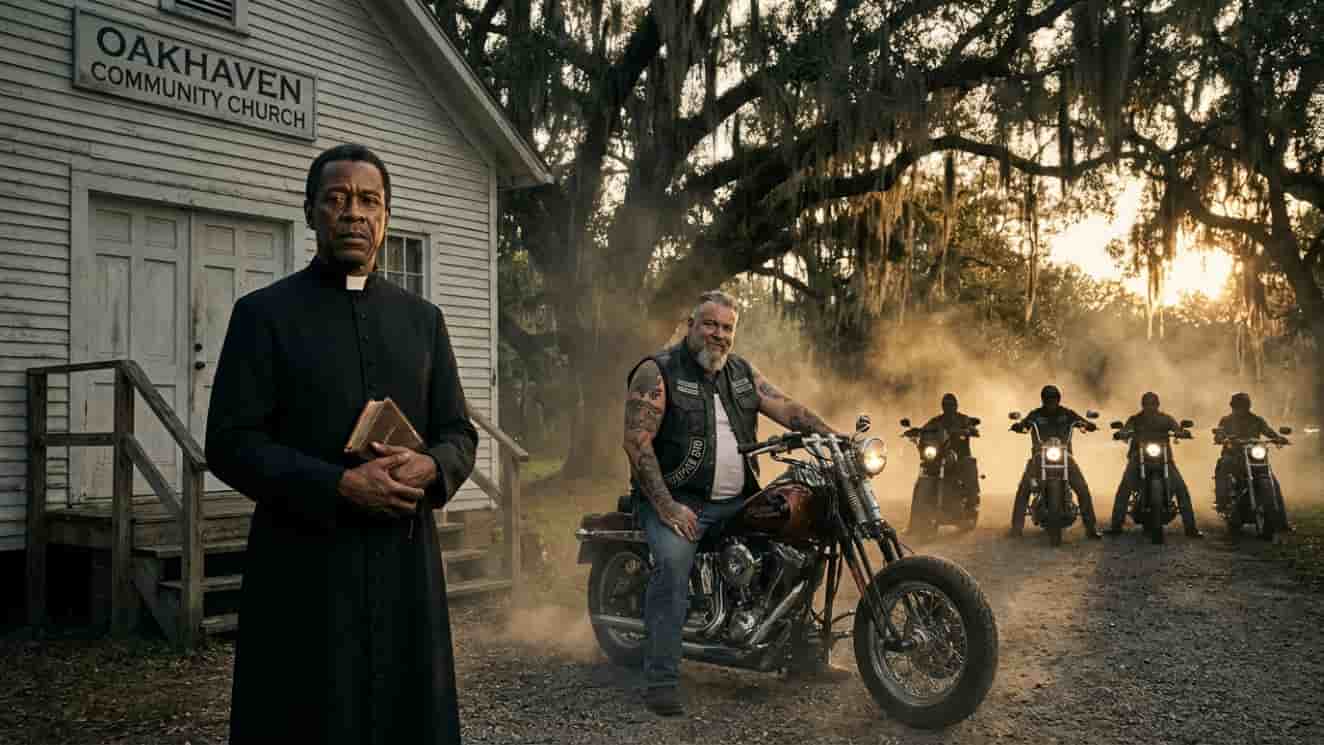
Caleb spent ten years trying to wash the grease and blood off his hands with holy water. He built a church in a town that didn’t want him, adopted a boy who needed a father, and buried his past under the floorboards.
But the Chapter 500 doesn’t believe in retirement.
When Deacon rolls into town with a pack of Harleys and a debt to collect, the peace of Oakhaven, Georgia, starts to smoke. They aren’t just here for the guns Caleb promised he’d destroyed. They’re here for the man Caleb used to be—the one who knew exactly where to strike to make a man stop screaming.
How do you protect a house of God when the devil has your old phone number?
FULL STORY
Chapter 1: The Weight of the Wood
The humidity in Oakhaven didn’t just hang in the air; it sat on your chest like a wet wool blanket. It was August in Georgia, the kind of heat that turned the cornfields into brittle yellow skeletons and made the local dogs too tired to bark at the mail truck. Inside the Grace Community Chapel, the air conditioner—a rattling window unit that Caleb had repaired four times in three years—was losing the battle.
Caleb stood at the front of the room, his hands resting on the edge of the pine pulpit he’d built himself. His palms were broad, the skin toughened by decades of work that had nothing to do with scripture. A thick, jagged scar ran from his left temple down to the corner of his jaw, a permanent souvenir from a night in a Savannah parking lot he tried not to think about before lunch.
He wasn’t a tall man, but he was wide, built like a bunker. When he wore the black shirt and the white plastic tab of the collar, he looked less like a messenger of peace and more like a bouncer for the Almighty.
“Turn to Micah, chapter six,” Caleb said, his voice a low, gravelly rumble that carried to the back row without a microphone.
The congregation was small today. Twenty people, maybe twenty-five. Most were elderly, people like Mrs. Gable, who had lived in Oakhaven since the roads were dirt, or Silas, the town’s former bartender who now spent his Sunday mornings nursing a different kind of spirit.
In the third row, Leo sat swinging his legs. He was ten, with hair the color of parched hay and a pair of oversized glasses that were constantly sliding down his nose. Caleb had taken him in two years ago after Leo’s mother—a woman Caleb had known in his “other” life—had succumbed to a fentanyl habit that didn’t care about the child she’d left behind.
Leo was the only reason Caleb still bothered to shave every morning. The boy was the only thing in this world that made Caleb believe he wasn’t just a collection of bad decisions held together by scar tissue.
“Micah asks a question we all know,” Caleb continued, his eyes scanning the room. He didn’t use notes. He didn’t like the way paper felt under his thumbs. “He asks what the Lord requires of us. And the answer isn’t complicated. To act justly. To love mercy. And to walk humbly.”
He paused, the rattle of the AC unit filling the silence.
“The hard part isn’t knowing the words,” Caleb said. “It’s the acting. It’s the doing. Justice isn’t a feeling you get in a pew. It’s a choice you make when you’re tired, or when you’re angry, or when someone has taken something from you that you can’t get back.”
Silas nodded slowly in the back. Caleb knew what Silas was thinking about—the daughter who wouldn’t call him, the years lost to the bottom of a brown bottle. Caleb looked back at Leo. The boy was drawing something on the back of a tithing envelope.
The service ended with a hymn that sounded thin in the heavy air. Caleb stood by the double doors, shaking hands that were calloused and dry. He smelled the peppermint on Mrs. Gable and the faint, lingering scent of motor oil on the younger men who worked the local garages.
“Good word, Pastor,” Silas said, pausing at the door. He leaned in, his eyes darting to the scar on Caleb’s face. “The heat’s making people mean, Caleb. You seen the trucks out by the interstate? The ones with the plates from up north?”
Caleb’s jaw tightened. “I seen ’em, Silas. People pass through all the time.”
“These ones ain’t passing,” Silas whispered. “They’re loitering. I recognize the look. You probably do, too.”
Caleb didn’t answer. He just squeezed Silas’s shoulder and turned to Leo, who was waiting by the steps with a worn backpack.
“Hungry, kid?” Caleb asked, forcing a smile.
“Can we go to Miller’s?” Leo asked. “They have the peach pie.”
“Peach pie it is.”
They walked across the parched grass to Caleb’s truck, a 2004 Ford F-150 that had more rust than paint. As Caleb climbed into the driver’s seat, he caught a sound on the wind. It was faint, a low-frequency vibration that most people would have dismissed as thunder or a distant tractor.
But Caleb knew that sound. It was the synchronized rhythm of heavy v-twin engines. Harleys. Not the polished, chrome-heavy bikes of the weekend warriors who rode to the coast, but the chopped, loud, aggressive roar of the Chapter 500.
He sat with his hand on the key, his heart hammering against his ribs in a way he hadn’t felt in years.
“Is the truck broken?” Leo asked, looking up from his drawings.
“No,” Caleb said, his voice sounding thin to his own ears. “Just checking the mirrors.”
He turned the key. The Ford groaned to life. He drove toward the diner, but his eyes never stopped checking the rearview mirror.
Miller’s Diner was the social hub of Oakhaven. It was a place of linoleum floors, chrome stools, and the smell of deep-fryer oil that never quite left your clothes. Sarah Miller, the owner’s daughter and a deputy with the county sheriff, was sitting at the counter in her uniform, a cup of black coffee in front of her.
Sarah was thirty, with sharp eyes and a way of standing that suggested she was always ready for a footrace. She’d grown up in Oakhaven, left for college, and came back because she believed the town was worth saving. She and Caleb had a strange, unspoken alliance. She knew he wasn’t from around here, and she knew his past was a dark room with the door locked, but she also saw how he looked at Leo.
“Pastor,” Sarah said, nodding as they walked in. “Leo. You look like you’ve been drawing again.”
“I drew a dragon,” Leo said, climbing onto a stool. “But it has a church on its back.”
Sarah smiled, but her eyes went to Caleb. They stayed there a second too long. “You okay, Caleb? You look like you’ve seen a ghost.”
“Just the heat, Sarah,” Caleb said, sliding onto the stool next to Leo. “Makes everything feel heavy.”
“It’s more than the heat,” she said, lowering her voice. “We got a call about an hour ago. A group of bikers stopped at the Sunoco on the bypass. They weren’t just refueling. They were asking questions. Specific ones.”
Caleb felt a cold drop of sweat slide down his spine. “What kind of questions?”
“They wanted to know where the old Baptist church was. The one that got bought out and renamed Grace Community.” Sarah leaned in, her badge glinting under the fluorescent lights. “They called it ‘The Enforcer’s Temple.’ You know anything about that?”
Caleb looked at his reflection in the napkin dispenser. He saw the scar. He saw the grey in his beard. He saw a man who had tried to bury his sins under a layer of pine boards and bad sermons.
“I’m the only pastor that church has had in five years, Sarah,” Caleb said, his voice flat. “I don’t know what they’re talking about.”
“Caleb,” she said, her voice soft but warning. “I’ve seen your files. Or rather, I’ve seen the holes where your files should be. You’re a good man. You’re good for this boy. Don’t let whatever is coming down that highway ruin that.”
Before Caleb could respond, the bell over the diner door chimed.
The air in the room didn’t just change; it died. The chatter of the three old men in the corner booth stopped. The sound of the grill scraping went silent.
Four men walked in. They wore denim vests over black hoodies, the back patches obscured by the way they moved, but Caleb didn’t need to see the “500” to know who they were. They smelled of unwashed leather, stale beer, and high-octane fuel.
The man in the lead was younger than Caleb, maybe mid-thirties, with a shaved head and a goatee that was braided with silver wire. He had a smile that didn’t reach his eyes—a practiced, shark-like grin that Caleb remembered all too well.
It was Deacon.
In the old days, Deacon had been Caleb’s apprentice. He was the one who cleaned the bikes, the one who handled the low-level collections, the one who watched Caleb’s back during the Savannah purge. Caleb had taught him how to ride, how to fight, and how to survive.
Deacon walked straight to the counter, ignoring the “Wait to be Seated” sign. He stopped three feet from Caleb.
“Well, look at this,” Deacon said, his voice a smooth, oily tenor. “The Hammer of the South. I heard you were wearing a collar now, but I didn’t believe it. I thought maybe you were just hiding out in a monastery or something.”
Leo shrunk back on his stool, his eyes wide behind his glasses. Caleb felt a surge of protectiveness that tasted like copper in his mouth.
“I’m a different man, Deacon,” Caleb said, his voice steady. “And this is a private conversation.”
Deacon glanced at Sarah, then at her badge. He chuckled. “Law enforcement. Always liked the way you played both sides, Caleb. Very pragmatic.” He turned his gaze to Leo. “And who’s the sprout? He yours? Or did you find him in the collection plate?”
Caleb stood up. He didn’t move fast, but he moved with a weight that made Deacon step back half an inch. The diner was silent. Sarah’s hand moved toward her holster, but she didn’t unclip the strap.
“Leave the boy out of it,” Caleb said.
Deacon held up his hands, palms out. “Hey, easy now. We’re just travelers, looking for a little spiritual guidance. We heard there was a man in this town who could help us find something we lost. Something very valuable.”
“I don’t have what you’re looking for,” Caleb said. “I told the Council that three years ago. I told them everything was gone.”
“Yeah, well,” Deacon said, the smile fading. “The Council changed. And the new guys? They aren’t as trusting as the old guard. They think you might have been… sentimental. They think you might have kept a few souvenirs for a rainy day.”
Deacon leaned in, his face inches from Caleb’s. “And Caleb, look outside. It’s starting to look like rain.”
“Get out of my town,” Sarah said, her voice sharp. “Now. Or I’m calling for backup and we’re going to have a very long conversation about your registrations and your priors.”
Deacon looked at her, then back at Caleb. He winked. “We’re staying at the Motel 6 by the interstate, Pastor. Room 12. In case you want to come by and give us a blessing. Or in case you remember where you put the ‘souvenirs.'”
He turned and signaled to his men. They walked out, the bell over the door ringing with a cheerful, mocking sound.
A moment later, the roar of the engines tore through the afternoon quiet, fading slowly as they headed toward the edge of town.
Caleb sat back down, but he didn’t pick up his fork. His hands were shaking. He tucked them under his thighs so Leo wouldn’t see.
“Caleb?” Sarah asked. “Who are they?”
“Shadows,” Caleb whispered. “Just shadows.”
“They don’t look like shadows to me,” she said. “They look like a problem I’m going to have to solve.”
“You can’t solve this, Sarah,” Caleb said, finally looking at her. “They don’t play by your rules. They don’t care about your jail.”
He stood up and put a ten-dollar bill on the counter. “Come on, Leo. We’re going home.”
“But I didn’t get my pie,” Leo said, his voice trembling.
Caleb looked at the boy, and for a second, he didn’t see the innocent kid he’d grown to love. He saw the world Deacon lived in—a world of fire and iron—creeping closer to the only thing Caleb had left.
“We’ll get pie tomorrow,” Caleb said, his voice hard. “Move.”
As they walked to the truck, Caleb looked up at the sky. There wasn’t a cloud in sight, but the air felt charged, like the moments before a lightning strike. He knew why Deacon was here. It wasn’t just about the guns. It was about the debt.
In the Chapter 500, you didn’t just quit. You died, or you disappeared so deep that not even the devil could find you. Caleb had tried to disappear in plain sight, behind a Bible and a wooden pulpit.
But as he drove Leo home, Caleb knew the truth. The pulpit wasn’t just a place to preach. It was a lid. And the things he’d buried underneath it were starting to claw their way out.
Chapter 2: The Shadow in the Pew
Monday morning arrived with the same relentless heat, but for Caleb, the world felt colder. He spent the morning at the church, ostensibly preparing for the mid-week prayer meeting, but mostly he just stood in the center of the sanctuary, listening to the building groan.
The Grace Community Chapel was an old structure, all dark oak and stained glass that had gone cloudy with age. It had been a sanctuary for generations of Oakhaven families, a place of baptisms and funerals. To Caleb, it was a fortress he’d built out of guilt.
He was currently painting the baseboards in the small office at the back when the front doors creaked open. It was a slow, deliberate sound.
Caleb wiped his hands on a rag and walked out into the sanctuary.
Deacon was sitting in the front row. He wasn’t wearing his vest now, just a black t-shirt that showed off the intricate, dark tattoos covering his arms—skulls, chains, and the weeping eye of the 500. He looked small in the vastness of the church, but his presence felt like a stain on the carpet.
“Nice place you got here, Caleb,” Deacon said without looking back. “Quiet. Good for thinking. I bet you do a lot of thinking in here.”
Caleb stayed by the pulpit. “I do. I think about the men I used to know. And I think about how lucky I am to be away from them.”
Deacon stood up and walked toward the altar. He ran a hand over the polished wood of the rail. “You always were the best at this. The ‘Enforcer.’ You had a way of making people understand the weight of their mistakes. You didn’t just break bones, Caleb. You broke spirits. That’s why the President loved you.”
“The President is dead,” Caleb said.
“He is. And he left a lot of loose ends.” Deacon stopped at the foot of the pulpit. He looked up at Caleb. “The guns, Caleb. Two hundred crates of high-grade hardware. Gone. You were supposed to sink them in the Atlantic. But the divers we sent down? They didn’t find anything but sand and old tires.”
Caleb’s heart skipped, but his face remained a mask of granite. “I told you. The current took them. The GPS was off.”
“Liar,” Deacon said, his voice dropping to a whisper. “You were always too smart for that. You didn’t dump them. You kept them. You thought they were your retirement fund. Or maybe your insurance policy.”
Deacon climbed the first step of the altar. Caleb didn’t move.
“Give them to me, Caleb,” Deacon said. “Give me the location, and we’re gone. I’ll tell the Council you’re a man of God now. I’ll tell them you’ve gone soft and you aren’t worth the gas it takes to ride down here. You can keep the boy. You can keep the church. You can keep your soul.”
“I don’t have them, Deacon.”
Deacon sighed, a sound of genuine disappointment. He reached into his pocket and pulled out a small, crumpled piece of paper. He laid it on the pulpit.
It was a drawing. A dragon with a church on its back.
Caleb felt the air leave his lungs. “Where did you get that?”
“The kid dropped it at the diner,” Deacon said. “He’s a talented little guy. Sharp eyes. He told me you keep a ‘big heavy box’ in the basement. He said you go down there at night when you think he’s asleep.”
Caleb’s hand clamped onto the edge of the pulpit so hard the wood groaned. “He’s a child. He has an imagination.”
“Does he?” Deacon leaned in. “Because he also said the box smells like ‘old pennies and grease.’ Now, I’ve been around guns my whole life, Caleb. And that’s exactly what a crate of oiled-down Berettas smells like.”
Deacon patted Caleb’s shoulder. The touch felt like a snake crawling over his skin. “I’ll give you until Wednesday. The night of your little prayer meeting. Either you tell me where the stash is, or I start showing this town who their pastor really is. I wonder how Mrs. Gable will feel when I show her the photos from the Savannah purge? The ones where you’re holding the gasoline can?”
Deacon turned and walked out, his boots thudding rhythmically against the floor.
Caleb stood alone in the silence. He felt a sudden, violent urge to vomit. He stumbled toward the back of the church, through the small door that led to the cellar stairs.
The cellar was damp and smelled of earth. It was filled with old hymnals, broken chairs, and boxes of Christmas decorations. In the far corner, hidden behind a stack of rotted plywood, was a heavy steel trunk.
Caleb knelt in the dirt. He pulled a key from a chain around his neck.
The lock turned with a heavy clack.
Inside, wrapped in oil-soaked rags and plastic sheeting, were the ghosts of his past. Not the two hundred crates—he’d actually destroyed most of those, fearful of the chaos they would cause—but he had kept the essentials. A dozen tactical shotguns. Twenty handguns. A crate of grenades. Enough firepower to turn Oakhaven into a war zone.
He’d told himself he kept them for protection. He’d told himself that if the club ever came for him, he wouldn’t go out like a lamb.
But looking at them now, in the dim light of the cellar, he realized he hadn’t kept them for protection. He’d kept them because, deep down, he didn’t believe he could ever truly be a pastor. He’d kept them because he was waiting for the monster to come back.
“Caleb?”
He jumped, slamming the lid of the trunk.
Sarah Miller was standing at the top of the stairs, her silhouette framed by the light from the sanctuary.
“Sarah,” Caleb said, his voice cracking. “I’m just… checking the pipes. The humidity is hell on the plumbing.”
She didn’t move. She walked down the stairs, her boots crunching on the dirt floor. She didn’t look at the pipes. She looked at him.
“I saw him leave,” she said. “The biker. Deacon.”
“He was just leaving a donation,” Caleb said, standing up and wiping his hands on his pants.
“Don’t lie to me, Caleb. Not in this house.” Sarah walked over to him. She looked at the rotted plywood, then at the corner where the trunk was hidden. “I did some digging this morning. I called a friend in the Bureau. They told me about the Chapter 500. They told me about a man they called ‘The Hammer.’ A man who disappeared three years ago right after a massacre in Savannah.”
She stepped closer, her face hard with a mixture of anger and something that looked like grief. “They said that man was a monster. They said he was the one who did the dirty work that even the club was afraid of.”
“Sarah, please,” Caleb whispered.
“Is it true?” she asked. “Is that who you are?”
Caleb looked at her—at the woman who believed in redemption, who believed that Oakhaven was a place of peace. He looked at the scar on his face, the physical manifestation of his failure.
“I was that man,” Caleb said. “But I’m trying… I’m trying to be someone else.”
“You can’t be someone else while you’re hiding their guns in my town’s church,” Sarah said, her voice rising. “I’m not a fool, Caleb. I smelled the oil when I walked in. I know what’s in that corner.”
“If you take them, they’ll kill me,” Caleb said. “They’ll kill Leo. They don’t care about the law, Sarah. They’ll burn this whole town to get what they want.”
“Then let me help you,” she said, reaching for his arm. “We can call the Feds. We can get you into protection.”
Caleb laughed, a dry, bitter sound. “The Feds? Deacon has people in the Feds. He has people everywhere. The only reason I’ve survived this long is because they thought I was dead or useless.”
He grabbed her shoulders, his fingers digging into her uniform. “If you do anything, Sarah—anything at all—you sign Leo’s death warrant. Do you understand me? You stay out of this. Let me handle Deacon.”
Sarah looked at him, and for the first time, she looked afraid. Not of Deacon, but of Caleb. The man standing in front of her wasn’t the pastor who visited the sick or the man who raised an orphan. He was the Enforcer.
“How are you going to handle him, Caleb?” she asked quietly. “With a Bible? Or with whatever is in that box?”
Caleb didn’t answer. He couldn’t.
She turned and walked up the stairs without another word.
Caleb stayed in the cellar for a long time. He listened to the silence, waiting for the peace of the church to return. But the peace was gone. The sanctuary above him felt like an empty shell, a lie he’d been telling himself for three years.
He reached out and touched the steel trunk. It was cold, even in the Georgia heat.
Later that evening, Caleb went to The Rusty Hook, the bar where Silas used to work. It was a dive on the edge of town, a place where the air was thick with the smell of stale beer and desperation.
Silas was sitting in his usual booth, a glass of tomato juice in front of him. He looked up as Caleb sat down.
“You look like hell, Pastor,” Silas said.
“I need to know something, Silas,” Caleb said. “When you were behind the bar… when you saw the bad men come through… how did you know when it was over? How did you know when they were done with you?”
Silas rubbed his chin, his eyes clouded with memory. “They’re never done with you, Caleb. Not really. They just find someone else to bleed for a while. But once you’re in their book? You stay in their book until the book gets burned.”
“And how do you burn the book?”
Silas looked at Caleb’s scar. “You know how. You don’t use water. You use fire. But the problem with fire, Caleb, is that it doesn’t care what else it burns. You start a fire to kill a snake, you might end up burning down the whole house.”
Caleb nodded. He understood.
He left the bar and drove out to the old blacksmith shop on the edge of the county. It was run by a man named Elias, a man who had been blind for twenty years but could still tell the quality of steel by the sound it made when it hit the anvil.
Elias was sitting on his porch, a pipe in his mouth. He didn’t turn his head as Caleb’s truck pulled up.
“You’re late, Caleb,” Elias said. “I expected you yesterday.”
“How did you know I was coming?”
“The wind smells like gasoline,” Elias said. “And your heart is beating like a drum with a hole in it.”
Caleb sat on the porch steps. “They’re here, Elias. Deacon and his crew.”
“I know. They stopped by this morning. Wanted me to sharpen some blades. Told them I only work for men, not dogs.” Elias spat into the dust. “You’re thinking about opening the floorboards, aren’t you?”
“I don’t have a choice,” Caleb said. “He’s threatening Leo.”
“There’s always a choice,” Elias said. “But some choices come with a price you can’t pay in cash. You pick up that iron again, Caleb, and the Pastor is dead. Even if you survive, you’ll never be able to look that boy in the eye again. You’ll be the Hammer again. And the Hammer only knows how to hit.”
“Then what do I do?” Caleb asked, his voice breaking. “I’ve prayed, Elias. I’ve begged. But God isn’t answering.”
“Maybe He is,” Elias said, leaning forward. “Maybe He’s telling you that the only way to save the boy is to lose yourself. Maybe the sacrifice isn’t your life, Caleb. Maybe it’s your soul.”
Caleb looked out over the withered cornfields. The sun was setting, casting long, bloody shadows across the land. He felt a weight in his chest, a heavy, cold certainty.
He wasn’t a man of God. He was a man of the 500 who had stolen a few years of peace. And now, the bill was due.
Chapter 3: The Ghost Under the Floorboards
Tuesday was a day of terrible stillness. Caleb kept Leo home from school, claiming the boy had a fever. In reality, Caleb couldn’t bear the thought of Leo being out of his sight for even a minute. They spent the morning in the small parsonage behind the church, Caleb cleaning and re-cleaning the kitchen while Leo played with his plastic knights on the linoleum floor.
“Why are we staying inside, Dad?” Leo asked, not looking up from a battle between a dragon and a king. “It’s sunny out.”
Dad. The word hit Caleb like a physical blow. Leo had only started calling him that a few months ago. Each time he said it, Caleb felt a flicker of hope that he might actually belong in this world. Now, each “Dad” felt like a countdown.
“The air is bad today, Leo,” Caleb said, his back to the boy. “The pollen is high. It’ll make your eyes itchy.”
“I don’t mind itchy eyes,” Leo said. “Can we go to the woods? You said you’d show me where the deer hide.”
“Not today, son. Maybe… maybe after Wednesday.”
Caleb walked to the window and pulled the curtain back just an inch. A black SUV was parked at the end of the gravel drive, sitting idly under the shade of a dying oak. He couldn’t see the driver, but he knew the shape of the man’s shadow. Deacon was watching. Deacon was letting the pressure build, waiting for the moment when Caleb would crack.
By afternoon, the house felt too small. Caleb’s skin felt tight, like it was vibrating with the need for action. He sent Leo to his room to read and went into his small study. He pulled a heavy, leather-bound Bible from the shelf—the one given to him by the elders when he took the job.
He sat at his desk and opened it, but the words were just ink on paper. Vengeance is mine, sayeth the Lord.
“Well, Lord,” Caleb whispered to the empty room, “You’re taking your sweet time.”
He closed the Bible and stood up. He knew what he had to do. He couldn’t wait until Wednesday. If he waited until the prayer meeting, the church would be full of people. Deacon would use them as shields. He would turn the sanctuary into a slaughterhouse.
Caleb grabbed a flashlight and a heavy canvas bag. He walked out the back door of the parsonage, staying low as he moved across the yard to the church’s side entrance. He slipped inside, the cool, quiet air of the sanctuary doing nothing to calm his nerves.
He went straight to the cellar.
The steel trunk sat where he’d left it, a silent witness to his cowardice. He knelt in the dirt and opened it again. This time, he didn’t hesitate. He pulled out the first weapon—a Remington 870 pump-action shotgun. It was heavy, familiar, and cold. He checked the action. It moved with a slick, metallic snick-snack that echoed in the small space.
He began to unload the trunk, laying the weapons out on an old tarp. Handguns, extra magazines, boxes of shells. He worked with the muscle memory of a man who had spent half his life in humid garages, prepping for runs into hostile territory.
He was halfway through cleaning a Glock 17 when he heard the floorboards groan above him.
He froze, his hand tightening around the grip of the pistol. He didn’t breathe.
The sound came again. Someone was walking slowly down the center aisle of the church.
Caleb set the gun down silently and moved toward the stairs. He kept his back to the wall, his heart hammering a frantic rhythm. He reached the top of the stairs and peered through the crack in the door.
It wasn’t Deacon.
It was Silas. The old bartender was standing at the altar, looking up at the large wooden cross that hung behind the pulpit. He looked small, his shoulders slumped, his hands trembling at his sides.
“Caleb?” Silas called out, his voice thin and shaky. “You in here? I seen your truck.”
Caleb pushed the door open and stepped out. He kept his hands behind his back, hiding the grease and the smell of gunpowder.
“I’m here, Silas. What’s wrong?”
Silas turned, and Caleb saw the bruise. A deep, purple welt ran across Silas’s cheek, and his lip was split. One of his eyes was already beginning to swell shut.
“They came to the bar,” Silas whispered. “Deacon and two of his boys. They wanted to know if I knew where you kept the ‘tithing.’ I told ’em I didn’t know nothing.”
Caleb felt a cold rage settle into his bones. “Did they hurt anyone else?”
“They broke some glass,” Silas said, wiping a bit of blood from his lip. “Scared the girl who works the dayshift. But Caleb… they said they were coming for the boy next. They said if you didn’t show up at the motel by sundown, they were gonna go ‘visit’ Leo.”
Caleb’s vision blurred at the edges. The rage was no longer cold; it was white-hot, a familiar heat that he hadn’t felt since Savannah. The “Hammer” was waking up, and it wanted to hit something.
“Go to Sarah Miller’s house, Silas,” Caleb said, his voice dropping an octave. “Stay there. Tell her what happened.”
“What are you gonna do, Caleb?” Silas asked, looking at the door to the cellar. “You can’t go to the police. You said so yourself.”
“I’m going to do what I should have done three years ago,” Caleb said. “I’m going to finish the job.”
Silas looked at Caleb—really looked at him—and for the first time, he saw the man the Chapter 500 had created. He saw the predator behind the pastor’s eyes. Silas didn’t argue. He just nodded and hurried out the front doors.
Caleb went back to the cellar. He didn’t clean the guns anymore. He loaded them.
He filled the magazines with a methodical, rhythmic precision. He stuffed extra shells into his pockets. He felt the weight of the hardware against his body, and for a terrifying second, it felt good. It felt right. Like a man finally putting on a suit that fit.
He heard the truck pull up outside.
He moved to the window of the cellar, peering through the small, dirt-streaked pane. Sarah Miller’s cruiser was idling in the parking lot. She stepped out, her face set in a grim expression.
Caleb swore under his breath. He couldn’t let her see him like this. He couldn’t let her stop him.
He grabbed his bag and slipped out the back door, staying in the long shadows cast by the church as the sun began its slow descent. He made it to his truck, tossed the bag onto the floor of the passenger side, and covered it with a pile of old blankets.
By the time Sarah reached the front door of the church, Caleb was pulling out of the parking lot. He saw her watch him go in the rearview mirror, but she didn’t follow. She had Leo to worry about now. Caleb had called her five minutes ago and told her the boy was home alone and scared. It was a lie, but it was a lie that would keep them both safe.
Caleb drove toward the edge of town, toward the Motel 6.
The parking lot was a sea of cracked asphalt and weeds. Four Harleys were lined up in front of Room 12, their chrome reflecting the orange glow of the setting sun. The black SUV was there, too, its engine clicking as it cooled.
Caleb parked his truck fifty yards away, behind a row of rusted shipping containers. He didn’t get out immediately. He sat in the cab, his hands gripping the steering wheel.
He thought about the first time he’d ever held a gun. He was eighteen, a runaway with nothing but a grudge and a fast bike. The 500 had given him a family. They’d given him a purpose. And in exchange, they’d taken everything that made him human.
He thought about the night in Savannah. The screaming. The smell of gasoline. The way the President had laughed as the building went up in flames. Caleb had realized then that he wasn’t part of a brotherhood. He was part of a plague.
And now, the plague had followed him to Oakhaven.
He reached into the bag and pulled out the Glock. He tucked it into the small of his back. He grabbed the Remington and stepped out of the truck.
The air was still thick and hot, but a wind was finally picking up, rattling the dry corn in the fields across the highway.
He walked toward Room 12. He didn’t try to hide. He walked with the heavy, deliberate stride of a man who had already accepted his fate.
The door to Room 12 was slightly ajar. Music was playing inside—something loud, industrial, and discordant.
Caleb kicked the door open.
The room was a mess of pizza boxes, beer cans, and scattered gear. Deacon was sitting on the edge of one of the twin beds, cleaning a knife with a leather strop. Two of his men were in the corner, one of them holding a shotgun, the other scrolling through his phone.
They all froze as Caleb stepped into the light.
“Well,” Deacon said, a slow grin spreading across his face. “Look who found his backbone. I was starting to think I’d have to go through your whole congregation before you’d show up.”
“Where are they, Deacon?” Caleb asked, his voice a low growl. “Where are the men who sent you?”
Deacon laughed. “They’re in Savannah, Caleb. Waiting for the good news. Waiting to hear that the Hammer has finally come home.”
Deacon stood up, the knife glinting in the dim light. He looked at the shotgun in Caleb’s hand. “You gonna use that, Pastor? You gonna blow a hole in the Gospel? Think about the boy. Think about what he’ll see when he looks at you.”
“The boy isn’t going to see anything,” Caleb said. “Because after tonight, you aren’t going to exist.”
The man in the corner with the shotgun started to raise his weapon.
Caleb didn’t hesitate. He swung the Remington and fired.
The roar of the shotgun in the small room was deafening. The man was thrown back against the wall, his chest a ruin of red and denim.
The other man reached for a pistol on the nightstand, but Caleb racked the slide and fired again. The man crumpled, his phone sliding across the floor.
Deacon dove behind the other bed, pulling a handgun from his waistband. He fired two shots, the bullets whistling past Caleb’s head and shattering the mirror on the dresser.
Caleb dived for cover behind a heavy armchair.
“You haven’t lost your touch!” Deacon yelled over the music. “But you’re outnumbered, Caleb! You think I only brought four guys? The whole chapter is five miles down the road!”
“Then they better hurry,” Caleb said.
He popped up and fired a round into the mattress where Deacon was hiding. Stuffing and springs exploded into the air.
Deacon scrambled toward the bathroom, firing blindly.
Caleb moved, his body working on instinct, his mind a cold, calculated void. He was no longer the man who preached about mercy. He was the man who had been built for this.
He reached the bathroom door just as Deacon slammed it shut. Caleb fired a round through the wood, the buckshot splintering the cheap hollow core.
He heard a grunt of pain from the other side.
Caleb kicked the door open.
Deacon was slumped against the bathtub, his hand clutching his side. Blood was soaking through his black t-shirt. His handgun was on the floor, out of reach.
He looked up at Caleb, and for the first time, the shark-like grin was gone. There was only fear.
“Do it,” Deacon wheezed. “Do it, Hammer. Show the world who you really are.”
Caleb stood over him, the shotgun aimed at Deacon’s head. His finger was on the trigger. The pressure was there—the familiar, seductive pull of the kill.
In that moment, he saw Leo’s face. He saw the drawing of the dragon.
If he pulled this trigger, the dragon won. The church would stay on its back, but it would be a church built on blood, not grace.
Caleb lowered the shotgun.
“I’m not the Hammer,” Caleb said, his voice trembling with the effort of restraint. “And I’m not your brother.”
He reached down, grabbed Deacon by the collar, and dragged him out of the bathroom. He threw him onto the floor of the main room, amidst the bodies of his men.
“Call them,” Caleb said, pointing to the phone on the floor. “Call the chapter. Tell them the guns were destroyed in Savannah. Tell them you found nothing but an old man and a kid who didn’t know anything.”
“Why would I do that?” Deacon spat, blood bubbling at the corner of his mouth.
“Because if you don’t,” Caleb said, leaning in close, “I won’t kill you. I’ll take you to the woods, and I’ll make you wish I had.”
Deacon looked into Caleb’s eyes. He saw the truth there. He saw that the Pastor was a mask, but the man underneath was something far more dangerous than anything the Chapter 500 had ever seen.
Deacon reached for the phone.
Caleb stood back, watching him. He felt a sudden, crushing weight of exhaustion. The adrenaline was fading, replaced by a cold, hollow ache.
He walked out of the motel room, leaving Deacon to his lies.
He drove back toward town, but he didn’t go to the church. He drove to the edge of the cornfields and watched the sun finally disappear.
The wind was blowing hard now, and for the first time in months, the smell of rain was in the air.
Caleb sat in the dark, his hands still covered in grease and blood. He had saved the boy. He had saved the town.
But as the first drops of rain began to hit the windshield, Caleb knew that he hadn’t saved himself. He had opened the floorboards, and the ghosts were out. And ghosts, once they were in the light, didn’t like to go back into the dark.
Chapter 4: The Crack in the Pulpit
Tuesday night didn’t bring sleep; it brought a heavy, suffocating silence that felt louder than the shotgun blasts at the motel. Caleb returned home well after midnight, his truck parked a mile away in a wooded grove. He walked the rest of the way through the parched fields, the new rain turning the dust into a slick, treacherous mud that clung to his boots.
He entered the parsonage through the back door. The house was quiet. He checked Leo’s room first. The boy was asleep, curled into a ball with his glasses on the nightstand and a book about dinosaurs face-down on his chest.
Caleb stood in the doorway for a long time, watching the rhythmic rise and fall of the boy’s shoulders. He looked at his own hands—scrubbed raw with Boraxo in the kitchen sink, but still feeling stained. He had killed two men. He had spared a third only to threaten him with a fate worse than death.
To act justly. To love mercy.
The words felt like a mockery.
He went to the bathroom and stripped off his clothes. He saw the fresh bruise on his ribs where a bullet had grazed his vest—a piece of Kevlar he’d pulled from the trunk that he’d never told anyone about. He saw the old scars, too. The Savannah burn on his shoulder. The knife wound on his thigh. They were a map of a life he had tried to burn, but the fire had only hardened the ink.
At 3:00 AM, there was a knock at the door. It wasn’t the heavy, rhythmic thud of a biker. It was sharp, official, and hesitant.
Caleb threw on a robe and went to the door. Sarah Miller was standing on the porch. She was still in uniform, her hair damp from the rain, her face pale.
“I found them,” she said without preamble.
Caleb didn’t invite her in. He just stood there, the screen door between them. “Found who, Sarah?”
“The men at the Motel 6. Two dead. One missing—your friend Deacon, I assume. The state police are all over it.” She looked at him, her eyes searching his face for a lie she could believe. “The neighbors heard the shots. They saw a truck leaving. A truck that looked a lot like yours.”
“A lot of people drive Fords in this county,” Caleb said.
“Don’t,” she snapped. “Don’t do that. Not now.”
She stepped closer, her voice dropping to a whisper. “I checked the church, Caleb. I went back after you left. I found the cellar. I found the tarp. I saw what you were doing.”
Caleb looked past her into the darkness of the yard. The rain was coming down harder now, a steady drumbeat on the tin roof. “They were going to kill Leo, Sarah. They beat Silas. They were going to burn this town down just to see if I’d flinch.”
“So you became the Hammer again,” she said. It wasn’t a question. It was an indictment. “You told me you were a different man.”
“I am,” Caleb said. “A different man would have enjoyed it. I just wanted it to be over.”
Sarah leaned her head against the doorframe, her eyes closing for a second. “I have to report this, Caleb. I’m a deputy. I can’t just walk away from a double homicide.”
“Then don’t,” Caleb said. “Do what you have to do. But wait until tomorrow. Let me take Leo to his aunt’s place in Valdosta. Let him be away from here when the sirens start.”
Sarah looked at him, and he saw the struggle in her. She was a woman of the law, but she was also a woman who had seen Caleb hold Leo’s hand during a thunderstorm. She had seen him fix Mrs. Gable’s porch for free. She had seen the man he had tried to become.
“Twenty-four hours,” she said, her voice shaking. “I’ll tell the state guys I’m still processing the scene. I’ll tell them I haven’t identified the vehicle yet. But after that, Caleb… I can’t help you.”
“I’m not asking for help,” Caleb said. “I’m asking for a head start for the boy.”
She turned and walked back to her cruiser, the blue and red lights off, but her presence feeling like a beacon in the dark.
Caleb didn’t go back to bed. He went to the church.
The sanctuary was cold and smelled of damp earth and old incense. He walked to the pulpit and sat on the floor behind it. He reached out and touched the wood. It felt solid, real.
He stayed there until the sun began to peek through the clouds. It wasn’t a bright sunrise; it was grey and muffled, the rain having settled into a persistent drizzle.
Leo came into the church around 7:00 AM. He was wearing his raincoat and carrying his backpack. “Are we going now, Dad?”
Caleb looked up. He hadn’t realized he’d been sitting there for hours. “Yeah, Leo. We’re going.”
“Is the air still bad?”
“No,” Caleb said, standing up and brushing the dust from his robe. “The air is clearing. But we’re going to visit Aunt Martha for a few days. It’ll be an adventure.”
“Will you stay with me?” Leo asked, his eyes wide and uncertain.
Caleb knelt in front of him. He grabbed the boy’s small shoulders. “I’ll be right behind you, Leo. I just have to finish some things here. Some… church business.”
He drove Leo to Valdosta. The drive was three hours of unbearable tension. Every time a siren sounded in the distance, Caleb’s heart jumped. Every time he saw a police car, he gripped the wheel until his knuckles went white.
Leo talked about his drawings, about the dragons and the knights. He seemed to sense the tension in the cab, his voice becoming smaller and more hesitant as the miles passed.
When they reached Martha’s house—a small, tidy bungalow with a porch full of ferns—Caleb walked Leo to the door.
Martha was a stern woman with a kind heart. She knew Caleb’s history—at least, the version he’d told her. She looked at his face, at the exhaustion and the hidden violence, and she didn’t ask questions. She just took Leo’s hand.
“Go on, Leo,” Caleb said. “I’ll call you tonight.”
Leo hugged him, his small arms barely reaching around Caleb’s waist. “Don’t forget the deer, Dad. You promised.”
“I won’t forget,” Caleb whispered.
He watched them go inside. He stood on the sidewalk for a long time, the silence of the suburban street feeling alien and wrong. He felt like a man who had just stepped off a cliff and was waiting to hit the ground.
The drive back to Oakhaven felt like an eternity. He passed the Motel 6. It was cordoned off with yellow tape. There were three state trooper vehicles in the parking lot.
He didn’t stop. He went straight to the church.
He didn’t go inside the parsonage. He went into the sanctuary and closed the doors. He sat in the front row, the same place Deacon had sat.
He waited.
Around 4:00 PM, the doors opened.
It wasn’t Sarah Miller. It wasn’t the state police.
It was Elias, the blind blacksmith. He was being led by his dog, a grizzled old Lab that moved with a slow, dignified gait. Elias tapped his cane against the floorboards as he walked down the aisle.
“You’re back,” Elias said, stopping a few feet from Caleb.
“I’m back,” Caleb said. “Leo is safe.”
“For now,” Elias said. He sat down next to Caleb, his sightless eyes turned toward the altar. “I heard about the motel. Word travels fast when people start dying.”
“I didn’t have a choice, Elias.”
“You keep saying that,” the blacksmith said. “But choice is a funny thing. You think you’re choosing to save the boy, but you’re really choosing to be the man you hate. You think the two are different, but they’re just two sides of the same coin.”
Elias leaned forward, resting his hands on his cane. “Deacon isn’t dead, Caleb. He’s at the hospital in Macon. I have a nephew who works the desk there. He said a man matching Deacon’s description came in with a gut shot and a story about a carjacking.”
Caleb felt a surge of cold dread. “He’s still alive?”
“He is. And he’s talking. Not to the police, but to his people. They’re coming, Caleb. Not just a few bikers. The whole Savannah chapter. They think you’re holding out on them. They think you killed their brothers and they want blood.”
“I told him the guns were gone,” Caleb said.
“He didn’t believe you. Or maybe he just doesn’t care. Men like that, Caleb… they don’t need a reason to burn things. They just need a target.”
Elias turned his head, as if listening to something far away. “You have to finish it, Caleb. Not with a shotgun. Not with a knife. You have to give them what they want.”
“The guns?”
“No,” Elias said. “The Hammer. They want the man who betrayed them. They want the man who thinks he can be a saint.”
Elias stood up. “The prayer meeting is tonight, Caleb. People are going to show up. Mrs. Gable. Silas. All those people who look at you and see a man of God. If you stay here, they’ll die. If you run, they’ll follow you to the boy.”
“Then what do I do?” Caleb asked, his voice a broken whisper.
Elias reached out and found Caleb’s shoulder. His grip was surprisingly strong. “You go to the mountain, Caleb. You go to the place where the fire started. And you make sure it doesn’t spread.”
The blacksmith turned and walked out, his cane tapping a rhythmic, final beat against the floor.
Caleb stood up. He walked to the pulpit. He looked at the Bible he’d left there.
He didn’t open it. He reached under the pulpit and pulled out the crowbar he’d left there.
He went to the cellar.
He spent the next three hours hauling the remaining crates out of the basement. He didn’t hide them. He stacked them in the center of the sanctuary, right in front of the altar. He ripped the plastic off the weapons, letting the smell of grease and cold steel fill the room.
He went to the parsonage and grabbed three five-gallon cans of gasoline he kept for the lawnmower. He carried them into the church.
He began to pour.
He soaked the pews. He soaked the altar. He soaked the crates of guns. The smell was overpowering, a sharp, chemical sting that made his eyes water.
He stood in the center of the room, the gasoline dripping from his hands.
He checked his watch. 6:30 PM. The prayer meeting was supposed to start in thirty minutes.
He walked to the front doors and locked them. He hung a sign on the handle: SERVICE CANCELLED. GO HOME. STAY INSIDE.
He went back to the altar and sat down on the floor, surrounded by the weapons of his past and the fuel of his destruction. He pulled a single matchbook from his pocket. It was from Miller’s Diner.
He waited.
He didn’t have to wait long.
The sound of the engines began as a low hum on the horizon. It grew louder, a mechanical roar that shook the very foundation of the church. Ten bikes. Twenty. Maybe more. They weren’t hiding now. They were a pack, and they were hungry.
The bikes pulled into the parking lot, their headlights cutting through the darkening drizzle like the eyes of predators.
Caleb stood up. He walked to the window and looked out.
The Chapter 500 had arrived. They were led by a tall man in a leather trench coat—the President of the Savannah chapter. Behind him stood a dozen men, all armed, all wearing the same cold, expectant grins.
Caleb didn’t feel afraid. He felt a strange, terrifying sense of peace.
He walked back to the altar. He struck a match.
The flame was small and blue, flickering in the drafty air.
“Okay, Lord,” Caleb whispered. “Let’s see what you require of me.”
Chapter 5: Fire and Brimstone
The roar of the bikes outside didn’t just vibrate the walls; it seemed to hum in Caleb’s very marrow. He stood in the center of the sanctuary, the air thick and shimmering with gasoline fumes. The smell was a heavy, sweet rot that coated the back of his throat.
He looked at the match in his hand. It was a tiny thing, a sliver of wood and sulfur that held the power to end everything.
Outside, the engines cut out one by one, replaced by the heavy thud of boots on gravel and the metallic clack of weapons being readied. A voice boomed through the front doors—deep, authoritative, and cold.
“Caleb! Open the doors!”
It was the President. He was a man named Jax, a man who had seen Caleb’s rise and fall, and who had never forgiven him for trying to leave.
Caleb didn’t answer. He walked to the front doors and leaned his forehead against the wood. Through the small, leaded glass window, he could see the mob. They had the church surrounded. They were holding torches and flashlights, the light flickering off their leather vests and the chrome of their bikes.
“I know you’re in there, Hammer!” Jax shouted. “We saw the truck. We know the boy is gone, but we don’t care about the brat. We want the guns. And we want the man who thought he could hide from us.”
Caleb stepped back. He looked at the crates of weapons stacked before the altar. The Berettas, the AR-15s, the grenades. It was a king’s ransom in the world of the 500. It was enough to fuel a war that would last for years.
He walked back to the altar. He didn’t pick up a gun. He picked up the Bible.
“I’m not coming out, Jax!” Caleb yelled back, his voice surprisingly steady. “And you aren’t coming in! Not for the guns!”
A chorus of laughter erupted from outside. “You think these doors are gonna stop us? We’ll burn you out, Caleb! We’ll turn this little shack into a funeral pyre!”
“I’ve already started the fire!” Caleb shouted.
The laughter died.
Caleb struck another match. He dropped it onto the gasoline-soaked carpet at the foot of the altar.
The fire didn’t just start; it exploded. A wall of orange flame surged upward, licking at the dry oak of the altar and the plastic wrapping on the gun crates. The heat was immediate and violent, pushing Caleb back toward the vestry door.
“He’s burning them!” someone outside screamed. “He’s burning the stash!”
The front doors were kicked with a thunderous bang. The heavy wood groaned, the locks straining against the pressure.
Caleb didn’t watch the doors. He watched the fire. It was beautiful in a terrifying way—a cleansing, hungry thing that didn’t care about history or guilt. It was eating the pews, the hymnals, and the very air he breathed.
The front doors finally gave way. Jax and three of his men burst into the sanctuary, their faces illuminated by the inferno. They stopped dead, the heat hitting them like a physical blow.
“You idiot!” Jax roared, shielding his eyes. “You’re burning millions of dollars! You’re burning your own life!”
“I’m burning the Hammer!” Caleb yelled over the roar of the flames. “I’m burning the Chapter 500! Get out, Jax! This place is gone!”
One of the bikers, a younger man with a frantic look in his eyes, lunged forward toward the crates of guns. He reached into the flames, trying to pull a box of handguns out of the fire.
“Don’t!” Caleb screamed.
The man didn’t listen. He grabbed the crate.
The heat had already reached the ammunition inside.
A series of sharp, rapid pops echoed through the sanctuary—the sound of 9mm rounds cooking off. The biker was hit in the shoulder and the chest, his body jerking as he was thrown backward.
The other men scrambled for the exit as the fire reached the first of the grenades.
Caleb didn’t wait. He dived through the small door behind the altar, the one that led to the parsonage yard. He hit the ground hard, the air outside feeling miraculously cool and sweet despite the smoke billowing from the church’s roof.
He didn’t run. He turned and watched.
The Grace Community Chapel was no longer a building. It was a chimney of fire. The stained-glass windows shattered from the heat, showering the gravel parking lot with a rain of colored glass. The roof began to sag, the old beams groaning under the weight of the destruction.
Jax and his men were backing away from the building, their bikes already being moved toward the road. They looked at the burning church, their faces masks of rage and disbelief. They had come for a treasure, and all they had found was ashes.
Caleb stood in the shadows of the parsonage, his face blackened with soot, his robe singed. He felt a sudden, sharp pain in his side—a piece of shrapnel from the exploding ammo had caught him. He pressed his hand to the wound, the warm blood soaking through the fabric.
He didn’t care.
Jax looked toward the parsonage. He saw Caleb. He reached for his holster, but his hand stopped.
The sound of sirens was already filling the air. Not just one or two, but a chorus of them, coming from every direction. The people of Oakhaven had seen the fire. Sarah Miller had made her call.
Jax looked at Caleb, then at the wall of fire, then at the approaching lights. He realized the game was over. The Hammer was dead, and the guns were gone. There was nothing left here but a long prison sentence or a shootout they couldn’t win.
“This isn’t over, Caleb!” Jax yelled, his voice barely audible over the sirens. “We’ll find you! We’ll find the boy!”
“No you won’t,” Caleb whispered to himself.
Jax signaled his men. They mounted their bikes and tore out of the parking lot, heading for the back roads and the swampy darkness of the Georgia border.
Caleb stayed until the first fire truck pulled into the drive. He watched the firemen jump out, their hoses snaking across the grass. He watched Sarah Miller’s cruiser slide to a halt, the blue and red lights reflecting in the puddles of rain.
He didn’t wait for her to find him.
He walked into the woods behind the parsonage, his steps slow and heavy. Every breath was a struggle, his lungs feeling like they were full of broken glass. The wound in his side was pulsing, a dull, rhythmic ache that seemed to be counting down his remaining minutes.
He walked until he reached the old blacksmith shop. The lights were off, but he could see Elias sitting on the porch, a silent sentinel in the dark.
Caleb collapsed onto the bottom step.
Elias didn’t move. “The sky is red, Caleb.”
“It’s over, Elias,” Caleb wheezed. “The church… it’s gone.”
“And the guns?”
“Ashes. Every last one of them.”
Elias nodded slowly. “And the man who kept them?”
Caleb looked at his hands. They were shaking. He felt a sudden, overwhelming wave of grief—not for the building, not for the guns, but for the man he had been trying so hard to be. He had burned the lie, but he had burned the truth along with it.
“He’s gone too,” Caleb said.
“Then you’re free,” Elias said. “Free to be whatever is left.”
“There’s nothing left, Elias. I’m a killer. I’m a liar. I’m a ghost.”
Elias reached down and touched Caleb’s head. His hand was rough, like the bark of an old oak. “A ghost is just a soul that hasn’t found its way home yet. You saved the boy, Caleb. You saved the town. That’s a start. That’s a foundation.”
Caleb closed his eyes. He listened to the distant sound of the fire trucks and the rain hitting the leaves. He felt the life draining out of him, a slow, quiet tide.
“Elias?”
“Yes, Caleb?”
“Tell Leo… tell him I’m sorry about the deer.”
“Tell him yourself,” Elias said, his voice firm. “You aren’t done yet, Caleb. The fire didn’t take you. The hammer didn’t break you. You’re still standing. And as long as you’re standing, you have work to do.”
Caleb didn’t answer. He felt the darkness closing in, but it wasn’t the cold, sharp darkness of the 500. It was something else. Something softer.
He drifted into a sleep that felt like a prayer.
Chapter 6: The Iron Tithe
The hospital in Valdosta was a place of white walls, the hum of fluorescent lights, and the smell of antiseptic that tried and failed to mask the scent of human suffering. Caleb woke up to the rhythmic beeping of a heart monitor—a steady, annoying sound that reminded him he was still alive.
His side was bandaged, a dull ache radiating from the surgical site where they’d removed the shrapnel. His lungs felt heavy, but the air was clean.
Sarah Miller was sitting in a chair by the window. She was out of uniform, wearing a faded Georgia Tech sweatshirt and jeans. She looked tired, her eyes red-rimmed.
“You’re awake,” she said, her voice flat.
Caleb tried to sit up, but the pain made him hiss. “How long?”
“Two days,” she said. “The fire department said it was the hottest blaze they’d ever seen. They found the remains of the weapons. The ATF is still trying to count the serial numbers.”
She stood up and walked to the edge of the bed. “Jax and his crew were picked up at a roadblock near Savannah. Deacon is in custody in Macon. They’re all talking, Caleb. Trying to cut deals. They’re telling stories about a man called the Hammer.”
Caleb looked at his hands. They were clean now, the soot scrubbed away by the nurses. “And what are you telling them, Sarah?”
She looked out the window. “I’m telling them that Pastor Caleb was inside the church trying to save the archives when the building exploded. I’m telling them that the bikers attacked him. I’m telling them that he’s a hero who nearly died protecting his congregation.”
Caleb looked at her in disbelief. “Why?”
“Because Oakhaven needs a hero,” she said, turning back to him. “And because Leo needs a father. If I tell the truth, you go to prison for the rest of your life. Leo goes into the system. And the Chapter 500 wins.”
She leaned in, her face inches from his. “But don’t think for a second that this is over. You owe this town, Caleb. You owe me. You’re going to spend every day for the rest of your life earning this lie. You’re going to be the man everyone thinks you are, even if it kills you.”
“I can’t be a pastor anymore, Sarah,” Caleb whispered. “Not after what I did.”
“No,” she said. “You can’t. The church is gone. But you’re still a man who knows how to fix things. You’re a man who knows how to listen. You’ll find a way.”
She left the room without another word.
A few hours later, the door opened again. Leo ran in, followed by Aunt Martha. The boy didn’t hesitate; he jumped onto the bed, burying his face in Caleb’s chest.
“You’re okay!” Leo cried, his voice muffled by the hospital gown. “The lady said you were in a big fire!”
Caleb held him, his arms trembling. He felt the boy’s heart beating against his own, a fast, frantic rhythm of life. “I’m okay, Leo. I’m okay.”
“Is the church really gone?” Leo asked, looking up.
“It is, son. It’s all gone.”
“Where will we go?”
Caleb looked at Aunt Martha, who gave him a small, encouraging nod. He looked at the window, where the Georgia sun was finally breaking through the clouds.
“We’re going to stay here for a bit,” Caleb said. “And then… then we’re going to build something new. Not a church, maybe. But a home. A real one.”
“With a garden?” Leo asked. “And a place for the deer?”
“With everything, Leo. I promise.”
Two weeks later, Caleb returned to Oakhaven.
He didn’t go to the parsonage. He went to the site of the church.
The building was a blackened skeleton, the charred beams reaching toward the sky like skeletal fingers. The ground was covered in ash and twisted metal. The smell of smoke still lingered, a ghostly reminder of the night the Hammer died.
He saw a group of people standing by the road. Mrs. Gable. Silas. A dozen others from the congregation. They weren’t crying. They were just standing there, looking at the ruins.
When they saw Caleb’s truck, they moved toward him. They didn’t see a monster. They didn’t see an enforcer. They saw their pastor.
“We’re sorry, Caleb,” Mrs. Gable said, taking his hand. “We’re so sorry about the chapel.”
“It was just wood and nails, Mrs. Gable,” Caleb said, his voice thick with emotion. “The church is still here.” He looked at the faces of the people who had accepted him, who had given him a second chance he didn’t deserve.
“We heard you’re staying,” Silas said. “We heard you’re going to work with Elias at the forge.”
“I am,” Caleb said. “Iron is easier to deal with than souls, I reckon.”
Silas smiled, a genuine, crooked grin. “Maybe. But we still need you, Caleb. We still need a man who knows how to stand his ground.”
Caleb spent the next year working at the blacksmith shop. He learned the rhythm of the hammer and the anvil, the way the heat changed the nature of the steel. He found a strange kind of peace in the work—it was honest, physical, and final.
He and Leo moved into a small house on the edge of town, a place with a wide porch and a yard that bordered the woods. They planted a garden. They built a fence.
Caleb never picked up a gun again.
He saw Sarah Miller once a week. They didn’t talk about the motel or the fire. They talked about Leo’s school, about the drought, about the town. There was a distance between them, a wall built of secrets and shared guilt, but there was also a respect that hadn’t been there before.
One evening, as the sun was setting over the cornfields, Caleb and Leo were sitting on the porch steps. They were watching a young buck emerge from the treeline, its movements cautious and graceful.
“He’s beautiful,” Leo whispered.
“He is,” Caleb said.
“Do you think he knows?” Leo asked. “About the fire? About everything?”
Caleb looked at the deer, then at the boy, then at his own hands—scarred, calloused, and finally, truly clean.
“I think he knows that the woods are still here,” Caleb said. “And I think he knows that the rain always comes eventually.”
The deer looked at them for a long moment, its ears twitching in the quiet air. Then, with a sudden, powerful leap, it disappeared back into the shadows of the trees.
Caleb put his arm around Leo’s shoulders. He felt the weight of the past, but it no longer felt like a chain. It felt like a foundation—a hard, dark stone upon which he was building a life he could finally call his own.
He wasn’t a saint. He wasn’t a hero. He was just a man who had survived his own history. And as the stars began to appear in the vast Georgia sky, Caleb realized that for the first time in his life, he wasn’t waiting for the monster to come back.
He was just waiting for tomorrow.