
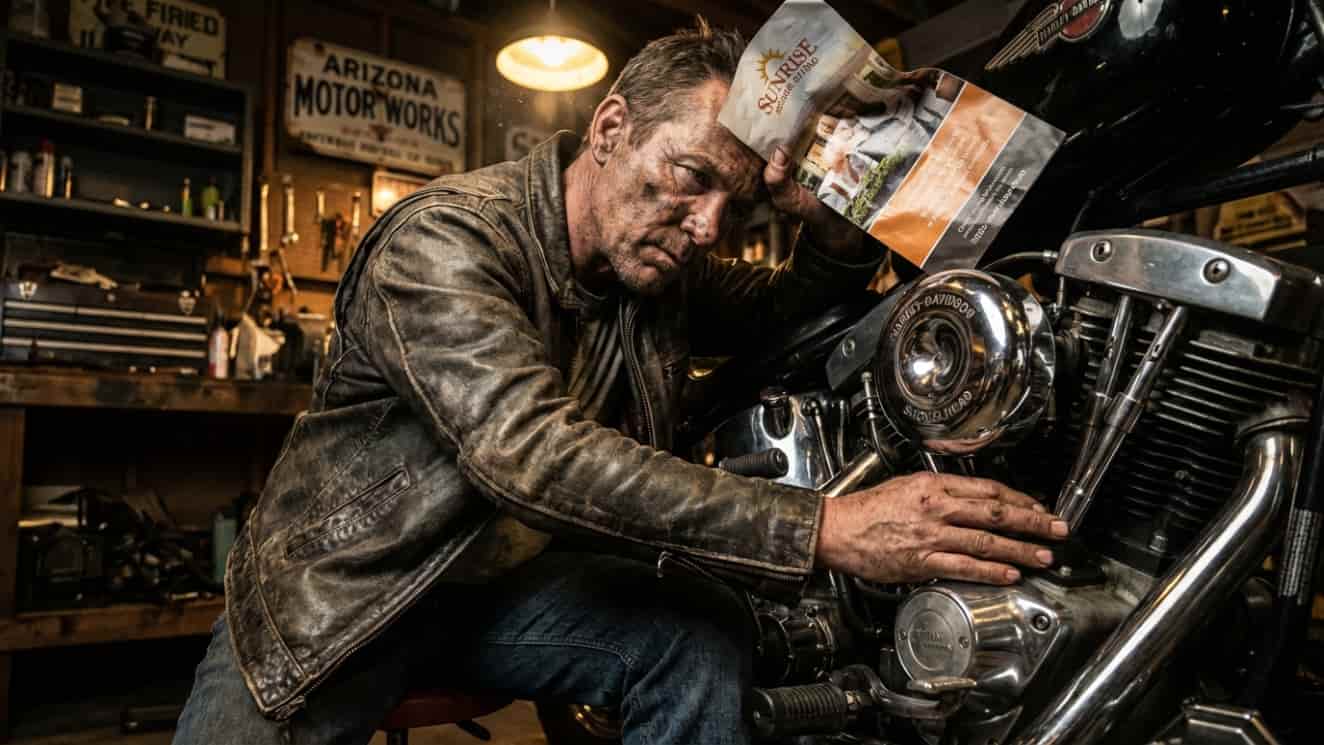
The doctors called it “early-onset.” Hammer called it a slow death sentence. He was losing the names of tools, the turn to his house, and most painfully, the shape of his late wife’s smile. But there was one thing the fog couldn’t touch: the Shovelhead between his knees.
Forty years ago, Hammer did something he shouldn’t have. He buried a secret in the Arizona sand that could save his son from the debt crushing their family. The problem? He could only find it when he was riding fast enough to outrun the ghosts in his head.
With his daughter-in-law’s hand on a nursing home contract and his mind slipping into the gray, Hammer has one run left in him. One chance to find the diamonds before the sunset takes everything.
Chapter 1: The Wrench and the Brochure
The wrench didn’t fit. That was the first problem. It was a half-inch, or maybe it was a nine-sixteenths. Hammer looked at the tray of tools, and for a second, the metal shapes looked like unreadable runes. He knew what they did. He knew the feel of the chrome and the weight of the steel. But the name of the one he needed was gone, evaporated like gas on hot pavement.
He stood in the humid shade of the garage, the scent of old oil and dried sage thick in his nose. His 1970 Shovelhead sat on the lift, a chrome skeleton that was the only thing in the world he still truly understood. He reached for a socket, then stopped. His hand was shaking. Not a tremor, not yet. Just a fine, electric vibration that felt like the engine was still running inside his bones.
“Hammer?”
The voice was sharp. It cut through the low hum of the swamp cooler. He didn’t turn around. He knew that tone. It was the tone people used when they were talking to a dog that might bite or a child who’d spilled the milk. It was Lisa.
“I’m busy, Lisa,” he said. He picked up a pair of pliers. He didn’t need pliers.
“David and I talked,” she said. She walked into his line of sight, stepping over a puddle of primary drive fluid he hadn’t cleaned up yet. She was wearing her work scrubs, the blue ones that made her look like part of the hospital machinery. In her hand was a piece of paper, glossy and bright. “The place in Mesa. They have a spot opening Monday. It’s secured. You’d have your own patio.”
Hammer finally looked at her. Her face was a map of exhaustion he’d helped draw. He saw the dark circles under her eyes and the way she held her shoulders high, like she was bracing for an impact. He wanted to tell her he was sorry. He wanted to tell her he remembered the day she married David, how she’d laughed when the cake tilted. But when he tried to find the memory, it was behind a curtain of gray smoke.
“I’m not a prisoner,” Hammer said. His voice was gravelly, a sound he’d earned through fifty years of unfiltered Camels and screaming over wind noise.
“It’s not a prison. It’s for your safety. You left the bike running in the garage last night, Hammer. The door was closed. David found you sitting on the floor, just watching the exhaust rise. Another ten minutes and the carbon monoxide would’ve finished it.”
Hammer looked at the Shovelhead. He didn’t remember that. He remembered being in the garage. He remembered the sound of the cylinders, that rhythmic potato-potato-potato that felt like a heartbeat. He didn’t remember the door being closed.
“I was tuning it,” he lied.
“You were disappearing,” she countered. She laid the brochure on the workbench, right on top of his greasy shop rag. “Read it. Please. David can’t sleep. He’s terrified he’s going to wake up and find the house burned down or you gone, wandering the highway in your underwear.”
She left then, her footsteps clicking on the concrete. Hammer waited until the screen door slammed shut before he picked up the brochure. Sunrise Senior Living: A Path Through the Fog. The photos showed old men in cardigans playing chess. None of them had grease under their fingernails. None of them had 1%er patches buried in the bottom of their closets.
He crumpled the brochure into a ball and threw it toward the trash can. He missed.
He looked back at the bike. He needed to ride. He needed the wind to blow the smoke out of his head. He knew that if he could just hit sixty, seventy, eighty miles per hour, the gears in his brain would mesh again. It was the only time the world made sense. It was the only time he could see Sarah’s face clearly, the way she looked in 1984, before the sirens and the screaming tires.
He reached into the pocket of his leather vest and felt the small, hard lump of a key. Not the bike key. A different one. A key to a locker he hadn’t opened in four decades. Somewhere out past the Superstition Mountains, buried under a flat rock near a dry wash, was a reason to stay out of the Home. He just had to remember which rock.
FULL STORY
Chapter 1: The Wrench and the Brochure
The wrench didn’t fit. That was the first problem. It was a half-inch, or maybe it was a nine-sixteenths. Hammer looked at the tray of tools, and for a second, the metal shapes looked like unreadable runes. He knew what they did. He knew the feel of the chrome and the weight of the steel. But the name of the one he needed was gone, evaporated like gas on hot pavement.
He stood in the humid shade of the garage, the scent of old oil and dried sage thick in his nose. His 1970 Shovelhead sat on the lift, a chrome skeleton that was the only thing in the world he still truly understood. He reached for a socket, then stopped. His hand was shaking. Not a tremor, not yet. Just a fine, electric vibration that felt like the engine was still running inside his bones.
“Hammer?”
The voice was sharp. It cut through the low hum of the swamp cooler. He didn’t turn around. He knew that tone. It was the tone people used when they were talking to a dog that might bite or a child who’d spilled the milk. It was Lisa.
“I’m busy, Lisa,” he said. He picked up a pair of pliers. He didn’t need pliers.
“David and I talked,” she said. She walked into his line of sight, stepping over a puddle of primary drive fluid he hadn’t cleaned up yet. She was wearing her work scrubs, the blue ones that made her look like part of the hospital machinery. In her hand was a piece of paper, glossy and bright. “The place in Mesa. They have a spot opening Monday. It’s secured. You’d have your own patio.”
Hammer finally looked at her. Her face was a map of exhaustion he’d helped draw. He saw the dark circles under her eyes and the way she held her shoulders high, like she was bracing for an impact. He wanted to tell her he was sorry. He wanted to tell her he remembered the day she married David, how she’d laughed when the cake tilted. But when he tried to find the memory, it was behind a curtain of gray smoke.
“I’m not a prisoner,” Hammer said. His voice was gravelly, a sound he’d earned through fifty years of unfiltered Camels and screaming over wind noise.
“It’s not a prison. It’s for your safety. You left the bike running in the garage last night, Hammer. The door was closed. David found you sitting on the floor, just watching the exhaust rise. Another ten minutes and the carbon monoxide would’ve finished it.”
Hammer looked at the Shovelhead. He didn’t remember that. He remembered being in the garage. He remembered the sound of the cylinders, that rhythmic potato-potato-potato that felt like a heartbeat. He didn’t remember the door being closed.
“I was tuning it,” he lied.
“You were disappearing,” she countered. She laid the brochure on the workbench, right on top of his greasy shop rag. “Read it. Please. David can’t sleep. He’s terrified he’s going to wake up and find the house burned down or you gone, wandering the highway in your underwear.”
She left then, her footsteps clicking on the concrete. Hammer waited until the screen door slammed shut before he picked up the brochure. Sunrise Senior Living: A Path Through the Fog. The photos showed old men in cardigans playing chess. None of them had grease under their fingernails. None of them had 1%er patches buried in the bottom of their closets.
He crumpled the brochure into a ball and threw it toward the trash can. He missed.
He looked back at the bike. He needed to ride. He needed the wind to blow the smoke out of his head. He knew that if he could just hit sixty, seventy, eighty miles per hour, the gears in his brain would mesh again. It was the only time the world made sense. It was the only time he could see Sarah’s face clearly, the way she looked in 1984, before the sirens and the screaming tires.
He reached into the pocket of his leather vest and felt the small, hard lump of a key. Not the bike key. A different one. A key to a locker he hadn’t opened in four decades. Somewhere out past the Superstition Mountains, buried under a flat rock near a dry wash, was a reason to stay out of the Home. He just had to remember which rock.
David came in twenty minutes later. He looked like Hammer, only softened by an office job and a mortgage. He had the same heavy brow, the same square jaw, but his eyes were full of a quiet, desperate kind of love that made Hammer’s chest ache.
“Hey, Pop,” David said, leaning against the doorframe. “Lisa told me you guys talked.”
“She talked. I listened,” Hammer said, picking up the half-inch wrench again. He recognized it now. The fog had lifted, just a bit.
“We can’t keep doing this, Dad. I’m getting calls from the bank about the house. The medical bills from your last three ‘incidents’ are piling up. Lisa’s working double shifts at the clinic. We’re drowning.”
Hammer looked at his son. He saw the fraying collar of David’s shirt. He saw the way David’s hands fumbled with his phone. His son was forty-two, but he looked sixty. Hammer felt a surge of shame so sharp it was physical. He was the patriarch. He was the one who was supposed to provide. Instead, he was the weight dragging them to the bottom.
“I have something,” Hammer whispered.
“What?”
“Money. Not in a bank. Not… not where they can see it.”
David sighed, a long, weary sound. “Dad, we’ve been over this. You don’t have any secret accounts. We checked your old club records. The MC dissolved years ago. There’s nothing left.”
“Not the club,” Hammer said, his voice rising. “Me. Before the crash. Before your mother…” He stopped. The name felt like a bruise. “I put something away. A hedge. For a rainy day. Well, it’s pouring, David.”
“Where is it, then?” David asked, his voice softening into that patronizing “doctor-talk” again.
Hammer looked at the Shovelhead. He looked at the vast, shimmering heat-mirage of the Arizona desert visible through the garage door. “I don’t know. Not right now. But if I ride… if I get the speed up… it comes back. It’s like a movie playing behind my eyes. I can see the landmarks. I can see the miles.”
David shook his head. “The doctor said you shouldn’t even be on a bicycle, Pop. Your reaction times are shot. You’re having hallucinations.”
“I’m not hallucinating the road, David! I’m hallucinating the rest of this life. The road is the only thing that’s real.”
Hammer stepped toward his son, the wrench still in his hand. For a second, he saw fear in David’s eyes—the fear of a man realizing his father is becoming a stranger. Hammer stopped. He dropped the wrench. It hit the floor with a final, heavy thud.
“Just one more run,” Hammer said. “Give me tomorrow. If I come back empty-handed, I’ll sign the papers. I’ll go to the Home. I’ll let them feed me pudding and tell me what year it is. But give me tomorrow.”
David looked at the bike, then at his father. He looked at the grease on Hammer’s forehead and the old, faded ink on his forearms. He looked like he wanted to say no. He looked like he wanted to scream.
“One day,” David said quietly. “But if you aren’t back by sunset, I’m calling the troopers.”
Hammer nodded. He didn’t tell David that by sunset, he might not even remember who David was. He just turned back to the Shovelhead and began to polish the chrome.
Chapter 2: The Medic and the Mirror
The Iron Horse Saloon smelled like a hundred years of spilled beer and stale regret. It was a dark cave in the middle of the blinding Arizona afternoon, a place where the sun was an enemy and the neon Budweiser sign was the only god worth praying to.
Hammer sat at the far end of the bar, his back to the door. He didn’t like the light anymore; it made the edges of things blur. He was nursing a lukewarm water, his fingers tracing the scars on the mahogany wood.
“You look like hell, Hammer,” a voice rasped from the shadows.
Hammer didn’t need to look. It was Doc. Doc hadn’t been a real doctor in thirty years—some business with a prescription pad and a federal agent—but he was the only medic the club had ever trusted. He was eighty now, his skin like yellowed parchment, his eyes milky with cataracts, but his hands were still steady.
“I’m going for a run tomorrow, Doc,” Hammer said.
Doc slid onto the stool next to him. He smelled of menthol rub and cheap gin. He reached out and grabbed Hammer’s wrist, his thumb finding the pulse. He didn’t say anything for a long minute.
“Your heart’s skipping beats like a broken record, Bill,” Doc said, using Hammer’s real name. “And your eyes… they’re wandering. You’re losing the focus.”
“I need a favor,” Hammer said, ignoring the diagnosis. “The stuff you gave me last year. For the tremors. The stuff that clears the head.”
“That was a one-time thing. It’s a stimulant, Bill. It’ll kick your blood pressure through the roof. At your age, with your heart? It’s a suicide pill.”
“Then it’s the right pill for the job,” Hammer said. He looked at Doc, really looked at him. “I’m losing her, Doc. I’m losing Sarah. I can’t remember the color of the dress she wore to the 1982 rally. I can’t remember if she liked her steak rare or medium. If I lose the rest of her, there’s nothing left of me but a body waiting to be buried.”
Doc looked away. He knew about the crash. Everyone did. They knew Hammer had been the one on the throttle, chasing a thrill or a ghost, or maybe just a high-speed high, when the back tire blew and the world flipped upside down. Hammer had walked away with a broken collarbone. Sarah hadn’t walked away at all.
“The diamonds,” Doc whispered. “You’re still thinking about that old score.”
Hammer stiffened. “I don’t know what you’re talking about.”
“Don’t bullshit a bullshitter. I was there the night you and Jax came back from that jewelry exchange in Scottsdale. I saw the look on your face. You didn’t give the club their cut. You hid it. Then Sarah died, Jax went to Yuma for twenty years, and you stayed quiet. I figured you’d sold ‘em long ago.”
“I couldn’t,” Hammer said, his voice breaking. “Every time I looked at ’em, I saw the blood on the asphalt. But David… David’s in trouble, Doc. He’s a good kid, and he’s drowning because of me. I owe him this.”
Doc reached into his vest and pulled out a small orange pill bottle. He set it on the bar. “Two pills. No more. If you take three, your heart will explode before you hit the county line. Take ’em an hour before you ride. It’ll give you clarity, but it’ll cost you. The crash afterward… the fog will come back twice as thick. You understand?”
Hammer took the bottle and tucked it into his pocket. “I understand.”
Just then, the front door swung open, letting in a blinding shaft of white light. A young man walked in, his boots clopping loudly on the floor. He couldn’t have been more than twenty-five. He was wearing a brand-new leather jacket with a generic “Outlaw” patch on the back and carrying a helmet that cost more than Hammer’s first car.
The kid strutted to the bar and ordered a tequila shot. He caught Hammer looking at him in the mirror.
“Old man’s still hanging on, huh?” the kid said, a smirk dancing on his lips. “I saw that Shovelhead outside. Surprised it hasn’t turned to a pile of rust yet. Must be like riding a tractor.”
Hammer felt a spark of the old fire. It wasn’t anger, exactly; it was a memory of what it felt like to be invincible. “That tractor’s got more soul in one cylinder than that plastic toy you’re riding has in its whole frame, kid.”
The kid laughed. “Soul doesn’t win races. Speed does. I’m doing a run to the border tomorrow morning. Gonna see if I can break three hours. Why don’t you bring that antique out and see if you can keep my taillights in sight?”
“I’m not interested in racing children,” Hammer said.
“Suit yourself. But if you see a blur of red on the I-10, that’s me. Don’t have a heart attack when I pass you.”
The kid finished his shot and walked out, the door slamming behind him.
Doc looked at Hammer. “He reminds me of you. In ’84. Too much throttle, not enough sense.”
“He’s a fool,” Hammer said.
“Yeah,” Doc said sadly. “He is. And so are you, Bill. But I guess that’s the only way we know how to be.”
Hammer stood up, his knees popping like dry twigs. He walked out of the bar, the Arizona heat hitting him like a physical blow. He looked at the Shovelhead. It looked tired. It looked like it belonged in a museum or a scrap heap. But as he swung his leg over the seat, he felt the familiar connection. The bike didn’t care about his failing mind. It didn’t care about the Home. It only cared about the spark and the fuel.
He rode home slowly, his mind drifting. He missed the turn to his street twice. He found himself three miles away, staring at a park he didn’t recognize, wondering how he’d gotten there. By the time he pulled into his driveway, the sun was a bruised purple on the horizon.
David was waiting on the porch, his arms crossed. He looked at the bike, then at his father. He didn’t say anything. He didn’t have to. The silence between them was a thick, heavy thing, filled with all the words Hammer couldn’t find anymore.
That night, Hammer sat at the kitchen table after David and Lisa had gone to bed. He had a piece of paper and a pencil. He tried to draw a map. He knew the location was near the old Vulture Mine, out past Wickenburg. He remembered a rock that looked like a bird’s head. Or was it a turtle?
He drew a line, then erased it. He drew a circle, then crossed it out. He felt a tear hit the paper, blurring the lead. He couldn’t see it. He couldn’t see the map.
He opened the pill bottle. Two small, white tablets. He swallowed them with a gulp of lukewarm coffee. He sat in the dark, waiting for the chemical fire to start.
Chapter 3: The Night the World Broke
The air had been different then. Or maybe it was just the way Hammer’s lungs worked—younger, stronger, greedy for the smell of rain on hot tar.
He was thirty-four. Sarah was twenty-nine. She’d been wearing a denim vest with a “Property of Hammer” patch she’d sewn herself, her blonde hair whipped into a chaotic nest by the wind. They’d just left Jax’s place. The bag of diamonds—raw, uncut, stolen from a courier who hadn’t been fast enough—was tucked into the lining of Hammer’s jacket. It felt heavy, like a lead weight against his ribs.
“We should go back!” Sarah had shouted over the roar of the exhaust. “Jax is paranoid, Hammer! The club’s gonna find out!”
“The club can’t find what they can’t see!” Hammer had yelled back, his heart hammering against his chest. “We’re going to the border! We sell these in Nogales, and we never have to look back! No more club, no more grease, no more dirt!”
He’d been riding a customized Panhead then, a beast of a bike that vibrated so hard it made your vision blur. He’d loved it. He’d loved the feeling of being faster than the law, faster than his own mistakes.
The flashing lights had appeared in the rearview mirror five miles outside of Gila Bend. Not a trooper. It was Jax and two others. They weren’t coming to say goodbye. They were coming for their cut.
Hammer had twisted the throttle. The bike had surged forward, the speedometer climbing. 70. 80. 90. Sarah had clung to him, her fingers digging into his waist.
“Slow down!” she’d screamed. “Hammer, stop!”
But he couldn’t stop. To stop was to give up the dream. To stop was to go back to being a nobody in a town that didn’t want him. He’d hit a patch of loose gravel on a sweeping curve. The bike had shimmied. He’d overcorrected.
He remembered the sound most of all. Not the crash, but the silence that came right before it—the moment the tires lost contact with the earth and the world became weightless. Then the screaming metal. The bone-deep crunch of the bike hitting the guardrail. The sensation of being launched into the dark.
When he woke up, he was lying in the dirt. His collarbone was a jagged spike of pain. He’d crawled toward the wreckage. The bike was a twisted heap of chrome. Sarah was twenty feet away, lying remarkably still. The desert moon had turned her skin to silver.
He’d reached for her, his fingers brushing her cold hand. He’d looked for the diamonds. They were gone, spilled out of his jacket. He’d spent an hour in the dark, sobbing, his mind fracturing as he searched the brush. He’d found them—a small leather pouch half-buried in the sand near a jagged rock formation.
He’d heard the sirens then. Real sirens this time.
He couldn’t take the diamonds to the hospital. He couldn’t let them be found on him. He’d crawled to the rock—a strange, leaning spire that looked like a hunched old man—and shoved the pouch into a deep, dry crevice. He’d marked the spot in his mind: three miles past the 42-mile marker, look for the Old Man rock, fifty paces north.
Then he’d blacked out.
Hammer woke up in the present, his head resting on the kitchen table. The morning sun was peeking through the blinds, stinging his eyes. The map he’d tried to draw was a mess of jagged lines and scribbles.
The pills. The pills were working.
His mind felt sharp, like a knife that had just been honed. The fog was gone, pushed back to the edges of his consciousness. He could remember the dress Sarah wore—it was yellow, with small blue flowers. He could remember the steak—she liked it charred on the outside, red on the inside. He could remember the weight of the diamonds.
He stood up, his body aching, but his mind clear. He walked to the garage.
David was there, standing by the Shovelhead. He had a backpack in his hand.
“I’m going with you,” David said.
“No,” Hammer said. “The bike can’t take the weight. And I need to do this alone, Dave. If I have to worry about you, I won’t find it.”
“Dad, you can’t even remember where the keys are half the time.”
“I remember everything right now,” Hammer said, his voice steady. “I remember the night you were born. I remember the way the hospital smelled like floor wax and old coffee. I remember holding you and thinking I’d never let anything hurt you.” He stepped closer to his son. “Let me do this. One last thing for my boy.”
David looked at him, searching his eyes. He saw the clarity there, the brief, flickering candle flame of his father’s old self. He nodded slowly.
“Sunset, Pop. I’ll be at the diner on 60. If you aren’t there…”
“I’ll be there,” Hammer said.
He geared up, pulling on his old leather vest. He felt the weight of the locker key in his pocket. He kicked the Shovelhead. It started on the first try, a roar that shook the very air in the garage.
He backed the bike out. He didn’t look at the house. He didn’t look at the brochure, which was still lying in the dirt near the trash can. He turned the throttle and headed toward the mountains.
Chapter 4: The Speed and the Ghost
The heat was an anvil. It dropped onto the desert, flattening the shadows and making the air ripple like water. Hammer rode north, his eyes fixed on the ribbon of black asphalt.
At sixty miles per hour, the memories started to churn. He saw the 42-mile marker. He saw the turnoff to the old mine. But the landmarks were wrong. New houses had been built. Roads had been paved over. The desert he remembered was being swallowed by the sprawl of the future.
“Come on,” he whispered into the wind. “Where are you?”
A red blur flashed past him on the left. It was the kid from the bar. He was tucked low over his sportbike, his engine screaming like a jet. As he passed, he raised a middle finger and disappeared into the shimmering heat.
Hammer didn’t care. He wasn’t racing the kid. He was racing the clock in his own head.
He twisted the throttle. 70. 80.
The vibration of the Shovelhead changed. It became a steady, humming resonance that vibrated through his boots and up into his skull. His vision began to tunnel. The modern houses faded away. The paved roads turned back into dirt tracks.
He was back in ’84. He could feel Sarah’s hands on his waist. He could hear her laughter in the whistle of the wind through his helmet.
Ninety.
The world became a blur of brown and gold. The Old Man rock. There it was. It wasn’t three miles past the marker; the marker had been moved. It was right there, hidden behind a cluster of giant saguaros.
Hammer braked hard, the back tire fishtailing. He skidded to a stop on the shoulder, the dust cloud swallowing him. He sat there for a moment, gasping for air, his heart pounding against his ribs. The clarity was intense, almost painful. He could smell the ozone before a storm. He could hear the clicking of a grasshopper a hundred yards away.
He dismounted, his legs shaky. He walked into the brush. The heat was unbearable, but he didn’t feel it. He was looking for the crevice.
He found the rock. It was smaller than he remembered, weathered by forty years of wind and rain. He reached into the opening, his hand disappearing into the darkness. His fingers brushed against something soft and rotted.
He pulled it out. The leather pouch was falling apart, the hide brittle and gray. He opened it.
The diamonds were still there. They didn’t sparkle like the ones in the movies. They looked like pebbles—cold, dull, unremarkable. But they were worth a life. They were worth David’s house. They were worth Lisa’s sleep.
Hammer clutched the pouch to his chest. He’d done it. He’d outrun the fog.
But as he stood there, the clarity began to waver. The sharp edges of the world began to soften. He looked at the pouch, and for a second, he didn’t know why he was holding it. He looked at the Shovelhead on the side of the road and felt a wave of confusion.
The pills. The crash.
Doc had warned him. The chemical fire was burning out, and the darkness was rushing back in to fill the void.
He scrambled back to the bike. He had to get to the diner. He had to give this to David before he forgot what it was.
He kicked the bike, but his leg felt weak. The engine coughed and died.
“No,” he groaned. “Not now.”
He kicked again. And again. On the fourth try, the Shovelhead roared to life. He swung his leg over and gunned it, spraying gravel as he pulled back onto the highway.
He was doing eighty when he saw the red bike again. It was on the side of the road, a mile ahead. The kid was standing next to it, his helmet off, looking at a smoking engine. He looked small and defeated.
Hammer didn’t stop. He couldn’t. He had a mission.
But then he remembered Sarah. He remembered the night of the crash, how people had driven past them for twenty minutes before someone finally stopped. He remembered the feeling of being invisible in your greatest moment of need.
He groaned, cursed under his breath, and slowed down.
He pulled up next to the kid. The sportbike was a mess—a blown coolant line had sprayed green fluid all over the hot engine, creating a cloud of foul-smelling steam.
“Dead?” Hammer asked, his voice sounding distant to his own ears.
“The hose snapped,” the kid said, his face flushed with anger and embarrassment. “I was pushing it too hard. I don’t have a signal out here. I’m stuck.”
Hammer looked at the sun. It was low, hovering just above the mountains. The shadows were stretching out, long and jagged.
“Get on,” Hammer said.
“What?”
“The back. Get on. I’m going to the diner on 60. You can call a tow from there.”
The kid looked at the old Shovelhead, then at Hammer. He looked like he wanted to argue, but the silence of the desert was closing in on him. He picked up his helmet and climbed onto the back of the bike.
Hammer felt the extra weight. It made the bike sluggish, harder to handle. He twisted the throttle, but the speed stayed low. 60. 50.
The fog was coming back fast now. He looked at the speedometer and couldn’t remember what the numbers meant. He looked at his own hands and wondered why they were covered in grease.
“Who are you?” he whispered.
“What?” the kid shouted over the wind.
“Nothing,” Hammer said. “Just… hold on.”
He rode by instinct. The road was a living thing, a muscle memory that lived in his spine. He didn’t need to know the names of the turns. He just needed to feel the lean.
He saw the neon sign of the diner in the distance. Eat. It was a red beacon in the gathering dark.
He pulled into the parking lot and nearly dropped the bike. The kid hopped off, looking shaken.
“Thanks, man,” the kid said. “I… I guess I owe you one.”
Hammer didn’t answer. He was staring at the man running toward him from the diner door. The man looked familiar. He was wearing a shirt with a fraying collar. He looked worried.
“Dad! Dad, you made it!”
Hammer looked at the man. “David?”
“Yeah, Pop. It’s me. Are you okay?”
Hammer reached into his vest. His fingers were numb. He pulled out the leather pouch and pressed it into David’s hand.
“Take it,” Hammer whispered. “For the house. For Lisa. Don’t let them take the patios.”
David opened the pouch. He looked at the stones, then at his father. His eyes filled with tears. “Dad… what is this?”
“I don’t know,” Hammer said, and he realized he was telling the truth. The memory was gone. The ’84 road, the diamonds, the crash—it was all slipping away like sand through a sieve. “But it’s yours. It’s for the boy.”
David grabbed Hammer’s arm, steadying him. “Let’s get you inside, Pop. Lisa’s waiting.”
Hammer looked back at the Shovelhead. It was cooling down, the metal ticking in the quiet evening air. The sun finally dipped below the horizon, and the desert turned a deep, velvet blue.
Chapter 5: The Aftermath of the Light
The diner was too bright. The fluorescent lights hummed with a frequency that made Hammer’s teeth ache. He sat in a vinyl booth, his hands folded on the Formica table. Lisa was there, her hand on his. She was crying, but she was smiling, too.
David was on the phone in the corner, his voice low and urgent. He was talking to someone about “appraisals” and “security.”
“You did it, Bill,” Lisa whispered. “I don’t know how, but you did it.”
Hammer looked at her. He knew she was Lisa. He knew she was important. But the “why” was getting fuzzy. “Did I fix the bike?”
Lisa’s smile faltered, just for a second. “No, honey. You found the treasure. You saved us.”
“Oh,” Hammer said. “That’s good. Is Sarah coming?”
The silence that followed was heavy. Lisa squeezed his hand, her knuckles white. “No, Bill. Sarah’s not coming. Remember? She’s… she’s resting.”
“Right,” Hammer said. “Resting. It’s a long ride. She needs her sleep.”
He looked out the window. The parking lot was full of shadows. He saw the young biker standing by a payphone, gesturing wildly. He saw the Shovelhead sitting alone under a streetlamp. It looked like an old dog waiting for a master who wasn’t coming back.
The next few days were a blur of activity he didn’t understand. Men in suits came to the house. There were papers to sign. David looked younger, the weight of the debt lifted from his shoulders. He bought a new car. He paid for a specialist in Phoenix.
But the specialist couldn’t fix the smoke.
Monday came. The day of the Home.
Hammer stood in the garage one last time. The Shovelhead was gone. David had sold it to a collector—a man who promised to keep it in a climate-controlled room and never ride it. Hammer had been angry at first, a flash of white-hot rage that had made him break a plate, but then he’d forgotten what he was angry about.
Now, the garage was empty. The smell of oil was fading, replaced by the scent of cleaning supplies and cardboard boxes.
“Ready, Pop?” David asked. He was standing in the driveway, the engine of his new SUV idling quietly.
Hammer looked at the spot where the lift used to be. He felt a phantom vibration in his feet. He felt the ghost of the wind on his face.
“I had a dream,” Hammer said. “About a rock. A rock shaped like a bird.”
David walked over and put an arm around his father’s shoulders. “It wasn’t a dream, Dad. It was real. You were a hero.”
“A hero,” Hammer repeated. The word felt strange in his mouth. “I think I was just fast, Dave. I think I was just trying to outrun the sunset.”
They got into the car. The seats were leather and smelled like a new shoe. There was no vibration. There was no noise. It was like sitting in a coffin that moved.
As they drove down the street, Hammer looked out the window. He saw the kids playing on the sidewalk. He saw the neighbors mowing their lawns. He saw the world going on, indifferent to the fact that his was ending.
He closed his eyes. He tried to find Sarah. He tried to find the yellow dress.
He found a flicker. A flash of blonde hair. The sound of a laugh.
I’m coming, Sarah, he thought. I’m just taking the slow way now.
Chapter 6: The Quiet Sunset
Sunrise Senior Living wasn’t as bad as the brochure. The patio was small, but it had a view of the mountains. The people were kind, even if they treated him like he was made of glass.
Hammer sat in a rocking chair, a blanket over his legs despite the Arizona heat. He liked the heat. It reminded him of something, though he couldn’t quite remember what.
Doc visited him sometimes. He’d bring a flask of gin and tell stories about the old club. Hammer would listen, nodding at the right times, even if the names Jax and Jax and Jax sounded like a song he’d forgotten the lyrics to.
“You really did it, Bill,” Doc said one afternoon. “That kid you picked up? He’s riding a Shovelhead now. Said the sportbike didn’t have enough soul. He comes by the bar and asks about you.”
Hammer looked at the mountains. “Is he fast?”
“Too fast,” Doc said. “Just like you.”
David and Lisa came every Sunday. They brought photos of a new house, a place with a big yard and a room for a workshop. They told him he’d saved them. They told him they loved him.
Hammer would smile and thank them. He knew they were his people. He knew he belonged to them.
But as the weeks turned into months, the world became smaller. The patio became his universe. The rocking chair became his bike.
One evening, the sun was setting in a spectacular display of orange and violet. It looked like the sky was on fire. Hammer watched it, his breath coming in slow, shallow rhythms.
He felt a hand on his waist.
“Hammer, look at the view,” a voice whispered.
He turned his head. A woman was standing next to him. She was wearing a yellow dress with small blue flowers. Her hair was a blonde mess, and she was smiling—that wide, crooked smile that made his heart stop.
“Sarah?” he whispered.
“It’s time to go,” she said. “The bike’s tuned. The tank’s full. And the road goes on forever.”
Hammer stood up. His knees didn’t pop. His hands didn’t shake. He felt light, like he’d finally dropped the bag of lead he’d been carrying for forty years.
“Where are we going?”
“Nowhere,” she said, laughing. “Everywhere.”
He looked back at the rocking chair. He saw an old man sitting there, his eyes closed, his head slumped to one side. He felt a momentary pang of pity for the man, but then the woman took his hand, and the feeling vanished.
He heard the roar of an engine. Not a generic roar, but the specific, rhythmic potato-potato-potato of a 1970 Shovelhead.
He climbed onto the seat. She climbed on behind him, her arms wrapping around his waist, her fingers digging into his ribs just the way he liked.
He didn’t need a map. He didn’t need a pill. He didn’t need to outrun anything anymore.
He twisted the throttle. The bike surged forward, leaving the patio and the Home and the shadows behind. He hit the highway, the speedometer climbing. 70. 80. 90. 100.
The wind blew the last of the smoke away. The Arizona desert opened up before him, a vast, golden expanse that never ended. He didn’t look back. He just rode into the light, his hand steady on the chrome, the ghost of the man he used to be finally catching up to the man he was always meant to be.
The nurse found him five minutes later. She checked his pulse, then gently closed his eyes. She looked out at the sunset and thought it was the most beautiful thing she’d ever seen. She didn’t hear the engine. She didn’t see the tire tracks in the dust. She just saw an old man who finally looked like he was at peace.
Hammer was gone. But somewhere out past the Superstitions, where the heat makes the horizon dance, the sound of a Shovelhead still echoes against the rocks, faster than the memory of the man who rode it.



