I spend my days six feet deep in the Louisiana mud, digging holes for people who don’t need them anymore. It’s quiet work. Honest work. The dead don’t lie, and they don’t cheat.
But the living? That’s a different story.
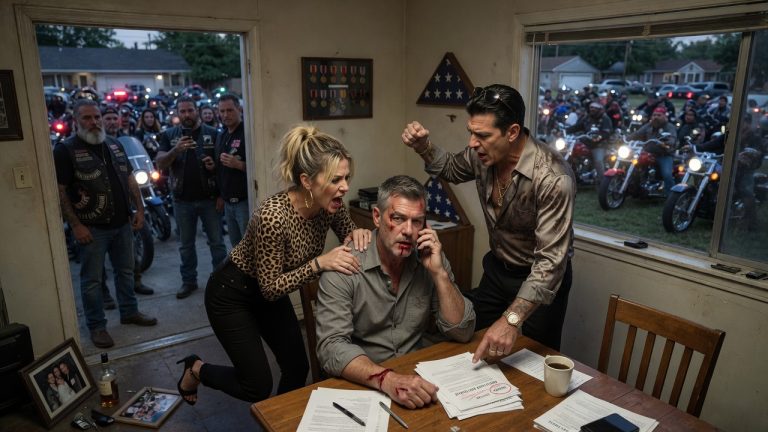
Three weeks ago, I almost didn’t come home. A routine run for the Iron Thorns turned into a bloodbath on Highway 190. I took a bullet to the shoulder and a slide across the asphalt that should have ended me.
The club said it was a setup. They said there was a rat.
I found the rat. I didn’t find him in a clubhouse or a back alley. I found him in my own bedroom, reflected in the glow of my wife’s phone at three in the morning.
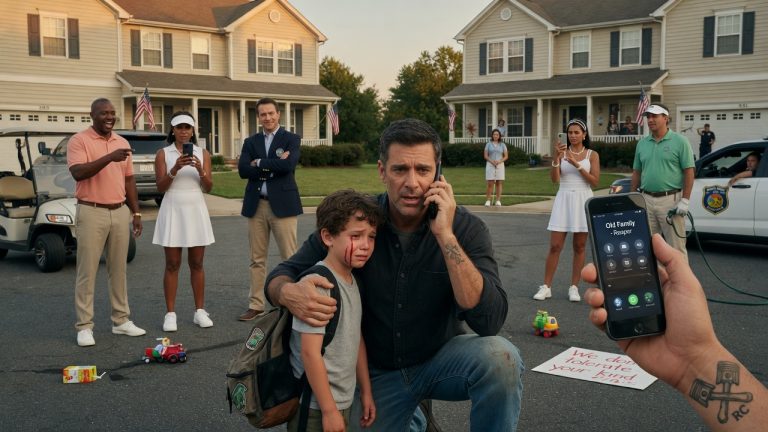
His name is Gary Miller. He’s a local contractor with a clean smile and a dirty secret. He wasn’t just sleeping with Beth; he was selling our routes to the rivals to get me out of the picture.
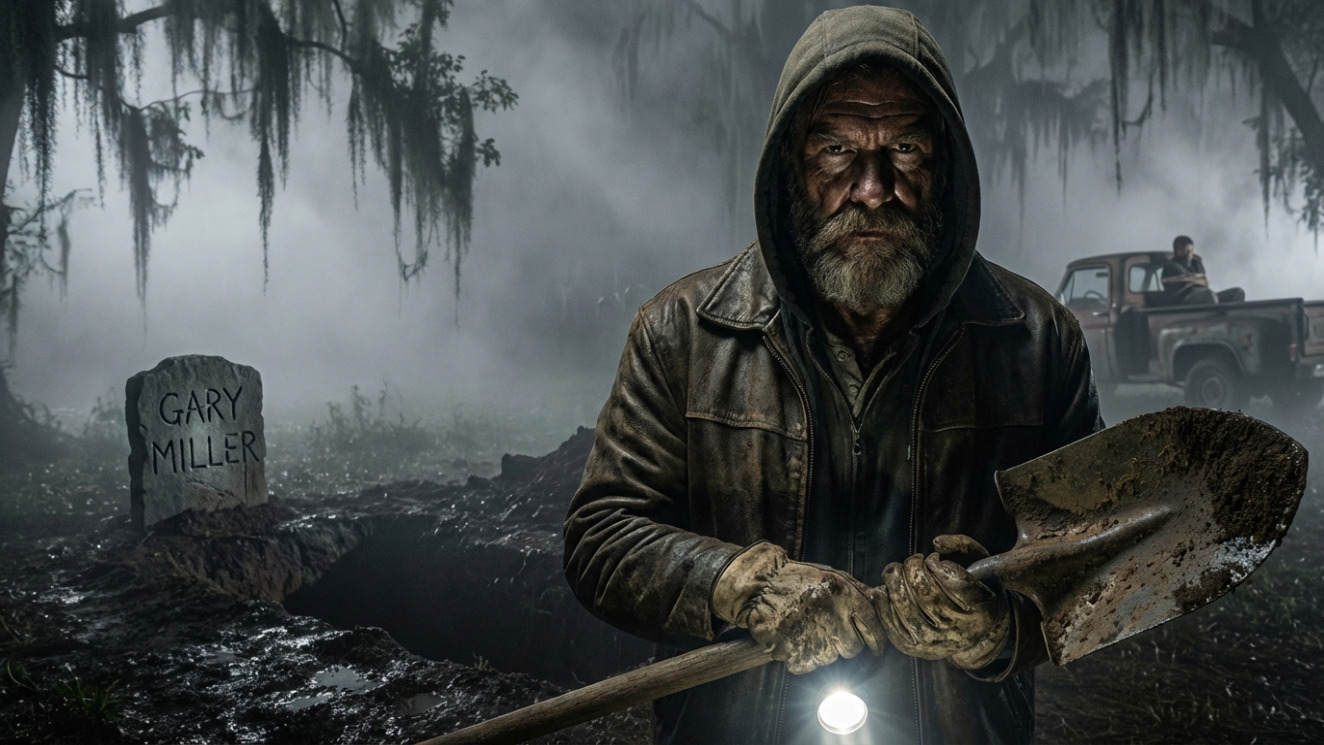
Tonight, the fog is thick over St. Jude Parish. The ground is soft. And Gary is sitting in the back of my truck, bound with zip ties and smelling of his own fear.
I’ve already dug the hole. I even carved the stone.
The club wants his head. Beth wants his love. But out here, under the cypress trees, the only thing that matters is what I do with this shovel.
FULL STORY
Chapter 1
The humidity in St. Jude Parish didn’t just hang in the air; it sat on your shoulders like a wet wool coat. It was seven in the morning, and I was already three feet down into the grey, sucking clay of Section 4. In Louisiana, you don’t really dig graves; you negotiate with the water table.
I shoved the spade into the earth, feeling the jar all the way up my forearms. My left shoulder throbbed, a dull, rhythmic reminder of the three inches of lead I’d taken near the Atchafalaya Basin a month ago. The scar tissue was tight, pulling every time I lifted a load of dirt.
“You’re off the rhythm, Logan,” a voice rasped from above.
I didn’t look up. I knew the sound of those boots—old, cracked leather that had walked through more funerals than a priest. It was Shovel. That wasn’t his real name, but nobody remembered the one on his birth certificate anymore. He’d been the groundskeeper at Pine Haven since before I was born.
“Shoulder’s tight,” I said, my voice sounding like gravel grinding together.
“Then stop manhandling it. Let the weight of the spade do the work. You’re fighting the ground. You fight the ground, the ground wins every time.”
Shovel leaned on his own rake, his skin the color of a cured tobacco leaf. He was my anchor in this place. When the world of the Iron Thorns MC got too loud—too full of the smell of unburnt fuel, stale beer, and the constant, vibrating threat of violence—I came here. The dead were the only ones who didn’t expect anything from me.
I took a breath, the air thick with the scent of rotting magnolias and damp stone. I thought about the night of the ambush. The way the headlights had cut through the swamp fog. The way the lead bike, ridden by a kid named Jax, had simply vanished in a spray of sparks and red mist. We’d been set up. The rival crew, the Blackwater Syndicate, knew exactly where we’d be slowing down for the bridge.
I’d survived by sliding into a cypress knee and holding my breath in the black water until the screaming stopped.
“You’re thinking about it again,” Shovel said.
“Hard not to,” I replied, tossing a clump of clay onto the pile. “Club’s looking for the leak. Deacon’s losing his mind. He thinks it’s one of the new prospects.”
“Is it?”
“No. The leak was too clean. Someone knew the manifests. Someone knew the timing down to the minute.”
I finished the cut, squared the corners, and hauled myself out of the hole. My boots were heavy with mud. I walked over to the faucet near the tool shed and ran the cold water over my hands, watching the grey silt swirl down the drain.
I left the cemetery at noon, the heat now a physical weight. I hopped on my Panhead, the engine’s roar a sharp contrast to the silence of Pine Haven. I rode past the rusted-out sugar mills and the trailer parks where the laundry hung limp on the lines.
When I pulled into my gravel driveway, I saw Beth’s SUV. She was usually at the clinic this time of day. She was a dental hygienist, a woman who smelled like peppermint and expensive shampoo, a woman who had somehow decided that a man who dug graves and rode with the Thorns was a project worth undertaking.
I walked in through the back door. The house was cool, the AC humming a low, expensive tune.
“Beth?” I called out.
No answer. I walked into the bedroom to grab a clean shirt. The bed was made—perfectly, as always—but her phone was sitting on the nightstand, buzzing with a persistence that felt aggressive.
I shouldn’t have looked. In our world, you don’t look. Trust is the only thing that keeps the floor from falling out. But the name on the screen caught my eye because it was a name I knew from the club’s ledger.
Gary Miller.
Miller was a contractor. He’d done the roof on the clubhouse last year. He was a “friend of the club,” the kind of guy who donated to the toy drives so he could get a pass when he wanted to speed through town.
The message on the screen was short: “He’s at the graveyard. Can you talk?”
My heart didn’t shatter. It didn’t stop. It just turned into a cold, hard stone in my chest. I felt a strange, detached clarity. I picked up the phone. It wasn’t locked. Beth never locked it. She thought she was safe in this life we’d built.
I scrolled back. It didn’t take long. Three months of messages. Pictures. Plans. Miller wasn’t just some guy she was seeing. He was the one asking about my “work trips.” He was the one asking if the club was moving “the heavy stuff” on Friday.
And Beth? She’d told him everything. She’d told him because he told her he was worried about me. He’d played the “concerned friend” while he was selling my life to the Syndicate for a percentage of the hijacked hauls.
I sat on the edge of the bed, the clean shirt forgotten in my hand. I looked at my reflection in the dresser mirror. I looked like a man who belonged in the dirt. My face was lined, my eyes tired.
The back door creaked open.
“Logan?” Beth’s voice was bright, a little too high. “You’re home early, honey.”
I didn’t move. I didn’t hide the phone. I just sat there, listening to the sound of her heels on the hardwood—the sound of the woman I loved walking toward the hole I hadn’t even finished digging yet.
Chapter 2
Beth stopped in the doorway. She was wearing her blue scrubs, her hair pulled back in a neat ponytail. She looked like the picture of suburban innocence, except for the way her eyes immediately darted to the phone in my hand.
The silence between us wasn’t “deafening.” It was just heavy, like the air before a hurricane. It was the sound of a thousand small lies finally settling into the floorboards.
“You left your phone,” I said. My voice was flat, devoid of the rage I knew should be there. It was the voice I used when I was talking to Shovel about a collapsed vault.
Beth didn’t scream. She didn’t cry. She just leaned against the doorframe, her face going a pale, sickly shade of grey. “Logan,” she whispered.
“Gary Miller,” I said, testing the name. “He’s a good contractor. Sturdy work. He’s also a rat, Beth. He’s the reason Jax is in a bag and I’ve got a hole in my shoulder.”
“No,” she said, her voice trembling. “No, he’s not… he’s not involved in that. He told me he was trying to help. He said if he knew where you were, he could make sure the police stayed away. He said the club was dangerous for you.”
I stood up. I’m not a giant man, but in that small bedroom, I felt too big for the walls. “The police? Beth, he sold our coordinates to Blackwater. They didn’t come with badges. They came with AR-15s.”
I walked toward her, and she flinched. That hurt more than the bullet had. The fact that she thought I’d lay a hand on her.
“I didn’t know,” she sobbed, finally breaking. The tears started then, messy and real. “I just wanted you out of it. I hate the bikes, Logan. I hate the vest. I hate wondering if you’re dead every time the phone rings at midnight. Gary… he listened. He made me feel like there was a way out.”
“There is a way out,” I said, stepping past her. “But it usually involves a casket.”
I walked out to the garage. I needed to move. I needed the mechanical certainty of tools. I grabbed my heavy wrench and began tightening bolts on the Panhead that didn’t need tightening. My hands were shaking, a fine tremor that I couldn’t suppress.
I thought about my mother. I was eight years old when I saw her climb into a black Cadillac in the middle of the night. I’d watched from the window as she hugged a man who wasn’t my father—a man who smelled like expensive cigars and didn’t belong in our gravel-road town. She hadn’t looked back. She’d just left a note on the kitchen table saying she couldn’t breathe in this humidity anymore.
I’d spent my whole life trying to build something that wouldn’t evaporate. A marriage. A home. Even the club, for all its ugliness, was a family that stayed.
The garage door opened, and Deacon stepped in.
Deacon was the Sergeant-at-Arms for the Iron Thorns. He was sixty years old, with a grey beard that reached his chest and eyes that had seen the inside of more prisons than a warden. He didn’t knock. He didn’t have to.
“You’re shaking, Cross,” Deacon said, leaning against my workbench.
“It’s the shoulder,” I lied.
“The shoulder is fine. You’re shaking because you’ve got a fever. A rat fever.” He spat a stream of tobacco juice into a coffee can. “We found Miller. He was trying to load a suitcase into his truck.”
My stomach dropped. “Where is he?”
“He’s at the clubhouse. Or what’s left of him is. He’s talking, Logan. He’s talking a lot about how he got his information.”
Deacon looked at me, his gaze settling on the wedding ring on my hand. He wasn’t a cruel man by nature, but he lived by a code that didn’t allow for sentiment.
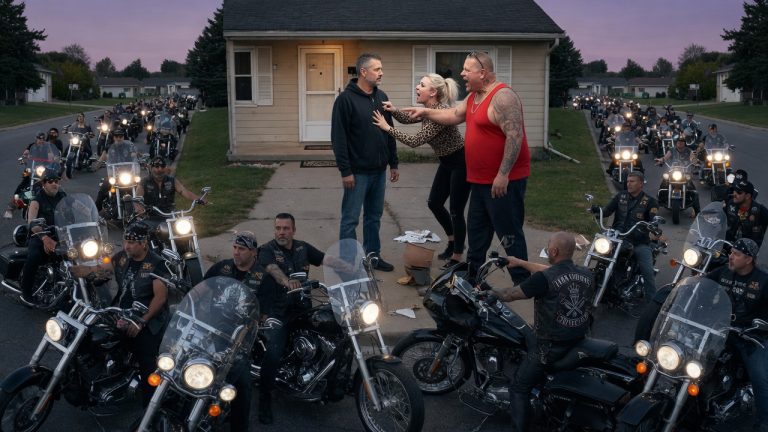
“The club is asking questions about your wife, Logan. They’re asking if you were in on it. Or if you’re just too soft to see what’s under your own roof.”
“She didn’t know what he was,” I said, my voice hardening. “She’s a dental hygienist, Deacon. She’s not a player.”
“She’s a liability,” Deacon corrected. “And Miller? He’s a dead man walking. The only question is who does the honors. Since it was your run he blew, the boys think it should be you.”
I looked at the oil stain on the floor. I thought about Gary Miller. I thought about him touching Beth. I thought about him sitting in his nice truck, counting the money he got for Jax’s life.
“I’ll do it,” I said.
“Good. But not at the clubhouse. Too much noise. Too much heat. You’re the gravedigger, Logan. You’ve got the perfect place for a man to disappear. Dig a hole. A deep one. Section 4, where the ground is soft. We’ll bring him to you at midnight.”
Deacon clapped a heavy hand on my bad shoulder. I didn’t flinch.
“One more thing,” Deacon said, his voice dropping to a low rumble. “Don’t let your heart get in the way of your hands. If she’s still in the house when this is over, the club will think you’ve chosen her over us. And you know how that ends.”
He left, the rumble of his Harley fading into the distance. I stood in the silence of the garage, the smell of grease and betrayal thick in my lungs.
I went back inside. Beth was in the kitchen, staring at a cold cup of coffee. She looked older. The light was gone from her face.
“Pack a bag,” I told her.
“Logan, please—”
“Pack a bag, Beth. Go to your sister’s in Shreveport. Don’t call me. Don’t text Miller. If you ever want to see me again, you’ll leave in the next ten minutes and you won’t look back.”
“Are you going to hurt him?” she asked, her voice a ghost of itself.
I looked at her, and for a second, I saw my mother in the window of that black Cadillac.
“I’m going to do my job,” I said. “I’m a gravedigger, Beth. I bury things that are dead. And as of an hour ago, Gary Miller is the deadest man in Louisiana.”
Chapter 3
The midnight air at Pine Haven was a different kind of thick. It was the kind of dampness that clung to the skin like a shroud, smelling of ancient mud and the metallic tang of the nearby swamp. I hadn’t turned on the lights in the tool shed. I didn’t need them. I knew every inch of this ground by touch.
I was back in Section 4. The hole I’d started that morning was waiting. I’d spent the last four hours deepening it, pushing past the five-foot mark until the walls were over my head. The clay was slick and grey, the color of a drowned man’s skin.
Every strike of the shovel felt like a heartbeat. My shoulder was screaming now, a hot, white pain that radiated down to my fingertips, but I welcomed it. The pain kept me from thinking about the suitcase Beth had carried out to her car. It kept me from thinking about the way she didn’t say goodbye, just looked at me with a mixture of terror and pity before driving away into the dusk.
I climbed out of the grave, my lungs burning. I sat on a nearby headstone—a simple granite marker for a woman named Clara who had died in 1942. I wondered if Clara had ever been betrayed. I wondered if she’d ever felt the world narrowing down to a single, violent choice.
Headlights cut through the fog near the main gate. Two sets. One was a heavy truck, the other a bike.
I stood up, wiping my hands on my jeans. I felt remarkably calm. It was the calm of a man who had already accepted the ending of the book.
The truck, a blacked-out F-150, pulled up near the edge of Section 4. Deacon hopped off his bike, the chrome reflecting the moon’s pale light. Two other club members, Snake and a prospect named Turtle, climbed out of the truck.
They dragged a man from the back bed.
Gary Miller didn’t look like a successful contractor anymore. His expensive polo shirt was torn, and his face was a map of purple bruises and dried blood. His hands were zip-tied behind his back, and a piece of silver duct tape was slapped over his mouth. When his feet hit the mud, his knees gave out, and he collapsed into the dirt.
“He’s a leaky faucet, this one,” Snake said, grinning. Snake was the kind of man who enjoyed the “jungle law” a bit too much. He carried a heavy chain wrapped around his fist like a trophy. “Cried the whole way here. Kept saying he has a daughter. Like that changes the price of the lead he put in Jax.”
Deacon walked over to me. He looked at the hole, then at me. “It’s deep enough.”
“It’s deep,” I agreed.
Deacon turned to the others. “Give us the room. Logan’s got a personal debt to settle. Wait by the gate. If you hear a shot, it’s done. If you don’t, it’s done anyway.”
Snake looked disappointed but nodded. They retreated to the bikes, their silhouettes disappearing into the mist.
It was just me, the contractor, and the hole.
I walked over to Miller. I reached down and ripped the tape off his mouth. He gasped, a wet, rattling sound.
“Logan,” he choked out. “Logan, listen to me. I didn’t mean for anyone to get killed. I just—I needed the money. The business was under. I thought… I thought the Thorns could afford a little loss. They’ve got so much.”
“Jax was twenty-one,” I said. I knelt down so I was eye-level with him. “He had a mother who worked two jobs to buy him his first bike. He wasn’t ‘the Thorns.’ He was a kid.”
“I’ll pay,” Miller pleaded. “I’ve got money hidden. I’ll give you everything. Just let me go. I’ll leave the state. I’ll never see Beth again, I swear to God.”
The mention of her name felt like a spark hitting dry tinder. I grabbed him by the collar and hauled him toward the edge of the grave. He scrambled, his boots slipping in the mud, his breath coming in frantic, high-pitched whimpers.
“You didn’t just sell the routes, Gary. You sat in my house. You ate at my table. You looked my wife in the eye and told her you loved her while you were planning to make her a widow.”
I pushed him to the very brink. He looked down into the black rectangle of the grave, and his whole body began to shake.
“Is she worth it?” I asked, my voice a whisper. “Is Beth worth dying for? Because she’s gone, Gary. She left four hours ago. She didn’t ask about you. She didn’t ask if you were okay. She just ran.”
That was a lie, but it was a lie he deserved.
Miller slumped. The fight went out of him. He looked at the mud on his expensive boots and began to cry—not the loud, performative cry of a man begging for his life, but the quiet, hopeless sob of a man who realized he was already dead.
I looked at the shovel leaning against the headstone. All I had to do was knock him in and start throwing the dirt. No one would ever find him. This was my kingdom. I knew where the old wooden vaults had rotted away, leaving space for a second, unrecorded occupant. I knew how to pack the earth so it didn’t sink.
I picked up the spade.
“Please,” Miller whispered. “I have a daughter.”
I froze.
The memory hit me like a physical blow—not of my mother leaving, but of my father the morning after. He’d sat at the kitchen table with a shovel in his hand, his eyes red, staring at the garden he’d spent all summer planting for her. He’d gone out and dug up every single rose bush, every tomato plant, every bit of life he’d put into the ground for a woman who didn’t want it. He’d turned the yard into a graveyard of dirt and broken roots.
I realized then that I was doing the same thing. I was digging up my life to bury a man who wasn’t worth the effort of the hole.
I looked at Miller, then at the dark woods where the club was waiting. If I let him live, I was a traitor. If I killed him, I was a ghost.
“Stand up,” I said.
“What?”
“Stand up, Gary. Before I change my mind.”
Chapter 4
Miller struggled to his feet, his chest heaving. He looked at me with a confused, terrifying hope. I didn’t look back. I was looking at the shovel in my hand.
“You’re going to run,” I said. “You’re going to run into those woods. There’s a creek about half a mile back. Follow it south. It’ll take you to the old highway. If the Thorns catch you, they’ll do things to you that make this hole look like a luxury suite. If I ever see your face again, I’ll finish the job myself.”
“Why?” he wheezed.
“Because my father spent his whole life digging holes for things he lost. I’m done digging for you.”
I pulled a pocketknife and sliced the zip ties on his wrists. He didn’t wait. He didn’t say thank you. He just turned and bolted into the darkness, his footsteps splashing through the shallow swamp water until the sound was swallowed by the night.
I stood there for a long time, listening to the crickets and the distant hum of the highway. Then, I picked up the shovel and began to fill the grave.
I worked with a frantic energy. I didn’t care about the rhythm anymore. I didn’t care about the shoulder. I threw the grey clay back into the hole, watching it cover the space where a man should have been. I packed it down, smoothing it over until the ground looked undisturbed, just another patch of Section 4.
I walked toward the gate. Deacon was leaning against his bike, smoking a cigarette. Snake and Turtle were gone.
“Where is he?” Deacon asked, his eyes narrow.
“He’s in the ground,” I said. I held out my hands. They were caked in mud, the skin raw and bleeding. “Deep. Section 4.”
Deacon looked at me for a long beat. He was an old wolf; he knew the scent of a lie. He walked past me, toward the grave site. I didn’t stop him. I followed him through the fog.
He stood at the edge of the freshly turned earth. He looked at the granite headstone I’d moved into place—an old, discarded marker I’d found in the “broken” pile behind the shed. It didn’t have Miller’s name on it. It was blank.
“You didn’t use a gun,” Deacon noted.
“Didn’t want the noise. A shovel works just as well if you’ve got the time.”
Deacon kicked at the dirt. It was packed tight. He looked at the woods, then back at me. “You’re a good soldier, Logan. But you’re a terrible liar.”
I felt the blood cold in my veins. My hand moved instinctively toward the knife in my pocket.
“I saw him running,” Deacon said quietly. “From the ridge. He’s fast for a guy with a polo shirt.”
The silence that followed was different. It wasn’t heavy; it was sharp. It was the sound of a hammer cocking.
“Why didn’t you stop him?” I asked.
Deacon exhaled a cloud of smoke. “Because I’m tired, Logan. I’m sixty years old, and I’ve spent forty of them burying friends and enemies. Jax is dead. Killing Miller won’t bring him back. And you? You’re the only man in this club who still has a soul worth saving. If you’d killed him, you’d have been just like Snake. And I can’t stand Snake.”
He turned away from the grave and started walking back to the bikes. “The club will believe he’s dead because I say he’s dead. But you’re done, Cross. Hand over your cut. You’re out. If I see you at the clubhouse, I’ll have to do what the boys expect.”
I felt a strange sense of relief wash over me, a weight lifting that I hadn’t even realized I was carrying. I reached up and unzipped my leather vest. I pulled the heavy “Iron Thorns” patch from my back—the wings and the crown I’d bled for. I handed it to him.
“Go find your wife, Logan,” Deacon said, taking the leather. “And if you’re smart, you’ll find a cemetery in a different state. The mud in Louisiana has a memory. It doesn’t like to let go of its secrets.”
He mounted his bike, kicked it to life, and roared out of the cemetery.
I was alone.
I walked back to the tool shed. I washed the mud from my face one last time. I looked at the rows of headstones, the silent witnesses to the best and worst parts of my life.
I thought about Beth. I didn’t know if she’d take me back. I didn’t know if the bridge I’d burned could be rebuilt. But as I walked toward my bike, I realized that for the first time in thirty-five years, I wasn’t digging a hole. I was just walking on the ground.