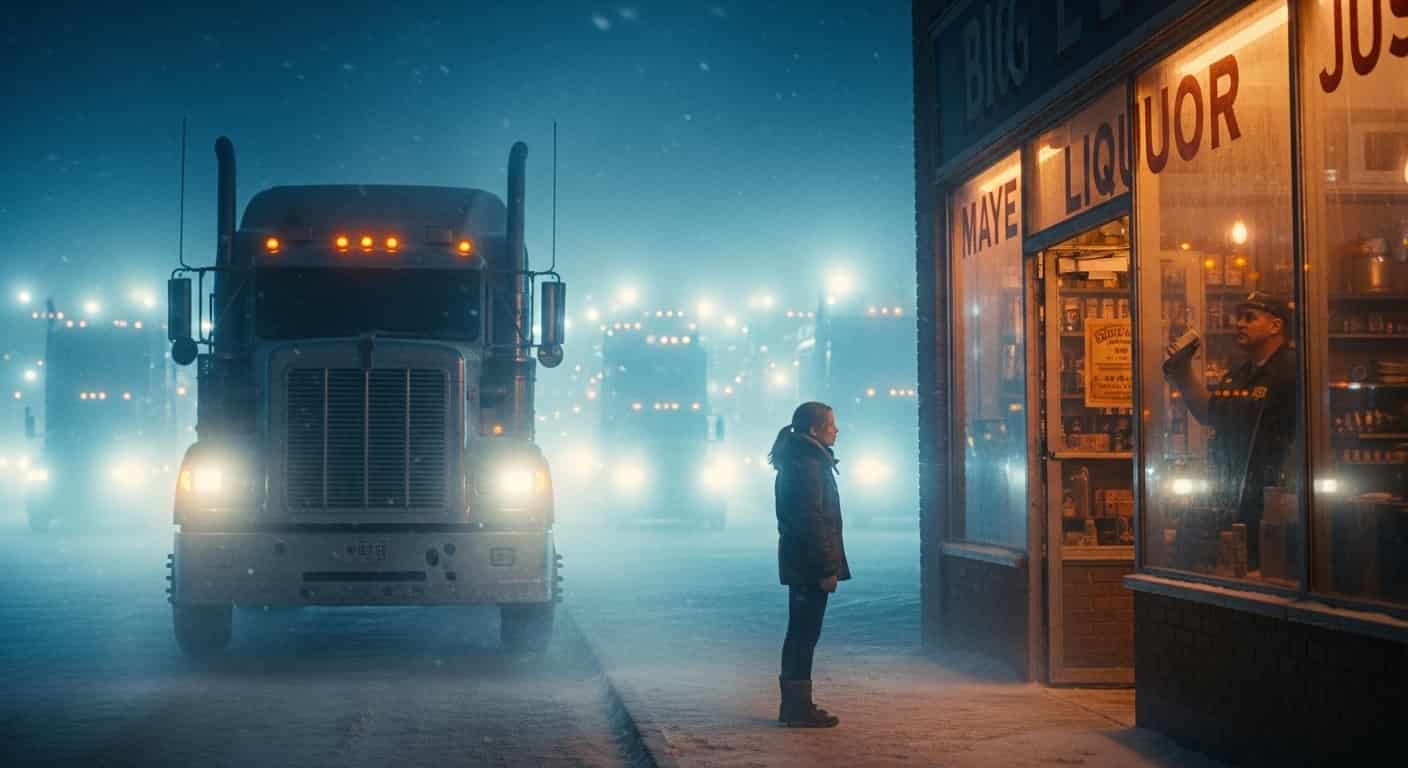
I watched from the cab of my idling rig as the thermometer on my dash dipped to minus ten. Across the street, the “”Open”” sign at Miller’s Vintage Spirits flickered and died.
But it wasn’t Maya, the soft-spoken girl who ran the place, who turned it off. It was Deputy Miller—the man who thought a badge gave him the right to own the town and everything in it.
He didn’t just close the shop. He shoved that poor girl out into the biting wind without so much as a cardigan, his boots crunching on the frost.
“”Consider this a tax for doing business in my county,”” he sneered, his voice carrying through the frozen air.
Then he locked the door from the inside. Through the glass, I saw him reach for the top shelf—the shelf where Maya kept her father’s 1945 reserve. The only thing she had left of the man who built that store from nothing.
He thought he was safe because the Sheriff is his brother-in-law. He thought nobody was watching.
He forgot that the road has eyes. And the road has a very long memory.
I didn’t call 911. Why would I call the fox to complain about the wolf?
Instead, I reached for the CB radio. I keyed the mic and spoke the three words that haven’t been used in this state for twenty years.
“”The Well is Dry.””
I didn’t have to say anything else. Within minutes, the static on the radio turned into a roar of “”Copy that, Big E.””
He thinks he’s the law. But he’s about to find out that when you mess with a legend’s daughter, you don’t get a trial. You get a reckoning.
“FULL STORY
Chapter 1: The Blue Hour of Injustice
The cold in Oakhaven didn’t just bite; it chewed. It was the kind of dry, Montana frost that turned your breath into tiny shards of ice before it even left your lips. I sat in the cab of The Iron Widow, my 18-wheeler, the engine a low, rhythmic heartbeat beneath my boots. I was seventy-two years old, retired in every way that mattered except for the fact that I couldn’t seem to stop driving.
Maya Vance’s shop was a beacon of warm yellow light against the bruising blue of the twilight. She was a good kid—twenty-four, hardworking, and carrying the weight of a legacy that was too heavy for her narrow shoulders. Her father, Silas, had been my best friend since we were both hauling logs in the seventies. When he passed, he left her that shop and a mountain of debt.
Then there was Deputy Miller.
Miller was a man who smelled like cheap cigars and unearned authority. He’d been leaning on Maya for months, “”protection fees”” disguised as “”zoning fines.”” Tonight, he’d finally snapped.
I watched through my windshield as the shop door swung open. Miller didn’t just escort her out; he threw her. Maya stumbled, her sneakers skidding on the black ice of the sidewalk. She wasn’t wearing a coat. In ten-below weather, you have about fifteen minutes before your fingers stop working. You have thirty before your heart starts to stutter.
“”You can’t do this, Miller!”” Maya’s voice was thin, vibrating with terror. “”That’s my father’s inventory! That’s my life!””
“”Your life belongs to the county now, sweetheart,”” Miller barked. He stood in the doorway, his silhouette blocked by the warmth of the store he was stealing. “”I found ‘irregularities’ in your liquor license. This property is seized.””
He slammed the door. The heavy iron bolt clicked into place.
I saw Maya press her hands against the glass, begging. Miller didn’t even look at her. He walked straight to the back of the store, to the locked cabinet. He smashed the glass with the butt of his service pistol. He pulled out a bottle—a 1945 Cabernet, the one Silas had saved for Maya’s wedding day. A bottle worth more than Miller’s patrol car.
He sat on the counter, put his muddy boots up on the mahogany, and used a letter opener to pry the cork.
My blood didn’t just boil; it turned into a pressurized steam.
I looked at the picture of Silas taped to my sun visor. I got her, brother, I whispered.
I didn’t reach for my phone. In this town, the police were just a gang with better funding. I reached for the CB.
“”This is Big Elias Thorne,”” I said, my voice cracking with an old, jagged rage. “”I’m at the corner of 5th and Main in Oakhaven. We’ve got a Code Blue. A legacy is being bled out by a vulture in a tan suit. The girl is in the cold. I repeat: The Well is Dry.””
There was a moment of dead silence. Then, a voice crackled through—Deep, gravelly, and pissed off.
“”This is ‘Grease’ Murphy. I’m ten miles out with a fleet of twelve. We’re turning around.””
“”This is ‘Long-Haul’ Larry. I’ve got forty rigs behind me coming off the I-90. We heard you, Elias. We’re coming.””
“”This is ‘Preacher.’ I’m calling the Union. Hold the line, Elias. Don’t let her freeze.””
I climbed out of my cab. My knees popped, and the wind tried to knock the air out of my lungs, but I didn’t care. I stripped off my heavy sheepskin coat and walked across the street.
“”Elias?”” Maya sobbed as I wrapped the coat around her. It was three sizes too big, swallowing her whole.
“”Shh,”” I said, pulling her into the shelter of my arms. “”Don’t cry, Maya. It ruins the view.””
“”He’s stealing it all,”” she whimpered. “”He said if I called the State Troopers, he’d plant enough ‘stuff’ in here to put me away for twenty years.””
I looked through the window at Miller. He saw me. He raised the bottle of her father’s wine in a mocking toast and took a long, slow swig. He pointed at his badge and then at the ground. My world, he was saying. My rules.
I checked my watch.
“”Five minutes, Maya,”” I whispered. “”Just give us five minutes.””
Chapter 2: The Sound of Growing Thunder
For the first five minutes, Oakhaven was silent. It was that eerie, heavy silence that precedes a landslide.
Miller was still inside, feeling invincible. He’d turned on the shop’s sound system, and I could hear the faint, muffled thumping of classic rock. He was dancing—actually dancing—behind the counter of a girl he had just made homeless.
I stood on the sidewalk, holding Maya. My old bones were screaming at the temperature, but the fire in my chest kept me upright.
“”Elias, you have to go,”” Maya pleaded, her teeth chattering. “”He’ll hurt you too. He thinks he’s a god in this town.””
“”A god is only a god until someone stops believing in him,”” I said.
Then, the sound started.
It began as a low-frequency hum, something you felt in your molars before you heard it with your ears. It sounded like a storm moving across the plains, but there wasn’t a cloud in the sky. It was the synchronized roar of hundreds—then thousands—of diesel engines.
From the north, the I-90 off-ramp began to glow. It looked like a string of fallen stars. One by one, the massive chrome grills of semi-trucks turned onto Main Street. They weren’t speeding; they were marching.
Grease Murphy’s rig was the first to arrive. He was driving a jet-black Kenworth that looked like a prehistoric beast. He didn’t pull over. He drove right onto the curb, blocking the south exit of the street.
Behind him came the flatbeds. Then the tankers. Then the independent drivers in their beat-up rigs.
Miller heard it now. He stood up, the wine bottle still in his hand, his face pressed to the shop window. He looked confused. In his mind, this was a quiet town where people took their beatings and moved on.
He didn’t realize that Oakhaven was a hub. And every driver who had ever stopped at Silas’s shop for a sandwich or a kind word was currently responding to a call for help from the man who had taught them how to drive.
The trucks began to circle. It was a “”Carousel of Steel.”” They filled every parking spot, every inch of the road, and the sidewalks. They parked three deep, nose-to-tail, creating a wall of metal that effectively cut the shop—and the Deputy—off from the rest of the world.
Miller dropped the bottle. It shattered on the floor, the 1945 vintage staining the white tile like a fresh wound.
He ran to the door and tried to unlock it, but Grease Murphy had already backed his trailer hitch flush against the front entrance. Miller was locked in.
I walked up to the window, Maya still tucked under my arm. I tapped on the glass with my wedding ring.
Miller was shouting, his face turning a purplish red. He was reaching for his radio, screaming for backup.
“”The radio won’t work, Miller!”” Grease shouted from the top of his cab. “”We’ve got three signal jammers running on this block. Nobody hears you but us.””
I looked Miller in the eye. I didn’t feel joy. I felt a cold, hard clarity.
“”You wanted the shop, Miller?”” I mouthed through the glass. “”It’s yours. All of it.””
By now, the street was packed. Men and women in heavy work jackets were climbing out of their cabs. There were no signs, no shouting—just two thousand people standing in the snow, their breath rising like a collective fog, staring at the small, lit box where a bully was trapped.
Chapter 3: The Secret in the Cellar
The standoff had reached a fever pitch. The town’s Sheriff, a man named Miller—the Deputy’s brother-in-law—had finally arrived, but he couldn’t even get his cruiser within three blocks of the shop. He was standing at the edge of the truck wall, screaming into a megaphone about “”illegal assembly”” and “”obstruction of justice.””
Nobody moved.
“”Elias,”” Maya whispered, her eyes wide. “”The Sheriff… he’s going to call the National Guard. They’ll hurt people.””
“”The Guard is six hours away, Maya,”” I said. “”And most of the Guard in this state are truckers in their day jobs. They aren’t coming to save a man who steals from orphans.””
I signaled to Grease. He jumped down from his cab, carrying a heavy iron pry bar.
“”Time to open up,”” Grease said.
With one synchronized movement, five truckers stepped forward. They didn’t break the glass—not yet. They simply used the weight of their rigs to nudge the trailer away from the door just enough for a man to pass.
Miller was backed up against the rear wall, his hand hovering over his holster.
“”Stay back!”” he screamed. “”I’ll shoot! I swear to God, I’ll shoot!””
“”With what, Miller?”” I asked, stepping into the store. “”You really think you can shoot two thousand people? You don’t have enough bullets, and you don’t have the spine.””
I walked past him as if he were a piece of furniture. I went straight to the back, to the cellar door.
“”Elias, what are you doing?”” Maya asked, following me in.
“”Your father didn’t just leave you a shop, Maya,”” I said. “”He left me a letter. He knew Miller was coming for this place. He knew the ‘zoning’ excuses were a lie.””
I kicked the rug aside, revealing a heavy steel floor safe that Miller hadn’t found yet. I entered the code—Silas’s badge number from when he was a volunteer firefighter.
The safe clicked open. Inside wasn’t money.
It was a ledger. And a digital recorder.
“”Miller wasn’t stealing your wine because he wanted a drink,”” I told Maya, loud enough for the Deputy to hear. “”He was stealing it because your father recorded the conversations in this office. Conversations about the Sheriff, the Mayor, and the land-grab they’ve been running for the last five years.””
Miller’s face went from purple to a ghostly, translucent white.
“”That’s… that’s private property,”” Miller stammered.
“”No,”” I said, holding the ledger up. “”This is evidence. And since you said this shop is now ‘seized by the county,’ I reckon this belongs to the public now.””
I walked to the front window and held the ledger against the glass for the crowd to see. A roar went up from the truckers—a sound so loud it made the remaining bottles on the shelves vibrate.
Chapter 4: The Breaking Point
The Sheriff outside realized the tide had turned. He stopped using the megaphone. He saw the ledger. He knew that if that book made it out of the circle of trucks, his career—and his freedom—were over.
“”Elias Thorne!”” the Sheriff yelled, his voice cracking. “”Give me the book, and I’ll let the girl go! I’ll drop all the charges!””
“”You aren’t in a position to negotiate, Sheriff!”” I yelled back.
Suddenly, a stone hit the front window. Then another. The glass didn’t shatter—it was reinforced—but the cracks began to spiderweb.
The crowd was getting restless. These were people who worked eighteen-hour shifts, who were away from their families, who were tired of being squeezed by the “”Millers”” of the world. They didn’t want a trial. They wanted a reckoning.
“”Break it down!”” someone yelled.
“”Wait!”” Maya screamed. She ran to the front, stepping between the angry crowd and the trembling Deputy.
“”Maya, move!”” Grease shouted. “”He deserves what’s coming!””
“”No!”” she yelled, her voice echoing in the sudden silence. “”If you do this, you’re just like him! My father loved this town. He loved the law. He didn’t build this place so it could be the site of a riot!””
She turned to Miller. The man who had thrown her into the sub-zero night. The man who had smashed her father’s legacy.
“”Give me your badge,”” she said.
Miller blinked. “”What?””
“”Give me the badge, and I’ll tell them to let you walk to the Sheriff’s car. You’ll go to jail, but you’ll walk there.””
Miller looked at the cracked glass. He looked at the two thousand shadows waiting in the cold. He unpinned the silver star with trembling fingers and dropped it into Maya’s hand.
I felt a surge of pride so strong it nearly knocked me over. Silas, your girl is a lioness.”