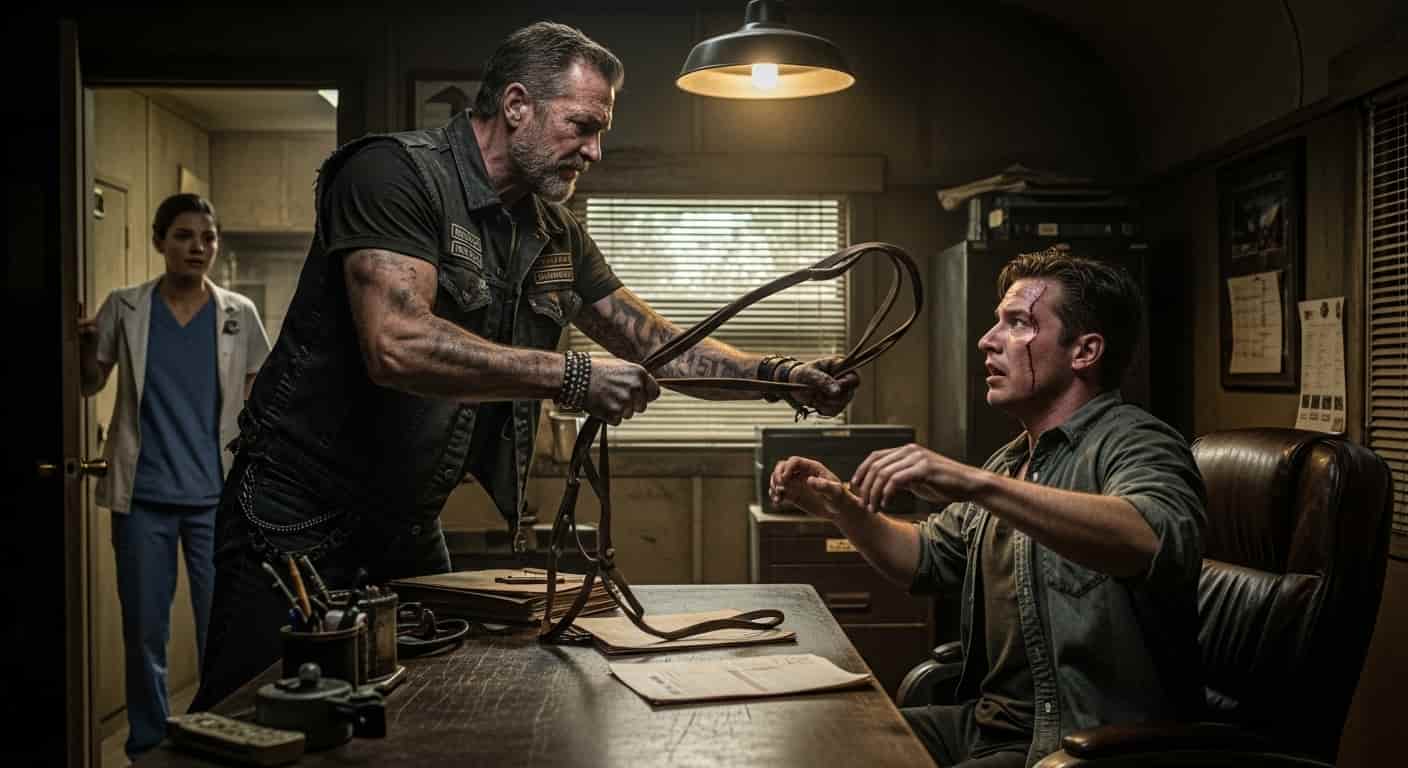
Twenty years.
That’s how long Julian Vane had been dead to the world. He had a new name, a shop in the Louisiana dirt, and a reputation for silence that kept the law at bay. He didn’t break rules, and he didn’t make friends.
Until Silas.
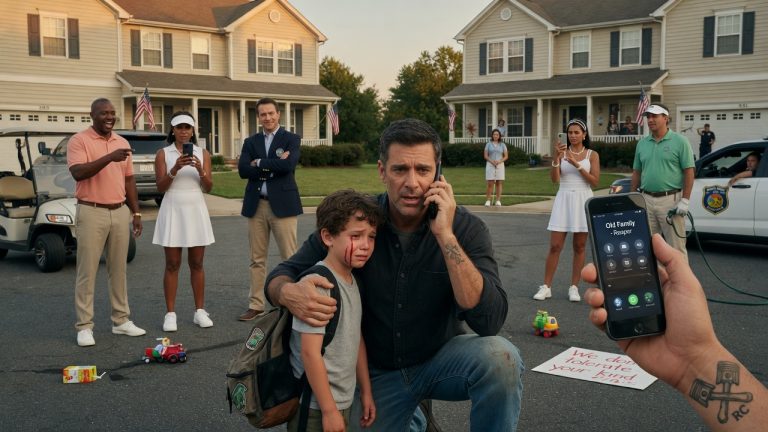
Old Silas, who survived the frozen hell of Chosin only to come home to a trailer park and a service dog named Baron. Baron wasn’t just a pet; he was the only thing keeping the old man’s night terrors from swallowing him whole.
When the local dog-fighting ring snatched Baron for “bait,” they thought they were stealing from a helpless old man. They didn’t realize who was watching from the shadows of the garage next door.
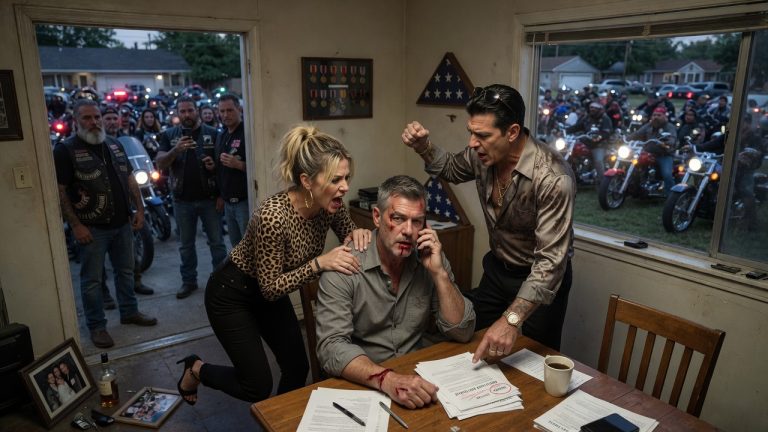
Ghost knew the faces of the men who took him. He’d seen them in the back rooms of his own club. He knew the cost of speaking up. It wouldn’t just mean a fight; it would mean the end of his twenty-year lie.
But when he saw Silas standing on his porch, holding an empty leash and shaking with a grief the world had forgotten, the “Ghost” decided to haunt the living.
FULL STORY: THE SILENCE OF THE PACK
Chapter 1: The Empty Leash
The humidity in the Atchafalaya Basin didn’t just sit on you; it pushed. It was a wet, heavy hand that flattened the sawgrass and turned the air into something you had to chew before you could breathe it. Julian—everyone called him Ghost now—wiped a streak of 10W-40 across his forehead, leaving a black smear that matched the ones on his jaw.
He was working on a ’94 Fat Boy, the chrome pitted by the salt air, when the sound started. It wasn’t the sound of a bike. It was the rhythmic, hollow thump-clack of a tennis ball inside a walker’s leg hitting the gravel.
Ghost didn’t look up. He didn’t have to.
“He’s gone, Ghost.”
The voice was thin, like parchment being folded. Ghost straightened his back, the vertebrae popping like small-caliber rounds. Silas stood at the edge of the garage bay, his knuckles white around the foam grips of his walker. He was eighty-four, wearing a faded “Korean War Veteran” cap that sat crooked on his age-spotted head.
In his right hand, Silas clutched a leather leash. The brass clip at the end dangled uselessly, catching the low afternoon sun.
“Maybe he went after a rabbit, Silas,” Ghost said, though his chest felt tight. “Baron’s got a nose on him. He’ll be back by dinner.”
“No,” Silas said. His watery blue eyes didn’t move from the empty space where his dog usually sat. “The bowl was full. He don’t leave a full bowl. And the gate… the latch was bent, Ghost. Someone reached over and pulled it.”
Ghost set the wrench down on the oily rag. He looked at the leash. It was an old piece of gear, softened by decades of Silas’s grip, scarred with the teeth marks of a dog that had been the old man’s only anchor since his wife passed in ’08. Baron was a Golden Retriever mix with a graying muzzle and a habit of leaning his entire weight against Silas’s shin when the old man started to shake.
“Who’d want a twelve-year-old dog, Silas?”
“The pits,” Silas whispered.
The word hung in the humid air like a bad smell. Ghost looked toward the treeline, where the cypress knees poked out of the black water like rotted teeth. He knew about the pits. Everyone in St. Mary Parish knew. A collection of trailers and plywood rings hidden deep in the swamp, where men with too much cheap beer and too little soul watched animals tear each other apart.
“I’ll look around,” Ghost said, his voice level. “Go inside, Silas. It’s too hot for you out here.”
“I can’t go in there,” Silas said, his lip trembling for the first time. “It’s too quiet. I can hear the cold coming back.”
Ghost knew what “the cold” meant. It was the frost of 1950, the memory of the Chosin Reservoir that Silas carried in his bones. Baron was the only thing that kept that winter at bay.
Ghost walked the old man back to his trailer, the silence between them heavier than the heat. As he turned to leave, he saw a black SUV—a late-model Tahoe with tinted windows—idling at the end of the county road. It wasn’t a local rig.
Ghost felt the old itch in his palms. The itch that had gotten him a dishonorable discharge twenty years ago when he’d broken a Major’s jaw for laughing while they bagged a corporal from Ohio. He’d spent two decades burying that man, Julian Vane, under layers of grease and silence.
He watched the Tahoe pull away, kicking up a plume of gray dust. He recognized the sticker on the back bumper. A jagged iron jaw.
It was the mark of the Iron Maw. His club. His “brothers.”
Ghost went back to his shop, but he didn’t pick up the wrench. He sat on a plastic crate and stared at the empty leash Silas had left on the workbench. He knew exactly where Baron was. And he knew that to get him back, he’d have to stop being a ghost.
Chapter 2: The Stolen Name
The bar was called The Rusty Hook, but to the locals, it was just the Maw’s porch. It smelled of stale cigarettes, spilled diesel, and the underlying rot of the swamp. Ghost pushed through the screen door, the spring screeching a warning.
At the back table sat Wrench and Cutter. Wrench was a man of sixty with a beard like steel wool and a loyalty to the club that bordered on religion. Cutter was younger, thirty at most, with a face that looked like it had been put together in a hurry. He had a jagged scar from a bar fight in Houma and a habit of looking at everyone like they owed him money.
“Ghost,” Wrench nodded, sliding a longneck across the scarred wood. “Thought you were finishing that Fat Boy.”
“Silas’s dog is gone,” Ghost said. He didn’t sit. He stood in the center of the room, his shadow long and jagged in the neon light of a Budweiser sign.
Cutter laughed, a dry, sharp sound. “Old man probably forgot to feed it. Dog’s probably halfway to New Orleans by now.”
“The gate was bent,” Ghost said, his eyes locked on Cutter. “Someone used a pry bar. Someone who knows the neighborhood. Someone who knew the old man wouldn’t be able to chase ’em.”
Cutter’s eyes shifted. He took a long pull of his beer, his throat working. “Lots of people in the parish, Ghost. Don’t go looking for trouble where there ain’t none.”
“I’m not looking for trouble, Cutter. I’m looking for a Golden Retriever with a gray chin.”
“Maybe you should stick to fixing bikes,” Cutter spat, his voice dropping an octave. “The club’s got business. We don’t need a grease monkey sniffing around the swamp.”
Ghost felt the familiar heat rising in his neck. He remembered the Major’s face—the way it had looked right before the bone snapped. He’d spent twenty years pretending he wasn’t that man. He’d lived under the name of a cousin who’d died in a car wreck in ’99. He had no bank account, no driver’s license, no paper trail. He was a ghost because the real Julian Vane was a man the U.S. Army wanted to put in a cage.
But then he thought of Silas sitting in that trailer, listening to “the cold.”
“If I find out the Maw is running bait dogs, Wrench,” Ghost said, turning to the older man, “we’re gonna have a problem.”
“The club does what it needs to stay afloat,” Wrench said, not looking up. “Don’t be a hero, Ghost. You can’t afford the attention.”
Ghost walked out. The sun was setting, turning the swamp water the color of bruised plums. He found Elena waiting by his shop. She was Silas’s granddaughter, a nurse at the county hospital who’d moved back from Shreveport to look after the old man. She was wearing her blue scrubs, her hair pulled back in a tight, tired bun.
“He’s in a state, Julian,” she said. She was the only one who used the name on his mailbox, even though she knew it wasn’t his. “He’s talking about the reservoir. He thinks the Chinese are in the woods.”
“I’m working on it, Elena.”
“Working on what? These people… they’re dangerous. I see the men who come into the ER from those pits. They aren’t just bikers, Julian. They’re monsters.”
She stepped closer, the scent of hospital soap cutting through the smell of grease. “Who are you, really? My grandfather trusts you like a son, but you don’t exist. I tried to look you up when I moved back. There’s no Julian Vane in the state records. Not a living one, anyway.”
Ghost looked at her. She had Silas’s stubborn jaw and a gaze that didn’t flinch.
“I’m the man who’s going to get that dog back,” he said. “That’s all you need to know.”
“If you go out there alone, you’re not a ghost,” she whispered. “You’re a suicide note.”
Chapter 3: The Blood on the Chrome
The “pits” were located behind an abandoned crawfish processing plant three miles into the basin. The only way in was a single-lane dirt road that turned into a muddy soup after the afternoon rains.
Ghost didn’t take his bike. The roar of a 1340cc Evo would be a dinner bell for the Maw. Instead, he took an old flat-bottomed skiff, poling his way through the cypress knees like he was part of the water.
He heard the noise before he saw the lights. The barking was frantic, a chorus of terror and aggression, drowned out by the shouting of men and the heavy thud of a generator.
He tied the skiff to a submerged stump and crept through the palmettos. The clearing was lit by work lights strung between the trees. In the center, a plywood ring had been built, the wood stained dark with old blood.
Cutter was there, standing on the bed of his Tahoe, holding a wad of cash. In a cage near the back, Ghost saw the flash of gold.
Baron was huddled in the corner of a rusted wire crate. He wasn’t barking. He was shaking so hard the cage rattled against the mud. His muzzle was muzzled with duct tape, and his front paw was bleeding where someone had kicked him to make him move.
“Next up, we got the bait!” Cutter yelled, his voice thick with bourbon. “Let’s see if the old man’s mutt has any fight left before the pit bulls get their dessert!”
A man in a stained undershirt reached for the cage.
Ghost didn’t think. He didn’t plan. The Julian Vane who had been buried for twenty years came screaming to the surface.
He stepped out of the shadows, a heavy iron pry bar in his hand. The first man didn’t even see him. Ghost swung the bar, catching him in the ribs with a sickening crunch. The man folded like a card table.
The clearing went silent. The only sound was the generator and the low, guttural growl of the fighting dogs in their pens.
“Ghost?” Cutter squinted through the light. “What the hell are you doing?”
“Opening the cage, Cutter.”
“You’re dead,” Cutter said, reaching into the waistband of his jeans. “You just broke the code. No one comes into Maw territory and touches a brother.”
“You aren’t my brother,” Ghost said, his voice as cold as the bottom of the basin. “You’re a coward who steals from an old man who bled for this country while you were still in diapers.”
Cutter pulled a snub-nosed .38, but Ghost was faster. He threw the pry bar. It wasn’t a clean hit, but it caught Cutter’s wrist, the gun skittering into the mud.
Ghost was on him in three strides. He dragged Cutter off the truck bed, his fingers digging into the man’s throat. The other men in the clearing—six or seven of them—started to close in.
“Stay back!” Wrench’s voice barked from the shadows.
The old biker stepped into the light, a shotgun leveled at the crowd. Not at Ghost. At the crowd.
“Wrench?” Cutter gasped, clawing at Ghost’s hand. “Help me!”
“I told you not to touch the dog, Cutter,” Wrench said, his voice heavy with disappointment. “I told you some things are worth more than a betting pool.”
Ghost didn’t wait for the debate. He kicked the lock off Baron’s cage. The dog didn’t run. He crawled out, his tail tucked, and pressed his head against Ghost’s thigh.
“Get him out of here,” Wrench said, his eyes never leaving the Maw members. “But Ghost… you know how this works. You don’t just walk away from this. They’ll come for you. And the law… the law is gonna want to know who you are.”
“Let ’em come,” Ghost said.
He picked up the dog, slinging the seventy-pound retriever over his shoulders like a fallen soldier, and disappeared back into the black water.
Chapter 4: The Swamp’s Edge
The rescue wasn’t clean. By the time Ghost got back to the shop, his denim vest was soaked in Baron’s blood and the black mud of the swamp. The dog was alive, but he was in shock, his breathing shallow and ragged.
Elena was waiting on the porch of the shop. When she saw Ghost emerge from the treeline with the dog, she let out a sob she immediately choked back.
“Get him inside,” she said, her professional instincts taking over. “I have my kit in the car.”
They laid Baron on the workbench—the same place Ghost had spent years repairing machines. Now, he was watching a woman stitch the life back into a dog.
“He’s got a deep gash on his haunch,” Elena said, her hands moving with practiced precision. “And he’s dehydrated. But he’ll make it. He’s tough, just like my grandfather.”
She looked at Ghost, who was leaning against the wall, his knuckles split and bleeding. “They’re coming, aren’t they?”
“Cutter won’t let it go. He lost face. In that world, face is the only currency they have.”
“Then we go to the police.”
Ghost let out a short, bitter laugh. “The Sheriff in this parish has been on the Maw’s payroll since he was a deputy. And even if he wasn’t… I can’t talk to the law, Elena.”
“Why? Because of your name?”
Ghost sat down on the floor, his back against a stack of tires. He felt the weight of the last twenty years pressing down on him. The silence was finally breaking, and it felt like a landslide.
“My name is Julian Vane,” he said. “I was a Sergeant in the 10th Mountain. In 2005, I was stationed in Kandahar. We had a Major—a real piece of work named Halloway. He liked to push the younger guys. One night, after we lost a kid from my squad, Halloway started making jokes. Said the kid was too slow, that he was a liability. Said we were better off without him.”
Ghost looked at his hands. “I didn’t think. I just saw red. I hit him so hard I broke his jaw and his eye socket. They were going to court-martial me, put me in Leavenworth for ten years. So I walked. I took a dead man’s ID and I disappeared.”
Elena stopped stitching. She looked at him, not with judgment, but with a terrifying kind of pity. “You’ve been living in a prison anyway, Julian. Just a bigger one.”
“I was fine,” he said. “Until Silas.”
“He loves you, you know,” she said quietly. “He thinks you’re the son he should have had.”
“He’s an old man who needs his dog,” Ghost said, standing up. “The rest doesn’t matter.”
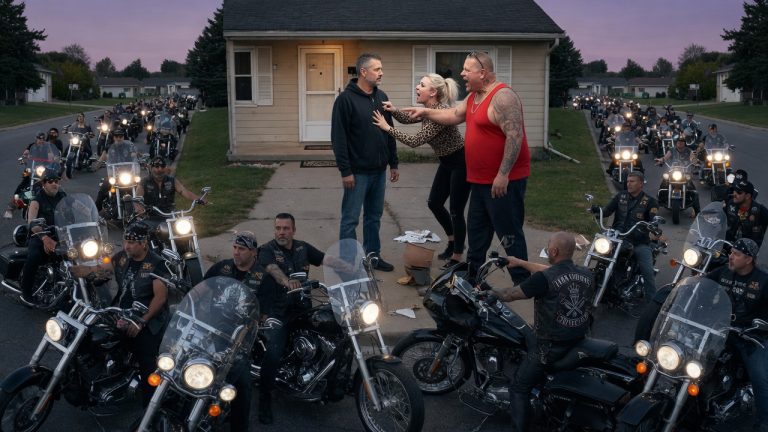
Suddenly, the night was split by the sound of a dozen engines. High-displacement V-twins, screaming down the county road.
“They’re here,” Ghost said. He reached under the workbench and pulled out a heavy canvas bag. Inside wasn’t a wrench. It was a 1911 Colt, kept clean and oiled for a day he’d hoped would never come.
“Take Baron and go to the house,” Ghost ordered. “Lock the doors. Don’t come out until the engines stop.”