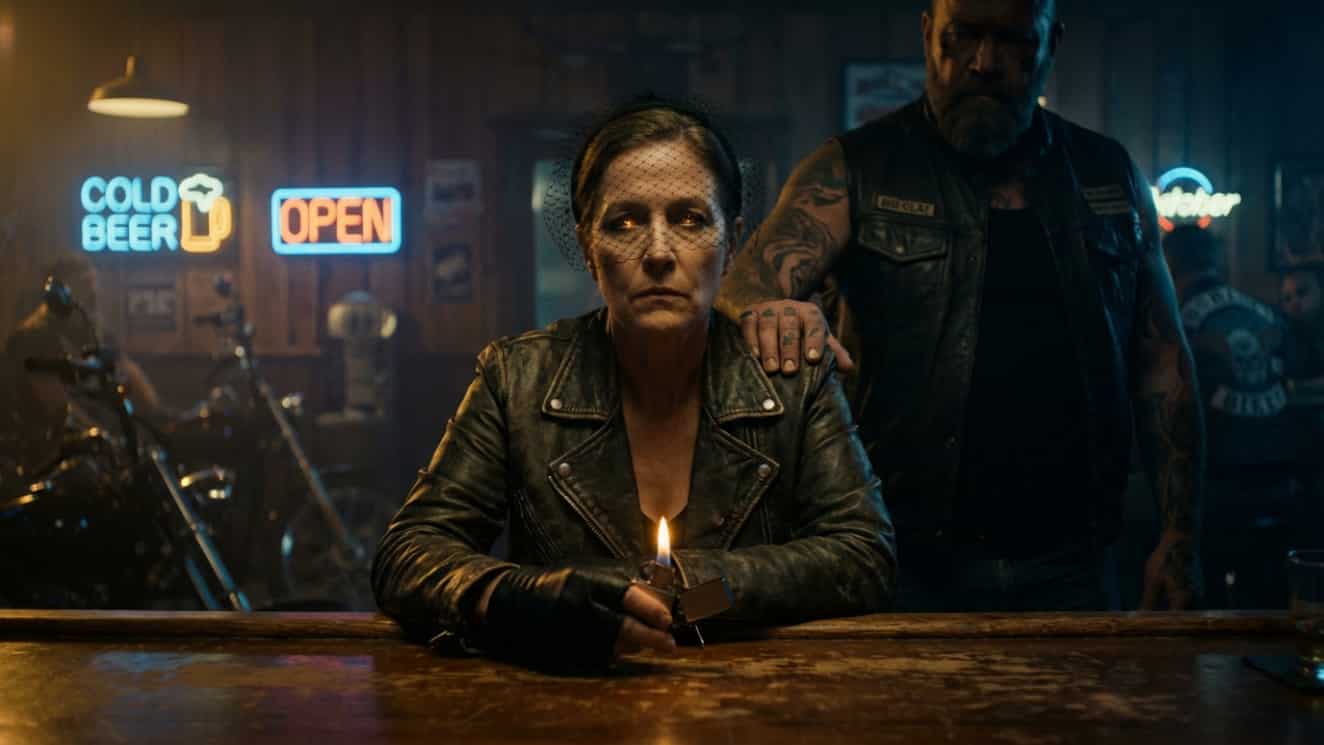
They told me Frank died in a high-speed wobble on Highway 95. They gave him a hero’s funeral, a hundred bikes roaring in a line, the smell of burnt rubber and cheap beer thick enough to choke on.
But when Big Clay put his hand on my lower back at the wake, I didn’t feel protected. I felt hunted.
Twenty years I gave this club. Twenty years of being “Jo-Jo,” the Sergeant-at-Arms’ old lady, the one who kept her mouth shut and the coffee hot. I was the wallpaper of the Iron Horse Bar.
Then I found the floorboard. I found the tapes.
Frank wasn’t just a biker. He was a man drowning, trying to buy us a way out. And the “brothers” who carried his casket? They’re the ones who put him in it.
Now, Clay wants me to take my place by his side. He wants the insurance money and the loyalty I don’t owe him.
He thinks I’m a grieving widow. He doesn’t realize I’m the one holding the match.
FULL STORY
Chapter 1: The Weight of the Cut
The heat in Pahrump doesn’t just sit on you; it pushes. It’s a physical weight, a dry, aggressive hand that forces the air out of your lungs. Jolene Vance stood at the edge of the cemetery, the gravel crunching under her boots, watching the priest’s mouth move. He was saying things about “the brotherhood of the road” and “a fallen warrior,” but Jolene was mostly focused on the way the sweat was stinging the corner of her left eye.
She didn’t wipe it away. To do that would be to move, and she didn’t want to move. If she stayed perfectly still, she could pretend she was made of the same sun-bleached stone as the markers around them.
Frank had been the Sergeant-at-Arms for the Reapers of the High Desert for twelve years. He’d been a member for twenty. To the men standing in a semi-circle around the grave—men with names like Stitch, Hammer, and Diesel—Frank was a legend. To Jolene, he was the man who snored on the left side of the bed and always forgot to tighten the cap on the milk.
“He was a titan,” Big Clay rumbled. Clay was the new SAA, a man built like a refrigerator with a beard that reached his chest. He stood too close to Jolene, his presence a deliberate claim. He smelled like tobacco and the heavy, sweet scent of chain grease. “A true Reaper. He died the way he lived—on two wheels, chasing the horizon.”
Jolene looked at the casket. It was black, draped with a club flag. Chasing the horizon. It sounded like something out of a bad movie. Frank had died at three in the morning on a straight stretch of asphalt where the only thing to hit was a jackrabbit or a telephone pole. The police report said he’d lost control. The club said it was a mechanical failure.
“He was just Frank,” Jolene said, her voice sounding thin and dry in the desert air.
Clay’s hand came down on her shoulder. It was heavy, the calluses on his palm catching on the fabric of her black denim vest. “He was more than that, Jo. And you’re more than just a widow. You’re our responsibility now. The club don’t leave its own behind.”
The way he said responsibility made Jolene’s stomach turn. It wasn’t a promise of care; it was a reminder of ownership. For twenty years, her identity had been tied to the three-piece patch on Frank’s back. Property of Frank Vance. Now that Frank was gone, the club didn’t see a woman in grief. They saw a vacancy.
After the service, the roar of forty Harleys leaving the cemetery was loud enough to vibrate in Jolene’s teeth. She drove her beat-up Toyota Corolla alone, the air conditioner blowing lukewarm air that smelled like dust. She could see the bikes in her rearview mirror, a long, black snake of chrome and leather winding through the sagebrush. They were heading to the Iron Horse, the club-owned bar where the wake would turn into a three-day bender.
Jolene didn’t go to the bar. She went to the small, one-story house on the edge of town, the one with the sagging porch and the chain-link fence. The house was too quiet. The silence was the kind that had an edge to it, like a razor blade hidden in a loaf of bread.
She sat at the kitchen table. There was a stack of mail she hadn’t opened. At the top was a letter from the insurance company. Frank had a policy, something the club had set up years ago. It was a lot of money—more money than Jo had ever seen at once. Two hundred and fifty thousand dollars. To the Reapers, that wasn’t just survival money. It was a windfall. It was bike parts, lawyer fees, and a new roof for the clubhouse.
A knock at the door made her jump. She didn’t have to look through the peephole to know who it was. The heavy, rhythmic thud was unmistakable.
She opened the door to find Big Clay and a younger guy named Toby, whose road name was “Ratchet.” Ratchet was barely twenty, his face still holding onto a lingering softness that the club was doing its best to burn away.
“Jo,” Clay said, stepping inside without being invited. He looked around the kitchen, his eyes lingering on the insurance letter. “You didn’t come to the Horse. Boys are missing you. Missing Frank.”
“I needed a minute, Clay,” Jo said, keeping her hands flat on the table. “It’s been a long day.”
“Days are gonna get longer,” Clay said. He pulled out a chair and sat down, the wood groaning under his weight. Ratchet stayed by the door, looking uncomfortable. “Look, Jo. Frank was SAA. He handled a lot of the club’s… internal affairs. We need to make sure everything is in order. His files, his notes. His gear.”
“I haven’t gone through his things yet,” Jo said.
“We can help with that,” Clay offered. His smile didn’t reach his eyes. It was a practiced, predatory expression. “Actually, the President wants me to move into the guest room for a few weeks. Just to make sure you’re safe. People know about that insurance money, Jo. Bad elements might get ideas.”
The air in the room suddenly felt very thin. Jolene knew what he was saying. He wasn’t there to protect her from “bad elements.” He was the bad element. He was there to make sure the money stayed within the club’s reach, and that Jolene stayed under the club’s thumb.
“I don’t need a babysitter, Clay,” she said, her voice steady despite the hammering of her heart.
“It ain’t a request, Jo-Jo,” Clay said, his tone dropping an octave. “It’s club business. Frank would’ve wanted it this way. You know how it is. You’ve been around long enough.”
He stood up and walked toward the back of the house, toward the bedroom she’d shared with Frank for two decades. Jolene felt a surge of cold fury, but she stayed still. In this world, you didn’t win by screaming. You won by being the last one standing when the screaming stopped.
“Ratchet, go get Clay’s bag from the truck,” she heard Clay call out.
Jolene waited until she heard the front door close behind the kid. She stood up and walked to the hallway. Clay was standing in the doorway of the master bedroom, looking at Frank’s dresser.
“Where’s his cut, Jo?” Clay asked, not looking at her. “The Sergeant-at-Arms vest. It wasn’t on him when they found him. The cops said it wasn’t at the scene.”
Jolene felt a prickle of sweat down her spine. “I don’t know. Maybe it got tossed in the brush. Maybe someone swiped it before the medics got there.”
Clay turned around slowly. His eyes were small, dark, and incredibly sharp. “That vest is club property. It has the SAA rockers on it. It don’t just disappear. You find it, you tell me.”
He brushed past her, his shoulder hitting hers with enough force to stagger her. He walked into the small guest room and dropped his keys on the nightstand.
Jolene went back to the kitchen and waited. She waited for the sun to go down. She waited for the sound of Clay’s heavy snoring to start vibrating through the thin drywall.
At 2:00 AM, she crept into the laundry room. Behind the dryer, there was a loose floorboard. Frank had put it in years ago, ostensibly to hide emergency cash. Jolene reached into the dark space and pulled out a heavy, oil-stained bundle.
It was Frank’s leather vest. The “cut.”
She unrolled it on the linoleum floor. It smelled like Frank—old spice, stale cigarettes, and the metallic scent of a hot engine. But there was something else. On the inside lining, near the armpit, there was a small, stiff patch of dried blood.
The police said there was no foul play. They said he’d died of blunt force trauma to the head when his helmet split. But Frank never rode without his vest. Never. And if he’d crashed at seventy miles per hour, this vest should be shredded.
Instead, it was pristine, except for that one spot of blood and a small, jagged hole in the leather that looked remarkably like a bullet entry point.
Jolene felt a coldness settle in her bones that had nothing to do with the night air. She reached into the hidden “stash” pocket sewn into the interior of the vest. Her fingers brushed against something hard and plastic.
She pulled out a small digital voice recorder.
She stared at it for a long time. The “Record” light wasn’t on, but the “Files” indicator showed a dozen entries.
She looked toward the guest room where Big Clay—the man who had “accidentally” survived the night Frank died—was sleeping. Then she looked back at the recorder.
She didn’t press play. Not yet. She tucked the recorder into her pocket and hid the vest back under the floorboards. She knew one thing for certain: the man sleeping in her guest house wasn’t there to protect her. He was there to see if she’d figured out that her husband hadn’t been killed by a “high-speed wobble.”
He’d been murdered by the men he called brothers. And now, they were waiting for her to make a mistake.
Chapter 2: The Iron Horse
The Iron Horse was a windowless cinderblock building on the outskirts of town, painted a shade of red that looked like dried blood under the desert sun. It was the kind of place where the air was permanent—composed of forty years of cigarette smoke, spilled beer, and the heavy, ozone scent of a nearby welding shop.
Jolene pulled her Corolla into the dirt lot the next afternoon. She shouldn’t have been there. A widow was supposed to stay home, receive visitors, and look mournful. But she knew that if she stayed in that house with Big Clay looming in the hallway like a gargoyle, she’d lose her mind.
As she stepped out of the car, the heat hit her like a physical blow. A group of “prospects”—the low-ranking kids who did the club’s dirty work—were washing bikes in the shade of a corrugated metal lean-to. They stopped and watched her. They didn’t nod. They didn’t offer a greeting. They just watched.
Inside, the bar was cool and dark. The jukebox was playing something low and gravelly—Waylon Jennings, maybe.
“Jo-Jo,” the bartender, a woman named Sheila with skin like tanned leather, said. She pushed a glass of iced tea across the scarred wood. “You shouldn’t be here, honey. You should be resting.”
“Resting makes me think too much, Sheila,” Jolene said. She took a sip of the tea. It was bitter and over-steeped. “Where’s Misty?”
Sheila jerked a thumb toward the back booths. “Over there. Trying to look like she ain’t crying.”
Misty was nineteen. She had bleached blonde hair that was starting to show dark roots and a tattoo of a butterfly on her collarbone that looked like it had been done in a garage. She was a “sweetbutt”—a girl who hung around the club for the reflected glory of the patches. Jolene had been Misty twenty-five years ago. It was like looking at a ghost of her own bad decisions.
Jolene walked over and slid into the booth opposite the girl. Misty jumped, her eyes wide and rimmed with red.
“Jo,” Misty whispered. “I’m so sorry. About Frank. He was… he was always nice to me.”
Frank hadn’t been nice. He’d just been less cruel than the others. In the world of the Reapers, that passed for chivalry.
“Thanks, Misty,” Jolene said. She noticed the way the girl was clutching her purse, her knuckles white. “You okay? You look like you’re ready to bolt.”
Misty looked toward the bar, where Big Clay had just walked in. He didn’t see them yet; he was busy greeting the President, a man called “The Hammer” who had a prosthetic leg and a temperament like a cornered rattlesnake.
“I want to leave,” Misty said, her voice barely audible. “But Clay… he says I owe the club for the apartment. He says if I leave, he’ll find my mom in Reno.”
Jolene felt a flare of protective rage. This was the cycle. They found girls who were running from something, gave them a place to sleep and a sense of “family,” and then turned that family into a cage.
“He’s just talking, Misty,” Jolene said, though she knew he wasn’t.
“He’s not,” Misty said. She leaned in, her voice a frantic hiss. “Jo, the night Frank… the night of the accident. I was in the back room of the clubhouse. I heard them talking. Clay and the Hammer.”
Jolene’s heart skipped a beat, but she kept her face perfectly still. “Talking about what?”
“About a rat,” Misty said. “They said there was a leak. They said the feds were getting too close to the North end of the shipment. Clay said he’d handle it. He said he’d take Frank for a ‘midnight run’ to clear his head.”
Jolene felt the digital recorder in her pocket. It felt like a piece of dry ice, burning against her thigh. “Did you see them leave?”
“Yeah,” Misty said, a tear finally escaping and tracking through her cheap foundation. “Frank looked… he looked tired, Jo. Not scared. Just tired. Clay was laughing. He had his arm around Frank’s shoulder.”
“Jo-Jo!”
The voice boomed across the bar. Big Clay was walking toward them, his spurs jingling on the floorboards. He looked at Misty with a sneer that made the girl flinch.
“Don’t you have some cleaning to do in the back, little girl?” Clay asked.
Misty scrambled out of the booth without a word, her head down. Jolene watched her go, a sick feeling in her gut. She’d seen this movie before, and it never ended well for the girl.
Clay slid into the seat Misty had vacated. He smelled like the road—exhaust and wind. “You’re making a habit of being where you shouldn’t be, Jo. First the cemetery, now here. It ain’t a good look for a widow.”
“I didn’t know there was a dress code for grief, Clay,” Jo said.
“There’s a code for everything,” Clay said. He reached across the table and took her hand. His grip was like a vice. “I told you, I’m taking care of you now. That means you stay close. You don’t go gossiping with the sweetbutts.”
“Is that what I’m doing? Gossiping?”
“I don’t know what you’re doing,” Clay said, his voice dropping to a dangerous whisper. “But I know what Frank was doing. He was getting sloppy. He was forgetting who his real family was.”
Jolene looked at him. She looked at the scar that ran from his ear to his jawline, a relic of some forgotten bar fight. “What does that mean?”
“It means,” Clay said, leaning in until she could see the broken capillaries in his eyes, “that Frank was lucky he died in a crash. A man who betrays the patch… well, they don’t get a hero’s funeral. They get a hole in the desert that nobody remembers.”
He squeezed her hand until the bones clicked, then he let go and stood up. “I’m going to the clubhouse. Be home by six. I want dinner on the table. Like the old days.”
He walked away, leaving Jolene shaking with a mixture of terror and loathing. She waited until he’d left the bar, then she stood up and walked toward the bathroom.
She locked herself in the stall, sat on the closed lid of the toilet, and pulled out the recorder. Her fingers were trembling so hard she almost dropped it. She found the most recent file and hit play.
The sound of wind was the first thing she heard—the roar of an engine at high speed. Then, the sound of bikes idling.
“Why we stopping here, Clay?”
It was Frank’s voice. It sounded older than she remembered, weary and thick with the Nevada dust.
“Just wanted to talk, brother,” Clay’s voice came through, distorted but clear. “Just you and me. Away from the noise.”
“I got nothing to say.”
“That’s the problem, Frank. You got too much to say. To the wrong people. We found the wire in the primary drive of your bike. Smart place to hide it. Almost worked.”
There was a long silence on the tape, save for the whistling of the desert wind.
“I was trying to get her out, Clay,” Frank said, his voice cracking. “She doesn’t belong in this. Twenty years of this shit… she deserves better.”
“She’s property of the club, Frank. Just like you. And you know the price of a rat.”
A loud, metallic clack echoed in the small bathroom stall. The sound of a hammer being cocked back on a handgun.
“Do it, then,” Frank said. There was no fear in his voice. Just a profound, crushing exhaustion. “But leave her alone. She didn’t know. I swear on the patch, she didn’t know.”
“The patch don’t mean shit to a dead man,” Clay said.
Then, a single, sharp pop.
The recording ended.
Jolene sat in the silence of the Iron Horse bathroom, the plastic recorder clutched in her hand. She didn’t cry. She didn’t scream. She just looked at the graffiti on the back of the door—For a good time call Candy—and realized that the man who had shared her bed for twenty years had died trying to save her from the very life she was currently living.
And the man who killed him was waiting for her to make him dinner.
She stood up, tucked the recorder back into her pocket, and walked out of the bathroom. She didn’t look at Sheila. She didn’t look at the prospects. She walked straight to her car and drove toward the edge of town, where the police station sat like a lonely fortress against the sagebrush.
Chapter 3: The Cold Shoulder
Detective Aris was a man who looked like he had been carved out of a piece of old, weather-beaten cedar. He was lean, grey-haired, and possessed a pair of eyes that seemed to be constantly looking for the lie in every sentence. He sat across from Jolene in a cramped interview room that smelled like floor wax and stale coffee.
“You’re Frank Vance’s widow,” Aris said. It wasn’t a question. He had a file open in front of him. “I’m sorry for your loss. It was a nasty accident.”
“It wasn’t an accident, Detective,” Jolene said. She felt strangely calm. The fear had crystallized into something harder, something that felt like a weapon.
Aris leaned back, his chair creaking. “The coroner’s report says blunt force trauma. The bike’s front fork snapped. It’s a common failure on those older chopped frames.”
“The bike didn’t fail,” Jolene said. She leaned forward, her voice a low, urgent murmur. “They killed him. Big Clay and the Hammer. They thought he was an informant.”
Aris didn’t blink. He didn’t even look surprised. He just watched her, his expression unreadable. “Informant for who, Mrs. Vance? We don’t have any record of your husband working for us.”
“The FBI,” Jolene said. “He had a recorder. He was making tapes.”
Aris sighed, a long, weary sound. “The FBI doesn’t share their toys with us, ma’am. Even if they were using him, he’s dead now. The case is closed. Without physical evidence of foul play at the scene, there’s nothing I can do. The Reapers are a powerful local interest. We don’t kick that hornet’s nest without a very good reason.”
“I have the recorder,” Jolene said.
Aris paused. For the first time, a flicker of genuine interest crossed his face. “Where is it?”
“Somewhere safe,” Jolene lied. She knew that if she handed it over now, it would vanish into an evidence locker, or worse, find its way back to the club. She’d lived in this town long enough to know that the line between the badge and the patch was often blurred by handshakes and envelopes of cash. “I want protection. I want out of this town, and I want them gone.”
“That’s a tall order, Mrs. Vance,” Aris said. He stood up and walked to the window, looking out at the dusty street. “If I take that recorder, and it’s what you say it is, you’ll be the star witness in a RICO case. You know what happens to star witnesses in this county?”
“They disappear,” Jolene said.
“They disappear,” Aris agreed. “Usually before the trial. The Reapers have friends in the DA’s office. They have friends on the city council. If you do this, you aren’t just taking on Big Clay. You’re taking on the whole machine.”
“They killed my husband,” she said, her voice finally breaking. “He was trying to get me away from them, and they put a bullet in him like he was a stray dog. I’m not just going to sit in that house and wait for Clay to decide I’ve outlived my usefulness.”
Aris turned back to her. His eyes softened, just a fraction. “Go home, Mrs. Vance. Keep that recorder hidden. Don’t tell anyone you have it. Not your friends at the bar, not the sweetbutts. Nobody.”
“And then what?”
“And then I see what I can dig up on the quiet,” Aris said. “But listen to me. If Clay suspects you’ve talked to me, he won’t wait for a midnight run. He’ll finish it right there in your kitchen. Do you understand?”
Jolene nodded. She understood perfectly. She was a dead woman walking; the only question was how many people she could take down with her before she fell.
When she got back to the house, Big Clay’s truck was in the driveway. He was sitting on the porch, drinking a beer and tossing the bottle caps into the dirt.
“Where you been, Jo?” he asked. His voice was casual, but the way he was holding the beer bottle—thumb tucked over the top—told her he was coiled tight.
“Grocery store,” Jolene said. She held up a plastic bag with a loaf of bread and some bologna. “Had to get stuff for dinner.”
Clay stood up and walked down the porch steps. He grabbed the bag from her hand and looked inside. “That’s it? Bread and meat? Frank used to say you made a mean pot of chili.”
“I ran out of beans,” she said, trying to walk past him.
He stepped in her way, his massive frame blocking the door. He leaned down, his face inches from hers. “You smell like the station, Jo.”
Jolene felt her heart stop. “What?”
“The police station,” Clay said, his voice a low, vibrating growl. “It has a smell. Pine-Sol and misery. I spent enough time in those rooms to know it anywhere.”
“I had to go by the impound lot,” Jolene said, the lie coming to her with a sudden, desperate clarity. “I wanted to see if I could get Frank’s bike back. I wanted his personal effects.”
Clay stared at her for a long, agonizing moment. He was looking for the tell—the twitch of the eye, the tremor in the voice. Jolene looked right back at him, letting her grief and her hatred fuel her stare.
“The bike’s evidence, Jo,” Clay finally said, his grip on the grocery bag loosening. “You know that. Don’t go poking around the law. It makes the club look bad. People start thinking we’re getting cozy with the heat.”
“I just wanted his things, Clay,” she said, her voice thick with fake tears. “Is that so much to ask?”
Clay softened, his predatory instinct momentarily satisfied by her apparent weakness. “I’ll get his things. I told you, I’m taking care of you now. You just stay here. Cook the food. Be a good widow.”
He patted her cheek—a gesture that felt like a slap—and walked inside.
Jolene followed him, her mind racing. She had to move. Aris wasn’t going to save her. He was a small-town cop with a big-town problem. If she wanted justice, she was going to have to create it herself.
She went into the kitchen and started making the sandwiches. As she worked, she looked through the window at the guest house. She saw Misty walking across the yard, carrying a basket of laundry. The girl looked like a ghost, her shoulders slumped, her spirit already being ground into the dirt.
Jolene realized then that she couldn’t just run. If she ran, Misty would be the next “property.” The cycle would just continue, one broken girl after another, until the desert was full of forgotten graves.
She needed to dismantle the brotherhood. She needed to turn them against each other. And she knew exactly how to do it.
Chapter 4: The Poisoned Well
The next few days were a choreographed dance of domesticity and dread. Jolene played the role of the dutiful, grieving widow. She made the chili. She cleaned the house. She let Big Clay sit in Frank’s chair and drink Frank’s beer.
Every time he touched her—a hand on the waist, a squeeze of the shoulder—she felt a wave of nausea so powerful she had to bite her tongue to keep from gagging. But she smiled. She nodded. She acted like a woman who was slowly accepting her fate as the new “Old Lady” of the Sergeant-at-Arms.
“You’re doing good, Jo,” Clay said one night, his feet up on the coffee table. “The Hammer is pleased. We’re moving the North shipment on Friday. Big payout. After that, maybe we take a trip. Get you out of the heat for a bit.”
“That sounds nice, Clay,” Jolene said. She was drying a plate, her back to him. “Where’s the shipment going?”
Clay’s eyes narrowed. “Business is business, Jo. You know the rules.”
“I just thought… Frank used to tell me things,” she lied. Frank had never told her anything. “He said the North route was compromised. He said someone was talking to the feds about the warehouse in Tonopah.”
The change in the room was instantaneous. The air didn’t just get tense; it turned electric. Clay took his feet off the table and sat up straight.
“Frank told you that?”
“He was worried, Clay,” Jolene said, turning around and leaning against the counter. She kept her face innocent, a mask of concern. “He said he didn’t trust the new guys. He said he thought one of the prospects was wearing a wire.”
“Which one?” Clay’s voice was like grinding stones.
“He didn’t say,” Jolene said. “But he mentioned Ratchet was spending a lot of time in town. Alone.”
It was a lie—a cruel, calculated lie. Ratchet was just a kid, a boy who probably didn’t have the stomach for what the Reapers did, let alone the courage to talk to the feds. But he was the weakest link. He was the one Clay would believe was a traitor because Clay already despised him for his softness.
“Ratchet,” Clay whispered, his face turning a dark, mottled red.
“Is everything okay, Clay?” Jolene asked, her heart hammering against her ribs.
“Everything’s fine,” Clay said, standing up. He grabbed his leather jacket from the back of the chair. “I gotta go to the clubhouse. Don’t wait up.”
He slammed the door so hard the windows rattled. Jolene watched his truck roar out of the driveway, kicking up a plume of white dust.
She didn’t waste a second. She grabbed her keys and ran out to the yard. She found Misty in the small shed where the club kept the lawnmower and the extra oil. The girl was sitting on a crate, smoking a cigarette, her eyes fixed on nothing.
“Misty, listen to me,” Jolene said, grabbing the girl’s arms. “You need to leave. Right now.”
Misty looked at her, confused. “What? Jo, I can’t. Clay said—”
“Clay is going to be busy,” Jolene said. “He thinks there’s a rat. He’s heading to the clubhouse to deal with Ratchet. In an hour, this whole town is going to be a war zone.”
“A rat?” Misty’s voice trembled. “But Ratchet wouldn’t… he’s just a kid.”
“I know,” Jolene said, the guilt stabbing at her, sharp and cold. “But he’s the one who’s going to buy you enough time to get out. Take my car. The keys are in the ignition. Go to my sister’s place in Elko. I’ve already called her. She’s expecting you.”
“What about you?” Misty asked. “Jo, come with me.”
“I can’t,” Jolene said. “I have to finish this. If I leave now, they’ll just find us. I have to make sure they’re too busy killing each other to come looking for anyone.”
She shoved a wad of cash into Misty’s hand—the last of her savings. “Go. Don’t stop for gas until you’re fifty miles out of town. Use the back roads. Don’t turn on your headlights until you hit the highway.”
Misty looked at the money, then at Jolene. She threw her arms around the older woman’s neck, a desperate, sobbing hug. “Thank you, Jo. I’m sorry. I’m so sorry.”
“Go,” Jolene whispered.
She watched the Corolla pull out of the driveway, its tail lights fading into the dark. She felt a moment of profound loneliness, standing there in the dust. She was forty-five years old, her husband was dead, her house was being occupied by a murderer, and she had just sent a nineteen-year-old girl into the night with nothing but a tank of gas and a prayer.
But she wasn’t done.
She went back into the house and headed for the laundry room. She pulled up the floorboard and took out the vest. She didn’t just take the recorder this time. She took the vest itself.
She sat at the kitchen table and began to work. She took a seam ripper and carefully opened the lining where the “Property of Frank Vance” patch was sewn. Inside, Frank had hidden more than just a recorder. He’d hidden a small ledger—a black book filled with names, dates, and amounts. It was the entire history of the Reapers’ drug trade for the last five years.
And on the very last page, in Frank’s messy scrawl, was a single entry: Clay. Tonopah. 15 kilos. Missing.
Frank hadn’t just been an informant. He’d been an auditor. He’d found out that Clay was skimming from the club. That was why Clay killed him. It wasn’t about the feds. It was about greed. It was the oldest story in the world.
Jolene looked at the book and then at the recorder. She had the proof that Clay was a murderer, and the proof that he was a thief. In the world of the Reapers, the latter was often considered the greater sin.
She picked up the phone and dialed a number she’d memorized from the bar’s payphone years ago. The Hammer’s private line.
The President picked up on the third ring. “Yeah?”
“Hammer,” Jolene said, her voice steady and cold. “It’s Jo. You need to come to the house. Alone.”
“I’m busy, Jo. Clay says we got a situation with a prospect.”
“The situation isn’t with a prospect, Hammer,” she said. “The situation is in Frank’s ledger. I think you’d be very interested to see what your Sergeant-at-Arms has been doing in Tonopah.”
There was a long, heavy silence on the other end of the line.
“I’ll be there in ten minutes,” the Hammer said.
Jolene hung up. She went to the drawer and pulled out Frank’s old .38 special. She checked the cylinder—six rounds, heavy and silver. She tucked it into the waistband of her jeans.
She wasn’t a killer. She was just a widow with a debt to pay. And in the Nevada desert, debt was the only thing that ever truly mattered.
Chapter 5: The Reckoning
The Hammer arrived in a black SUV, the tires churning up a storm of dust as he skidded to a halt in the driveway. He walked with a heavy, rhythmic limp—the mechanical clack-hiss of his prosthetic leg a warning signal in the quiet night.
Jolene was sitting on the porch, the ledger open on her lap. She had a lamp turned on next to her, casting a pool of yellow light that made the surrounding darkness feel even deeper.
“Where is it?” the Hammer asked. He was a small man, wiry and scarred, with eyes that looked like they’d seen everything and liked none of it.
Jolene handed him the book. He took it, his gnarled fingers flipping through the pages. He stopped at the last entry. His face didn’t change, but his breathing slowed, becoming shallow and dangerous.
“Frank found this?” he asked.
“He was going to bring it to you,” Jolene lied. “He thought the club was being bled dry. But Clay found out. He killed Frank on the road and made it look like a crash. He’s been in my house for a week, looking for this book.”
The Hammer looked at the guest house, then back at Jolene. “Where’s Clay now?”
“He’s at the clubhouse,” Jolene said. “He went there to kill Ratchet. He’s going to use the boy as a scapegoat. He’ll tell you Ratchet was the one skimming, and then he’ll ‘dispose’ of the evidence.”
The Hammer closed the ledger with a soft thud. He looked at Jolene, and for a second, she saw something like respect in his eyes. Or maybe it was just pity.
“You’ve been playing a dangerous game, Jo,” he said.
“The game was already dangerous, Hammer. I just decided to start throwing the dice.”
Before he could respond, the sound of another engine tore through the air. A truck—Clay’s truck—came screaming down the road, fishtailing into the yard.
Clay jumped out before the vehicle had even stopped moving. He was covered in blood—not his own. His eyes were wide, wild with a combination of adrenaline and panic.
“Hammer!” he shouted, seeing the President on the porch. “We got him. Ratchet talked. He admitted to everything. He was the leak, he was—”
He stopped dead as he saw the ledger in the Hammer’s hand.
The silence that followed was absolute. The only sound was the wind whistling through the sagebrush and the ticking of Clay’s cooling engine.
“Ratchet’s dead?” the Hammer asked, his voice deceptively soft.
“He… he resisted,” Clay stammered. He looked at Jolene, and the mask finally slipped. The “protector” was gone, replaced by a cornered animal. “She’s lying, Hammer. Whatever she told you, she’s a lying bitch. She’s been talking to the cops. I saw her at the station!”
“I went to the station to tell them my husband was murdered,” Jolene said, standing up. She didn’t move toward the gun in her waistband. She didn’t have to. “But the Hammer knows the truth now, Clay. He knows about Tonopah. He knows you’ve been stealing from your brothers for years.”
Clay lunged for the porch, his hand reaching for the holster at his hip.
The Hammer was faster. Despite his leg, he moved with the practiced grace of a man who had survived a dozen wars. He pulled a compact 9mm from his jacket and fired twice.
The shots were deafening in the small yard.
Clay jerked back, his chest blooming with red. He hit the dirt hard, his boots kicking at the gravel for a few seconds before he went still.
The Hammer didn’t look at the body. He looked at the ledger. “Fifteen kilos,” he muttered. “Stupid bastard.”
He turned to Jolene. He didn’t point the gun at her, but he didn’t put it away either. “You did the club a service, Jo. You found a parasite.”
“I found my husband’s killer,” she said.
“Same thing,” the Hammer said. He tucked the ledger into his waistband and the gun back into his holster. “But you can’t stay here. The boys… they won’t like that a woman brought down an SAA. Even a dirty one. It sets a bad precedent.”
“I don’t want to stay,” Jolene said. “I want the insurance money, and I want to be left alone.”
“The insurance money is club property,” the Hammer said.
“No,” Jolene said, her voice hardening. “It’s Frank’s. And Frank died for this club. If you take that money, I’ll make sure Detective Aris gets the digital recordings I have hidden. The ones where Clay describes exactly how the North shipment is moved. The ones with your name all over them, Hammer.”
It was a bluff. The recordings she had didn’t mention the Hammer. They were mostly Frank’s private thoughts and the final confrontation with Clay. But the Hammer didn’t know that. And he was a man who lived and died by the math of risk.
The Hammer stared at her. He looked at the dark house, the dead man in the dirt, and the woman who had lived in the shadows of his club for twenty years.
“You got twenty-four hours to get out of the county,” he said. “After that, you’re just another target. You understand?”
“I understand,” Jolene said.
The Hammer walked back to his SUV, his prosthetic leg clicking on the gravel. He didn’t look back at Clay. He didn’t look back at her. He just drove away, leaving her alone with the silence and the dead.
Chapter 6: The Long Road Out
Jolene spent the rest of the night packing. She didn’t take much. A suitcase of clothes, a few photos, and the small digital recorder. Everything else—the furniture, the dishes, the twenty years of “property” status—she left behind.
She walked out to the guest house one last time. It was empty and smelled like Big Clay’s cheap cologne. She went to the sink and turned on the tap, letting the water run until it was hot. She washed her face, scrubbing at the feeling of the last week until her skin was raw and red.
She went back to the main house and stood in the kitchen. She looked at the insurance check on the table. Two hundred and fifty thousand dollars. It was a ticket to a new life, a way to start over in a place where nobody knew her as “Jo-Jo.”
She picked up a pen and signed the back of it. Then she tucked it into an envelope and addressed it to Misty, care of her sister in Elko.
She didn’t need the money. The money was blood. Every cent of it was a piece of Frank, and she didn’t want to live off the ghost of a man who had been a part of the very machine that destroyed him. She had her own small savings, and she had her pride. That would have to be enough.
As the first hint of grey began to bleed into the eastern sky, Jolene walked out to the yard. She looked at Big Clay’s body. The desert was already reclaiming him; the dust was settling in his beard, and a few scavengers were circling high above.
She didn’t feel triumph. She didn’t feel peace. She just felt a profound, hollow coldness.
She got into her car—the Corolla that Misty had returned under the cover of darkness, having decided she couldn’t leave Jolene behind. Misty was asleep in the passenger seat, her head lolling against the window, looking younger and more fragile than ever.
Jolene started the engine. It coughed, then settled into a steady, rhythmic thrum.
She drove out of the driveway, past the sagging porch and the chain-link fence. She drove past the Iron Horse, where the neon sign was flickering feebly against the coming dawn. She drove past the cemetery, where Frank was buried under a pile of lies and a club flag.
As she hit the open highway, the sun began to crest the mountains, flooding the desert with a harsh, unforgiving light. The shadows of the sagebrush stretched long and thin across the asphalt.
Jolene looked in the rearview mirror. The town of Pahrump was already shrinking, becoming just another cluster of buildings in a vast, empty landscape.
She reached into her pocket and felt the digital recorder. She rolled down the window and held it out into the wind. She let it go. It hit the pavement and shattered, the plastic pieces bouncing into the dirt.
The truth was out. The debt was paid.
She turned her eyes back to the road ahead. It was a straight line, gray and shimmering with heat, stretching out toward an uncertain horizon. She didn’t know where she was going, and she didn’t know who she was without the patch.
But as the wind whipped through her hair, carrying the scent of sage and freedom, Jolene Vance realized one thing.
For the first time in twenty years, she didn’t belong to anyone.
She was just a woman, driving into the light, leaving the ghosts of the brotherhood in the dust behind her.