Leo spent ten years learning how to be a ghost. In the world of The 500, silence isn’t just a habit—it’s survival. They think he’s their most loyal soldier, the man who cleans up the messes and never asks why.
They don’t know about the recorder hidden in his bike. They don’t know about the bookstore on 4th Street where he pretends he’s a different man. And they definitely don’t know that every time Leo looks at the club president, he sees the man who executed his father.
But the police department is tired of waiting. His handler is tightening the noose, and the line between the “good guys” and the “bad guys” has been smeared with enough grease and blood that Leo can’t tell them apart anymore.
When the trap is set, Leo has to choose: the brothers who would die for him, or the law that’s ready to let him burn.
FULL STORY
Chapter 1: The Weight of the Wire
The smell of the bookstore was the only thing that kept Leo from forgetting the sound of his own name. It was a scent of vanilla, rotting paper, and cold coffee—a sharp, clean contrast to the world of The 500, which smelled exclusively of unwashed denim, burnt oil, and the metallic tang of stale beer.
Leo sat in the back corner of The Dusty Page, a narrow shop tucked between a closed-up deli and a laundromat in a part of Jersey City that the tourists usually skipped. He was holding a worn copy of Steinbeck. His fingernails were permanently stained black with engine grease, the crescent moons of filth a mark of his trade as the club’s primary mechanic.
“You’ve been on that page for twenty minutes, Leo,” Clara said from behind the counter. She was seventy, with silver hair and eyes that saw too much. She didn’t ask about the leather vest with the “500” patch on the back. She didn’t ask about the scars on his knuckles.
“It’s a good page,” Leo said. His voice was a low rasp, a habit born from years of saying as little as possible.
The bell over the door jangled—not a light sound, but a violent rattle. The air in the shop changed instantly. The quiet evaporated. Zip stepped in, his boots clomping on the floorboards like hammers. Zip was lean, twitchy, and had a nervous energy that made people want to reach for a weapon. He wore his colors like a suit of armor, his “Sgt. at Arms” patch gleaming under the dim fluorescent lights.
“Look at this,” Zip shouted, his voice echoing off the stacks of biographies. “Our resident scholar. Reading about farmers and dust storms while the world is turning.”
Leo didn’t look up immediately. He finished the sentence, then slowly closed the book. “I’m on my time, Zip.”
“Big Sal wants you. The docks. We got a shipment of ‘spare parts’ coming in from the Philly chapter, and the truck’s got a blown head gasket two miles out.” Zip leaned over, his shadow falling across the book. He tapped a greasy finger on the cover. “You coming, or do I have to tell Sal you’re busy getting an education?”
Leo stood up. He was a head taller than Zip, broader in the shoulders, with a stillness that Zip found unnerving. “Tell Clara goodbye.”
Zip snorted. “Goodbye, Grandma. Hope you sell a book today. It’d be a miracle.”
Leo caught Clara’s eye for a fraction of a second. There was no judgment there, only a weary kind of pity. He hated that pity more than Zip’s aggression. He tucked the book back into its slot on the shelf and followed Zip out into the humid Jersey afternoon.
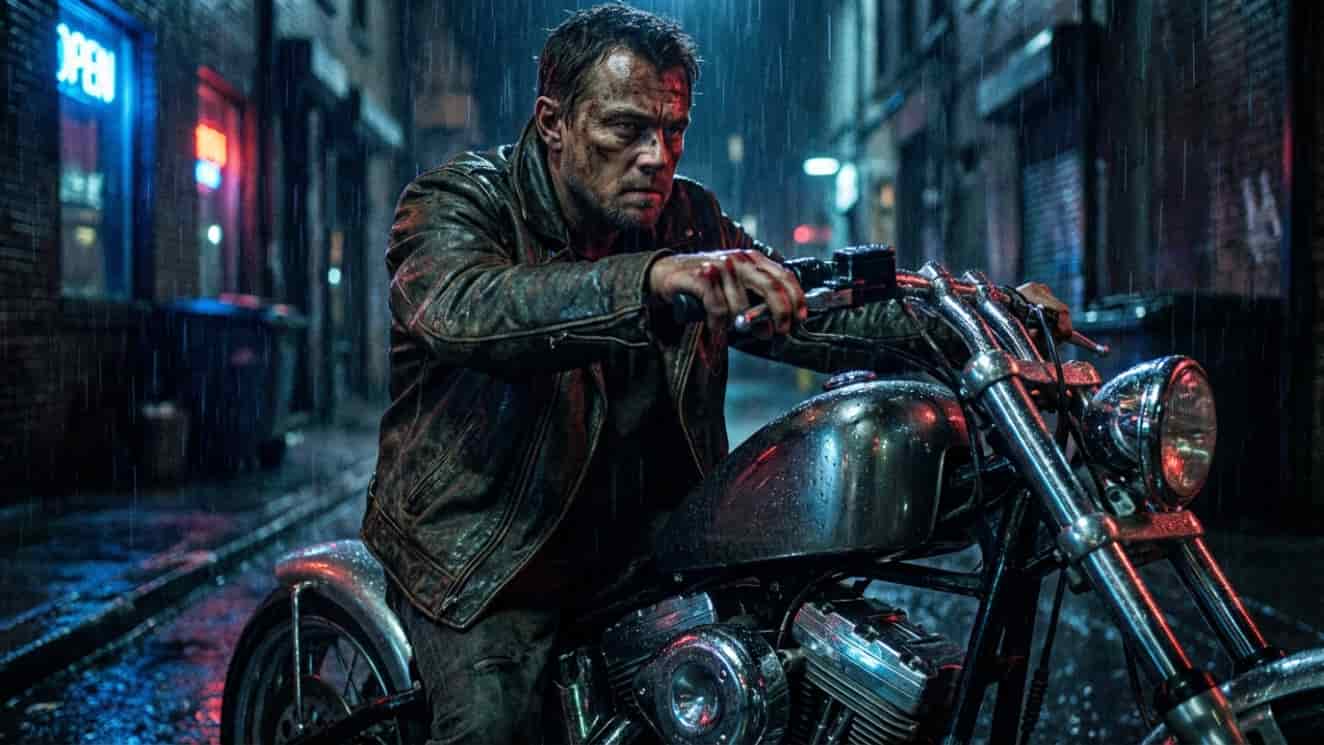
His bike, a modified 1998 Heritage Softail, sat idling at the curb. It was his masterpiece, a machine that ran so smoothly it felt like an extension of his own nervous system. But it held a secret that would get him buried in a shallow grave in the Pine Barrens if it were ever found.
Inside the chrome gas cap was a custom-fitted housing. Within that housing sat a digital recording device, wired into the bike’s electrical system. Every conversation held within ten feet of the bike, every plan whispered at a roadside stop, was captured and stored.
Leo swung his leg over the saddle and kicked it into gear. He followed Zip’s erratic weaving through traffic, his mind already shifting into the persona he’d occupied for the last six years. He wasn’t Leo anymore. He was “Lefty,” the man who fixed things.
An hour later, he was under the hood of a rusted-out Peterbilt in a gravel lot overlooking the Newark bay. The heat coming off the asphalt was brutal, and the smell of salt and diesel was thick enough to chew. Big Sal, the president of the 500, stood nearby, smoking a thick cigar. Sal was a wall of a man, sixty years old, with a grey beard and a reputation for crushing the windpipes of anyone who lied to him.
“How’s it look, Lefty?” Sal asked.
“It’s a mess,” Leo said, his head buried in the engine block. “The gasket’s gone, but I can bypass the cooling sensor and limp it to the warehouse. You won’t make it to Philly, though.”
“Just get it to the warehouse,” Sal said. “The ‘parts’ inside don’t like to sit in the sun.”
Leo knew what the “parts” were. They were crates of stolen Glock frames, destined for the streets of Camden. He could hear the low murmur of the other bikers—Mouse, a heavy-set guy with a stutter, and Runt, a kid who looked too young to be wearing a patch. They were talking about the route, about the “blues” who were on the take and the ones who weren’t.
Leo reached into his pocket for a wrench, his hand brushing against the small, hard shape of his burner phone. He needed to trigger the recorder. He leaned against the bike, his back to the crew, and fumbled with the gas cap as if checking the fuel level. A quick twist, a click of a button hidden in the underside of the rim. The red light started its slow, rhythmic blink.
I’m a cop, he thought, the words a mantra he had to repeat to keep from drowning. I’m a Detective with the State Police. My badge number is 7742. My father was David Vance. They killed him in ’94.
He didn’t call himself Leo when he was undercover. He used his father’s last name in his head, a way to stay anchored to the mission.
The warehouse was a cavernous, rotting structure near the shipping terminals. Inside, the air was stagnant. As the bikers began unloading the crates, Leo stepped away to wash the grease off his hands at a rusted utility sink.
A shadow moved in the doorway of the small office overlooking the floor. It was Vance—not his father, but his handler, Special Agent Marcus Vance. No relation, just a cruel coincidence of names. Marcus was a man who lived in the shadows of parking garages and late-night diners. He was currently posing as a corrupt port official who handled the club’s “clearance.”
Leo walked toward the office, grabbing a rag to dry his hands. He stepped inside and closed the door. The windows were tinted, allowing them to look out at the bikers without being seen.
“You’re late with the last data dump,” Marcus said. He didn’t look at Leo. He was staring at Big Sal through the glass.
“I had a bike to rebuild. Sal’s getting suspicious of how much time I spend ‘visiting my aunt’ in the city,” Leo said.
“Sal isn’t the problem. The FBI is sniffing around the port. They don’t know about you, Leo. If they move in before we have the full distribution list, you’re going to get caught in the crossfire. I can’t protect you from a federal sweep.”
“Then pull me out,” Leo said. The words felt heavy. He’d been saying them for two years.
“Not yet. We need the buyer in Camden. We need the names of the port authorities on the payroll. You’re the only one close enough to get them.” Marcus finally turned. His eyes were cold, professional. “You’re doing a good job, Leo. You’re one of them. That’s why it works.”
“I’m not one of them,” Leo snapped.
Marcus gestured to the floor. “Look at your hands. Look at your clothes. You haven’t shaved in a week. You haven’t been home in three months. When was the last time you spoke to anyone who wasn’t a felon or a cop?”
Leo thought of Clara. He thought of the Steinbeck book. “Today. I went to the bookstore.”
Marcus laughed, a dry, humorless sound. “The bookstore. That’s your tether? A bunch of old paper? You’re losing it, kid. The wire in your bike—is it hot?”
“Yeah. They’re talking about the Camden drop now.”
“Good. Get the audio. Meet me at the diner on Route 1 tonight at 3 AM. Don’t be late.”
Marcus walked out of the office, nodding to Big Sal on his way out like they were old friends. Leo stayed in the dark room for a moment, watching the men he called “brothers” lift heavy crates of weapons. He saw Zip laughing, throwing a playful punch at Runt’s shoulder. He saw the genuine affection in Sal’s eyes as he watched the younger guys.
It was a brotherhood built on blood and theft, but it was the only one Leo had. His father’s old police friends had stopped calling years ago. His mother was long gone. The state police academy was a distant memory.
He walked back out to the floor. Zip saw him and tossed him a cold beer.
“Drink up, Lefty. We’re heading to the ‘Pit’ after this. Sal’s buying.”
Leo caught the can. The condensation was cold against his palm. “I got work to do on the Softail.”
“The bike can wait,” Zip said, throwing an arm around Leo’s neck. Zip smelled like sweat and cheap cigarettes. “You’re too quiet, man. You think too much. It ain’t healthy. Come have a drink with your family.”
Family. The word felt like a stone in Leo’s throat. He looked at the patch on Zip’s chest, then down at his own. He cracked the beer and took a long swig. It tasted like bitterness and betrayal.
Chapter 2: Blood and Grease
The “Pit” was a basement bar beneath a shuttered body shop, a place where the air was 40% smoke and 60% desperation. It was the unofficial headquarters of The 500 when they didn’t want to be seen at the main clubhouse.
Leo sat at a corner table, his back to the wall, watching the room. The recording device on his bike was off—he’d deactivated it when they arrived—but his internal recorder was always running. He noted who was talking to whom, who looked nervous, who was flashing new cash.
“You’re doing it again,” a voice said.
Leo looked up. It was Doc. He wasn’t a real doctor, but he’d spent three years in med school before an addiction to Percocet and a botched surgery on a mobster’s mistress had sent him into the underground. Now, he was the club’s primary medical resource. He was a thin man with trembling hands and eyes that seemed to be looking at things five seconds in the future.
“Doing what?” Leo asked.
“Evaluating,” Doc said, sliding into the chair across from him. He smelled of antiseptic and bourbon. “You look at this room like a man trying to find the exit during a fire.”
“I just like to know where the doors are,” Leo replied.
“Smart. Most of these idiots think the walls are made of steel. They don’t realize they’re made of glass.” Doc leaned in closer. “I heard about the truck. Sal’s happy you got it moving. He thinks you’re a goddamn magician with an engine.”
“It’s just physics, Doc. You turn the right bolt, things work.”
“And if you turn the wrong one?” Doc smiled, revealing yellowed teeth. “Everything explodes. You ever worry about that, Lefty? Turning the wrong bolt?”
Leo didn’t answer. He didn’t like Doc. The man was too observant, too familiar with the anatomy of a lie. Before Leo could respond, the heavy steel door at the top of the stairs banged open.
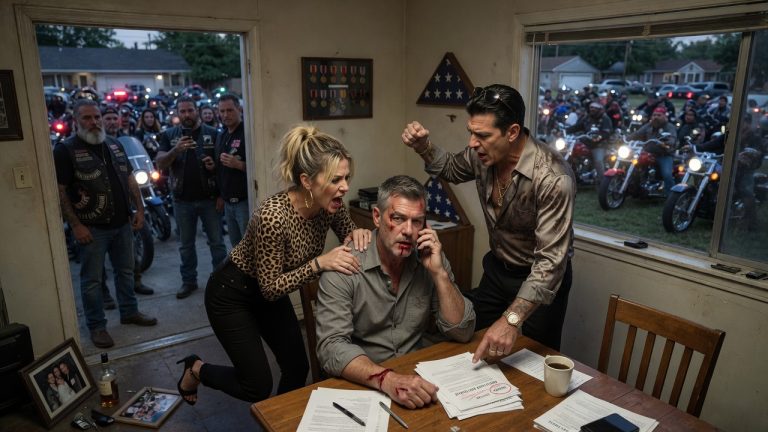
Runt stumbled in, his face a mask of crimson. He was clutching his side, blood leaking through his fingers and staining his white T-shirt. Behind him, Zip was shouting, his face contorted in a mix of rage and panic.
“Clear the table!” Zip screamed. “Doc! Get over here!”
The bar went silent. The music—some grinding heavy metal track—was cut off. Big Sal stood up from the bar, his presence instantly commanding the room.
“What happened?” Sal demanded, his voice low and dangerous.
“Stupid kid,” Zip spat, shoving Runt toward a pool table. “We were checking the perimeter at the warehouse. Some locals thought they could score a crate. Runt tried to play hero. One of them had a piece.”
Leo was already moving. He helped Runt onto the pool table, the green felt quickly turning a dark, wet brown. Doc was right behind him, his trembling hands suddenly steady as he opened an old leather bag.
“Hold him down,” Doc barked at Leo.
Leo gripped Runt’s shoulders. The kid was shaking, his breath coming in ragged, shallow gasps. “Hey, look at me,” Leo said, his voice firm. “Look at me, Runt. You’re alright. It’s a clean hit. Just meat and air.”
It wasn’t a clean hit. Leo could see the entry wound—low in the abdomen. There was no exit wound. The bullet was still inside, probably bouncing off a rib or worse.
“I… I didn’t see him,” Runt whispered, his eyes wide and glassy. “Lefty… I messed up.”
“Shut up,” Leo said, leaning in so only the kid could hear him. “Don’t apologize. You did fine. Just breathe.”
As Doc worked, cutting away the shirt and pouring vodka over the wound to clean it, the rest of the club gathered around. There was a palpable sense of tension in the room—not just concern for Runt, but a rising tide of violence. They wanted someone to pay.
“Who was it?” Sal asked Zip.
“Three guys. Driving a beat-up Monte Carlo. I got a look at the plates, but they were stolen. They headed toward the projects on 12th.”
Sal looked at the room. “Zip, take Mouse and Dutch. Go find them. I don’t care if you find the guys or just someone who knows them. Bring me a name.”
“On it,” Zip said, his eyes gleaming with a predatory light. He looked at Leo. “Lefty, you coming?”
Leo felt the weight of the moment. If he went, he’d likely be a witness to—or a participant in—a murder. If he didn’t, he’d look weak, or worse, suspicious.
“He stays here,” Doc said, not looking up from Runt’s abdomen. “I need someone with steady hands to help me probe for the slug. The rest of you are too drunk or too stupid.”
Sal nodded. “Stay with Doc, Lefty.”
Leo exhaled, a silent release of tension. He watched Zip and the others vanish up the stairs. The room felt even smaller now, the air thick with the smell of Runt’s blood and Doc’s sweat.
For the next hour, Leo was a surgical assistant. He held retractors, he sponged away blood, he gripped Runt’s hands when the kid screamed. He watched Doc work with a terrifying, practiced efficiency. The “doctor” found the bullet lodged near the hip bone. When he finally dropped the lead slug into a glass jar, the sound it made—a sharp clink—felt like a gavel striking a bench.
“He’ll live,” Doc said, wiping his brow with his sleeve. “But he’s done for the season. He needs real antibiotics and a bed that doesn’t smell like a urinal.”
“I’ll take him to my place,” Leo said.
Sal looked over. “Your place? You live in a goddamn garage, Lefty.”
“It’s clean. And I don’t have people coming in and out. He’ll be safe there.”
Sal studied him for a long moment. Leo didn’t blink. He knew the value of his own reputation. He was the quiet one. The reliable one.
“Fine,” Sal said. “Take the van. If he dies, it’s on you.”
Leo hauled Runt’s semi-conscious body into the back of an unmarked van. He drove carefully, avoiding the potholes of the industrial district. His “place” was a small apartment above a garage he rented in a quiet corner of Bayonne. It was filled with tools, bike parts, and a single, neatly made bed.
After he got Runt settled and pumped him full of the stolen penicillin Doc had provided, Leo sat on the floor, his back against the wall. The kid was asleep, his breathing heavy but stable.
Leo pulled out his burner phone. He had a message from Vance: Where are you? 3 AM has passed.
Leo typed: Stitching up a brother. Kid got shot. Can’t make it. The port deal is still on for Friday. They’re looking for the shooters now. It’s going to be a bloodbath.
He hit send and stared at the phone.
A “brother.” He’d used the word without thinking.
He looked at Runt. The kid was nineteen. He’d joined the club because his father had been a drunk and the 500 offered him a jacket and a sense of belonging. Leo remembered being nineteen. He remembered the day the police chaplain had come to the door to tell them his father was dead. The “brothers” in the department had been there for the funeral, standing in their dress blues, promising they’d find the killers.
They never did. The case had gone cold in six months.
Leo reached out and adjusted the blanket over Runt. His hands were still stained with the kid’s blood. He thought about the men Zip was looking for right now. They were probably scared, probably desperate, and they were almost certainly dead men walking.
He closed his eyes and tried to remember the Steinbeck book. He tried to remember the words on page twenty. But all he could see was the red blinking light in his gas cap and the way Runt had looked at him like he was a savior.
The silence of the room was heavy, but it wasn’t peaceful. It was the silence of a man holding his breath, waiting for the floor to give way.
Chapter 3: The Ghost in the Tank
The rain in New Jersey has a way of making everything look like it’s rotting. Leo stood in a gravel lot under the Pulaski Skyway, the massive steel legs of the bridge looming over him like the ribs of a dead giant. He was meeting Miller, the FBI agent Vance had warned him about.
Miller was the “Mirror.” He was everything Leo was supposed to be: clean-cut, rigid, and absolutely certain of the line between right and wrong. He stood by a black SUV, his suit protected by a long trench coat.
“You’re late, Detective,” Miller said. He used the title like a taunt.
“I don’t go by that name here,” Leo said, leaning against his bike. The rain was slicking his leather jacket, turning it a deep, obsidian black.
“Vance tells me you’re ‘deep,'” Miller said, stepping closer. “I think you’re just lost. You’ve been under for how long? Six years? Most guys start to smell like the trash they’re sitting in after three.”
“I’m getting the job done.”
“Are you? Because I see a biker gang moving high-grade firearms through my port, and I see a ‘detective’ who spends his nights stitching up criminals and drinking in basement bars. We have a wire on the warehouse, too, Leo. We heard the shooting. We heard Sal send out a hit squad. Why didn’t you call it in?”
Leo looked at the grey water of the Hackensack River. “Because if I call it in, I’m burned. And if I’m burned, you don’t get the distribution network. You just get a few street-level shooters.”
“A life is a life,” Miller said. “Even a street-level shooter. You’re letting people die to protect your cover.”
“I’m letting people die to stop the flow of ten thousand guns,” Leo countered. “Don’t lecture me on morality, Miller. You sit in an office. I sit in the dirt.”
Miller reached into his coat and pulled out a manila envelope. “This came across my desk. An old internal affairs file. David Vance. Your father.”
Leo’s body went rigid. The hum of the bridge above him seemed to grow louder, a vibrating roar in his ears. “What about him?”
“The official report says he was killed in a botched robbery. But this file… it suggests he was looking into the 500 back in the nineties. It suggests he might have been working his own angle. Maybe he wasn’t the hero you remember.”
Leo moved so fast Miller didn’t have time to flinch. He grabbed the lapel of the FBI agent’s coat and slammed him against the SUV. “My father was a good cop. He was murdered by Big Sal. I saw the bike, Miller. I saw the colors when they drove away. Don’t you ever say his name again.”
Miller didn’t look scared. He looked intrigued. “So that’s what this is. A vendetta. You’re not working for the state, Leo. You’re working for a ghost.”
Leo released him, his hands shaking with a rage he hadn’t felt in years. He turned away, staring at his bike. The chrome was dull in the rain.
“Get out of here,” Leo said. “Stay away from the warehouse on Friday. If you move too early, I won’t be the only one who dies.”
Miller straightened his coat. “The clock is ticking, Leo. Don’t forget who you’re supposed to be.”
Leo watched the SUV pull away. He felt a sudden, desperate need to check the recorder. It was his only proof that he was still a cop, his only connection to the truth. He unscrewed the gas cap, his fingers fumbling with the hidden catch.
He pulled the small device out. The red light was dead.
Panic flared in his chest—a cold, sharp spike. Had it run out of battery? Had it been damaged in the rain? He opened the casing and checked the SD card. It was still there. He plugged a small earbud into the device and hit play.
The audio was clear. He heard the rumble of his own engine. He heard the wind. And then, he heard a voice he didn’t expect.
“He’s too quiet, Sal. He spends too much time looking at the walls.”
It was Zip. The recording was from two days ago, when Leo had left the bike outside the Pit.
“Lefty’s a good kid,” Sal’s voice crackled. “He’s been with us six years. He fixed the Peterbilt. He’s taking care of Runt.”
“I don’t care. I checked his gear while he was at that bookstore. He’s got nothing. No phone, no wires. But he’s got a look in his eyes. Like he’s judging us. And that garage he rents? I went by there. It’s too clean, Sal. Nobody lives like that.”
“Keep an eye on him, then. If he’s a rat, we’ll find out on Friday. If he isn’t, he’s the best mechanic we’ve ever had. Don’t touch him until I say.”
Leo felt the blood drain from his face. They were watching him. Zip had been to his apartment.
He looked at the gas cap in his hand. If Zip was suspicious, he’d check the bike again. The recorder was a death sentence.
He should throw it into the river. He should call Vance and demand an extraction right now. He should disappear into the witness protection program and never look back.
But then he thought of Runt, sleeping in his bed. He thought of his father’s face, blurred by thirty years of memory. He thought of the crates of guns.
He put the recorder back in the cap. He tightened it.
He rode back to the clubhouse, the vibration of the engine feeling like a countdown. When he walked in, the atmosphere was different. The mourning for Runt had turned into a celebration of vengeance. Zip was sitting at the bar, a fresh bruise on his cheek and a wide, manic grin.
“We found ’em, Lefty!” Zip shouted, holding up a glass of whiskey. “The guys in the Monte Carlo. They won’t be shooting anyone ever again.”
“You get the names?” Leo asked, his voice steady, though his heart was hammering against his ribs.
“Names don’t matter. Results do.” Zip leaned over the bar. “Where’ve you been? You look like you seen a ghost.”
“Just riding,” Leo said. “The rain helps me think.”
“Think about what?”
“About Friday. About the deal. I want to make sure the bikes are ready. If things go south, we need to be able to move fast.”
Zip studied him, his eyes narrow and predatory. For a moment, the silence between them was a physical weight. Then, Zip laughed and slapped him on the back.
“That’s my Lefty. Always thinking about the machine. Don’t worry, brother. Friday’s going to be a payday we’ll talk about for years. Just make sure that Softail of yours is topped off.”
Leo nodded. He walked away, feeling Zip’s eyes on his back like a crosshair. He realized then that he wasn’t just hiding from the club anymore. He was hiding from the police, from the FBI, and from the man he used to be.
He was alone in a world of chrome and blood, and the only thing he had left was a secret hidden in his gas tank.
Chapter 4: The Tipping Point
The warehouse on Friday was a hive of activity. The air was thick with the smell of exhaust and anticipation. The 500 had gathered in full force—nearly forty men, all wearing their colors, all armed.
The Camden shipment was the biggest in the club’s history. It wasn’t just Glock frames this time; it was high-end tactical rifles, redirected from a shipment meant for overseas.
Leo was in the middle of it, checking the tire pressure on the lead bikes. His hands were moving mechanically, his brain operating on two levels. One level was focused on the task at hand. The other was counting heads, noting weapons, and trying to spot the surveillance teams he knew were hidden in the surrounding buildings.
Vance had promised him that the bust would happen after the exchange. “We need the buyers,” he’d said. “Once the money changes hands, we move in. You just stay near your bike. When the flash-bangs go off, get on the ground and stay there.”
But Miller’s words haunted him. We have a wire on the warehouse, too.
Leo saw Zip pulling a crate toward the loading dock. The “Sgt. at Arms” was in his element, barking orders, his nervous energy transformed into a focused, violent efficiency. He looked over at Leo and winked.
“Almost time, Lefty. You nervous?”
“Just focused,” Leo said.
“Good. Stay focused. Sal wants you on the rear guard. If any blues show up, you’re the one who leads the diversion.”
Rear guard. That meant he’d be the last one out—and the first one the police would hit.
A black Mercedes-Benz pulled into the warehouse, its windows tinted dark. This was the buyer. A man stepped out, dressed in a sharp grey suit that looked entirely out of place in the grime of the docks. He was followed by two bodyguards who moved with a professional stillness that screamed ex-military.
Big Sal stepped forward, his arms open in a mock gesture of welcome. “Mr. Thorne. You’re on time. I like that in a businessman.”
“Let’s skip the pleasantries, Sal,” Thorne said. “I have a schedule to keep. Show me the hardware.”
As they moved toward the crates, Leo stepped toward his bike. He needed to trigger the recorder one last time. This conversation was the final nail in the coffin.
He reached for the gas cap.
“Hey, Lefty.”
Leo froze. His hand was inches from the chrome. He turned slowly.
It was Runt. The kid was pale, leaning on a crutch, his midsection wrapped in thick bandages. He shouldn’t have been there.
“What are you doing here, kid?” Leo asked, his voice low.
“I couldn’t stay in that room,” Runt said. “I wanted to see… I wanted to be part of it. You saved my life, man. I wanted to thank you properly.”
“You thank me by staying alive,” Leo said, stepping toward him, trying to lead him away from the bike. “Go back to the van. This isn’t a place for someone who can’t run.”
“I don’t want to run,” Runt said. He looked at the bikers, at the guns, at the power in the room. “I want to be like you. Quiet. Respected.”
Leo felt a wave of nausea. “You don’t want to be like me, Runt. Trust me.”
“Why not? You’re the best of us. Zip said so. He said even if you’re a little weird, you’re the most loyal brother he’s ever seen.”
Leo’s heart stopped. Zip said that? He looked over at Zip. The biker was watching them from across the warehouse. He wasn’t smiling. He was staring at Leo’s hand, which was still hovering near the gas cap.
“Go to the van, Runt,” Leo said, his voice cold. “Now.”
Runt blinked, hurt by the tone, but he nodded and began to limp away.
Leo turned back to the bike. He knew he was being watched. He couldn’t trigger the recorder. He had to trust that the previous recordings were enough.
The exchange began. The crates were opened. Thorne inspected a rifle, his fingers running over the matte black finish. He nodded. One of his bodyguards produced a heavy gym bag. He opened it, revealing stacks of hundred-dollar bills.
The air in the warehouse seemed to vibrate with the collective greed of forty men.
Then, the silence was broken. Not by a siren, but by a soft, electronic chirp.
It came from the office.
Everyone froze. Big Sal looked up. “What was that?”
Zip was already moving. He sprinted up the stairs to the office. A moment later, he emerged, holding a small, black device with a long antenna.
“A federal bug,” Zip yelled, his voice cracking with rage. “They’re listening! We’re burned!”
Chaos erupted.
“Close the doors!” Sal roared. “Get the money! Kill the lights!”
Thorne’s bodyguards pulled their weapons. The bikers drew theirs. The tension that had been building for years finally snapped.
Leo dived behind his bike. He pulled his own weapon—a Glock 17, his service piece he’d kept hidden.
Where are the sirens? he thought. Vance, move in!
But there were no sirens. There was only the sound of heavy steel doors slamming shut and the frantic shouting of men trapped in a cage.
Zip was scanning the room, his eyes wild. He looked at the bug in his hand, then at the men on the floor. He looked at Leo.
“You,” Zip whispered. The word carried across the room even through the noise.
He started walking toward Leo, his gun raised. “I knew it. The bookstore. The quiet. The way you looked at us.”
“Zip, put the gun down,” Leo said.
“You brought them here! You’re the one!”
“Zip, look at the bug,” Leo shouted. “That’s FBI. I’m State. If you kill me, you’re dead anyway. The building is surrounded!”
The revelation hit the room like a physical blow. Big Sal turned, his face a mask of disbelief. “Lefty? You?”
“Sal, it’s over,” Leo said. “Give it up. I can negotiate. I can get you out of here alive.”
Sal laughed, a deep, hollow sound. “Alive? You think I want to spend the rest of my life in a cage because a kid I treated like a son betrayed me?”
Sal raised his own weapon.
At that moment, the roof exploded.
Flash-bangs detonated in a blinding sequence of light and sound. The air was filled with smoke and the roar of tactical teams rappelling from the rafters.
Leo hit the ground, his ears ringing. He saw figures in black tactical gear moving through the smoke. He saw muzzle flashes.
He saw Zip fire at a tactical officer. The officer went down. Zip turned his gun back toward Leo.
Leo didn’t think. He didn’t evaluate. He fired.
The bullet caught Zip in the chest. The biker spun, his eyes wide with shock, and fell backward over a crate of rifles.
“Leo!” a voice shouted.
It was Vance. He was wearing a tactical vest, his face grimed with soot. He moved toward Leo, grabbing him by the shoulder and hauling him up.
“You okay?”
Leo couldn’t speak. He was looking at Zip. He was looking at the blood pooling on the concrete.
“We got them,” Vance said. “We got Sal. We got the buyer. It’s a clean sweep.”
Leo looked around the warehouse. It looked like a war zone. Men he had ridden with, men who had shared their bread and their beer with him, were being zip-tied and dragged away.
He saw Runt, huddled in the corner, his eyes wide with a terror that would never leave them.
“Is it?” Leo asked. His voice was a hollow rasp.
“Is it what?”
“A clean sweep.”
Leo walked toward his bike. It was riddled with bullet holes. The gas tank had been punctured, and fuel was leaking out, smelling of chemicals and failure.
He unscrewed the gas cap. He pulled out the recorder. It was smashed, the internal circuitry exposed.
He looked at Vance. “The FBI moved in early. They didn’t care about me. They didn’t care about the deal.”
“Miller’s an idiot,” Vance said. “But it doesn’t matter. The results are the same.”
Leo looked at the recorder in his hand. The silence of the chrome was final now. The secret was out, the mission was over, and the only thing left was the weight of the bodies on the floor.