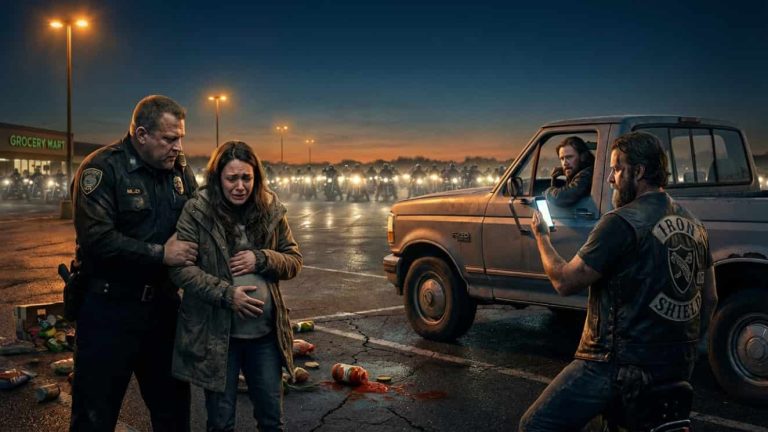
They locked me and my shivering daughter out in the midnight rain, laughing through the window of the house I paid for. My wife thought she’d broken me. She didn’t hear the thunder approaching—not from the clouds, but from 1,500 brothers coming to reclaim their brother’s dignity and his home.
Chapter 1
The rain wasn’t just falling; it was punishing. It was that mid-October Maryland rain that felt like needles of ice, the kind that soaked through a heavy Carhartt jacket in seconds and settled deep into your marrow. I stood on the porch of the house I had spent ten years of overtime pay to build, and for the first time in my life, I felt like a ghost.
My daughter, Lily, was tucked under my arm, her small body vibrating with uncontrollable shivers. She was only six. She still believed that four walls and a roof were a birthright, not a weapon. She didn’t understand why her mother had turned the deadbolt. She didn’t understand why the lights were glowing so warmly inside while we were drowning out here in the dark.
“”Daddy, why is Mommy mad?”” she whimpered, her voice barely audible over the rhythmic drumming of the downpour on the porch roof.
“”She’s not mad, baby,”” I lied, my voice thick with a rage I was trying to bury for her sake. “”The lock is just stuck. I’m going to fix it.””
I hammered on the door again. “”Sarah! Open the door! Lily is freezing! This isn’t a game!””
A shadow moved behind the frosted glass of the side-panel. For a second, hope flared. Then, the porch light flickered off. Total darkness. I heard the muffled sound of a laugh—a sharp, jagged sound that didn’t belong to my wife. It was a man’s laugh.
I stepped back, the rain catching me fully now. I looked up at the second-floor window, our bedroom. The curtain pulled back just an inch. Sarah was there. She wasn’t alone. Marcus, the guy she’d told me was “”just a consultant”” for her real estate firm, was standing behind her. He didn’t look like a consultant now. He looked like the man who had stolen my life while I was working double shifts at the shipyard.
He raised a glass of bourbon—my bourbon—and gave a mocking little toast through the glass. Sarah didn’t look away. She didn’t look guilty. She looked like she was watching a movie she found mildly entertaining.
My phone buzzed in my pocket. A text from her.
“The locks are changed, Elias. The restraining order is being filed tomorrow. Don’t make this harder on Lily by causing a scene. Go to a motel. If you touch this door again, I’m calling the cops. Marcus has the whole thing recorded.”
I stared at the screen, the water blurring the words. A restraining order? For what? For being a father? For paying the mortgage? The injustice of it felt like a physical weight in my chest, a pressure so immense I thought my ribs might snap.
I looked at Lily. Her lips were turning a faint shade of blue. My neighbors, the Miller family from across the street, were standing at their window, watching the drama unfold like it was Sunday night cable. No one came out. No one offered a blanket. This was the suburbs, where people minded their own business until the blood hit the driveway.
I realized then that I was losing everything. Not just the house, but my reputation, my daughter, and my sanity. Sarah had planned this. She had waited for a night when I was exhausted, when the weather was brutal, to cast me out.
But Sarah had forgotten one thing. She had forgotten who I was before I became a “”suburban dad.”” She had forgotten the ink on my back and the men I had bled with in the dirt of places the map doesn’t show.
I picked Lily up, marched her to my old truck, and cranked the heater to the max. I wrapped her in a greasy moving blanket I kept in the back.
“”Stay here, Lily. Daddy has to make one call.””
My hands were shaking, not from the cold, but from the adrenaline. I scrolled through my contacts to a name I hadn’t dialed in three years. A name that represented a life I had tried to leave behind for the sake of a “”quiet life.””
I hit dial.
It picked up on the first ring. A voice like grinding gravel answered. “”Elias? You dead or something?””
“”Dutch,”” I said, my voice cracking. I looked at my house, at the laughing man in my window, and then at my shivering daughter. “”I’m at the house. They locked us out. Lily’s in the rain. She’s laughing, Dutch. She’s laughing at me.””
There was a long silence on the other end. I could hear the faint sound of a pool game and the low thrum of a jukebox. Then, the sound of a chair scraping across a floor.
“”Is the girl okay?”” Dutch asked, his voice dropping an octave.
“”She’s cold, Dutch. She’s scared.””
“”Elias,”” Dutch said, and I could practically hear the fire lighting in his eyes. “”Stay right there. Don’t go to a motel. Don’t call the cops. Just keep that little girl warm.””
“”What are you going to do?””
“”I’m calling the Council,”” Dutch replied. “”You’re a patched brother, Elias. You might have gone soft for a woman, but the brotherhood doesn’t expire. How many men do you think we can get to your zip code by dawn?””
“”I don’t know,”” I whispered.
“”All of them,”” Dutch said. “”We’re bringing the thunder.””
“FULL STORY
Chapter 1
(Same as above – Integrated into the narrative flow)
Chapter 2: The Ghost of the Road
The truck cabin smelled of stale coffee and the damp wool of the blanket wrapped around Lily. As the heater finally began to win the battle against the Maryland chill, Lily fell into a fitful sleep, her head lolling against the passenger door. I sat there, watching the house.
The lights in the master bedroom stayed on. I wondered what they were saying. Were they planning the legal battle? Were they laughing about how easy it was to discard a man who had given them everything? I felt a hollow ache in my stomach. I had spent ten years working sixty-hour weeks at the Sparrows Point shipyard, welding steel in the belly of massive tankers, all to provide this—the white picket fence, the manicured lawn, the “”safe”” neighborhood.
I looked at my hands. They were scarred, the knuckles thickened by years of hard labor and a few years of hard living before that. I had met Sarah when I was twenty-five, fresh out of the service and riding with the Iron Guard. I was the “”bad boy”” she wanted to fix. And for a while, I thought I wanted to be fixed. I traded my leather vest for a polo shirt. I traded my Harley for a Ford F-150. I thought I was building a future.
I reached into the glove box and pulled out a small, weathered leather pouch. Inside was my “”cut””—the leather vest of the Iron Guard. It was folded tight, the “”Mother Chapter”” patch staring back at me. I hadn’t worn it since Lily was born. Sarah had made me promise to “”grow up.””
I remembered Dutch, the President of the Iron Guard. He was a man who lived by a code that the suburbanites in this neighborhood couldn’t possibly comprehend. To them, “”community”” meant a homeowner’s association meeting and a shared lawnmower. To Dutch, community meant that if one of us couldn’t eat, we all went hungry. If one of us was disrespected, it was a declaration of war.
I pulled the vest out and draped it over the steering wheel. The smell of old leather and oil filled the cabin, grounding me.
About twenty minutes later, a set of headlights appeared at the end of the cul-de-sac. It wasn’t a bike. It was a blacked-out SUV. It pulled up alongside my truck, and the window rolled down. It was Dutch. His beard was whiter than I remembered, his face etched with deeper lines, but his eyes were still two coals of blue fire.
“”Get in,”” he said.
“”I can’t leave Lily,”” I said.
“”The SUV is armored and heated. My daughter, Sarah-Jane, is in the back. She’s a nurse. She’ll look after the sprout while we talk.””
I looked into the back of the SUV. A woman in her thirties, with the same steady eyes as Dutch, waved at me. I carefully moved a sleeping Lily into the SUV. Sarah-Jane wrapped her in a professional-grade thermal blanket and tucked her in.
I stepped out into the rain and climbed into the passenger seat of Dutch’s rig.
“”You look like hell, Elias,”” Dutch said, handing me a thermos of black coffee spiked with something strong.
“”I feel like hell. She’s got a guy in there, Dutch. A lawyer named Marcus. He’s been coaching her. They’ve drained the joint account. She’s claiming I’ve been unstable. That I’m a ‘violent biker’ who threatens the peace of the home.””
Dutch let out a low, dark chuckle. “”Unstable? You’re the most level-headed man I ever knew. You saved my life in a bar in Kentucky when four guys had me pinned with broken bottles. You didn’t even raise your voice; you just handled it.””
“”She knows the system, Dutch. She knows that in this town, the guy with the grease under his fingernails loses to the guy with the silk tie every time.””
Dutch leaned back, his rings clicking against the steering wheel. “”The system is built on the idea that you’re alone, Elias. That’s where they win. They think you’re a lone wolf they can trap in a cage. They don’t realize you’re part of a pack that stretches from Maine to California.””
“”What’s the plan? I don’t want a bloodbath. Not with Lily right here.””
“”We aren’t going to touch ’em,”” Dutch said, a predatory smile spreading across his face. “”We’re just going to make sure the whole world sees what they are. We’re going to hold a ‘vigil.’ And I’ve called in every favor the Guard owes. The Vets, the Union boys, the independent clubs. They’re all coming.””
“”How many?”” I asked.
Dutch looked at his watch. “”The first wave is crossing the bridge now. By 6:00 AM, this street won’t belong to the HOA anymore. It’ll belong to us.””
Chapter 3: The Secret in the Walls
The night dragged on, but I wasn’t cold anymore. I sat in the SUV, watching the house. Every hour, more vehicles arrived—not bikes yet, those would come at dawn to maximize the impact. For now, it was trucks, vans, and sedans. Men in work clothes, men in military jackets, men who looked like they hadn’t slept in a week. They parked blocks away, quietly filling the surrounding streets.
Dutch’s daughter, Sarah-Jane, checked on Lily constantly. “”She’s fine, Elias,”” she whispered. “”She’s dreaming. She’s safe.””
As I sat there, the rage began to clear, replaced by a cold, calculating clarity. I started thinking about why Sarah was doing this now. It wasn’t just the affair. We had been distant for a year, but this level of calculated cruelty—locking a child out in a storm—felt desperate.
“”Dutch,”” I said, “”I need to get into my shop. It’s a detached garage in the back. I have a secondary set of financial records hidden there. I’m a welder, but I’ve been doing high-end custom fabrication for private collectors for years. Cash business. Sarah didn’t know how much I was pulling in.””
“”You think she’s after more than just the house?””
“”I think Marcus is in debt,”” I said, remembering a snippet of a phone call I’d overheard weeks ago. Something about “”settling the books.”” “”I think they’re trying to seize my assets before I can file for divorce. If she gets a restraining order and temporary custody, she gets control of everything I own for at least ninety days. That’s enough time for them to liquidize my shop equipment and my private accounts.””
Dutch nodded. “”Go. Two of my boys, Tank and Preacher, will go with you. If she calls the cops, you’re just going into your own garage to get ‘work tools.’ There’s no order served yet, so it’s legal.””
We slipped out of the SUV. The rain had turned into a thick mist. We moved like shadows through the side yard. Tank was a mountain of a man who moved with surprising silence; Preacher was a former combat medic with a face full of tattoos and a heart of gold.
I unlocked the garage side door. The smell of ozone and burnt metal greeted me—the smell of my real life. I went to the floor joists in the back corner, pried up a loose board, and pulled out a fireproof lockbox.
Inside wasn’t just money. It was a ledger. But there was something else. A folder I’d found in our shared office months ago and tucked away, not wanting to believe what I was seeing. It was a series of emails Sarah had printed out—correspondence between her and Marcus from a year ago.
They hadn’t just met. Marcus was her high school sweetheart. They had been planning this since before Lily was born. The marriage, the house, the “”rehabilitation”” of the biker—it was a long con. She had married me because I was a “”stable earner”” who was never home, giving her the perfect cover to build a life with him on my dime.
The last email in the stack made my blood run cold. It was a draft for a life insurance claim.
“”They weren’t just going to lock me out, Dutch,”” I whispered as I climbed back into the SUV. “”They were waiting for me to snap. If I’d kicked that door down tonight, Marcus was waiting with a registered firearm. He’s a ‘scared homeowner’ protecting his ‘partner’ from a ‘violent ex.’ It was a setup for a ‘justified’ shooting.””
Dutch gripped the steering wheel so hard his knuckles popped. “”Then it’s a good thing you called us, Elias. Because now, the narrative changes.””
Chapter 4: The Gathering Storm
At 5:30 AM, the first low rumble began.
It started as a vibration in the soles of my boots. A deep, rhythmic thrumming that sounded like a tectonic plate shifting. In the upscale suburb of Oakcrest, where the only noise was usually the morning leaf blowers, this sound was apocalyptic.
I stood by the SUV as the sun began to bleed a pale, sickly grey through the clouds. At the entrance of the cul-de-sac, a single headlight appeared. Then two. Then ten. Then a wall of light.
The Iron Guard led the way. One hundred bikes, chrome gleaming even in the overcast light, engines roaring in a synchronized symphony of defiance. Behind them came the “”Leathernecks””—a veteran MC. Behind them, the “”Steel Workers Local 302″” in a fleet of pickup trucks.
They didn’t speed. They moved at a walking pace, a slow, unstoppable tide of leather and steel.
Neighbors began to emerge onto their porches in bathrobes, clutching coffee mugs, their faces pale with confusion and fear. This wasn’t supposed to happen here. This was a neighborhood of “”law and order.””
The bikes filled the street, three abreast. They pulled up onto the sidewalks, onto the lawns—specifically Sarah’s lawn, the one I had spent every Saturday morning mowing. They didn’t park haphazardly; they formed a perfect, intimidating perimeter around the entire property.
Dutch stepped out of the SUV and put on his vest. He looked at me. “”Put it on, Elias.””
I took my old vest and slid it over my shoulders. It felt heavy. It felt right.
By 6:15 AM, the street was completely blocked. 1,500 men and women. Some were on bikes, some were standing in the street, arms crossed. They weren’t shouting. They weren’t breaking windows. They were just there. A silent, massive wall of witnesses.
I saw the curtain in the master bedroom twitch. Then it flew open. Sarah’s face appeared, her mouth agape. Behind her, Marcus looked like he’d seen a ghost. He was on his phone, frantically gesturing.
“”He’s calling the cops,”” I said.
“”Good,”” Dutch replied. “”Let them come. We have the permits. We’re having a ‘Peaceful Assembly for Labor Awareness.’ My brother-in-law is the Chief of Police in the next county over. He’s the one who signed the paperwork.””
The roar of the engines died down all at once. The silence that followed was even more deafening. 1,500 people stood perfectly still, eyes fixed on the front door of my house.
“”Elias!”” a voice barked.
It was Mrs. Gable, my 80-year-old neighbor from next door. She walked out onto her porch, wrapped in a thick cardigan. She looked at the sea of bikers, then at me.
“”Elias, dear, is that Lily in that SUV?””
“”Yes, Mrs. Gable. She’s safe.””
The old woman looked at the house, then back at the bikers. She had seen me work on my house. She had seen me carry Lily’s groceries. She knew the truth.
“”Well,”” she said, her voice carrying in the silence. “”It’s about time someone did something about that woman. She’s been bringing that man over the moment your truck left the driveway for a year. I have the doorbell camera footage, if you need it, dear. I never liked the way he looked at your tool shed.””
A low murmur went through the crowd of 1,500. The “”witnesses”” were already working.”