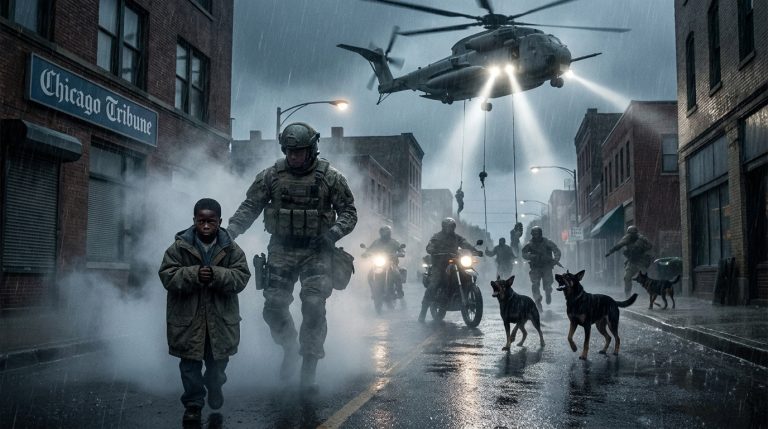
The silver skull necklace was supposed to be a ghost story—a piece of junk Maya’s mother left behind before she disappeared. Maya wore it like a shield, a scholarship kid trying to survive the shark-infested waters of a Georgia elite university. She didn’t know the “Southern Skulls” MC was real. She didn’t know the man who paid her tuition was currently sitting on two hundred horsepower of rolling thunder, watching her from the tree line.
But when the varsity captain decided to humiliate her in front of the entire dining hall, snatching that necklace and calling it “biker trash,” the line was crossed. Roman Cruz had promised to stay away. He’d promised her a life of light, books, and safety—the life he traded his soul for twenty years ago.
But watching her cry isn’t in the contract.
Now, the gates of the most prestigious college in the state are being held open by fifty men in leather. There are no sirens. There are no negotiators. There is only a father who has run out of patience and a town about to learn that you never, ever touch the only clean thing left in a King’s world.
Chapter 1: The Shadow on the Perimeter
The heat in Athens, Georgia, didn’t just sit on you; it owned you. It was a thick, humid weight that smelled of freshly cut grass and expensive car wax. Roman Cruz sat in the cab of his beat-up ‘98 Silverado, the engine off, the windows cracked just enough to let in the sound of the world he wasn’t allowed to touch. He wiped a bead of sweat from his forehead with a hand that was permanently stained with primary-drive oil and the ghost of old ink.
Across the street, the University of Georgia campus was a sea of pastel polos and golden-hour light. It was a world of “sir” and “ma’am,” of hedge funds and legacy admissions. It was the exact opposite of the Southern Skulls clubhouse, which smelled of stale beer, burnt rubber, and the kind of desperation that only comes from knowing you’re one bad turn away from a prison cell or a pine box.
Roman raised the binoculars, his movements practiced and slow. He didn’t look like a threat; he looked like a tired contractor taking a lunch break. That was the trick.
He found her.
Maya was walking across the North Quad, a stack of heavy textbooks clutched to her chest. She looked like her mother—the same defiant tilt of the chin, the same dark, wild curls that refused to be tamed by the humidity. But she had Roman’s eyes. They were a piercing, unsettling blue that looked like they were constantly searching for a lie.
She stopped at a stone bench, adjusted her backpack, and reached for the thin silver chain around her neck. Her fingers traced the small, intricate skull pendant. Roman felt a sharp, familiar ache in his chest, right behind the tattoo of a crow that occupied the space over his heart.
“Don’t do it, kid,” he whispered to the empty cab. “Don’t look back.”
He’d given her up when she was three days old. It was the only way to save her from his father, “Old Man” Cruz, who believed that the only way to keep a bloodline loyal was to baptize it in the club’s business. Roman had made a deal: he would stay, he would lead, he would be the monster the Skulls needed, as long as Maya was placed with a family three hundred miles away, her records sealed, her life scrubbed clean of the Cruz name.
He’d kept his end of the bargain. For two decades, he’d lived in the mud so she could walk on the clouds. He’d used the club’s “discretionary funds” to pay her adoptive parents’ mortgage when the recession hit. He’d funneled money through a dozen shell companies to ensure her “scholarship” was always fully funded.
He was a ghost. A benefactor. A silent guardian who only saw his daughter through a long-range lens.
A black Range Rover pulled up near the quad, its tires crunching on the gravel with an arrogant rhythm. Four boys hopped out. They were the “Golden Boys”—the sons of local judges and real estate moguls who ran the town like it was their personal playground. Roman knew the type. They were bullies who had never been hit back, shielded by their daddies’ checkbooks.
One of them, a tall kid with a jawline like a hatchet and a “State Champions” ring on his finger, headed straight for Maya. Roman’s grip tightened on the binoculars.
“Leave her alone, Bryce,” Roman muttered. He knew their names. He knew their fathers’ names. He knew which one of them had a DUI buried by the sheriff and which one had a habit of taking things that didn’t belong to him.
Bryce said something that made the other boys laugh. Maya didn’t look up. She tried to walk past them, but Bryce stepped into her path, his chest puffed out. He reached out and snagged the strap of her backpack, jerking her backward.
Maya stumbled. Her books spilled onto the pavement, the heavy spines cracking.
Roman’s hand went to the ignition. His heart was hammering a rhythm against his ribs that felt like a war drum. Stay down, Roman. If you go over there, you kill her future. You’re the monster. You’re the reason she has to hide.
On the quad, Bryce reached down and grabbed the silver skull necklace. He yanked it. The thin chain snapped.
Maya let out a small, sharp cry. She lunged for it, but Bryce held it high above his head, dancing away from her. He was laughing, a bright, cruel sound that carried across the street and into Roman’s open window.
“What’s this, Maya?” Bryce shouted, loud enough for the passing students to hear. “Biker trash? You keeping a souvenir from the trailer park you crawled out of?”
Maya’s face went pale, then a deep, burning red. “Give it back,” she said, her voice trembling.
“Make me, scholarship,” Bryce sneered. He tossed the necklace to one of his friends. “Hey, catch! Let’s see what the help values so much.”
Roman didn’t think. He didn’t weigh the consequences. He didn’t consider the twenty years of silence he was about to incinerate. The Silverado roared to life, the rusted muffler screaming as he slammed the truck into gear. He didn’t drive toward the parking lot. He drove over the curb, his tires tearing deep ruts into the pristine university grass, heading straight for the center of the quad.
Chapter 2: The Weight of the Patch
The Southern Skulls MC clubhouse was a windowless cinderblock building on the edge of the county line, tucked behind a screen of weeping willows and rusted-out car frames. Inside, the air was a thick soup of tobacco smoke and the hum of a refrigerator that had been dying since the late nineties.
“Preacher” sat at the long wooden table that served as the club’s “Church.” He was a man made of right angles and scar tissue, with a beard that reached his sternum and a Bible verse tattooed in Greek across his knuckles. He was Roman’s sergeant-at-arms and the only man who knew the truth about Maya.
Preacher looked up as the heavy steel door swung open. Roman walked in, his face a mask of cold, controlled fury. His knuckles were split, and there was a smear of someone else’s blood on the collar of his denim vest.
“You’re early,” Preacher said, his voice a low rumble. “And you look like you just went ten rounds with a woodchipper.”
Roman didn’t answer. He went to the bar, grabbed a bottle of cheap bourbon, and took a long, burning pull. He sat down across from Preacher and threw the silver skull necklace onto the table. It landed with a tiny, metallic clink. The chain was mangled.
Preacher stared at it. His eyes went wide. “Roman. Tell me you didn’t.”
“He touched her,” Roman said. His voice was too quiet, the kind of quiet that usually preceded a funeral. “He took it off her neck. Called her trash. Called her ‘the help’.”
“Who?”
“Some kid named Bryce. His old man is Judge Miller. The kind of kid who thinks the world is a buffet and he’s the only one with a plate.” Roman wiped his mouth with the back of his hand. “I didn’t kill him. But he’s going to need a good dentist and a lot of explanations for his daddy.”
Preacher sighed, a long, weary sound. He leaned back, the wooden chair groaning under his weight. “You just set a fire, King. A big one. The Millers own the sheriff. They own the DA. You’ve spent twenty years being a ghost so that girl could have a name. Now you’ve linked the Skulls to her in front of a hundred witnesses.”
“I don’t care,” Roman snapped. “I watched him do it, Preacher. I sat in that truck and I watched him humiliate her. I saw the look in her eyes. It was the same look Elena had the night my father told her to get lost or get buried.”
Roman’s mind flashed back to the day he became “King.” His father, a man who smelled of motor oil and malice, had sat him down in this very room. He’d handed Roman a choice: a life with a pregnant waitress and a job at a garage, or the presidency of the Skulls and the power that came with it.
“A Cruz doesn’t leave,” the Old Man had said. “You leave, and that girl and her baby become a liability. You stay, you run the business, and I’ll make sure they’re taken care of. From a distance. But if I ever see you near them, Roman… I’ll consider it a breach of contract. And I don’t like messy contracts.”
The Old Man was dead now, buried in a nameless plot behind the state pen, but his ghost still held the leash. Roman had spent every day since then trying to be the man his father wasn’t, while doing the things his father required. He ran the club’s “logistics”—mostly moving untaxed cigarettes and the occasional crate of unmarked parts—but he kept the violence focused inward. He kept the Skulls out of the headlines.
“She saw me,” Roman said, his voice breaking. “When I got out of the truck… when I grabbed that kid… she looked at me. She didn’t recognize me, not really. But she saw the vest. She saw the patch. I saw the fear in her eyes, Preacher. She was terrified of me.”
“Of course she was,” Preacher said gently. “You’re a nightmare in leather, Roman. To a girl like that, you’re the villain in the story.”
“I have to fix it.”
“Fixing it usually means making it worse,” Preacher warned. “The Millers are going to come for you. They’ll use the law. They’ll use the school. They’ll try to ruin her just to get to you.”
Roman looked at the broken necklace. The small silver skull seemed to be mocking him. It was a relic of a world he’d tried to burn down, a world that was now bleeding into the only part of his life that was still pure.
“Let them come,” Roman said, standing up. “Call the brothers. All of them. Not just the local chapter. I want the Nomads. I want the South Carolina boys. I want every man who wears the Skull to be in Athens by tomorrow morning.”
“Roman, that’s a war footing,” Preacher said, his voice dropping to a whisper. “You do that, and there’s no going back. You’ll be declaring the university campus Skulls territory.”
“It’s not territory,” Roman said, heading for the door. “It’s a perimeter. And nobody crosses it. Not the Millers, not the sheriff, and especially not those pampered little shits who think they can touch my blood and walk away.”
Chapter 3: The Seduction of Belonging
Maya sat in her dorm room, the silence of the four walls feeling like a cage. Her books were piled on the desk, the torn covers a constant reminder of the afternoon’s disaster. Her neck felt strangely light, the absence of the silver chain like a missing limb.
She couldn’t stop thinking about the man.
He had come out of nowhere. One second, Bryce was laughing, holding her mother’s necklace like a trophy, and the next, a rusted silver truck had jumped the curb and come barreling across the lawn like a juggernaut.
The man who stepped out hadn’t looked like a hero. He looked like a storm. He was huge, dressed in weathered leather and grease-stained denim, his face a landscape of lines and old scars. But when he looked at her, just for a split second before he turned on Bryce, there was something in his eyes that made her heart stop. It wasn’t just anger. It was a raw, agonizing grief.
He had grabbed Bryce by the throat with one hand, lifting the two-hundred-pound athlete off his feet as if he weighed nothing. He hadn’t yelled. He hadn’t made a scene. He’d just leaned in and whispered something into Bryce’s ear that turned the boy’s face the color of ash.
Then he’d dropped him, picked up the necklace, and looked at Maya. He had reached out, his hand trembling, as if he wanted to touch her face. But he’d stopped. He’d looked at his own dirty, scarred fingers, then at her clean, white skin, and he’d pulled back. He’d dropped the necklace into her hand and walked back to his truck without a word.
There was a knock on her door. Maya jumped, her heart racing.
“Maya? It’s Dean Holloway.”
Maya opened the door. The Dean of Students was a tall, polished woman who looked like she’d been born in a power suit. Behind her stood two campus police officers.
“Can we come in?” the Dean asked. Her voice was kind, but it had the sharp edge of a razor.
“Is this about what happened on the quad?” Maya asked, stepping back.
“It is,” the Dean said, sitting on the edge of Maya’s bed. “Mr. Miller’s family is very concerned. They’re claiming that a man you know—an associate of yours—attacked Bryce without provocation.”
“An associate?” Maya’s voice rose. “I’ve never seen that man in my life! And Bryce wasn’t ‘unprovoked.’ He stole my necklace. He pushed me. He was bullying me, just like he has been all semester because I’m a scholarship student.”
The Dean sighed. “Maya, we understand there was a disagreement. But the man who intervened… he’s the President of a known criminal organization. The Southern Skulls. Are you sure you’ve never met him?”
“A criminal organization?” Maya felt a cold chill wash over her. “He… he was a biker. I saw the patch.”
“The Millers are pressing charges for felony assault,” the Dean said. “And because of the… nature of your defender, the university is conducting a formal review of your scholarship. We have to ensure that our students aren’t connected to organized crime. It’s a matter of campus safety.”
“You’re punishing me?” Maya’s voice cracked. “Because some stranger decided to help me? Bryce is the one who started it!”
“Bryce is a legacy student whose father has donated a library to this institution,” one of the officers said, his tone bored. “The man who hit him is a thug. And you’re the common denominator, kid. If I were you, I’d start packing. Once the Millers get the sheriff involved, a scholarship review will be the least of your problems.”
They left, the door clicking shut with a finality that felt like a gavel hitting a block.
Maya sank to the floor. She felt small. She felt disposable. All her life, she’d been told that if she worked hard, if she kept her head down, she could be someone. She could escape the hazy, half-remembered shadows of her childhood.
She reached into her pocket and pulled out the broken necklace. She looked at the tiny silver skull. It was a grim thing, a symbol of death and rebellion. Why had her mother left it for her? Why had she clung to it like a lifeline?
She realized then that the Dean was right about one thing: the man in the truck wasn’t a stranger. Not really. He was the first person in twenty years who had looked at her and seen someone worth fighting for.
She stood up and walked to the window. Down in the parking lot, she saw a flicker of movement. A motorcycle was parked in the shadows of the oak trees, its chrome glinting in the moonlight. A man was leaning against it, his arms crossed over a leather vest. He wasn’t doing anything. He was just… there.
Watching.
Chapter 4: The Sound of Five Hundred
The next morning, the University of Georgia woke up to a different world.
It started at 6:00 AM. A low, rhythmic thrumming began to vibrate through the floorboards of the dormitories, a sound that felt less like a noise and more like a heartbeat. It grew louder, a mechanical roar that drowned out the morning birds and the distant hum of the interstate.
By 8:00 AM, the campus was under a soft, leather-clad siege.
Roman stood at the main entrance of the university, his Harley-Davidson “King” idling beneath him. To his left was Preacher, and to his right were twenty members of the Athens chapter. But behind them, stretching back for three city blocks, was a river of iron.
Five hundred motorcycles.
They weren’t blocking traffic. They weren’t shouting. They were just… parked. Two by two, a silent, menacing wall of chrome and black leather that lined every exit and entrance to the campus. The riders didn’t get off their bikes. They sat there, engines idling, their faces hidden behind dark glasses or bandanas.
The campus police had tried to intervene an hour ago. The Chief had walked up to Roman, his face red, his hand hovering over his holster.
“Cruz, you get this circus out of here right now,” the Chief had barked. “You’re obstructing a public roadway.”
Roman had just looked at him, his eyes like blue ice. “We’re just visiting, Chief. It’s a free country. We’re admiring the architecture. Is there a law against having five hundred friends in town for a rally?”
“You know exactly what this is,” the Chief hissed. “The Millers aren’t going to be intimidated by a bunch of grease monkeys.”
“I don’t care about the Millers,” Roman said, leaning forward. “I care about the girl. I hear the university is ‘reviewing’ her scholarship. I hear they’re thinking of kicking her out because a ‘thug’ defended her.”
Roman pointed a scarred finger at the main administration building. “We’re going to sit here until that review is over. And if the decision isn’t the right one… well, I’ve got brothers coming in from as far as El Paso. We might just decide to make Athens a permanent stop on the tour.”
By noon, the atmosphere on campus was electric with fear and curiosity. Students gathered on the sidewalks, taking photos and videos of the silent army. The “Golden Boys” were nowhere to be seen. Rumor had it that Bryce Miller had been whisked away to his father’s estate in a private security detail.
Roman checked his watch. He knew he was burning every bridge he’d ever built. The FBI would be looking at the Skulls’ books by dinner time. The state police would be looking for any excuse to start swinging batons. He was destroying the club’s carefully cultivated invisibility.
“King,” Preacher said, nodding toward the quad.
Maya was walking toward them.
She looked small in the middle of the wide, empty street, her backpack slumped over one shoulder. The sea of bikers parted for her, the engines dipping in volume as she passed, a silent mark of respect that made the air feel heavy.
She stopped ten feet from Roman’s bike. Her face was pale, her eyes wide with a mixture of terror and a strange, desperate hope.
“Why are you doing this?” she asked. Her voice was thin, barely audible over the low rumble of five hundred engines.
Roman looked at her. He wanted to tell her. He wanted to climb off the bike, pull her into his arms, and tell her that her name wasn’t just Maya—it was Maya Cruz. He wanted to tell her that every cent she’d ever spent, every roof she’d ever lived under, had been provided by the man she was currently looking at with fear.
But he couldn’t. Not yet. The truth would be a different kind of violence.
“Because they’re wrong about you,” Roman said, his voice cracking. “They think they can throw you away because you don’t have a donor’s name on a building. They think you’re alone.”
He gestured to the miles of motorcycles behind him. “I wanted them to see that you’re not alone.”
“I don’t even know you,” she whispered.
“You don’t have to,” Roman said. He reached into the pocket of his vest and pulled out a small, worn photograph. It was a picture of a woman with dark, wild curls, laughing as she sat on the back of a much younger Roman’s bike.
He held it out to her.
Maya took it, her fingers brushing his. She gasped, her eyes flying to the photo, then back to Roman.
“This is… this is my mother,” she said, her voice trembling. “How do you have this?”
“I was the one who took it,” Roman said.
Before she could respond, a black sedan with government plates screeched to a halt at the edge of the line. A man in a sharp grey suit stepped out, followed by Judge Miller and the University President.
The Judge looked at the sea of bikers, his face contorted with rage. “Cruz! You’ve made a terrible mistake. You think you can hold a city hostage? You’re going to prison for the rest of your life for this.”
Roman didn’t look at the Judge. He looked at Maya.
“Go back to your room, kid,” he said softly. “Lock the door. Whatever happens next… don’t look out the window.”
“What are you going to do?” she asked, her voice rising in panic.
Roman turned his gaze to Judge Miller. He felt the “King” inside him take over—the man who had spent twenty years suppressed, the man who knew exactly how to dismantle a world.
“I’m going to show the Judge what happens when you try to steal from a Cruz,” Roman said. He raised his hand, and five hundred bikers throttled their engines at once.
The sound was a physical blow, a wall of noise that shattered the windows of the nearby library and sent the Judge stumbling back against his car.
It was the sound of a father coming home.
Chapter 5: The Blue Line and the Black Leather
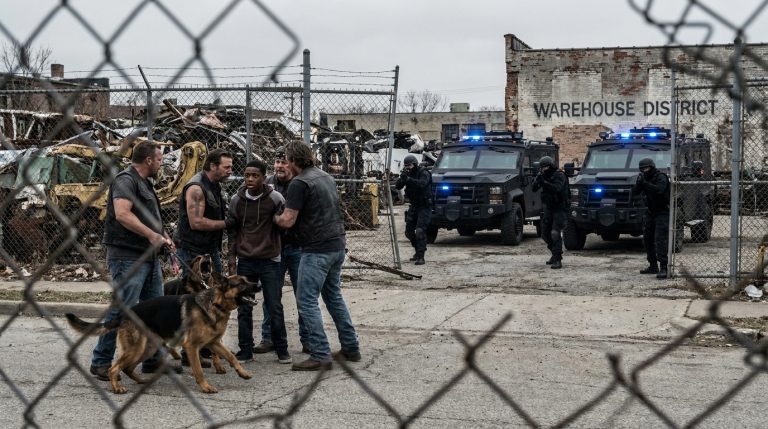
The humidity of the Georgia morning had turned into a suffocating, leaden afternoon. By 2:00 PM, the perimeter wasn’t just a gathering of motorcycles; it was a barricade. The local Athens police had been supplemented by a phalanx of State Troopers in their wide-brimmed campaign hats and mirrored sunglasses. They stood twenty yards from the front line of the Southern Skulls, their cruisers parked nose-to-tail, creating a second wall of steel.
Roman Cruz sat on the saddle of his Harley, his back straight, his eyes fixed on the red-brick gates of the university. He could feel the vibration of the idling engines through his spine, a constant, low-frequency hum that kept his adrenaline at a steady, vibrating simmer. Beside him, Preacher was quietly reciting something under his breath—not a prayer, but a rhythmic counting of the tactical units moving into position on the rooftops of the surrounding classroom buildings.
“Snipers on the library, Roman,” Preacher said, his voice barely audible over the thrum. “East corner and the clock tower. They aren’t hiding them. They want us to see the glass glinting.”
“Let them watch,” Roman said. He didn’t move. He didn’t adjust his grip on the handlebars. “They won’t pull the trigger unless we move first. And we aren’t moving. We’re just sitting on public asphalt, enjoying the view.”
A State Trooper Captain, a man with a chest full of commendations and a face like a slab of granite, walked across the no-man’s-land between the two lines. He stopped five feet from Roman’s front tire.
“Cruz,” the Captain said. “I’m Captain Vance. We’ve met before. Back in ’12, when your boys had that dust-up in Savannah.”
Roman nodded once. “I remember. You were the one who told me the law was a flexible thing if the right people were happy.”
Vance didn’t flinch. “The right people are very unhappy right now, Roman. Judge Miller has been on the phone with the Governor every fifteen minutes. You’ve got five hundred bikers blocking the entrance to the state’s flagship university. This isn’t a protest. It’s an occupation. And my orders are to clear this road by sunset, with or without your cooperation.”
“Then you better start calling for more ambulances, Vance,” Roman said. “Because my boys aren’t leaving until the University President comes out here and hands me a signed document stating that Maya Hart’s scholarship is secure and that all disciplinary charges against her have been dropped.”
“You’re throwing away twenty years of peace for one girl,” Vance said, his voice lowering. “I know who she is, Roman. I’ve known since you placed her with the Harts. I’m the one who made sure the local deputies stayed away from that house. You’re blowing the cover on the only good thing you ever did.”
“The cover is already gone,” Roman said. “The Judge’s kid blew it when he put his hands on her. Now, I’m not asking for favors. I’m telling you how this ends. You bring me that paper, or you start the riot. It’s your choice.”
Vance looked at the sea of leather behind Roman—men from Alabama, Tennessee, and the Carolinas, all sitting in grim silence. He knew as well as Roman did that the Southern Skulls weren’t just a gang; they were a brotherhood built on a foundation of shared trauma and hard-won loyalty. If the first tear gas canister was fired, the campus would turn into a war zone that the evening news wouldn’t be able to spin.
Vance turned and walked back to his line without another word.
Half an hour later, a small side gate opened, and Maya stepped out. She wasn’t alone. She was flanked by two campus security guards, but she brushed past them as soon as she saw Roman. She walked with a purpose that made Roman’s heart ache—the same stubborn, head-down stride he’d seen a thousand times in his own reflection.
She stopped at his bike, the photograph he’d given her clutched in her hand. Her eyes were red, but she wasn’t crying anymore. She looked like she had aged a decade in three hours.
“I called them,” she said, her voice shaking. “My parents. The Harts.”
Roman felt a cold knot tighten in his stomach. “Maya…”
“They told me,” she interrupted, her voice rising. “They told me the money didn’t come from a trust fund. They told me that the ‘anonymous donor’ was a man who sent them a cashier’s check every month for eighteen years. They said they were scared of you, but they were more scared of what would happen if they didn’t take the money.”
“It wasn’t like that,” Roman said, finally swinging his leg over the bike and standing up. He felt the weight of the eyes on him—the snipers, the troopers, his own men. He didn’t care. “I wanted you to have a chance. A real one. Away from the Skulls. Away from the life my father built.”
“You lied to me my whole life,” she said, stepping closer. She held up the photo. “This woman… Elena. My mother. They told me she died in a car accident. But that’s not what happened, is it?”
Roman looked at the photo, the image of the woman he’d loved more than his own life. “No. She didn’t die in an accident. She died of a broken heart and a heavy dose of reality. My father… he made sure she understood that being with me was a death sentence for both of you. She left because she loved you. She went to California, tried to start over. She died of a stroke three years later. I couldn’t even go to the funeral, Maya. I had to stay here and run this club so my father wouldn’t go looking for you.”
Maya looked at him, really looked at him, for the first time. She saw the grease under his fingernails, the faded tattoos of a life spent in the dirt, and the crushing weight of the choices he’d made.
“So this is it?” she asked, gesturing to the bikes. “This is your solution? A five-hundred-man intimidation tactic? You think this makes up for twenty years of silence?”
“It doesn’t make up for anything,” Roman said. “But it’s the only language these people understand. Judge Miller thinks he can erase you because you’re a ‘scholarship kid.’ He thinks his name is a shield. I’m here to show him that his shield is made of paper, and mine is made of iron.”
“You’re going to get yourself killed,” she whispered. “Or sent to prison.”
“I’ve been in prison for twenty years, Maya,” Roman said, his voice soft. “Every day I didn’t get to hear you speak, every day I didn’t get to see you grow up… that was my sentence. This? This is just the bill coming due.”
He reached out and gently took the silver skull necklace from her hand. It was still broken. He pulled a small, heavy-duty silver ring from his pocket—a spare part from his bike’s primary chain—and threaded the ends of the broken necklace through it, twisting the metal with his calloused fingers until it held. It was crude, ugly, and unbreakable.
He handed it back to her. “Put it on. It’s not a ghost story anymore. It’s a promise.”
Maya took the necklace, her fingers lingering on his. For a second, the roar of the engines and the tension of the standoff seemed to fade into the background. There was just a man and his daughter, standing in the middle of a war they hadn’t started but were determined to finish.
“Roman!” Preacher called out.
A black SUV was pulling up behind the police line. It didn’t have the markings of the State Troopers. It was a high-end, armored vehicle. The door opened, and Judge Miller stepped out, looking like a man who was about to deliver a death sentence. He was accompanied by a man in a dark, expensive suit who Roman recognized instantly: the University’s lead legal counsel.
The Judge walked to the edge of the police line and pointed a finger at Roman.
“That’s enough, Cruz!” the Judge shouted, his voice amplified by a megaphone. “We’ve checked your records. We’ve checked your club’s ‘discretionary funds.’ We have enough to tie you to money laundering, racketeering, and witness intimidation. If you don’t clear this road in the next ten minutes, the FBI is going to move in, and I will personally see to it that every man wearing that patch is processed through the federal system.”
Roman looked at the Judge, then at the University lawyer. A slow, dangerous smile spread across his face.
“Is that right, Judge?” Roman shouted back, his voice carrying easily over the engines. “You want to talk about records? You want to talk about ‘discretionary funds’?”
Roman reached into the saddlebag of his bike and pulled out a thick, weathered leather folder. He held it high.
“I’ve got a record of my own,” Roman said. “I call it the ‘Inheritance of Iron.’ It’s twenty years of receipts. Every bribe paid to the sheriff’s office to keep the Skulls out of the news. Every ‘donation’ made to certain judges to ensure their sons’ DUIs disappeared. And most importantly… the original contract my father signed with the University’s board of directors twenty years ago to ensure this land stayed ‘undisturbed’ by club business.”
The University lawyer’s face went the color of parchment. He whispered something into the Judge’s ear, but the Judge brushed him off.
“You’re bluffing!” Miller screamed.
“Try me,” Roman said. “I’ve got the dates, the amounts, and the account numbers. If I go down, this whole town goes with me. The library with your name on it? I paid for the foundation with cigarette money, Judge. The scholarship fund? That was the Skulls’ way of paying the rent.”
The silence that followed was absolute. Even the engines seemed to quiet down. Maya looked from Roman to the Judge, the realization of the world’s ugliness finally hitting her with full force.
“You used me,” she whispered, her eyes fixed on the Judge. “You used my scholarship as a way to keep him quiet.”
The Judge didn’t answer. He couldn’t.
“The clock is ticking, Vance,” Roman said, turning his gaze back to the Trooper Captain. “Ten minutes. Give me the paper, or I start reading the names in this folder to the local news crew that just pulled up behind your line.”
Chapter 6: The Receipt of Blood
The boardroom of the University of Georgia was a temple of mahogany and silence. Outside, the roar of five hundred motorcycles was a muffled, rhythmic thumping, like the heart of a giant beating against the walls of the ivory tower.
Roman Cruz stood at the head of the long table. He hadn’t taken off his vest. He hadn’t washed the grease from his hands. He looked like a stain on the pristine carpet, and he knew it. He took a seat across from the University President, a man named Dr. Sterling, who looked as though he was witnessing the end of civilization. Judge Miller sat in the corner, his face a mask of purple rage, his hands trembling as he clutched a glass of water.
“Let’s be clear,” Dr. Sterling said, his voice measured and cold. “This is extortion, Mr. Cruz.”
“No,” Roman said, leaning forward. “This is a closing statement. For twenty years, the Southern Skulls have been the invisible labor that kept this town running. We moved the things you didn’t want to see. We settled the debts your sons ran up in the dark. We stayed in the shadows because my father made a deal with yours. He got a quiet territory, and you got a clean campus. But the deal changed when your golden boy decided to make my daughter a target.”
Roman tapped the leather folder on the table. “This isn’t just about Maya anymore. This is about the fact that your ‘legacy’ is built on a graveyard of secrets. I’ve got the proof that Judge Miller’s son wasn’t just bullying Maya—he’s been running a prescription pill ring out of his fraternity house for two years. And I’ve got the proof that the University police were told to look the other way because his daddy is the one who signs their checks.”
Judge Miller stood up, his chair screeching against the floor. “You’re a liar! You’re a criminal! My son is a hero!”
“Your son is a predator, Miller,” Roman said, his voice like a whip. “And he’s a sloppy one. My boys have been watching him since the day he first walked onto this campus. Not because I wanted to hurt him, but because I needed to know who was around my daughter. We have the photos. We have the ledgers. We have the witnesses.”
Roman looked back at Sterling. “Here is the deal. You sign the paper. Maya stays. Her record is scrubbed. Bryce Miller is expelled and handed over to the State Troopers for the narcotics ring. And the Judge… well, the Judge is going to retire. Effective immediately. For ‘health reasons’.”
“And what do we get in return?” Sterling asked.
“You get to keep your university,” Roman said. “I’ll take the folder. I’ll take my boys. And we’ll go back to being ghosts. The Southern Skulls will move their operations across the state line. We leave Athens for good. You get your ‘clean’ town back, and I get my daughter’s future.”
Sterling looked at Miller, then back at Roman. He was a man of logic, of cost-benefit analysis. He knew that if this went to court, the University would be dismantled by the ensuing scandal. The donors would flee, the board would be purged, and his own career would be over.
“Give me the paper,” Sterling whispered to his assistant.
Ten minutes later, Roman walked out of the administration building. He held a single sheet of paper in his hand, the ink still wet. The sun was beginning to set, casting long, orange shadows across the quad. The air was cooling, but the tension in the air was still thick enough to choke on.
He walked past the police line, past the silent troopers, and stopped at the edge of the campus. Maya was waiting for him.
He handed her the paper.
She read it slowly, her eyes moving back and forth. When she finished, she looked up at him, her expression a mix of relief and profound sadness.
“It’s over?” she asked.
“For you, it is,” Roman said. “You can stay. You can finish your degree. Nobody is going to touch you, Maya. Not the Millers, not the school. You’re safe.”
“And you?”
“The Skulls are moving out,” Roman said. “The deal was that we leave. I’m taking the club to South Carolina. It’s better this way. As long as I’m here, you’ll always be ‘the biker’s daughter.’ I want you to just be Maya.”
“You’re leaving again,” she said. It wasn’t an accusation; it was a statement of fact.
“I never really left, kid,” Roman said, reaching out and gently brushing a stray curl from her forehead. His hand was rough, but his touch was as light as a feather. “I’ve been five minutes away for twenty years. And I’ll still be five minutes away. You won’t see the bikes. You won’t see the leather. But if you ever need me… if anyone ever makes you feel small again… you just look for the shadow on the perimeter. I’ll be there.”
He turned and walked back to his motorcycle. He climbed onto the saddle and looked at the five hundred men who had risked everything for a girl they didn’t know, simply because their King had asked them to.
Roman raised his hand.
One by one, the engines roared to life. It wasn’t a chaotic noise this time; it was a disciplined, thunderous salute. The smell of exhaust and burnt rubber filled the air, a gritty incense for a departing army.
Preacher pulled up beside him. “Where to, King?”
“East,” Roman said. “We’ve got a long ride ahead of us.”
As Roman pulled away, he looked in his rearview mirror. He saw Maya standing on the quad, the small silver skull necklace glinting around her neck. She didn’t wave, and she didn’t smile. But she didn’t look away. She stood her ground, her head held high, a Cruz through and through.
The Southern Skulls flowed out of the city like a river of oil, leaving the manicured lawns and the red-brick buildings behind. They rode into the gathering dark, the sound of their engines echoing off the hills of Georgia like fading thunder.
Roman didn’t look back again. He kept his eyes on the road, on the horizon, on the life he had finally earned for the only person who mattered. He was a man of many sins, a man of blood and iron, but as the wind whipped past his face and the weight of the leather vest felt lighter than it ever had, Roman Cruz finally felt like a free man.
He had paid the debt. He had settled the account. And for the first time in twenty years, the silence that followed the roar wasn’t empty. It was full of the only thing a monster ever truly wants: the knowledge that the light he protected was still burning bright.
The road ahead was long, and the law would eventually come knocking for the things he’d done, but that was a problem for another day. For now, there was only the rumble of the engine, the brotherhood at his back, and the silver skull in the mirror, reflecting a world that finally knew the cost of his name.