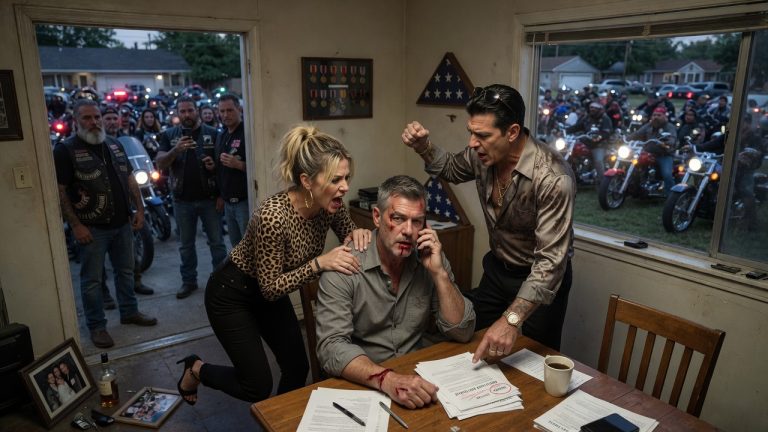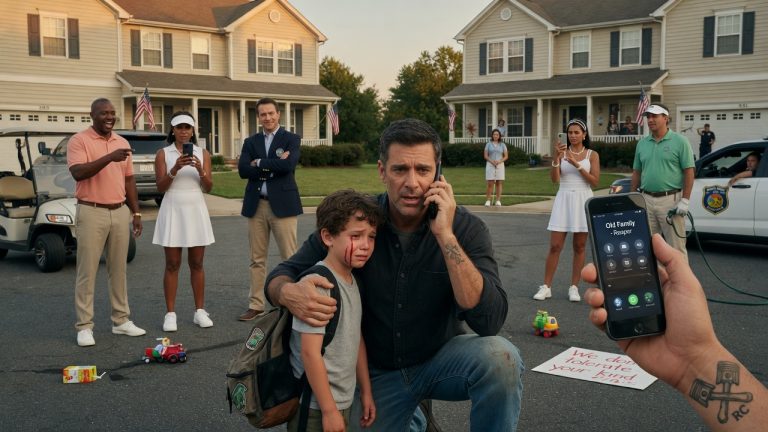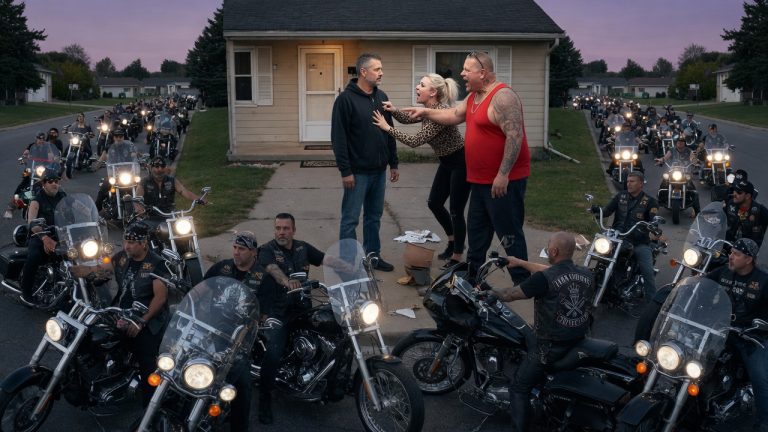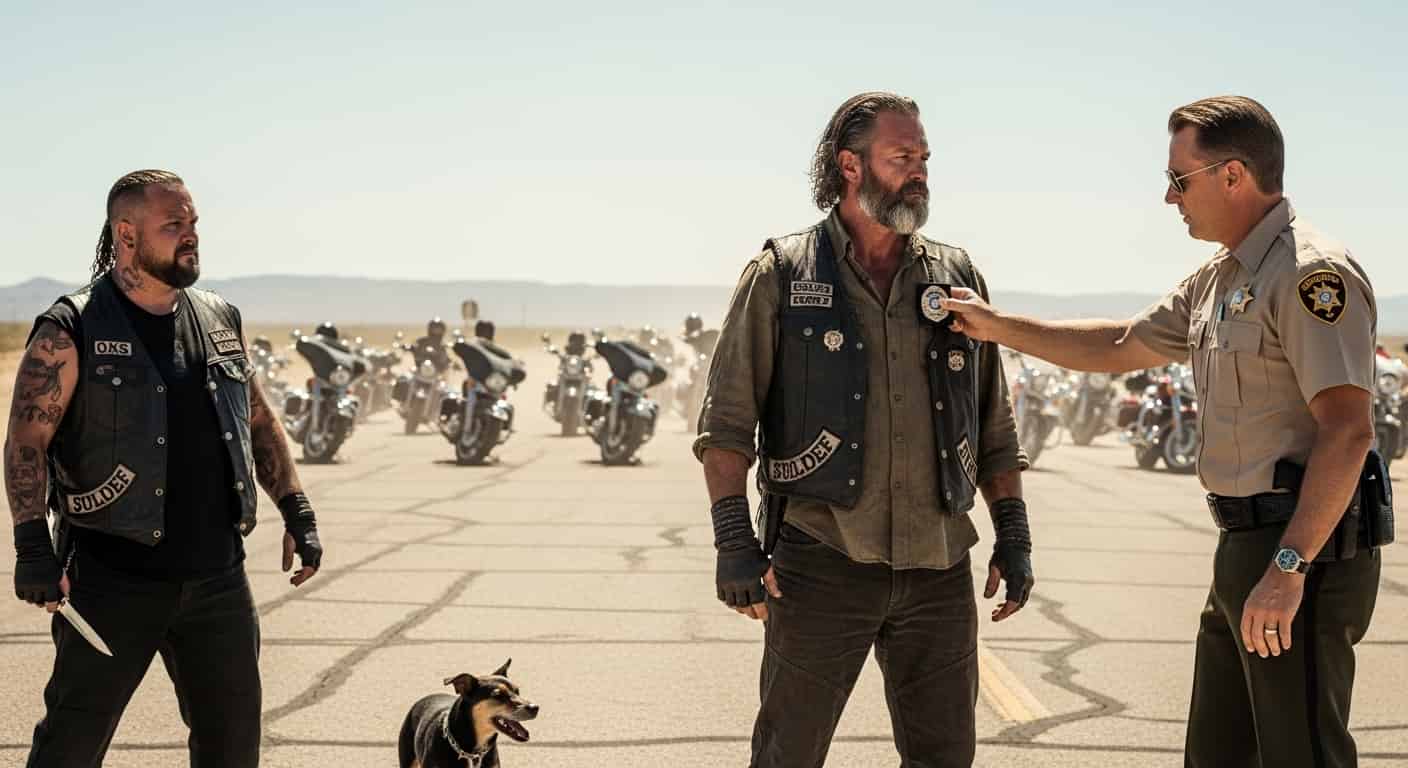
Ten years.
That’s how long Canyon Reed spent building a life in the dust of Gila Bend. He wore the leather. He took the hits. He became the man the MC trusted to lead the blockade against a corrupt Sheriff who wanted to bulldoze a veteran’s home.
But when Sheriff Miller walked into the center of the stand-off, he didn’t bring a warrant.
He brought a piece of metal that changed everything.
When that silver badge hit the hood of the car, the 500 bikers standing behind Canyon didn’t see a leader anymore. They saw a ghost. They saw the one thing they hate more than death.
“Tell them, Canyon,” Miller whispered. “Tell them why you really know our tactical codes.”
The blockade is holding, but the man leading it just ran out of places to hide.
FULL STORY: THE HIGHWAY’S LAST STAND
Chapter 1: The Heat and the Hound
The heat in Gila Bend didn’t just sit on you; it chewed. It was a dry, predatory thing that tasted of creosote and old oil. Canyon Reed sat on the porch of a shack that looked like it was held together by spit and stubbornness, watching the horizon where the asphalt of Highway 85 shimmered into a fake lake.
Bullet, a terrier with more scars than fur and a missing chunk of his left ear, let out a low, liquid growl.
“I see him, buddy,” Canyon muttered. His voice was like gravel being turned in a tin drum.
A white-and-green cruiser kicked up a plume of dust, slowing as it approached the perimeter of the veteran’s property. This was Sarge’s place. Sarge was seventy-eight, had a chest full of medals he never looked at, and a lung capacity diminished by orange mist in a jungle fifty years ago. To the county, he was an eyesore on a valuable piece of transit-adjacent land. To Canyon, he was the only man who hadn’t asked questions when Canyon rolled into town ten years ago with a bleeding side and a bike that shouldn’t have been able to idle.
The cruiser stopped. Sheriff Miller stepped out. He looked exactly like the man Canyon had shared a patrol car with fifteen years ago in Phoenix—lean, arrogant, and wearing a uniform that was too clean for a man who did dirty work.
“Reed,” Miller said, leaning against the door. He didn’t take off his aviators. “You’re on the wrong side of the fence.”
“Sarge has the deed, Miller. You’ve got a piece of paper signed by a developer who’s golfing in Scottsdale. Doesn’t seem like a fair trade.”
Miller laughed, a short, sharp sound. “The eviction is legal. In two hours, the bulldozers come through. If you and your dirtbag friends are still here, it’s a felony interference. I’d hate to see you go back to a cage, Canyon. Especially after how hard you worked to disappear.”
Canyon stood up. He was a head taller than Miller, his frame thickened by a decade of manual labor and heavy bikes. His leather vest—the “kutte”—felt heavy. The patches on it weren’t just decorations; they were a contract.
“The brothers are already coming,” Canyon said quietly. “All of them. From the border up to Flagstaff. You want to move Sarge? You’re going to have to move five hundred of us first.”
Miller’s smile didn’t fade, but his jaw tightened. “Five hundred felons against the state? You think that ends well for the dog?” He looked at Bullet.
“The dog’s seen worse than you,” Canyon said. “And so have I.”
Miller turned back to his car, but stopped. He looked over his shoulder, the sun catching the gold star on his chest. “I know why you’re doing this, Reed. You couldn’t save your brother from those kids in high school, so you’re playing hero for an old man. But you’re not a hero. You’re a fugitive in a costume. I’ll see you at the blockade.”
Canyon watched the cruiser leave. His hands were shaking, just a little. He reached down and scratched Bullet behind his good ear.
“He’s right about one thing, pal,” Canyon whispered. “I am in a costume.”
Inside the shack, the radio crackled. It was Oaks, Canyon’s lieutenant.
“Canyon, we’ve got three hundred bikes at the crossroads. Another two hundred coming in from the South. The road is closed. What’s the word?”
Canyon looked at the badge he kept hidden in a velvet pouch inside his vest—not his own, but his brother’s. The brother who had ended his own life because he wasn’t strong enough to fight the world.
“The word is hold,” Canyon said into the radio. “Nobody passes. Not the Sheriff. Not the state. Nobody.”
Chapter 2: Tactical Ghosts
The blockade was a masterpiece of illegal engineering. Canyon had positioned the bikes in a staggered “V” formation, a tactic he’d learned in a police riot-control seminar in 2011. It allowed for maximum visibility and a quick exit if the tear gas started flying.
Oaks walked up to him, spitting a stream of tobacco juice onto the parched earth. Oaks was a man who looked like he’d been carved out of a hickory stump. He was loyal to a fault, but he was observant.
“You’ve got a mind for this, Canyon,” Oaks said, nodding at the line of bikes. “The way you’ve got the perimeter set. It’s like you’ve done this before. Professional-like.”
Canyon didn’t look at him. He was busy adjusting the carburetor on his shovelhead. “I read books, Oaks. You should try it.”
“I read people,” Oaks countered. “And you’re wound tighter than a watch spring. This ain’t just about Sarge’s dirt. You and that Sheriff… there’s a smell between you two. Like old blood.”
“He’s a bully with a badge,” Canyon said. “I don’t like bullies.”
“There’s a lot of bullies in the world. You don’t call in five hundred brothers to start a war over every one of ’em. Why this one? Why now?”
Canyon finally looked up. He thought about the phone call he’d made three weeks ago from a burner phone in a truck stop. He’d called an old contact at the Department of Justice. He’d given them the ledger numbers, the names of the deputies on Miller’s payroll, and the coordinates of the desert burials. He’d burned Miller to the ground, and now he was just waiting for the fire to catch.
“Because Sarge is the only one who doesn’t owe anyone anything,” Canyon said. “He deserves to die in his own bed.”
The sound of a helicopter began to throb in the distance. The state was waking up.
“The Feds are coming, Oaks,” Canyon said, lower this time. “But they won’t be here for four hours. We just have to hold the line until then. If Miller breaks through before the DOJ arrives, he’ll destroy the evidence in Sarge’s cellar. He’ll kill the old man and call it a tragic accident during an eviction.”
Oaks frowned. “What evidence? The hell are you talking about?”
“Sarge has the old county records,” Canyon lied, his heart hammering against his ribs. “Proof that Miller’s been skimming the land taxes. That’s why he wants the house gone.”
It was a good lie. It was a biker lie. It played into the “us vs. the system” narrative that kept the club together. But the truth was simpler: Canyon had used Sarge’s property as a dead-drop for the documents he’d stolen from Miller’s office years ago. He’d been sitting on them, too afraid to use them, until he saw Miller’s men beat a homeless kid behind the diner last month.
The bully had gone too far.
“Whatever you say, Boss,” Oaks said, though the suspicion didn’t leave his eyes. “But if the blue-and-reds show up and start cracking skulls, I need to know you’re with us. Not just leading us.”
“I’m here,” Canyon said, patting the leather of his vest. “I’m not going anywhere.”
Chapter 3: The Rookie’s Choice
By noon, the sun was a hammer. The 500 bikers had created a city of leather and chrome in the middle of the highway. People had brought coolers, umbrellas, and a sense of grim purpose.
At the edge of the blockade, a young deputy named Miller—no relation to the Sheriff, just a kid with a fresh buzzcut and eyes that were too wide—stood by a plastic orange barrier. He was holding a riot shield, but he looked like he wanted to drop it and run.
Canyon walked up to the line. He didn’t have a weapon visible, but his presence was enough to make the kid stiffen.
“Hot out here, isn’t it, son?” Canyon asked.
The rookie, Deputy Vance, swallowed hard. “Sir, you need to move the bikes. The Sheriff’s orders are final.”
“I know what the orders are,” Canyon said. He leaned in, his voice dropping to a whisper. “But I also know you didn’t join the force to throw a purple-heart veteran out of his house for a shopping mall. You grew up in Tucson, right? Your dad was a mechanic?”
Vance blinked. “How do you—?”
“I know people,” Canyon said. “I know your dad would be ashamed to see you standing there. Miller is going to tell you to use the gas. He’s going to tell you to swing the baton. When he does, I want you to remember that the man in that house survived the Tet Offensive just so you could have the right to choose who you follow.”
“I have a job, Mr. Reed,” Vance said, his voice cracking.
“No,” Canyon said. “You have a conscience. Don’t let Miller kill it. Because once it’s gone, it doesn’t come back. I know.”
Vance looked at Canyon, really looked at him. He saw the way Canyon stood—balanced, shoulders back, the posture of a man who had once worn a uniform himself.
“Who are you?” Vance whispered.
“I’m the guy who’s giving you a head start,” Canyon said. “The Feds are forty miles out. When they get here, they aren’t looking for bikers. They’re looking for Miller. If you’re standing next to him when the cuffs come out, you’re going down too.”
Canyon turned and walked back to the bikes. He could feel Vance’s eyes on his back. He could also feel Miller’s eyes from the cruiser fifty yards away.
The Sheriff was tired of waiting.
Chapter 4: The Pressure Break
The bulldozers arrived at 2:00 PM. They were yellow monsters, their engines roaring like angry beasts. Behind them were two dozen cruisers from three different counties. Miller had called in favors.
He stepped out of his car with a megaphone.
“This is your final warning!” Miller’s voice echoed across the desert. “Clear the road or we will use force!”
Oaks looked at Canyon. “They’re bringing the heavy iron, Canyon. What’s the move?”
“Bikes in a circle,” Canyon ordered. “Tighten the gap. If they want to move the veteran, they have to crush a hundred thousand dollars’ worth of American steel first. They won’t do it. Not with the news cameras arriving.”
A few news vans had indeed parked on the shoulder, their satellite dishes unfolding like alien flowers. Canyon had made sure the local stations knew about the “Biker Blockade for a Hero.”
Miller walked forward, alone this time. He stopped ten feet from Canyon. The tension was so thick you could smell it—sour sweat and ozone.
“You think the cameras save you?” Miller hissed, his megaphone lowered. “You think these guys follow you because they like you? They follow you because they think you’re one of them.”
“I am one of them,” Canyon said.
“No,” Miller smiled. It was a predatory, ugly look. “You’re a ‘Blue.’ You’re a rat who couldn’t handle the heat in Phoenix, so you stole a file and ran. You’ve been playing dress-up for a decade, Canyon. But the thing about leather? It doesn’t hide the smell of a cop.”
Miller reached into his pocket and pulled out a small, velvet-lined box. He opened it.
Inside was a silver badge. Number 7422.
Canyon’s heart stopped.
“I went through your old locker, Canyon. The one the department ‘lost.’ Funny thing… you left your brother’s memorial badge in there. And a photo. You remember the photo? You and me at the academy graduation? Arms around each other? You looked so proud to be part of the brotherhood.”
Miller looked past Canyon, at Oaks and the other bikers who were leaning in, listening.
“Hey!” Miller shouted, his voice carrying. “You guys want to see who’s leading you? You want to see the man who’s been ‘protecting’ you for ten years?”