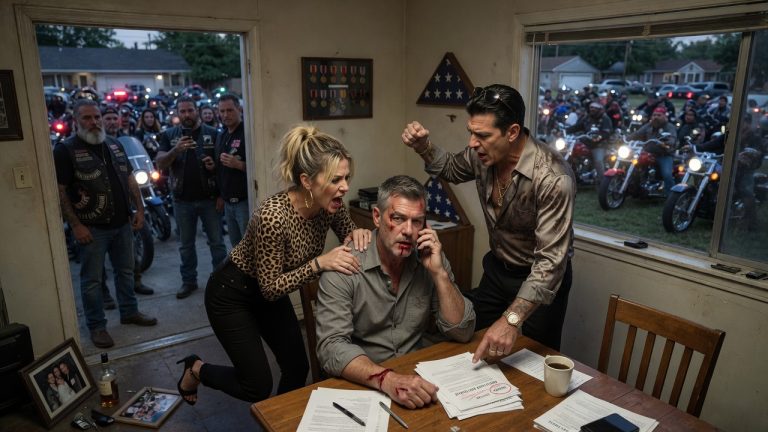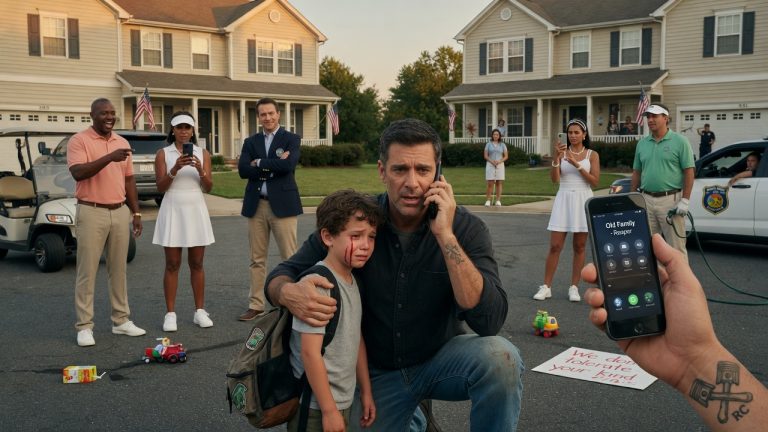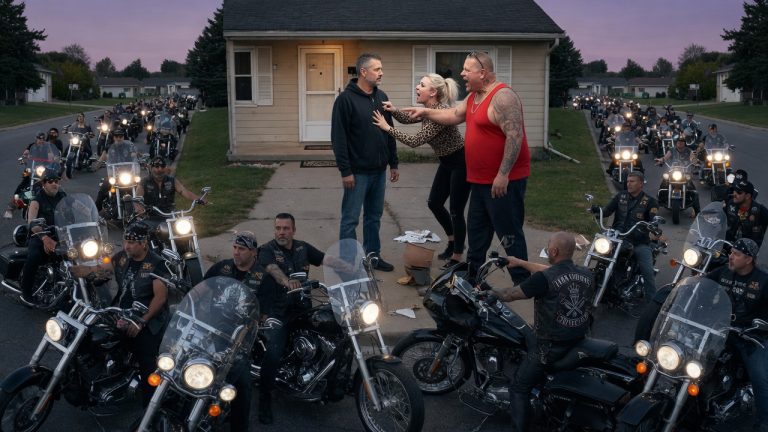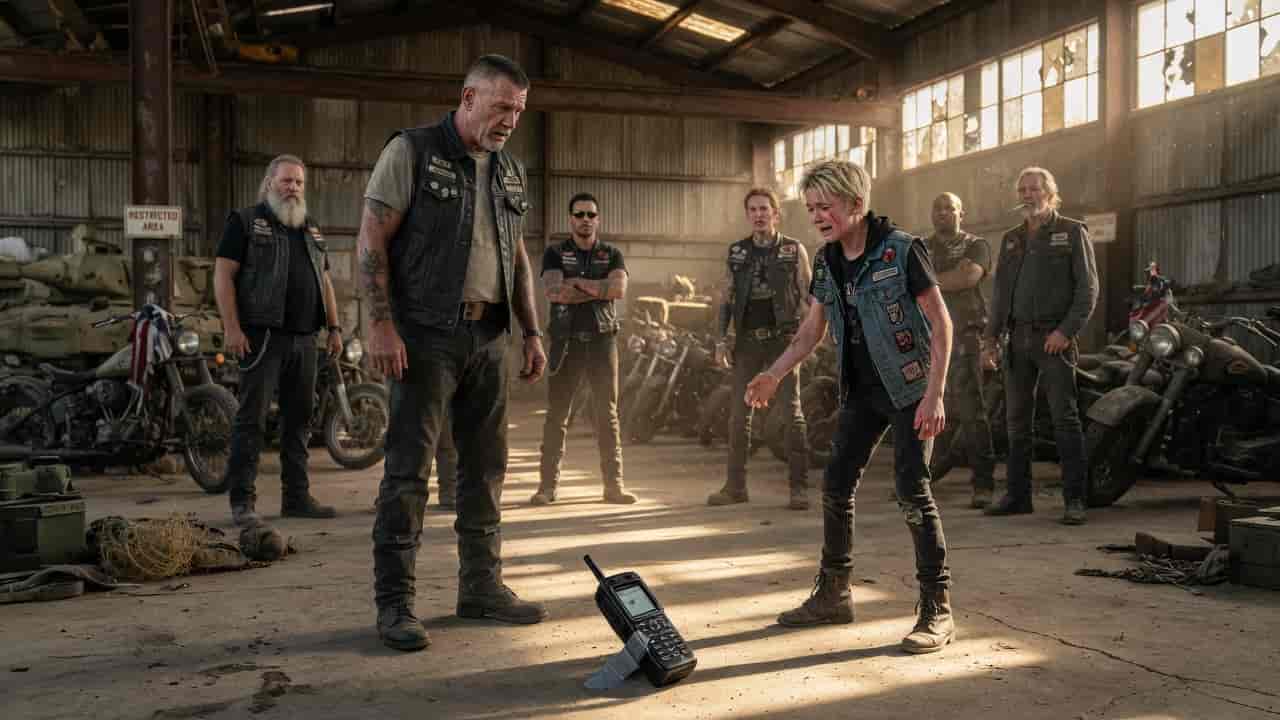
“Whose name is on the screen, Cobra?”
Tiny’s voice didn’t just shake; it cracked the silence of the entire hangar. He stood there, the smallest man in the club, holding the one piece of evidence that proved their leader was a lie. Nine hundred and ninety-nine men had followed Cobra Vance into the Texas heat, believing he was the only thing standing between them and a federal prison.
Cobra didn’t move. He didn’t reach for his vest. He just stood there like a man who had already been erased.
“It’s a burner, Tiny,” Cobra said, but his voice lacked the gravel that usually made men stand at attention. “Give it to me.”
“I saw the contact list,” Tiny whispered, and the three bikers standing behind him stepped into the light. Their faces weren’t filled with the usual loyalty. It was something colder. Something that looked like a reckoning. “I saw the title. ‘Internal Affairs.’ You weren’t saving us, Cobra. You were pricing us out.”
The room went so quiet you could hear the wind whistling through the rusted corrugated metal. Nine hundred and ninety-nine brothers. One secret. And a choice that was about to turn the desert into a graveyard of broken loyalty.
Chapter 1
The heat in the Texas Panhandle doesn’t just sit on you; it tries to get inside your skin. It’s a dry, aggressive weight that smells of baked caliche and old grease. Inside the hangar of the decommissioned Biggs Army Airfield, the air was worse. It was stagnant, trapped by four walls of corrugated steel that groaned every time the wind shifted.
Cobra Vance stood at the edge of the shadows, watching the perimeter. He was a big man, built like a fortress that had survived a few sieges, but lately, the foundations were feeling thin. He wiped a hand over his buzzed scalp, feeling the grit of the desert. Behind him, the low murmur of nearly a thousand men sounded like a hive of bees.
Nine hundred and ninety-nine. That was the count as of this morning. The Brotherhood of the Iron Cross was no longer just an MC; it was a small, desperate city on wheels. And Cobra was its mayor, its priest, and its primary liar.
“Water’s down to four pallets, Boss.”
Tiny’s voice came from the darkness near a stack of rusted ammunition crates. Tiny was twenty-four, half the size of Cobra, and possessed of a loyalty so fierce it was almost painful to witness. He was the kind of kid who would jump into a fire if Cobra told him the smoke was actually a cloud.
“I know,” Cobra said, his voice a low, disciplined rumble. “The trucks are coming tonight.”
“You’ve been saying that since Tuesday,” Tiny said. He stepped into the light, his face gaunt. “The guys are starting to talk, Cobra. Maverick is saying we should head for the border. Hammer wants to raid that grain elevator five miles back. People are thirsty. Thirsty people don’t listen to speeches.”
Cobra turned, his boots crunching on the dusty concrete. He looked at Tiny, really looked at him. The kid’s eyes were bloodshot, sunken. Tiny had been the one to pull Cobra’s father out of a burning wreck ten years ago, a debt Cobra had been paying back by keeping the boy close, keeping him clean-ish.
“I’m not giving speeches,” Cobra said. “I’m giving orders. Tell Maverick to keep his mouth shut or I’ll shut it for him. The supplies are coming. We stay put.”
“Why here?” Tiny’s voice was small, lacking its usual bite. “We’re sitting ducks in this hole. The feds know we’re here. They’re just waiting.”
“They’re waiting because they’re afraid,” Cobra lied.
The lie tasted like copper in his mouth. The feds weren’t afraid. The feds were his landlords. They were the ones who had provided the GPS coordinates for this hangar. They were the ones who had promised that if Cobra kept all 999 members in one place, they wouldn’t swarm the desert with Blackhawks and HRT teams.
Cobra felt the weight of the ruggedized satellite phone in his inner vest pocket. It was a cold, hard lump against his ribs. It only had one number programmed into it. A man named Miller. Miller didn’t care about the Brotherhood. Miller cared about the three million dollars in laundered cryptocurrency that Cobra’s father had hidden before he died in prison. Miller wanted the money, and Cobra wanted his men to live. It was a simple, dirty trade.
“Go find Hack,” Cobra said, dismissing the kid. “Tell him I need the comms checked again. If we can’t hear them coming, we’re already dead.”
Tiny nodded once, a sharp, jerky movement, and disappeared back into the sea of leather and denim.
Cobra waited until he was sure he was alone, then he stepped behind a disassembled Huey engine. He pulled the phone out. His thumbs were thick, scarred from a lifetime of mechanics and violence, and they trembled slightly as he hit the call button.
“Status,” a voice said on the second ring. Miller. He sounded like he was sitting in an air-conditioned office, sipping something expensive.
“We’re dying out here, Miller,” Cobra whispered. “The water is gone. The men are losing their minds. You said forty-eight hours. It’s been four days.”
“Logistics take time, Vance. Moving that much water and food to a restricted zone without a paper trail isn’t easy.”
“If you don’t send the trucks, I’m moving them,” Cobra said. “I’ll take them through the fence and we’ll disappear into the hills. You’ll never find that drive.”
“You move, and I authorize the strike,” Miller said, his voice as flat as the desert horizon. “I have a drone over you right now. I can see the heat signatures of nearly a thousand men. Think about that, Cobra. One push of a button and the Iron Cross becomes a historical footnote. Stay in the hangar. The trucks will arrive by midnight. And Vance?”
“What?”
“Don’t let any of them wander off. If the count drops, the deal drops.”
The line went dead. Cobra stared at the small screen. Internal Affairs. That was the label Miller had insisted on. It was a joke, a sick little irony. Miller wasn’t Internal Affairs. He was something much worse—a ghost in the machine who had found a way to use a biker gang as a bargaining chip for his own retirement fund.
Cobra tucked the phone back into his vest, but as he turned, he saw a shadow move near the hangar doors. It was Maverick. The man was a former Air Force pilot who had crashed his career and found a home in the club. He was observant, cynical, and currently staring at Cobra with a look that wasn’t quite a challenge, but wasn’t a salute either.
“Who you talking to, Boss?” Maverick asked, stepping out into the late afternoon glare. He was leaning against the rusted frame of a transport truck, picking at a callus on his palm.
“Business,” Cobra said, his jaw tightening.
“We don’t have any business,” Maverick said. “We’re out of fuel. We’re out of money. We’re just out. So, who’s on the other end of that fancy satellite phone? ‘Cause I know the club’s treasury didn’t pay for that.”
“I said it’s handled, Maverick. Get back to your crew.”
Maverick didn’t move. He stood his ground, his eyes scanning Cobra’s face for the tells he knew were there. “The guys are saying you’re holding out on us. They’re saying you got a side deal. I told them you weren’t that stupid. I told them you knew what happens to a leader who sells his brothers for a ticket out.”
Cobra stepped forward, his massive shadow falling over Maverick. He didn’t raise his hands, but the threat was there, thick and suffocating. “You want to lead, Maverick? You want to be the one to tell nine hundred men there’s no water? You want to be the one to explain why the feds haven’t kicked the door down yet? Because I can hand you the vest right now.”
For a second, Maverick didn’t blink. Then, he looked down, a slow, mocking smile spreading across his face. “Nah. I like my head right where it is. Just make sure the water shows up, Cobra. Because if it doesn’t, they won’t come for me. They’ll come for you.”
Maverick turned and walked away, his boots echoing in the hollow space. Cobra felt a chill that had nothing to do with the desert wind. He was losing them. The 999. The brotherhood he had spent fifteen years building was turning into a pack of wolves, and he was the one holding the empty meat bucket.
He walked back toward the center of the hangar, where a small fire was being lit in a trash can. Men were huddled around it, their faces orange and flickering in the twilight. These were men who had lost everything—their jobs, their families, their dignity—and found it again in the patch on their backs.
Cobra felt a hand on his shoulder. It was Hammer, the club’s blacksmith. A man of few words and immense strength.
“Tiny’s looking for you again,” Hammer said. “He found something. Near the south fence. He says you need to see it.”
“What is it?” Cobra asked, his heart hammering against his ribs.
“He didn’t say. Just said it looks like ‘the beginning of the end.'”
Cobra pushed past Hammer, his mind racing. Had the feds moved in? Had Miller betrayed him early? He ran toward the south fence, his lungs burning in the dry air. He found Tiny standing by a gap in the chain-link, staring out at the darkness.
“What is it, Tiny?” Cobra panted.
Tiny didn’t speak. He just pointed. Out in the desert, about half a mile away, a single red light was blinking. It was a marker. A landing zone.
“They’re coming, aren’t they?” Tiny whispered, his voice trembling with a terrifying mixture of hope and fear. “The rescue. You called them, didn’t you?”
Cobra looked at the red light, and then at the boy who looked at him like he was a god. He knew that light wasn’t for water trucks. It was for a transport. Miller was coming to collect.
“Yeah, Tiny,” Cobra said, his heart breaking in the silence. “I called them. It’s almost over.”
He reached out and squeezed the boy’s shoulder, feeling the thin bone beneath the denim. He was a protector who had turned into a butcher, and the worst part was, he was doing it because he loved them. He just didn’t know if that would matter when the lights came on.
Chapter 2
The night didn’t bring relief; it just changed the color of the misery. The Texas wind turned sharp, biting through the thin layers of sweat-soaked clothing the men wore. Inside the hangar, the smell of woodsmoke and unwashed bodies thickened into a fog.
Cobra sat in the “command center,” which was nothing more than a rusted metal desk and a map of the Panhandle pinned to a piece of plywood. He was staring at the satellite phone. It hadn’t buzzed since the call with Miller. Every minute that passed felt like a gallon of water evaporating from their collective soul.
“Cobra.”
It was Hack. The club’s tech specialist was a man who looked like he’d been assembled from spare parts in a basement. He was pale, twitchy, and had a permanent slouch from years over a keyboard. He was holding a handheld scanner, the screen glowing a sickly green.
“I’m picking up a localized signal,” Hack said, his voice dropping to a conspiratorial whisper. “High-frequency, encrypted. It’s coming from inside the hangar.”
Cobra felt a jolt of adrenaline that made his fingers tingle. “The feds?”
“Maybe. But it’s low power. Like a beacon. Or a bug.” Hack looked around nervously. “If we have a rat, Cobra, he’s actively broadcasting our position right now.”
Cobra leaned back, the metal chair screaming under his weight. “Can you track it?”
“I’m trying. But whoever’s running it knows what they’re doing. They’re hopping frequencies every thirty seconds. It’s professional. Gov-level.”
Cobra’s mind went to Maverick. Then to Hammer. Then, with a sickening lurch, he thought of the phone in his own pocket. Miller had said he was watching. Was the phone he’d been given also a tracking device? Of course it was. He was an idiot for thinking otherwise.
“Forget it for now,” Cobra said, his voice harsh. “Keep the perimeter scanners on. Let me know if anything moves within a mile.”
Hack hesitated, his eyes lingering on Cobra’s vest. “You okay, Boss? You look… grey.”
“I’m fine. Go.”
As Hack shuffled away, Cobra pulled the phone out. He needed to disable the beacon if he was going to have any leverage left. But before he could even look for a battery compartment, the hangar doors groaned open.
A group of bikers, led by Maverick and a massive, bearded man named Ox, marched toward the desk. They weren’t coming for orders. They were coming for blood.
“We just checked the south cistern,” Maverick said, his voice echoing off the steel walls. “It’s dry, Cobra. Not just low. Bone dry. And Tiny says you told him the trucks were coming at midnight. It’s 12:15.”
Cobra stood up, his height usually enough to cow most men, but Maverick didn’t flinch. Behind him, dozens of other bikers were closing in, their faces hard and unforgiving in the dim light.
“The trucks are delayed,” Cobra said. “There’s a checkpoint on the 287. They’re finding a way around.”
“Liar,” Ox growled. He stepped forward, his fists clenched. “I saw you out by the fence. I saw you talking to someone on that little black box. You ain’t talking to no truck drivers, Cobra. You’re talking to the Man.”
The accusation hung in the air like a noose. The crowd surged forward an inch. Cobra could feel the collective heat of their anger.
“I am the Man here,” Cobra roared, his voice shaking the rafters. “I am the one who kept the DEA out of our clubhouse in Austin. I am the one who negotiated the truce with the Pagans. If I’m on a phone, it’s to keep you all from ending up in a federal hole!”
“Then show us,” Maverick said, his voice deceptively calm. “Give us the phone, Cobra. Let Hack see who you’ve been calling. If it’s a logistics company in Dallas, we’ll all sit down and wait for our water. If it’s anything else… well, the Brotherhood has a very specific way of handling traitors.”
Cobra’s hand went instinctively to his vest. He could feel the phone. He could also feel the weight of his father’s secret—the three million dollars that was supposed to be their salvation. If he gave them the phone, they’d see Miller. They’d see the Internal Affairs tag. They’d kill him before he could explain that the money was for them.
“I don’t take orders from you, Maverick,” Cobra said.
“This ain’t about orders,” Ox said, reaching for Cobra’s shoulder. “This is about survival.”
Cobra moved before Ox could touch him. It was a practiced, brutal motion—a palm strike to the chest that sent the massive man stumbling back into the crowd. But the move didn’t intimidate them. It broke the last thread of restraint.
The hangar erupted.
It wasn’t a fight; it was a riot. Cobra was swallowed by a sea of leather and fists. He fought with the desperation of a man who knew that if he went down, he’d never get back up. He felt a boot catch him in the ribs, a fist crack against his cheekbone. He roared, throwing men off him, his eyes searching for an exit.
“Stop it!”
A shot rang out, the sound deafening in the enclosed space. The hangar went silent.
Tiny stood ten feet away, holding a rusted .45 caliber pistol he’d taken from the armory. His hands were shaking so hard the barrel was dancing, but his eyes were fixed on Cobra.
“Get away from him,” Tiny screamed. “All of you! Get back!”
The bikers hesitated, looking at the kid. Maverick sneered. “Put the toy away, Tiny. Your hero is a rat.”
“He’s not!” Tiny cried. “He’s the only one who cares! He’s the one who stayed when everyone else ran!”
Cobra wiped blood from his mouth, looking at Tiny. The boy’s loyalty was the only thing he had left, and it was the very thing that was going to get him killed.
“Tiny, put the gun down,” Cobra said, his voice soft, pleading.
“No,” Tiny said, his voice breaking. “I’ll show them. I’ll show them you’re good.” Tiny looked at the crowd, then back at Cobra. “Give me the phone, Cobra. I’ll show them it’s just a trucking company. I’ll show them.”
The silence that followed was the heaviest thing Cobra had ever felt. Every eye in the hangar was on him. 999 men, waiting for the truth.
Cobra looked at Tiny. He saw the desperation, the need to believe. And he knew he couldn’t do it. He couldn’t give him the phone.
“I can’t, Tiny,” Cobra whispered.
Tiny’s face crumbled. It was a slow-motion collapse of every hope he’d ever held. He lowered the gun, his arm falling to his side as if it had turned to lead.
“Why?” Tiny asked. The word was barely a breath.
Before Cobra could answer, the sound of rotors filled the air. Heavy, rhythmic, and terrifyingly close. Searchlights cut through the high windows of the hangar, blinding white beams that swept across the terrified faces of the bikers.
“Federal agents! Stay where you are!” The voice came from a loudspeaker outside, amplified and booming like the voice of a wrathful god.
“You brought them here,” Maverick hissed, looking at the lights. “You led them right to the nest.”
“I didn’t,” Cobra said, but even he didn’t believe it.
The hangar doors were kicked open. Flashbangs detonated in a series of bone-shaking cracks and blinding white light. Cobra was thrown to the ground by the pressure wave. Smoke filled the air, acrid and thick.
Through the haze, Cobra saw tactical teams in olive drab rushing in, their rifles raised. He saw his brothers—men who had lived for the road—dropping to their knees, their hands behind their heads.
In the chaos, Cobra looked for Tiny. He saw the boy standing near the ammunition crates, looking around in a daze. A tactical officer moved toward him, shouting commands. Tiny, still holding the .45, turned toward the officer, his face a mask of confusion and grief.
“Tiny, no!” Cobra screamed.
He lunged forward, but a heavy boot slammed into his back, pinning him to the concrete. He watched, helpless, as the officer fired.
Tiny didn’t fall immediately. He spun, his denim vest catching the light, and then he slumped against the crates. The .45 clattered to the floor.
Cobra roared, a sound of pure, unadulterated agony. He fought against the weight on his back, his fingers clawing at the concrete.
“Vance! Stay down!”
He looked up to see a man in a crisp suit walking through the smoke, flanked by two armed guards. It was Miller. He looked exactly as he had sounded—clean, efficient, and entirely devoid of a soul.
Miller looked down at Cobra, then at the dying boy by the crates. He didn’t even blink.
“You should have been more careful with your toys, Cobra,” Miller said. “Now, where’s the drive?”
Cobra looked at the man who had destroyed his world, and for the first time in his life, he didn’t feel fear. He didn’t feel loyalty. He only felt the cold, hard weight of a debt that could never be repaid with money.
“Go to hell,” Cobra spat.
Miller sighed, a sound of genuine disappointment. “I was hoping you’d be reasonable. But I suppose we’ll have to do this the hard way.”
As Miller turned to his guards, Cobra felt a hand brush against his. He looked down. It was Hammer, pinned beside him. The blacksmith’s eyes were full of a dark, simmering rage.
“The phone,” Hammer whispered, his voice barely audible over the shouting. “Where is it?”
Cobra realized the phone had fallen out of his vest during the struggle. It was lying three feet away, half-hidden under a discarded tire.
“Get it to Maverick,” Cobra whispered back. “Tell him… tell him the password is his daughter’s birthday. Tell him the truth is on the drive.”
Hammer nodded, a slow, grim movement.
Cobra looked back at Tiny. The boy’s eyes were open, staring at the ceiling of the hangar. He wasn’t breathing.
The Brotherhood of the Iron Cross was over. But Cobra Vance wasn’t finished. He had one more lie to tell, and this one was going to burn the whole world down.
Chapter 3
The interrogation room was a concrete box that smelled of stale cigarettes and industrial cleaner. It was deep inside a temporary field office the feds had set up in a nearby town, a place that didn’t appear on any local maps.
Cobra sat with his hands cuffed to a metal bar on the table. His face was a map of the riot—his left eye was swollen shut, and a jagged cut ran across his cheek. Every breath felt like a knife in his lungs. But the physical pain was a dull hum compared to the image of Tiny’s body slumped against those ammunition crates.
The door opened, and Miller walked in. He wasn’t alone this time. Behind him was a woman in a dark suit, her hair pulled back in a severe bun. She looked like she was made of flint and ice.
“This is Agent Vance—no relation, I assume,” Miller said, a thin smile on his lips. “She’s with the Department of Justice. She has a lot of questions about the 999 men currently being processed in the holding pens.”
The woman, Agent Vance, sat down across from Cobra. She didn’t look at his injuries. She looked through them.
“You’re a hard man to pin down, Mr. Vance,” she said. “Your father was a legend in the world of illicit finance. You, however, seem to have spent your life playing dress-up with a bunch of outlaws. Why?”
“It wasn’t play,” Cobra said, his voice a dry rasp.
“No, I suppose not. Not when you’re brokering deals with federal informants to keep your ‘brothers’ out of the very prison system you’re currently inhabiting.” She leaned forward. “Miller tells me you have something that belongs to the government. A drive containing records of offshore accounts used by the Aryan Circle and the Mexican Mafia. Records your father spent twenty years compiling.”
Cobra looked at Miller. The man was leaning against the wall, looking bored. He knew Miller hadn’t told her the whole truth. He hadn’t told her about the three million in crypto. Miller was playing his own game, using the DOJ as his muscle.
“I don’t know what you’re talking about,” Cobra said.
“Don’t lie to me,” she said, her voice sharpening. “We found the satellite phone. We tracked the calls. We know you were in contact with someone inside the DOJ. We just don’t know who.”
Cobra felt a flicker of hope. She didn’t know it was Miller. Miller was a ghost even to his own people.
“I want to see my men,” Cobra said. “I want to know they’re being fed. I want to know who’s paying for Tiny’s funeral.”
At the mention of the name, Miller’s eyes flickered. A warning.
“The ‘men’ are being processed,” Agent Vance said. “Most of them will be released with time served if you cooperate. But the boy… that was an unfortunate accident. He shouldn’t have been armed.”
“He was armed because I told him to be,” Cobra said, the lie coming easily now. “He was following my orders. He was innocent.”
“Innocence is a luxury you don’t have,” she said. She stood up and walked to the door. “Think about it, Cobra. You have twelve hours before I start signing the indictments. 999 men. That’s a lot of lives on your conscience.”
She left, and Miller stayed. He waited until the door clicked shut before he moved. He walked over to Cobra and leaned down, his face inches from his.
“You’re smarter than I thought,” Miller whispered. “Keeping her in the dark. I appreciate that. But don’t think for a second that I won’t let her bury those men if you don’t give me the drive.”
“I don’t have it,” Cobra said. “The riot… someone must have picked it up. Maverick. Hammer. One of them has it.”
Miller’s face twisted in anger. He grabbed Cobra by the throat, his fingers digging into the bruised skin. “If you’re lying to me, Vance, I’ll make sure you’re the one who watches them walk into the gas chamber. You hear me?”
“I hear you,” Cobra choked out.
Miller let go and straightened his tie. “I’ll give you two hours to ‘remember’ where it is. If I don’t have a location by then, I’m sending a team into the holding pens to start ‘interrogating’ your friends. I think Maverick would be a good place to start, don’t you?”
Miller walked out, leaving Cobra alone in the cold room.
Cobra closed his eyes. He could still feel the weight of his father’s legacy. His father hadn’t been a biker. He’d been a banker for monsters. He’d built the Iron Cross as a way to hide his wealth, using the club as a screen of noise and violence that the feds would never look past. And Cobra had been the willing participant, the son who thought he could turn a criminal empire into a sanctuary.
He thought of the phone. He had told Hammer to give it to Maverick. He had told him the password was his daughter’s birthday.
Maverick didn’t have a daughter.
It was a code. Maverick knew exactly what it meant. It meant the drive was hidden in the one place no one would ever look—the grave of the man who had started it all. Cobra’s father.
But to get there, they had to get out of the holding pens. And to get out, Cobra had to give Miller something else. Something Miller would believe was the truth.
He waited. He counted the seconds by the drip of a leaky pipe in the corner. He thought of the 999. He thought of the desert. He thought of the red light blinking in the darkness.
Two hours later, Miller returned. He looked impatient.
“Well?”
“It’s in the hangar,” Cobra said. “Under the floorboards in the old machine shop. There’s a loose plate. It’s in a lead-lined box.”
Miller’s eyes lit up. “Finally. You’re learning.” He turned to the door. “I’ll send a team. If it’s there, we might just forget about those indictments.”
“I want to talk to Maverick,” Cobra said. “One minute. To tell him to tell the men to stay calm.”
Miller hesitated, then shrugged. “Fine. One minute. But if you try anything, the deal is dead.”
Ten minutes later, Cobra was led into a large, communal holding cell. It was packed with bikers, their leather vests stripped, their faces etched with fatigue and resentment. As Cobra entered, the room went silent. A thousand eyes fixed on him, and none of them were friendly.
He saw Maverick standing by a barred window, looking out at the sunset. He walked toward him, the crowd parting like he was a leper.
“You got a lot of nerve showing your face here,” Ox growled, stepping into his path.
“Let him through,” Maverick said, his voice cold.
Ox hesitated, then stepped aside. Cobra reached Maverick and leaned against the wall next to him.
“The trucks are coming,” Cobra whispered, his voice so low it was barely a breath.
“I don’t care about trucks, Cobra,” Maverick said. “I care about the kid. I care about why we’re sitting in a cage like animals.”
“The drive,” Cobra whispered. “The password. Did you get it?”
Maverick looked at him, his eyes sharp. “I got it. But I don’t have a daughter, Cobra. You know that.”
“I know,” Cobra said. “The date. Use the date of the wreck. The day my father died.”
Maverick’s expression didn’t change, but Cobra saw the gears turning. “The graveyard?”
“The graveyard,” Cobra confirmed. “There’s a truck waiting at the old gas station three miles north. It has water. It has fuel. Get the men out. Now.”
“How?” Maverick asked.
“The fire,” Cobra said. “The ventilation system in the south wing is old. One spark and the whole place will fill with smoke. They’ll have to evacuate. In the chaos, take the north gate. The guards will be distracted.”
Maverick looked at Cobra, a long, searching look. “What about you?”
“I’m staying,” Cobra said. “I have to finish this with Miller.”
Maverick nodded once. “If you’re lying to us again, Cobra…”
“I’m not,” Cobra said. “This is for the 999. Tell them… tell them I’m sorry about Tiny.”
Cobra turned and walked back toward the door, where the guards were waiting. As he left, he heard a low murmur start among the men. A sound of shifting, of purpose.
He was led back to his cell, but he didn’t sit down. He stood by the small, barred window, watching the horizon.
An hour later, he saw it. A thin plume of black smoke rising from the south wing of the holding facility. Then, the sirens began to wail.
Cobra smiled. It was a grim, painful smile, but it was the first real thing he’d felt in days.
The Brotherhood was moving. The wolves were out of the cage. And Miller was about to find out that a lead-lined box in a machine shop was empty.
Chapter 4
The facility was a cacophony of sirens, shouting, and the heavy thud of tactical boots on concrete. Smoke, thick and grey-white, began to curl through the ventilation grates of Cobra’s interrogation room.
Miller burst through the door, his face no longer calm. It was a mask of frantic, sweating rage. He was holding a tablet, the screen flickering with security feeds.
“What did you do?” Miller screamed, lunging across the table and grabbing Cobra’s collar. “The holding cells are empty! They broke through the north gate! How did they get the gate codes?”
Cobra looked at him, his expression one of stone. “I didn’t give them codes, Miller. I gave them a reason to leave. You don’t need codes when you have a thousand men with nothing left to lose.”
Miller shoved him back, his hands shaking. “You think you’re smart? You think they’re going to get away? I have three strike teams in the area. I’ll have them all back in cages by dawn. And you… I’m going to put you in a hole so deep you’ll forget what the sun looks like.”
“The strike teams are going to be busy,” Cobra said. “The smoke is triggering the automatic lockdown in the armory. If your men don’t get there in five minutes, the fire suppression system is going to vent the halon gas. They’ll suffocate in their own gear.”
Miller stared at him, the realization dawning that he was losing control of the narrative. He turned to his guards. “Get him out of here! Take him to the secondary site. Now!”
As the guards grabbed Cobra, the lights flickered and died. The emergency red lights kicked on, casting the room in a bloody, rhythmic glow.
Cobra was marched through the corridors, the smoke making him cough. He could hear the sounds of struggle—the sharp crack of batons against leather, the roar of bikers who had found their second wind.
They reached the parking lot, where a black SUV was waiting. Miller was already in the front seat, his face illuminated by the glow of his phone. He was barking orders into it, his voice shrill.
“I don’t care about the perimeter! Find the drive! They’re heading for the cemetery! intercept them!”
Cobra was shoved into the back seat, flanked by two guards. The SUV sped out of the lot, tires screaming on the asphalt.
As they drove through the dark Texas night, Cobra watched the landscape. He knew every mile of this road. He knew every ditch, every hidden turn. He also knew that Maverick and the others would be at the cemetery by now. They would be digging.
“Why the cemetery, Vance?” Miller asked, turning around in his seat. “Your father’s grave? It’s a bit cliché, isn’t it?”
“It’s the only place he ever felt safe,” Cobra said. “He knew you’d come for it. He knew you couldn’t help yourself.”
“He was a thief and a traitor,” Miller spat. “Just like you.”
“He was a man who knew the price of a soul,” Cobra said. “He told me once that the only thing more dangerous than a man with a secret is a man who doesn’t care if he dies.”
Miller sneered. “Well, you’re about to find out if that’s true.”
They reached the cemetery—a desolate, wind-swept plot of land surrounded by a rusted iron fence. The SUV skidded to a halt near the entrance.
Miller jumped out, his gun drawn. “Vance! Out! Show us where it is!”
Cobra was hauled out of the car. The cemetery was dark, the only light coming from the moon and the distant glow of the facility fire.
He led them toward a large, granite headstone at the far end of the plot. Elias Vance. 1952-2016.
As they approached, Cobra saw shadows moving among the graves. He heard the low, unmistakable rumble of motorcycle engines.
“They’re already here,” Miller hissed, his eyes darting around the darkness. “Strike teams! Engage!”
A searchlight from a nearby tactical vehicle cut through the cemetery, illuminating the scene.
Maverick was standing by the grave, a shovel in his hand. Beside him were Hammer and Ox. They were covered in dirt, their faces hard and unforgiving.
In Maverick’s other hand was a small, silver box.
“Drop it, Maverick!” Miller screamed, leveling his gun at the biker. “Drop it or I’ll kill him right here!”
Miller grabbed Cobra and pulled him in front of him, using him as a human shield. He pressed the barrel of his pistol against Cobra’s temple.
Maverick didn’t drop the box. He looked at Cobra, then at Miller.
“The box is empty, Miller,” Maverick said, his voice steady.
“Liar!” Miller shrieked. “Open it!”
Maverick slowly flipped the lid. The box was empty, save for a small, handwritten note.
Miller’s face went pale. “What… what is this?”
“It’s a receipt,” Cobra said, his voice a low, cold growl. “For the three million dollars you wanted. I donated it to the Families of Fallen Officers fund this morning. Using your name, Miller. And your personal account information.”
The silence that followed was absolute.
Miller’s hand began to shake. He looked at the note, then at Cobra.
“You… you killed me,” Miller whispered.
“No,” Cobra said. “I just made sure you’d never be alone again. The feds are going to have a lot of questions about where a DOJ agent got three million dollars in crypto. And the Iron Cross… we have a lot of questions about what you did to Tiny.”
Suddenly, the night erupted in light.
Agent Vance and a dozen tactical officers stepped from behind the mausoleums, their weapons trained on Miller.
“Drop the gun, Miller!” Agent Vance shouted. “We have the logs. We have the wire transfers. It’s over.”
Miller looked at the officers, then at Cobra. He saw the trap. He saw the 999 men standing behind the fence, their faces a wall of silent judgment.
He didn’t drop the gun. He tightened his grip on Cobra’s collar, his eyes wild.
“I’m not going back to a cage,” Miller screamed.
He pulled the trigger.
The sound was a dull click.
Cobra looked at him, a grim smile on his face. “I took the firing pin out while you were shouting at the facility, Miller. I told you… I know my way around a gun.”
Cobra spun, his massive fist connecting with Miller’s jaw. The man went down like a sack of stones.
Agent Vance and her team swarmed in, pinning Miller to the ground.
Cobra stood over him, his breath coming in ragged gasps. He looked at Maverick, who was still holding the silver box.
“Is it done?” Maverick asked.
“It’s done,” Cobra said.
He looked at the grave of his father. He thought of Tiny. He thought of the 999 men who were now free, but homeless.
He walked toward the cemetery gate, his boots heavy on the dry earth. As he passed Maverick, he reached out and took the silver box.
He didn’t look back. He just walked toward the line of motorcycles waiting on the road.
The Brotherhood was broken. But as the sun began to peek over the Texas horizon, Cobra Vance knew that for the first time in his life, he wasn’t carrying a single lie.
He climbed onto his bike, the engine roaring to life. He looked at the men who were waiting for his command.
“Where to, Boss?” Maverick asked, pulling up beside him.
Cobra looked out at the vast, open desert.
“Home,” he said. “We’re going home.”
He kicked the bike into gear and headed out into the morning light, the 999 following him like a shadow across the sand.
Chapter 5
The road back from the cemetery wasn’t a victory lap; it was a funeral procession that stretched for two miles. The dawn was a bruised purple over the horizon, casting long, distorted shadows of nine hundred and ninety-nine motorcycles across the cracked asphalt of Highway 285. Cobra rode at the head of the column, the wind whipping past his face, but he didn’t feel the usual liberation of the open road. He felt the weight of every man behind him—a thousand lives he had nearly bargained away, and one life he had lost forever.
They pulled into an abandoned weigh station twenty miles north of the facility. It was a skeletal remains of a building, surrounded by a sea of gravel and rusted chain-link. Cobra killed his engine, and the sudden silence was more violent than the roar of the bikes. One by one, the engines cut out, leaving only the ticking of cooling metal and the heavy, collective breathing of the men.
Cobra stood by his bike, his legs feeling like they were made of lead. He didn’t look back. He couldn’t yet. He felt the heat of their eyes on his back—some filled with relief, most with a cold, simmering confusion. They were free, but they were homeless, hunted, and led by a man who had admitted to being a federal pawn.
“Water’s here.”
Maverick’s voice was flat. He pointed toward the three transport trucks Cobra had arranged. They were idling at the edge of the lot, their drivers looking terrified. Hammer and Ox were already directing the men to form lines. There was no cheering. The men moved with a grim, mechanical efficiency, filling canteens and splashing their faces with lukewarm water.
Maverick walked up to Cobra, his leather cut covered in the grey dust of the cemetery. He didn’t say anything at first. He just pulled out a crumpled pack of cigarettes and offered one to Cobra.
“I don’t smoke,” Cobra said.
“Start,” Maverick replied, lighting his own. He blew a plume of smoke into the still morning air. “We’re about sixty miles from the New Mexico border. Agent Vance—the female one—she let us go at the cemetery, but that don’t mean we’re clear. The DOJ is going to have a heart attack when they realize what you did with Miller’s money. They’ll come for the club just to save face.”
“The money is gone, Maverick,” Cobra said, finally turning to face him. “The paper trail leads to Miller. By the time they untangle it, the Iron Cross will be ghosts.”
“Ghosts with no clubhouse, no bank account, and a dead kid on their conscience,” Maverick said. He looked toward the trucks where the younger members were huddled together. “They’re asking about Tiny. I told them we’d handle it. But they want to know why, Cobra. Why the lies? Why the side deal? You could have told us.”
“If I told you, Miller would have known,” Cobra said, the old defense feeling hollow even as he spoke it. “He was watching everything. Every call, every move. I had to make him believe I was his.”
“And in the process, you made us believe you were his, too,” Maverick said. He stepped closer, his voice dropping. “You think they’re following you right now because they trust you? They’re following you because you’re the only one who knows where the next meal is coming from. But that’s not brotherhood, Cobra. That’s a hostage situation.”
Cobra felt the sting of the truth. It was a sharp, localized pain in his chest that no amount of physical beating could match. He looked past Maverick to the men. They were exhausted, their faces etched with the reality of their situation. These were men who had traded their lives for the promise of a family that wouldn’t lie to them.
“I’m going to talk to them,” Cobra said.
“You better make it good,” Maverick said. “Because Ox has been sharpening his knife since we left the cemetery.”
Cobra walked toward the center of the lot. He climbed onto the back of one of the water trucks, his massive frame silhouetted against the rising sun. He waited until the men noticed him, until the murmurs died down and the only sound was the wind whistling through the rusted rafters of the weigh station.
“Look at me!” Cobra roared, his voice carrying across the gravel.
Nine hundred and ninety-nine heads turned. A sea of patches—the Iron Cross—stared back at him.
“You’re free,” Cobra said, his voice lower now, but steady. “The feds are busy eating each other in that facility back there. Miller is in a cage. But I know what you’re thinking. You’re thinking the man standing in front of you is no different than the man we just escaped. You’re thinking I sold you out for a silver box and a secret.”
He reached into his vest and pulled out the small, silver box he’d taken from his father’s grave. He held it up so they could all see it.
“This box was supposed to be our salvation,” Cobra said. “My father spent twenty years building a fortune of blood and secrets. He thought that money was the only way the Iron Cross would survive. He thought the only way to be free was to buy it.”
Cobra opened the box and took out the note Maverick had seen earlier—the receipt for the donation. He crumpled it in his fist.
“I gave that money away,” Cobra shouted. “I gave it to the families of the men we’ve been fighting for thirty years. Not because I’m a saint. But because as long as that money existed, we weren’t a brotherhood. We were a business. We were Miller’s assets. We were my father’s legacy of lies.”
A low murmur rippled through the crowd. Cobra saw Ox standing near the front, his arms crossed, his face unreadable.
“Tiny is dead because I thought I could out-lie the liars,” Cobra said, his voice breaking for the first time. “He died believing in a man who didn’t exist. And for that, I will carry the weight of his grave until the day I join him. But I will not lead you into another lie. From this moment on, there are no side deals. There are no secrets. If we starve, we starve together. If we ride into a wall, we hit it as one.”
He looked at the men, his eyes searching for a sign of connection. “I’m not asking for your forgiveness. I’m asking for your help. We’re going to a place my father bought thirty years ago. A ranch near the Chisos Mountains. It’s remote, it’s hard, and it’s ours. No one knows it exists but me. We go there, we bury our brother, and we decide what the Iron Cross is going to be. Not what it was. What it is.”
Cobra jumped down from the truck. He didn’t wait for applause. He didn’t expect it. He walked back to his bike and kicked it to life.
One by one, the other engines joined in. It wasn’t the thunderous roar of a unified club; it was a fragmented, hesitant sound. But it was a sound.
As they pulled out of the weigh station, Maverick pulled up beside Cobra.
“The Chisos ranch?” Maverick yelled over the wind. “I thought you said that place was a myth.”
“Everything my father said was a myth,” Cobra replied. “But the land is real. I saw the deed in the silver box before I burned it.”
They rode south, away from the interstate, into the rugged, unforgiving heart of the Big Bend country. The heat began to rise, the desert air shimmering over the scrub brush and the red rocks. Cobra felt the vibration of the road through the handlebars, a constant, grounding rhythm.
He thought about the “residue” Miller had mentioned. The fallout of a life built on deception. He could see it in the way the men rode—the extra space they left between their bikes, the way they didn’t look at each other when they stopped for fuel. The trust was gone, replaced by a fragile, desperate necessity.
They reached the ranch late in the afternoon. It was a sprawling, neglected piece of earth at the end of a fifteen-mile dirt track. There was a main house made of stone and cedar, several outbuildings, and a vast, empty horizon. It was a place where a man could disappear, or where he could finally be seen.
Cobra led the men to the center of the property, a natural amphitheater of rock. In the middle was a lone, ancient oak tree, its branches gnarled and defiant.
“We bury him here,” Cobra said, pointing to the base of the tree.
Hammer and Ox stepped forward with shovels. The men gathered around in a circle, their bikes parked in a defensive perimeter. The silence returned, but this time it felt different. It was the silence of a house where a tragedy had occurred—the air was thick with the things that couldn’t be said.
Cobra stood by the shallow grave, watching as they lowered Tiny’s body, wrapped in a clean white sheet someone had found in the ranch house. He felt a hand on his arm. It was Hack, the tech specialist. The man looked even more fragile in the harsh sunlight, his skin like parchment.
“I found the beacon,” Hack whispered.
Cobra turned to him, his eyes narrowing. “Where?”
“It wasn’t in the phone, Cobra,” Hack said. He reached into his pocket and pulled out a small, metallic disc, no larger than a nickel. “It was sewn into Tiny’s vest. Under the Iron Cross patch.”
Cobra felt the world tilt. He looked at the disc, then at the body in the grave.
“Miller?” Cobra asked, his voice a ghost.
“No,” Hack said, looking at the ground. “The signature… it matches the encryption your father used for his private servers. This beacon was activated years ago, Cobra. It’s been pinging a location for a decade.”
Cobra looked back at the grave. His father hadn’t just used the club as a screen. He had used Tiny—the boy who had saved his life—as a literal tracking device. He had known that Cobra would always keep the kid close. He had turned the boy’s loyalty into a homing signal for the money.
“Does anyone else know?” Cobra asked.
“Just me,” Hack said. “But Cobra… if the beacon was active, it wasn’t just Miller watching. Whoever else was looking for that money… they know exactly where we are.”
Cobra looked out at the darkening horizon. The desert was vast, but it suddenly felt like a cage again. He looked at the 999 men who were finally starting to breathe, finally starting to believe they were safe.
He felt a familiar weight in his chest—the need to protect them, to hide the truth for their own sake. But then he looked at Maverick, who was watching him from across the grave, his eyes full of a hard-won, fragile trust.
Cobra took the beacon from Hack’s hand. He walked to the edge of the circle of men and held it up.
“There’s one more thing,” Cobra said, his voice echoing in the canyon.
He told them. He told them about the beacon, about his father’s final, most personal betrayal. He watched their faces as the last of their illusions crumbled. He watched Ox’s hand move to the hilt of his knife. He watched Maverick close his eyes in weary resignation.
“We have two choices,” Cobra said, his voice cracking the silence. “We can run again. We can scatter into the hills and hope they don’t find us one by one. Or we can stay. We can turn this ranch into a fortress. We can wait for whoever is coming, and we can show them that the Iron Cross isn’t a tracking signal. It’s a family that’s done being lied to.”
He looked at the men, his heart hammering in his throat. He was no longer their leader by birthright or by business. He was just a man standing over a grave, offering them the only thing he had left: the truth.
Ox stepped forward. He looked at the beacon, then at Cobra. He didn’t pull his knife. He reached out and took the metallic disc. He placed it on a flat rock and smashed it with the butt of his shovel.
“We stay,” Ox said.
One by one, the men nodded. It wasn’t a roar of approval. it was a quiet, grim consensus.
Cobra looked at the grave of the boy he had failed. He felt the residue of the day—the grief, the exhaustion, the mounting fear of what was coming. But for the first time in his life, he didn’t feel like a liar.
He picked up a handful of red Texas dirt and dropped it onto the white sheet.
“Rest easy, Tiny,” Cobra whispered. “The brotherhood is awake.”
Chapter 6
The first week at the Chisos ranch was a study in controlled desperation. Nine hundred and ninety-nine men in a place built for fifty meant that every hour was a logistical battle. They slept in shifts, huddled in the outbuildings or on the hard-packed earth under the stars. Water was rationed with religious precision, and the smell of roasting jackrabbit and wild hog became the scent of their survival.
Cobra barely slept. He spent his days fortifying the perimeter, working alongside Hammer to weld scrap metal into defensive gates and building observation posts in the surrounding cliffs. His body was a map of aches—his ribs were still purple from the riot, and his hands were raw from labor—but he welcomed the physical pain. It was the only thing that kept the psychological noise at bay.
The “residue” of the betrayal was everywhere. It was in the way the men avoided the oak tree where Tiny was buried. It was in the quiet, intense conversations that died out whenever Cobra approached. He was their general, their provider, but he was no longer their friend. He was a man who had earned their survival, but lost their love.
Maverick had taken over the “intelligence” wing of the club. He spent his nights with Hack in the ranch’s old cellar, monitoring the radio frequencies and the satellite feeds Hack had managed to patch together from salvaged equipment.
“We’ve got movement,” Maverick said, walking into the main house on the eighth night.
Cobra was sitting at the stone fireplace, cleaning his father’s old Colt .45. He didn’t look up. “Miller?”
“No. Miller is still in a federal ward in El Paso, screaming about conspiracies. This is something else.” Maverick sat down across from him, his face illuminated by the dying embers of the fire. “Three blacked-out Suburbans. They’ve been circling the access road for two hours. They’re not feds, Cobra. They don’t have the formation for it. They’re mercenaries.”
“The money,” Cobra said, the word a bitter taste. “My father’s ‘partners’ have finally arrived to collect.”
“There is no money,” Maverick reminded him. “You gave it to the cops.”
“They don’t know that,” Cobra said. “And even if they did, they’d want the drive. They’d want the records of their own accounts. To them, we’re just the trash standing between them and their security.”
Cobra stood up, the old Colt heavy in his hand. “Wake the men. No lights. No engines. We do this on foot.”
The ranch transformed in minutes. Nine hundred and ninety-nine men became shadows in the brush. They didn’t need orders anymore; the week of hardship had forged them into something sharper than a club. They were a collective organism, fueled by a shared history of abandonment and a singular, burning need for a home.
Cobra took his position on a ridge overlooking the main house. He watched as the three Suburbans pulled into the yard, their headlights cutting through the darkness like twin scalpels. The doors opened, and twelve men stepped out. They were dressed in high-end tactical gear, moving with the precision of professional killers.
At the head of the group was a man who didn’t look like a soldier. He was older, wearing a tailored wool coat that looked absurd in the Texas desert. He stood in the center of the yard, looking around with a bored, clinical detachment.
“Elias!” the man shouted, his voice smooth and carrying. “I know you’re not in that grave, you old fox. And I know your son is hiding in the rocks like a frightened pup. Bring me the drive, and we can all go home.”
Cobra felt a surge of cold fury. This was the man his father had served. This was the voice behind the secrets.
He didn’t answer. He waited until the mercenaries began to move toward the house.
“Now,” Cobra whispered into his radio.
The night exploded.
It wasn’t a gunfight. It was an ambush. The Iron Cross didn’t use high-end rifles; they used the land. Boulders, rigged with simple pulley systems, crashed down onto the access road, blocking the exit. Molotov cocktails, made from engine oil and old rags, ignited the Suburbans, turning the yard into a ring of fire.
The mercenaries scrambled, their training momentarily failing them in the face of such raw, uncoordinated violence. They began to fire into the darkness, but there were too many targets, and the bikers were moving too fast.
Hammer and Ox led the charge from the shadows, their massive forms looking like demons in the flickering firelight. They didn’t use guns; they used heavy chains and iron bars, the tools of their trade. It was a brutal, intimate collision.
Cobra moved down from the ridge, his eyes fixed on the man in the wool coat. The man had pulled a small, elegant pistol from his pocket, but his face was no longer bored. It was pale with the realization that he had brought a scalpel to a sledgehammer fight.
“Who are you?” Cobra asked, stepping into the light of a burning SUV.
The man turned, his gun hand shaking. “I’m a man who is owed three million dollars, Vance. And I’m a man who can make sure you and your thousand dogs never see another sunrise.”
“The money is gone,” Cobra said, walking toward him. “I gave it to the families of the people you’ve been killing for thirty years. Your name is on the list of donors, by the way. The DOJ should be knocking on your door by morning.”
The man’s eyes widened. “You… you’re insane. You’ve destroyed yourself just to spite me?”
“No,” Cobra said, stopping three feet away. “I destroyed the lie that built you. My father thought he was protecting us by serving you. He thought he could buy our safety with your blood. But he was wrong. We don’t need your money. And we definitely don’t need your permission to exist.”
The man snarled and raised his pistol.
Cobra was faster. He didn’t fire his gun. He lunged forward, his massive hand closing over the man’s wrist. He squeezed until the bone groaned, and the pistol clattered to the dirt. Cobra spun him around, pinning his arm behind his back, and shoved him toward the group of mercenaries who were currently being disarmed by Maverick and the others.
“Pack them up,” Cobra said, his voice a low, dangerous rumble. “Drive them to the border and leave them there without their shoes. If they come back, bury them next to the Suburbans.”
As the bikers led the mercenaries away, Maverick walked up to Cobra. He was breathing hard, a cut over his eye bleeding into his beard. He looked at the burning vehicles, then at the man in the wool coat.
“Is that it?” Maverick asked. “Is the past finally dead?”
“The past is never dead,” Cobra said, looking at the stone house. “But it doesn’t own the deed to this ranch anymore.”
The next morning, the ranch was quiet. The smoke from the SUVs had cleared, leaving only the smell of charred rubber. The men were gathered in the yard, sitting on the porches or leaning against their bikes. They looked at Cobra, but the look had changed. The suspicion was gone, replaced by a quiet, somber respect. He had led them through the fire, and he had done it without a single lie.
Cobra walked to the center of the yard. He was carrying his leather cut—the one with the “President” patch. He looked at it for a long moment, the heavy leather feeling like a weight he could no longer carry.
“Ox,” Cobra called out.
The massive man stepped forward, looking confused.
“You’re the road captain,” Cobra said. “You know the men. You know the land. You take the vest.”
Cobra held out the cut. The yard went silent. 999 men watched as the power shifted.
“Why?” Ox asked, his voice a low growl.
“Because a man who spent his life lying shouldn’t be the one to tell the truth,” Cobra said. “I’ll stay. I’ll work the forge with Hammer. I’ll help hold the perimeter. but the Iron Cross needs a leader who doesn’t have the ghost of a fed in his pocket.”
Ox hesitated, then reached out and took the vest. He didn’t put it on. He looked at Cobra, his eyes searching.
“You’re still one of us, Cobra,” Ox said. “Always.”
Cobra nodded once. He felt a sudden, overwhelming sense of lightness. He was no longer the King. He was just a brother.
He walked toward the oak tree at the edge of the property. He sat down on the red earth next to Tiny’s grave. He looked out at the Chisos Mountains, the peaks jagged and purple against the clear Texas sky.
He felt a presence beside him. It was Maverick. The former pilot sat down, leaning his back against the trunk of the tree.
“You think we’ll make it?” Maverick asked.
“I think we’re already making it,” Cobra said. “We have land. We have water. And we have each other. That’s more than most men ever get.”
“What about the feds?”
“Agent Vance gave me her card at the cemetery,” Cobra said. “She said if we stay out of the narcotics business and keep the noise down, she might forget where she parked those transport trucks. I think she wants Miller’s head more than she wants ours.”
They sat in silence for a long time, watching the sun climb higher in the sky. Cobra felt the residue of the journey—the grief for Tiny, the shame of the lies, the exhaustion of the struggle. But underneath it all, there was something new. A sense of peace that he hadn’t felt since he was a boy, before his father had shown him the silver box.
He looked at the 999 men who were now his family in every sense of the word. They were broken, they were outlaws, and they were the only truth he had left.
“You know,” Maverick said, looking at the horizon. “Your father would have hated this. No money. No secrets. Just a bunch of bikers in the middle of nowhere.”
Cobra smiled. It was a real smile, reaching his eyes for the first time in years.
“Yeah,” Cobra said. “He would have hated it. And that’s why it’s perfect.”
He reached out and patted the red earth of the grave one last time. He stood up, his boots crunching on the gravel, and walked back toward the ranch house.
The Brotherhood of Lies was gone. In its place was something harder, uglier, and infinitely more real.
Cobra Vance picked up a wrench from a workbench and began to work on an old, rusted motorcycle engine. He didn’t look back. He didn’t need to. He knew exactly who was behind him, and for the first time in his life, he knew exactly where he was going.
The Texas sun beat down on the ranch, a harsh, honest light that revealed every crack in the stone and every scar on the men. It was a good day to be alive. It was a good day to be home.