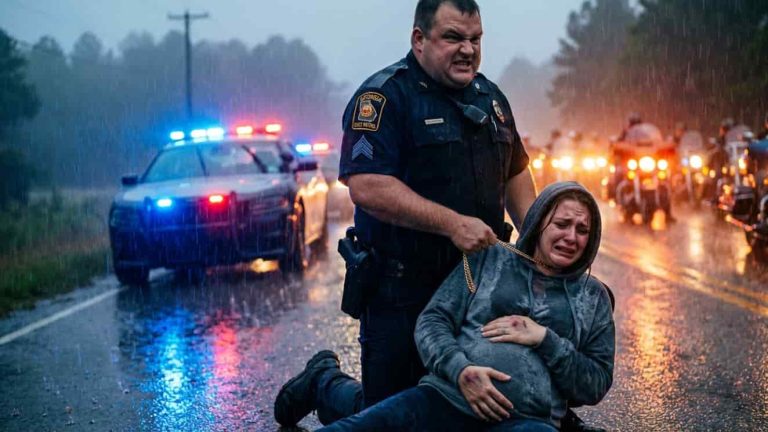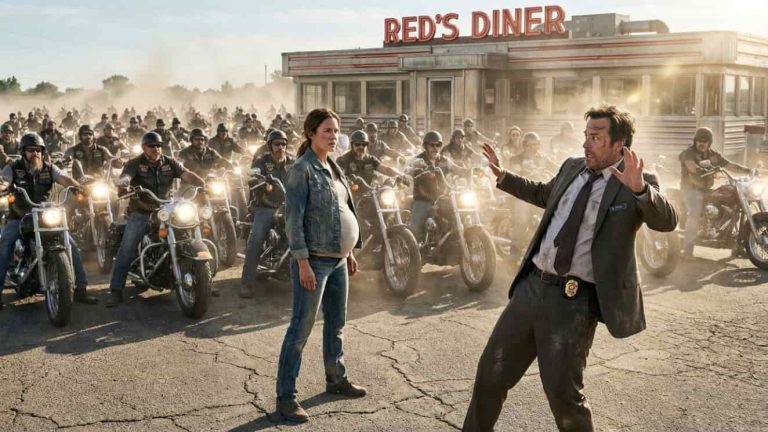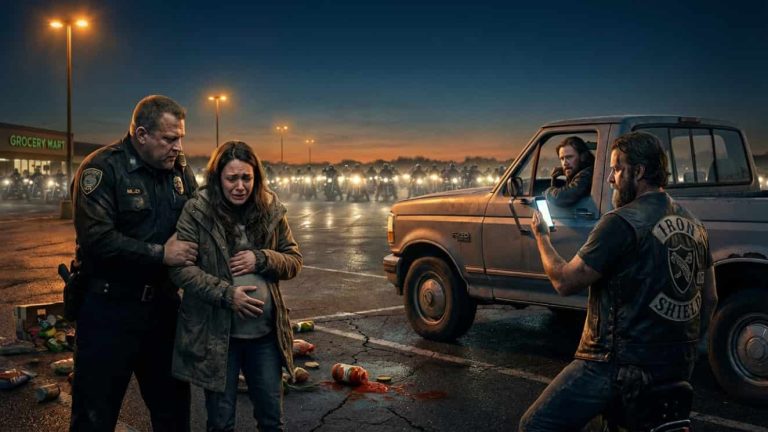
I stood in the shadows of Arthur’s garage, the smell of motor oil and old memories thick in the air. Arthur “Sarge” Miller was a man who had survived the jungles of Nam only to lose his legs to a roadside IED in a war the world forgot. He was the man who pulled me out of a burning Humvee in ’04 when I was just a scared kid from Ohio.
Today, he was just an old man in a wheelchair trying to fix a lawnmower.
And then there was Deputy Vance. A man with a badge that was way too big for his soul.
“I’m not asking again, Arthur,” Vance sneered, his boots clicking on the concrete. “This property is condemned. The Sheriff wants you out by sunset.”
Arthur looked up, his voice steady. “I’ve paid my taxes, Vance. This shop is all I have left. My daughter needs the income.”
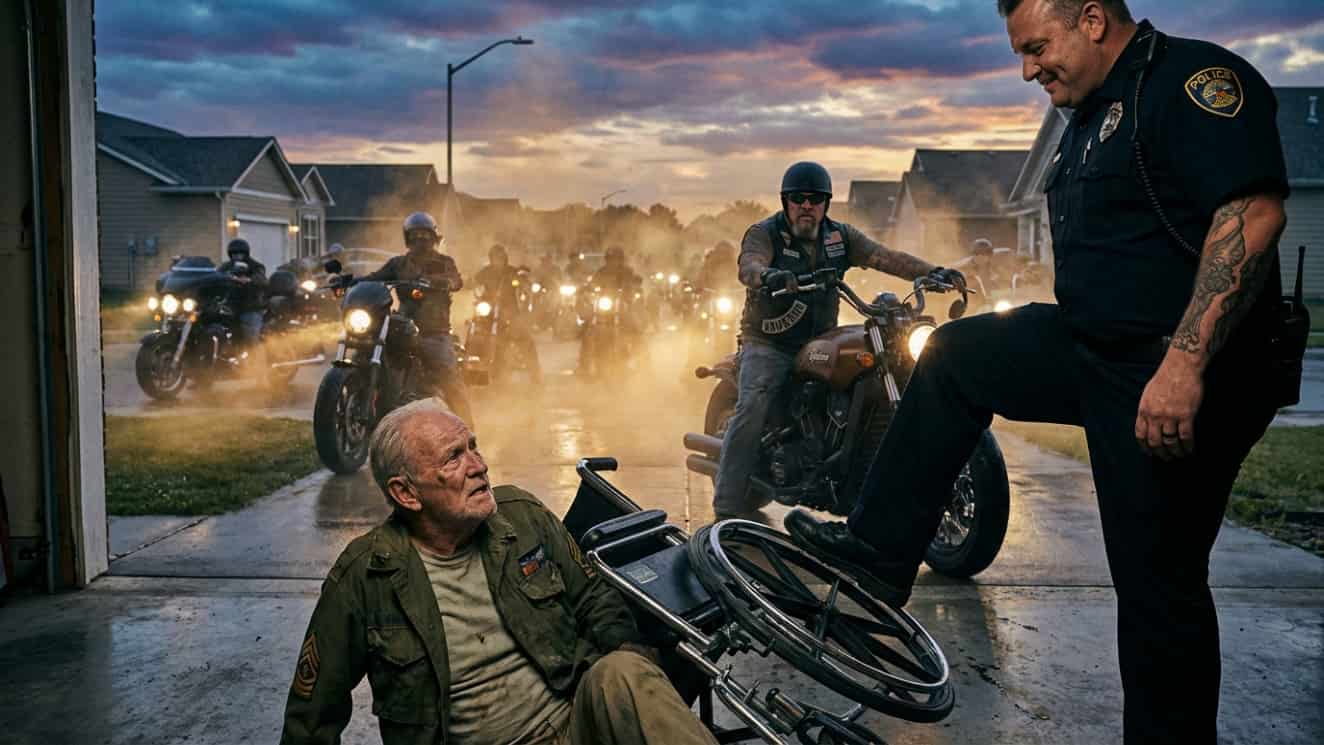
Vance didn’t argue. He didn’t cite a code. He just grinned that crooked, sadistic grin of his and swung his heavy boot. He kicked the chair right from under Sarge.
The sound of Arthur hitting the floor—the dull thud of a hero’s body meeting cold concrete—is a sound I will hear until the day I die.
Vance stood over him, looking down at a man who had sacrificed everything for this country, and he laughed. “Look at you. Not so tough without your wheels, are ya?”
He didn’t see me in the corner. He didn’t see the phone in my hand, recording every second of his cowardice. But more importantly, he didn’t know who I was. He didn’t know about the “”Broken Arrow”” signal I had just sent out to every veteran within three states.
I stepped out of the dark, my heart thumping like a war drum.
“Help him up,” I said. My voice was quiet. The quiet before a hurricane.
Vance spun around, hand on his holster. “Who the hell are you? Get out of here before I lock you up for interfering with police business.”
I looked at Sarge, who was looking at me with those tired, proud eyes. I looked back at the coward with the badge.
“I’m the debt collector,” I told him. “And Arthur just called in his markers. All fifteen hundred of them.”
“FULL STORY
Chapter 1: The Sound of a Falling Hero
The town of Oakhaven looked like a postcard, but it smelled like rot. It was the kind of place where the grass was perfectly manicured, but the hearts of the men in power were overgrown with weeds. I’d come back here for one reason: to say thank you.
Arthur Miller, or “”Sarge”” to anyone who knew his history, was the reason I was breathing. Twenty years ago, under a sky filled with smoke and the screams of dying men, he’d dragged me through two hundred yards of fire. He lost his legs that day. I kept my life.
Standing in his garage, watching Deputy Vance kick the wheelchair away, I felt something in me snap. It wasn’t the kind of snap that makes you scream. It was the kind that makes you go cold. Very, very cold.
Arthur lay on the floor, his breathing ragged. His prosthetic legs were leaning against a workbench a few feet away, mocking him. Vance, a man who looked like he’d never seen a day of real struggle in his life, stood over him with his thumbs tucked into his duty belt.
“”You’re a nuisance, Arthur,”” Vance said, his voice dripping with a fake, honeyed concern that turned my stomach. “”The town council wants this lot for the new shopping center. You’re holding up progress. Now, are you going to leave quietly, or do I have to call the paramedics to haul you out?””
I stepped into the light. My boots crunched on a stray bolt. Vance’s head whipped around. He was maybe thirty-five, with a buzz cut and a face that suggested he’d been the high school bully who never grew up.
“”Who are you?”” Vance demanded.
“”A friend,”” I said. I didn’t move toward him yet. I didn’t have to. I just watched him.
“”This is a closed scene, ‘friend.’ Move along,”” Vance said, his hand drifting toward his Glock. It was a practiced move, meant to intimidate.
I ignored him and knelt beside Arthur. The old man’s face was pale, a thin line of blood trickling from where his temple had clipped the edge of the workbench.
“”You okay, Sarge?”” I whispered.
Arthur gripped my forearm. His hand was like a vice—the strength of a man who had spent decades pulling himself up. “”Elias? That you, son?””
“”It’s me. I’ve got you.””
“”Get out of here,”” Arthur wheezed. “”Vance… he’s got the Sheriff behind him. They’ve been doing this to the whole block. I’m just the last one left.””
I looked up at Vance. He was smirkng now, emboldened by my lack of immediate violence. “”You heard the gimp. Leave. Or you can share a cell with him for the night.””
I stood up slowly. I’m not a small man, and the way I stood—feet shoulder-width apart, hands loose at my sides—usually told people I wasn’t someone to mess with. Vance was too arrogant to read the signs.
“”You have five minutes to apologize to this man and help him back into his chair,”” I said.
Vance laughed. It was a sharp, ugly sound. “”Or what? You gonna call the cops? I am the cops, boy.””
“”No,”” I said, pulling my phone from my pocket. I hit ‘Send’ on a pre-drafted message to a private Discord server and a Signal group. “”I’m calling the family. And unlike you, my family actually knows what ‘honor’ means.””
Vance pulled his baton. “”That’s it. You’re under arrest for obstruction.””
He lunged. I didn’t even have to try. I stepped inside his reach, caught his wrist, and squeezed until the bone groaned. The baton clattered to the floor. I looked him dead in the eye, my face inches from his.
“”Five minutes, Vance. The clock is ticking. And you have no idea how many people are coming to watch it strike midnight.””
Chapter 2: The Rot in Oakhaven
Vance backed away, nursing his wrist, his face a mask of shocked fury. He didn’t pull his gun—not yet. There were too many neighbors peeking through their curtains, too many smartphones glinting in the afternoon sun. He knew the optics of shooting an unarmed man in front of a dozen witnesses would be hard to scrub, even for Sheriff Whitaker.
“”You’re dead,”” Vance hissed, pointing a trembling finger at me. “”You and this old drunk. I’m coming back with the whole department.””
He hopped into his cruiser, tires screaming as he peeled out of the gravel driveway.
I turned back to Arthur and helped him into his chair. He was shaking, not from fear, but from the raw, soul-crushing humiliation of it. For a man like Sarge, who had been a titan in his youth, being treated like trash in his own town was a wound deeper than any shrapnel.
“”You shouldn’t have done that, Elias,”” Arthur said, his voice gravelly. “”Vance is just the dog. Whitaker is the master. They’ve got the judge in their pocket, the mayor… everyone. They’re clearing this land for a developer out of Chicago. Big money.””
“”I don’t care about their money, Sarge. I care about the man who taught me how to find my North Star when I was lost in the desert.””
Just then, a woman ran into the garage. She looked to be in her late thirties, wearing nursing scrubs, her eyes wide with panic. This was Clara, Arthur’s daughter. I remembered her from old photos Arthur used to carry—the little girl with pigtails was now a woman with exhaustion etched into the corners of her eyes.
“”Dad! I saw the cruiser—what happened?”” She stopped short when she saw the bruise on Arthur’s head and then looked at me. “”Who are you?””
“”Elias Thorne, ma’am. I served with your father.””
Her expression softened for a fraction of a second before hardening again. “”If you’re a friend, get him out of here. They’ve been harassing us for months. They cut our water last week. They’re trying to break him.””
“”They won’t,”” I said. I looked at the time. “”In about three hours, this town is going to realize they picked the wrong man to bully.””
“”What did you do?”” Clara asked, her voice trembling.
“”I called Gunny,”” I replied.
Arthur’s eyes widened. “”Gunny Thompson? From the 1st Battalion? Elias, he’s the national president of the Iron Brotherhood now. You didn’t…””
“”I did,”” I said. “”And I called the Legion. And the VFW riders. And every man I know who still wears a ‘Remember the Fallen’ bracelet.””
Outside, the quiet of the suburb felt eerie. But I knew the highway. I knew the rumble that was building miles away. It starts as a hum, a low-frequency vibration that you feel in your teeth before you hear it in your ears.
“”Clara,”” I said, “”Go inside. Pack a bag for your dad, just in case. But stay away from the windows. Things are about to get very loud.””
I walked to the end of the driveway and sat on a stone wall. I pulled out a cigarette, lit it, and waited. I saw Deputy Jackson, a younger kid I’d seen around town, park his cruiser a block away. He didn’t get out. He just watched me. He looked worried. He should have been.
The first bike appeared ten minutes later. A lone scout on a blacked-out Harley. He wore a vest with a patch that said THE IRON BROTHERHOOD. He saw me, nodded, and parked his bike across the entrance to the street, effectively blocking it.
Then came two more. Then a line of trucks.
The storm was moving in.
Chapter 3: The Gathering of Shadows
By 5:00 PM, Oakhaven didn’t look like a postcard anymore. It looked like a staging area.
The “”1,500 brothers”” wasn’t an exaggeration. Word travels fast in the veteran community, especially when a video of a double-amputee hero being kicked out of his wheelchair goes viral on the private networks. I’d uploaded the clip of Vance’s assault, and it had acted like a match in a room full of gasoline.
Gunny Thompson pulled up in a custom Jeep that looked like it belonged in a war zone. He was a mountain of a man with a beard as white as a mountain peak and eyes that had seen the end of the world and decided they weren’t impressed.
He hopped out and hugged me, a brief, crushing embrace. “”Where is he?””
“”Inside,”” I said. “”He’s hurt, Gunny. Not just his head. His spirit.””
Gunny looked at the line of bikes stretching down the block. Men and women of all ages, all branches, were dismounting. Some wore leather vests, some wore old field jackets, others were in suits, having driven straight from their office jobs in the city. There was a grim silence to the gathering. No shouting. No rowdiness. Just the terrifying discipline of people who knew how to take orders and how to hold a line.
“”Establish a perimeter,”” Gunny barked. The Brotherhood moved with surgical precision. Within minutes, Arthur’s house and shop were surrounded by a human wall.
Suddenly, a siren wailed. Three Oakhaven PD cruisers pushed through the crowd, followed by a black SUV. The crowd parted just enough to let them in, then closed behind them like a trap.
Sheriff Whitaker stepped out of the SUV. He was an older man, silver-haired and polished, looking more like a politician than a lawman. Vance was right behind him, looking smug again now that he had backup.
“”What is this?”” Whitaker demanded, looking around at the sea of veterans. “”This is an illegal assembly. You’re blocking a public thoroughfare.””
Gunny stepped forward, looming over the Sheriff. “”We’re just a group of concerned citizens, Sheriff. We heard there was a safety issue in this neighborhood. Specifically, a dangerous animal in a tan uniform who likes to kick heroes.””
Whitaker’s eyes flickered to Vance, then back to Gunny. “”Deputy Vance was performing his duty. This property has been condemned by the city.””
“”Show me the paperwork,”” I said, stepping forward. “”Show me the court-ordered eviction notice signed by a judge. Because Arthur hasn’t seen one. And neither has his lawyer.””
“”Who the hell are you?”” Whitaker asked.
“”The man with the camera,”” I said, holding up my phone. “”That video of your deputy has 1.2 million views as of three minutes ago. The Governor’s office has been tagged. So has the VA. How do you think the evening news is going to handle ‘Sheriff Assaults War Hero for Developer Kickbacks’?””
Whitaker’s face went from pale to a deep, bruised purple. “”You’re threatening me?””
“”No,”” Gunny said, his voice a low growl. “”We’re promising you. You have one hour to bring a written apology, a dismissal of all charges against Arthur Miller, and a guarantee that this shop stays open. Or we stay. And more are coming. There’s a caravan of five hundred more coming in from the coast.””
The tension was a physical weight. I saw Deputy Jackson, the young kid, looking at the veterans. He looked at their patches—Purple Hearts, Silver Stars. He looked at his own badge, then back at the men. He slowly stepped back and leaned against his car, folding his arms. He wasn’t going to draw his weapon for Whitaker.
The Sheriff saw it. He saw the rot in his own ranks beginning to show.
“”This isn’t over,”” Whitaker spat. He turned and marched back to his SUV.
“”You’re right,”” I called out. “”It’s just beginning.””
Chapter 4: The Night of the Long Shadows
The sun dipped below the horizon, casting long, orange shadows across the street. The veterans didn’t leave. They set up small campfires in portable pits. They shared coffee. They told stories. To the residents of Oakhaven, it must have looked like an occupying army had moved in. To Arthur, looking out from his porch, it looked like a miracle.
Clara came out with a tray of coffee. Her eyes were wet as she looked at the men guarding her father’s home. “”I didn’t think anyone cared anymore,”” she whispered to me. “”We’ve been fighting this alone for two years.””
“”You were never alone,”” I told her. “”We just didn’t know where the front line was.””
But the night wasn’t destined to be peaceful.
Around midnight, a group of blacked-out SUVs pulled up at the far end of the street. These weren’t cops. These were ‘security contractors’—hired muscle for the development company. They were carrying zip-ties and batons, looking to do the dirty work the Sheriff couldn’t do on camera.
They stepped out, about twenty of them, led by a man with a jagged scar across his chin. He looked like he’d spent time in the same places we had, but for the wrong reasons.
“”Clear the way,”” the leader shouted. “”We have a work order for this site. Move, or we’ll move you.””
Gunny didn’t even stand up from his folding chair. He just whistled.
From the shadows of the garages and the spaces between the parked bikes, hundreds of men stood up. The sound of boots hitting the pavement was like a synchronized heartbeat. They didn’t pull weapons. They didn’t have to. They just formed a wall ten deep.
The contractors stopped. The leader looked at the sheer mass of humanity in front of him. He looked at the discipline in their eyes. These weren’t protestors. These were warriors.
“”You really want to do this?”” Gunny asked quietly. “”For a paycheck? These men here? They do it for the man standing next to them. You don’t have enough money in the world to win that fight.””
The leader of the contractors looked at his men. They were already backing toward the SUVs. They knew a losing battle when they saw one. Without a word, they piled back into their vehicles and sped off into the night.
I looked over at Deputy Jackson’s cruiser. He had his window down, listening. He caught my eye and gave a sharp, subtle nod. He was done being a spectator.
Twenty minutes later, my phone buzzed. It was an anonymous tip. An encrypted file containing the Sheriff’s emails with the development company, detailing the offshore accounts where the “”incentive”” payments were being held.
The storm was no longer just outside. It was inside the system.”