Chapter 1
The gravel bit into my palms, a familiar sting that pulled me back to the dry dirt of Kandahar. But this wasn’t a battlefield in a foreign land. This was the driveway of the house I’d spent fifteen years paying for.
“”Stay down, Jax,”” Bradley sneered, his polished Italian loafers inches from my face. “”You’re a washed-up loser. A ghost. You don’t belong in this neighborhood anymore. Look at you—you’re scaring the kids.””
I didn’t look at him. I looked at Leo and Mia. They were huddled under the old oak tree, the one where I’d built them a swing before my final deployment. Leo, only eight, had his arms wrapped tight around six-year-old Mia. Their eyes were wide, glassy with a kind of terror no child should ever know.
I could have ended him. In three seconds, I could have snapped Bradley’s wrist and had him tasting the dirt he’d just pushed me into. The training was still there, buzzing under my skin like a live wire. But if I fought back, if I became the monster they wanted me to be, the state would take my kids. Elena, my ex-wife, stood in the doorway, her arms crossed, watching with a cold, detached curiosity.
“”Just go, Jackson,”” she called out, her voice devoid of the warmth that used to tuck me in at night. “”Bradley is right. You’re not well. You’re making a scene.””
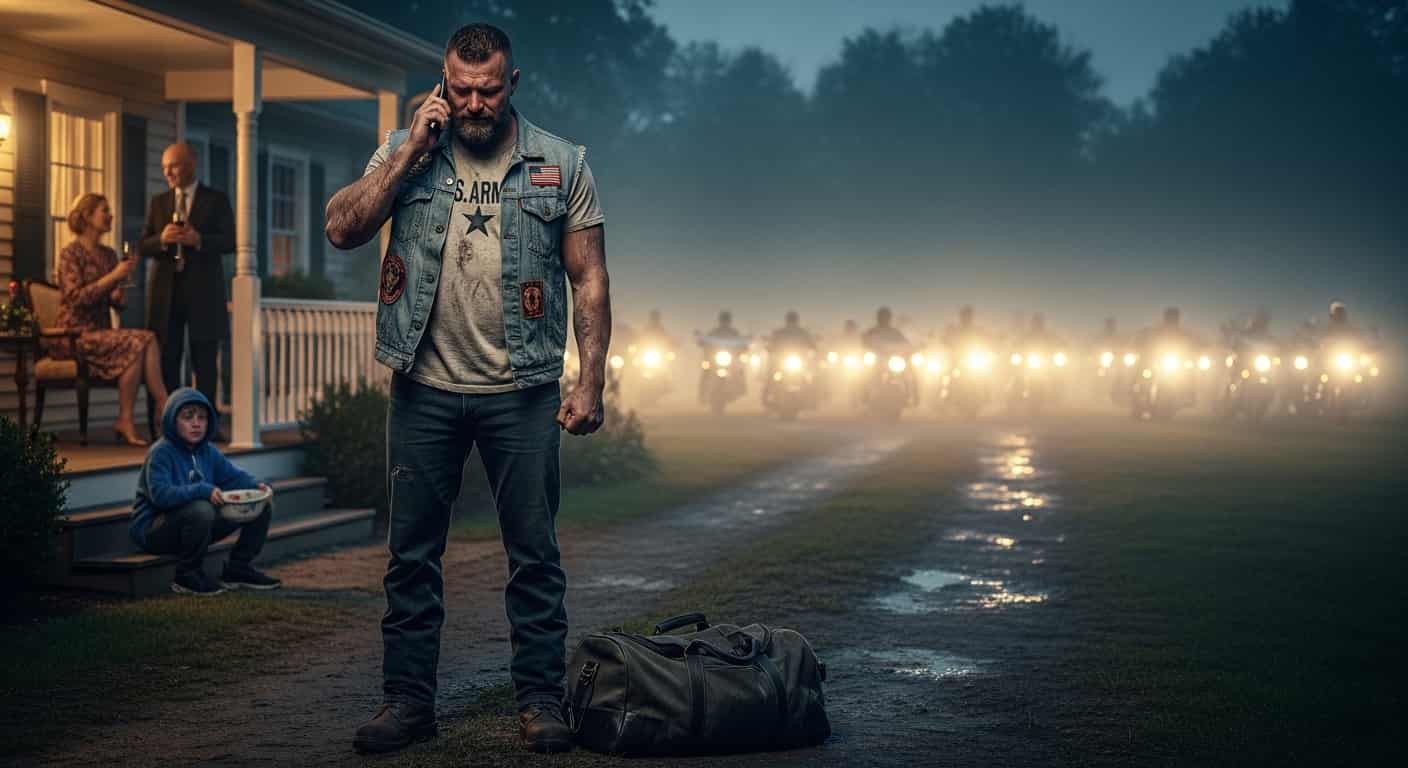
A scene. That’s what my life was to her now. A messy scene in her perfectly curated suburban life. I reached out for my duffel bag, the one Bradley had just thrown into the mud. My fingers brushed the “”U.S. Army”” patch on the side.
“”I’m leaving,”” I said, my voice raspy. I looked at my children. “”Daddy’s okay. I’ll see you soon, okay? I promise.””
“”He’s not going anywhere with you!”” Bradley laughed, a sharp, ugly sound. He kicked the bag further into the street. “”Go find a bridge to live under, hero.””
I stood up slowly, every joint in my body screaming. I didn’t swing. I didn’t yell. I just picked up my bag, walked to my old, battered truck, and drove away.
But as I pulled out of the cul-de-sac, I saw the neighbors watching from behind their curtains. I saw the judgment. And I felt the hole in my chest where my pride used to be.
I pulled over two blocks away, my hands shaking on the steering wheel. I reached into the glove box and pulled out a burner phone I hadn’t touched in three years. There was only one number in the contacts.
I hit dial.
“”Sarge?”” I said when the line picked up.
“”Jax? That you, kid?”” The voice on the other end was deep, like grinding stones.
“”They took the house, Sarge. They took the kids. He called me a loser in front of them. He pushed me… and I stayed down.””
There was a long silence on the other end. Then, the sound of a heavy engine turning over.
“”Where are you, son?””
“”Home. Or what’s left of it.””
“”Stay put,”” Sarge said. “”The brotherhood doesn’t leave a man in the dirt. I’m calling the Iron Remnant. We’re coming to start a fire.””
I looked in the rearview mirror at my bruised face. For the first time in years, the “”ghost”” felt a heartbeat.
“FULL STORY
Chapter 2
The Motel 6 on the edge of town smelled like stale cigarettes and broken dreams. I sat on the edge of the bed, the springs groaning under my weight. My head was in my hands, the silence of the room louder than any explosion I’d ever heard.
When you come home from a war, they give you a medal and a handshake. They don’t tell you that the real war starts when you try to figure out which cereal to buy at the grocery store while your brain is still scanning for IEDs in the produce aisle. Elena had tried, for a while. But a “”war hero”” is only romantic until he wakes up screaming at 3:00 AM, or until he loses his job at the plant because he can’t handle the sound of the pneumatic presses.
Then came Bradley. Bradley was everything I wasn’t. He was “”stable.”” He was “”successful.”” He didn’t have nightmares. He had a hedge fund and a collection of watches that cost more than my truck.
A knock at the door startled me. I was on my feet in a second, my back to the wall, heart hammering against my ribs.
“”Jax? It’s Miller.””
I exhaled, the tension leaving my body in a shaky rush. I opened the door to find Sarah Miller, my sister-in-law from my brother who didn’t make it back. She was holding a bag of takeout and a look of deep concern.
“”I heard what happened,”” she said, pushing past me into the room. “”The neighborhood grapevine is faster than a radio dispatch.””
“”I look that bad, huh?”” I sat back down, feeling the weight of the day again.
“”You look like a man who’s letting a coward win,”” Sarah said firmly. She set the food on the small table. “”I saw Leo and Mia an hour ago. Bradley was making them help him wash his car. Leo looked like he wanted to disappear into the pavement.””
My jaw tightened. “”I can’t fight him, Sarah. If I touch him, I go to jail. If I go to jail, I lose the kids forever. He knows that. He’s playing me.””
“”Then don’t fight him,”” she said, her eyes softening. “”But don’t hide, either. You’re Jackson Miller. You’re a Ranger. You’ve faced worse things than a guy in a suit with a spray tan.””
I looked at the burner phone on the nightstand. “”I called Sarge.””
Sarah went still. Sarge—Marcus Thorne—was a legend. He was the man who had pulled me out of a burning Humvee in the Korengal Valley. After the service, he’d started The Iron Remnant, a motorcycle club made up entirely of combat veterans. They weren’t an outlaw gang, but they weren’t a Sunday riding club, either. They were a family of men who had seen the bottom of the world and decided to climb back up together.
“”What did he say?”” she whispered.
“”He said they’re coming.””
As if on cue, a low vibration began to rattle the windowpane of the motel room. It started as a hum, then grew into a rhythmic thrumming that I felt in my teeth. It was the sound of heavy-duty V-twin engines. Dozens of them.
I walked to the window and pulled back the grimy curtain.
Two dozen motorcycles were pulling into the motel parking lot, their headlights cutting through the dusk like searchlights. In the lead was a massive black Harley-Davidson. The man riding it was built like a mountain, wearing a leather vest with a “”President”” patch over his heart.
Sarge didn’t wait for me to come out. He kicked his kickstand down, dismounted with a grunt, and looked straight up at my window. He didn’t wave. He just tapped his chest twice.
I see you. I’m here.
I looked at Sarah. “”I think the neighborhood is about to get a lot more interesting.””
FULL STORY
Chapter 3
By the next morning, the Motel 6 parking lot looked like a staging area for an invasion. But it wasn’t just the two dozen men who had arrived with Sarge. As the sun crested the horizon, more bikes began to trickle in. They came from Indiana, from Kentucky, from as far as Pennsylvania.
Men in leather, men in denim, men with graying beards and prosthetic limbs. Every one of them had a story. Every one of them was a brother.
Sarge was sitting on a plastic chair outside my room, drinking black coffee from a foam cup. “”We’ve been doing some digging, Jax,”” he said, handing me a file folder.
“”Digging into what?””
“”Bradley Vance,”” Sarge said, his voice a low growl. “”You thought he was just a guy who moved in on your wife. But guys like him, they have patterns. He’s not a hedge fund manager, Jax. He’s a liquidator. He buys up veteran-owned businesses that are struggling, strips them for parts, and pockets the pension funds.””
I opened the file. My blood turned to ice. There were photos of a local community center for veterans that had been shut down six months ago. Bradley’s signature was all over the foreclosure documents.
“”He’s been using his position on the town council to hike up property taxes on the ‘older’ parts of the suburb,”” Sarge continued. “”Your neighborhood. He’s been pushing out guys like you to make room for high-end condos. He didn’t just want your wife, kid. He wanted your land, and he wanted to break you so you wouldn’t fight the zoning board.””
I felt a surge of nausea. The humiliation on the porch hadn’t been an outburst of passion. It had been a tactical maneuver. He wanted a police report. He wanted me to swing so he could file a restraining order and clear the last obstacle to his project.
“”He’s skimming from the Veteran’s Relief Fund, too,”” a voice said. I looked up to see ‘Stitch,’ our old medic, leaning against a bike. “”We’ve got a brother in the bank who saw the transfers. Bradley’s been using the money to pay for that fancy SUV and the renovations on your house.””
“”So what do we do?”” I asked, the file shaking in my hand. “”We take this to the Sheriff?””
Sarge spat on the asphalt. “”Sheriff Miller? He’s in Bradley’s pocket. They play golf every Tuesday. No, Jax. We aren’t going to the law. We’re going to the court of public opinion. And we’re going to do it with 1,500 witnesses.””
“”1,500?”” I asked, stunned.
Sarge checked his watch. “”The word is out on the veteran networks. Every chapter of the Remnant, the VFW, and the Legion within five hundred miles is wheels up. They heard one of our own was pushed into the dirt in front of his kids.””
He stood up, his massive frame blotting out the sun. “”Today, we remind this town that some things aren’t for sale. And some men… you just don’t push.””
“”I need to see my kids,”” I said, a new kind of resolve hardening in my gut.
“”Oh, you’ll see them,”” Sarge smiled, a grim, toothy expression. “”We’re all going to see them.””
FULL STORY
Chapter 4
The atmosphere in the “”Oak Ridge Estates”” was usually quiet, punctuated only by the sound of electric lawnmowers and the occasional barking of a golden retriever. But at 2:00 PM on a Saturday, the air changed.
The silence was replaced by a low-frequency vibration that made the windows of the million-dollar homes rattle in their frames.
I was in the passenger seat of Sarge’s sidecar, my heart hammering. Behind us, the road was a river of black leather and gleaming chrome. We weren’t riding fast. We were riding in a tight, disciplined formation—four bikes abreast, stretching back as far as the eye could see.
As we turned into the entrance of my old neighborhood, the neighbors came out. They didn’t come out with cameras this time; they came out with looks of sheer awe and terror.
We pulled into the cul-de-sac. Bradley’s SUV was parked in the driveway, looking small and fragile against the sudden wall of motorcycles.
Sarge signaled, and 1,500 engines died at the exact same moment. The silence that followed was deafening.
I stepped out of the sidecar. I was wearing my old flight jacket, my boots polished, my head held high. Sarge and ten other officers of the Remnant walked behind me. We didn’t look like a gang. We looked like a formation.
Bradley came out onto the porch, his face a mask of indignation that quickly crumbled into fear. Elena was behind him, clutching a wine glass so hard I thought it would shatter.
“”What is this?”” Bradley shouted, his voice cracking. “”This is private property! I’m calling the police!””
“”Already called ’em, Bradley,”” Sarge yelled back, his voice booming through the neighborhood. “”In fact, we called the State Troopers and the FBI’s financial crimes division, too. They’re about ten minutes behind us. Something about a missing four million dollars from the Veteran’s Relief Fund?””
Bradley’s face went from pale to ghostly white. He looked at the sea of bikers. These weren’t “”washed-up losers.”” These were the men who built the world he lived in.
“”Jax,”” Elena stammered, stepping forward. “”What are you doing? You’re scaring the children.””
“”No, Elena,”” I said, my voice calm and cold. “”You were scaring them. By showing them that their father can be bullied. By showing them that money matters more than loyalty.””
Suddenly, the front door flew open. Leo and Mia didn’t look scared. They looked at the bikes, then at me, and then at the giant of a man standing next to me.
“”Dad!”” Leo yelled, breaking away from Elena’s grasp.
He ran down the steps. Bradley tried to reach for his arm to stop him, but Sarge moved with a speed that defied his size. He didn’t hit Bradley. He just stepped into his path.
“”Don’t,”” Sarge said. It was a single word, but it carried the weight of thirty years of war.
Bradley froze. His hand stayed in the air, trembling.
I caught Leo in my arms, swinging him up. Mia followed, burying her face in my neck.
“”Are all these people your friends, Daddy?”” Mia whispered.
I looked at Sarge. I looked at the 1,500 men standing at attention on their bikes, every one of them watching my children with a look of fierce protection.
“”No, honey,”” I said, loud enough for the whole neighborhood to hear. “”They’re not friends. They’re family.”””