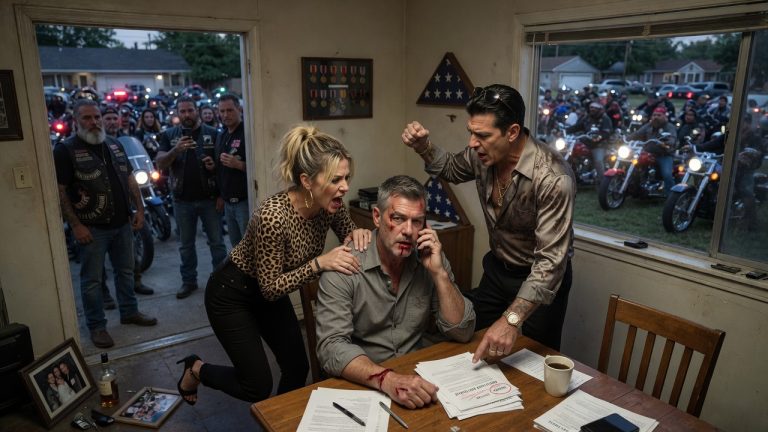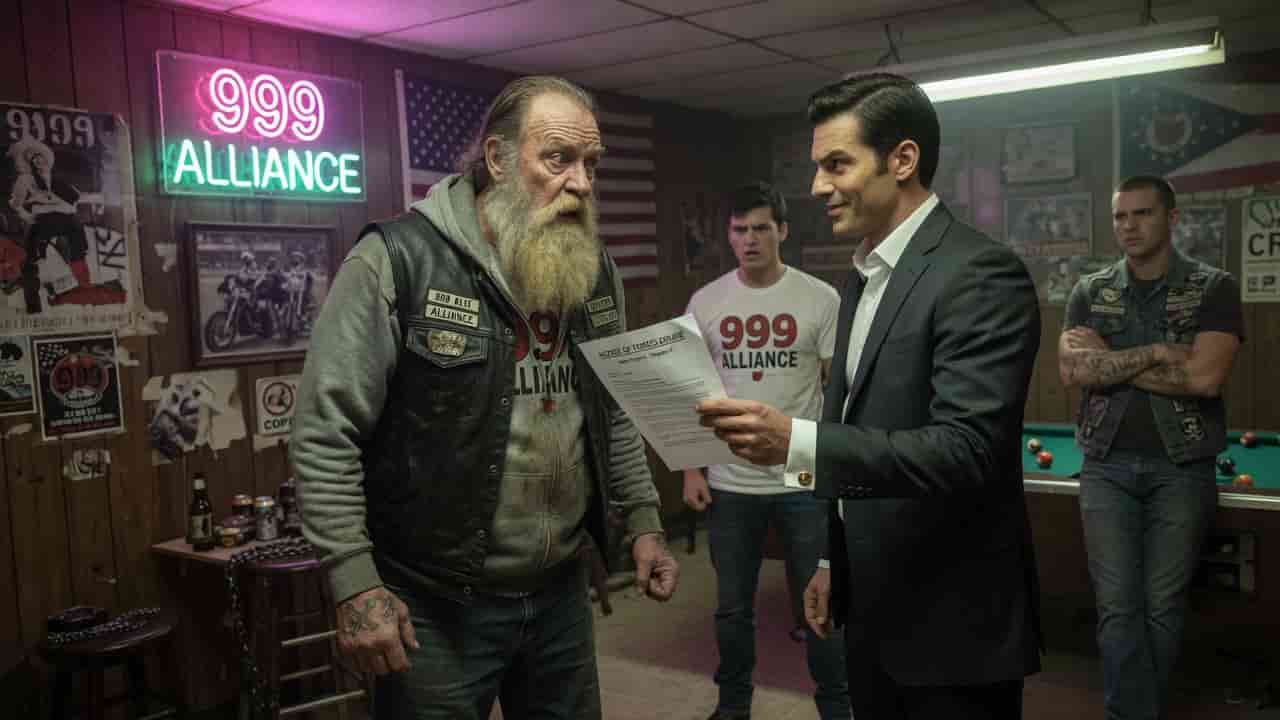
“Look at the signature, Arthur. Did you forget your own name, or just the part where you sold the roof over your brothers’ heads?”
The room went so quiet you could hear the neon sign humming against the wall. Julian Vane didn’t just want the land; he wanted to watch the toughest man in the county realize he’d become his own worst enemy. He shoved the paper against Hoss’s chest, mocking the tremor in the old man’s hands, while the rest of the 999 Alliance watched their leader struggle to find words that weren’t there anymore.
Hoss stood there, a giant made of rusted iron, staring at his own handwriting on a document that signed away forty years of history. He didn’t remember the meeting. He didn’t remember the coffee or the handshake. All he saw was the blue ink and the smirk on the face of a man half his age who was currently stripping him of his dignity in front of his own grandson.
When Leo finally lunged forward to stop the humiliation, the damage was already done. The secret Hoss had been burying in a pill bottle was out in the open, and the “Rusted Crown” he wore was about to be snatched away by the very people he thought he was protecting.
Chapter 1
The knuckles on Arthur “Hoss” Miller’s right hand were the color of a bruised plum, swollen and stiff from sixty years of gripping chrome and throwing the occasional punch that shouldn’t have been thrown. He sat at the scarred oak desk in the back office of the Iron Horse, watching his fingers. They were doing that thing again—a fine, rhythmic twitch that felt like a low-voltage wire was live under his skin. He tucked the hand into the pocket of his leather vest, squeezing his thigh until the muscle hurt.
Outside the office door, the 999 Biker Alliance was waking up. It was Tuesday, 10:00 AM, the hour when the air smelled like industrial floor cleaner and the previous night’s stale cigarette smoke. The Iron Horse wasn’t just a bar; it was the lungs of the club. If the bar stopped breathing, the Alliance died. Hoss had built this place in 1986, back when Youngstown was still a city that made things instead of a graveyard for things that used to be made.
A heavy rap on the door frame made Hoss stiffen. He didn’t look up immediately. He needed a second to make sure his face was set right—the “Old Hoss” face. The one that looked like it was carved out of an Appalachian ridge.
“Door’s open,” Hoss said. His voice was a low rumble, the sound of gravel in a drum.
Jax stepped in. He was thirty, lean, and carried himself with the kind of twitchy energy that made Hoss feel every one of his seventy years. Jax was the Vice President, a man who viewed loyalty as a currency to be traded rather than a bedrock to stand on. He was wearing his denim kutte, the patches clean and sharp. Too clean, Hoss often thought.
“Power’s flickering in the north bay again, Hoss,” Jax said, leaning against the doorframe. He didn’t come in and sit. He never did. He always looked like he was halfway to somewhere else. “Sarge says the wiring’s shot. We need to get a pro in here, not just have Flash patch it with electrical tape.”
Hoss nodded slowly, his mind reaching for the name of the electrician they’d used last summer. It was… it was Mike. No, Mark. Mark with the limp. He could see the man’s face clearly—the grease-stained cap, the way he smelled like menthol—but the name was sliding away, like a wet bar of soap.
“Call… call the guy,” Hoss said, his pulse accelerating. “The one from down on 5th. With the white van.”
Jax squinted. “You mean Miller Electric? They went bust two years ago, Hoss. We’ve been using Thompson’s kid.”
Hoss felt a cold prickle of sweat at the base of his hairline. “Right. Thompson. That’s what I meant. My head’s in the books, Jax. These property taxes are a bitch this year.”
Jax lingered, his eyes roaming over the stacks of paper on Hoss’s desk. “You’ve been in here a lot lately. Everything okay with the books? You know I can help with the digital side of things. Most of this stuff should be on a cloud, not in manila folders.”
“I like paper,” Hoss snapped, a bit too sharp. “Paper doesn’t disappear when the Wi-Fi goes out. I’ve handled the Alliance’s business since before you were in diapers. I think I can manage a few folders.”
Jax held up his hands in a mock gesture of surrender. “Easy, Hoss. Just offering. By the way, that developer guy called again. Vane. He says he still hasn’t heard back from you about the ‘finalizing’ of that easement agreement.”
Hoss frowned. Vane. The name tasted like copper. He remembered a meeting. A sleek office in Cleveland. Glass walls that made him feel like he was standing on air. He remembered Vane—a man who looked like he’d been manufactured in a lab to sell overpriced condos.
“I’ll get to him,” Hoss said.
“He sounded pretty insistent. Said something about a deadline.”
“I said I’ll get to him, Jax.”
Jax shrugged and pushed off the doorframe. “Whatever you say, Boss. Oh, Leo’s out front. He’s trying to fix the sink in the men’s room. You might want to tell him to stop before he floods the place. The kid’s got heart, but he’s got your luck with plumbing.”
When Jax left, the silence in the office felt heavy, pressing against Hoss’s eardrums. He reached into the small, hidden drawer at the bottom of his desk and pulled out a crumpled pack of Marlboros. Inside, tucked behind the cigarettes, was a small plastic vial with a white label. No name on the label. Just “Doc’s Vitamin” written in his own shaky hand.
He took one of the small white pills, swallowing it dry. He hated the way they made his brain feel—like it was wrapped in wool—but he hated the “slips” more. The slips were getting worse. A name here. A date there. The terrifying five minutes last Thursday when he’d been driving his Harley and forgot, for one heart-stopping moment, which way was home.
He stood up, his knees popping like small-caliber gunfire. He needed to see Leo. Leo was his grandson, the only thing Hoss had left of his daughter, Sarah. Sarah had died ten years ago, leaving Leo in the care of a man who knew more about carburetors than bedtimes. Leo was nineteen now, a “prospect” for the Alliance, though Hoss secretly wished the boy had more ambition than wearing a patch and smelling like motor oil.
Hoss walked out into the bar. The Iron Horse was a sprawling, dark cave. The walls were covered in photos of brothers who were either in the ground or in the state pen. In the corner, by the jukebox, Leo was hunched under the sink, his legs sticking out like a pair of discarded stilts.
“You’re gonna need a pipe wrench, not a screwdriver, kid,” Hoss said, standing over him.
Leo scooted out, his face smeared with rust-colored water. He grinned, and for a second, Hoss saw Sarah’s eyes. It was a physical ache in his chest.
“I almost got it, Grandpa,” Leo said. He still called him Grandpa inside the club, despite the rules. Hoss never corrected him. “Just a loose gasket.”
“Get the wrench from the garage,” Hoss said, his voice softening. “And don’t tell the guys I let you do it. They’ll think I’m going soft on my prospects.”
Leo stood up, wiping his hands on a rag. “You’re never soft, Hoss. Everyone knows that. Even Vane.”
Hoss felt the name hit him again. “What do you know about Vane, Leo?”
Leo’s smile faltered. “Nothing much. Just… I saw him at the gate yesterday. He asked if I was your grandson. He said you were a ‘pragmatic man.’ I told him you were the most stubborn man in Ohio.”
Hoss forced a laugh, but his stomach was in knots. Pragmatic. It was a word a man used when he thought he’d bought someone.
“Stay away from him, Leo,” Hoss said. “Men like that… they don’t see people. They see square footage.”
“I know, Hoss. Don’t worry about me.”
Hoss watched him walk away toward the garage. He wanted to call him back. He wanted to tell him everything—about the pills, about the fog in his head, about the fear that was rotting him from the inside out. But he couldn’t. The 999 Alliance was built on strength. If the leader was broken, the pack would tear itself apart.
He walked back to his office, his gait steady despite the tremor in his pocketed hand. He sat down and pulled the Vane folder toward him. Inside were maps of the neighborhood. The Alliance owned three blocks—the bar, the garage, and an old warehouse they used for storage. It was prime real estate now that the city was trying to “revitalize” the riverfront.
He flipped through the pages. His eyes landed on a document near the back. It was a “Memorandum of Understanding.” At the bottom, there was a signature line.
Arthur Miller.
It looked like his handwriting. The “A” had that specific loop he’d used since high school. But he didn’t remember signing it. He searched his mind, clawing through the woolly layers. He remembered a dinner. Steak. Red wine. Vane talking about “synergy” and “preserving the culture.” He remembered feeling tired. So very tired.
He looked at the date on the document. March 12th.
March 12th was the day of the spring run. He’d been out on the road all day. He hadn’t been in Cleveland. He hadn’t been at dinner.
Then how is my name on this?
He closed the folder, his heart hammering against his ribs. He needed to talk to Doc. Doc was the only one who knew about the Alzheimer’s. Doc was a former combat medic who’d been patched into the Alliance in the seventies. He was the only man Hoss trusted with his life, and more importantly, with his secret.
Hoss stood up to leave, but as he reached for the door, he stopped. He looked at the wall where a framed photo of the original “Founding Five” hung. They were young, wild, and indestructible. He was the only one left.
“I’m still here,” he whispered to the empty room.
But as he stepped out into the hallway, he realized he didn’t remember where he’d put his keys. He stood there for three minutes, the light of the hallway feeling too bright, the sounds of the bar sounding like they were coming from underwater.
Then, he felt the keys in his left hand. He’d been holding them the whole time.
He let out a shaky breath and walked toward the exit. He had to keep moving. If he stopped, the fog would swallow him whole. And if the fog swallowed him, Julian Vane would be waiting there with a pen and a smile to take everything that was left.
Chapter 2
The Iron Horse was packed on Friday night. The air was a thick soup of diesel fumes, cheap beer, and the heavy, sweet scent of barbecue from the pit out back. This was the Alliance’s church, and Friday was the high mass. The pool table was a battlefield, and the jukebox was screaming out a classic rock anthem that everyone knew by heart but no one actually listened to.
Hoss sat in his usual booth at the far end of the bar, the shadows hugging him. He had a glass of ginger ale in front of him—he hadn’t touched alcohol in months, ever since the doctor told him it was like pouring gasoline on the fire in his brain. Most of the brothers thought he was just being disciplined. Only Doc, sitting across from him, knew the truth.
Doc was a man who looked like he’d been dried out in the sun. His skin was like parchment, and his eyes were perpetually narrowed as if he were trying to see something a mile away.
“You’re staring again, Arthur,” Doc said quietly, his voice cutting through the noise.
Hoss blinked. He’d been looking at the neon sign over the bar, mesmerized by the way the ‘9’ flickered every seven seconds. “Just thinking, Doc.”
“Thinking is dangerous for you right now. You need to be doing. Or resting.” Doc leaned in, his voice dropping an octave. “Did you take the new script? The ones I got from the clinic in Columbus?”
“Yeah,” Hoss lied. He’d stayed away from the new ones. The last batch had made him hallucinate that Sarah was standing in the kitchen of the clubhouse, making coffee. It had taken him an hour to stop shaking. “I’m fine. I just… I saw a signature, Doc. On a Vane document. It looked like mine, but I don’t remember being there.”
Doc’s face went grim. “Loss of time. It’s a stage, Hoss. We talked about this. You might be having fugue states. Moments where you’re ‘there’ but the recording light isn’t on. You could have met with him and simply not filed the memory.”
“I wouldn’t sign that property over,” Hoss hissed, leaning over the table. “Not even in a fog. That land is the club’s blood. If I sold that, I’m a traitor.”
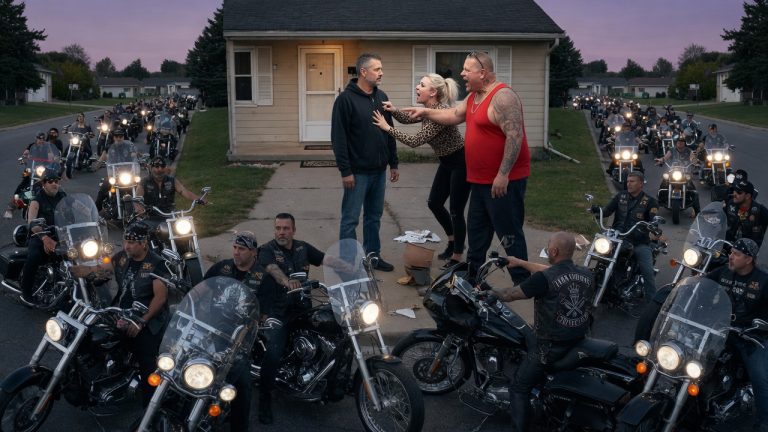
Before Doc could answer, the heavy front doors of the Iron Horse swung open. The sound was like a thunderclap. The room didn’t go silent—it was too loud for that—but the energy shifted. It was like a predator had stepped into a room full of scavengers.
Julian Vane walked in. He was wearing a grey overcoat that probably cost more than the Harley parked outside. Behind him were two men who looked like they’d been recruited from a private security firm—thick necks, earpieces, and eyes that didn’t move.
Vane didn’t look around. He walked straight toward Hoss’s booth. Every biker in the room stopped what they were doing. Jax, who had been leaning against the bar talking to a girl, stood up straight, his hand drifting toward the knife on his belt.
“Arthur,” Vane said, reaching the booth. He didn’t wait for an invitation. He sat down next to Doc, forcing the older man to slide over. “I told you I’d be in the neighborhood.”
Hoss didn’t move. He kept his hands under the table. “You’re a long way from the Heights, Vane. This isn’t a place for suits.”
Vane smiled, and it was a cold, sharp thing. “Actually, as of forty-eight hours ago, this is exactly the place for a man in my position. I like the ‘industrial chic’ vibe you’ve got going here. Though the smell of grease is a bit overwhelming. We’ll have to fix that when we break ground.”
The room actually did go silent then. Sarge, a man the size of a refrigerator, stepped forward from the pool table. “What the hell are you talking about, Suit?”
Vane ignored him. He reached into the inner pocket of his overcoat and pulled out a white legal envelope. He tapped it against the scarred wood of the table.
“I tried to do this quietly, Arthur. I really did. I sent the emails. I made the calls. But I suppose when the brain starts to go, the administrative tasks are the first to fall by the wayside.”
Hoss felt a surge of pure, hot adrenaline. It was the only thing that could burn through the fog. “Get out of my club.”
“That’s the thing,” Vane said, his voice rising so it carried across the bar. “It’s not your club anymore. It’s not the 999 Alliance’s headquarters. It’s the future site of the Vane Riverfront Commons.”
He opened the envelope and pulled out the deed. He flattened it on the table and slid it toward Hoss.
“Look at the signature, Arthur. Right there. March 12th. Witnessed and notarized.”
Hoss stared at it. The blue ink. The loop of the ‘A’. It was his. He felt a wave of nausea. March 12th. The spring run. He remembered the wind in his face. He remembered the smell of the highway. He didn’t remember a notary. He didn’t remember Vane.
“This is a fake,” Jax said, stepping up to the table. He snatched the paper up. “Hoss wouldn’t sign this. He’s the one who taught us that land is the only thing they can’t take if you don’t let them.”
Jax looked at the signature, then at Hoss. His expression shifted from defiance to something else. Something colder. “Hoss… this looks like your hand.”
“It’s a lie,” Hoss said, but his voice lacked the thunder it usually carried. He looked around the room. Fifty men were watching him. His brothers. The men who looked to him for everything. “I didn’t sign it.”
Vane laughed. It was a sharp, barking sound. He stood up and took the paper back from Jax. He turned to face the room, holding the deed up like a trophy.
“Arthur Miller is a legend, isn’t he? The great ‘Old Hoss.’ But look at him.” Vane pointed a finger at Hoss. “Look at the way his hands are shaking. Look at the way he’s looking at me right now—like he’s trying to remember who I am.”
“Shut up,” Leo shouted, pushing through the crowd. He stood between Vane and the booth. “You get out of here right now before we throw you out.”
Vane didn’t back down. He stepped right into Leo’s space. “You’re the grandson, right? The one he’s trying to leave a legacy for? Well, your grandfather’s legacy is a pile of debt and a brain that’s turning into mush. He signed this deed in my office in exchange for a ‘consultation fee’ that I suspect went straight into his private medical bills. Isn’t that right, Arthur? Tell them about the pills. Tell them about the doctor in Columbus.”
Hoss felt the world tilting. The shame was a physical weight, pressing him down into the booth. He looked at Leo. The boy was looking back at him, his face filled with a desperate hope that Hoss would stand up and crush this man.
Instead, Hoss stayed seated.
“Did you forget your own name, Arthur?” Vane sneered. He took the deed and slapped it against Hoss’s chest. The sound of the paper hitting the leather was like a gunshot in the silent bar. “Or did you just forget the part where you sold the roof over your brothers’ heads so you could die in a nicer bed?”
Hoss’s hand came out of his pocket. It was trembling violently. He tried to grab Vane’s throat, but his movements were slow, sluggish. Vane easily stepped back, his smirk widening.
“Twenty-four hours,” Vane said, his voice cold and final. “I have the sheriff’s department on standby. By tomorrow night, the 999 Alliance is officially evicted. If you’re still here, you’re trespassing on private property. I suggest you start packing your trophies. Most of them look like junk anyway.”
Vane turned and walked toward the door. His security team followed, their eyes never leaving the bikers.
As the door swung shut, the silence in the Iron Horse didn’t break. It curdled.
Hoss looked down at the paper in his lap. He looked at the signature. He looked at his hands.
“Hoss?” Jax asked. His voice was different now. There was no loyalty in it. There was only the smell of a carcass. “Tell us he’s lying. Tell us you didn’t sell the Horse.”
Hoss looked up. He saw the faces of his brothers. He saw Sarge’s disappointment. He saw Jax’s ambition. And he saw Leo’s heartbreak.
He tried to speak. He wanted to tell them it was a trick. He wanted to tell them he was being framed. But the fog was thick now, white and cold, and for a terrifying second, he couldn’t remember the name of the bar he was sitting in.
He stood up, his legs shaking. He didn’t say a word. He walked through the crowd, his head down, and disappeared into the back office.
Behind him, the shouting began.
Chapter 3
The back office of the Iron Horse felt like a tomb. Hoss sat in the dark, the only light coming from the orange glow of his cigarette. He hadn’t turned on the lamp. He didn’t want to see the folders. He didn’t want to see the wall of photos. Most of all, he didn’t want to see the man he’d become.
A soft knock came at the door. Not Jax. Not Sarge.
“Grandpa?”
Hoss closed his eyes. “Go home, Leo.”
The door opened anyway. Leo stepped in, closing it behind him. He didn’t turn on the light either. He sat on the edge of the desk, his silhouette dark against the window.
“Is it true?” Leo asked. His voice was small, stripped of the bravado he’d used with Vane. “Did you sign it?”
Hoss took a long drag of the cigarette, the smoke burning his throat. “I don’t know, Leo. That’s the goddamn truth. I look at that ink and it looks like my hand. But there’s a hole in my head where that memory should be. There’s holes in everything lately.”
Leo was silent for a long time. “Vane said something about a doctor. In Columbus.”
“Doc took me,” Hoss said, his voice cracking. “Six months ago. They did tests. Scans. Told me my brain was shrinking. Said the protein was building up, like rust on an engine. Told me I had maybe a year before I didn’t know who I was looking at in the mirror.”
“Why didn’t you tell me?”
“Because you’re nineteen! You’re supposed to be worried about girls and bikes and how to get your patch. You’re not supposed to be watching your grandfather rot.” Hoss stood up, his anger finally flaring. “I built this club so you’d have a place where you were respected. So you wouldn’t have to work in a dying mill or beg for a paycheck from a man like Vane. I was trying to protect the legacy.”
“By selling it?”
“I didn’t sell it! Not on purpose!” Hoss slammed his fist onto the desk. The pain was sharp, but he welcomed it. It felt real. “Vane… he must have caught me on a bad day. Or he drugged me. Or he just lied to me until I didn’t know which way was up.”
“The guys are talking out there,” Leo said, his voice trembling. “Jax is calling an emergency meeting for midnight. He’s saying you’re unfit. He’s saying we should take the bar by force and let the sheriff try to move us. But Sarge is saying if the deed is legal, we’re just making ourselves targets.”
Hoss felt a cold dread settle in his stomach. Jax was moving. He’d been waiting for a crack in the foundation, and now he had a canyon. “Jax doesn’t care about the club. He cares about being the one in the big chair when the dust settles.”
“Then do something, Hoss. Prove him wrong.”
“How?” Hoss asked, his voice dropping to a whisper. “How do I fight a man who has my own signature as a weapon? I’m an old man with a broken head, Leo. The lion is dead. The hyenas are just waiting for the heart to stop beating.”
Leo stood up. “The lion I grew up with wouldn’t sit in the dark waiting to die. He’d find a way to make Vane regret he ever stepped foot in Ohio.”
Leo left, the door clicking shut with a finality that made Hoss feel like he was already in the ground.
He sat back down and reached for the light. He turned it on, the yellow glare stinging his eyes. He opened the Vane folder again. He looked at the signature. Arthur Miller.
He began to pull everything out. Every scrap of paper. Every receipt. He was looking for something—anything—to prove he hadn’t been there on March 12th.
He found a receipt from a gas station in Marietta. Dated March 12th, 2:14 PM.
Marietta was three hours south of the Vane headquarters.
His heart skipped a beat. If he was in Marietta at 2:00, he couldn’t have been in a lawyer’s office in Cleveland at 3:00, which was when the notary had signed the document.
But then he looked at the receipt again. The signature on the credit card slip. It was his handwriting, but it was… different. Shaky in the wrong places.
He pulled out his phone—a burner he used for club business—and called Doc.
“Hoss? It’s late.”
“Doc, I need you to come to the office. Now. And bring your magnifying glass. The good one.”
Ten minutes later, Doc was hunched over the desk, a jeweler’s loupe pressed to his eye. He was looking at the gas station receipt and the deed side by side.
“What do you see?” Hoss asked, leaning over his shoulder.
Doc grunted. “The pressure is wrong, Hoss. On the deed. It’s too consistent. When you sign, especially lately with the tremor, you have ‘starts and stops.’ Micro-shakes. This signature on the deed is too smooth. It’s a machine signature. A high-end plotter.”
“So it’s a forgery.”
“A damn good one,” Doc said, straightening up. “But to prove it, you’d need a forensic handwriting expert and a court date. You don’t have time for that. Vane’s coming with the law in twenty-four hours.”
“If it’s a forgery, how did he get my signature to copy? And how did he know I wouldn’t remember where I was that day?”
Doc looked at him, his eyes filled with pity. “Because someone told him, Arthur. Someone told him about the slips. Someone who had access to your desk, your papers, and your schedule.”
The realization hit Hoss like a physical blow. He didn’t need to ask who.
“Jax,” Hoss whispered.
“He’s been meeting with Vane’s people for months,” Doc said. “I didn’t want to tell you because I didn’t have proof, and I knew how much you trusted him. But Jax wants a seat at the corporate table. He thinks if he helps Vane clear the land, he’ll get a kickback or a job in the new development.”
Hoss felt a cold, hard resolve settle over him. The fog didn’t disappear, but it retreated to the edges. He wasn’t just a sick old man anymore. He was a man who had been betrayed by his own son-in-spirit.
“He’s holding a meeting at midnight,” Hoss said. “To vote me out.”
“Are you going?”
“No,” Hoss said, reaching for his leather vest. “If I go there, I’m just an old man arguing with a younger one. I’m going to find the one thing Vane can’t fake.”
“And what’s that?”
“The truth,” Hoss said. “And I’m going to need Leo.”
He walked out of the office, his step more certain than it had been in weeks. He found Leo in the garage, sitting on his bike, staring at the floor.
“Get your gear, kid,” Hoss said.
Leo looked up, surprise flickering in his eyes. “Where are we going?”
“We’re going to Cleveland,” Hoss said. “We’re going to pay a visit to the notary who signed that deed. And then, we’re going to show this club what happens to people who try to steal a crown.”
As they rode out of the Iron Horse parking lot, the roar of the engines drowned out the shouting from the bar. Hoss looked back once at the flickering neon sign. He didn’t know if he’d ever see it again, but he knew one thing: he wasn’t going to let it go out without a fight.
The night air was cold, biting through his leather, but for the first time in a long time, Hoss felt awake. He had twenty hours left. Twenty hours to save forty years.
He gripped the handlebars, his right hand steady. The wire under his skin was silent. For now, the “Old Hoss” was back, and he was hunting.
Chapter 4
The ride to Cleveland was a blur of salt-stained asphalt and the orange glow of highway lamps. Hoss led the way, his Harley-Davidson Fat Boy cutting through the freezing Ohio night like a black blade. Leo rode at his flank, the kid’s smaller Sportster humming a higher, nervous pitch.
Hoss’s mind was a battlefield. Every twenty miles, a wave of disorientation would hit him—the road would seem to stretch into infinity, or the lights of an oncoming semi would look like the eyes of a beast. He’d squeeze the grips until his knuckles throbbed, grounding himself in the vibration of the engine. Marietta. March 12th. Jax. Vane. He repeated the words like a mantra, a fence against the encroaching white noise in his skull.
They pulled into a suburban neighborhood in Shaker Heights just as the sky was turning the color of a fresh bruise. The houses here were large, silent, and smelled of old money and manicured lawns—the kind of place where a pair of bikers looked like a virus.
Hoss killed his engine in front of a colonial-style house with a pristine white fence. The sign in the yard read: Linda Vance, Public Notary & Legal Services.
“What are we doing here, Hoss?” Leo whispered, his breath frosting in the air. “It’s five in the morning. We’re gonna get the cops called on us.”
“Let ’em call,” Hoss said, dismounting. He felt the stiffness in his hips, a sharp reminder of the miles. “Linda Vance notarized that deed. She’s the one who swore she saw me sign it in Cleveland while I was three hours away buying gas in Marietta.”
He walked up the driveway, his heavy boots sounding like hammers on the concrete. He didn’t knock. He hammered his fist against the door until a light flickered on in the hallway.
A woman in her fifties, wrapped in a thick quilted robe, opened the door just a crack. Her face was tight with sleep and fear. “What is this? Who are you?”
Hoss pulled the copy of the deed from his vest. He didn’t hand it to her; he held it up to the glass. “My name is Arthur Miller. You signed this. You swore you saw me put pen to paper on March 12th.”
The woman’s eyes darted to the paper, then back to Hoss’s face. She paled, the blood draining so fast she looked like a ghost. “I… I don’t know what you’re talking about. Please leave or I’m calling the police.”
“Call ’em,” Hoss growled, leaning his weight against the door. “But before they get here, tell me how much Julian Vane paid you to lie. Or maybe it wasn’t Vane. Maybe it was a guy named Jax? Mid-thirties, buzz cut, thinks he’s smarter than he is?”
“I… I can’t…” She started to close the door, but Hoss jammed his boot in the frame.
“Look at me!” Hoss roared. The sound was so loud it seemed to shake the frost off the trees. “I’m a seventy-year-old man who’s losing his mind. I’ve got nothing left to lose. But I’m not going to lose my home because you needed a new kitchen or a car payment. You tell me the truth, or I’m going to sit on your porch until the news cameras arrive.”
The woman started to cry, a jagged, ugly sound. “He said you wouldn’t remember! He said you were sick and that the club was going to be disbanded anyway! He said I was helping you get out before things got violent!”
“Who?” Leo asked, stepping up behind Hoss. “Who said that?”
“The young one,” she sobbed. “Jax. He brought the papers. He had the signature already on them. He just needed the seal. He gave me five thousand dollars. I… I needed the money for my daughter’s tuition. Please, don’t hurt me.”
Hoss felt a cold, hollow space open up in his chest. Confirmation was worse than suspicion. Jax hadn’t just betrayed the club; he’d weaponized Hoss’s own illness against him. He’d sold Hoss out as a “mercy.”
“You’re going to write it down,” Hoss said, his voice dangerously quiet. “Everything. The date, the bribe, the name. You’re going to sign an affidavit right now, or I’m taking you back to the clubhouse with me.”
“I can’t… I’ll lose my license. I could go to jail.”
“Then you’d better start writing,” Hoss said. “Because if you don’t, I’m going to let the ninety men waiting back at that bar decide what happens next. And they aren’t as patient as I am.”
Half an hour later, Hoss and Leo were back on the road. Tucked into Hoss’s vest was a handwritten confession, witnessed by Leo. It wasn’t a formal legal document yet, but in the world of the 999 Alliance, it was a death warrant.
The sun was up now, a pale, weak disc hanging over the industrial skeletons of Cleveland. Hoss felt the fatigue beginning to claw at him. The “slips” were coming faster now. He looked at the speedometer and for a second, he couldn’t remember what the numbers meant. He shook his head, biting his lip until he tasted copper.
“Hoss! Look out!” Leo’s voice cracked over the roar of the wind.
A black SUV pulled out from a side street, cutting across three lanes of traffic. It wasn’t an accident. The vehicle slammed into the side of Leo’s Sportster.
Hoss watched in slow motion as Leo’s bike skidded, sparks showering the pavement like a swarm of angry hornets. Leo went down, his body tumbling across the asphalt like a rag doll.
Hoss roared, a sound of pure, primal rage. He swerved, his heavy Harley screaming as he fought for control. He pulled over, the tires screaming, and ran toward Leo.
The SUV didn’t stop. It sped away, the tinted windows hiding the driver. But Hoss knew. He knew the make. He knew the ruthlessness.
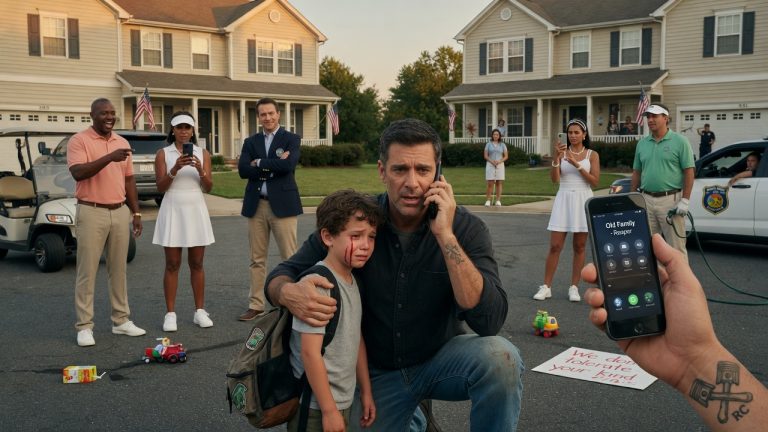
“Leo! Leo, talk to me!” Hoss knelt in the middle of the highway, pulling his grandson into his arms.
Leo’s face was shredded, blood masking his features. He was breathing, but it was a wet, rattling sound. His leg was bent at an angle that made Hoss’s stomach turn.
“Grandpa…” Leo wheezed, his eyes fluttering. “The paper… did you… keep the paper?”
“I’ve got it, kid. I’ve got it. Just stay with me. Don’t you dare leave me.”
Hoss looked up at the empty highway. He was alone. His grandson was bleeding out in his arms, his club was being stolen by a traitor, and his own brain was a house on fire.
He pulled out his phone and called Doc.
“Doc. It’s Hoss. I’m on Route 2, near the Euclid exit. Leo’s down. It’s bad. Get an ambulance here. And Doc…”
“I’m here, Arthur. What is it?”
“Tell the brothers,” Hoss said, his voice sounding like it was coming from a thousand miles away. “Tell them the lion isn’t dead yet. Tell them I’m coming home. And tell Jax… tell him I’m bringing the fire.”
He sat there on the cold pavement, holding Leo, as the sirens began to wail in the distance. He looked at his hands. They weren’t shaking anymore. They were steady. For the first time in months, the fog was gone, replaced by a cold, crystalline clarity.
He knew what he had to do. He couldn’t save his mind, and he might not be able to save his life. But he was going to save the 999 Alliance. He was going to burn Julian Vane’s empire to the ground, and he was going to make sure Jax never wore a patch again.
The “Rusted Crown” was heavy, but as Hoss stood up and watched the paramedics swarm his grandson, he realized he was finally ready to wear it one last time.
The countdown had begun. Six hours until the eviction. Six hours until the end of an era.
Hoss mounted his Harley, the engine roaring to life with a defiant scream. He didn’t look back at the ambulance. He pointed the chrome toward Youngstown.
He was going home to finish it.
Chapter 5
The sky over Youngstown was the color of a wet sidewalk, heavy with the promise of a freezing rain that never quite broke. Hoss rode the last ten miles into town with a ghost sitting on his pillion. He could still feel the weight of Leo’s head against his shoulder from the highway, the heat of the boy’s blood soaking into the leather of his vest. Every time he blinked, he saw the black SUV—a shadow with teeth—and the way Leo’s bike had disintegrated into a spray of chrome and plastic.
The “slips” were trying to take him again. Twice on the ride back, the road had turned into a river of grey ink, and he’d forgotten whether he was coming or going. He’d had to pull over near an abandoned steel mill, gripping the handlebars until his palms bled, screaming the names of the Founding Five into the wind just to anchor himself to the earth.
Arthur. Sarge. Doc. Miller. Ohio.
He pulled into the Iron Horse parking lot at 10:00 AM. There were four hours left until Julian Vane’s eviction deadline. The lot was full of bikes—not just the Alliance, but a few local affiliates who smelled blood in the water. The air was charged, static-heavy, like the moment before a transformer blows.
As Hoss kicked the stand down, Sarge met him at the door. The big man’s face was a map of exhaustion and worry. He didn’t ask how the trip went. He just looked at the blood on Hoss’s sleeve.
“Leo?” Sarge asked, his voice a low rumble.
“He’s alive,” Hoss said, his voice sounding like it was being dragged over broken glass. “Doc’s at the hospital with him. He’s got a shattered leg and more stitches than a baseball, but he’s alive.”
“Jax is inside,” Sarge said, blocking the entrance for a moment. “He’s got the room. He’s telling them you’re a liability, Hoss. He’s telling them the accident with Leo is proof you can’t lead a pack across the street, let alone through a legal war. He’s calling for a vote to strip the patch. Now.”
Hoss felt a surge of something cold and sharp. Not anger—anger was too hot, too messy. This was the clarity of a man who knew he was looking at the end of his life and decided he didn’t like the view.
“Let him talk,” Hoss said, pushing past Sarge.
The interior of the Iron Horse was dim, the air thick with the smell of unwashed bodies and cheap coffee. Jax was standing on the small stage in the corner, usually reserved for local blues bands. He was holding a beer, looking down at the thirty or so men gathered at the long tables.
“—and it’s not just about the land!” Jax’s voice was ringing with a false, practiced passion. “It’s about the fact that our President is a man who doesn’t know what year it is. He’s wandering into traffic. He’s letting suits slap him in our own house. If we stay behind a man whose brain is rotting, we’re all going to end up in the same grave. Vane has the deed. The law is coming. We need a leader who can negotiate, not a ghost who’s haunting his own office.”
Hoss walked into the center of the room. The floorboards creaked under his boots, a sound that seemed to cut through Jax’s monologue. One by one, the heads turned. The room went silent, save for the hum of the refrigerator.
Jax stopped mid-sentence, his smirk faltering for a fraction of a second before he smoothed it back into place. “Hoss. Glad you could join us. We were just discussing the transition of power. Where’s the kid? I heard he had a bit of a spill.”
Hoss didn’t stop until he was at the edge of the stage, looking up at the man he’d treated like a son for a decade. He could see the tremor in Jax’s jaw—the tell-tale sign of a liar who’s started to believe his own bullshit.
“Leo was run off the road by a black SUV,” Hoss said, his voice steady, echoing in the rafters. “The kind Vane’s security detail drives. The kind you’ve been riding in for the last three months, Jax.”
A murmur went through the room. Jax laughed, a sharp, dismissive sound. “You’re hallucinating again, old man. You probably saw a shadow and panicked. That’s the problem, brothers. He’s seeing ghosts everywhere.”
“I saw Linda Vance,” Hoss said.
The name hit Jax like a physical blow. He shifted his weight, his eyes darting toward the exit. “Who?”
“The notary,” Hoss said. He reached into his vest and pulled out the handwritten affidavit. He didn’t hand it to Jax. He held it up for the room to see. “The woman you paid five thousand dollars to forge my signature on that deed. The woman who watched you steal forty years of history while I was three hours away in Marietta.”
Hoss stepped up onto the stage. He was older, slower, and his mind was a fractured mirror, but in that moment, he was a giant. He grabbed Jax by the front of his kutte, the leather creaking under the strain.
“You told her I wouldn’t remember,” Hoss hissed, his face inches from Jax’s. “You counted on the fog to hide your tracks. You figured I’d just fade away into a nursing home and you’d get a nice corner office in Vane’s new development.”
“You’re crazy!” Jax shouted, trying to pry Hoss’s hands loose. “He’s making it up! Look at him—he’s shaking! He’s having an episode!”
“I am having an episode,” Hoss said, his voice dropping to a terrifying whisper. “An episode of clarity. And in this episode, I remember exactly what the bylaws say about a brother who conspires with an outsider to steal club assets.”
Hoss turned to the room. “Sarge! Check his locker. Bottom drawer, under the floorboard. See if you find a matching set of those ‘consultation’ checks Vane’s been cutting.”
Sarge didn’t hesitate. He headed for the back. Jax started to struggle in earnest now, his face turning a mottled purple. “This is a setup! You can’t do this!”
“I’m not doing anything,” Hoss said, releasing him. Jax stumbled back, nearly tripping over the microphone stand. “The club is doing it. If Sarge finds those checks, you’re out. No patch. No bike. No city. You’ll be lucky if you leave this county with your teeth.”
Ten minutes of agonizing silence followed. The men in the bar didn’t move. They didn’t speak. They looked at the floor, at their hands, at the flickering neon sign. The weight of the betrayal was settling over them, a heavy, suffocating blanket.
Sarge returned, holding a stack of high-quality bank envelopes. He walked up to the stage and handed them to Hoss.
Hoss opened the top one. A check for ten thousand dollars, made out to Jax Miller. The memo line read: Acquisition Facilitation.
Hoss didn’t feel the triumph he expected. He felt a profound, aching sadness. He looked at Jax, who was now huddled at the back of the stage, the bravado gone, replaced by the twitchy desperation of a cornered rat.
“You sold us out for the price of a mid-range truck,” Hoss said, tossing the check onto the floor. “You thought we were worth that little.”
“I was trying to save something!” Jax screamed, his voice cracking. “The club is dying, Hoss! The world is changing! Vane was going to take it anyway! I was just making sure we got something out of the deal before you lost the whole thing for nothing!”
“You don’t save a house by burning it down while your family is sleeping inside,” Hoss said. He turned to the room. “The vote is cancelled. Jax is stripped of his rank and his membership. Effective immediately. Sarge, escort him to the gate. If he’s still in the zip code by sunset, deal with it.”
Sarge and two other brothers moved in. They didn’t use weapons. They didn’t need to. They grabbed Jax by the arms and dragged him off the stage. He didn’t fight. He just stared at Hoss with a look of pure, unadulterated hatred.
“You’re still going to lose, Hoss!” Jax yelled as they dragged him toward the door. “The law doesn’t care about a handwritten note from a scared woman! Vane’s coming at noon! You’ve got two hours! Two hours until you’re nothing but a homeless old man in a leather vest!”
The door slammed shut. The silence that followed was even heavier than before.
Hoss stood on the stage, his breath coming in ragged hitches. The fog was creeping back in now, the adrenaline fading and leaving him hollow. He looked at the faces of his brothers. They were looking at him, waiting for the next order. Waiting for the “Old Hoss” to tell them how to stop the bulldozers.
But Hoss didn’t have an answer. He had the truth, but Vane had the lawyers, the sheriff, and the money. In the real world, the truth was often just a footnote to the invoice.
He sat down on the edge of the stage, his head in his hands. He could feel the fine, rhythmic twitch in his fingers starting up again.
“Hoss?” Sarge asked, standing at the foot of the stage. “What do we do? It’s 11:30. The sheriff’s cruisers are already lining up at the end of the block.”
Hoss looked up. The room was blurring at the edges. He needed a pill. He needed a nap. He needed a different life.
“Get the files,” Hoss whispered. “All of them. The original charters. The property taxes from the seventies. Everything. If we’re going to lose, we’re going to make sure it costs them every goddamn penny they have.”
He stood up, his knees popping. He had two hours. Two hours to find a miracle, or two hours to say goodbye to the only world he’d ever known. He walked toward his office, his gait heavy, the “Rusted Crown” feeling like it was made of lead.
Behind him, the brothers began to move, but the energy was different now. It wasn’t the energy of a pack ready to hunt. It was the energy of a crew preparing for a funeral. And Hoss knew, deep in the parts of his brain that were still clear, that he was the one they were planning to bury.
Chapter 6
The clock on the wall of the Iron Horse office didn’t tick; it hissed, a rhythmic reminder that the sand was running out. At 1:45 PM, the sound of sirens began to cut through the heavy grey air of Youngstown. Not the frantic wail of an emergency, but the steady, low-frequency pulse of authority.
Hoss stood by the window, watching three county sheriff’s cruisers and two black Suburbans pull into the lot. The cruisers parked in a semi-circle, their lights flashing blue and red against the grimy windows of the bar. Julian Vane stepped out of the lead Suburban, looking immaculate in a navy blue wool coat. He looked at his watch, then at the building, with the practiced boredom of a man checking a grocery list.
Beside Vane stood Sheriff Miller—no relation to Hoss, just a man with a badge and a mortgage he couldn’t afford to lose.
Hoss turned back to the room. Sarge, Doc, and ten of the senior members were there. They were armed, though the weapons were tucked away, a silent promise of what would happen if the sheriff tried to use force.
“Listen to me,” Hoss said, his voice low and firm. This was the most important moment of his life, and for some reason, the fog had granted him a temporary reprieve. His mind felt sharp, the edges of his memories crisp. “No one fires unless they fire first. This isn’t a shootout. This is a siege. We play this by the book until there is no book left.”
“Hoss, Leo’s on the phone,” Doc said, handing over a cell.
Hoss took the phone. “Leo?”
“I’m okay, Grandpa,” the boy’s voice was weak, punctuated by the beep of a heart monitor. “I’m watching the news. They’re saying there’s a standoff. Don’t let them take it. Don’t let them take the Horse.”
“I’m doing my best, kid,” Hoss said, his throat tightening. “You just focus on healing. I’ll see you tonight.”
He handed the phone back to Doc and walked toward the front door. He didn’t wait for them to knock. He swung the heavy oak doors open and stepped out onto the porch, Sarge and Doc at his shoulders.
The cold air hit him like a physical blow. Vane and the Sheriff were halfway up the walk. They stopped when Hoss appeared.
“Arthur,” Vane said, his voice smooth and carrying. “It’s two o’clock. According to the deed in my possession, you and your associates are currently trespassing on private property owned by Vane Development Group. I’d like to keep this civil for the sake of the cameras.”
He gestured toward a news van parked at the edge of the lot. A reporter was already doing a live hit.
“The deed is a forgery, Julian,” Hoss said. He held up the affidavit Linda Vance had signed. “I have a sworn statement from the notary. She admits Jax Miller bribed her to seal a forged signature. She’s ready to testify.”
Vane didn’t even look at the paper. He smiled, a thin, patronizing curve of the lips. “An affidavit from a woman with a history of financial instability, obtained under duress by a known outlaw? Any judge in this state will toss that in the trash before the first recess. The deed is recorded. The title is clear. Sheriff, if you would?”
Sheriff Miller looked at Hoss, his expression pained. “Hoss, come on. Don’t make me do this. I’ve got an order. If you’ve got a legal grievance, you take it to court on Monday. But today, you have to vacate.”
“We aren’t going anywhere,” Sarge growled, stepping forward.
The deputies behind the Sheriff shifted, their hands moving toward their holsters. The air in the parking lot turned brittle, ready to snap.
“Wait,” Hoss said, putting a hand on Sarge’s arm. He looked at Vane. “You think you’ve thought of everything, Julian. You think you can just buy the ground and the history disappears. But you forgot one thing about this town.”
Vane raised an eyebrow. “And what’s that? The quality of the chili?”
“The EPA,” Hoss said.
Vane’s smile faltered. “What?”
Hoss pulled a yellowed, fragile piece of parchment from his vest. It wasn’t a deed. It was an environmental survey from 1974, conducted by the steel mill that used to sit on the adjacent lot.
“This land was used as a secondary runoff site for the mill’s chemical storage,” Hoss said. “There’s a three-thousand-gallon tank of PCB-laden sludge buried twenty feet under this bar. I’ve known about it since I bought the place. I’ve kept it capped and monitored. But the minute you break ground for your ‘Riverfront Commons,’ you’re going to hit it. And according to the new state regulations, the owner of the property—which you claim is you—is 100% liable for the cleanup and the environmental fines.”
Hoss stepped off the porch, walking slowly toward Vane. “The cleanup cost alone is estimated at four million dollars. Not to mention the lawsuits from the neighbors when that sludge hits the water table. Are you sure you want this land, Julian? Are you sure your investors are ready for a decade of litigation and a black hole on the balance sheet?”
Vane’s face went pale. He looked at the Sheriff, then at the black Suburban where his legal team was sitting. “He’s bluffing. If there was a tank there, it would be on the public record.”
“It’s on a private record,” Hoss said. “One that I’m happy to hand over to the EPA and the local news right now. Or, we can find a third option.”
“What option?” Vane hissed.
“You void the deed,” Hoss said. “You walk away from this block. You keep your development on the north side of the tracks where the ground is clean. In exchange, I don’t call the EPA. I don’t release the affidavit. And you get to tell your investors that you ‘generously’ donated the land back to the community for historical preservation.”
Vane stared at Hoss. He looked like he wanted to scream, but he was a man of business, and business was about minimizing loss. He looked at the news cameras, then at the grit-stained bar that was currently a four-million-dollar liability.
“You’re a senile old man,” Vane whispered, loud enough only for Hoss to hear. “You’re going to die in a year and this place will rot anyway.”
“Maybe,” Hoss said. “But I’ll die in my own bed. And this place will rot on its own time, not yours.”
Vane turned to the Sheriff. “The… the deed was found to have a clerical error. We’ll be postponing the eviction indefinitely. We’re going to re-evaluate the site plan.”
Vane didn’t wait for a response. He turned and climbed back into his Suburban. The engine roared, and the black vehicle sped out of the lot, followed closely by the legal team.
The Sheriff looked at Hoss, a look of profound relief on his face. “You really have a tank under there, Hoss?”
Hoss looked at the ground. “Sheriff, in this town, if you dig deep enough, you’ll find something that’ll kill you. It’s just a matter of who knows where the shovel is.”
The cruisers pulled away, the sirens silent. The news van lingered for a few minutes before packing up.
The 999 Alliance stood on the porch of the Iron Horse, watching the dust settle. Sarge let out a whoop of victory, and a few of the younger guys started hugging each other. They’d won. They’d kept the Horse.
But Hoss didn’t feel like celebrating. He felt the fog returning, a slow, inevitable tide. He looked at the “environmental survey” in his hand. It was actually just a bill for a roof repair from 1992. He’d bluffed. He’d used the one thing he knew about Vane—the man’s fear of a bad investment—and he’d won on a pair of deuces.
“Hoss?” Sarge asked, coming over. “You okay?”
Hoss looked at him, and for a second, he didn’t recognize Sarge. He saw a large man with a beard and a leather vest, but the name was gone. He looked at the bar, and he knew it was home, but he didn’t know why.
“I’m tired, Sarge,” Hoss said, the name coming back to him just in time. “I’m real tired.”
“You did it, Boss. You saved us.”
“No,” Hoss said, looking at the flickering neon sign. “I bought us some time. That’s all any of us ever do.”
He walked back into the bar. He sat down in his booth, the shadows wrapping around him like an old friend. He took the last of the white pills from his pocket and swallowed it.
He knew that tomorrow, he might not remember this afternoon. He might not remember the look on Vane’s face or the way the sirens sounded. He might look at Leo in the hospital and wonder who the boy was.
But as he sat there in the quiet of the Iron Horse, listening to the muffled cheers of the brothers outside, Arthur “Hoss” Miller felt a sense of peace. The legacy was safe. The boy was alive. The traitor was gone.
He leaned his head back against the booth and closed his eyes. The “Rusted Crown” was still there, heavy and cold, but for the first time in a long time, he wasn’t afraid to let it slip.
The fog was coming, and this time, he was ready to let it carry him home. He’d fought the war. He’d kept the faith. And in the dark of an Ohio afternoon, that was more than enough for any man.
The Iron Horse breathed, a slow, steady pulse of neon and grease, and for one last hour, Old Hoss was the king of the asphalt, even if he was the only one who knew it.
THE END