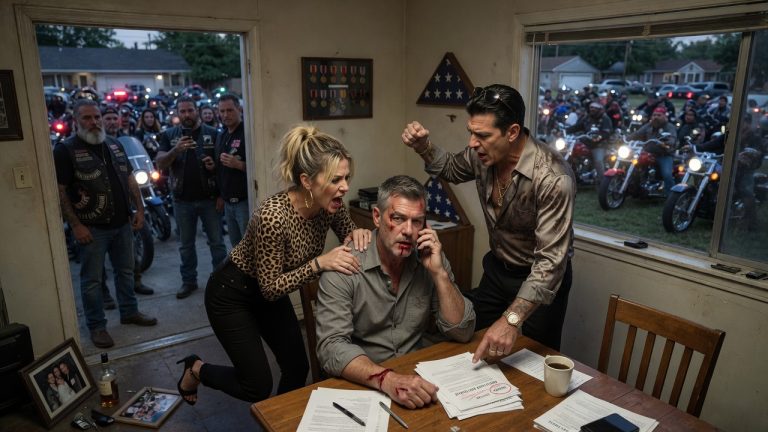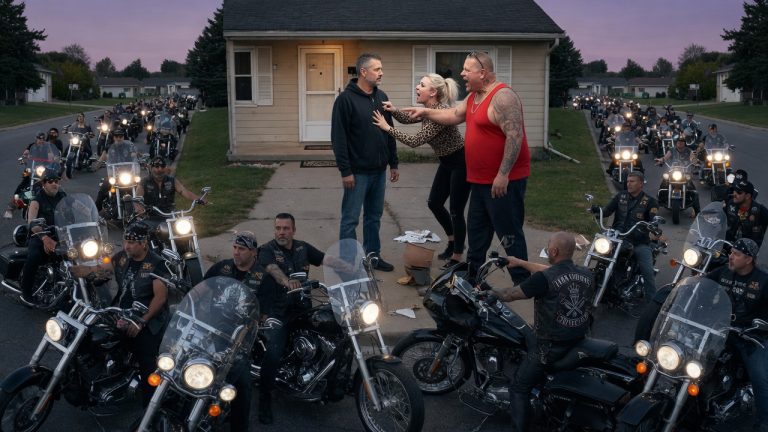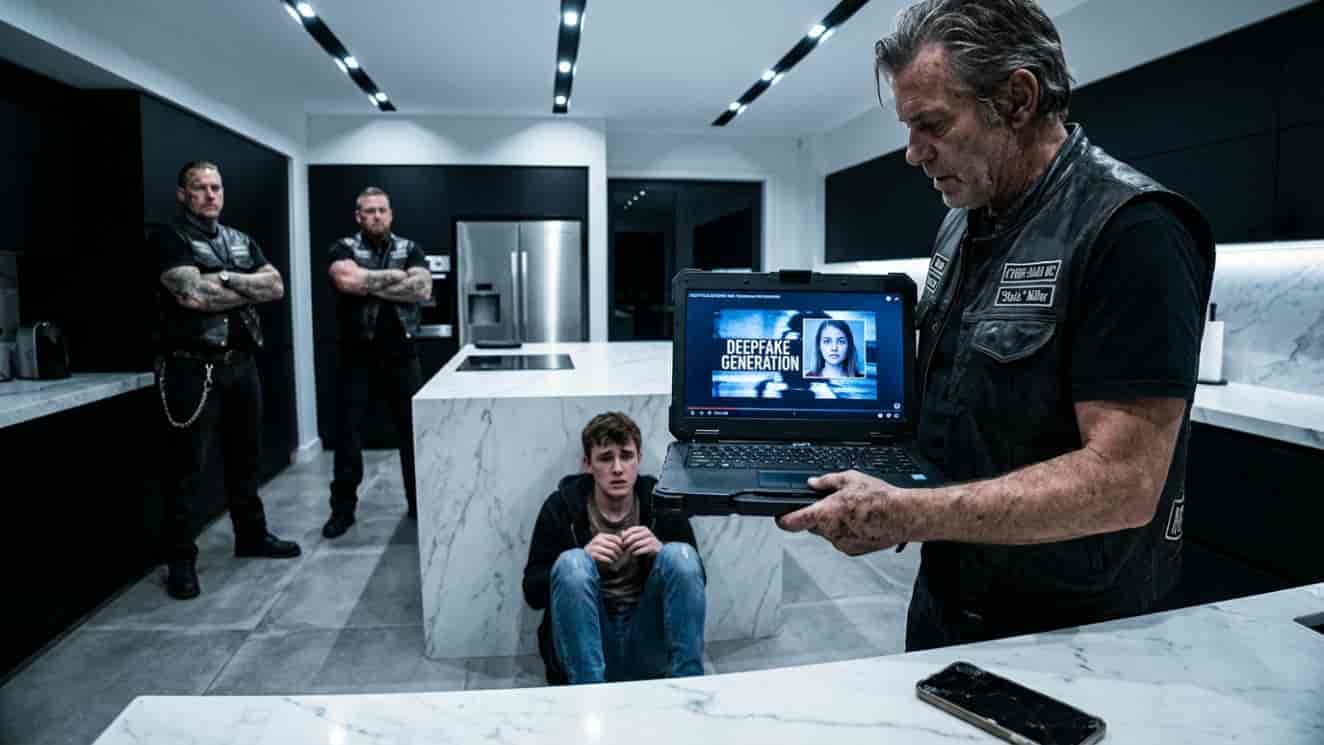
The blue light of the laptop was the only thing moving in the house, a cold flicker that made Daisy’s room look like an underwater tomb. She was curled in the corner, her phone vibrating with a rhythmic, cruel persistence—another notification, another “request” for money, another threat to send the fake photos to her school. She didn’t hear me come in. I’ve spent twenty years trying to bury the man I used to be—the one who could dismantle a server farm as easily as a carburetor—just to keep her safe. But as I picked up that glowing piece of glass and saw what they were doing to my girl, the old code started scrolling behind my eyes again.
“Dad, don’t look,” she whispered, her voice breaking.
I didn’t tell her that I’d already seen the source code. I didn’t tell her that the boy behind the screen lived only three miles away in a house with a three-car garage and parents who thought he was a genius. I just handed her my heavy leather jacket, the one that smelled like road salt and old oil.
“Stay here, Daisy,” I said, my voice as flat as a dead battery. “I’m going to go show them the difference between a virtual threat and three hundred pounds of steel at their front door.”
Chapter 1: The Blue Light in the Garden
The smell of 90-weight gear oil is the only thing that ever truly settles my mind. It’s thick, sulfurous, and honest. It doesn’t hide behind encryption or ghost servers. When a transmission is grinding, you can hear the metal screaming at you. You can feel the heat. There’s no ambiguity in a mechanical failure.
I was hunched over the primary drive of my 2012 Road Glide, the fluorescent shop lights of the “Server Room”—our MC’s clubhouse garage—buzzing like a trapped hornet. My knuckles were skinned, the blood mixing with the black sludge of the primary fluid. To anyone walking by on the street, I was just “Static,” the national president of the Cyber-Road MC. A man who looked like he’d spent his life eating road dust and settle-agreements. My beard was mostly salt now, very little pepper, and my leather vest felt like a second skin, heavy with the weight of the patches and the history they represented.
“You’re over-torquing that bolt, Static,” Router said, leaning against a stack of tires. He was the club’s Sergeant-at-Arms, a man built like a concrete pylon with a beard that reached his belt. He earned his name because he was the only one who could find a path through any police blockade or rival territory.
“It’s slipping,” I grunted, not looking up. “Everything feels like it’s slipping lately.”
“It’s the heat,” Router said, wiping a rag over a chrome fender. “Or maybe it’s just the city. Too many towers, not enough road.”
He wasn’t wrong. The Cyber-Road MC was a relic in a town that was rapidly turning into a playground for tech giants. We were a “hybrid” club—most of our guys were veterans who’d gone into private security or network infrastructure after the wars. We knew how to ride, and we knew how to code. But we kept the tech side quiet. In the world of 1%er clubs, being a “computer geek” was a liability until someone needed a bank account emptied or a witness’s GPS coordinates.
I wiped my hands on a rag and stood up, my knees popping. “I’m heading out. Daisy’s got a track meet tomorrow. I told her I’d be home for dinner.”
“How is she?” Router asked. There was a genuine softness there. The club was small, and we looked after our own. Daisy was the club’s kid.
“Quiet,” I said, and the word tasted like copper. “Too quiet. She’s sixteen, so I figured it was just the age, but… she’s looking at her phone like it’s a live grenade.”
“The world’s a loud place for kids these days,” Router remarked.
I didn’t stay to chat. I rode the Glide home through the neon-soaked arteries of the city, the wind cutting through the humidity. My house was a small, unassuming bungalow on the edge of the suburbs, a place I’d bought with the “consulting fees” from a life I’d tried to leave behind. I was Gabe Miller at home. Static stayed in the garage.
When I walked through the front door, the house was silent. No TV, no music. Just the low hum of the refrigerator and the distant sound of a lawnmower three houses down.
“Daisy?” I called out.
No answer.
I walked down the hallway, my boots heavy on the hardwood. Her door was closed. I knocked softly. “Hey, kiddo. I brought tacos.”
Still nothing. I pushed the door open.
The room was dark, the curtains drawn tight. Daisy was curled on her bed, a small, shivering shape under a heavy quilt despite the eighty-degree evening. The only light came from the laptop on her desk—a cold, surgical blue that illuminated the posters on her wall and the track medals hanging from her mirror.
“Daisy, talk to me,” I said, sitting on the edge of the bed.
She didn’t move at first. Then, she turned her head, and the sight of her face hit me harder than any barroom brawl ever had. Her eyes were rimmed with red, her skin sallow. She looked hollowed out.
“I can’t go to school,” she whispered. “I can’t go anywhere.”
“Why? Did something happen?”
She just shook her head and pointed a trembling finger at the laptop.
I stood up and walked to the desk. I’ve spent my life looking at screens. I’ve seen data breaches that could sink companies and surveillance footage that could end lives. I thought I was desensitized. I was wrong.
On the screen was a message from an encrypted Discord server. Below the text was a series of images. At first glance, they looked like her—my Daisy, in her bedroom, in states of undress that made my stomach turn to lead. But as I leaned in, the “Static” in my brain—the part of me that understood pixels and frame rates—saw the truth. The lighting was slightly off on the neck. The shadows didn’t match the bone structure of her jaw.
“It’s not me, Dad,” she sobbed into her pillow. “I never… I would never. But they sent it to the whole track team group chat. Everyone thinks it’s real. They’re saying… they’re saying I’m a whore. And now this guy says if I don’t pay him five thousand dollars by Friday, he’s sending them to the college recruiters.”
I didn’t feel anger right away. Anger is a hot, messy thing. This was something else. It was a cold, clicking sound in the back of my skull, like a hard drive spinning up after years of dormancy.
“Who is he?” I asked.
“I don’t know. His name is ‘Apex.’ He told me he’s watching me. He told me he knows where you work.”
I looked at the images again. They were deepfakes—high-quality ones. This wasn’t a kid with a basic app. This was someone using a neural network, someone with processing power and a grudge.
“Gabe?” she asked, using my real name, her voice small. “What are we going to do?”
I looked at her, and then I looked at my hands—the ones covered in motorcycle grease and old scars. I reached out and closed the laptop, the blue light vanishing, leaving us in the honest, heavy dark.
“We’re going to do what I should have done a long time ago,” I said. “We’re going to find him.”
I walked out of the room and headed straight for the garage. I didn’t go to the bike this time. I went to the back corner, where a heavy steel tool chest sat under a layer of dust. I entered a code into the digital lock on the third drawer.
Inside wasn’t a wrench or a socket set. It was a ruggedized Panasonic Toughbook, its casing scarred and battered. Beside it lay a black hard drive, encrypted with a 256-bit key that I hadn’t touched in five years.
I sat on my mechanic’s stool and opened the lid. The boot-up screen flickered to life, the logo of a defunct government agency ghosting across the glass.
“Okay, Apex,” I whispered, my fingers hovering over the keys. “Let’s see how much you like being watched.”
Chapter 2: The Grid and the Grudge
The next morning, the city didn’t look like a home anymore. It looked like a map of vulnerabilities.
I didn’t go to the shop. I told Router to handle the morning meeting and headed toward “The Grid.” It was a revitalized warehouse district where glass-walled tech incubators sat right next to crumbling brick factories. It was the kind of place where you could buy a five-dollar artisanal coffee or a stolen identity, depending on which door you knocked on.
I parked the Glide in front of a sleek building with a sign that simply read Prism Logic. It was a high-end cybersecurity firm, the kind that hired “consultants” who didn’t exist on paper.
I walked into the lobby, my heavy boots echoing on the polished concrete. The receptionist, a young man with a man-bun and a shirt that cost more than my first bike, looked up with a smirk.
“Can I help you, sir? We don’t really do… repairs here.”
I didn’t smile. I walked up to his desk and leaned over, the smell of exhaust and old leather filling his air-conditioned bubble. “Tell Elias that Static is in the lobby. And tell him if he doesn’t see me in thirty seconds, I’m going to start bypass-printing my own security clearance on his office printer.”
The kid’s smirk vanished. He tapped a few keys, whispered into a headset, and then nodded toward the elevators. “Floor four. He’s… expecting you.”
Elias was a man who looked like he’d been carved out of a block of salt. He was my foil—a man who’d taken the same skills I had but sold them to the highest bidder until he could afford a view of the bay. He was wearing a grey suit that fit him like armor.
“Static,” he said, not standing up. “You look like hell. Is the MC life finally catching up to your joints?”
“I need a trace, Elias. Private server, Discord relay, AI-generated content.”
Elias leaned back, his eyes narrowing. “That’s a lot of buzzwords for a guy who spent all of last year arguing about the merits of carburetors over fuel injection. Who hit you?”
“They hit my daughter.”
The air in the room changed. Elias wasn’t a good man, but he wasn’t a monster. He’d known my wife before the accident. He’d seen the photos of Daisy on my desk back when we worked for the Agency.
“Deepfakes?” he asked, his voice dropping an octave.
“Good ones. High-end rendering. They’re extorting her. Five grand or they leak them to the recruiters.”
Elias stood up and walked to a massive touchscreen wall. He swiped through a few windows, his fingers moving with a grace that made my own feel like clubs. “There’s a group out of the university district. They call themselves ‘The Script Kiddies,’ but they’re more sophisticated than the name suggests. They’ve been running a protection racket on influencers and local families for months. They use a neural net called ‘Chimera’ to generate the images.”
“Where are they?”
“They’re smart, Static. They bounce their traffic through a series of nodes in Eastern Europe. Even if you find the IP, it’s a ghost. But…” He paused, a small, cold smile touching his lips. “They’re arrogant. They think they’re untouchable because they’re ‘digital natives’ and we’re just relics.”
“Give me a name, Elias.”
“The leader goes by ‘Zero.’ Real name is Caleb Thorne. His dad is a partner at Thorne & Associates. Big-time real estate developers. The kid has a penthouse near the park and more processing power than a small country. He thinks he’s a god because he can ruin lives from his bedroom.”
“I need proof. I need the source files. I need to show the world that these images are fakes before they hit the recruiters’ desks.”
“That’s a tall order, even for you. Caleb’s got a hardware firewall that would take me a week to crack. And he’s got friends. One of them is a guy named Detective Miller—no relation to you, obviously. He’s on the cyber-crimes task force. He’s been taking kickbacks to look the other way when these kids ‘prank’ people.”
I felt the pressure behind my eyes increasing. This wasn’t just a kid with a laptop. This was a system. A wealthy kid, a corrupt cop, and a technology that could rewrite reality.
“I don’t have a week,” I said. “And I don’t care about the cop.”
“You should,” Elias warned. “Miller is a shark. He’s been waiting for a reason to take a swing at the MC. If you go in there with chains and boots, he’ll have you in a cage before the sun sets. You have to play this clean, Static. Or at least, clean-adjacent.”
I looked out the window at the city. Somewhere out there, Caleb Thorne was probably sitting in his air-conditioned penthouse, laughing at the “old man” who didn’t know how to fight back.
“I tried clean,” I said, thinking of the five years I’d spent trying to be Gabe Miller. “Clean didn’t protect my daughter. I’m going back to what I know.”
“Which is?”
“Asymmetric warfare.”
I left Elias’s office and headed back to the clubhouse. My mind was already building the architecture of the response. It wouldn’t be a simple hack. And it wouldn’t be a simple beating. It had to be a total collapse of their world.
When I pulled into the Server Room, Router was waiting for me. He saw the look on my face and stepped away from the bike.
“We got a problem?” he asked.
“Call a meeting,” I said, not stopping. “Full patch. No prospects. I need the guys who remember what we did in ’08.”
“The doxing incident?” Router’s voice was hushed. “Static, we swore we’d never pull those files again. That’s what got your family targeted in the first place.”
“This is different,” I said, turning to look at him. “They’ve already targeted my family. Now, they’re going to find out why I’m the one who stayed alive.”
Chapter 3: The Weight of the Hard Drive
The clubhouse basement was a concrete bunker, cooled by four industrial AC units that fought a losing battle against the heat generated by the server racks lining the walls. This was our real “inner sanctum.” Up stairs was for whiskey and talk; down here was for work.
Seven men sat around a heavy oak table. These were the founders. Men with names like ‘Patch,’ ‘Volt,’ and ‘Codec.’ They all had grey in their beards and the same hard, expectant look in their eyes.
I placed the black hard drive in the center of the table. It looked like a small, harmless brick. But every man in the room knew what was on it. It contained the “Grey Book”—a collection of backdoors, zero-day exploits, and social engineering data we’d compiled over twenty years. It was the digital equivalent of a nuclear option.
“Daisy’s being targeted,” I said, my voice echoing off the concrete. I didn’t give them the emotional version. I gave them the technical one. I told them about Caleb Thorne, the deepfakes, and the corrupt cop, Miller.
“So we go to the penthouse,” Patch said, his hand instinctively going to the knife on his belt. “We take the servers, we take the kid, and we drop them both off a bridge.”
“No,” I said. “That’s what they expect. Caleb Thorne thinks he’s playing a game of ‘Capture the Flag.’ If we show up with violence, he wins because he can call his cop friend and put us away. He wants us to be the ‘scary bikers’ so he can be the victim.”
“Then what?” Volt asked. “We can’t out-hack a kid with a million-dollar rig and the city’s bandwidth at his disposal.”
“We don’t have to out-hack him,” I said, leaning forward. “We have to out-think him. He’s using a neural net called Chimera. It’s powerful, but it’s hungry. It needs data. And it needs a connection to the primary server at his father’s office to handle the heavy rendering.”
I tapped the hard drive. “We’re going to feed the beast. Codec, I want you to ghost his network. Every time he tries to generate an image of Daisy, I want the system to swap the metadata with his own face. I want him to see himself in those images.”
A few of the guys chuckled, but the humor didn’t reach their eyes.
“That’s just a prank,” Router said. “He’ll just reset the server.”
“That’s only phase one,” I continued. “Phase two is the social side. This kid thinks he’s a god because he’s anonymous. We’re going to take that away. We’re going to make his private world very, very public. But first, I need to see him. I need to look him in the eye and give him a chance to stop.”
“You’re going to talk to him?” Patch asked, incredulous. “After what he did?”
“I need to confirm the link between him and the cop,” I said. “And I need to see if he has any soul left. Because if he doesn’t, I’m going to feel a lot better about what comes next.”
I left the clubhouse and drove to the university district. It was a world of manicured lawns and stone buildings that looked like they belonged in a movie. I found Caleb’s penthouse building—a glass spire that seemed to look down on the rest of the city with contempt.
I didn’t try to sneak in. I walked right up to the concierge, showed him a fake private investigator badge I’d printed in the clubhouse, and told him I was there to discuss a “security breach” with Mr. Thorne.
Five minutes later, I was standing in a living room that looked like a museum. Caleb Thorne was sitting on a white leather sofa, a tablet in his hand. He looked younger than nineteen. He had soft features and expensive hair. He looked like a kid who’d never had a physical consequence in his life.
“You’re the biker,” he said, not even looking up. “The one with the daughter. Gabe, right?”
“Static,” I corrected him. My voice was low, vibrating in my chest. “I’m here to give you one chance, Caleb. Delete the files. Send a public retraction to the track team. And leave my daughter alone.”
Caleb finally looked up, a smirk playing on his lips. “Or what? You’ll rev your engine at me? You’ll throw a chain? My dad owns half this block, Gabe. And my friend Miller… he’s already written the report for when you inevitably ‘harass’ me. You’re a dinosaur. You’re a loud, greasy relic in a world that’s moved on to quiet, efficient power.”
He stood up, walking closer, his confidence radiating like a physical heat. He was a foot shorter than me, but he felt like he was standing on a mountain.
“Those images? They’re beautiful, aren’t they? The AI really captured her… spirit. And by Friday, everyone will see it. Unless, of course, you have that five thousand. But let’s be honest, you probably spent that on chrome and whiskey.”
I looked at him—really looked at him. I saw the hollowness Elias had mentioned. He didn’t care about the money. He cared about the power. He cared about the fact that he could make a man like me—a man who’d seen war and death—tremble with rage.
“You think the screen is a wall, Caleb,” I said, my voice surprisingly calm. “You think because you can’t see the blood, it isn’t real. But walls can be knocked down.”
“Try it,” he challenged, stepping into my personal space. “Go ahead. Hit me. I’ve got four cameras in this room recording in 4K. I’ll have your patch and your bike before the ambulance arrives.”
I didn’t hit him. I just leaned in, close enough that he could smell the gear oil and the road salt. “I’m not going to hit you, Caleb. I’m going to do something much worse. I’m going to show you who I really am.”
I turned and walked out. Behind me, I heard him laughing. It was a high, shrill sound that followed me all the way to the elevator.
When I got back to the clubhouse, I didn’t go to the basement. I went to the kitchen and made a pot of coffee. My hands were steady, but the “Static” in my head was screaming.
Daisy called me an hour later. She was crying again. “Dad, it’s happening. They just posted a countdown on the school forum. ‘The Big Reveal.’ Friday at noon.”
“I know, honey,” I said, staring at the hard drive on the table. “I know. Just stay home tomorrow. Don’t look at the phone. I’m handling it.”
“How?” she asked.
“I’m going to turn the lights on,” I said.
I hung up and looked at Router, who was standing in the doorway. “Is the MC ready?”
“Fifty bikes are staged at the secondary warehouse,” he said. “And the ‘Projectors’ are ready. Volt’s got the signal-jammers in his truck.”
“Good,” I said, picking up the hard drive. “Let’s go to work.”
Chapter 4: The Sound of the Shift
The day before the “reveal,” the tension in the clubhouse was thick enough to choke on. We weren’t just a biker club anymore; we were a mobile command center.
We’d identified the “bottleneck” in Caleb’s system. To render the high-resolution deepfakes for the “Big Reveal,” he was using a high-speed fiber uplink to his father’s real estate office downtown. That office was the brain; Caleb’s penthouse was the remote.
But there was a third point in the triangle: Detective Miller.
We’d tracked the cop’s phone. He was currently sitting in a steakhouse three blocks from the university, probably waiting for his “bonus” from Caleb.
“We need to separate them,” I told the guys. “Router, you take six bikes. I want you to ‘escort’ Detective Miller. Don’t touch him. Just stay on his tail. Every time he turns a corner, I want him to see a Cyber-Road patch in his rearview mirror. Make him nervous. Make him think the MC is going to hit him.”
“And while he’s distracted?” Router asked.
“Volt and I are going to the office. We’re not going to hack the server. We’re going to physically ‘re-route’ it.”
We moved out at dusk. The sound of fifty motorcycles starting at once is a physical force. It’s a low-frequency growl that vibrates in your teeth. As we rode through the city, the skyscrapers reflecting our headlights, I felt a sense of clarity I hadn’t felt in years. We were moving as one organism.
We reached the Thorne & Associates building at 9:00 PM. It was a temple of glass and steel, guarded by a single night watchman who looked like he was more interested in his phone than the perimeter.
Volt and I slipped through the loading dock. I didn’t need to pick a lock; I’d already spoofed the guard’s keycard from the lobby terminal an hour earlier. We took the service elevator to the server room on the 12th floor.
The room was a cathedral of blinking lights and humming fans. I found the Thorne primary rack. My fingers moved over the keyboard of my Toughbook, connecting to the local bus.
“I’m in,” I whispered.
“What are we doing, Static?” Volt asked, keeping watch at the door. “Deleting the files?”
“No,” I said. “If I delete them, he’ll just restore from his local backup. I’m doing something better. I’m injecting a ‘Ghost Script.’ Every time his system tries to broadcast the ‘Big Reveal,’ it will instead pull from a folder I’ve just created.”
“What’s in the folder?”
“Evidence,” I said. “Every extortion email he’s sent. Every bank transfer to Detective Miller. And the original, unedited photos of the girls he’s been targeting, side-by-side with the deepfakes he created. I’m turning his ‘Reveal’ into a confession.”
Suddenly, the lights in the server room flickered. My screen turned red.
ACCESS DENIED.
“He’s in the system,” I hissed. “Caleb. He’s noticed the intrusion.”
“Can he stop us?”
“He’s trying to lockout the admin port. He’s fast, I’ll give him that.” I started typing furiously, a line of sweat rolling down my neck. This was the war I knew—not of fists, but of logic gates and latency.
SYSTEM OVERRIDE INITIATED.
“Come on, you arrogant little shit,” I muttered. “Think you’re a god? Let’s see how you handle a power surge.”
I didn’t just fight for control of the software. I used the building’s smart-management system to override the cooling units in the server room. The fans slowed to a crawl. The temperature began to rise—80 degrees, 90, 100.
“He’s going to notice the heat,” Volt warned.
“That’s the point. He has to choose: keep fighting me for the script, or save his father’s quarter-million-dollar server from melting.”
For three minutes, it was a stalemate. The air in the room became stifling. Then, the red screen vanished. Caleb had backed out to initiate the emergency cooling protocol.
“Got you,” I said, hitting the final ‘Enter’ key. “Script injected. It’s a dormant worm. He won’t see it until he hits ‘Broadcast’ tomorrow at noon.”
We slipped out of the building just as the security guard started his rounds. As we rode away, my phone buzzed. It was a text from an unknown number.
I see you, Gabe. You think you’re smart? Check your front porch.
My heart hammered against my ribs. I ignored the speed limits, the Glide screaming as I pushed it toward the suburbs. I pulled into my driveway, the tires smoking.
On my front porch sat a small, neatly wrapped box.
I opened it with a pocketknife, my breath hitching. Inside was a single, charred hard drive. It was the one I’d given Daisy years ago to keep her childhood photos. And on top of it was a printed note:
The digital world isn’t the only thing that can burn.
I ran inside, screaming Daisy’s name. The house was empty. The back door was hanging open, the glass shattered.
I stood in the center of the kitchen, the silence of the house deafening. I looked at the charred hard drive in my hand, and the “Static” in my brain finally snapped. The cold, logical hacker was gone. The biker who’d fought his way through the worst roads in America was all that was left.
I picked up the radio on my belt. “Router. This is Static. Abort the escort. All units to the Thorne Penthouse. Now.”
“Static? What happened?”
“He took her,” I said, my voice sounding like it was coming from the bottom of a well. “He took my daughter.”
“We’re three minutes out,” Router said, his voice hard as iron. “We’re bringing the thunder.”
I walked back to the Glide and kicked the stand up. I didn’t care about “clean-adjacent” anymore. I didn’t care about the law or the consequences. Caleb Thorne wanted to see the man behind the patches?
I was going to show him a ghost that wouldn’t stop until his whole world was ashes.
Chapter 5: The Physical Interface
The sound of fifty heavy-displacement V-twin engines idling in a dead-end industrial lot isn’t just noise. It’s a rhythmic, subsonic pressure that pushes against your sternum until your heart has no choice but to sync with the machinery. It’s the sound of a mechanical heartbeat, one that doesn’t skip or flutter under the weight of fear.
I stood at the center of the semicircle of headlights, my Road Glide parked behind me like a tether to the earth. The air was thick with the smell of unburnt fuel and the metallic tang of cooling chrome. My brothers—the men of the Cyber-Road MC—were silent, their faces obscured by the shadows of their helmets or the deep brims of their caps. They weren’t looking for a speech. They were looking for the “Static” that had led them through the black-hat wars of the mid-2000s, the man who treated a city’s infrastructure like a game of chess.
“He took her from the house,” I said. I didn’t have to raise my voice; the engines seemed to dip their roar just to hear me. “Caleb Thorne thinks he’s playing a game of pixels. He thinks because he can move data, he can move people. He’s got Detective Miller on his payroll, and he’s got his daddy’s lawyers on speed-dial. He thinks we’re just a loud distraction.”
I looked at Router, who was checking the tension on a heavy length of tow chain. I looked at Volt, who was syncing a series of signal-jamming bricks in the bed of a blacked-out pickup.
“We aren’t going to kill him,” I continued, and I could feel the collective ripple of disappointment, followed by a deeper, more dangerous curiosity. “Killing him makes him a martyr for his class. It gives the cops a reason to scrub the club from the map. No. We’re going to do something that stays with him longer than a bullet. We’re going to strip him of his anonymity. We’re going to show the world the coward behind the code.”
“And the girl?” Patch asked, his voice a low growl from the back.
“Daisy is the priority. If a hair on her head is touched, the rules change. Until then, we are a surgical strike. Router, you take the ‘Wall.’ I want those bikes blocking every entrance to the penthouse block. No one gets in, no one gets out. Volt, you’re with me. We’re going to use the maintenance hatch on the roof.”
“Static,” Router said, stepping forward. “The cop. Miller. He’s already calling for backup. He knows we’re coming.”
“Let him call,” I said, swinging my leg over the Glide. “By the time they get their riot gear on, the truth will already be halfway around the world.”
We moved out as a single unit, a black ribbon of leather and steel winding through the city’s neon-lit guts. We didn’t weave through traffic; we claimed it. Cars pulled to the shoulder, drivers staring in a mix of awe and terror as the Cyber-Road MC thundered past. It wasn’t the “freedom” the movies talked about. It was the weight of collective intent.
As we neared the university district, the blue and red flashes of a patrol car appeared in the intersection. It was Detective Miller, parked sideways across the road, his arm resting on the open window, a smirk visible even from fifty yards away. He was alone, but he was arrogant—the kind of arrogance that comes from a badge and a steady stream of Thorne’s money.
I held up a hand, signaling the pack to stop. I rolled forward until my front tire was inches from his driver-side door.
“Turn it around, Miller,” the detective said, not even bothering to unholster his weapon. “You’re already looking at a dozen violations. Don’t add ‘aggravated assault on a peace officer’ to the list. Go back to your garage and play with your wrenches.”
I didn’t reach for a weapon. I reached for the Toughbook strapped to my tank. I flipped it open, the screen illuminating my face in a ghostly white.
“I’m not here for a fight, Detective,” I said, my voice as cold as the wind off the bay. “I’m here to give you a choice. At exactly 11:58 PM—four minutes from now—an automated script is set to trigger. It doesn’t go to the news. It doesn’t go to the DA. It goes to Internal Affairs, the IRS, and every one of your ‘friends’ in the precinct who didn’t get a cut of Caleb Thorne’s extortion money.”
Miller’s smirk faltered, just for a fraction of a second. “You’re bluffing. You’re a grease monkey in a leather vest.”
“Check your personal tablet, Miller. The one you keep in your glove box for your ‘private’ banking.”
He hesitated, then reached over and pulled out a sleek iPad. His face went gray. On the screen was a scrolling list of every offshore transaction he’d made in the last three years, complete with the GPS coordinates of the ATMs where the cash was withdrawn.
“That’s a 256-bit encrypted drive,” he stammered. “How…?”
“You used your daughter’s birthday as the password, you idiot,” I said. “You think the digital world is a safe? It’s a glass house, and I just threw a brick. Now, you have two choices. You can stay here and wait for the SWAT team that isn’t coming because Caleb hasn’t paid them yet, or you can move that car, go home, and start packing your bags. Because whether I hit ‘Enter’ or not, Caleb’s going to talk the second I get my hands on him. And you’re the first name he’s going to give up to save his own skin.”
For a long ten seconds, the only sound was the clicking of my engine cooling and the distant siren of an ambulance. Miller looked at the screen, then at the fifty bikers behind me, their headlights reflecting in his wide, terrified eyes. He put the car in reverse, tires screeching as he cleared the intersection. He didn’t look back.
“Path’s clear,” I said into the radio. “Move.”
We hit the penthouse block like a tidal wave. Router’s crew peeled off, their bikes skidding into position to block the underground garage and the front lobby. Passersby scrambled for cover, phones out, recording the spectacle. This was the “social danger” Elias had warned me about, but I didn’t care. The more witnesses, the better.
Volt and I didn’t use the front door. We rode the bikes through a construction alley to the adjacent parking structure, jumped the gap to the penthouse’s fire escape, and began the climb. My lungs burned, and my knees felt like they were filled with broken glass, but the “Static” in my head was a steady, driving hum.
We reached the roof. The city stretched out below us, a carpet of light and shadow, beautiful and indifferent. I didn’t look at the view. I looked at the heavy steel maintenance hatch.
“Ready?” Volt asked, pulling a handheld plasma cutter from his pack.
“Don’t just cut it,” I said, checking the time. “I want the alarm to go off. I want him to know the house is falling down.”
As the sparks began to fly, I looked at the charred hard drive I’d tucked into my vest. It was a reminder that some things can’t be fixed with code. Some things require the physical interface—the messy, violent reality of being human.
“Thirty seconds to noon,” I whispered. “Hold on, Daisy. Daddy’s coming.”
Chapter 6: Zero-Day Response
The maintenance hatch didn’t just open; it groaned under the heat of the cutter until Volt kicked it in with a heavy, steel-toed boot. The sound echoed through the penthouse’s ventilation shafts like a gunshot. Instantly, the high-pitched whine of a security alarm began to scream, a digital panic that matched the one I felt clawing at my throat.
We dropped into the hallway. It was a world of white marble and minimalist art, a place designed to make people feel small and replaceable. I didn’t follow the floor plan. I followed the signal. My Toughbook was slung over my shoulder, the Wi-Fi sniffer tracking the massive data burst coming from the back of the unit.
“There,” I pointed. “The media room.”
We burst through the double doors. The room was dark, filled with the hum of high-end servers and the glow of a dozen monitors. In the center of the room, Caleb Thorne sat in a custom ergonomic chair, his fingers flying across a backlit keyboard. He didn’t look like a god. He looked like a cornered animal, his eyes wide and frantic as the alarm continued to wail.
And there, in the corner, sat Daisy. She was tied to a chair, a piece of heavy duct tape over her mouth, her eyes red from crying but wide with a sudden, desperate hope. She wasn’t physically hurt—Caleb was too much of a coward for that—but the look of pure, unadulterated terror on her face was a wound I knew would take years to heal.
“Static! Get back!” Volt shouted.
Caleb had stood up, holding a small, sleek device in his hand. A detonator? No. It was a high-frequency transmitter.
“One more step and I hit ‘Send’!” Caleb screamed, his voice cracking. “The ‘Big Reveal’ is queued. Every recruiter, every teacher, every student in the state gets the images. I’ll ruin her, Gabe! I’ll make sure she never walks onto a track again!”
I stopped. I could feel the heat radiating from the server racks, the smell of ozone and expensive cologne. My heart was a hammer, but my hands were steady.
“It’s 11:59, Caleb,” I said, my voice low and conversational. “You’re running out of time.”
“I don’t need time! I just need one click!” He hovered his thumb over the screen of the device. “You think you’re so smart with your old-school tricks. You think you can scare me with your bikes and your leather. I’m the one with the power here! I’m the one who decides what’s real!”
I took a step forward, ignoring the way his thumb trembled. “Is that what you think, Caleb? You think reality is something you render?”
“Don’t move!”
“I’m not moving,” I said, pointing to the wall of monitors behind him. “But look at your screens.”
Caleb glanced back, his confidence flickering. The progress bar for the “Big Reveal” was at 99%. But instead of the deepfake images of Daisy, the preview windows began to flicker. One by one, they replaced her face with his. Then, they replaced the bedroom background with the interior of his penthouse. Then, a new window opened—a live feed of the very room we were standing in, captured by his own security cameras.
“What is this?” he hissed. “What did you do?”
“I told you, Caleb. I’m the ghost you invited in. The script I injected yesterday didn’t just change the files. It turned your entire network into a mirror. When you hit ‘Send,’ you aren’t sending photos of my daughter. You’re sending a 4K livestream of yourself holding a kidnapped girl in a room full of illegal server equipment. You’re sending your own confession to every person you ever intended to impress.”
“You’re lying!” Caleb screamed. He slammed his thumb down on the device. “Die in a hole, you old freak!”
The progress bar hit 100%. The monitors flashed white, then began to scroll with a list of “Success” notifications. Caleb started to laugh—a high, jagged sound—but the laughter died in his throat as his own phone began to blow up with notifications.
He looked at the screen. His eyes went wide. He wasn’t seeing the “shaming” of Daisy Miller. He was seeing himself, live, looking like a manic loser, while the text below the video detailed every extortion payment, every deepfake algorithm, and the GPS coordinates of his location.
“The whole school is watching, Caleb,” I said, walking toward him. “The recruiters are watching. Your father’s business partners are watching. You wanted a big reveal? You got one.”
Caleb dropped the device, his knees buckling. He slumped into his expensive chair, the blue light of the monitors making him look like a ghost. He didn’t even try to fight when Volt stepped forward and began to dismantle the server rack with a crowbar.
I didn’t look at him anymore. I went to Daisy.
I peeled the tape back gently, my hands shaking for the first time. I cut the zip-ties on her wrists with my pocketknife. The second she was free, she threw herself into my arms, sobbing into my leather vest. She smelled like fear and the cheap perfume she’d started wearing last month.
“I’ve got you, Daisy,” I whispered, burying my face in her hair. “I’ve got you. It’s over.”
“He… he said he’d kill you,” she sobbed.
“He doesn’t know how to kill anything that isn’t made of pixels,” I said.
Outside, the sound of sirens began to drown out the club’s engines. Not the lone patrol car of a corrupt cop, but the full weight of the city’s response. The “Reveal” had worked too well for anyone to ignore.
We walked out of the penthouse ten minutes later. The lobby was swarming with police, news crews, and a few of the brothers who’d stayed behind to make sure we got out. Detective Miller was nowhere to be seen.
I stood on the sidewalk, holding Daisy close. The sun was high and hot, the city feeling loud and real and messy. Router walked up to us, his helmet under his arm, a grim smile on his face.
“The ‘Wall’ held, Static,” he said. “Cops are taking the kid out in the back. His dad’s lawyers are already there, but with that livestream… it’s going to be a long road for them.”
“Good,” I said.
“What now?” Router asked, looking at the MC members who were starting to mount their bikes.
I looked at Daisy. She looked exhausted, her face pale, but she wasn’t hiding anymore. She was standing tall, her hand gripped firmly in mine.
“Now,” I said, “we go home. I have a primary drive to finish, and Daisy has a track meet to get ready for.”
“You think they’ll let her run?” Router asked.
“I think if they don’t,” I said, looking back at the glass spire of the penthouse, “they’ll find out that the Cyber-Road MC has a very long memory.”
We rode out of the district, the fifty bikes creating a thunderous escort for the girl who had become the heart of the club. As we hit the highway, the wind clearing the smell of the city from my lungs, I realized that the “Static” in my head had finally gone quiet.
The digital world would always be there—cold, fast, and full of shadows. But as the sun hit the chrome of my handlebars and the weight of my daughter pressed against my back, I knew which world mattered more. The one that bled. The one that scarred. The one that lived on the road.
I didn’t look at the screens in the shop windows as we passed. I didn’t need to. I knew exactly who I was. And for the first time in five years, that was enough.