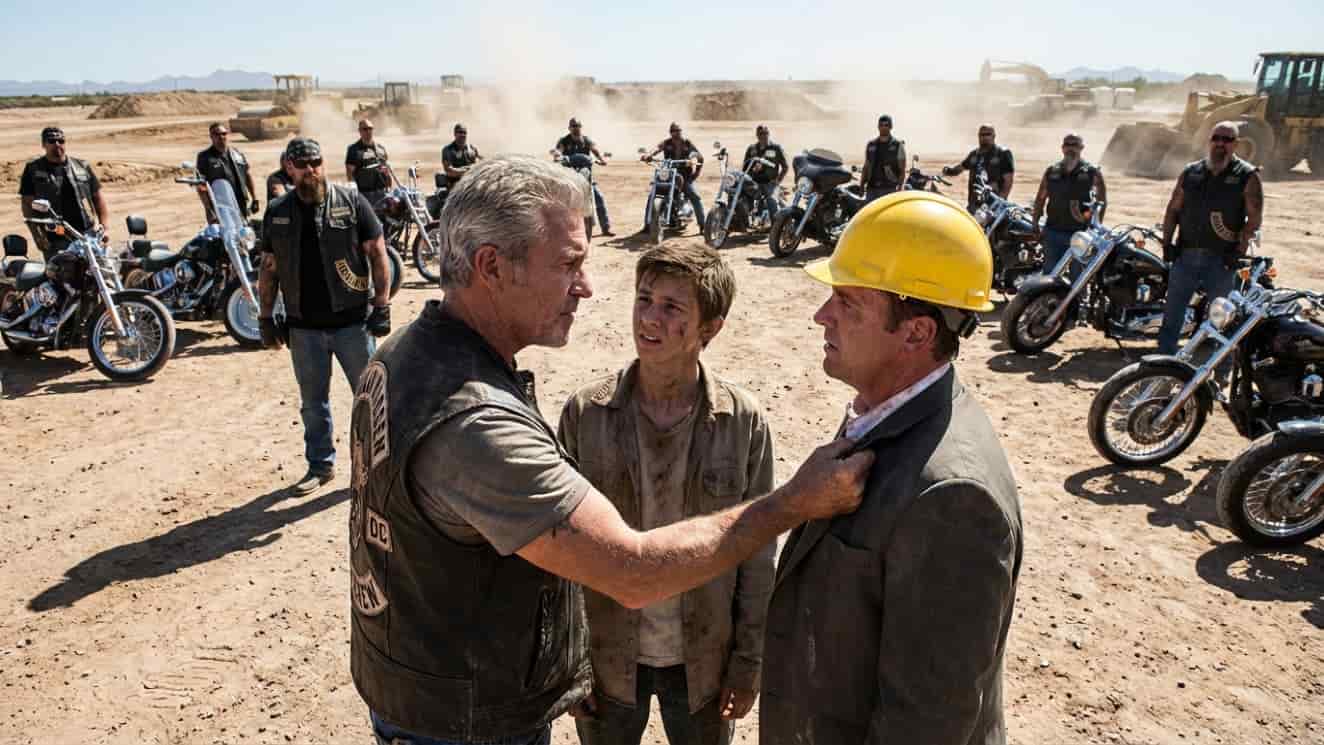
The dust in the Yard tasted like copper and diesel, the kind of heat that made your vision vibrate. I watched Miller put his hand on the kid’s shoulder—my kid’s shoulder—and shove him toward a trench that looked more like a grave. Miller didn’t know I was watching. He didn’t know that the man in the dusty leather vest wasn’t just another drifter off the I-10. He didn’t know that I had a hole in my lung and a brotherhood at my back that didn’t believe in the word ‘mercy.’
“He’s worked ten hours, Miller,” I said, stepping out from the shadow of the equipment shed. My voice sounded like gravel grinding together, the cancer finally taking its bite.
Miller laughed, a wet, arrogant sound that belonged to a man who thought he owned the county. “He works until I say he’s done. Who the hell are you?”
I didn’t answer with words. I answered with the sound of twenty-four 1200cc engines screaming as they crested the ridge. I watched the color leave Miller’s face as he realized that the boy he’d been bullying wasn’t an orphan. He was royalty in a kingdom built on chrome and blood. The debt was due, and I wasn’t leaving until the ledger was clear.
Chapter 1: The Iron Diagnosis
The doctor’s office smelled like lemon floor wax and a slow, sterile death. It was a small room in a clinic outside of Mesa, the kind of place where people went when they didn’t have insurance but had enough cash to keep questions to a minimum. Wolf Madsen sat on the edge of the crinkly paper-covered exam table, his boots dangling. His leather vest, heavy with the “Nomad Crew” top rocker and the “President” patch, felt like it weighed fifty pounds today.
Dr. Arispe didn’t look at him. He looked at a set of grey-and-black films clipped to a lightbox. The man was old, his hands spotted with age, but he’d stitched up enough of Wolf’s brothers over the last two decades to earn a seat at the table.
“It’s not a chest cold, Wolf,” Arispe said, his voice reaching through the silence like a dull blade. “It’s a fire. And you’ve run out of water.”
Wolf didn’t flinch. He’d lived through three shootings, two high-speed wrecks, and a decade in state prison. He knew how to take a hit. He reached into his pocket, pulled out a crumpled pack of unfiltered Luckies, then remembered where he was and shoved them back. “How long?”
“Six months if you’re lucky. Three if you keep riding like a maniac and breathing in desert grit.” Arispe finally turned around. “There’s no surgery for this. Not at this stage. It’s in the lymph nodes now.”
Wolf nodded slowly. He felt a strange, cold lightness in his chest, as if the weight of the world had finally decided to let go because it knew he was falling anyway. “Don’t tell the boys. Axle will start mourning me before I’m in the ground, and I can’t stand the sight of him crying into his beer.”
“They’re going to find out, Wolf. You’re coughing up blood.”
“I’ll tell ’em when the time is right,” Wolf said, sliding off the table. He stood six-foot-two, a wall of scarred muscle and faded tattoos. Over his left breast, a jagged scar cut right through a tattoo of a woman’s name: Elena. He’d tried to cut her out of his skin twenty years ago after she’d vanished with a suitcase and a secret. He thought he’d succeeded.
He paid the doctor in cash—crisp hundreds from a “membership” fund—and walked out into the blinding Arizona sun. His bike, a customized 1998 Heritage Softail with ape hangers and a seat worn to the shape of his bones, was waiting. He kicked it over, the thunder of the exhaust vibrating in his teeth, and headed toward the clubhouse.
But he didn’t go straight back. He stopped at a roadside diner called The Rusty Spur, a place where the coffee was burnt and the ghosts stayed out of the light. He sat in a back booth and pulled out a yellowed envelope he’d received a week ago. It had no return address, just a postmark from a small town called Gila Bend.
Inside was a single photograph and a short, shaky note. The photo showed a teenage boy with Wolf’s same high cheekbones and deep-set, narrowed eyes. He was wearing a filthy t-shirt, standing in front of a construction trailer. He looked exhausted. He looked like he’d been beaten by life before he’d even started living it.
The note said: His name is Toby. He’s eighteen. Elena died three years ago, Wolf. She kept him hidden, but she couldn’t keep him safe. He’s at the Miller site in Gila Bend. They’re killing him. If you have any soul left under that leather, go find him.
Wolf stared at the boy’s face. He’d spent twenty years convincing himself that Elena had left because she hated the life, that she’d found some accountant in San Diego and raised a family in a house with a white fence. To find out she’d died in some trailer park and left his son to rot in a labor camp… it was a different kind of cancer. One he couldn’t just ignore.
He folded the paper, his knuckles white. He thought about the “Nomad Crew.” They were five hundred strong across four states. They were his family. But they were also a burden. If he told them he had a son, the boy would be a target. If he didn’t, the boy would die in the dirt.
He walked out to his bike and didn’t head north to the clubhouse. He headed south, toward the dust.
Chapter 2: The Dust and the Debt
Gila Bend was a town that the desert was slowly trying to eat. The heat was a physical weight, a shimmering haze that turned the horizon into a distorted mirror. Wolf rode through the main drag, past the boarded-up motels and the gas stations that looked like they hadn’t seen a shipment of fuel since the nineties.
The “Miller Site” wasn’t hard to find. It was a massive expanse of scarred earth on the edge of town, a planned residential development that had clearly stalled out. Half-finished foundations sat like tombstones in the red dirt.
Wolf parked his bike on a ridge overlooking the yard. He pulled out a pair of binoculars and adjusted the focus. He saw the trailers, the rusted cranes, and the men. They didn’t look like construction workers. They looked like ghosts. Most of them were young, some probably illegal, all of them moving with the slow, rhythmic desperation of people who knew there was no way out.
He found the boy within ten minutes. Toby was hauling bags of concrete toward a mixer. He was thin, his ribs showing through the sweat-soaked fabric of his shirt. His movements were shaky. As Wolf watched, a man in a white hard hat walked up and shoved Toby, shouting something Wolf couldn’t hear over the wind. Toby stumbled, dropped the bag, and took a kick to the thigh for his trouble.
Wolf felt a heat in his blood that had nothing to do with the Arizona sun. It was an old, predatory instinct. He’d spent his life being the wolf, the one who took what he wanted and protected his own with a violence that bordered on the religious. Seeing his own blood—his son—treated like a pack animal snapped something inside him that had been brittle for a long time.
He rode down into the yard, the tires of the Softail kicking up a plume of red dust. He didn’t slow down until he was ten feet from the mixer.
The man in the white hard hat stepped forward, squinting against the sun. He was a thick-necked guy with a gut that overhung a heavy tool belt. This was Miller. Or at least, one of his lieutenants.
“You’re trespassing, Pops,” the man said, resting a hand on a heavy wrench at his hip. “This is a private job site. Turn that noise-maker around and get lost.”
Wolf didn’t turn the engine off. He let it idle, the low-end thrumming making the dust dance on the ground. He looked past the foreman at Toby. The boy was staring at him, his eyes wide and clouded with confusion. He didn’t recognize the man, but he recognized the aura. Everyone did.
“I’m looking for the man in charge,” Wolf said, his voice a low vibration that seemed to cut through the heat.
“You’re looking at him. Name’s Silas. Now, I told you to leave.”
Wolf swung his leg over the bike and stood up. He didn’t draw a weapon. He didn’t have to. He just walked toward Silas until he was inside the man’s personal space. Silas was big, but Wolf was a different kind of big—the kind that came from decades of holding a line against men who didn’t care if they lived or died.
“The boy,” Wolf said, nodding toward Toby. “He’s done for the day.”
Silas laughed, but it was a nervous sound. He looked around at the other workers, who had stopped to watch. “He’s done when the sun goes down. He owes us for his room and board. He’s on a contract.”
“Contract’s over,” Wolf said. He reached out, his hand moving like a snake, and grabbed Silas by the front of his shirt. He leaned in close, the smell of leather and old tobacco overpowering the smell of concrete. “I’m going to give you a choice, Silas. You can let the boy walk to that ridge with me right now, or I can call five hundred of my brothers and we can turn this whole yard into a funeral pyre.”
“You’re crazy,” Silas wheezed, trying to pull away. “Miller has friends. The Sheriff, the Mayor… you can’t just—”
“I don’t care about Miller’s friends,” Wolf Growled. “I’m a man with nothing to lose and a very short calendar. Think about that very carefully.”
He let go of the foreman and turned his back on him—a move of pure, calculated disrespect. He looked at Toby. “Come on, kid. We’re going.”
Toby hesitated, looking at Silas, then at the empty desert, then back at the man in the leather vest. He didn’t know who Wolf was, but he knew that for the first time in his life, someone had stood up for him. He dropped the bag of concrete and started walking.
Chapter 3: The Law of the Desert
They sat in a small, air-conditioned diner ten miles outside of Gila Bend. Toby was inhaling a double cheeseburger as if he hadn’t eaten in a week, which he probably hadn’t. Wolf sat across from him, nursing a black coffee and trying to keep his hands from shaking. The cough was bubbling in the back of his throat again, a hot, metallic itch.
“Who are you?” Toby asked between bites. His voice was cracking, a mix of late-adolescence and pure exhaustion. “You’re with that biker gang, right? The Nomads? I saw the patches.”
“I am the Nomads,” Wolf said simply. He watched the boy. Up close, the resemblance was haunting. The way Toby held his head, the stubborn set of his jaw—it was like looking into a cracked mirror of 1994. “Your mother was Elena Madsen. She didn’t tell you about me, did she?”
Toby stopped chewing. He slowly put the burger down. His eyes searched Wolf’s face, looking for the lie. “She said my dad died in the war. She said he was a hero.”
Wolf felt a bitter laugh rise in his chest. “I’ve been in a lot of wars, kid. But none of them involved a uniform. She lied to protect you. She knew what this life does to people. She wanted you to have a chance.”
“So why now?” Toby’s voice turned sharp, defensive. “She’s been gone three years. I’ve been bouncing around foster homes and work crews ever since. Why show up now when I’m already half-dead?”
“I didn’t know,” Wolf said, and for the first time in years, he felt the cold sting of genuine shame. “I thought she’d gone to find a better man. I didn’t know about you until a week ago.”
Toby looked away, his eyes welling with a rage he was trying to suppress. “Well, thanks for the burger. But you should probably go back to your club. Miller… he’s not just a contractor. He’s the one who runs the ‘Work Release’ program for the county. He gets kids from the system, tells the state he’s ‘vocational training’ us, and then keeps us in debt for the trailers we sleep in. If I don’t go back, the Sheriff will put out a warrant for me.”
“Let him,” Wolf said.
Before he could say more, the bell over the diner door jingled. A man in a tan uniform with a silver star on his chest walked in. Sheriff Miller—no relation to the contractor, but a man who clearly shared the same payroll—took a seat at the counter. He didn’t look at them directly, but he didn’t have to.
Wolf recognized him. Sheriff Miller was a man who had been “clean” for twenty years, mostly because he was too smart to get caught. He was the foil to everything Wolf stood for: the system’s power used for personal gain.
The Sheriff turned his stool around, his hand resting casually near his holster. “Wolf Madsen. You’re a long way from your territory. I heard you caused a bit of a stir at the job site today.”
“Just taking a family member out for lunch, Sheriff,” Wolf said, his voice level. “Nothing illegal about a meal.”
“The boy is under a state-mandated work contract,” the Sheriff said. “Taking him off-site without authorization is a felony. Interference with a state program. Now, I like you, Wolf. You keep your boys in line and you don’t bring your drug wars into my county. But I can’t let you walk out of here with that kid.”
Wolf stood up. He felt the cough coming and forced it down, his chest burning. “He’s my son, Sheriff. You know what that means to a man like me.”
“It means you’re blinded by sentiment,” the Sheriff replied, stepping closer. “Miller has a lot of money tied up in those contracts. He has the Governor’s ear. If you take this kid, you’re not just fighting a contractor. You’re fighting the state of Arizona. You want that kind of heat on your club?”
Wolf looked at Toby, who was shaking. Then he looked at the Sheriff.
“I’ve spent thirty years building an empire so that I wouldn’t have to ask for permission to breathe,” Wolf said. “I’m not starting now. You tell Miller that the debt is canceled. If I see a patrol car or a process server within five miles of this boy, I won’t call a lawyer. I’ll call a war.”
The Sheriff sighed, a sound of genuine regret. “You’re a dinosaur, Wolf. The world doesn’t work on ‘honor’ and ‘brotherhood’ anymore. It works on paper. And you don’t have any.”
“I have five hundred men who don’t care about paper,” Wolf said. He grabbed Toby’s arm. “Let’s go.”
They walked out. The Sheriff didn’t stop them, but Wolf saw him pick up his radio as soon as the door closed. The clock wasn’t just ticking in Wolf’s lungs anymore. It was ticking on the highway.
Chapter 4: The Line in the Sand
They spent the night in a hidden “safe house”—a run-down garage owned by a former Nomad named Axle. It was a place filled with the smell of motor oil and the sound of the desert wind howling through the corrugated metal walls.
Wolf spent the night sitting in a lawn chair by the door, a shotgun across his lap. His breathing was wet now, a rattling sound that he couldn’t hide in the stillness of the garage.
Toby sat on a cot, watching him. “You’re sick,” the boy said quietly.
“I’m old,” Wolf corrected. “There’s a difference.”
“No. I’ve seen people die in the Yard. Heat stroke, lung rot from the dust. You have that look. Why are you doing this if you’re just going to leave me anyway?”
Wolf looked at the boy. The question hit harder than any bullet ever had. “Because I’ve spent my life being a ghost, Toby. I’ve built things that don’t last. I’ve loved people I couldn’t keep. But you… you’re the only thing I’ve ever made that’s actually real. If I can give you one day of being free, one day where nobody can tell you what you’re worth… then the rest of it doesn’t matter.”
“I don’t want your empire,” Toby said, his voice trembling. “I just wanted a dad.”
Wolf closed his eyes. The pain in his chest was a white-hot spike. “I know. And I’m sorry I’m late.”
By dawn, the roar of engines began. It started as a low hum on the horizon, like a coming storm. Then it grew into a bone-shaking thunder. One by one, the Nomads began to arrive. They didn’t come in a neat line. They came from the backroads, from the highways, from the dirt tracks. Men with grizzled beards and patched vests, their bikes covered in the dust of three different states.
Axle, a man with a prosthetic leg and a laugh like a chainsaw, walked up to Wolf. “You called the ‘Long March,’ boss. We’re all here. Every chapter. What are we doing in this hellhole?”
Wolf stood up, leaning heavily on his bike for a moment before finding his balance. He looked at the fifty men already gathered, with hundreds more on the way.
“We’re going back to the Yard,” Wolf said. “There’s a man named Miller who thinks he owns my blood. He thinks he can treat our children like scrap metal because he has a piece of paper from the state.”
A murmur of dark approval went through the crowd. In the biker world, family was the only thing more sacred than the patch.
“I’m not asking you to die for a kid you don’t know,” Wolf continued, his voice rising, cutting through the idling engines. “I’m asking you to show this town that the Nomads don’t leave their own in the dirt. We’re going to walk into that yard, and we’re going to take what’s ours. If they want to fight, we give ’em a war they’ll tell stories about for a hundred years.”
They rode out at noon. The sun was at its peak, turning the road into a ribbon of liquid fire. Wolf led the pack, Toby sitting behind him, clutching his waist. Behind them, the line of chrome and leather stretched back for a mile—a literal river of iron.
When they reached the construction site, the gates were locked. A line of private security guards stood behind the fence, holding shotguns. Behind them, the Sheriff’s cruisers were parked in a defensive semi-circle. Miller was there too, standing on the balcony of his trailer, looking down like a king on a castle wall.
Wolf didn’t stop. He rode his Softail straight into the chain-link gate, the heavy iron frame of the bike shattering the lock. The five hundred bikers poured into the yard like a flood, the sound of their engines drowning out everything else.
Wolf stopped at the center of the yard, the same spot where he’d seen Toby humiliated the day before. He dismounted and looked up at Miller.
“I told you the debt was canceled,” Wolf yelled.
Miller stepped forward, clutching a megaphone. “You’re under arrest, Madsen! This is a riot! Sheriff, do your job!”
The Sheriff stepped out of his car, his face pale. He looked at the five hundred men circling the yard. He looked at the heavy chains they were pulling from their bikes, the quiet, disciplined fury in their eyes. He knew that if he pulled his gun, the desert would swallow him and his men before the first shell hit the ground.
“I can’t stop them, Miller,” the Sheriff said into his radio, his voice shaking. “You shouldn’t have touched his kid.”
Wolf walked toward the trailer, his hand moving to the front of his vest. He unzipped it, revealing the scar over his heart. He pulled a small, digital recorder from his pocket—the one Axle had helped him rig the night before.
“I don’t just have brothers, Miller,” Wolf said. “I have your bookkeeper. I have the records of every bribe you paid to the ‘Work Release’ board. I have the names of the kids you buried in the back forty because they got too sick to work.”
Miller’s face went from red to a sickly, greyish white.
“You want to talk about paper?” Wolf asked, stepping onto the stairs of the trailer. “I have enough paper to put you in a cage for the rest of your miserable life. Or, we can do this the Nomad way.”
Wolf turned to his men. “Axle! Bring the gas!”
Toby watched from the bike, his heart hammering against his ribs. He saw his father, a man who was literally dying on his feet, standing against an entire system. He saw the power of the brotherhood, the way they moved as one. For the first time, he didn’t feel like a victim. He felt like a Madsen.
But as Wolf reached the top of the stairs, he stumbled. A violent cough racked his body, and he sprayed a dark, crimson mist across the white siding of the trailer. He slumped against the railing, his face contorted in pain.
“Wolf!” Axle screamed, moving forward.
The Sheriff saw his moment. He drew his weapon. “Stay back! Everyone stay back!”
The yard turned into a tinderbox. Five hundred bikers reached for their gear. The security guards leveled their shotguns. The silence that followed was the loudest thing Toby had ever heard.
Wolf looked up, blood on his lips, a terrifying grin on his face. “Go ahead, Sheriff. Make my son an orphan twice in one day. See what happens to your town when I stop being the one holding these men back.”
The Sheriff’s hand trembled. The stand-off held, a jagged line of tension in the Arizona heat.
And then, from the back of the crowd, the sound of more engines appeared. Not bikes. Heavy trucks. The locals. The parents of the other kids Miller had stolen. They had seen the “Long March” on the news, and they had decided they’d had enough of the silence, too.
The war for Mercy had officially begun.
Chapter 5: The Reckoning in the Red Dirt
The blood on the white siding of the trailer looked like a Rorschach test of a dying man’s sins. Wolf Madsen wiped his mouth with the back of a gloved hand, the metallic tang of it coating his tongue like a copper penny. He didn’t look at the blood. He looked at Miller, whose eyes were darting between the dying biker on his porch and the five hundred engines idling in his yard.
“You’re done, Miller,” Wolf said, his voice a rasping whisper that somehow carried further than the megaphone ever could. “The Sheriff knows it. These men know it. Even the dirt knows it.”
The Sheriff, a man caught between a career of complicity and a sudden, sharp fear for his life, didn’t move. His hand was still on his holster, but the thumb wasn’t on the strap. He was looking at the crowd of locals—mothers in faded floral dresses, men with calloused hands and sun-cracked faces—who were now standing shoulder-to-shoulder with the bearded, tattooed giants of the Nomad Crew. It was a strange, jagged mosaic of American desperation.
“Put the gun away, Silas,” the Sheriff said, his voice cracking. He wasn’t talking to Wolf. He was talking to the foreman standing behind the fence with the shotgun. “It’s over. Look at them. You pull that trigger, and there won’t be enough left of Gila Bend to put on a map.”
Silas looked at the crowd, then at the bikers. He saw Axle, a man who looked like he’d been forged in a furnace and tempered in oil, leaning against his handlebars with a heavy chain wrapped around his fist. Silas lowered the shotgun. He wasn’t a soldier; he was a bully, and bullies always know when the math has stopped working in their favor.
Wolf took a shaky step forward, his boots heavy on the metal stairs. He pushed past Miller and walked into the trailer. The air inside was cool, smelling of expensive cologne and stale cigar smoke. It was the office of a man who thought he had bought his way out of the desert’s judgment.
“What are you doing?” Miller hissed, following him in, his bravado replaced by a high-pitched panic. “You can’t just walk in here! I have rights!”
“You had rights,” Wolf said, pulling a heavy steel filing cabinet away from the wall with a strength that shouldn’t have been possible for a man with half a lung. “Then you started stealing the lives of children. Now you just have consequences.”
He kicked the lock off a smaller, fireproof box hidden behind the cabinet. Inside were the ledgers—the real ones. The ones that didn’t go to the state auditors. They contained the kickback schedules, the names of the “disposable” workers, and the cash payments to the board members who kept the Work Release program funded.
Wolf grabbed the stack of papers and walked back out onto the balcony. The heat hit him like a physical blow, making his head swim. He held the papers up high.
“This is your town!” Wolf roared, the effort sending a fresh spasm of pain through his chest. “This is what your silence bought! He didn’t just hurt my son. He’s been eating your future to pay for his swimming pools and his campaign funds!”
A roar went up from the crowd, a guttural sound of collective realization. The locals began to push against the fence. The security guards, seeing the tide turn, simply stepped aside. They weren’t paid enough to die for a contractor’s secrets.
Toby ran toward the trailer, dodging through the parked bikes. He reached the bottom of the stairs just as Wolf’s knees finally gave out. The big man slumped against the railing, his face a ghostly grey.
“Dad!” Toby yelled, the word sounding foreign and desperate on his lips.
Wolf looked down at him, his vision blurring. He saw the boy—his boy—and for a second, the twenty years of darkness felt like they’d been worth it just to hear that one word. He handed the ledgers to Axle, who had climbed the stairs in two massive strides.
“Get these to the state police,” Wolf wheezed. “Not the locals. Get them to the city. Make sure they don’t disappear.”
“I got ’em, Wolf,” Axle said, his eyes wet. “But we gotta get you to a hospital. Now.”
“No,” Wolf said, grabbing Axle’s arm with surprising force. “No hospitals. Take me to the garage. I’m not dying in a room that smells like bleach.”
The retreat from the Yard was a slow, solemn procession. The bikers formed a corridor, their engines humming in a low, respectful thrum as Wolf was lifted onto a sidecar usually reserved for gear. Toby sat beside him, holding his father’s hand—a hand that was rough, scarred, and cooling by the minute.
Miller was left standing on his porch, alone. The Sheriff didn’t arrest him right then—he didn’t have to. The people of Gila Bend were already moving toward the trailer, their faces set in a grim, righteous fury. The system hadn’t saved them, so they were going to save themselves.
Back at Axle’s garage, the sun was beginning to dip below the horizon, painting the desert in shades of bruised purple and deep orange. The five hundred bikers parked in the surrounding dirt, their headlights cutting through the growing gloom like a thousand tiny stars. They didn’t talk. They didn’t drink. They just waited.
Inside the garage, the air was thick with the smell of old grease and sagebrush. Wolf lay on the cot, his breathing shallow and rattling. Toby sat on a milk crate next to him, his face streaked with dirt and tears.
“I didn’t… I didn’t want it to be like this,” Wolf said, his voice barely a shadow. “I wanted to take you to the coast. Show you the ocean. It’s bigger than the desert, Toby. You can’t see the end of it.”
“It’s okay,” Toby whispered. “You came for me. That’s all that matters.”
“Listen to me,” Wolf said, struggling to focus. “The club… they’re rough men. But they’re loyal. Axle will look after you. There’s money in a locker in Mesa. The key is under the seat of my bike. It’s yours. Use it to go to school. Don’t… don’t put on the leather, Toby. Be better than me.”
“I don’t want the money,” Toby said, his voice breaking. “I just want you to stay.”
Wolf smiled, a small, sad movement of his lips. “I’ve been running for fifty years, kid. I’m tired. My legs are gone, and the road’s run out.”
He looked past Toby at the open door of the garage. He could see the silhouettes of his brothers, the men he’d led, bled for, and loved in his own broken way. He saw the firelight reflecting off the chrome of their bikes. It was a kingdom of iron and dust, and for the first time in his life, he felt like he’d finally finished the job.
“Axle!” Wolf called out, his voice suddenly clear.
The big man stepped into the light, his head bowed. “I’m here, Wolf.”
“Tell the boys… tell ’em the March is over. We’re home.”
Wolf’s hand went limp in Toby’s grip. The rattling in his chest stopped, replaced by a silence so profound it felt like the desert itself had stopped breathing.
Toby sat there for a long time, the weight of his father’s hand still heavy on his own. He didn’t feel like a victim anymore. He didn’t feel like a foster kid or a laborer. He felt the weight of a name—Madsen—and the strange, terrible grace of a man who had burned down his own world just to make sure his son wouldn’t have to live in the ashes.
Chapter 6: The Last Ride of the Nomad
The funeral wasn’t in a church. Wolf Madsen hadn’t stepped inside a house of God since he was six years old, and he wasn’t about to start when he was dead. They held it on a ridge overlooking the Gila Valley, a place where the wind never stopped and the view went on forever.
Five hundred bikes lined the ridge, a wall of black and chrome that shimmered in the morning light. The men stood in their “Full Colors,” their faces grim and set. There were no flowers, just a single, battered leather vest laid across a plain pine casket. The “President” patch was still there, faded by thirty years of sun and rain.
Axle stood at the head of the casket. He didn’t give a long speech. He wasn’t a man of words; he was a man of action, and everyone there knew what Wolf had done.
“He was a hard man,” Axle said, his voice echoing off the canyon walls. “He was a violent man. But he never lied to his brothers, and he never turned his back on his blood. He went out the way he lived—on his own terms, with his boots on. He’s the last of the old breed. The road’s going to be a lot quieter without him.”
One by one, the men filed past the casket. They didn’t say anything. They just touched the leather of the vest, a final, silent salute to the man who had been their north star for three decades. Some left challenge coins, some left small stones, and some just nodded.
Toby stood at the end of the line. He felt small in the middle of all that leather and muscle, but nobody looked down on him. When he reached the casket, Axle stepped aside, giving him the space.
Toby looked at the vest. He reached out and touched the scar on the leather where the bullet had hit Wolf in ’04, a story Axle had told him the night before. He felt the history of the man, the sheer, stubborn weight of a life lived without apology. He realized then that Wolf hadn’t just saved him from Miller; he’d saved him from being nobody.
“I’ll remember,” Toby whispered, his voice steady. “I’ll be the man you wanted me to be.”
As they lowered the casket into the dry, red earth, the sound began. It started with one bike, then ten, then a hundred. Five hundred engines roared at once, a deafening, bone-shaking scream of defiance against the desert sky. It wasn’t a song; it was a war cry. It was the sound of the Nomad Crew saying goodbye to their king.
The aftermath in Gila Bend was swift and brutal. With the ledgers in the hands of the state police, the “Work Release” program was dismantled within forty-eight hours. Miller was arrested at his home, dragged out in his silk pajamas in front of a dozen news cameras. The Sheriff resigned “for health reasons,” though everyone knew he’d struck a deal to avoid the cell next to Miller’s.
Toby stayed at the garage for a week after the funeral. He helped Axle clean the tools, sweep the floors, and organize the parts. He didn’t talk much, and Axle didn’t push him. They moved in a comfortable, quiet rhythm, two people bound by the same ghost.
On the final morning, Axle walked out to the driveway where Wolf’s Heritage Softail was parked. It had been cleaned and polished until it looked like it had just rolled off the showroom floor in ’98. The chrome was blinding, and the leather seat was supple and dark.
“It’s yours,” Axle said, handing Toby the keys.
Toby looked at the bike, then at Axle. “I told him I wouldn’t put on the leather. He didn’t want me in the club.”
“This isn’t the club, kid,” Axle said, his voice soft. “This is just a machine. It’s a way to get from where you are to where you want to be. Your dad didn’t want you to be him, but he wanted you to have his strength. This bike… it knows the way. It’ll take you wherever you need to go.”
Toby took the keys. They were heavy, cold in his hand. He looked at the long, straight line of the I-10 stretching out toward the horizon. He thought about the ocean Wolf had mentioned. He thought about the school in Phoenix he’d looked up on the old computer in the office.
“Where are you going to go?” Axle asked.
“West,” Toby said. “I want to see the water.”
Axle nodded, a slow, approving movement. “Good. Take the backroads. Avoid the weigh stations. And if you ever find yourself in trouble, you look for the patch. You’re a Madsen. You’ll never have to ride alone.”
Toby climbed onto the bike. He was still a bit small for it, his feet barely reaching the ground, but he felt the power of it beneath him. He kicked it over, and the engine roared to life, a deep, familiar thunder that vibrated in his chest. It sounded like his father’s voice.
He rode out of the garage, the dust kicking up behind him. He passed the Miller site, now a ghost town of abandoned equipment and yellow police tape. He passed the diner where he’d had that first burger with a man he’d only known for three days.
He didn’t look back. He kept his eyes on the road, the wind whipping past his face, the heat of the Arizona sun on his back. He felt the weight of the key in his pocket and the strength of the engine between his legs.
Wolf Madsen was gone, buried in the dirt of a town that had tried to break him. But as Toby hit the open highway, shifting into fourth gear and feeling the bike lunge forward toward the coast, he knew that his father hadn’t really died. He was there in the roar of the exhaust, in the smell of the sagebrush, and in the steady, unwavering heartbeat of a boy who finally knew who he was.
The desert was vast, and the road was long, but for the first time in his life, Toby wasn’t afraid of the distance. He had a name, he had a legacy, and he had a horizon that didn’t have a fence.
He twisted the throttle, and the Nomad Crew’s last prince disappeared into the shimmering heat, riding toward a world that would never be the same again.