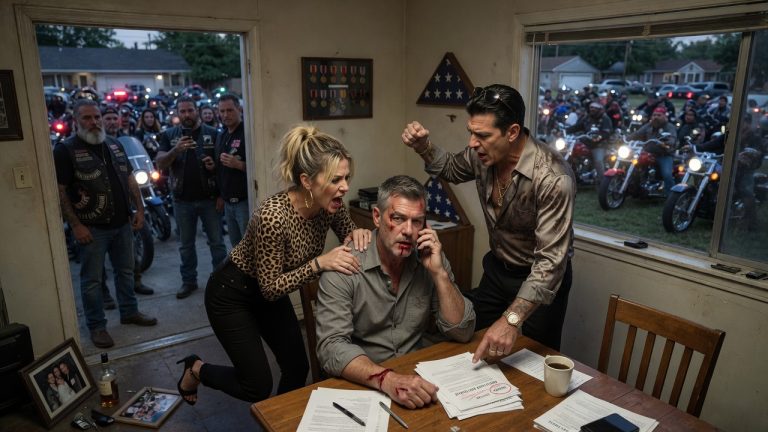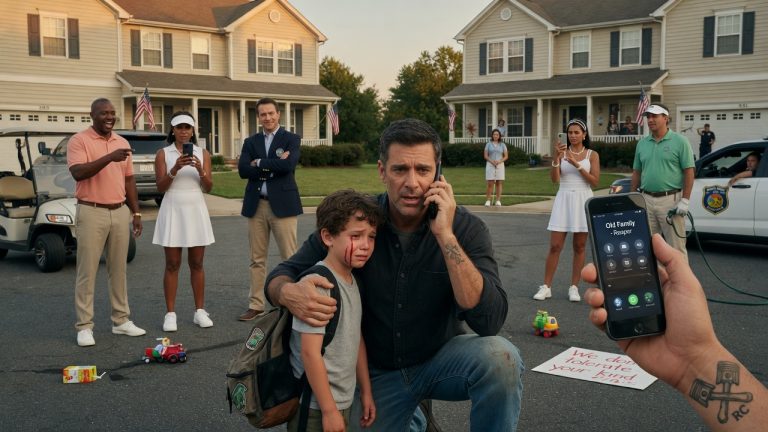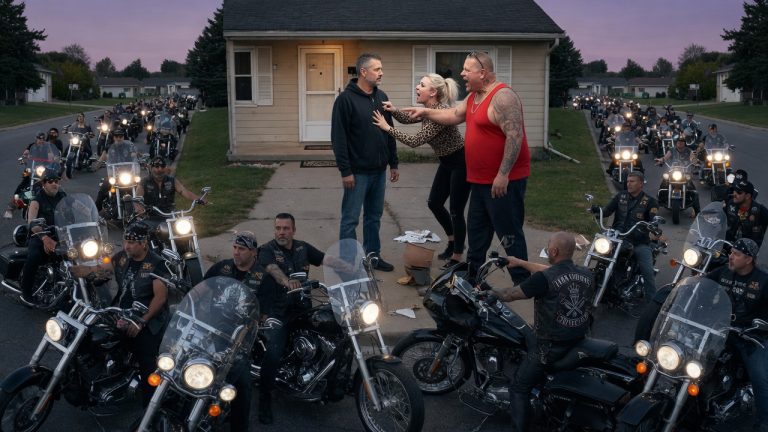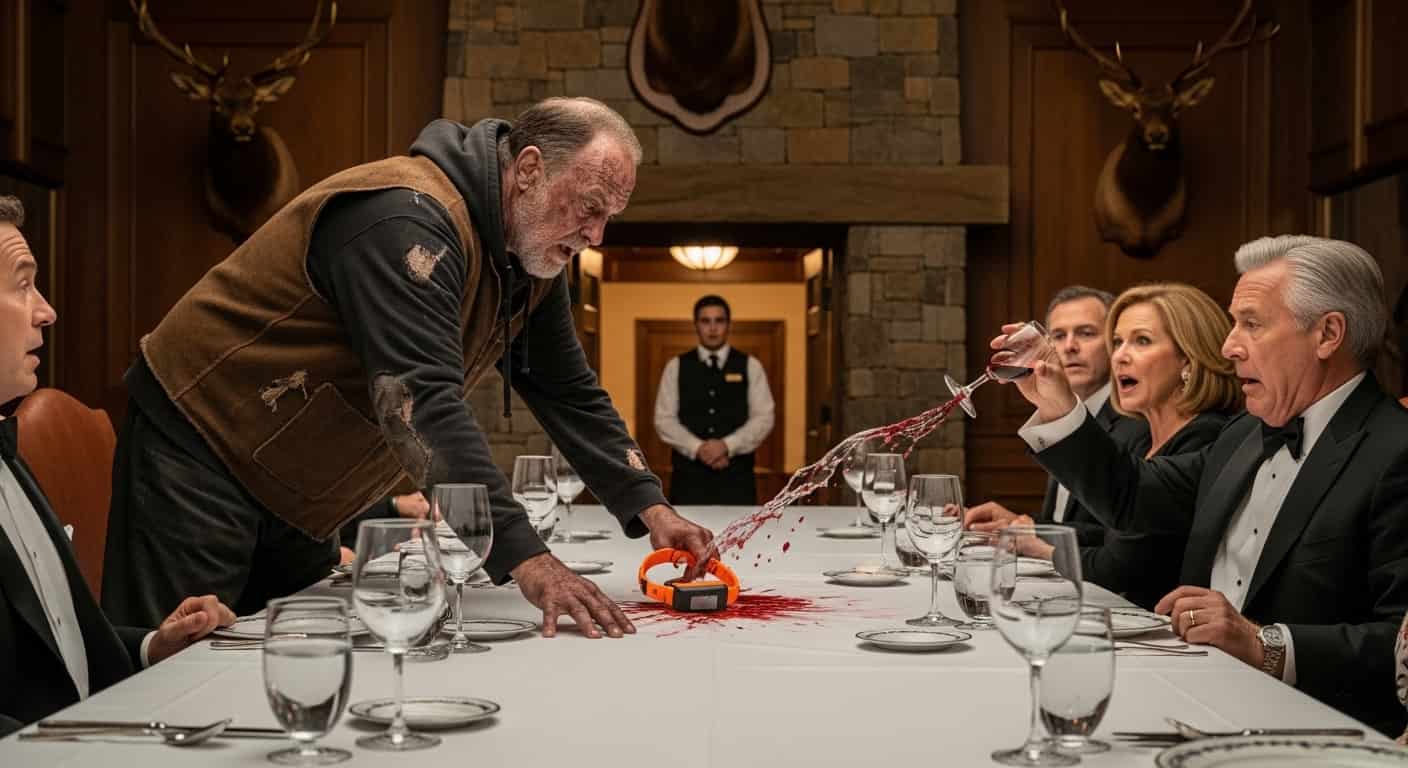
The gala was $1,000 a plate. The wine was older than the men drinking it. To the High Ridge Club, a beagle in the woods was just a moving target—something to shoot at when the deer weren’t biting.
They thought Elias was just a broken old man who wouldn’t fight back. They thought nobody was watching.
But Steel Rossi was watching. And he’s running out of time to be a good man.
When the bloody GPS collar hit the linen, the music stopped. The lies were over. But the fire was just beginning.
FULL STORY: NO PEACE FOR THE CRUEL
Chapter 1: The Rattle in the Chest
The winter in Northern Minnesota doesn’t just arrive; it colonizes. It moves into your joints and stays there until May. Steel Rossi sat on the porch of his cabin, a small, cedar-shingled box that smelled permanently of chain lube and woodsmoke. He took a drag from a generic-brand cigarette, then immediately regretted it. The cough came from deep in his diaphragm, a wet, tearing sound that ended with a copper taste in his mouth.
He wiped his lips with the back of a hand mapped with blue veins and faded ink. The doctor in Duluth had called it “aggressive.” Steel called it a debt. He’d spent forty years running with the Iron Disciples, breathing in exhaust fumes and bad decisions. Now, the bill was due.
“Easy, Steel,” a voice called from the gravel drive.
It was Elias, a man who looked like he’d been carved out of a fallen pine. Elias was a Vietnam vet who lived half a mile down the road. He was carrying a small, shivering bundle wrapped in a flannel shirt. Behind him, Daisy, his three-year-old beagle, was uncharacteristically silent.
“What happened?” Steel stood up, his knees popping like dry kindling.
Elias laid the bundle on the porch table. It was Daisy. Her flank was matted with dark, freezing blood. “High Ridge boys,” Elias said, his voice paper-thin. “They were up on the ridge with the long rifles. Target practicing on the stumps. One of ’em… one of ’em decided the ‘stump’ was moving too fast.”
Steel looked at the dog. She was breathing in shallow, terrified hitches. He reached out, his thick, calloused fingers surprisingly gentle as he felt for the exit wound. “Bullet grazed her. Shock’s the worst of it. Where’s Doc?”
“He’s at the clubhouse. Said he’d meet us here.”
Steel looked toward the ridge. The High Ridge Hunting Club owned six thousand acres of the best timberland in the county. It was a playground for Minneapolis lawyers and pharmaceutical executives who liked to play pioneer for a weekend. They had a three-story lodge with a chef and a landing strip. To them, the locals were just part of the scenery—and sometimes, the scenery got in the way.
“They did it on purpose, Steel,” Elias whispered. “They were laughing. I heard ’em through the brush. One of ’em said, ‘Nice lead, Vance.'”
Vance Thorne. Steel knew the name. The President of High Ridge. A man who bought his way into “nature” so he could dominate it.
Steel looked at his hands. They were shaking. Not from the cold, and not from the cancer. He felt a familiar, ugly heat rising in his gut—the kind of heat he hadn’t felt since he’d hung up his colors three years ago.
“Take her inside,” Steel said. “Doc’ll be here in ten. Stay with her.”
“Where are you going?”
Steel didn’t answer. He walked to the shed where his 1998 Electra Glide sat under a tarp. He shouldn’t be riding. His balance was off, and the vibration made his lungs ache. But as he pulled the tarp back, the smell of the oil and the sight of the chrome felt like the only medicine he had left. He reached into a hidden compartment in the tool chest and pulled out an old leather kutte. The patches had been stripped, leaving ghost-marks where the “Iron Disciples” rockers used to be.
He put it on. It felt heavy. It felt right.
He had a daughter in St. Paul. She was getting married in three days. He had the invitation in his kitchen, tucked under a bottle of morphine. He’d told himself he was too sick to go, that he was “poison” and would only ruin her day. But looking at the blood on the porch, he realized he was just scared. Scared of dying in a hospital bed without doing one last thing that mattered.
He kicked the bike to life. The roar echoed through the pines, a middle finger to the silence of the woods.
Chapter 2: The High Ridge Warning
The gates to the High Ridge Hunting Club were made of wrought iron, shaped like intertwining antlers. There was an intercom, but Steel didn’t use it. He parked the Harley squarely in front of the gate, the exhaust thumping like a heavy heart. He waited.
Three minutes later, a white Range Rover rolled down the private drive. A man in a high-end camo jacket—crisp, never seen a day of real brush—stepped out. This wasn’t Thorne. This was a younger man, maybe thirty, with the soft face of someone who had never been hit.
“This is private property,” the man said, staying behind the iron bars. “The public road is back that way, old-timer.”
“I’m looking for Vance Thorne,” Steel said. His voice was a low rasp, forced through a throat that felt like it was lined with sandpaper.
“Mr. Thorne is preparing for the Founders’ Gala. He doesn’t see uninvited guests.” The younger man looked at Steel’s bike, then at his worn leather. “Especially ones who look like they’re lost on their way to a dive bar.”
Steel didn’t move. He leaned back against his seat, the heat of the engine warming his calves. “A dog got shot this morning. On Elias Vance’s property. Your boys were on the ridge.”
The man’s expression shifted. It wasn’t guilt; it was annoyance. “We have a massive perimeter. Sometimes strays wander onto the grounds. It’s a hunting club. Guns go off. It’s an unfortunate reality of the sport.”
“It wasn’t a stray. It had a collar. And it wasn’t on your grounds. Your ‘boys’ were shooting across the property line.” Steel stood up. He was a head shorter than the gate-keeper, but he seemed to take up more space. “I want to hear Thorne say he’s going to pay the vet bill. And I want him to stay off the ridge.”
The younger man laughed. It was a sharp, condescending sound. “Do you know who you’re talking to? Mr. Thorne pays more in property taxes than your entire neighborhood is worth. If you want to file a complaint, call the Sheriff. But I’d be careful. The Sheriff is a member here.”
Steel felt the cough coming. He fought it down, his jaw tight. “The Sheriff likes the club because of the donations. I get that. But the woods have a different set of rules. You tell Vance that Steel Rossi came by. Tell him I’m looking for a correction.”
“A correction?” The man sneered. “Is that biker talk for a shakedown?”
“It’s neighbor talk for ‘don’t make me come back,'” Steel said.
He turned the bike around, kicking up a spray of gravel that peppered the white Range Rover. As he rode away, he saw the man pulling out a cell phone. Steel knew what was coming. He knew he was outnumbered, out-funded, and out-lived. But as he looked at the treeline, he saw a flash of orange—a hunter’s vest. They were still up there.
He rode back to his cabin. Doc was there, a man with a ponytail and a medical bag that had seen more gunshot wounds from club business than the local ER. He was stitching Daisy up on the kitchen table.
“She’ll live,” Doc said, not looking up. “But she’s terrified of the wind now. Every time a branch hits the roof, she jumps.”
Elias was sitting in the corner, a glass of whiskey in his hand. He looked small. “They don’t care, Steel. They think they’re gods because they have the money to buy the mountain.”
“They aren’t gods,” Steel said, sitting down heavily. He felt a sharp, stabbing pain in his chest. He reached for the morphine, then stopped. He needed to be sharp. “They’re just men who haven’t been shown the bill yet.”
Chapter 3: The Price of Silence
The next forty-eight hours were a study in escalation. Steel tried to stay home. He tried to look at his daughter’s invitation. Sarah Rossi and Michael Brennan. The wedding was in a chapel in St. Paul. He could imagine the smell of the lilies, the way the light would hit the stained glass. He could imagine Sarah looking at the back of the room, hoping to see a man who hadn’t been there for ten years.
He picked up the phone twice. Both times, he hung up before it rang. What was he going to say? Hey, I’m dying, and I spent my life being a monster, but I’d like to walk you down the aisle?
The decision was made for him on Thursday night.
A truck—dark, heavy-duty, no plates—roared past Elias’s house at midnight. They didn’t stop. They tossed something onto the porch.
Steel heard the engine and ran toward Elias’s place. He found the old man standing on his porch in his undershirt, holding a flashlight. On the deck lay a heavy, burlap sack. It was dripping.
Steel opened it. Inside was the head of a buck, freshly killed, with a note pinned to its ear with a fishhook.
STAY IN YOUR HOLE, BIKER. THE RIDGE IS OURS.
“They’re trying to scare me off,” Elias said, his voice trembling. “They want the land. Thorne’s been sending lawyers for months to buy my three acres so he can build a private road. I said no. Now this.”
Steel looked at the buck’s eyes. They were glassy, reflecting the moonlight. He looked at Elias, a man who had served his country and just wanted to live out his days with a dog and some peace. Then he thought of himself. He’d spent his life taking. Taking territory, taking respect, taking peace from others.
This was his mirror. Vance Thorne was just a different kind of club president. He used suits instead of leather, and lawyers instead of lead, but the soul was the same. The soul was a void that only felt full when it was crushing something smaller.
“They aren’t scaring you off,” Steel said. “They’re just proving they don’t deserve the mountain.”
He spent the rest of the night in his shed. He wasn’t fixing a bike. He was digging through an old trunk. He found a GPS tracker—one the club used to keep tabs on “unfriendly” vehicles during runs. He found a gallon of high-octane fuel. And he found the orange collar Doc had removed from Daisy. It was still stained with her blood.
His lungs were screaming now. Every breath was a struggle against the fluid building up. He knew he wouldn’t make the wedding. He knew he wouldn’t see the weekend. But as he looked at the bloody collar, he felt a strange, cold peace.
He didn’t have to be a father. He didn’t have to be a hero. He just had to be the monster that stopped the other monsters.
Chapter 4: The Mirror in the Dark
The Founders’ Gala at High Ridge was a sea of shimmering silk and stiff collars. From the woods, two hundred yards away, Steel watched through a pair of binoculars. The lodge was lit up like a beacon of arrogance.
He sat in the brush, his Electra Glide hidden behind a thicket of spruce. He was wearing his kutte. He felt the weight of his terminality. It was a superpower, in a way. What can you do to a man who is already dead?
He watched Vance Thorne through the window. Thorne was laughing, a glass of scotch in one hand, gesturing to a map on the wall. He looked safe. He looked untouchable.
Steel thought about his own father. A “pillar of the community” in their small town. A man who chaired the school board and then went home to break Steel’s mother’s ribs because the dinner was cold. Steel had spent his life trying not to be that man, only to end up a different version of him. Violent. Isolated. Terrified of being known.
He looked at the wedding invitation one last time. He pulled a lighter from his pocket and flicked it. The flame danced in the cold air. He watched the paper curl, the names Sarah and Steel disappearing into ash. He wasn’t going to her wedding. Not because he was poison, but because he was the cure for this specific sickness.
He stood up. The pain in his chest was a dull, rhythmic throb now. He grabbed the gallon of fuel and the GPS collar.
He didn’t sneak in. That wasn’t the Rossi way.
He rode the Harley right up the main drive, the headlights cutting through the expensive shadows. He didn’t stop at the gate; he’d cut the chain an hour earlier. He rode across the manicured lawn, the tires tearing deep ruts into the $50,000 sod. He parked at the front steps and walked in.
The scent of the lodge was a mix of expensive perfume and roasted lamb. It was sickening.
He pushed open the double doors to the dining hall. The room went silent. The clink of silverware died an instant death.
“Rossi,” Thorne said, standing up. His face was flushed with wine, but his eyes were sharp with predatory instinct. “You’ve got a lot of nerve. Security!”
“They’re busy,” Steel said. He’d left the security guard tied to a tree near the gate. “I brought you something, Vance. A gift from the neighborhood.”
Steel walked toward the head table. The guests recoiled. He looked like a nightmare—greasy, dying, and unbothered. He reached the table and slammed the orange collar down.
Thwack.
The blood on the collar had dried into a dark, ugly crust. It sat there on the white linen like a sin.
“Whose frequency is this, Thorne?” Steel’s voice was a low growl.
Thorne didn’t look at the collar. He looked at his guests. “It’s a stray, Rossi. I told your man. It was an accident. Now get out before I have you arrested for trespassing.”
“It had a name,” Steel said. He leaned over the table, his face inches from Thorne’s. “And the man you took it from… he has friends. I’m the last one. And I’m the meanest.”
“You’re a dying biker in a dead-end town,” Thorne hissed, leaning in. “I could buy your cabin and turn it into a dog kennel tomorrow. You have no power here.”
“I don’t have power,” Steel whispered. “I have nothing to lose. That’s better than power.”
Steel turned and walked out. He didn’t look back at the shock or the murmurs. He went to the kitchen. The staff had fled. He took the gallon of fuel and began to pour.