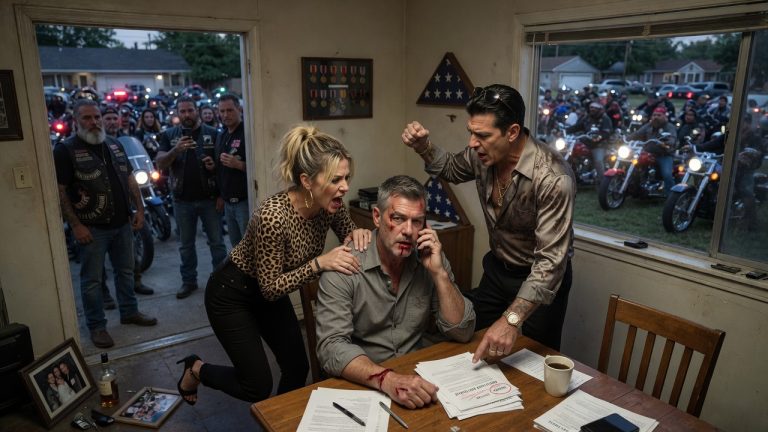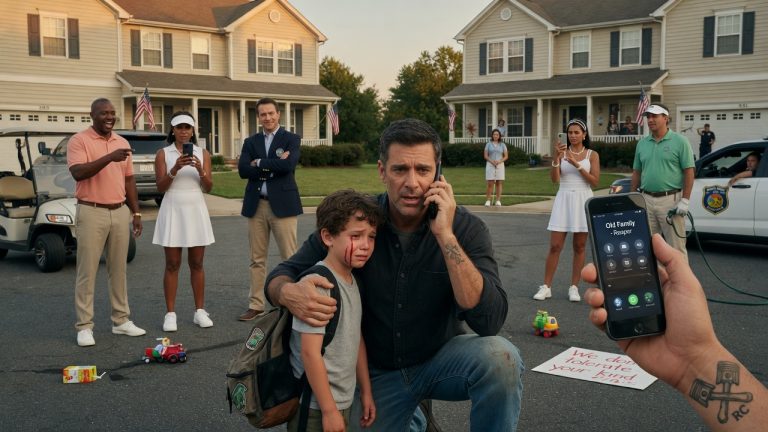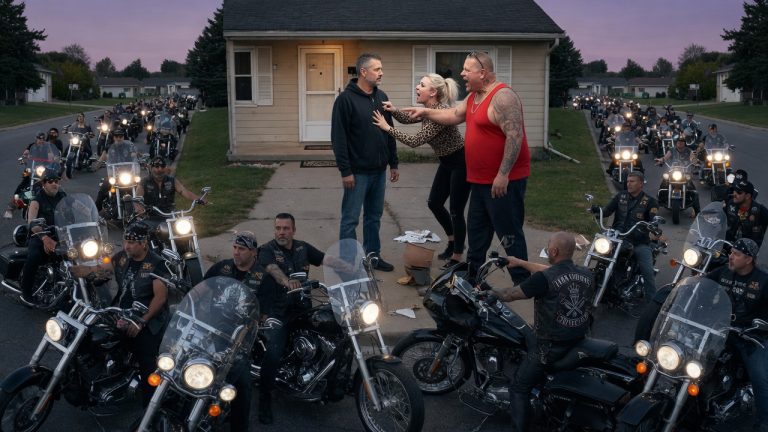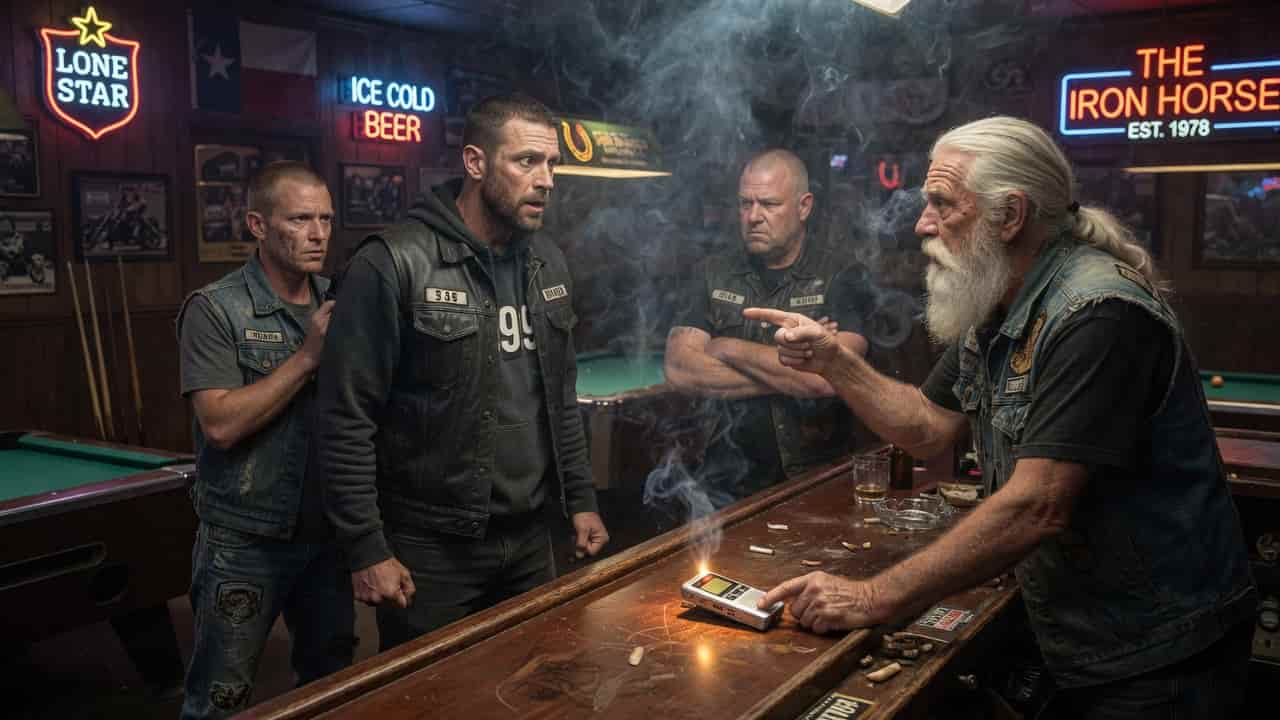
“Is that your voice on the tape, Jackson, or did the feds just find a rat who sounds exactly like the man wearing my patch?”
Silas didn’t raise his voice. He didn’t have to. The roar of the party at The Iron Horse died mid-breath. Six months ago, Steel Jackson had been the man who saved the club from a massive federal sweep. He was the hero who kept them out of orange jumpsuits. He was the son who finally surpassed the father.
But as the silver recorder sat blinking on the scarred wood of the bar, Jackson’s face went the color of ash. He looked at the brothers who had just been chanting his name, and for the first time in his life, the man they called Steel looked like he was about to snap.
Silas leaned in, his weathered face inches from Jackson’s, his voice a low, jagged blade. “You didn’t just give them the club, kid. You gave them your own blood. You told them where to find your old man so you could sit in that chair. Tell them. Tell them what you promised the Special Agent in charge.”
The whole room was watching. Vance, the club’s enforcer, stepped out of the shadows, his hand resting on the hilt of a knife, his eyes fixed on the man he’d spent half a year protecting.
Jackson tried to speak, but the words were caught in the wreckage of his own lie. He had built an empire on a foundation of betrayal, and now, the man he thought was gone forever was standing in front of him, holding the one truth that would end it all.
Chapter 1: The Victory Lap
The humidity in East Texas doesn’t just sit on you; it possesses you. It’s a wet, heavy shroud that smells of pine sap, diesel exhaust, and the looming threat of a thunderstorm that never quite breaks. Inside The Iron Horse, the air was even thicker, seasoned by the sweat of sixty men in heavy leather and the sweet, metallic tang of cheap beer spilled on old wood.
Steel Jackson stood at the center of it, the undisputed king of a kingdom that shouldn’t exist. Six months ago, the Nine-Nine-Nine Biker Club had been staring down the barrel of a RICO indictment that would have buried every patched member from Amarillo to the Gulf. Then came the miracle. A series of “procedural errors” by the US Attorney’s office, a sudden lack of cooperating witnesses, and a legal defense led by a man Jackson had personally hand-picked.
The case had collapsed like a house of cards in a hurricane. And Jackson, the man who had stepped into the vacuum of leadership when the old guard was hauled off in zip-ties, was the man who had pulled the strings.
“To Steel!” Vance roared, his voice cutting through the thrum of the jukebox. Vance was a mountain of a man with a head like a weathered boulder and a loyalty that was as simple as it was terrifying. He hoisted a glass of bourbon, the amber liquid catching the flicker of a neon Budweiser sign. “The man who kept the gates closed and the dogs out!”
The room erupted. It was a primal sound—a chorus of boots stomping on floorboards and fists rhythmic against tabletops. Jackson raised his own glass, his face a practiced mask of humble strength. He felt the weight of the “President” patch on his chest, a piece of embroidered leather that felt heavier than it had ten minutes ago.
“It wasn’t just me,” Jackson said, his voice low but carrying. He knew how to play them. He knew that for men like this, the myth of the brotherhood was more important than the reality of the business. “We held the line. We didn’t talk. We didn’t break. That’s why we’re still here.”
He caught the eye of the Kid—a prospect named Leo who looked at Jackson with the kind of holy reverence usually reserved for martyrs. The Kid had been the one to clean the blood off the clubhouse floors after the first raid. He’d stayed when others ran. Jackson felt a sharp, localized pang of something he refused to call guilt. It was more like a glitch in the system, a momentary shudder in the engine.
He turned away from the cheers and headed toward the back of the bar, toward the small, grease-stained office that served as the club’s nerve center. He needed a minute away from the heat and the noise. He needed to stop being “Steel” for sixty seconds.
Inside the office, the silence was a physical relief. He sat behind the metal desk, his fingers tracing a deep scratch in the surface. His phone buzzed against his thigh. He didn’t have to look at the screen to know who it was. There was only one person who called him at this hour, and she was the only person in the world who didn’t care about the 999 or the RICO case.
“Elena,” he said, answering on the third vibration.
“I heard the news,” his sister’s voice came through, cool and professional, the sound of air-conditioned courtrooms and expensive stationery. “The final motions were granted. The case is officially dead, Jackson.”
“I know. We’re celebrating.”
“Are you?” There was a beat of silence. Elena was a federal prosecutor in the Western District. She wasn’t on the biker task force—that would have been a conflict of interest that even their messy family couldn’t navigate—but she knew the mechanics of the building. She knew how things worked. “Jackson, I saw the discovery logs. Or what was left of them. Things don’t just ‘disappear’ from a federal filing system because of a clerical error.”
“Sometimes the universe provides, El.”
“Don’t lie to me. Not tonight. I know what you did to get that seat. I know what you gave up to make sure those indictments didn’t stick to the new leadership.”
Jackson felt his pulse thudding in his throat. “I did what I had to do to keep this club alive. My father would have done the same.”
“Our father is rotting in a cell in Beaumont because of men like the ones you’re drinking with,” she snapped. “And don’t you dare compare yourself to him. He was a lot of things, Jackson, but he wasn’t a ghost. You’re turning into something I don’t recognize.”
“I’m the one who stayed, Elena. You’re the one who went to law school and forgot where we came from. I’m the one looking after the families of the men who didn’t get out.”
“You’re looking after yourself,” she said, her voice softening into something that hurt worse than the anger. “Just be careful. The thing about deals with the devil is that the devil doesn’t have a statute of limitations. Silas is out, Jackson. He was granted early compassionate release this afternoon. Medical grounds. He’s already on a bus heading back to the county.”
The air in the office suddenly felt very thin. Silas. The Old Man. The man who had worn the President’s patch for twenty years before the sweep. The man who had treated Jackson like a son and a servant in equal measure.
“He’s sick?” Jackson asked, his voice sounding distant to his own ears.
“Heart, supposedly. But Silas could have his chest ripped open and he’d still find a way to spit in your eye. He knows, Jackson. He might not have the proof yet, but he knows you’re the reason he’s the only one who didn’t walk.”
“He’s an old man with a bad heart, El. He’s not a threat.”
“He’s a legend in that room you’re standing in. And legends don’t go away quietly. Don’t call me again until you’re ready to tell the truth.”
She hung up. Jackson stared at the flickering fluorescent light on the ceiling. He thought about the ledger hidden in the floorboards beneath his feet—the one with the names, the dates, and the signatures that the FBI had been so desperate to find. He thought about the recording he’d made in a parking lot in Conroe, the one where he’d traded his father’s freedom for the survival of the 999.
He stood up, adjusted his vest, and checked his reflection in the darkened window. His eyes looked hard, bright, and utterly hollow. He looked like a leader. He looked like a hero.
He walked back out into the bar. The music had changed to something louder, a grinding Southern rock anthem that made the floorboards vibrate. He saw Vance laughing with a group of prospects, his arm draped around a woman in a faded Harley shirt. He saw the Kid standing by the door, acting as a lookout even though there was nothing to look out for.
Jackson felt a surge of adrenaline, the familiar, addictive hum of power. He had won. Silas was a relic. Elena was a critic. And the 999 belonged to him.
He walked to the bar and signaled for another round. He was going to drink until the heat didn’t matter, until the silence in his sister’s voice was drowned out by the roar of his brothers. He was Steel Jackson, and in this room, his word was law.
But as he reached for his glass, the front door of The Iron Horse swung open, cutting a swath of humid night air into the room. The music didn’t stop, but the laughter near the entrance died instantly. A man walked in, moving slowly, leaning on a cane made of dark, polished wood. He was thin, his skin hanging loose on a frame that had once been massive, his white hair a stark contrast to the black leather around him.
It was Silas. And he wasn’t looking for a drink. He was looking at Jackson.
Chapter 2: The Return
The silence didn’t happen all at once. It rippled outward from the door like a drop of ink in a glass of water. First, the prospects at the pool tables stopped their chatter, their cues hovering mid-stroke. Then the veterans at the bar turned, their faces shifting from drunken cheer to a confused, heavy stillness. Finally, even the jukebox seemed to lose its nerve, the song ending and the mechanical arm clicking into a hollow, scratching void.
Silas didn’t look like a man who had just been released from a federal penitentiary on medical grounds. He looked like a ghost that had forgotten it was supposed to be dead. He moved with a deliberate, agonizing precision, the tip of his cane hitting the floorboards with a rhythmic thud-clack that felt like a heartbeat.
Jackson didn’t move. He kept his hand wrapped around his glass, his knuckles white. He felt the eyes of the room shifting—away from him, the new king, and toward the old one. It was a physical weight, the sudden redistribution of loyalty.
“Silas,” Vance said, his voice cracking slightly. The big man stepped forward, his face a mess of conflicting emotions. Silas had been the one who patched Vance in fifteen years ago. “We didn’t know. We thought… the lawyer said you were down for the count.”
Silas stopped three feet from the bar. He ignored Vance. His eyes, a pale, piercing blue clouded by age but sharp with intent, were locked on Jackson.
“The lawyer says a lot of things when you’re paying him with the club’s treasury,” Silas said. His voice was a rasp, a sound like dry leaves skittering over pavement. “He told me the 999 was dead. He told me the brothers had scattered like rats. Imagine my surprise when I get to the county line and hear that the party’s been going on for six months.”
Jackson forced himself to let go of the glass. He straightened his back, making use of every inch of his height. “You should have called, Silas. we would have sent a detail to pick you up. This isn’t exactly the homecoming we had planned.”
“I’m sure it isn’t,” Silas said. He turned his head slightly, scanning the room. He looked at the new patches, the fresh paint on the walls, the high-end liquor behind the bar. “You’ve done well for yourself, Steel. Or should I call you Mr. President?”
“The club voted,” Jackson said, his voice hardening. “When you went in, someone had to hold the gavel. I did what I had to do to keep the feds from tearing this place down.”
“Keep them from tearing it down?” Silas let out a dry, hacking laugh that turned into a cough. He pulled a grey handkerchief from his pocket and pressed it to his mouth. When he pulled it away, Jackson saw a fleck of dark red. “Is that what you told them? That you’re the savior of the Nine-Nine-Nine?”
“The RICO case was dropped, Silas. Every man in this room is walking free because of the moves I made.”
“Except for me,” Silas said. He stepped closer, the smell of the bus station and medicinal soap clinging to him. “And except for your father. Funny how that worked out, isn’t it? The two men who knew where the bodies were buried are the only ones the feds managed to keep.”
The room felt dangerously tight. Vance was looking between them, his hands twitching at his sides. The Kid, Leo, was standing by the pool table, his face pale. He looked like he wanted to defend Jackson, but the weight of Silas’s presence was too much to overcome.
“My father made his own choices,” Jackson said. “And you were the one who led us into that sweep, Silas. Your leadership is what put us in the crosshairs.”
“My leadership is what built this club from a garage in Tyler into a three-state operation!” Silas roared, the sudden volume shocking the room. He slammed his cane against the bar, the wood splintering. “I gave you everything, Jackson. I treated you better than my own blood. And how do you repay me? You wait until my back is turned and you start selling off the furniture.”
“I didn’t sell anything!”
“No?” Silas reached into the pocket of his denim vest. He pulled out a small, silver digital voice recorder. It looked clean, modern, and utterly out of place in his trembling, liver-spotted hand. “Then maybe you can explain what’s on this. Because the man who gave it to me said it was the reason the US Attorney decided to play nice with you.”
Jackson felt a cold, oily slick of dread slide down his spine. The recorder. He knew that model. He’d seen it in the hands of a man named Miller—a “consultant” who acted as a bridge between the club and certain interests in the city.
“That’s nothing,” Jackson said, but his voice lacked the steel of his name. “Silas, you’re tired. You’re sick. Let’s go in the back and talk about this like men.”
“I’m done talking in the back,” Silas said. He turned to the room, his eyes scanning the faces of the brothers who were now crowding closer, their curiosity turning into something sharper. “You boys want to know how you got your freedom? You want to know why the feds just walked away from a five-year investigation?”
“Silas, stop,” Jackson stepped forward, his hand reaching for the recorder.
Vance stepped between them. It wasn’t an aggressive move, but it was a block. The big man’s eyes were narrow, focused on the silver device in Silas’s hand. “Let him speak, Steel. If it’s nothing, then it’s nothing.”
The betrayal of that moment hit Jackson harder than a physical blow. Vance, his enforcer, his wall. The wall was turning.
Silas smiled, a jagged, ugly expression. He placed the recorder on the mahogany bar and pressed a button. A red light began to blink, a tiny, rhythmic pulse that seemed to sync with the pounding in Jackson’s ears.
For a second, there was only static. Then, a voice came through the small speaker. It was muffled, distorted by the wind, but the cadence was unmistakable.
“I can give you the locations of the three primary distribution hubs. I can give you the names of the suppliers in Juarez. But I want a guarantee. The new executive board stays clean. My name stays off the witness list.”
The voice belonged to Jackson.
The room didn’t explode. It went into a state of suspended animation. Jackson looked at the Kid, who was staring at him with a look of such profound horror that Jackson had to look away. He looked at the bar, at the scarred wood where he had sat and planned the club’s future.
“And what about Silas?” a second voice asked on the recording—cold, professional, the sound of a federal agent. “He’s the big fish. We need him for the headline.”
There was a pause on the tape. A long, agonizing silence where the only sound was the distant hum of traffic.
“Silas is old,” Jackson’s voice said. “He’s a relic. Do what you want with him. Just make sure the path is clear for me to take the chair. If he’s in the way, the club won’t follow the transition.”
Silas pressed the stop button. The red light went out.
The silence that followed was different than the one that had greeted Silas at the door. This one was jagged. It was full of the sound of men realizing they had been led by a Judas.
“You sold me,” Silas said, his voice a whisper that carried to every corner of the bar. “You sold your brothers. You sold the man who gave you a name.”
Jackson looked around the room. He saw the shift in posture. The men who had been cheering his name five minutes ago were now stepping back, their hands moving toward their belts, their eyes turning into flint.
“It was the only way!” Jackson shouted, his voice cracking. “The feds had us! They had everything! If I didn’t make that deal, we’d all be in a cage! I saved you!”
“You didn’t save us,” Vance said, his voice low and dangerous. He stepped toward the bar, his massive shadow falling over Jackson. “You saved yourself. And you used us as the currency.”
Vance reached out and grabbed Jackson by the front of his hoodie, yanking him forward until their faces were inches apart. The smell of bourbon and tobacco on Vance’s breath was overwhelming.
“You called yourself Steel,” Vance spat. “But you’re just a copper-plated rat.”
Vance shoved him back. Jackson hit the pool table, the balls clattering in their pockets. He looked up and saw the circle closing in. Silas was standing by the bar, leaning on his cane, watching the destruction of his successor with a grim, satisfied silence.
“What do we do with a rat, Silas?” someone from the back called out.
Silas didn’t answer immediately. He looked at Jackson—really looked at him—and for a second, Jackson saw a flicker of pity in the old man’s eyes. It was gone in an instant, replaced by the cold, hard code of the road.
“A rat doesn’t get to wear the patch,” Silas said. “And a rat doesn’t get to walk out of the room with his skin.”
Chapter 3: Cracks in the Chrome
The pool table felt like a slab of ice against Jackson’s spine. He could feel the eyes of the 999 drilling into him, sixty pairs of predators scenting blood in the water. This was the nightmare he’d kept buried under layers of bravado and expensive legal filings. He’d known, in the quiet hours of the night, that the foundation was rotted. He just hadn’t expected the collapse to be so public.
“Wait,” Jackson said, his hands out in a placating gesture. He tried to keep his voice steady, but the adrenaline was making his fingers twitch. “Listen to me. Silas is playing you. Where do you think he got that recording? The feds. Why would the feds give a convicted felon a tape of their star informant? Think about it!”
Vance paused, his fist still clenched. He looked at Silas, then back at Jackson. The logic was a thin thread, but it was there.
“He’s right,” the Kid, Leo, said suddenly. He stepped out from the shadows of the pool table, his face pale but his eyes bright with a desperate need to believe. “Why would they give you that, Silas? Unless they wanted us to tear ourselves apart?”
Silas didn’t blink. He just leaned harder on his cane, the wood groaning. “They didn’t give it to me, boy. I have friends in places Jackson thinks he’s already bought. There are people in that US Attorney’s office who don’t like seeing a rat take the crown. They wanted the truth out. And now it is.”
“It’s a fake,” Jackson snarled, regaining his footing. He stepped away from the pool table, trying to reoccupy his space. “It’s an AI scrub. Silas is desperate. He’s an old man who lost his chair and he’ll say anything to get it back.”
“Is that so?” Silas pointed at the recorder. “Then why don’t we call your lawyer? Why don’t we call Miller and ask him about the meeting in the parking lot at the Conroe pier? The one on October 14th? The day before my bail was denied?”
Jackson’s heart skipped a beat. October 14th. The day he’d signed the cooperation agreement. Silas had the date. He had the location.
The room sensed the hesitation. The doubt that had flickered in Vance’s eyes died out, replaced by a cold, obsidian certainty.
“You’re a liar, Steel,” Vance said. He didn’t shout. The quietness of the statement was more terrifying. He reached out and gripped the edge of Jackson’s leather vest—the “cut” that signified his membership and his rank. “You don’t deserve the leather. You don’t deserve the name.”
Vance didn’t wait for an answer. He yanked. The sound of the heavy leather tearing was like a gunshot in the silent bar. Jackson stumbled forward, his hands flying up to protect his face.
“Get it off him!” someone yelled.
Suddenly, the circle collapsed. It wasn’t a fight; it was a harvesting. Hands grabbed at Jackson’s shoulders, his arms, his waist. He felt the weight of his vest being stripped away, the ritualistic humiliation of a “stripping.” In the biker world, your cut was your identity. Without it, you were less than a civilian. You were a target.
“No! Get off me!” Jackson fought back, throwing a jagged elbow that caught a prospect in the cheek. He heard a satisfying crack, but it was a drop in the bucket. A heavy boot caught him in the calf, buckling his leg.
He was forced to his knees in the middle of the bar. The floor smelled of stale beer and the pine-scented cleaner they used to hide the scent of the weekend’s sins. He looked up and saw Silas standing over him. The old man looked taller now, infused with a dark, vengeful energy.
“You thought you were smarter than the road, didn’t you?” Silas whispered. He leaned down, his face a landscape of scars and white hair. “You thought you could trade the brotherhood for a seat at the big table. But the big table doesn’t want you, Jackson. They just wanted to use you to clear the room. And now the room is empty.”
“I saved them!” Jackson screamed, his voice echoing off the corrugated metal ceiling. “Look at them! They’re not in jail! They’re here! Because of me!”
“They’re here,” Silas agreed, looking around at the men. “But they’re not brothers anymore. They’re just suspects waiting for the next deal to be made. You broke the one thing that made us a club. You broke the trust.”
Vance stepped forward, holding Jackson’s vest in his hands. He looked at the “President” patch, then at the “999” on the back. With a slow, deliberate motion, he pulled a pocketknife from his belt and sliced the patches off, letting the scraps of leather fall onto the floor in front of Jackson.
“Get out,” Vance said.
Jackson blinked, stunned. “What?”
“Silas said you don’t walk out with your skin,” Vance said, his voice thick with a simmering rage. “But I’m not going to give the feds the satisfaction of a body on the floor tonight. Not yet. You walk out of here. You leave the keys to the shop. You leave the bike. You walk into the dark, and if we see you again after tonight, the deal’s off.”
“Vance, you can’t—”
“I’m the Enforcer,” Vance said, stepping into Jackson’s space, his massive frame blotting out the light. “And right now, I’m enforcing the exit. Move. Before I change my mind.”
Jackson looked at the faces around him. He saw no pity. He saw the Kid, Leo, looking down at the floor, his shoulders shaking. He saw the men he had protected, the men whose families he had supported, all of them standing in a silent, judging line.
He stood up, his legs shaking. He felt small. He felt naked without the weight of the leather. He reached into his pocket and pulled out a heavy ring of keys, dropping them on the bar next to the voice recorder.
He turned and walked toward the door. Every step felt like a mile. The silence followed him, a heavy, suffocating pressure. As he reached the exit, he heard Silas’s voice one last time.
“Jackson.”
He stopped, his hand on the doorframe. He didn’t turn around.
“Your father is still in Beaumont,” Silas said. “He’s got a hearing next week. I wonder what he’ll say when he finds out his son was the one who signed the warrant.”
Jackson didn’t answer. He pushed the door open and stepped out into the Texas night. The humidity hit him like a wall. The sky was a deep, bruised purple, and the first heavy drops of rain began to fall, hot and stinging against his skin.
He started walking. He didn’t have a bike. He didn’t have a patch. He had a phone in his pocket and a secret that was no longer a secret.
He reached the end of the gravel parking lot and stopped. He looked back at The Iron Horse. The neon signs were flickering, the red and blue light reflecting in the puddles. It looked like a temple, and he had just been cast out of the priesthood.
His phone buzzed. He pulled it out. A text from Miller, the lawyer.
Silas is back. We need to talk. The feds are asking about the Conroe tapes.
Jackson gripped the phone until his knuckles ached. He looked at the dark road ahead of him, the pine trees lining the highway like silent witnesses. He wasn’t done. He couldn’t be done. He had spent his whole life trying to be more than a bastard son, more than a biker’s kid.
He started walking toward the highway. He needed to find Elena. She was the only one left who knew how to navigate the wreckage he’d created. But as he walked, he couldn’t get the sound of the recorder out of his head. Silas is a relic. Do what you want with him.
He hadn’t just betrayed the club. He had betrayed himself. And in the dark of the Texas woods, the residue of that realization began to settle, heavy and cold, like the rain.
Chapter 4: The Ledger’s Weight
The rain didn’t break the heat; it just turned the world into a steaming, suffocating laundry room. Jackson walked for three miles before he found a gas station that was still open—a lonely, flickering Shell station on the edge of the county line. He looked like a man who had been through a car wreck without the car. His charcoal hoodie was soaked through, clinging to his chest, and his face was smeared with the grime of the road and the residue of the bar floor.
He used the payphone. He didn’t want a trace on his cell.
“Elena,” he said when she picked up. His voice sounded like it had been dragged over gravel.
“Jackson? Where are you? You sound… what happened?”
“Silas is back,” he said, leaning his forehead against the cool, scratched plexiglass of the phone booth. “He had a recording. He played it for the room.”
There was a long silence on the other end of the line. Jackson could hear the faint sound of a television in the background—a news report, maybe.
“What did they do?” she asked, her voice hushed.
“They stripped me. They took the bike. I’m walking.”
“God, Jackson. I told you. I told you he was coming.”
“I need a place to go, El. I can’t go back to my house. They’ll be there by morning.”
“You can’t come here,” she said immediately, and the sting of it was sharper than Vance’s fist. “I’m a prosecutor, Jackson. If you’re being hunted by a biker gang, having you in my guest room is a career death sentence. Not to mention the physical risk.”
“I’m your brother.”
“And you’re a federal informant who just got outed,” she snapped. “Do you have any idea how dangerous you are right now? To everyone? The feds won’t protect you because the case is closed. The 999 wants your head. And if our father finds out…”
“He won’t,” Jackson said, but he knew he was lying. Silas would make sure of it. Silas would probably hand-deliver the news to the prison.
“Listen to me,” Elena said, her tone shifting into the one she used for difficult witnesses. “There’s a ledger. The one you told me about. The one with the signatures from the Mexican side of the operation. Do you still have it?”
“It’s under the floor in the clubhouse office.”
“You left it there?” Her voice rose in pitch. “Jackson, that’s your only leverage! If Silas finds that, he doesn’t just have proof you’re a rat; he has the names of everyone who ever did business with us. He can trade that for a clean slate and put you in the ground.”
“I couldn’t get to it,” he yelled back, his frustration boiling over. “I was lucky to get out with my teeth!”
“You have to go back.”
“Are you crazy? They’ll kill me!”
“Not tonight,” she said, her voice dropping to a whisper. “Tonight they’re drinking. They’re celebrating the return of the king. They won’t expect you to come back for a book. If you get that ledger, you can come to the office tomorrow. I can get you into a witness protection program. A real one. Not the half-assed deal you made with Miller.”
Jackson looked at the dark highway. The thought of going back into The Iron Horse, of facing Vance and Silas again, made his stomach turn. But he knew she was right. Without the ledger, he was a man without a country. He was just a body waiting for a burial.
“Jackson?”
“I hear you,” he said. “I’ll get it.”
“Don’t use your phone. And don’t trust Miller. I looked into him—his firm has been on the club’s payroll for twenty years. He wasn’t working for you, Jackson. He was working for the chair. And now Silas is in the chair.”
He hung up. He stood in the booth for a moment, watching a lone moth batter itself against the flickering light. He felt a strange, hollow clarity. He had spent his whole life trying to outrun the shadow of the Nine-Nine-Nine, trying to be the one who finally broke the cycle of violence and poverty that had claimed his father. And here he was, at thirty-four, standing in a gas station at midnight, planning a burglary of his own life.
He started walking back.
The rain had intensified, a steady, rhythmic drumming that masked the sound of his boots. He stayed off the road, moving through the thick brush and pine needles. He knew these woods. He’d grown up hunting in them, hiding in them.
When he reached the perimeter of The Iron Horse, the party was still in full swing. He could hear the music from two hundred yards away—a distorted, bass-heavy thrum that felt like a headache. The parking lot was packed with bikes, their chrome glinting under the security lights.
He moved toward the back of the building, toward the service entrance. He saw the Kid, Leo, sitting on the back steps. The boy was holding a bottle of beer, but he wasn’t drinking. He was just staring at the ground.
Jackson hesitated. Leo was his only friend in that room. But Leo was also the one who had seen his hero crumble.
He picked up a stone and tossed it into the brush ten feet from the boy.
Leo looked up, his eyes darting around. “Who’s there?”
Jackson stepped into the faint light at the edge of the woods. He put a finger to his lips.
Leo froze. His face went through a dozen expressions—fear, anger, confusion—before settling on a weary, bone-deep sadness. He stood up and walked toward the tree line, his boots crunching on the gravel.
“You’re supposed to be gone, Steel,” Leo whispered when he was close enough. “Vance is looking for a reason to go after you. He’s already talking about the bike.”
“I need to get into the office, Leo.”
“Are you crazy? Silas is in there right now. He’s sitting in your chair.”
Jackson felt a jolt of cold electricity. Silas was in the office. He was probably already looking for the ledger.
“I need to get something out of the floorboards,” Jackson said, stepping closer. He gripped Leo’s arm. “The book. If Silas finds it, he’s going to burn everything. Not just me. You. Vance. The whole club. It’s got the Mexican names in it, Leo. If that gets out, the cartels won’t care about a RICO case. They’ll just end us.”
Leo looked back at the bar. He looked like he wanted to run. “I can’t help you. I’m a prospect. If they catch me helping a rat…”
“I’m not a rat, Leo. I made a deal to keep you out of jail. Look at yourself! You’re twenty-one years old. You want to spend the next forty years in a federal pen because Silas wanted to play big shot with the feds?”
“You told them where to find your father,” Leo said, his voice trembling. “I heard the tape.”
Jackson closed his eyes. The residue of that truth was a bitter taste in his mouth. “I did. Because my father was already gone. He was a dead man walking. I chose the living over the dead, Leo. I chose you.”
It was a lie, or at least a half-truth, but it was the only currency he had left.
Leo stayed silent for a long time. The rain dripped off his hat. Finally, he nodded. “The side door is unlocked. They’re all in the main room doing shots with Silas. He’s telling stories about the old days. But you have to be fast. If Vance comes back to check the perimeter…”
“I’ll be fast,” Jackson said.
He moved toward the side of the building, staying in the shadows. He felt like a thief in his own house. He reached the side door and slipped inside. The hallway was narrow and smelled of industrial cleaner and stale tobacco. He could hear the roar of the party through the wall—a wall he had helped build.
He reached the office door. It was cracked open. A sliver of light spilled out into the hallway.
He held his breath and peered inside.
Silas was sitting at the desk. He looked small in the high-backed leather chair, his white hair glowing under the desk lamp. He wasn’t looking for the ledger. He was holding an old photograph—a picture of the original 999 charter members. Jackson’s father was in that picture.
Silas looked tired. The vengeful energy from the bar had faded, leaving behind a hollowed-out old man who looked like he was waiting for the end.
Jackson waited. His heart was hammering against his ribs. He just needed Silas to leave. Five minutes. That was all it would take to pry up the board and get the book.
But Silas didn’t move. He sat there, staring at the photo, his lips moving in a silent conversation with the dead.
Suddenly, the front door of the bar swung open, and the music surged in volume. Jackson heard Vance’s voice, loud and booming.
“Where’s the Kid? He was supposed to be on the back steps.”
Jackson froze. If Vance came looking for Leo, he’d find the side door unlocked. He’d find Jackson in the hall.
He looked at Silas. The old man was still staring at the photo.
Jackson had a choice. He could run now and lose the ledger forever. Or he could do the one thing he’d spent his whole life trying to avoid. He could stop being the man who managed the problem and start being the man who ended it.
He stepped into the office.
Silas didn’t look up. “I figured you’d come back for it,” the old man said, his voice surprisingly steady. “You always were a greedy bastard, Jackson. Just like your father.”
Jackson didn’t answer. He walked toward the desk. The red light of the voice recorder was still blinking on the mahogany surface, a tiny, accusing eye.
“It’s not under the floorboards anymore,” Silas said, finally looking up. He reached into the desk drawer and pulled out the black leather ledger. He tossed it onto the desk. “I found it ten minutes after you left. I know everything, Jackson. I know about the Mexican deal. I know about the payments to Miller.”
Jackson reached for the book, but Silas slammed his hand down on top of it.
“You think this is your ticket out?” Silas asked, his eyes burning. “This is your death warrant. As soon as I turn this over to the right people, you’re done. And I’m not talking about the feds.”
“Give it to me, Silas.”
“Or what? You’ll kill me?” Silas laughed, a dry, rattling sound. “Go ahead. I’m dying anyway. My heart is a bag of wet paper. But you… you have to live with what you are. A man who sold his father for a chair he couldn’t even keep for a year.”
Outside, Jackson heard boots on the gravel. Vance was coming.
“Give me the book,” Jackson said, his voice a low growl.
He reached out and grabbed Silas’s wrist, yanking his hand off the ledger. The old man was surprisingly strong, his fingers digging into Jackson’s skin like iron claws.
“You’re nothing!” Silas hissed. “You’re just a ghost in a leather vest!”
Jackson shoved him back. Silas hit the chair, his breath coming in ragged gasps. He clutched at his chest, his face contorting in pain.
“The… book…” Silas gasped, his eyes rolling back in his head.
Jackson grabbed the ledger. He didn’t look at Silas. He didn’t check his pulse. He turned and ran toward the side door.
He burst out into the rain just as Vance rounded the corner of the building.
“Steel!” Vance roared, his hand going to his belt.
Jackson didn’t stop. He ran into the woods, the ledger tucked under his arm like a stolen heart. He heard Vance shouting behind him, the sound of boots on gravel, the roar of a motorcycle engine kicking to life.
He didn’t look back. He ran until his lungs burned and the lights of The Iron Horse were swallowed by the pines. He had the ledger. He had the truth. But as he stood in the dark, the rain washing the sweat from his face, he realized that he had left Silas in that office.
And he didn’t know if the old man was breathing.
He looked down at the ledger in his hands. It was heavy, cold, and smelled of old paper and betrayal. It was everything he’d ever wanted. And it was the only thing he had left.
The residue of the night was settling in, a dark, inescapable weight. He was a man on the run, a rat with a ledger, and the road ahead was as black as the Texas sky.
Chapter 5: The Geography of a Rat
The pine needles underfoot were slick with oil and rot, a carpet of decay that tried to claim Jackson’s boots with every step. He didn’t run like a hero; he ran like a man who had forgotten how to breathe. The ledger, tucked inside his charcoal hoodie, felt like a slab of cold marble against his ribs. It was too heavy for a book. It carried the weight of every name, every kilo, every bribe that had built the Nine-Nine-Nine into something worth killing for.
Behind him, the roar of the Harleys was a jagged, mechanical scream. They were close. Vance knew these woods nearly as well as Jackson did, and Vance had the advantage of rage. Rage was a cleaner fuel than the oily, smoking panic that was currently churning in Jackson’s gut.
He broke through a thicket of brambles, the thorns tearing at the skin of his forearms, and scrambled up an embankment toward Highway 287. His lungs felt like they had been filled with hot glass. Every gasp was a jagged reminder of the sixty cigarettes he’d smoked a day during the RICO trial. He reached the asphalt and collapsed against a rusted guardrail, his head hanging between his knees.
The rain was a deluge now, a gray curtain that turned the world into a series of blurred, flickering shapes. He pulled the ledger out, checking to see if the plastic bag he’d wrapped it in was holding. It was. The black leather was dry, but the secret it held felt like it was leaking through the skin of his palms.
He looked at his hands. They were shaking—not the fine tremor of fear, but the violent, rhythmic shudder of a body that had reached its breaking point. He thought of Silas. He thought of the way the old man’s eyes had rolled back, the way his fingers had gripped Jackson’s wrist like he was trying to pull him into the grave.
I didn’t kill him, Jackson told the rain. The heart did it. The stress did it.
But the lie didn’t stick. In the biker world, intent didn’t matter. Only the result did. And the result was Silas down, and Steel Jackson running into the night with the family jewels.
A pair of headlights cut through the gray mist a mile down the road. Jackson didn’t wait to see if it was a brother or a stranger. He rolled over the guardrail, sliding down the muddy slope on the other side, and started moving toward the outskirts of Huntsville. He needed a phone. He needed Elena. But more than anything, he needed to stop being the man in the charcoal hoodie.
Two hours later, he was standing in the lobby of a shuttered laundromat, using the heat of the driers to stop the shivering. He’d found a burner phone in a hidden compartment of his truck—the one he’d parked three blocks from the bar as a contingency he’d prayed he’d never need. He called Elena’s private line.
“I have it,” he said when she answered. No greeting. No preamble.
“Where are you?” Her voice was tight, the sound of a woman who had spent the last two hours staring at the wall, waiting for the news of her brother’s death to scroll across the bottom of the television.
“Huntsville. Near the old mill. I’m in the truck.”
“Is Silas…” She hesitated. “People are calling the office, Jackson. There’s a report of a medical emergency at The Iron Horse. An ambulance was seen leaving twenty minutes ago.”
“He had a heart attack,” Jackson said, his voice flat. He stared at his reflection in the glass of a washing machine. He looked like a stranger—someone older, smaller, and infinitely more dangerous. “He found the ledger. We struggled. He went down.”
“Did you call it in?”
“Vance was coming, Elena! If I’d stayed to play paramedic, I’d be in a ditch right now. I have the book. That’s what matters, right? That’s what you said.”
“I said get the book so we could protect you,” she snapped. “I didn’t say leave a dying man on the floor. If he dies, Jackson, this isn’t a RICO case anymore. It’s a homicide investigation where the primary suspect is the man who just had his patch stripped in front of sixty witnesses.”
“He’s not going to die,” Jackson said, though he didn’t believe it. Silas was made of leather and spite, but even leather wears out. “Listen, I need you to meet me. Not at the office. Not at your house. The rest stop on I-45, the one by the lake. Thirty minutes.”
“Jackson, I can’t—”
“Thirty minutes, Elena! Or I’m calling Miller and I’m selling this book back to the highest bidder. And I’ll make sure your name is on the list of people who knew it existed.”
He hung up before she could refuse. The residue of the threat hung in the air, a bitter, metallic taste. He was threatening his own sister. He was using the one person who still cared about him as a human shield. The transition from leader to rat was complete, and the skin of the new man felt cold and tight.
He drove to the rest stop, the truck’s wipers struggling against the downpour. He parked in the back, under a flickering streetlamp that cast long, skeletal shadows across the pavement. He waited. Every car that pulled in made his hand drift toward the pistol tucked under the seat—a Glock 19 he’d taken from Silas’s desk during the struggle. He’d never been a shooter. He was the strategist, the man who used words and law to win. But words were useless now.
When Elena’s silver sedan finally pulled into the lot, he felt a momentary surge of relief that was immediately crushed by a wave of shame. She didn’t get out. She flashed her lights twice, the signal they’d used since they were kids.
Jackson climbed out of the truck, the ledger tucked under his arm, and ran to her car. He slid into the passenger seat, the smell of her expensive perfume hitting him like a physical blow. It smelled of a world he had never truly been part of—a world of safety, stability, and clean hands.
Elena didn’t look at him. She stared straight ahead at the rain-slicked windshield. Her hands were gripped so tightly on the steering wheel that her knuckles were white.
“You look like hell,” she said.
“I feel like hell. Here.” He held out the ledger.
She didn’t take it. She looked at the black leather book as if it were an unexploded bomb. “Is everything in there? The Mexican names? The payoffs to the judge in Dallas?”
“Everything. Silas kept better books than a bank. He didn’t trust anyone, El. Not even himself.”
“And our father?” she asked, her voice dropping to a whisper. “Is his name in there?”
Jackson felt the weight of the book increase tenfold. He looked out the window. “He’s the one who started it, Elena. You know that. He’s the one who signed the original charter. The ledger starts with him.”
“If I take this to the US Attorney, he’s never coming out,” she said. A single tear tracked down her cheek, but her voice remained steady. “They’ll use this to bury the entire history of the 999. They’ll dig up bodies from the eighties. They’ll go after the widows. They’ll take the houses of the women who didn’t even know what their husbands were doing.”
“It’s them or me,” Jackson said. It was the most honest thing he’d said all night.
“Is it?” She finally turned to look at him, her eyes hard and searching. “Or is it just you trying to be the last man standing? You sold Silas because you wanted his chair. Now you’re selling the rest of them because you’re scared of the chair you bought.”
“I did it for the club!” He slammed his fist against the dashboard, the sound echoing in the small car. “I kept them out of jail for six months. I gave them a life they didn’t earn. If they want to turn on me because Silas played a tape, then they can pay the price. I’m done being the martyr for a bunch of outlaws who would kill me for a patch.”
“You’re not a martyr, Jackson,” she said, her voice full of a weary, devastating pity. “You’re just a ghost. Silas was right. You’ve been dead since the day you walked into that FBI office in Conroe. You just haven’t stopped moving yet.”
She reached out and took the ledger. The transfer was silent, but it felt like the final snap of a rope.
“What happens now?” he asked.
“I’m going to take this to a safe house,” she said. “I have a contact in the Marshal Service. They’ll find a place for you until the indictments are unsealed. But you can’t stay in Texas. You’re going to have to leave everything, Jackson. The name, the truck, the history. All of it.”
“I already left it,” he said.
“No, you haven’t. You’re still wearing the boots. You’re still carrying the gun.” She looked at the Glock 19 tucked into his waistband. “Get rid of it. If the Marshals find you with a stolen weapon, the deal is off.”
Jackson looked down at the gun. It was Silas’s gun. It felt heavy and familiar, a piece of the world he was supposed to be leaving behind.
“I’ll get rid of it,” he said.
He stepped out of the car, the rain immediately soaking through his hoodie again. He watched as Elena drove away, her taillights fading into the gray mist. He was alone now. Truly alone. No club, no sister, no father. Just a man in a truck with a stolen gun and a hole where his life used to be.
He drove back toward the city, moving slowly, his eyes scanning the rearview mirror. He was looking for the headlights of a Harley, for the silhouette of Vance, for the ghost of Silas. He felt the residue of the night clinging to him like grease. Every time he closed his eyes, he saw the red light of the voice recorder, blinking in the dark of the office.
Play it, Steel. Show them how you bought that throne.
He reached a bridge over the Trinity River and stopped. He got out of the truck and walked to the edge. He pulled the Glock from his waistband and looked at it. It was a beautiful tool, simple and efficient. Just like the deal he’d made.
He threw the gun into the dark water. The splash was small, instantly swallowed by the roar of the rain.
He didn’t feel better. He didn’t feel lighter. He just felt empty.
He got back in the truck and started the engine. He had to meet the Marshals at a motel in Plano at 4:00 AM. He had three hours to disappear. But as he pulled back onto the highway, he saw a pair of headlights in the distance, moving fast. They weren’t car lights. They were too close together.
The bikes were back.
Vance hadn’t stopped. The 999 didn’t believe in medical release, and they didn’t believe in legal deals. They only believed in the road. And on the road, there was no place for a rat to hide.
Jackson stepped on the gas, the engine of the truck roaring in protest. He wasn’t running to a motel anymore. He was running for his life. And for the first time, he realized that the ledger wasn’t his leverage. It was his anchor. And it was pulling him down into the dark, deeper than any river could ever take him.
Chapter 6: The Residue of Steel
The motel in Plano was a sprawling, two-story relic of the 1970s, its mustard-yellow paint peeling like sunburnt skin under the flickering security lights. It was the kind of place people went when they wanted to be forgotten, or when they had already been erased.
Jackson sat in the truck, the engine idling, watching the rain dance on the hood. His eyes were burning, the edges of his vision beginning to fray from exhaustion. He’d lost the bikes somewhere near McKinney, a high-speed game of cat-and-mouse through backroads and construction zones that had left his nerves raw and his hands cramped. He didn’t know if he’d actually lost them, or if Vance was just letting him feel safe before the end.
He checked the time. 3:52 AM.
The Marshals were supposed to be in Room 214. He’d been told to wait for the signal—a light in the window, or a call to the burner. But the phone stayed silent, and the window stayed dark.
He felt a sudden, sharp pang of paranoia. Elena had taken the ledger. She was safe. She was the one with the evidence, the one who could make the case. What was he? He was the loose end. He was the man who knew too much and felt too little.
What if there was no safe house? What if the “Marshal” was just a way to get him off the streets while the feds processed the book?
He looked at the motel office. A small, neon “Vacancy” sign hummed with a low, irritating buzz. He needed to move. He couldn’t sit in the truck like a target.
He climbed out of the truck, his boots hitting the pavement with a heavy, wet thud. He walked toward the stairs, his eyes scanning the parking lot. It was nearly empty—a few rusted sedans, a white van with no markings, and an old Ford pickup with a cracked windshield. No Harleys. No leather vests.
He reached the second-floor balcony and walked toward Room 214. The air smelled of chlorine from the pool and the metallic scent of wet asphalt. He stopped in front of the door and knocked—three short, two long. The code Elena had given him.
The door opened instantly.
But it wasn’t a Marshal standing there. It was Vance.
The big man was leaning against the doorframe, his massive arms crossed over his chest. He wasn’t wearing his vest. He was in a plain black t-shirt that stretched over his muscles, his face a mask of cold, concentrated fury. Behind him, inside the room, Jackson could see the Kid, Leo, sitting on the edge of the bed. The boy looked like he’d been crying.
“You’re late, Steel,” Vance said.
Jackson didn’t run. He couldn’t. His legs felt like they were made of lead, and the exhaustion had finally caught up to his heart. He just stood there, the rain dripping off the edge of the balcony onto his shoulders.
“How did you find me?” Jackson asked, his voice a ghost of itself.
“Miller,” Vance said, stepping aside to let Jackson into the room. It wasn’t an invitation; it was a command. “Turns out the lawyer likes his skin more than he likes your money. He told us about the meeting with your sister. He told us about the ledger.”
Jackson walked into the room. The air was thick with the scent of stale cigarettes and the smell of a man who hadn’t slept in forty-eight hours. He saw the ledger sitting on the small, cigarette-burned table in the corner.
He felt a cold, hollow realization. Elena.
“Where is she?” Jackson asked, his voice rising in panic. “Vance, if you touched her—”
“She’s fine,” Vance said, closing the door and locking it. The sound of the deadbolt clicking home felt like the final period on a long, ugly sentence. “She’s at her house. We didn’t have to touch her. We just had to show her what was on the rest of that tape Silas had. The part he didn’t play in the bar.”
Jackson looked at the ledger, then at Leo. The Kid wouldn’t look at him. He was staring at his own hands, his shoulders hunched.
“What tape?” Jackson asked.
Vance reached into his pocket and pulled out the silver digital recorder. He placed it on the table next to the ledger. “The feds are thorough, Jackson. They record everything. Not just the deals you make, but the ones you try to make.”
Vance pressed play.
A voice came through the speaker. It was Jackson’s voice, but it sounded different—older, more desperate. It was from three years ago, before the RICO case even started.
“I can give you my father. I can put him in the room when the shipment arrives. But I want the club. I want the whole thing. Silas is too old, too cautious. He’s holding us back. You give me the 999, and I’ll give you the man who started it.”
Jackson felt the world tilt. The room seemed to shrink, the walls closing in until he could feel the heat of Vance’s anger.
“You didn’t sell him to save us, Jackson,” Vance said, his voice a low, vibrating growl. “You sold him to take his place. You’ve been planning this for three years. The RICO case wasn’t a crisis you solved. It was a crisis you created to clear the board.”
“No,” Jackson whispered. “That’s not… it wasn’t like that.”
“It was exactly like that,” Leo said, finally looking up. His eyes were red-rimmed, full of a betrayal so deep it looked like physical pain. “I believed in you. I thought you were the one who was going to save us. I thought you were better than Silas.”
“I was trying to make us something better!” Jackson shouted, his voice cracking. “I was trying to get us out of the grease and the blood! I wanted us to be a business, Leo! A real business!”
“A business built on your father’s life?” Vance stepped forward, his shadow falling over Jackson. “A business built on a rat’s promise? You’re not a businessman, Steel. You’re just a parasite.”
Vance picked up the ledger. He looked at it for a moment, then tossed it onto the bed next to Leo. “We’re not going to kill you, Jackson. Silas told us what to do before he went into the ambulance.”
Jackson felt a flicker of hope. “He’s alive?”
“He was when they took him,” Vance said. “He told me that killing you was too easy. He said a man like you shouldn’t get to be a martyr. He said you should have to live with the silence.”
Vance walked to the window and pulled back the curtain. Outside, the rain was beginning to let up, the sky turning a pale, sickly gray.
“We’re taking the ledger,” Vance said. “And we’re taking the club. We’re going to disappear, Jackson. All of us. We’re burning the clubhouse, we’re burning the bikes, and we’re going to ground. You can keep the truck. You can keep the money you hid in the Dallas account. But if we ever see your face again—if we even hear your name—we’ll finish what Silas started.”
“You’re just going to leave me here?” Jackson asked.
“You’re already gone,” Vance said. He turned to Leo. “Let’s go, Kid.”
Leo stood up. He walked toward the door, but he stopped in front of Jackson. He didn’t say anything. He just reached out and touched the “999” tattoo on Jackson’s forearm—a piece of ink that had once meant everything. Then, with a slow, deliberate motion, Leo spat on the floor at Jackson’s feet.
They walked out. The door stayed open, the cool morning air rushing into the room. Jackson stood in the center of the motel room, his hands hanging at his sides. He heard the sound of a truck engine starting—not a bike, but a truck. They were leaving the life, just like he’d wanted. But they were leaving without him.
He walked to the window and watched as the white van pulled out of the parking lot. He saw Vance in the driver’s seat, and Leo in the passenger side. They didn’t look back.
He was alone.
He sat on the edge of the bed, the same bed where Leo had sat. He looked at the empty table where the ledger and the recorder had been. There was nothing left but the smell of stale smoke and the residue of a life he had dismantled piece by piece.
He reached into his pocket and pulled out his phone. He called Elena.
It went straight to voicemail.
“El,” he said, his voice a whisper. “It’s me. They took the book. They’re gone. I… I’m in Plano. I don’t know where to go.”
He waited for a moment, hoping she’d pick up, hoping for a miracle he didn’t deserve. But the silence on the other end of the line was absolute. It was the silence of a bridge that had been burned from both ends.
He hung up.
He walked out onto the balcony. The sun was starting to rise, a pale, weak light that didn’t provide any warmth. The rain had stopped, but the world was still wet, the trees dripping with a rhythmic, funeral sound.
He looked down at his boots. They were covered in the mud of the woods, the grease of the bar, and the shame of the road. He realized then that Silas had been right. He wasn’t Steel. He wasn’t a president. He was just a man who had sold everything he had to buy a throne that didn’t exist.
He walked down the stairs to his truck. He got in and started the engine. He didn’t have a destination. He didn’t have a patch. He didn’t even have a sister.
He drove out of the motel parking lot and turned onto the highway, heading north. He didn’t look at the rearview mirror. There was nothing behind him but ghosts, and there was nothing ahead of him but the long, silent road.
As the city of Plano faded into the distance, Jackson reached out and turned on the radio. A country song was playing—something about home and family and the things you can’t get back. He turned it up until the speakers rattled, trying to drown out the sound of his own breathing.
But the song didn’t help. The silence was inside him now, a cold, heavy residue that no amount of noise could ever wash away. He was the last of the Nine-Nine-Nine, the man who had won the war and lost the world.
He kept driving, a ghost in a charcoal hoodie, moving through the gray light of a Texas morning that had no room for a man like him. He was free, just like he’d always wanted. And as the tears finally began to track through the grime on his face, he realized that freedom was the most terrifying thing he had ever known.