“Move your hand, Gabriel. Or I’ll let the hammer do the talking.”
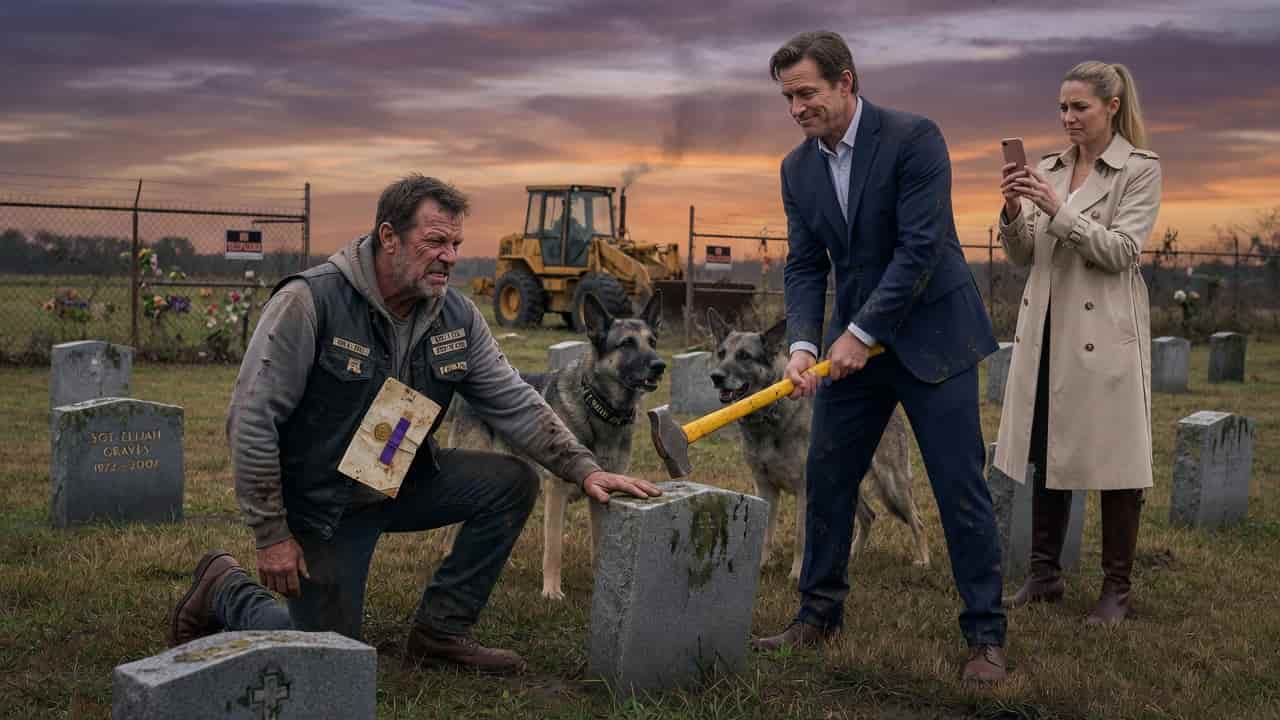
Richard stood there in a three-thousand-dollar suit, tapping a sledgehammer against the headstone of the only man who ever called me a brother. He looked at me like I was something he’d stepped in—trash that belonged in the overgrown weeds of this forgotten Alabama cemetery.
Beside him, Linda didn’t even look away from her phone. She was recording it all, her thumb hovering over the screen, probably ready to show the world how far her “useless” ex-husband had fallen.
“He’s not a pile of dirt,” I said, my voice sounding like gravel under a boot. “He’s a United States Marine.”
Richard laughed, a sharp, ugly sound that made Sarge, my old dog, pull back his lips and growl. “He’s an obstacle to progress, Gabe. And you? You’re just a squatter with a bike and a bad attitude. Now, move. The bulldozers are on a schedule.”
He didn’t know about the paper tucked into my vest. He didn’t know about the ownership deed or the citation for valor that Richard’s own father had signed twenty years ago. But mostly, he didn’t hear the sound.
A low, deep vibration was starting to crawl up through the soles of my boots. It wasn’t the bulldozer. It was the sound of five hundred heavy engines screaming through the valley, coming to reclaim the sacred ground Richard thought he could buy.
“I’m not moving,” I whispered. “And neither is he.”
Chapter 1
The air in Marengo County always tasted like damp pine and woodsmoke, but today, it had the metallic tang of diesel. It was a heavy, suffocating smell that didn’t belong in the quiet acres of St. Jude’s. I sat on the rusted tailgate of my ’94 Silverado, the metal groaning under my weight, and watched the yellow machines crawl toward the gate like giant, mindless insects.
St. Jude’s wasn’t much to look at. It was six acres of sloping Alabama hills, populated by leaning grey stones and the kind of high, yellow grass that stayed wet long after the sun came up. It was a place for the forgotten—men who came home from wars and realized the world didn’t have a place for them anymore, and bikers who lived hard and left nothing behind but a name carved in granite.
I adjusted the leather vest over my shoulders. The leather was stiff, seasoned by years of road salt and rain, the “Reapers of the Road” patch on the back a heavy weight I’d carried since the day I buried Elias.
Elias was three rows back, under a cedar tree that was slowly losing its fight with the wind. He’d been the one who dragged me out of a burning Humvee in Fallujah. He’d been the one who told me that if we made it back, we’d find a piece of land where the noise couldn’t find us. He made it back, but the noise followed him. Three years ago, it got too loud, and he laid down in the woods with a bottle of bourbon and didn’t wake up.
“Gabriel?”
The voice was sharp, polished, and it hit me like a splash of ice water. I didn’t turn around. I knew the cadence of Linda’s footsteps. She walked like she was afraid the ground might stain her shoes.
“The gate is locked, Gabriel. Richard is losing his patience.”
I looked at the gate. A heavy chain and a Master Lock I’d bought at the hardware store two days ago. Simple. Effective. “He can find it when he learns to wait,” I said.
I finally turned. Linda was standing ten feet away, her cream-colored trench coat a stark, arrogant contrast to the bruised purple of the sunset. She looked exactly the way she did the day she served me the papers—clean, detached, and utterly convinced she was the only adult in the room.
Behind her, Richard climbed out of a black Range Rover. He was adjusting his cufflinks, his movements precise and practiced. He looked like every developer who had ever tried to turn a piece of history into a strip mall. To him, this wasn’t a cemetery. It was “unutilized acreage.”
“Graves,” Richard said, his voice carrying that easy, unearned authority of a man who had never had to work for a paycheck. “I thought we were past the dramatics. The county signed off on the rezoning. This land is under my jurisdiction now.”
“The county didn’t talk to the people in the ground, Richard,” I said. I stood up, the movement slow and deliberate. Sarge, my old German Shepherd, hopped down from the truck bed and took his place by my left boot. His hackles were already up, a low vibration in his chest that echoed my own.
“The people in the ground are dead, Gabe,” Linda said, stepping closer. She had her phone out, the screen glowing. “And the living are tired of looking at this eyesore. You’re the only one clinging to this. You and those… associates of yours.”
She said associates the way someone might say vermin. She meant the men I rode with. The men who didn’t show up to town council meetings because they were too busy working two jobs or nursing old wounds.
“There are fifty-four veterans in this dirt, Linda,” I said, my voice low. “Elias is one of them. You remember Elias? He stood at our wedding. He held your sister’s kid when she was too sick to do it herself.”
Linda’s expression flickered, just for a second. A ghost of a memory passed through her eyes, but then she blinked, and the corporate wall was back up. “Elias was a troubled man who couldn’t handle the real world. This isn’t about him. It’s about a five-million-dollar development that’s going to bring jobs to this county.”
“Jobs,” I repeated, tasting the bitterness. “You mean a Starbucks and a car wash built on top of men who gave everything so you could sit in that Range Rover.”
Richard walked toward the gate, his polished shoes sinking into the soft mud. He looked at the chain, then back at the bulldozer idling fifty yards away. He signaled to one of the workers—a man in a hard hat who looked like he’d rather be anywhere else.
“Cut it,” Richard commanded.
The worker hesitated, looking at me, then at the dog. Sarge let out a bark that sounded like a gunshot. The worker took a step back.
“I said cut it!” Richard snapped. He turned his gaze back to me, a cruel smirk spreading across his face. “You want to play the martyr, Graves? Fine. But you’re doing it on my time. And my time is expensive.”
He reached into the back of his vehicle and pulled out a heavy, yellow-handled sledgehammer. He didn’t look like a man who knew how to use it, but he held it with the clumsy aggression of someone who was used to breaking things he didn’t understand.
“I’m going to make this real simple for you,” Richard said, walking toward the fence line. “You unlock this gate, or I’m going to start with the headstones. I’ll consider it ‘preliminary site clearing.’ Let’s see how long your sentimentality lasts when your friend’s name is in pieces.”
I felt the heat rise in my neck, a dark, pulsing rhythm. My hand went to the pocket of my vest, feeling the edges of the citation I carried everywhere. It was a piece of paper that said Elias was a hero. It was a piece of paper that Richard’s own father, the former Congressman, had presented to Elias’s mother with tears in his eyes.
But I didn’t pull it out. Not yet.
“You touch one stone, Richard,” I said, my voice barely a whisper, “and you’ll realize that some things in this world don’t have a price tag.”
“Is that a threat, Gabriel?” Linda asked, her phone pointed directly at me. “Because I’m recording. I’ll have you in a cell before the sun goes down.”
I looked at the lens of her camera, then at the man with the hammer. I realized then that they weren’t just here for the land. They were here to break me. To prove that the world they built—the world of contracts, and image, and cold, hard cash—could crush a man like me without even breaking a sweat.
I didn’t answer. I just walked to the gate and stood in front of the chain. Sarge moved with me, his body a solid weight against my leg. We were the only thing standing between them and the quiet. And as the first stars began to poke through the Alabama haze, I knew it wasn’t going to be enough.
Chapter 2
Richard didn’t wait for me to move. He didn’t even acknowledge the space I was occupying. He walked straight to the chain-link fence, the sledgehammer gripped in both hands, and slammed the head of it against the steel post. The sound was a harsh, jarring clang that echoed through the trees, shattering the evening silence.
“You see that, Graves?” Richard said, his breath hitching with the effort. He wasn’t a physical man, but his anger gave him a frantic sort of strength. “That’s the sound of the world moving on. You can sit here and rot with your ghosts, but this dirt belongs to me.”
He signaled the bulldozer driver again. This time, the machine lurched forward, its massive treads churning the soft earth, tearing deep, ugly gashes into the grass. The roar of the engine was a physical assault, a mechanical scream that drowned out the wind in the cedars.
Linda stepped up beside him, her phone held steady. She was narrating now, her voice pitched for an audience I couldn’t see. “As you can see, we’re facing some illegal obstruction here at the development site. It’s unfortunate when individuals refuse to respect the legal process, even when it’s for the benefit of the entire community.”
She looked at me over the top of the phone. “Give it up, Gabe. You look pathetic. Look at your boots. Look at that dog. You’re fighting for a graveyard that hasn’t been mowed in a decade. Nobody cares about this place but you.”
The humiliation was sharp, a calculated needle. She knew where the skin was thinnest. She knew about the nights I’d spent out here with a weed-whacker and a gallon of gas, trying to keep the briars from swallowing the names of men I’d served with. She knew I’d spent my last three paychecks from the garage on gravel for the entrance path.
“I care,” a voice said.
It was faint, trembling, but it carried through the noise of the bulldozer.
An old woman was standing by a rusted sedan parked twenty yards down the road. She was wearing a floral housecoat under a heavy cardigan, her hands clutching a small bouquet of store-bought carnations. Mrs. Gable. Her husband, Henry, had been a Seabee in the South Pacific. He was buried in the fourth row.
Richard didn’t even turn around. “This is a construction site, ma’am! For your own safety, stay back!”
“You can’t do this,” Mrs. Gable said, her voice gaining a bit of strength as she walked toward the fence. “My Henry is right there. You can’t just… you can’t drive over him.”
Richard finally looked at her, his expression one of bored exasperation. “Ma’am, your husband’s remains will be relocated to a municipal facility with all due respect. We sent the notices six months ago.”
“I didn’t get no notice,” she whispered, her eyes filling with tears. “And Henry don’t want to be in no municipal facility. He wanted to be here. With his friends.”
Richard turned back to me, ignoring the woman as if she were a piece of stray trash. “You see what you’re doing, Graves? You’re giving these people false hope. You’re making it harder on them by dragging this out. You want to talk about honor? Honor means knowing when the battle is over.”
He stepped closer to the gate, his face inches from mine. The smell of his expensive cologne was thick and cloying. “Open the gate, Gabriel. Don’t make me have the sheriff drag you out of here in front of this poor woman. Think about how that’s going to look on Linda’s feed. ‘Local Biker Assaults Developer at Cemetery.’ You’ll lose your job at the shop. You’ll lose that trailer you call a house. Is a dead man’s name worth all that?”
I looked past him at Mrs. Gable. She was crying now, the carnations limp in her hand. She looked so small against the backdrop of the massive yellow machine.
“I’m not opening it, Richard,” I said. My voice was steady, but I could feel the tremor in my hands. It wasn’t fear. It was the effort of not reaching through the fence and wrapping my fingers around his throat.
“Fine,” Richard said. He turned to the bulldozer. “Level the gate! If he stays in the way, that’s a police matter!”
The driver hesitated. He was a local kid, maybe twenty, twenty-one. He knew who I was. He’d seen me at the diner. He’d seen the patch on my back.
“I said do it!” Richard screamed, his face turning a blotchy, frantic red.
The kid looked at me, then at the crying woman, then at Richard. Slowly, he shook his head and cut the engine. The silence that followed was even louder than the roar had been.
“You’re fired!” Richard yelled, throwing his hands up. “Get off the machine! I’ll drive the damn thing myself!”
Linda stepped forward, her voice sharp. “Richard, honey, don’t. Let the sheriff handle it. We have the footage.”
“No!” Richard barked. He was beyond listening now. The humiliation of being told ‘no’ by a grease monkey and a construction kid had snapped something in him. He grabbed the sledgehammer and swung it with all his might against the Master Lock.
The lock held. He swung again. And again. His breath came in ragged, wet gasps. On the fourth swing, the chain snapped, the links skittering across the dirt like broken teeth.
Richard kicked the gate open. It swung back and hit the fence with a violent thud. He stepped into the cemetery, the sledgehammer trailing in the mud behind him.
“Richard, stop,” I said, stepping into his path. Sarge moved with me, his growl now a constant, low-frequency warning.
“Get out of my way, Gabe,” Richard sneered. He pointed the hammer at Elias’s grave. “I’m going to start with that one. Since it’s so special to you. I’m going to break it into gravel, and then I’m going to have it hauled off to the landfill.”
Linda followed him in, her phone still up, her face a mask of cold triumph. “This is what happens when you don’t play by the rules, Gabriel. You lose everything.”
I stood my ground, my heart hammering against my ribs like a trapped bird. I knew the law wasn’t on my side. I knew that on paper, Richard had the right to be here. But as he raised that hammer over Elias’s headstone, I realized that the law didn’t know a damn thing about what was buried in this dirt.
“Don’t do it, Richard,” I said, my voice dropping to a register that made even Linda pause. “You don’t know what you’re waking up.”
Richard just laughed and swung the hammer back.
Chapter 3
The sledgehammer whistled through the air, but it didn’t hit the stone. At the last possible second, Richard pulled the swing, the heavy head of the hammer thudding into the soft earth just inches from the granite base of Elias’s grave. He did it on purpose—a feint, a little game to see if I’d flinch.
I didn’t flinch. I stood there, my boots anchored in the mud, staring at him.
“You’re shaking, Gabriel,” Richard said, leaning on the handle of the hammer like it was a cane. He wiped sweat from his forehead with the sleeve of his suit, leaving a smear of Alabama clay. “I can see it. You’re terrified. You’re realizing that all that ‘brotherhood’ and ‘honor’ talk doesn’t mean a thing when a man with a checkbook walks into the room.”
Linda moved in closer, the camera lens practically brushing my shoulder. “Tell the camera, Gabe. Tell everyone why you’re standing over a grave for a man who didn’t even have the guts to stay alive. Was he worth it? Is this worth your life?”
The cruelty of it was a physical weight. She was trying to strip away the only thing I had left—the dignity of the memory. She wanted me to look small, to look broken, to look like a fool clinging to a ghost.
I looked at her, really looked at her, for the first time in months. I saw the lines of bitterness around her mouth, the way she clutched her expensive bag like a shield. She had traded a life of messy, beautiful truth for a life of polished lies, and she couldn’t stand the sight of someone who still held onto the dirt.
“He had more guts in his pinky finger than Richard has in his whole body, Linda,” I said quietly. “And you know it. That’s why you’re filming this. You’re trying to convince yourself that you made the right choice.”
Her face went pale, her hand trembling just enough to make the camera shake. “I made the only choice I could! You were never there, Gabriel! You were always off with the club, or at the VA, or sitting in this graveyard! I wanted a life! I wanted to be someone!”
“And who are you now?” I asked.
She didn’t answer. She just looked away, her jaw tight.
Richard spat on the ground. “Enough of this. Move, Graves. I’m not playing anymore.”
He raised the hammer again, for real this time. I saw the muscles in his forearms bunch up. He was going to do it. He was going to shatter the stone.
“Wait,” I said.
Richard paused, a look of smug satisfaction crossing his face. “Finally. Going to be reasonable? Going to sign the waiver?”
“No,” I said. I reached into the front pocket of my vest. I pulled out the folded, stained piece of paper. It was heavy, high-quality parchment, though the edges were frayed and the ink was fading.
“What’s that?” Linda asked, the curiosity overriding her anger for a moment.
“This is a Citation for Valor,” I said, unfolding it slowly. “Presented posthumously to Corporal Elias Thorne. For actions taken on October 14th, 2004. It describes how he stayed in a burning vehicle to suppress enemy fire so his squad could reach cover.”
Richard rolled his eyes. “We know he was a soldier, Gabe. That doesn’t change the zoning laws.”
“Read the bottom, Richard,” I said, holding the paper out.
Richard didn’t move, so Linda stepped forward and squinted at the faded script. Her eyes widened.
“The signature,” I said. “It was presented by Congressman Arthur Vance. Your father, Richard.”
Richard stiffened. The smugness drained out of his face, replaced by a sharp, defensive prickliness. “My father did a lot of things for PR. He signed a thousand of those things. It doesn’t mean anything.”
“It means he stood in Elias’s mother’s living room,” I said, my voice growing stronger. “It means he cried when he told her that as long as he was in office, the Thorne family would never have to worry about a place for their son to rest. He made a promise, Richard. A public one. There were reporters there. There’s a transcript in the county archives.”
Richard’s knuckles turned white on the hammer handle. “My father is retired. He’s in a memory care facility. His promises died with his career.”
“But the deed didn’t,” I said. I pulled a second piece of paper from the vest. “This is a life-lease for the land surrounding the Thorne plot, granted by the county in 1952 to the St. Jude’s Veterans Association. I’m the president of that association. And I haven’t signed a damn thing.”
Richard grabbed the paper from my hand, his eyes darting over the legal text. His face went from red to a sickly, pale grey. “This… this is an old document. It’s been superseded by the new development plan.”
“It hasn’t,” I said. “I checked with a lawyer. A real one. Not the kind you keep on retainer to bully widows. This lease is ironclad as long as the cemetery is ‘actively maintained.’ And like Linda said… I’ve been out here every weekend for ten years.”
The silence that fell over the cemetery was heavy. Even the birds seemed to have stopped singing. Richard looked at the paper, then at the hammer, then at the bulldozer. He was cornered, and a man like Richard doesn’t handle being cornered well.
“You think this stops me?” Richard hissed, leaning in so close I could see the broken capillaries in his nose. “I’ll tie you up in court for the next twenty years. I’ll make sure you can’t buy a loaf of bread in this county without a lawsuit. I will ruin you, Gabriel. I will destroy every memory you have of this man.”
He turned to the bulldozer driver—the new one he’d called on his radio while we were talking. “Drive it in! Now! Start at the fence and don’t stop until you hit the trees!”
“Richard, wait,” Linda said, her voice sounding uncertain for the first time. “If that paper is real…”
“I don’t care if it’s the Magna Carta!” Richard screamed. “Drive the machine!”
The new driver, a man who didn’t know the town and didn’t care about the ghosts, slammed the bulldozer into gear. The black smoke belched into the air, and the massive blade began to descend, ready to bite into the sacred earth.
I stood in front of Elias’s stone, my arms crossed, Sarge at my side. I didn’t have any more papers. I didn’t have a lawyer. I just had my body and the memory of a man who wouldn’t have blinked at a piece of yellow machinery.
“You’re going to have to go through me, Richard,” I said.
“Fine by me,” Richard said, a manic light in his eyes.
But then, the sound began.
It wasn’t the bulldozer. It wasn’t the wind.
It was a low, rhythmic thrumming that seemed to vibrate in the very marrow of my bones. It started as a whisper from the valley below, a distant thunder that grew louder with every passing second.
Richard stopped. Linda lowered her phone, her eyes searching the darkening horizon.
“What is that?” she whispered.
I knew that sound. I’d heard it in my dreams, and I’d heard it on the long, lonely stretches of Highway 43. It was the sound of iron and chrome. It was the sound of a thousand miles of road.
I looked at the gate. And then I saw the first headlight.
Chapter 4
The first headlight crested the hill like a rising star, a piercing white beam that cut through the Alabama dusk. Then another. And another. Within seconds, the road leading to St. Jude’s was a river of light, a mechanical tide flowing toward the rusted gates.
Richard took a step back, the sledgehammer suddenly looking very small and very useless in his hand. “What the hell is this? Graves, what did you do?”
I didn’t answer. I didn’t have to.
The sound was a physical force now, a deafening, guttural roar that shook the very air. It was the sound of five hundred heavy-displacement engines, a symphony of defiance that drowned out the bulldozer’s pathetic whine. The ground beneath our feet trembled, the vibration rattling the old headstones in their sockets.
They didn’t stop at the road. They didn’t slow down.
The lead bike—a blacked-out Road Glide—swerved through the open gate, the tires spitting mud. The rider was a mountain of a man, his grey beard streaming over his shoulders, his vest covered in patches that told a hundred stories of war and road. Big Mike. He’d been Elias’s sergeant in the first Gulf War.
He pulled the bike to a halt ten feet from Richard, the engine idling with a deep, menacing lope. He didn’t say a word. He just stared through his mirrored shades, his hands resting on the bars.
Behind him, they poured in. Two by two, then four by four. Bikers in leather, bikers in denim, men and women with faces carved from the same hard road I’d traveled. They filled the pathways, they lined the fence, they surrounded the bulldozer. They parked their machines and cut the engines in a synchronized silence that was more terrifying than the noise had been.
Five hundred people stood in the cemetery. And the only sound was the clicking of cooling metal and the wind in the cedars.
Linda had backed up against the Range Rover, her phone forgotten in her hand. Her face was a mask of pure, unadulterated terror. She looked at the sea of leather and patches, then at me, as if seeing me for the first time. She hadn’t realized that the “associates” she mocked were a brotherhood that stretched across state lines and decades.
Richard was trying to find his voice, his chest heaving. “This… this is an illegal assembly! I’m calling the authorities! You’re trespassing on private property!”
Big Mike dismounted his bike, the leather of his boots creaking. He walked toward Richard, his presence so massive it seemed to pull the light from the sky. He stopped three feet away, looming over the developer.
“We heard there was some site clearing going on,” Mike said, his voice a deep, gravelly rumble. “And we realized we hadn’t paid our respects to our brother in a while.”
He looked at the sledgehammer in Richard’s hand. “That a new way to lay flowers, son?”
Richard tried to puff out his chest, but he looked like a child playing dress-up. “I am the legal owner of this land! I have a court-ordered development plan! You people need to leave, or I will have you all arrested!”
Mike didn’t flinch. He didn’t even blink. He just turned his head and looked at the five hundred men and women standing behind him. Every single one of them was staring at Richard. No one shouted. No one made a move. They just watched.
The weight of five hundred silent stares is a heavy thing. It’s the weight of judgment. It’s the weight of the truth.
“You see all these people, Richard?” I said, stepping forward. I felt a strange, cold calm settling over me. The humiliation of the last hour was gone, replaced by a clarity that felt like steel. “They didn’t come here for a development plan. They came here for Elias. And for Henry Gable. And for all the men and women you were going to turn into landfill.”
I walked over to the bulldozer. The driver had climbed down and was standing by the treads, his hands in his pockets, looking at his boots. He knew the fight was over.
“This machine stays off,” I said. It wasn’t a request.
Richard looked at Linda, looking for support, but she was staring at the ground, her face hidden by her hair. He looked at the bulldozer. He looked at the sea of bikers. He was realizing that all the money and all the influence in the world didn’t mean a damn thing when you were standing in a field of five hundred people who weren’t afraid of you.
“You think you won?” Richard hissed, his voice cracking. “You think a bunch of thugs on motorcycles can stop progress? I’ll be back tomorrow with the state police! I’ll have this whole place leveled before you can get your kickstands up!”
“No, you won’t,” I said.
I pulled a third paper from my vest. This one was fresh, the ink still dark.
“What’s that?” Richard asked, his voice trembling with a mix of rage and fear.
“This is an injunction,” I said. “Filed three hours ago in the county court. It’s a stay of execution for St. Jude’s, based on the discovery of historical significance and the violation of the 1952 lease agreement. It was signed by Judge Miller. You remember him, Richard? He was the one who served with your father.”
I held the paper out. Richard didn’t take it. He just stared at it as if it were a venomous snake.
“The sheriff is on his way,” I continued. “But he’s not coming to arrest us. He’s coming to serve you. And to make sure you and your equipment are off this property by nightfall.”
The first siren wailed in the distance, a lonely, rising sound that signaled the end of the standoff.
Richard looked at the hammer in his hand. For a second, I thought he was going to swing it anyway—not at the stone, but at me. I saw the desperation in his eyes, the absolute refusal to be humiliated by a man like me.
But then, Big Mike stepped an inch closer. Sarge let out a low, warning growl.
Richard dropped the hammer.
It fell into the mud with a dull, wet thunk. He turned without a word and climbed into his Range Rover. He slammed the door so hard the vehicle rocked on its suspension.
Linda stood there for a moment longer. She looked at me, her eyes wet, her mouth opening as if to say something. Maybe an apology. Maybe a plea.
“Go, Linda,” I said, my voice quiet but firm. “You got what you wanted. You got the clean life. Don’t go getting mud on your boots now.”
She flinched as if I’d struck her. She turned and ran to the car, her cream-colored coat flapping in the wind. The Range Rover roared to life and sped away, its tires throwing up a spray of Alabama clay that coated the cemetery gates.
The silence returned, but it was a different kind of silence now. It wasn’t the silence of a graveyard. It was the silence of a sanctuary.
Big Mike walked over to me and put a hand on my shoulder. His grip was like iron. “You did good, Saint. Elias would have been proud.”
I looked at the five hundred bikers. One by one, they began to move. But they didn’t go to their bikes. They walked to the graves. They pulled small, faded American flags from their vests. They laid flowers. They stood in silence, their heads bowed, paying the respects that Richard had tried to steal.
I walked back to Elias’s grave. I knelt in the mud, my hand resting on the cracked granite.
“We’re still here, brother,” I whispered. “The noise didn’t win.”
I stayed there as the sun finally dipped below the horizon, leaving the world in a soft, blue twilight. I stayed there until the last biker had ridden away, their tail-lights fading into the darkness.
I stayed there until it was just me, and Sarge, and the quiet. And for the first time in three years, the air in St. Jude’s didn’t taste like diesel. It just tasted like home.
Chapter 5
The roar of five hundred engines didn’t just vanish; it bled into the ground, leaving a vibration in the soles of my boots that lasted long after the last taillight flickered out at the bend of County Road 43. Silence in Alabama is never truly silent. It’s a thick, heavy thing made of cicadas, the shifting of pine needles, and the distant, rhythmic thrum of the paper mill in the next valley over. But tonight, the silence at St. Jude’s felt different. It felt like a held breath.
I sat on the edge of a flat marble slab belonging to a man named Thomas Miller, a Korean War vet who had died three years before I was born. My hands were grease-stained and shaking, the kind of fine tremor that comes when the adrenaline finally decides it’s done with you. Sarge sat at my feet, his chin resting on my boot, his eyes fixed on the empty gateway where the Range Rover had disappeared.
“You’re going to need more than a piece of paper and a few bikes, Saint.”
I didn’t have to look up to know it was Big Mike. He was the only one who stayed behind, his massive Road Glide idling near my truck like a tether to the real world. He walked over, his heavy boots crunching on the gravel, and handed me a lukewarm bottle of water from his saddlebag.
“I know,” I said, taking a swallow. The water tasted like plastic and heat. “Richard doesn’t lose. He just finds a bigger hammer.”
Mike leaned against a cedar tree, his shadows stretching long and jagged over the rows of the dead. “He’s already calling the DA. I saw him on his phone as he backed out. He’s going to go after the club, Gabe. He’ll frame this as an MC intimidation tactic. He’ll say you used the Reapers to coerce a legitimate business transaction.”
“He attacked a grave with a sledgehammer, Mike. Linda filmed it.”
Mike let out a short, dry laugh that sounded like snapping kindling. “You think she’s going to turn that footage over? That video is already deleted, or edited to show you threatening them. You know how this works. Men like Richard own the narrative because they pay for the ink.”
I looked over at Elias’s stone. The granite looked darker in the moonlight, the name Thorne etched deep into the grain. “The injunction is real. Judge Miller signed it.”
“Miller is eighty-two and has one foot in the grave himself,” Mike countered, stepping closer. “Richard’s father, the Congressman, basically bought Miller his seat thirty years ago. If Richard puts enough pressure on the family, that injunction will dissolve faster than sugar in a rainstorm. You didn’t win today, Saint. You just started a war you can’t afford to lose.”
The weight of it settled on my chest. It wasn’t just about the land anymore. It was about the residue of a decade of being the “problem” in this town. To the people in the nice houses on the hill, I was the biker who worked on their cars but wasn’t invited to their barbecues. I was the man who spent too much time in a graveyard because I couldn’t handle the living.
“I have the lease,” I whispered, though it felt like a flimsy shield.
“Then you better guard it like it’s your life,” Mike said, his voice softening. “Because tomorrow morning, the town is going to wake up and remember they want that Starbucks more than they want to remember a bunch of dead men. You’re the ghost in the machine now, Gabe. And ghosts usually get exorcised.”
He patted my shoulder once—a heavy, grounding pressure—before walking back to his bike. The roar returned for a moment as he kicked it into gear, then faded into a low hum as he disappeared down the road.
I didn’t go home. I couldn’t. Home was a single-wide trailer with a leaky roof and a sink full of dishes I didn’t have the heart to wash. Here, at least, I was useful. I spent the next three hours with a hand-spade, carefully smoothing out the ugly gouges the bulldozer’s treads had left in the grass. I worked by the light of a small LED lantern, the sweat stinging my eyes, my back screaming with every movement.
Sarge followed me, his nose to the ground, occasionally stopping to growl at the dark tree line. He knew the threat hadn’t left; it had just changed shape.
Around midnight, a pair of headlights swept across the cemetery. I froze, my hand tightening on the spade, thinking Richard had returned with the promised authorities. But the vehicle was a beat-up Ford Ranger, the engine knocking in a way that signaled a bad fuel pump.
It was Mrs. Gable. She climbed out slowly, her movements stiff with age, still wearing the same heavy cardigan. She didn’t look at me at first. She walked straight to her husband Henry’s grave and knelt down, her fingers tracing the letters on the stone.
“He was a good man, Mr. Graves,” she said, her voice thin but clear in the night air. “He wasn’t famous. He didn’t have no money. But he built things that lasted. He helped build the high school. He helped build the church. He deserved to stay where he put himself.”
I walked over and stood a respectful distance away. “He’s staying, Mrs. Gable. I promise.”
She looked up at me, her eyes clouded with cataracts but sharp with a sudden, piercing intensity. “Promises are easy when the sun is up and you got five hundred men behind you. But Richard… he’s like the kudzu. You cut it back one day, and it’s twice as thick the next. He called my daughter tonight.”
I felt a cold prickle at the back of my neck. “What did he say?”
“He told her the county was going to condemn our house if I didn’t sign a statement saying you harassed me,” she said, her voice trembling. “Said you were using the cemetery for ‘illicit club activities.’ My daughter is scared, Gabriel. She wants me to sign. She says Henry is gone anyway, and we need to worry about the living.”
I felt a surge of nausea. This was the residue. Richard wasn’t going to hit me directly—not yet. He was going to bleed the people around me until they turned on me. He was going to turn my sanctuary into a cage.
“Did you sign it?” I asked.
Mrs. Gable looked back at her husband’s grave. She reached out and touched the carnations I’d helped her place earlier. “Not yet. But I’m an old woman, Gabriel. I don’t have no fight left in me. I just want to be with Henry when it’s time.”
She stood up, her bones popping in the quiet. “You’re a good boy. But you’re carrying a heavy cross. Just make sure you don’t get buried under it.”
She drove away, the tail-lights of the Ranger disappearing into the mist. I stood there in the dark, the hand-spade still in my grip, feeling the absolute isolation of the moment. The bikers were gone. The law was a shifting shadow. And now, the people I was trying to protect were being used as leverage against me.
I walked back to my truck and sat in the cab, the smell of old tobacco and Sarge’s wet fur filling the small space. I pulled out my phone. One new message.
It was from Linda.
Richard is beyond furious, Gabe. He’s filing for a permanent restraining order and a civil suit for damages to the equipment. He’s going to make sure the garage loses its business license by Monday. You don’t know what you’ve done. You think you’re a hero, but you’re just a man burning down his own house to keep the porch light on. Just sign the release. I can still talk him down if you do it tonight. Please.
I looked at the screen until the light turned gray, then black. I thought about the garage. I thought about the three guys who worked for me—men with kids and mortgages who relied on those bays being open. I thought about the way Linda used to look at me before the war, before the silence, before the cemetery became the only place I felt like I belonged.
She was right about one thing: I was burning the house down. But she was wrong about the reason. I wasn’t doing it to keep the light on. I was doing it because the house was already empty, and the only thing left worth saving was the ground it sat on.
I put the truck in gear and drove toward the garage. I needed to see the ledger. I needed to see how much time I had before the money ran out and Richard’s long shadow finally eclipsed the sun.
The garage was a corrugated metal building on the edge of town, a place of oil and hard work. I unlocked the side door and stepped into the dark interior. The smell of degreaser and cold iron usually calmed me, but tonight, it felt like a tomb.
I sat at the small, cluttered desk in the back office and opened the books. We were barely breaking even. Between the rising cost of parts and the fact that I’d been giving “veteran discounts” to half the county, the margins were razor-thin. If Richard pulled the business license, or even just pressured the local parts suppliers to cut us off, we’d be dead in the water in ten days.
I leaned back in the creaky chair, staring at the ceiling fan that hadn’t worked since 2019.
The phone on the desk rang. It was 2:14 AM.
I picked it up. I didn’t say anything.
“I hope you’re looking at the numbers, Gabriel.” Richard’s voice was smooth, devoid of the frantic rage he’d shown at the cemetery. This was the voice of the predator who had already tasted blood. “I imagine they don’t look very promising.”
“Trespassing is a crime, Richard,” I said. “Harassing a business owner is another.”
“Harassment is such a subjective term,” Richard mused. “I’m just a concerned citizen looking into the safety protocols of a local establishment. Did you know your fire extinguishers are six months out of date? Or that your waste oil disposal doesn’t quite meet the new environmental standards I helped draft last year?”
I gripped the phone until my knuckles ached. “What do you want, Richard?”
“I want what I paid for,” he said, his tone sharpening. “I want that land. And I want you to realize that your little stunt with the bikers was the biggest mistake of your life. You brought a circus to my town, Gabriel. And now, the town wants the circus to leave. I’m giving you until eight o’clock tomorrow morning. Sign the release, vacate the lease, and I’ll let the garage stay open. I’ll even buy the land for ten percent over market value. You can take the money and ride off into the sunset with your ‘brothers.'”
“And if I don’t?”
“Then I’ll start with the garage,” Richard said. “Then I’ll move to the bank that holds your mortgage. And by noon, I’ll be back at St. Jude’s. And this time, I won’t be bringing a sledgehammer. I’ll be bringing a court order that says the cemetery is a public health hazard due to ‘neglected maintenance.’ I’ll have the remains moved to a mass trench in the county line before sunset. Your choice, Saint. Be a man, or be a ghost.”
The line went dead.
I sat in the dark for a long time, the silence of the garage pressing in on me. I looked at the photos on the wall—me and Elias in uniform, grinning like idiots in the desert sun. Me and Linda at the county fair. Sarge as a puppy.
I realized then that Richard was right. I couldn’t win this way. Not with papers. Not with bikers.
The only way to stop a man who thinks he owns the world is to show him a part of it he can’t touch.
I stood up and walked to the tool chest. I didn’t reach for a wrench. I reached for the bottom drawer, the one I kept locked with a separate key. Inside was a small, wooden box. And inside that box was the one thing Richard’s father had given me that wasn’t a piece of paper.
It was a key. Not to a lock, but to a secret.
Chapter 6
The dawn didn’t break; it leaked into the Alabama sky like a slow, grey bruise. I was back at St. Jude’s before the first logging trucks started their run on the highway. I’d spent the last four hours in the basement of the county library and then in the crawlspace of an old house that didn’t belong to me anymore. My clothes were covered in cobwebs and the dust of thirty years of secrets, but my hands were no longer shaking.
I stood by the gate, waiting. Sarge sat beside me, his ears twitching at the sound of every approaching engine. I didn’t have to wait long.
At 7:55 AM, the black Range Rover pulled up to the gate. Richard stepped out, looking immaculate in a charcoal suit, followed by Linda, who looked like she hadn’t slept at all. Behind them, two sheriff’s cruisers and a flatbed truck carrying a heavy-duty excavator rumbled to a halt.
Richard checked his watch, a smug grin pulling at the corners of his mouth. “Eight o’clock, Gabriel. I hope you brought a pen. I’d hate to have to start the day with an eviction.”
The Sheriff, a man named Miller who had gone to high school with my father, stepped out of his car. He looked at me with a pained expression. “Gabe… don’t make this hard. The DA looked at the injunction. Since it was based on an association that hasn’t filed tax returns in five years, it’s being stayed. Richard has the right of entry.”
“I’m not here to talk about the injunction, Sheriff,” I said. I looked at Linda. She was avoiding my eyes, staring at a patch of weeds near the fence. “I’m here to talk about the deed.”
Richard laughed, a short, barking sound. “We’ve been over this. The lease is dead. The land is mine.”
“Not this land,” I said. I stepped aside and pointed to the small, brick building at the back of the property—the old sexton’s cottage that had been falling into ruin for forty years. “I’m talking about the four acres behind the creek. The part you need for the access road to your ‘luxury’ development.”
Richard’s smile faltered. “That land was part of the municipal acquisition.”
“Check again,” I said, tossing a heavy, leather-bound ledger onto the hood of his car. The dust puffed up in a small cloud. “I went through the archives last night. The archives your father tried to have ‘archived’ into a dumpster back in ’98. That four-acre plot wasn’t municipal. It was a private endowment, granted in 1944 to a trust. A trust that only had two names on it.”
Richard grabbed the ledger, his hands moving with a sudden, frantic energy.
“Arthur Vance and Elias Thorne Senior,” I said. My voice was calm, almost conversational. “Your father and Elias’s grandfather. They bought it together after they came back from the Pacific. They wanted to make sure there was always a place for the boys who didn’t come back.”
“This doesn’t mean anything,” Richard hissed, though his face was turning a dangerous shade of purple. “My father was the trustee. He had the power to dissolve it.”
“He did,” I said. “But he didn’t. Because Elias’s grandfather never signed the dissolution papers. I found them last night, Richard. In the crawlspace of the old Thorne house. They’re unsigned. And according to the trust’s bylaws, without both signatures, the land cannot be sold, developed, or transferred for ninety-nine years.”
Richard’s eyes darted to the Sheriff, then back to the ledger. “This is a forgery. It has to be.”
“It’s not,” Linda said.
We all turned to her. She was looking at Richard now, and for the first time, the look wasn’t one of support. It was one of realization.
“I remember Elias talking about this,” she whispered, her voice cracking. “When we were kids. He said his granddad held onto a piece of the world that nobody could touch. I thought he was just being poetic. I thought it was just Biker talk.”
“Linda, shut up,” Richard snapped.
“No,” she said, her voice rising. “Gabe, I saw the files in Richard’s office last week. There was a folder marked ‘Thorne Trust.’ He knew. He knew the title wasn’t clean, and he was trying to push the development through before anyone figured it out.”
Richard turned on her, his face contorted with rage. “I did this for us! For our future! You think you’d be wearing that coat on a mechanic’s salary?”
“I don’t care about the coat, Richard!” she screamed, the tears finally breaking through. “I care that I’m standing in a graveyard watching you try to destroy the only honest thing I ever knew!”
She turned and walked away, toward the road, her expensive boots splashing through the mud she had been so afraid of.
The Sheriff looked at Richard, then at the ledger, then at me. He sighed, a long, weary sound of a man who had seen too much of the wrong kind of politics. “Richard, if that trust is active… I can’t let you move a single spoonful of dirt. Not until the title is cleared in a state court. And with an unsigned dissolution? That could take a decade.”
Richard stood there, his world collapsing in the grey morning light. The power he’d spent his life accumulating—the money, the influence, the cold corporate certainty—had been undone by a piece of paper in a dusty crawlspace.
He looked at me, and for a second, I saw the man behind the suit. He was small. He was hollow. He was just a boy trying to live in a shadow that was too big for him.
“You think you’ve won, Graves?” he whispered, his voice trembling. “I’ll still ruin you. I’ll still take the garage. I’ll make sure you never have a moment of peace in this town.”
“You can try,” I said. I walked over to him, standing so close I could hear his shallow, panicked breathing. “But every time you look at the hill where your development was supposed to be, you’re going to see those headstones. And you’re going to know that the ‘trash’ in the ground was stronger than you. That’s your residue, Richard. Live with it.”
Richard didn’t say another word. He climbed into his Range Rover and drove away, the tires spinning in the mud, the black smoke from his exhaust a final, ugly stain on the air. The Sheriff signaled the excavator driver to head out, then tipped his hat to me and followed.
The silence returned to St. Jude’s.
I stayed there for a long time, watching the sun finally burn through the mist. The garage was still in trouble. The legal fees were going to be astronomical. I’d probably be eating ramen for the next five years, and the town was still going to whisper when I walked down the street.
But as I walked back to Elias’s grave, I felt a weight lift that I hadn’t even realized I was carrying.
I knelt down and pulled a few stray weeds from the base of the stone. I didn’t say anything. I didn’t have to. The quiet was enough.
Sarge nudged my hand with his cold nose, and I realized I wasn’t a ghost anymore. I was a man with a piece of ground to stand on. And in Alabama, sometimes that’s all you need.
I stood up, whistled for the dog, and walked toward the truck. We had a garage to open. We had work to do. And for the first time in a long, long time, the road ahead didn’t look lonely at all.
I looked back one last time at the gate. The sign I’d hung there was still straight, the letters clear in the morning light:
ST. JUDE’S. RESPECT THE DEAD. WE’RE WATCHING THE LIVING.
I climbed into the Silverado, put it in gear, and drove home. The noise was gone. The peace remained. And Elias, wherever he was, was finally, truly, at rest.