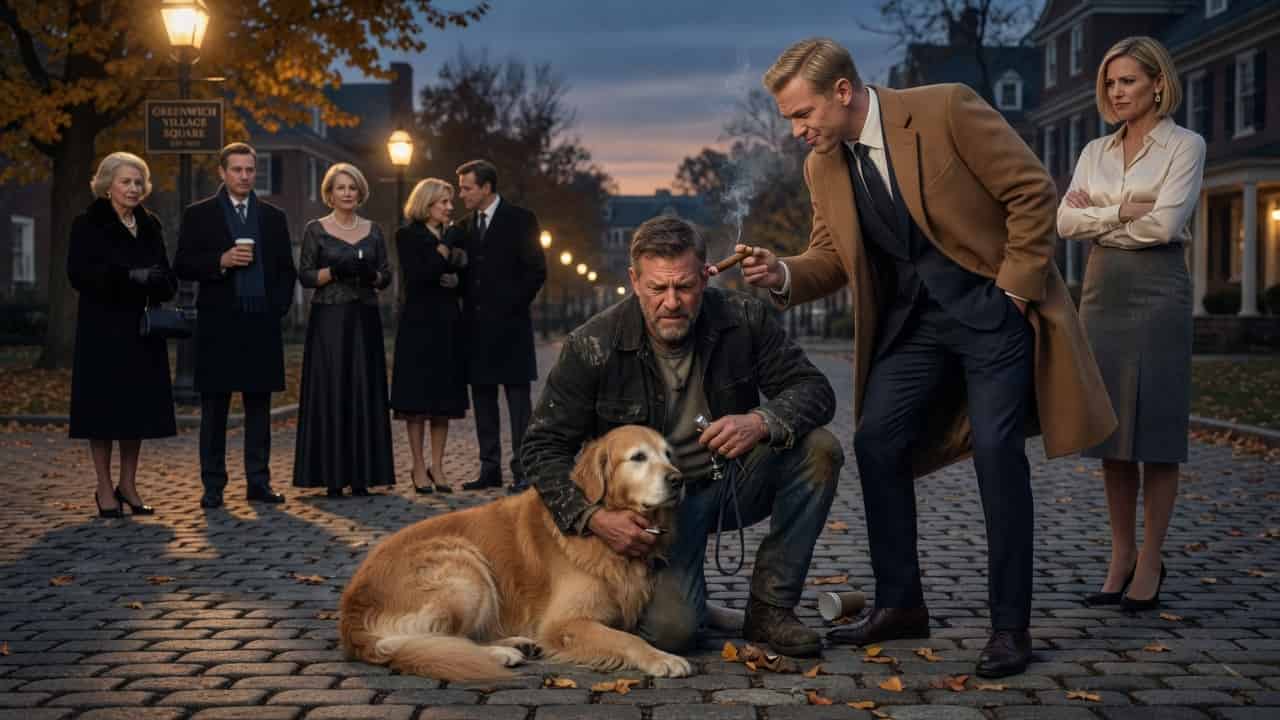
“Can you even hear me, you broken dog? Or is that side of your head just for decoration now?”
Sterling leaned down, the expensive scent of his cologne mixing with the smell of the glowing cigar he was holding inches from my ear. He wanted me to flinch. He wanted the whole town to see me crawl. Behind him, Megan—the woman who used to share my bed before she decided a biker wasn’t a good ‘investment’—just watched with those cold, polished eyes.
“Say it, Cade,” she whispered, her voice carrying across the quiet square where the wealthy elite had gathered for their gala. “Tell everyone how you lost everything because you were too slow to keep up.”
I didn’t answer. I couldn’t. Not yet. I was kneeling on the cold cobblestones, my arm wrapped around Buster. My dog was shivering, his grey muzzle tucked into my side. He was the only one who knew why I was really there. He was the only one who knew about the memorial being held three blocks away for a brother we’d lost.
I had to stay quiet. I had to keep their eyes on me so they wouldn’t see what was happening behind the trees. But then Sterling’s hand reached out for Buster’s collar, his fingers tightening.
That was the moment the world stopped.
I reached into my pocket and pulled out the tarnished silver whistle. Sterling laughed, thinking it was a toy. He didn’t see the shadows moving in the fog. He didn’t hear the low rumble of five hundred engines waiting for a single breath of air.
He thought I was alone. He was wrong.
Chapter 1: The Ringing
The ringing in Cade’s left ear never truly stopped; it just changed pitch depending on how much he hated the world that day. On a Tuesday in Greenwich, Connecticut, it sounded like a high-tension wire snapping over and over in a storm.
Cade sat in the cab of his rusted ’98 Ford F-150, the engine idling with a rhythmic thrum that he felt in his teeth more than he heard in his head. He looked at the grocery store—a temple of organic kale and thirty-dollar olive oil—and felt like a smudge on a clean window. He was thirty-eight, but his knees felt fifty, and his left side was a map of scar tissue and silence.
“Stay, Buster,” Cade murmured, his voice a low rumble that vibrated in his chest.
In the passenger seat, the Golden Retriever huffed, a soft puff of air that Cade felt against his hand. Buster didn’t mind the silence. Buster didn’t mind that Cade sometimes had to ask people to repeat themselves three times before the words made sense. The dog just leaned his heavy head against Cade’s thigh, his eyes milky with cataracts but full of an ancient, steady loyalty.
Cade stepped out of the truck, his boots hitting the pavement with a heavy thud. He adjusted the collar of his black canvas jacket. It was an old habit, a way to hide the faded “Sons of Thunder” patch he’d ripped off years ago. He wasn’t a member anymore, not officially. He was a ghost with a mechanic’s license and a bad ear. But today was different. Today, the club was in town, and for the first time in a decade, Cade felt the pull of the collective heartbeat he’d tried so hard to outrun.
The grocery store was bright, too bright. The lighting was designed to make everything look expensive and untouchable. Cade moved through the aisles, grabbing the essentials—steak, heavy cream, the good kind of bourbon. Not for him. For the wake. They were gathering at the old chapel on the edge of the county line tonight to remember ‘Hammer’—the man who had taught Cade how to rebuild a carburetor and how to hold his liquor.
As he stood in the checkout line, the woman in front of him flinched. She was dressed in a sleek athletic set that probably cost more than Cade’s truck, her hair pulled back into a ponytail so tight it looked painful. She glanced at his hands—calloused, stained with permanent grease, the knuckles scarred from a lifetime of bad decisions—and visibly moved her cart six inches away.
Cade didn’t care. He was used to being the monster in the room. What he wasn’t used to was the voice that drifted from the next register over.
“I told you, Sterling, the catering for the gala has to be perfect. The Mayor is bringing his entire cabinet.”
Cade froze. The ringing in his ear spiked, turning into a piercing whistle. He knew that voice. It was a voice that had once whispered promises against his neck in the back of a crowded bar in New Haven. It was a voice that had screamed at him when he came home from the hospital with half his hearing gone and a chest full of medals he refused to wear.
He turned his head slowly, leading with his right ear.
There she was. Megan.
She looked different. Polished. The rough edges of the girl who used to ride pillion on his Harley had been sanded down by years of wealth and calculated social climbing. She was wearing a cream silk blouse that made her skin look like porcelain. Beside her stood a man who looked like he’d been grown in a lab for the sole purpose of appearing on the cover of a yachting magazine. Sterling.
“Oh, I know, darling,” Sterling said, his voice a smooth, practiced baritone. “Only the best for your debut as the Board Chair.”
Megan smiled, but the smile didn’t reach her eyes. She glanced toward the checkout lines, her gaze sweeping over the ‘commoners’ with a practiced indifference. Then, her eyes hit Cade.
For a second, the mask slipped. The polished Board Chair vanished, and for a heartbeat, he saw the girl who used to steal his t-shirts. Her breath hitched. She looked at his grease-stained jacket, his unkempt beard, and the way he held his head slightly tilted to the side.
Then, the mask slammed back into place. It wasn’t just indifference now. It was horror. It was the look of a woman seeing a cockroach in her jewelry box.
“Megan?” Sterling asked, noticing her sudden stillness.
“It’s nothing,” she said, her voice turning sharp, brittle. “Just… some local trash. Let’s go. This place is starting to feel cramped.”
Cade watched them walk toward the automatic doors. He felt the familiar heat of shame rising in his chest—a shame he shouldn’t feel, a shame he’d earned through blood and fire, yet it remained. He paid for his groceries in a daze, the cashier’s mouth moving but the words failing to penetrate the static in his head.
He walked back to the truck, his grip on the brown paper bags so tight the handles tore. Buster was waiting, his tail thumping against the seat. Cade climbed in and sat there for a long time, the silence of the cab pressing in on him.
He reached into his pocket and felt the cool, tarnished metal of the silver whistle. It was a relic from the old days, a gift from Hammer. ‘If you’re ever in the dark, kid, just blow. We’ll find you.’
Cade looked at the grocery store one last time. He knew what was coming. Megan wouldn’t let it go. She was a climber, and he was the anchor she thought she’d cut loose. But anchors have a way of dragging things down with them when the tide changes.
He turned the key, and the truck roared to life, a low-frequency growl that drowned out the ringing for just a moment.
Chapter 2: The Social Cost
The “Sons of Thunder” were not supposed to be in Greenwich. This was a land of quiet money, of hedges trimmed to the inch, and residents who called the police if a lawnmower ran past 6:00 PM. But Hammer had grown up here, back when the town was still full of farms and families who worked with their hands. He’d wanted to be buried where he started, even if the town had spent the last forty years trying to forget people like him existed.
Cade spent the afternoon at the small, ivy-covered chapel. He helped the younger guys move the heavy floral arrangements—mostly lilies and dark roses that smelled like a funeral home. He didn’t talk much. He didn’t have to. The brothers knew about his ear. They knew that if they wanted Cade to hear them, they had to stand on his right and speak clearly. There was a respect in their silence, a shared understanding of the price he’d paid during the fire at the warehouse ten years ago.
“You okay, Cutter?”
Cade looked up. It was Jax, a man ten years younger than him, wearing a vest that was still too clean.
“I’m fine,” Cade said, his voice grating like gravel.
“The town’s buzzing,” Jax said, leaning against the stone wall of the chapel. “A lot of suits driving by, looking at us like we’re a plague of locusts. There’s some big gala happening in the square tonight. Police are already on edge.”
Cade nodded. “We’re just here for Hammer. We do the service, we leave. No trouble.”
“Tell that to them,” Jax muttered, gesturing toward the road where a black SUV had slowed down to a crawl.
Cade recognized the driver. It wasn’t Sterling, but it was one of his ilk—a man in a suit with a cell phone pressed to his ear, his face tight with annoyance.
The social pressure was a physical weight. Cade could feel it in the way the air seemed to thin out whenever a local passed by. It was the look of ‘not in my backyard.’ It was the silent agreement that Cade and his brothers were a visual pollution, a reminder of a world the residents of Greenwich had spent millions of dollars to insulate themselves from.
Around 4:00 PM, a silver Mercedes pulled into the chapel’s small gravel lot. The door opened, and Megan stepped out.
She was alone this time. She looked around the lot, her heels sinking into the gravel, her nose wrinkled at the smell of exhaust and old leather. She saw Cade standing by the chapel doors and began to walk toward him with a determined, predatory grace.
“Cade,” she said, stopping five feet away.
Cade didn’t move. He kept his eyes on the horizon, where the sun was beginning to dip behind the treeline. “Megan.”
“You shouldn’t be here,” she said, her voice low and urgent. “You and… these people. It’s disrespectful.”
Cade finally looked at her. He led with his right eye, his gaze steady. “It’s a funeral, Megan. A man I loved died. This is where he wanted to be.”
“He wanted to be in a town that hates him?” she snapped. “He wanted to make a scene? Because that’s all this is. A scene. You’re embarrassing me, Cade.”
Cade felt a hollow laugh vibrate in his throat. “I haven’t seen you in seven years. How am I embarrassing you?”
“People know who I was,” she hissed, stepping closer. The scent of her expensive perfume was cloying, a sharp contrast to the smell of the lilies behind him. “They know I grew up on the wrong side of the tracks. I’ve worked too hard to build this life, Cade. Sterling is about to announce a major endowment for the hospital. My name is going to be on the wall. I won’t have you dragging your grease and your… your brokenness into my square.”
“Your square?” Cade asked, his voice dropping an octave. “I’m not in your square. I’m at a chapel.”
“The square is where the gala is,” she said. “And the only way to get to the highway from here is through the square. I want you to take your friends and find another route. Now.”
“No,” Cade said simply.
Megan’s face flushed, a mottled red appearing under her carefully applied foundation. “You think you’re still the big man on the bike, don’t you? You’re a ghost, Cade. You’re a half-deaf mechanic who lives in a trailer with a dog that’s as pathetic as you are. If you show up in that square, Sterling will make sure you regret it. He has friends in this town. Real friends. Not people who wear patches and think they’re outlaws.”
“Go home, Megan,” Cade said, turning his back on her.
“I’m trying to save you!” she yelled after him. “You’re an eyesore! You’re a reminder of everything I had to kill to become who I am!”
Cade didn’t turn back. He walked into the chapel, the ringing in his ear rising to a deafening roar. He found Buster sitting near the altar, the dog’s tail thumping softly against the wood. Cade sat down on a pew and put his head in his hands.
He wasn’t a reminder of what she had to kill. He was a reminder that she hadn’t killed it. She’d just buried it, and now the dirt was starting to wash away.
The weight of the afternoon felt like a physical bruise. He looked at the tarnished silver whistle in his hand. He’d promised the brothers he’d stay quiet. He’d promised them he wouldn’t let the town’s hostility provoke them. But as he listened to the low, distant rumble of the first few bikes arriving for the service, he knew that peace was a fragile thing in a town built on the illusion of perfection.
Chapter 3: The Gathering Storm
The service for Hammer was short, brutal, and honest. There were no flowery speeches about the afterlife, only stories about broken bones, long rides, and the kind of loyalty that doesn’t ask questions. By the time it was over, the sun had vanished, leaving the world in a cold, blue twilight.
Cade stood at the edge of the chapel lot as the brothers began to mount their bikes. There were nearly fifty of them—a drop in the ocean compared to the full club, but enough to make a formidable sound.
“Remember,” Cade said to Jax as the younger man zipped up his leather. “We go straight to the highway. No stopping. No looking back. We let the town have their party.”
Jax nodded, but his eyes were hard. “Whatever you say, Cutter. But they’ve been circling like vultures.”
Cade climbed into his truck, Buster jumping into the passenger seat with a tired groan. He led the procession, the old Ford’s headlights cutting through the growing fog.
The route to the highway did, indeed, go through the center of town. As they approached the square, the change in atmosphere was immediate. The streetlamps were draped in festive banners. Rows of luxury cars—Bentleys, Porsches, Maseratis—lined the curbs. In the center of the square, a massive white tent had been erected, glowing from within like a giant lantern.
Cade kept his speed steady, his eyes fixed on the road ahead. But then, he saw the flashing lights.
A police cruiser was parked diagonally across the main intersection, blocking the way to the highway. An officer stood in the road, his hand raised.
Cade slowed the truck to a stop. Behind him, the roar of fifty engines idled down into a low, menacing growl.
The officer walked up to Cade’s window. He was young, his uniform crisp, his expression one of bored authority. “Road’s closed for the gala, fellas. You’ll have to turn around.”
Cade leaned out the window. “This is the only way to the highway, Officer. We’re just passing through. It’ll take us two minutes.”
“Did I stutter?” the officer asked, his hand moving toward his belt. “Turn it around. Go back the way you came.”
“Back the way we came is a dead end at the chapel,” Cade said, his voice tight. “We’re not looking for trouble. We just want to get home.”
At that moment, a group of people emerged from the gala tent. They were dressed in tuxedos and evening gowns, holding champagne flutes. Among them was Sterling, his camel-hair coat draped over his shoulders, and Megan, looking like a queen in her silk blouse.
Sterling saw the truck and the line of bikers behind it. A slow, cruel smile spread across his face. He whispered something to Megan, then began walking toward the intersection.
“Is there a problem, Officer Miller?” Sterling asked as he reached the cruiser.
“Just moving some debris out of the way, Mr. Sterling,” the officer said with a sycophantic grin.
Sterling looked at Cade, his eyes scanning the rusted truck with theatrical distaste. “Ah, the mechanic. And his band of… what do you call them? Rebels? You’re late for the party, Cade.”
Cade didn’t answer. He kept his hands on the steering wheel, his knuckles white.
“Tell you what,” Sterling said, leaning his elbows on the driver’s side door of the truck. “Since it’s a celebration, why don’t you come out and say hello? Let everyone see the man Megan used to tell me about. The hero. The one who… what was it? Saved some kids from a fire? You don’t look like a hero to me, Cade. You look like a man who forgot to wash his hands for twenty years.”
Megan stepped up beside Sterling. She didn’t look at Cade; she looked at the crowd of onlookers who were now gathered at the edge of the square, watching the confrontation with amused interest.
“He’s not a hero, Sterling,” Megan said, her voice carrying across the quiet air. “He’s just a man who can’t hear the word ‘no.’ He thinks the world owes him something because he got hurt doing his job.”
Cade felt a surge of heat in his chest, a primal urge to open the door and show Sterling exactly what a ‘broken’ man could do. But he felt Buster’s cold nose against his arm. The dog was sensing the tension, his ears back, a low whine vibrating in his throat.
“Turn the truck around, Cade,” Megan said, her voice turning cold. “Don’t make this more pathetic than it already is.”
Cade looked at the officer, then at Sterling. He saw the trap. If he moved forward, he’d be arrested. If he turned back, he’d be humiliated in front of his brothers.
But Sterling wasn’t done. He reached into his coat and pulled out a long, dark cigar. He lit it with a silver lighter, the flame reflecting in his cold, blue eyes.
“You know, I’ve always wondered,” Sterling said, blowing a cloud of smoke into Cade’s face. “If I whisper in that dead ear of yours, do you hear anything? Or is it just… empty space?”
He reached out, his fingers brushing against Cade’s left ear.
Cade flinched, pulling away. The ringing in his head turned into a scream.
“Don’t touch me,” Cade rasped.
“Oh, he speaks!” Sterling laughed, turning back to the crowd. “The monster speaks!”
He leaned in closer, the glowing tip of the cigar just inches from Cade’s skin. “Get out of the truck, Cade. Let’s see if that dog of yours has more spine than you do.”
Cade looked at the silver whistle on the dashboard. He thought about Hammer. He thought about the fire. He thought about the five hundred brothers who were currently scattered across the state, waiting for the word that the memorial was over.
The storm wasn’t coming. It was already here.
Chapter 4: The Humiliation
“Out of the truck. Now.”
The officer’s voice was no longer bored. He had his holster unclipped. Behind Cade, the bikers were starting to dismount, their leather creaking in the cold air. Jax was stepping forward, his eyes fixed on the officer.
“Cade, don’t,” Jax warned.
But Cade knew he couldn’t stay in the truck. If he did, they’d drag him out. He opened the door slowly. As he stepped down, his boots hit the cobblestones with a heavy, final sound. Buster scrambled out after him, staying close to Cade’s leg, his tail tucked between his hind legs.
The crowd moved closer. They formed a semi-circle, a wall of expensive fabric and judgmental stares. The streetlamps cast long, distorted shadows across the square.
Sterling stepped into Cade’s personal space. He was shorter than Cade, but he held himself with the confidence of a man who owned the air he breathed. He looked at Buster, then back at Cade.
“You really brought a mangy stray to Greenwich?” Sterling asked, flicking a bit of ash onto Buster’s golden fur. “He smells like wet wool and failure. Just like his owner.”
Buster growled—a low, rumbling sound that came from deep in his chest.
“Careful, Sterling,” Megan said, her voice laced with a cruel delight. “That dog is the only thing he has left. He’s very sensitive about it.”
Sterling leaned down, his face inches from Cade’s. The cigar was still lit, a small ember of orange in the blue twilight. “Is that true, Cade? Is this dog your only friend? Does he help you remember what it’s like to be a man?”
Cade didn’t blink. He felt the ringing in his ear intensify, a physical pressure that made it hard to breathe. “Leave the dog out of this, Sterling. We’re leaving.”
“You’re not going anywhere until I say you can,” Sterling said. He reached out and grabbed Buster by the collar. The dog yelped as Sterling jerked him forward.
“Let him go,” Cade said. His voice wasn’t a rumble now; it was a warning.
“Or what?” Sterling mocked. “You’ll hit me? In front of all these witnesses? In front of the police? You’ll be in a cell before you can even hear the handcuffs click.”
He looked at Megan. “What do you think, darling? Should we let the mechanic go? Or should he have to earn his passage?”
Megan stepped forward, her eyes fixed on Cade’s face. She looked at the scars, the grease, the look of a man who had been beaten down by life. She felt a surge of power—a way to finally erase the version of herself that had once loved him.
“I think he should have to admit it,” Megan said. “I think he should have to tell everyone here that he’s nothing. That he’s a broken, useless mistake. Say it, Cade. Say you’re not fit to be in this town. Say you’re not fit to even have that dog.”
Cade looked at Buster. The dog was struggling in Sterling’s grip, his eyes wide with fear. Cade felt a wave of nausea. This was the public degradation she wanted. She wanted him to crawl in front of the people she’d sold her soul to impress.
“Say it,” Sterling hissed, bringing the glowing cigar closer to Cade’s left ear. Cade could feel the heat radiating from the ember. He could smell the tobacco. “Say the words, or the dog gets a souvenir.”
The square was silent. The wealthy onlookers watched with bated breath, their champagne forgotten. They weren’t horrified; they were entertained. This was a blood sport, and the target was a man they considered less than human.
Cade felt his hand go to his pocket. His fingers closed around the tarnished silver whistle.
He thought about the fire ten years ago. He’d been the first one into the warehouse. He’d carried three children out before the roof collapsed. The blast had shattered his eardrum and sent a piece of shrapnel through his shoulder. He’d never asked for a medal. He’d just wanted to go back to work.
Megan had hated the injury. She’d hated the way he’d pull away when she spoke too loudly. She’d hated that he wasn’t the ‘perfect’ hero anymore.
“I’m waiting, Cade,” Sterling said. He pressed the tip of the cigar against the lobe of Cade’s left ear.
The pain was sharp, a white-hot needle that lanced through the silence. Cade didn’t scream. He didn’t even flinch. He just watched Sterling’s eyes.
“Say it,” Sterling whispered.
Cade slowly raised the silver whistle to his lips.
“What’s that?” Sterling laughed, glancing at the crowd. “A toy? You going to whistle for help, Cade?”
Megan let out a sharp, mocking laugh. “He’s losing it. He really is pathetic.”
Cade looked past them. He looked at the dark streets that led into the square. He looked at the fog that was rolling in from the coast.
He didn’t say he was nothing. He didn’t say he was a mistake.
He blew the whistle.
The sound was thin, a high-pitched trill that seemed to vanish into the night air.
Sterling laughed louder. “That’s it? That’s your big move?”
He raised the cigar again, his face twisted in a snarl. “I’m going to make sure you never hear anything again, you—”
He stopped.
From the distance, a sound began to rise. It wasn’t the high-pitched whine of the ringing in Cade’s ear. It was a low-frequency vibration that started in the soles of everyone’s feet and climbed up their spines.
The champagne in the glasses began to ripple. The banners on the streetlamps began to shiver.
One by one, the wealthy onlookers turned their heads toward the four corners of the square.
Out of the fog, the headlights appeared. Not two, or ten, or fifty.
Hundreds.
A sea of white light cut through the blue twilight. The sound grew into a thunderous roar—the collective heart of five hundred heavy-duty engines, moving in perfect, terrifying unison.
The “Sons of Thunder” weren’t just a club. They were a family. And they had been waiting for the signal.
Sterling dropped his cigar. He let go of Buster’s collar, his face turning a shade of grey that matched the fog. Megan stepped back, her hand flying to her throat, her silk blouse suddenly looking very thin.
The bikes flooded into the square, filling every available inch of space. They didn’t stop. They didn’t shout. They simply circled the gala tent, a wall of black leather and chrome that blocked out the lights of the town.
Five hundred bikers came to a halt. The engines died all at once, leaving a silence that was far more deafening than any ringing.
Cade stood up. He picked up Buster, the dog licking his hand in relief. He looked at Sterling, who was now trembling, his expensive coat looking like a costume.
Cade didn’t say a word. He didn’t have to. The residue of the humiliation was still on his face, in the burn on his ear, but the power in the room had shifted irrevocably.
He looked at Megan. She was staring at the wall of men in black, her eyes wide with the realization that the world she’d built was made of glass, and the hammer had just arrived.
Cade turned his head, leading with his right ear, and heard the first heavy boot hit the cobblestones as the brothers began to dismount.
Chapter 5: The Weight of Silence
The silence that followed the killing of five hundred engines was not a void; it was a physical pressure, a heavy, oxygen-starved blanket that dropped over the Greenwich town square. It was the sound of a thousand boots not moving, of a thousand lungs holding breath, and of a heart—Cade’s heart—thumping against his ribs like a trapped bird.
Sterling stood frozen. The lit cigar he had dropped lay on the expensive cobblestones, a tiny, defiant ember dying in the damp Connecticut air. His face, which had been flushed with the red heat of a bully’s triumph only moments ago, was now the color of wet parchment. His hand, the one that had been twisted into Buster’s collar, was hovering in mid-air, trembling so violently that the heavy gold signet ring on his pinky finger caught the light in jagged, frantic flashes.
“Officer,” Sterling croaked. The word was thin, a dry reed snapping in a gale. He didn’t look at the bikers. He couldn’t. He looked at Officer Miller, the young cop whose crisp uniform now seemed like a child’s costume. “Officer, do something. They’re… they’re trespassing. They’re threatening the peace. Look at them.”
Officer Miller didn’t move. He stood by his cruiser, his hand still resting on the grip of his sidearm, but his shoulders had rounded. He was looking at the line of bikes nearest to him—massive, blacked-out machines with no chrome, no vanity, just raw power and the smell of hot oil. He looked at the men sitting on them. These weren’t the weekend warriors from the city with their shiny boutique leather. These were men with faces like canyon walls, men whose vests were aged to the color of midnight and held together by grease and history.
“I can’t arrest five hundred people for standing in a public square, Mr. Sterling,” Miller said. His voice was remarkably steady, though his eyes never left the front tire of the lead bike. “Especially when they haven’t done a damn thing but turn off their motors.”
Cade shifted his weight, wincing as the movement pulled at the fresh burn on his ear. The ringing had changed again; it was no longer a scream, but a low, steady hum that seemed to sync with the collective presence of the club. He felt Buster lean against his calf, the dog’s tail giving a single, tentative thump.
Megan stepped forward then, her heels clicking like gunshots on the stones. She was trying to salvage the evening, trying to find the thread of the social tapestry she had spent a decade weaving. “This is ridiculous,” she said, her voice high and brittle, directed at the crowd of onlookers who were huddled near the gala tent. “It’s just a stunt. A pathetic, loud, dirty stunt by a man who can’t accept that he’s been forgotten.”
She turned to Cade, her eyes flashing with a desperate, venomous heat. “You think this changes anything? You think having a bunch of criminals stand around in the dark makes you important? It makes you a nuisance, Cade. A bigger one than you were five minutes ago. Tell them to leave. Tell them to go back to whatever hole they crawled out of before the real authorities get here.”
From the wall of black leather, a single figure dismounted. He didn’t rush. He moved with the slow, deliberate grace of an old bear. He was taller than Cade, broader in the shoulders, with a beard that reached the middle of his chest, streaked with silver. This was “Chief,” the national president of the Sons of Thunder. He was a man who had sat in boardrooms and courtrooms, a man who owned three legitimate trucking companies and a private security firm, and a man who had carried a piece of lead in his hip since the early nineties.
Chief walked into the circle of light under the streetlamp, his heavy boots echoing. He didn’t look at Megan. He didn’t look at Sterling. He walked straight to Cade and stopped two feet away. He looked at the burn on Cade’s ear, his eyes narrowing into slits of cold, blue flint.
“He hit you, Cutter?” Chief asked. His voice was a low-frequency rumble that seemed to vibrate the very air in Sterling’s lungs.
“He used a cigar,” Cade said, his voice grating. “Wanted to see if I could hear the fire.”
Chief turned his head slowly, looking at Sterling. He didn’t yell. He didn’t threaten. He simply existed in Sterling’s space, a six-foot-six wall of historical consequence.
“You’re Sterling Van Ness,” Chief said. It wasn’t a question. “Your father owns the holding company that tried to buy out our clubhouse in Oakland three years ago. The one that lost the lawsuit when we proved the zoning was fraudulent.”
Sterling blinked, his mouth opening and closing. The arrogance of the Greenwich elite was built on the assumption that people like Chief didn’t know how the world worked. It was a fatal miscalculation.
“This is a private matter,” Sterling managed to gasp. “This… this man is a menace. He was harassing my fiancée.”
“Fiancée?” Chief glanced at Megan, then back to Sterling. “Funny. I remember her. She used to sit in the back of the garage in New Haven while Cutter rebuilt engines. She used to cry when he came home from the hospital because she said the smell of the burn unit made her sick. I didn’t think she had the stomach for a man who actually worked for a living.”
The crowd shifted. A few of the gala guests, the ones who had been laughing a few minutes ago, began to back away toward their cars. The “outrage” they had felt on Sterling’s behalf was being rapidly replaced by a much more primal instinct: social survival. They realized they were standing in a circle of men who didn’t care about their endowment funds or their hospital boards.
“I want them gone,” Megan shouted, her voice cracking. “Cade, tell them to leave! You’re ruining everything!”
Cade looked at her. Really looked at her. He saw the silk blouse, the expensive bob, the way she clutched her designer clutch like a shield. He realized he didn’t feel rage anymore. He didn’t even feel the sting of the betrayal. He just felt a profound, exhausting pity.
“I didn’t call them here to ruin your party, Megan,” Cade said. “I blew the whistle because I was done being the only one in the room who knew the truth. You spent ten years telling people I was a mistake. You told this guy I was trash. You told everyone I was a ‘broken dog’ because I got hurt saving people you wouldn’t even look at in the street.”
Cade stepped toward Sterling. The younger man flinched, nearly tripping over his own camel-hair coat.
“You wanted to see if I could hear you?” Cade asked, his voice low and intimate. “I hear everything, Sterling. I hear the way your heart is hitting your ribs right now. I hear the way your ‘friends’ are already starting their engines to leave you standing here alone. I hear the sound of a man who’s never had to stand for anything in his life, realizing he’s standing on nothing.”
Cade reached down and picked up the discarded cigar. He held it out to Sterling, his hand steady as a rock. “You dropped your toy.”
Sterling didn’t take it. He just stared at Cade’s hand, the grease-stained skin and the scarred knuckles, as if he were looking at a live grenade.
“We’re leaving now,” Chief said, his voice projecting across the square. “We’re going to the highway. We’re going to ride past your little tent, and your little cars, and your little lives. And the next time you see a man in a black jacket, I want you to remember this feeling. I want you to remember that the only reason you’re still standing there is because the man you called trash has more mercy than you have money.”
Chief turned to Cade. “You riding with us, Cutter?”
Cade looked at Buster. The dog was looking up at him, his tongue lolling out, the fear gone. Cade looked at his truck—the rusted Ford that had been his only home for longer than he cared to admit.
“I’ll follow in the truck,” Cade said. “I’ve got the dog. And I’ve got the groceries for Hammer’s wake.”
“Copy that,” Chief said. He turned and raised a hand.
As if by some invisible command, five hundred men moved as one. They didn’t speak. They didn’t jeer. They simply mounted their bikes. One by one, the engines roared back to life—a localized earthquake that shattered the last of the gala’s pretenses. The smell of exhaust filled the square, a thick, blue haze that blurred the edges of the white tent and the silk dresses.
Cade walked back to his truck. He didn’t look at Megan. He didn’t look at Sterling. He climbed into the cab and felt Buster settle into the passenger seat. He put the silver whistle back into his pocket.
He put the truck in gear and pulled out, following the lead bike. Behind him, five hundred riders fell into formation, two by two. They rode through the center of the square, a black river of steel and defiance. As they passed the gala tent, the vibrations were so intense that a pyramid of champagne glasses on a nearby table simply disintegrated, a cascade of crystal and bubbles falling onto the white linen.
Cade watched in his rearview mirror as the square grew smaller. He saw Sterling standing alone in the middle of the road, his camel-hair coat looking small and ridiculous against the backdrop of the fog. He saw Megan standing by the curb, her face obscured by the exhaust, her world finally, irrevocably quiet.
The ringing in his ear was still there, but for the first time in ten years, it didn’t feel like a wound. It felt like a resonance.
Chapter 6: The Residue of Truth
The morning after the “Greenwich Invasion,” as the local papers would later call it, the world was strangely bright. A cold front had pushed through during the night, sweeping away the fog and leaving the Connecticut sky a hard, polished blue.
Cade sat on the back porch of his small, weathered cottage on the edge of the Litchfield hills. He wasn’t in a trailer anymore; he’d used a small portion of the settlement money he’d never touched to buy this place three years ago—a quiet patch of woods where the only neighbors were the deer and the occasional hawk. He’d kept it a secret from everyone, a place where he didn’t have to be ‘Cutter’ or the ‘broken biker.’ He could just be Cade.
Buster lay at his feet, his golden fur catching the morning sun. The dog was snoring softly, his paws twitching in a dream. He was safe. He was warm. He was home.
Cade held a cup of coffee in his right hand, the steam rising in a thin, straight line. His left ear felt tight, the skin pulled where the cigar burn was healing. He’d cleaned it with antiseptic and covered it with a small bandage, but the ache remained—a dull, thumping reminder of the night before.
He picked up his phone. There were dozen of messages, mostly from the brothers, checking in, sending photos of the square, or just offering a ‘thumbs up’ emoji. But there was one message from an unknown number.
I lost the board seat. Sterling’s father pulled the endowment. They’re saying I’m a liability because of my ‘history.’ I hope you’re happy.
Cade deleted the message without responding. He wasn’t happy, exactly. There was no joy in seeing Megan’s glass castle shatter. But there was a profound sense of equilibrium. For years, he had carried the weight of her shame, the idea that he was a broken thing that needed to be hidden away. Seeing her stand in that square, surrounded by the silence of her own making, had stripped that weight away. He wasn’t the mistake. He was just the truth she couldn’t afford to tell.
Around noon, a familiar rumble echoed through the trees. A single bike—a vintage Indian—pulled into the dirt driveway. Chief killed the engine and kicked down the stand. He was wearing a flannel shirt and jeans today, looking more like a retired professor than an outlaw.
He walked up the porch steps, carrying a cardboard box. “Brought you some leftovers from the wake,” Chief said, setting the box on the small wooden table. “And some of that bourbon you liked.”
“Thanks,” Cade said, gesturing to the chair beside him.
Chief sat down, the wood creaking under his weight. He looked out over the woods for a long time, the silence between them comfortable, rooted in decades of shared miles.
“The town is in a panic,” Chief said, a small smirk playing on his lips. “The Mayor called a press conference this morning. Said they’re looking into ‘gang activity.’ But the police chief, that guy Miller’s boss, he came out and said no laws were broken. Said a group of citizens were just exercising their right to travel on a public road.”
“Sterling will find a way to make it hurt,” Cade said. “Men like him always do.”
“He can try,” Chief shrugged. “But his father’s company is already under investigation for that Oakland deal. We just gave the local reporters a reason to dig a little deeper into the Van Ness name. Turns out, people like Sterling only have power as long as everyone agrees to look the other way. Once you stop looking away, they just look like small men in expensive coats.”
Chief leaned back, his eyes fixing on Cade. “You coming back to the shop, Cade? Jax is struggling with the transmission on that Shovelhead. He needs your hands.”
Cade looked at his hands. They were still stained, still scarred. He felt the silver whistle in his pocket, a small, heavy piece of his past.
“I’ll be there on Monday,” Cade said. “But I’m not doing the ‘Cutter’ thing anymore, Chief. No patches. No titles. I just want to fix the bikes.”
“Whatever you want,” Chief said. “You earned the right to just be a man a long time ago. We were just waiting for you to realize it.”
Chief stayed for another hour, talking about the old days, about Hammer’s legacy, and about the road ahead. When he finally left, the silence that returned to the porch was different. It wasn’t the heavy, suffocating silence of the square. It was a light silence, a silence that felt like a beginning rather than an end.
Cade spent the afternoon working in his small garden, pulling the last of the summer weeds. He moved slowly, his body aching from the tension of the previous night, but the work felt good. It was tangible. It was real.
As the sun began to set, casting long, golden shadows across the lawn, Cade went back inside. He fed Buster, the dog’s tail thumping a steady rhythm against the kitchen floor. He made himself a simple dinner and sat at the small table by the window.
He thought about the fire again. Not the heat or the smoke, but the moment he’d reached the last child in the warehouse. He remembered the way the girl had looked at him—not with fear, but with a total, unshakeable trust. She hadn’t seen the scars or the grease. She’d just seen a man who was there to take her home.
He realized then that the “brokenness” Megan had hated wasn’t a flaw. It was a record. It was the residue of a life lived for other people. The ringing in his ear was the price of those three lives, and it was a price he would pay a thousand times over.
He reached into his pocket and pulled out the silver whistle. He looked at the tarnished metal, the small dents and scratches that told its own story. He set it on the center of the table.
He didn’t need to blow it anymore.
Cade finished his dinner and walked into the living room. He sat on the sofa, and Buster immediately climbed up beside him, resting his heavy head on Cade’s lap.
Cade reached out with his left hand—the one that still smelled faintly of antiseptic—and began to scratch Buster behind the ears. He closed his eyes. The ringing was there, a steady, high-pitched hum in the back of his mind. But as he focused on the sound of Buster’s breathing and the ticking of the clock on the wall, the ringing seemed to fade into the background.
The world was still imperfect. He was still half-deaf. Sterling was still out there, Megan was still bitter, and the town of Greenwich would still look at him with suspicion if he ever crossed the county line again.
But as he sat in the quiet of his own home, with the dog he had protected and the peace he had earned, Cade realized that the residue of the night wasn’t shame. It was clarity.
He reached over and turned off the lamp, plunging the room into darkness. He didn’t flinch. He didn’t feel the need to look over his shoulder. He just sat there in the dark, listening to the silence of a life that finally belonged entirely to him.
The final sentence of the story didn’t need to be loud. It didn’t need to be profound. It just needed to be true.
Cade leaned his head back against the cushion, took a deep breath, and for the first time in ten years, he let himself fall asleep before the ringing could stop.