My hands are still shaking as I tell you this story. I never thought I would live to see the day when justice finally found its way into the cold, sun-drenched heart of the grand palace. For ten long, brutal years, I was nothing more than a ghost hidden in plain sight, a nameless face among thousands of suffering souls breaking their backs under the blistering heat of the Great Quarry.
Every single day, the heavy leather whips of Lord Setau’s overseers tore into our skin. Lord Setau was a man of immense wealth and absolute cruelty. He was the Pharaoh’s chief administrator of the northern territories, a nobleman who viewed the poor as less than the dirt beneath his gold-trimmed leather sandals. To him, our tears were just water for the desert sand, and our lives were entirely disposable.
But I didn’t care about my own pain. I didn’t care about the raw blisters on my hands or the aching hunger that hollowed out my stomach every night. I only cared about my little boy, Kem.
Kem was just a child, a precious eight-year-old soul born into a world of chains. He had the brightest, sweetest eyes, eyes that reminded me of a life I had lost long ago. Despite the darkness of our windowless stone hovel, he always managed to smile when I held him close at night, whispering old songs to drown out the distant, terrifying cries of the quarry guards.
Then came the morning that changed everything.
It was the day of the Great Procession, when the Pharaoh himself was scheduled to visit Lord Setau’s palace near the banks of the Nile. The entire city was ordered to clear the main limestone road. We, the slaves, were commanded to kneel in the dust, our faces pressed hard against the burning ground. We were strictly forbidden from looking up. To gaze upon the royal carriage was considered a crime punishable by immediate death.
Lord Setau stood at the front of the palace steps, draped in finest linen and heavy lapis lazuli collars, his chest swelling with arrogant pride.
As the royal drums began to thunder in the distance, announcing the arrival of the Pharaoh’s golden chariot, a sudden gust of wind swept across the desert. The fierce wind kicked up a massive cloud of blinding sand and dust.
Kem, who was kneeling right beside me, gasped for air. The heavy dust filled his tiny lungs, causing him to erupt into a violent, unstoppable coughing fit. In his disorientation and panic, he lost his balance.
Before I could grab his tattered tunic, my poor boy tumbled forward, rolling right out onto the pristine, swept limestone path—directly into the path of Lord Setau.
The noble lord didn’t hesitate. His face twisted into a mask of pure, unadulterated rage. He saw Kem’s presence on the road as a personal insult, a filthy stain on his perfect display of loyalty to the crown.
With a sickening snarl, Lord Setau stepped down and kicked my young boy hard in the ribs, sending his small, frail body skidding across the stones.
“Filthy quarry rat!” Lord Setau bellowed, his voice echoing over the silent, terrified crowd. “How dare you defile this sacred path before the eyes of the living god? You have brought shame upon my house!”
Hearing my baby scream in pain broke something deep inside my soul. The instinct of a mother completely erased ten years of instilled fear.
I scrambled forward on my hands and knees, throwing my own bruised body over Kem to shield him from another brutal blow. “Mercy, my lord! Please, have mercy!” I wept, clutching my sobbing child tightly against my chest. “He is just a child! He did not mean to fall! Punish me, beat me, but please spare my son!”
Lord Setau laughed, a cold, hollow sound that chilled me to the absolute bone. He reached down, grabbed a handful of my matted, dusty hair, and violently jerked my head back.
“You dare speak to me, slave?” he hissed, his breath hot against my face. “You and this worthless whelp have ruined the sacred procession. You want punishment? You shall have it. But a simple whipping will not clean this stain. I am going to drag both of you before the High Pharaoh’s throne this very afternoon. I will demand an imperial execution for high treason. The whole city will watch you both feed the crocodiles of the Nile.”
The crowd around us gasped in horror, but nobody dared to move or speak. The royal guards stepped forward, binding our wrists with thick, rough hemp ropes. As they dragged us away toward the massive, towering bronze gates of the Pharaoh’s palace, Lord Setau walked ahead of us, a cruel, triumphant smirk plastered across his wealthy face.
He truly believed we were nothing. He believed he was completely invincible.
But as we crossed the threshold into the grand, torch-lit throne hall, where the Pharaoh sat in terrifying majesty, I looked down at my weeping son. The rough ropes had pulled back the sleeve of his torn linen tunic, fully exposing a deep, jagged, cross-shaped childhood scar on his right wrist.
And that was the exact moment the High Pharaoh’s eyes locked onto us.
I know you’re curious about what happens next—Read the full story in the comments.
CHAPTER 1
The heavy scent of burning myrrh and cedarwood filled the vast, echoing spaces of the Grand Throne Hall, but to me, it felt like the suffocating air of a tomb.
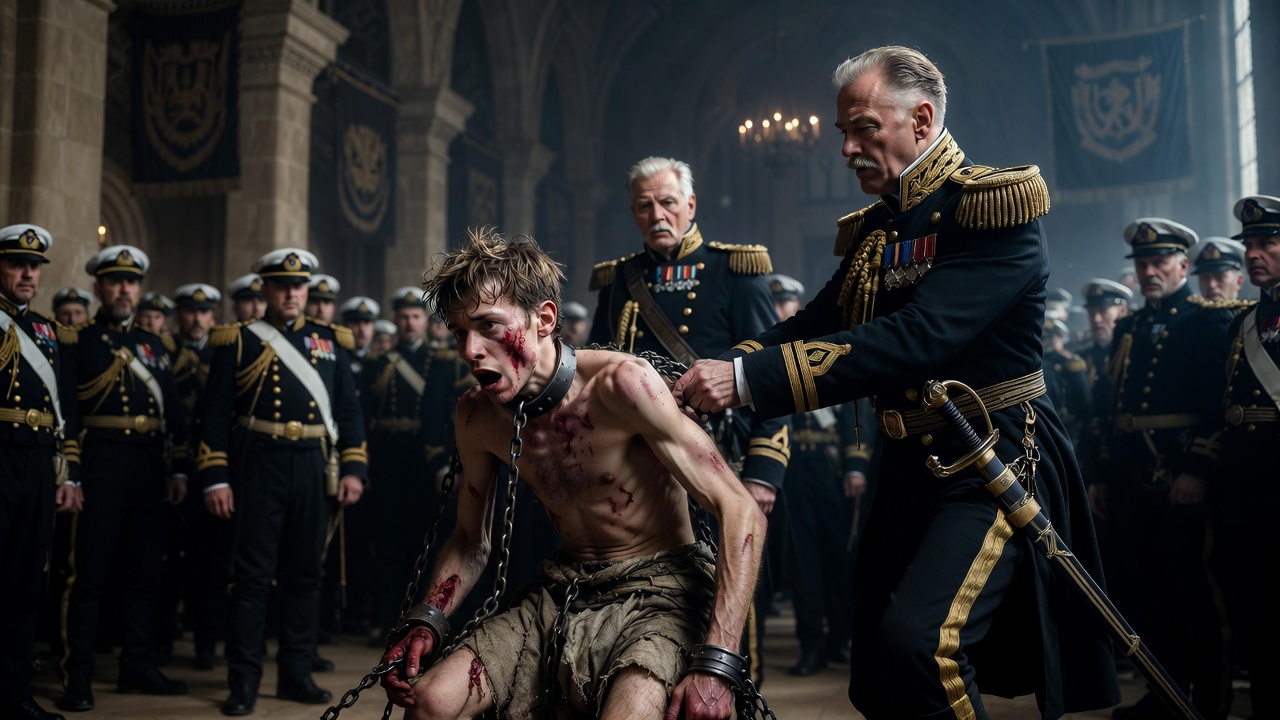
The polished limestone floor beneath my bare, bleeding feet was so cold it seemed to freeze my very blood. Every step I took was a battle against the heavy iron chains dragging behind me, their metallic clinking sounding like a death knell in the sudden, heavy silence of the court.
“Kneel, you miserable dogs!” a guard screamed, slamming the butt of his heavy bronze spear into the small of my back.
I collapsed forward, my knees cracking painfully against the hard stone. Next to me, my little boy, Kem, let out a sharp whimpering cry as he was violently shoved down beside me.
He was only eight years old. He was so small, his ribs clearly visible beneath the filthy, threadbare linen rags that barely covered his sun-blackened skin. He was trembling so violently that I could feel the vibrations of his fear through the floorboards.
“Do not look up,” I whispered through cracked, bleeding lips, my voice barely a breath. “Keep your eyes on the stone, my sweet boy. Do not look at them.”
“Silence!”
The voice boomed from high above us, dripping with absolute authority and venom. It belonged to Lord Setau.
He stood just a few paces away from us, dressed in the blindingly white linen of the high nobility. His chest was covered by a massive collar of solid gold, lapis lazuli, and turquoise that caught the flickering light of the towering bronze torches.
His face was contorted into a mask of pure, self-righteous arrogance. He held himself with the posture of a man who believed he owned the very air we breathed. And in this province, he practically did.
“Great Pharaoh, King of the Upper and Lower Nile, Living Image of Ra,” Lord Setau began, bowing deeply toward the elevated golden dais at the far end of the hall. His voice was smooth, practiced, and dripping with false humility. “I bring before your divine presence a sickness that threatens the absolute order of your kingdom. These two… these wretched quarry slaves… have committed an act of unspeakable treason.”
The grand hall was packed with hundreds of wealthy nobles, royal scribes, and high-ranking military commanders. A low, angry murmur rippled through the crowd like a wave of locusts.
I could feel their eyes burning into us—eyes filled with disgust, apathy, and amusement. To them, we were not human beings. We were merely a brief distraction from their luxurious courtly lives, a minor piece of business to be disposed of before the evening feast.
“Speak, Setau,” a deep, ancient voice resonated from the throne.
It was the High Pharaoh. He sat enveloped in the shadow of the great golden canopy, his face partially obscured by the traditional striped Nemes headdress.
He was a man carrying the immense weight of an empire, his expression unreadable, hardened by decades of war and rule. Beside him stood his royal guard captain, a towering warrior named Hori, whose hand rested firmly on the pommel of a massive, curved khopesh sword.
Setau turned his cruel eyes down toward us, a smirk playing at the corners of his thin lips. “Today, during your Majesty’s sacred procession through the city gates, this woman and her whelp deliberately broke the imperial quarantine. They threw themselves onto the holy limestone path, defiling the ground before your royal chariot.”
“That is a lie!” the words tore from my throat before I could stop them.
The entire hall gasped. A slave speaking without permission in the presence of the living god was a crime that usually resulted in immediate tongue-severing.
Setau’s eyes flared with sudden, dangerous anger. He stepped forward and delivered a backhanded strike across my face. The heavy gold rings on his fingers tore into my cheek, and the metallic taste of blood immediately filled my mouth. I crashed to the floor, gasping for air.
“Mother!” Kem cried out, trying to push himself over me, his tiny hands clawing at Setau’s pristine white robes. “Don’t hit her! Please, don’t hit my mother!”
Setau disgusted ly kicked the boy away, sending him sprawling across the floor. “You see, Divine Majesty? Even now, they show no respect, no fear, no understanding of their place. They are animals from the Great Quarry. If we do not make a public example of them, the law of the land will crumble into chaos. I demand they be taken to the execution platform outside the palace gates and publically put to death. Let the crocodiles of the Nile feast upon their treasonous flesh!”
The murmur in the crowd grew louder, many nodding in agreement. In ancient Egypt, the word of a high noble was law, and the life of a quarry slave was worth less than a broken pottery shard.
My heart hammered against my ribs like a trapped bird. I looked at my son, who was crying silently now, his face buried in the dust of the palace floor.
I didn’t care about my own life. I had lived a life of endless labor, hunger, and grief. But Kem… he was innocent. He was just a beautiful boy who had stumbled because the dust had choked his lungs.
“Please,” I begged, pushing myself back onto my knees, ignoring the searing pain in my cheek. I directed my words toward the dark silhouette on the throne. “Great Pharaoh, hear the truth! We did not throw ourselves onto the path. A sudden desert wind blinded us. My boy… he coughed, he lost his footing. He is a child, a foolish, hungry child who knows nothing of the world. Take my life! Take my flesh and throw it to the river! But spare my boy… I beg of you, by the light of Ra, spare my only son!”
Setau stepped between us and the throne, deliberately blocking the Pharaoh’s view. “Do not listen to her pathetic lies, Your Majesty. The boy is a parasite, just like his mother. Guards, take them away! Execute them now!”
Two massive royal guards, their bronze armor clanking loudly, stepped forward. They gripped my arms with hands like iron vices, lifting me off the ground. Another guard grabbed Kem by the scruff of his neck, lifting him into the air like a stray pup.
Kem screamed, kicking his small legs frantically. “Mother! Help me! Mother!”
In his desperate struggle to break free from the guard’s iron grip, the sleeve of Kem’s oversized, tattered tunic tore away entirely, sliding up past his elbow.
The movement caught a stray beam of afternoon sunlight filtering through the high clerestory windows of the throne hall. The bright light illuminated his small, thin right wrist.
There, carved deeply into the pale underside of his brown skin, was a prominent, highly unusual mark. It was an old, thick, jagged scar shaped precisely like a cross-bearing circle—the sacred sign of life, but fractured perfectly down the center. It was a birth scar, a mark that no ordinary citizen or slave could ever possess.
The guard who was holding Kem suddenly froze. His eyes widened as he stared at the boy’s wrist. His grip slackened, and his hand began to tremble so violently that his bronze arm-guards rattled against each other.
“What are you doing, idiot?” Setau barked at the guard, his voice laced with venomous impatience. “I said drag them to the river! Move!”
But the guard didn’t move. Instead, with a face pale as death, he slowly let go of Kem’s neck, allowing the boy to drop gently back onto the stone floor. Then, to the utter bewilderment of everyone in the grand hall, the massive warrior slowly sank to both knees, lowering his head until it touched the cold limestone.
“What is the meaning of this madness?” Setau roared, turning to the other guards. “Are you all under some peasant spell? Kill them!”
“Stand down, Setau.”
The voice from the throne didn’t boom this time. It was incredibly quiet, but it possessed a terrifying, freezing intensity that made every single person in the hall instantly lock their jaws.
The High Pharaoh slowly rose from his golden throne.
For the first time, he stepped out of the deep shadows of the canopy and into the brilliant sunlight streaming through the hall. His ancient, lined face was completely pale. His dark eyes were fixed entirely on Kem’s right wrist, staring at the fractured mark with an intensity so profound it looked like he was gazing upon a ghost.
The entire throne hall fell into a suffocating, breathless silence. You could hear the faint whistling of the desert wind outside the massive bronze doors. Nobody moved. Nobody breathed.
Setau looked from the Pharaoh to the kneeling guard, his arrogant expression suddenly faltering, replaced by a subtle flicker of deep confusion and growing unease. “Your Majesty…?” he stammered, his confident voice cracking slightly. “It is just a filthy slave boy… a thief…”
The Pharaoh didn’t even look at Setau. He began to descend the golden steps of the dais, his royal linen robes rustling softly against the stone.
His hand, which held the sacred golden scepter of Egypt, was shaking.
CHAPTER 2
Every single step the High Pharaoh took down those golden stairs felt like a hammer striking an anvil inside my chest.
The silence in the grand hall was so absolute that the soft slap of his leather sandals against the polished limestone sounded like thunder. The wealthy nobles looked at each other in utter confusion, whispering behind their silk fans and heavy gold rings. They had never seen their king look like this. They had never seen the living god of Egypt show weakness.
Setau shifted his weight uneasily, his fingers nervously twitching against the ornate hilt of his ceremonial dagger. “Your Majesty,” he whispered quickly, trying to step into the Pharaoh’s path once more. “Please, do not degrade yourself by approaching these animals. The air around them is foul with the quarry’s filth. Allow my men to handle this…”
“Step back, Setau,” the Pharaoh said. His voice was dangerously low, a soft growl that carried the promise of immediate death.
Setau choked on his next words, his face flushing a deep, angry crimson as he was forced to step aside. He glared down at me and Kem with a look of pure, murderous hatred. If looks could kill, my boy and I would have been turned to ash on the spot.
The Pharaoh reached the bottom of the steps. He completely ignored me, his entire existence focused solely on my small, shivering boy.
Kem had stopped crying now, his wide, innocent eyes staring up at the grand ruler of Egypt with a mixture of awe and absolute terror. He instinctively tried to crawl backward toward me, but his small body hit the base of a massive stone pillar.
“Do not fear, child,” the Pharaoh murmured.
To the absolute shock of the entire royal court, the High Pharaoh—the master of the empire, the man who held the power of life and death over millions—slowly lowered himself onto one knee right there in the dust of the floor.
He reached out a long, trembling hand toward Kem’s right arm. His fingers, covered in heavy signet rings of solid gold and emerald, hovered over the boy’s wrist for a long moment before he gently, almost reverently, closed his hand around Kem’s arm.
He pulled the boy’s wrist closer to his eyes, his gaze tracing the jagged, fractured cross-like scar.
“Where did he get this?” the Pharaoh asked, his voice cracking with an emotion I couldn’t quite understand. He did not look at me; his eyes remained glued to the scar. “Tell me the truth, woman. Who carved this into his flesh?”
I swallowed hard, the metallic taste of blood still heavy on my tongue from Setau’s blow. Fear gripped my throat like a physical hand. If I said the wrong thing, would it mean a more painful death for my baby? But looking into the Pharaoh’s eyes, I saw something I never expected to see in a ruler: deep, agonizing pain.
“He… he was born with a faint mark, Your Majesty,” I stammered, my voice shaking uncontrollably. “But eight years ago… during the great fire in the eastern delta… a falling piece of burning cedar from a destroyed temple struck his wrist. It burned him deeply. When the wound finally healed, it left that exact scar. I… I have tried to hide it with his sleeve ever since, because the overseers in the quarry called it a curse of the gods.”
A collective gasp echoed through the court.
The royal guard captain, Hori, stepped forward, his massive frame casting a long shadow over us. His hardened face was pale under his bronze helmet. “Your Majesty… the eastern delta fire… eight years ago. That was the night of the great betrayal. The night the royal nursery was burned to the ground.”
Setau’s eyes widened. A sudden, visible tremor passed through his entire body. The arrogant, untouchable noble lord suddenly looked like a man who had just realized he was standing on the edge of a crumbling cliff.
“This is absurd!” Setau cried out, his voice high-pitched and frantic, completely losing its smooth, noble cadence. “Your Majesty, do not let this clever slave woman deceive you! She has obviously heard the old legends of the lost prince and fabricated this story to save her own miserable neck! She probably burned the boy herself to mimic the royal sign! It is a peasant trick! A disgusting, treasonous lie!”
Setau turned to the guards, his eyes wild with desperation. “I order you to strike these peasants down now! Protect the Pharaoh from this blasphemy!”
But not a single guard moved. The guard who had initially dropped to his knees remained there, his forehead pressed firmly against the stone floor. The others stood like statues, their eyes darting between the Pharaoh and the young boy.
The Pharaoh slowly stood up. The warmth and vulnerability that had filled his face moments ago instantly vanished, replaced by a cold, terrifying majesty that made the air in the room feel heavy enough to crush a man.
He turned his gaze toward Setau. The look in the Pharaoh’s eyes was so intensely furious that Setau actually took a step back, his hand flying to his throat.
“You speak of lies, Setau?” the Pharaoh said, his voice echoing off the high stone walls like a rolling thunderclap. “You speak of peasant tricks? You think I do not know the markings of my own bloodline? You think a mother’s love could replicate the exact scar left by the sacred golden ankh that was melted onto my infant son’s wrist during the night my palace was betrayed?”
The Pharaoh turned back to Kem, his eyes softening just for a fraction of a second before hardening once more as he looked at me.
“Woman,” the Pharaoh demanded, his voice trembling with a mixture of hope and dread. “If this boy is who I think he is… then he did not survive that fire alone. Someone carried him out of the burning palace. Someone risked their life to save the heir to the throne of Egypt. Who was that person?”
I looked up at the High Pharaoh, the tears finally spilling over my bruised cheeks. The secret I had kept locked away in the darkest corners of my soul for eight agonizing years—the secret that had kept us alive in the brutal misery of the quarries—could no longer be hidden.
“It was me, Your Majesty,” I whispered, my voice carrying clearly through the silent hall. “I was the junior handmaid to the late Queen. And I know the name of the man who set the fire.”
Setau let out a strangled, desperate cry and reached for the bronze dagger at his waist, lunging forward toward me before the guards could react.