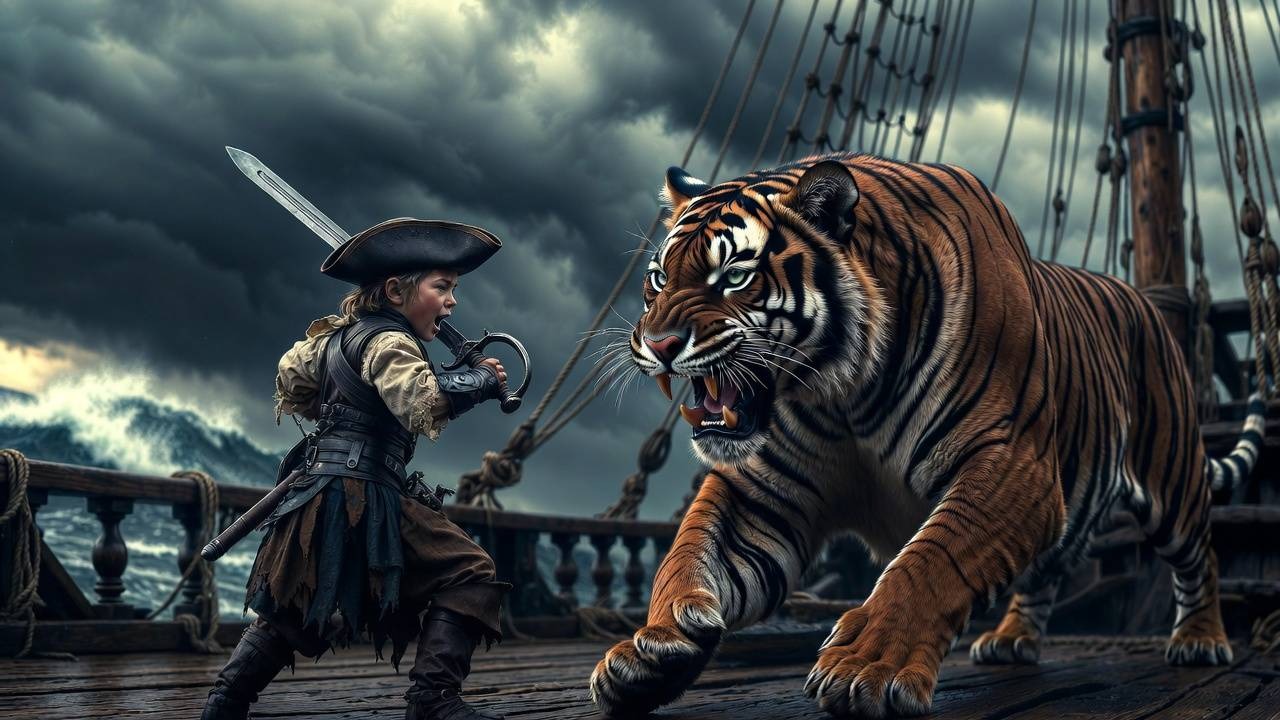
CHAPTER 3: The Storm and the Shadow
The Storm-Caller was not a ship; it was a fortress of black timber and iron, riding the grey swells of the Northern Sea like a predator. As we boarded, the crew stared. It wasn’t the staring of men at a prisoner anymore. It was the heavy, suffocating silence of men looking at a ghost.
I was Einar, the “Sea-Rat,” the orphan who lived on gruel and fear. Now, I walked the deck of the fleet’s greatest ship, and the sailors—men who had seen entire villages burn—stepped aside to let me pass. But it wasn’t respect yet. It was uncertainty.
Commander Harlon, the man who had knelt before me in the square, walked by my side. He didn’t speak to me like a guard speaks to a charge. He spoke to me like a man trying to remember a lost prayer.
“The crew is uneasy, Einar,” Harlon said, his voice barely audible over the whipping wind. “They have followed the current administration for twenty years. They were told your father died a traitor, abandoned by the gods, his fleet lost to cowardice. To believe you are his son… is to believe their entire world is a lie.”
“And if it is a lie?” I asked, looking up at the towering masts that scraped the grey, weeping sky.
“Then the world burns,” Harlon replied grimly. “There are men in the High Council who built their fortunes on the dismantling of your father’s house. They won’t welcome you with open arms.”
That night, the fog rolled in—a thick, suffocating blanket that tasted of brine and old iron. I slept in the Commander’s cabin, a room filled with maps that looked like puzzle pieces I didn’t understand. But I didn’t sleep. The shadow I had seen in the square, the cloaked figure who watched with cold, calculating eyes—he haunted me.
I woke to the sound of steel sliding against steel.
It wasn’t a loud noise. On a ship, the wind creates a thousand symphonies of creaking wood and snapping rope. But this was specific. It was the rasp of a blade being drawn from a scabbard.
I rolled off the cot and pressed myself against the bulkhead, my hand gripping the small, rusted knife I had kept hidden in my boot since the workhouse. The door to the cabin creaked open. A sliver of moonlight spilled across the floor, illuminating the silhouette of a man. He didn’t move like a soldier. He moved like a viper.
He drifted toward the cot, his blade raised high.
I didn’t wait. I lunged from the shadows. I was small, yes, but I was fast—the speed of a boy who had survived docks, brawls, and the cruelty of the workhouse. I drove my shoulder into his gut, slamming him against the heavy oak table.
He grunted, a sound of surprise, and swung his sword. It caught the edge of the table, shattering the wood.
“The boy is a rat,” he hissed, his voice raspy, like dry leaves. “And rats belong in the hold.”
He was strong, much stronger than Kaelen. He shoved me back, his boot connecting with my ribs. Pain flared white-hot, stealing my breath. I scrambled back, gasping, but I saw his face in the moonlight—a jagged scar running from his temple to his chin. A veteran’s scar.
He lunged again, but I didn’t fight him head-on. I knew the ship. I knew the sway of the floor. As he stepped, I kicked the heavy brass lantern hanging from the ceiling. It swung, smashing into his face.
He howled, dropping his sword to clutch his burning eyes. I grabbed his dagger from his belt and didn’t hesitate. I didn’t kill him—not yet—but I pinned his hand to the floorboards with the blade.
“Who sent you?” I screamed, my voice cracking, shaking with the adrenaline of a boy who had finally stopped running.
He laughed, a wet, bloody sound. “You think you are the first Admiral’s son to try and reclaim this fleet? The Council has a long memory, boy. They know the bloodline is tainted. You will die before we reach the Harbor of Kings.”
He reached for a hidden vial of poison at his neck, but I was faster. I smashed his hand again, forcing him to drop it. Before he could speak another word, guards burst into the cabin, their torches illuminating the chaos.
Harlon stepped forward, his sword drawn. He looked at the assassin, then at me. I was standing over him, blood on my hands, my chest heaving.
“He tried to kill me,” I said, my voice steady for the first time. “He said the Council sent him.”
Harlon looked at the assassin’s face and went deathly pale. “Kael. He is the Captain of the Council’s personal guard.”
The realization hit the room like a physical blow. The Council—the very men who were supposed to welcome me—had sent an assassin. They weren’t just skeptical. They were terrified.
“They aren’t just doubting you, Einar,” Harlon said, sheathing his sword. “They are afraid of you. That means you are a threat to their power.”
The next few days were a blur of cold terror and relentless preparation. A massive storm descended upon us, a true northern gale that tossed the Storm-Caller like a toy in a bathtub. The waves were mountains of black water, crashing over the deck with the force of a battering ram.
The crew was panicked. The experienced navigators were arguing, their voices lost in the wind. We were drifting off course, heading straight for the jagged reef of the Dead Man’s Teeth.
“We have to turn!” the lead navigator shouted, his face white with fear. “If we hit the reefs, we’re all dead!”
“We can’t turn into the wind!” Harlon roared. “The ship will capsize!”
I stood on the deck, soaked to the bone, watching the waves. My father’s voice, a memory I hadn’t realized I possessed, flickered in my mind. “The sea is not an enemy to be fought, boy. It is a beast to be ridden. You must find the eye of the dance.”
I walked to the helm. The helmsman was struggling, his hands frozen on the wheel. I pushed him aside.
“Get out of the way!” I commanded.
“Boy, you’ll kill us all!” he shouted.
“If we stay on this path, we are already dead!” I grabbed the wheel. The resistance was immense, a living, groaning thing. I watched the waves. Not the chaos, but the rhythm. The pulse of the water.
“Hard to port!” I screamed over the roar of the wind.
“That’s suicide!” Harlon yelled, but he didn’t stop me. He saw something in my eyes—a certainty that defied my age.
I turned the wheel, not with strength, but with timing. I waited for the swell, the moment the ship crested the peak, and threw the wheel hard. The Storm-Caller groaned, her timbers screaming as she pivoted. For a heartbeat, the ship hung on its side, the mast dipping into the black foam.
Then, she leveled. We surged forward, sliding through a narrow gap in the reefs that no one else had seen. The water ahead turned calm—the eye of the storm.
Silence fell over the deck. The sailors, who had been gripping the rigging in terror, looked at me in awe. I wasn’t just a boy with a medallion anymore. I was a sailor. I was one of them.
Harlon walked over, his eyes wide. He looked at the compass, then at the horizon, then at me.
“That gap,” he whispered. “It’s not on any chart. How did you know?”
“I didn’t,” I said, my hands still shaking on the wheel. “I just… I felt the ship wanted to go there.”
Harlon looked at the crew, who were slowly letting go of their fear. He nodded slowly. “You have his blood, Einar. And you have his touch. The Council will not be able to hide you much longer.”
But as we sailed through the calm, I looked back at the churning dark clouds behind us. The assassin had failed, but he had given me a warning. The Council was waiting. And they would not make the same mistake twice.
I gripped the medallion beneath my shirt. It felt heavy, a burden and a weapon. We were reaching the Harbor of Kings by dawn. My fate, and the fate of this fleet, would be decided there.
“Commander,” I said, watching the first light of the sun touch the horizon. “When we land, do not protect me. Let them come.”
Harlon looked at me, a grim smile touching his lips. “As you command, my Prince.”
The journey to the throne was almost over, but the final, deadliest chapter was about to begin.
CHAPTER 4: The Admiral’s Seat
The Harbor of Kings was a sprawling testament to the power of the Northern Fleet. Massive stone piers jutted into the bay like the fingers of a giant, each one lined with warships that stretched as far as the eye could see. Black sails, white sails, gold-trimmed galleys—the entire might of the empire was anchored here.
As the Storm-Caller glided into the harbor, the bells began to toll. Not a celebratory peal, but a slow, rhythmic mourning. News of our arrival, and the rumors of the “Lost Prince,” had outpaced us.
Harlon stood by my side. He had dressed me in the finest furs the ship’s store could provide, though they were still too large for my thin frame. I stood tall, the medallion clearly visible now, resting against my chest.
“They are waiting,” Harlon said, his voice tense. “The High Council is assembled on the Great Pier. Lord Valerius leads them. He is the one who took control after your father… disappeared.”
I nodded. I had heard the name in the workhouse, whispered by the old slaves who had served the fleet long ago. Valerius. The man who had been the Admiral’s second-in-command, the man who had supposedly “tried” to save the fleet during the Great Sea War, only to come back alone, covered in glory and gold.
We descended the gangplank. The pier was lined with thousands of soldiers, silent and rigid. At the end of the dock stood a dais, and upon it, a council of twelve men in robes of deep crimson and black.
In the center sat Lord Valerius. He was an old man, his hair silver and his beard trimmed to a sharp, aristocratic point. He looked like a statue—unmoving, cold, and utterly terrifying.
As I walked toward him, the crowd parted. There were no cheers. Just the sound of leather boots on stone, echoing in the vast, open space.
When I reached the foot of the dais, I stopped. Valerius looked down at me, his eyes hooded. He didn’t smile. He didn’t frown. He simply looked at me as if I were an insect to be crushed.
“Commander Harlon,” Valerius said, his voice smooth, like oil on stone. “You bring us a stray dog and claim it is a wolf. This is a treasonous waste of the fleet’s time.”
Harlon didn’t bow. He stood straight. “I bring you the son of the Admiral. I bring you the blood of the Northern Watch.”
A ripple of laughter went through the Council. Valerius stood up, his robes flowing behind him. “The Admiral’s son died in the wreck twenty years ago. The sea does not return what it has claimed. This boy is a fraud—an orphan groomed by a desperate Commander to destabilize our order.”
He stepped down the stairs, his eyes locking onto mine. He was tall, and he carried the weight of a man who had never lost a battle.
“Who are you, boy?” he asked, his voice dripping with condescension. “What is your name?”
“My name is Einar,” I said, my voice projecting across the silent pier. “And I am the son of the Admiral.”
Valerius stepped into my space, leaning down so his face was inches from mine. He smelled of expensive incense and rot. “You have a piece of metal, boy. A trinket. Any thief can steal a bauble. You think a medallion makes you an Admiral? The Admiral was a commander of men, a master of strategy, a king of the waves. You are nothing but a gutter-rat.”
He turned to the crowd, his voice booming. “This boy has been found on the docks, living like an animal! He has been coached, bribed, and brought here to insult the memory of our great leader! Do we allow this? Do we allow a beggar to soil the seat of power?”
The guards began to move forward, their hands on their swords. The crowd began to murmur, the doubt shifting into anger.
I felt the panic rising, but I pushed it down. I remembered the storm. I remembered the feel of the wheel. I looked at the medallion. It wasn’t just a symbol. It was a lock.
“I am not just a beggar,” I said, my voice loud, clear, and cold.
Valerius sneered. “And what are you then? Tell us, boy.”
I looked him straight in the eye. “I am the one who knows the final order.”
The room went still. Valerius paused. “What?”
“My father,” I said, loud enough for every captain on the pier to hear. “Before he sailed into the final battle, he left a record. A code. Not for the fleet. For the Council. He knew he might not return. He left a seal that only the Council can read, but only his blood can explain.”
I reached up and unclasped the medallion. It was rusted, weathered, and ugly. Valerius laughed. “A story! A clever story!”
“It isn’t a story,” I said, walking to the edge of the dais. I pulled out a small, hidden key—it had been taped to the back of the medallion for my entire life, something I had assumed was just a part of the scrap metal I had found in the wreck. “The medallion is not the symbol. It is the key to the vault.”
I held up the key. It was shaped like a trident.
The entire Council froze.
Valerius’s face went white. The trident key was the legend of the fleet. It was said to open the Admiral’s private war chest, the vault that contained the battle plans for the war that was coming—plans that Valerius had claimed were destroyed in the fire.
“Where did you get that?” Valerius hissed, his composure shattering.
“My father gave it to me,” I lied. It wasn’t my father. It was the legacy of my survival. “He told me that if I ever returned, to open the vault. To show the Council the truth.”
“He is lying!” Valerius shouted, pointing at me. “Kill him! He has stolen the key! He is a pirate, a thief!”
“Am I?” I asked. I turned to the crowd. “Lord Valerius says the plans were burned. He says the fleet was lost because of the Admiral’s failure. But if those plans are in the vault… if they show that my father had a path to victory… then who is the traitor?”
The crowd erupted. The sailors, the captains, the men who had served under my father—they were whispering. The doubt that had been directed at me shifted toward Valerius.
“Open the vault!” a voice shouted from the crowd. It was an old captain, a man with a wooden leg. “Open the vault, Valerius! If the boy is a liar, the vault won’t open. If he is the Admiral’s son, the trident will fit!”
Valerius looked around, his face a mask of panic. He knew. He knew that the vault was real, and he knew that he had been lying about the plans for two decades.
“The vault is sealed!” Valerius screamed. “It cannot be opened!”
“It can,” I said, stepping toward him. “If the heir is present.”
I walked to the Great Vault door, a massive iron slab embedded in the harbor wall, untouched for twenty years. The symbol of the trident was carved into the center. It was rusted, locked, and forgotten.
I placed the trident key into the slot. It was stiff, stubborn, but as I turned it, I felt a click.
A click that echoed across the entire harbor.
The massive iron gears groaned, a sound that hadn’t been heard in a generation. The door swung open, revealing a chamber filled with scrolls, maps, and the original fleet logs—the evidence of my father’s genius, and the proof of Valerius’s betrayal.
Valerius scrambled back, his hands shaking. He turned to run, but the guards—my father’s old men, the ones who had seen the truth—stepped into his path. They didn’t look at him with respect. They looked at him with the cold, hard eyes of executioners.
“Take him,” Harlon ordered.
The guards grabbed Valerius. He struggled, screaming, “I am the Council! You cannot do this! The fleet will fall without me!”
“The fleet was never yours,” I said, standing at the doorway of the vault, the light of the chamber casting a long shadow behind me. “You were just a caretaker of a dream you didn’t understand.”
They dragged him away, his cries fading into the sound of the ocean. The Council members sat in silence, their heads bowed. They knew their time was over. They knew that the “Sea-Rat” had returned to claim the horizon.
Harlon stepped forward and knelt. This time, he didn’t kneel alone.
Thousands of sailors, captains, and soldiers dropped to their knees, their armor clanking in the sudden, reverent silence. It was a sea of metal and fur, a tidal wave of submission.
“My Prince,” Harlon said, his voice thick with emotion. “The fleet is yours. What is your command?”
I looked out at the water. I looked at the black sails, the white crests, and the vast, infinite ocean that had taken everything from me—and then returned it. I thought of the gruel, the dirt, the cold, and the sting of the overseer’s belt. I had earned this. Not with a name, but with the fire I had kept burning when the rest of the world told me to extinguish it.
I didn’t take the throne. I didn’t take the gold. I walked down to the pier and picked up a simple, wooden sword—a training blade.
“My command,” I said, my voice clear and ringing across the harbor, “is that we stop fighting for the greed of old men. We start fighting for the men who hold the oars. We rebuild the fleet, not to conquer, but to protect.”
The roar that went up from the crowd was deafening. It wasn’t a cheer for a king. It was a roar for a brother.
I looked back at the vault, then at the horizon. The shadow that had haunted me, the assassin, the doubt, the hunger—it was all gone.
I took my father’s seat, not as a boy who was broken by the world, but as a man who had built himself from the ruins of it. I had been called a rat, a slave, a nothing. But as the sun rose over the harbor, illuminating the white crests of the waves, I knew the truth.
The sea had tried to drown me, but it had only taught me how to swim.
And for the first time in many years, nobody knelt on my back again.