CHAPTER 3
The great throne hall of the Pharaoh was so silent that the hiss of the burning frankincense in the golden braziers sounded like the striking of a desert viper. Thousands of high-born nobles, wealthy merchants, and foreign ambassadors remained frozen, their bodies pressed flat against the polished black granite floor.
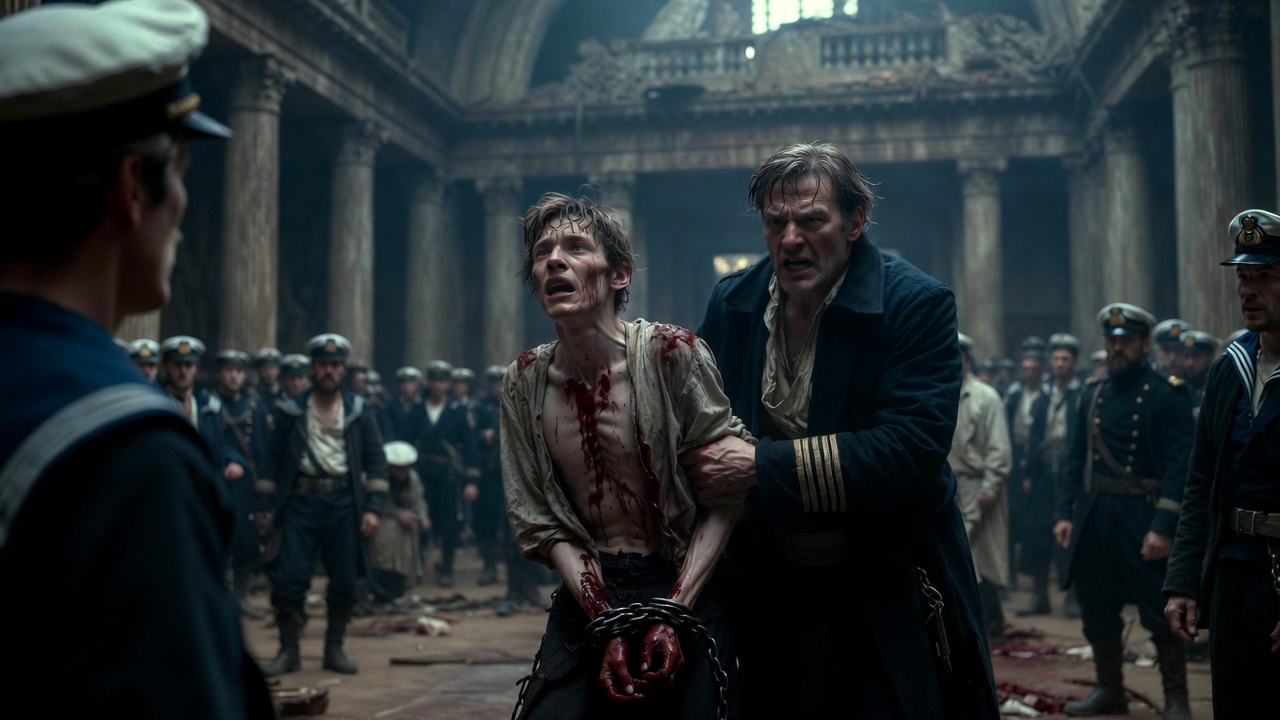
I stood there, my chest heaving, the ragged, torn remnants of my slave tunic hanging from my waist. My bare skin was covered in gray limestone dust, dried sweat, and the dark crimson streaks of my own blood. My hands, which had spent twelve long, brutal years raw and blistered from hauling the Pharaoh’s monument stones, were trembling. The heavy iron chains that had bound my wrists for hours now lay shattered at my feet, cut by the Pharaoh’s own golden-handled dagger.
Just inches away from me, the great iron grate over the Sacred Pit of Anubis remained wide open. From the deep, suffocating darkness below, the agonizing, blood-curdling screams of Lord Hemon echoed off the high sandstone pillars. The arrogant, cruel overseer—the man who had ruled the Great Quarry of Thebes like a tyrant god—was now flailing helplessly in the pitch-black abyss, his body covered by a swarming, writhing mass of hundreds of starved desert scorpions.
Nobody moved to help him. Not a single guard stepped forward. Not a single priest offered a prayer. The crowd simply watched in absolute, paralyzed horror as the justice of the gods claimed the man who had tried to murder me.
High Pharaoh Thutmose stood right beside me. He was no longer the cold, distant king who looked at the world with bored, unblinking eyes. His majestic double crown was slightly askew, his chest was heaving under his embroidered silk robes, and his long, royal fingers were gripping my trembling shoulder with a fierce, iron-like strength.
He wasn’t looking at the pit. He wasn’t looking at his court. His tear-filled eyes were locked completely on the falcon-shaped birthmark on my left shoulder—the sacred mark of our family bloodline that had been hidden from the world beneath a slave’s dirt and sweat.
“Amenhotep,” the Pharaoh whispered again, his voice cracking with a raw, agonizing pain that had been carried in his chest for fourteen long years. “My little brother… you are alive. The gods have brought you back from the dead.”
I looked at him, my mind spinning into a dark, chaotic fog. Amenhotep. The name sounded completely foreign to my ears. For as long as I could remember, I was just Kem. I was the nameless orphan boy who slept on the hard dirt of the slave quarters. I was the boy who ate molded barley bread and drank muddy water from the edge of the Nile. I was the boy whose back was mapped with twenty-four deep, raised white scars from Hemon’s leather whips.
How could I be a prince? How could I be the brother of the living god of Egypt?
“My Lord…” I rasped, my voice cracking from the smoke and the sheer terror of the moment. “I… I am just a quarry slave. I don’t know anything of palaces. I don’t know anything of crowns. My mother… the woman who raised me… she died of the quarry fever when I was ten. She told me to keep my head high, but she never told me I was royal.”
The Pharaoh’s hand moved down to my hand, where he still held the tiny, tarnished bronze scarab amulet that had been hidden inside the lining of my loincloth. He held it up before my eyes, his thumb tracing the crude, deep hieroglyphs carved into the flat underbelly of the bronze metal.
“She didn’t tell you because she was trying to save your life,” Thutmose said, his voice rising so that every trembling noble in the hall could hear him. “This amulet bears the secret seal of our father’s private chamber. The woman who raised you was not a slave, Amenhotep. She was Lady Asenath, the chief royal nurse of the palace. Fourteen years ago, when the nomadic desert rebels breached the outer walls and slaughtered our family in the middle of the night, she took you from your golden cradle and fled into the dark.”
The Pharaoh turned his gaze toward the high priest of Ra, who was still kneeling in the dust, his golden staff lying forgotten on the floor. “The palace guards found her body years later in the city ruins, or so we thought. But she didn’t die there. She hid you in the absolute last place my soldiers would ever think to look for a royal prince—among the faceless, starving masses of the Great Quarry. She gave up her own identity, her own wealth, and her own life to live as a slave, just to ensure that the bloodline of the sun god would not be extinguished.”
A heavy sob tore from my throat as the truth finally crashed through my chest. Memories of the woman I called mother flashed through my mind—her soft, beautiful voice singing strange, elegant lullabies in the dark corners of the mud-brick huts; her delicate hands turning rough, cracked, and bleeding from grinding grain; her constant, fierce warnings to never let the overseers see the falcon mark on my shoulder. She hadn’t been hiding my shame; she had been protecting a royal secret that would have caused my immediate execution if the wrong people had discovered it.
“She died to keep me safe,” I wept, the tears washing long, clean tracks through the dust on my cheeks. “She worked until her lungs failed, and she died in the dirt while Hemon laughed.”
The mention of Hemon’s name made the Pharaoh’s face harden into an expression of pure, unadulterated vengeance. The screams from the scorpion pit were beginning to fade into low, bubbling groans as the paralyzed lungs of the overseer finally began to shut down.
Thutmose stepped away from me, walking slowly toward Captain Sebni, the royal guard leader who was still groveling on the floor, weeping and begging for mercy.
“Captain Sebni,” the Pharaoh said, his voice dropping to a terrifyingly calm whisper. “You took twenty silver shekels from Hemon to falsely accuse my brother. You struck a prince of Egypt with the butt of your spear. You dragged the rightful heir to the southern dynasties through the mud like an animal.”
“Mercy, High Pharaoh!” Sebni screamed, his face pressed so hard against the black granite that his nose was bleeding. “I did not know! I swear by the light of the sun, I thought he was just a worthless quarry rat! Hemon threatened to kill my family if I didn’t support his lie! I am a loyal servant of the throne!”
“A loyal servant does not sell his honor for twenty pieces of silver,” the Pharaoh replied coldly. He didn’t even look at his executioners. He simply raised his hand and pointed a single finger toward the open courtyard.
“Strip him of his armor,” Thutmose commanded. “Break his spear before his face. Then, take him to the western desert cliffs. Leave him bound to a wooden stake without water, let the vultures and the desert sun show him the same mercy he showed my brother for twelve long years.”
“No! Please! Spare my life!” Sebni shrieked as four large, royal palace guards stepped forward. They didn’t show an ounce of pity. They violently ripped the heavy bronze breastplate from Sebni’s chest, tearing his linen tunic and exposing him to the judging eyes of the entire court. They snapped his ceremonial spear over their knees, tossing the broken wood onto his weeping face, before dragging him out of the hall like a dead weight.
The nobles in the court watched in terrified silence. They knew that the Pharaoh’s wrath was not finished. The air in the room was suffocatingly tense. Everyone who had laughed when I was dragged into the hall, everyone who had turned their eyes away in disgust, everyone who had cheered when Hemon poured the boiling water near my feet—they were all guilty. And they knew it.
The Pharaoh walked back to the front of the dais. He looked down at the high priest of Ra, his eyes cold and demanding.
“Rise, Priest,” Thutmose ordered.
The old man stood up, his legs shaking under his long leopard-skin robes. He didn’t dare to look the Pharaoh in the eye.
“You are the keeper of the sacred records,” Thutmose said. “Tell this court what the punishment is for a noble lord who knowingly enslaves, tortures, and attempts to execute a member of the divine royal house.”
The high priest swallowed hard, his voice trembling as he spoke the ancient laws. “According to the sacred decrees of the first dynasty, O Great Pharaoh… any man, noble or common, who lays a hand of violence upon the royal bloodline commits an act of treason against the gods themselves. His house shall be burned to ash. His wealth shall be stripped and given to the victim. His name shall be erased from every stone monument in Egypt, and his entire family line shall be banished to the salt mines of the northern seas forever.”
A loud, agonizing gasp echoed from the left side of the hall. I looked over and saw a group of wealthy, heavily jeweled people collapsing to their knees. It was Hemon’s family—his wife, his brother, and his teenage sons. They had been sitting in the VIP pavilion, drinking wine and waiting to watch me get eaten alive by scorpions. Now, their faces were white with absolute terror. They went from being the most envied, powerful family in Thebes to the lowest outcasts in the entire empire within the span of a single heartbeat.
“Let the law be fulfilled,” Pharaoh Thutmose declared, his voice echoing like thunder through the rafters. “Every gold piece, every acre of grain along the Nile, every slave, and every palace belonging to the house of Hemon now belongs to my brother, Prince Amenhotep. By tomorrow morning, I want Hemon’s name chipped away from every temple wall he ever supervised. He will not exist in the memory of Egypt.”
The Pharaoh turned back to me, his expression softening into a look of deep, brotherly love. He reached out and took his own royal, embroidered white silk sash, draping it over my bare, scarred shoulders to cover my nakedness. He then walked down the steps, picked up his heavy golden scepter from the dirt, and placed it back into his hand before turning to face the entire room.
“My brother has spent his childhood in the dark,” Thutmose said proudly, taking my hand and lifting it high into the air. “But today, he stands in the light. Guards! Prepare the royal baths! Bring the finest linen robes of state, the golden collar of the first prince, and the signet ring of our father. Tonight, the entire kingdom will feast in honor of the prince who was lost, and found.”
The thousands of nobles in the hall immediately slammed their foreheads back onto the floor, their voices rising in a massive, deafening chant that shook the very foundations of the palace. “Long live Prince Amenhotep! Long live the blood of the sun god! Long live the savior of the Nile!”
I stood there, looking down at the sea of bowing heads. Just an hour ago, these same people were laughing at my tears. Now, they were begging for my favor. The transformation was so total, so overwhelming, that I could barely breathe.
But as I looked down at my rough, scarred hands, a cold realization began to settle deep into my soul. The villain Hemon was dead, and his accomplices were being punished. But the quarry—the place where thousands of innocent, faceless slaves were still bleeding and dying under the brutal heat of the sun—was still out there. I had been saved by a birthmark, but what about the others who had no royal blood? What about the men who had shared their meager bread with me when I was starving?
I looked at my brother, the Pharaoh, who was smiling at me with pure joy. I knew that my journey was not over. The slave boy named Kem had died in that scorpion pit, but the prince named Amenhotep was just beginning to wake up. And I knew exactly what my first royal decree would be.
CHAPTER 4
The transformation from a quarry slave to a prince of Egypt was a surreal, intoxicating blur. For three days and three nights, the grand palace of Thebes did not sleep. The air of the city was thick with the scent of roasting oxen, sweet fig cakes, and expensive lotus wine. The sound of harps, flutes, and grand bronze trumpets echoed across the Nile from sunrise until the deep hours of the night. Over a hundred thousand citizens lined the streets, shouting my royal name, throwing palm fronds before my path, and praising the gods for the miraculous return of the lost prince.
They had washed the gray limestone dust from my skin with milk and rosewater. They had rubbed my raw, calloused body with precious oils imported from the distant eastern lands. The palace tailors had dressed me in robes of woven white linen so light and fine it felt like wearing air, and around my neck hung the heavy, magnificent golden collar of the first prince, sparkling with hundreds of diamonds and emeralds. On my right middle finger sat our father’s ancient gold signet ring, bearing the carved image of a soaring falcon.
Yet, as I sat on a high ebony chair next to my brother’s golden throne, looking out over the endless sea of bowing nobles during the great victory feast, I felt completely hollow.
Every time a servant offered me a silver platter of roasted meats or sweet grapes, I saw the dirty, skeletal faces of my fellow slaves in the quarry, fighting over a handful of molded barley bread. Every time I stepped onto the cool, polished black granite floor, my feet remembered the blistering heat of the jagged quarry rocks that had cut my skin for twelve years. They could wash the dirt from my body, but they could never wash the memories from my soul.
The scars on my back were still there. They were deep, jagged, and white, a permanent map of human cruelty that no amount of royal oil could ever erase. And every time I looked at those scars in the mirror of my grand new bedchamber, I remembered the man who had given them to me.
Lord Hemon was dead, his body thrown into the desert waste outside the city gates to be eaten by jackals, but his twisted legacy of corruption and cruelty still ruled the Great Quarry.
On the fourth morning of my new life, before the sun had even risen over the eastern mountains, I woke up with a burning determination in my chest. I did not call for my servants to dress me. Instead, I put on a simple white linen tunic, grabbed my father’s golden signet ring, and walked straight into the Pharaoh’s private chambers.
Thutmose was sitting at a large cedar table, reviewing papyrus tax scrolls with his grand vizier. When he saw me enter, a warm smile spread across his majestic face.
“Amenhotep, my brother,” Thutmose said, standing up to embrace me. “You are awake early. Are the palace beds not soft enough for you? If you require anything—more servants, a larger palace, the finest horses from the delta—you only have to speak the word.”
“I do not want horses, Thutmose,” I said, my voice steady, carrying the raw, direct tone of a man who had survived the pits. “And I do not want more servants. I want justice. Real justice.”
The Pharaoh’s smile faded slightly, replaced by a look of curiosity. He dismissed the grand vizier with a wave of his hand. Once the heavy doors were closed, he looked at me deeply. “What is troubling your heart, brother? Hemon is dead. His family is banished. His wealth is yours. What more do you seek?”
“Hemon was just one monster,” I replied, stepping closer to the table. “He was the head of a serpent, but the body is still alive. The Great Quarry of Thebes is still filled with thousands of innocent men, women, and children who are being beaten, starved, and murdered every single day by corrupt overseers who learned everything from Hemon. I was saved by a birthmark, Thutmose. But those people have no royal blood. They have no sacred marks. They only have their suffering. If I sit here in this palace of gold and luxury, drinking wine while they die in the dirt, then I am no better than Hemon.”
Thutmose sighed, his expression turning grave. “The quarries are the foundation of the empire, Amenhotep. Without the stone, we cannot build the temples for the gods. We cannot build the tombs for our ancestors. The work is hard, yes, but it is the law of Egypt.”
“The law of Egypt should be built on Ma’at—on justice and truth,” I argued, my voice rising with a passionate intensity that shocked him. “Not on the blood of the innocent. Hemon stole millions of gold pieces from your treasury by falsifying the quarry records. He starved the slaves to pocket the food money. He executed anyone who discovered his crimes. I know this because I lived it. I want your permission to return to the Great Quarry today. Not as a slave, and not for a feast. I want to bring royal justice to the very place where I was broken.”
The Pharaoh looked at me for a long, silent moment. He saw the fire in my eyes—a fire that twelve years of chains had failed to put out. He realized that I was not a fragile boy who needed to be protected in a gilded cage; I was a prince who carried the fierce, unyielding spirit of our father.
“Very well,” Thutmose said, a proud smile returning to his lips. “You are the Prince of Thebes, and the quarries are now your rightful territory. Take the First Royal Regiment. Take the high executioners. Bring justice to the dirt, brother.”
An hour later, a massive royal procession moved through the eastern gates of the city, heading toward the desert mountains. I rode at the front, sitting in a magnificent golden chariot pulled by two powerful white stallions. Behind me marched five hundred elite palace guards, their bronze breastplates and heavy shields gleaming like fire in the morning sun. Next to them rode the high executioners, carrying the heavy bronze axes of royal judgment.
As the sound of our thundering hooves approached the Great Quarry, the entire work site fell into a terrified silence. The thousands of slaves hauling the massive limestone blocks stopped in their tracks, dropping their ropes, their hollow eyes wide with confusion and fear as they saw the royal army invading their hellish world.
The corrupt under-overseers and slave drivers—men who had spent years torturing the workers under Hemon’s protection—immediately dropped their leather whips and threw themselves into the dust, their bodies trembling as the golden chariot of the prince came to a halt in the center of the main quarry pit.
I stepped down from the chariot. I walked slowly across the hot, jagged sand, my fine linen robes dragging in the grey limestone dust. I stopped right in front of the massive stone block I had been hauling just four days ago. The dried blood from my raw hands was still visible on the rough red granite.
The current head overseer, a cruel, rat-faced man named Merab who had been Hemon’s loyal right hand, crawled forward on his belly. He was sweating so profusely that the dust turned to mud on his cheeks.
“O Mighty Prince! Star of Thebes!” Merab blubbered, his voice shaking with terror. “Welcome to your royal quarry! We… we are honored by your divine presence! We have doubled the stone production in your honor! We are working the slaves from dawn until midnight to build your grand new monuments!”
I looked down at him, my face an absolute mask of cold, merciless stone. “Stand up, Merab.”
The man scrambled to his feet, trying to force a sycophantic smile onto his face, though his eyes were darting wildly toward the line of bronze-clad soldiers behind me.
“Do you remember me, Merab?” I asked quietly.
Merab blinked, looking at my face, my clean skin, and my royal jewelry. He shook his head frantically. “No… no, your Highness! I have never seen your divine face before today! I am just a humble servant of the throne!”
I reached out and gripped the collar of his fine linen tunic, pulling him violently forward until his face was just inches from mine. With my other hand, I pulled back my royal silk sash, exposing the white, jagged lash scars on my shoulder, right next to the falcon birthmark.
“Four days ago, right here at this very wall, you watched Lord Hemon backhand me into the dirt,” I hissed, my voice dripping with a terrifying intensity. “You were the one who handed Captain Sebni the boiling water. And two weeks ago, when a seventy-year-old slave collapsed from heat exhaustion under this very block, you ordered your guards to whip him until he died because he was ‘wasting royal time.’ Do you remember now, monster?”
Merab’s eyes went completely wide. His jaw dropped, his face turning a horrific, ghostly white as he finally recognized the starving, scarred boy he had treated like trash for a decade. He fell to his knees, his hands grabbing at my leather sandals, weeping and howling like a dying dog.
“Mercy! Mercy, Prince Amenhotep!” Merab shrieked, his voice echoing across the entire quarry. “I was only following orders! It was Hemon! Hemon made us do it! We had no choice! Please, spare my life! I have a family! I have children!”
I pulled my leg away from his filthy grip, looking out over the thousands of slaves who were now watching the scene in absolute, breathless shock. I saw old men I had worked beside; I saw young boys who had cried in my arms during the cold desert nights.
“Guards!” I roared, my voice carrying the absolute, undeniable authority of the throne.
“Bring every under-overseer, every guard captain, and every slave driver in this quarry to the front! Line them up against the eastern wall!”
The royal soldiers moved with terrifying speed. Within minutes, over fifty corrupt quarry officials were rounded up, their whips stripped from their hands, forced to kneel in a long line against the very stone wall where they had tortured thousands of innocent people.
I walked down the line, my eyes scanning their terrified faces. “For twelve years, you men believed that these people were powerless. You believed that because they were poor, because they were slaves, because they had no status, you could treat them like animals. You believed that no one would ever hear their cries, and that the gods did not care about the dirt.”
I turned to the high executioners, pointing a single, trembling finger at the kneeling villains.
“By the royal decree of High Pharaoh Thutmose, and by the power of the signet ring of my father, I strip these men of their ranks, their wealth, and their freedom,” I declared proudly. “Their houses in the city shall be given to the families of the workers they murdered. And for the rest of their miserable lives, they will remain right here in this quarry. Put the heavy iron collars around their necks. Tie the thick transport ropes to their shoulders. Let them haul the twelve-ton blocks of granite under the blazing sun. Let them feel the weight of the injustice they created.”
A massive, world-shaking cheer erupted from the thousands of slaves. Men began to weep with joy, falling to their knees not out of fear, but out of absolute gratitude. The sound of their shouting was louder than any palace music I had ever heard. It was the sound of freedom. It was the sound of justice.
I walked over to an old, frail slave named Seti, a man who had given me his own water skin when I was fainting from heat three weeks ago. I reached down, took his rough, dirt-caked hands into my own royal hands, and pulled him to his feet.
“The chains are broken, old father,” I said softly, the tears finally blurring my eyes. “You will never haul another stone as long as you live. Today, you are going home.”
I stood in the center of the Great Quarry, the hot desert wind blowing my white linen robes as the royal guards began to chain the corrupt overseers. As I looked up at the blazing sun, I knew that I had finally fulfilled my mother’s final words. I had kept my head high through the dark, and the Nile had finally returned to its banks. I was no longer just a slave who had survived the dark pit; I was the prince who had brought the light of justice back to the forgotten soul of Egypt.