CHAPTER 3
The silence in the longhouse was so heavy it felt like the walls themselves were holding their breath. Bjorn’s chest heaved, his face purple with a mixture of rage and mounting fear. His fingers, calloused and stained with the grease of a hundred bad meals, twitched on the handle of his axe. He wanted to swing it. I saw it in his eyes. He wanted to bury his fear deep into the floorboards along with my skull.
But he couldn’t.
Not now. Not with the eyes of the village elders fixed upon him like flint points.
“You are delusional, boy,” Bjorn spat, though his voice cracked at the end. He took a step toward me, but the Elder—a man whose face was mapped with the scars of the Northern wars—stepped into his path. The Elder was old, but he moved with the surprising speed of a wolf. He raised a hand, and his men, the household guards who usually stood back to let Bjorn do as he pleased, shifted their footing. They were no longer guarding Bjorn. They were watching him.
“Bjorn,” the Elder said, his voice quiet, carrying the weight of ancient law. “A man who claims a bloodline is one thing. A man who bears the mark of the Southern Admiral is another. Do you know what happens to those who shed the blood of the King’s kin?”
Bjorn scoffed, a desperate, guttural sound. “He is a rat! A scavenger I found in the woods! This… this trinket,” he gestured wildly at the silver raven hanging from my neck, “he stole it from a merchant! He’s a thief. You want to execute a man of this village because of a lie told by a thief?”
“I am no thief,” I said, and my voice surprised me. It was clear. It was steady. It was the voice of someone who finally had nothing left to lose.
I walked toward the Elder, ignoring Bjorn completely. The cold rain was still clinging to my rags, and I felt the shivers racking my body, but my focus was a singular flame.
“My mother told me the story,” I said, looking at the Elder. “She told me of the night the ships burned. She told me of the night she fled the southern ports with me hidden beneath her cloak. She said she was not a servant. She was the one who held the key to the Admiral’s safe, the one who took the seal when the betrayal happened.”
Bjorn roared, a sound of pure panic, and lunged.
He didn’t aim for me. He aimed for the Elder. He knew if he could topple the authority in the room, he could reclaim the narrative, he could bury the truth under a pile of corpses and claim I was a runaway slave who had killed an elder in a fit of madness.
“You senile fool!” Bjorn shouted, swinging the axe.
But he had miscalculated. The village was tired of his rule. They were tired of the fear he fed them every single day. As his axe whistled through the air, two of the guards caught his arms. They didn’t strike him—not yet—but they held him with iron grips, pinning him to the spot.
Bjorn thrashed, his face a mask of primal terror. “Let me go! He is a liar! Look at his back! Look at the whip marks! Does a prince have the scars of a slave?”
That was his mistake. He had admitted to the abuse in front of everyone.
The room went dead silent. The confession hung in the air, thick and suffocating. The Elder turned slowly, his eyes drifting from Bjorn’s frantic face to my back, where the tunic had been torn away during my escape from the shed.
The marks were there. Not just one or two. A latticework of white, raised scars that told the story of years of agony. Every lash, every kick, every night in the cold—it was written on my skin in blood and pain.
The Elder’s breath hitched. He reached out, his gnarled hand hovering near my shoulder, not touching, but acknowledging.
“You did this?” the Elder asked, his voice barely a whisper, turning his gaze back to Bjorn.
Bjorn went pale, the color draining from his face until he looked like a corpse. He stopped fighting the guards. He knew. He knew that the line had been crossed, and there was no coming back from this. He had not just abused a child; he had abused the bloodline that the village was sworn by ancient oath to protect.
“He… he was a burden,” Bjorn whispered, his defiance crumbling. “He was a drain on the winter stores.”
“You fed the village on stolen fish and lied about the taxes,” the Elder said, his voice rising, steel sharpening the edges of his words. “You kept us in fear while you grew fat on the rations of a ghost. And all this time, you had the heir to the Southern Fleet in your shed.”
I stood tall. For years, I had been the boy who looked at the ground, the boy who hoped not to be noticed. But today, the ground felt like it belonged to me. The fire in the hearth wasn’t just heat—it was a beacon.
I walked over to the table where Bjorn had been drinking his ale. I picked up his heavy iron knife, the one he used to carve his meat. I didn’t attack him. I simply held it. I wanted him to see that I was no longer afraid of his weapons. I was no longer afraid of the tools of his trade.
“The storm is over, Bjorn,” I said, my voice echoing off the rafters. “And you are standing in the wreckage of your own house.”
Outside, the thunder rumbled, but it was distant now. The rain was slowing to a drizzle. And inside the hall, the air was shifting. The men who had laughed at me only an hour ago were now looking at the floor, unable to meet my eyes. The women, who had pretended not to see the bruises on my arms, were weeping.
But Bjorn? Bjorn was staring at the doorway.
He wasn’t looking at me. He was looking past me, toward the entrance of the longhouse.
The heavy wooden doors creaked open.
A tall figure stood there, drenched in the storm, clad in heavy iron mail that glinted even in the dim light. Behind him, a dozen warriors stood, their shields bearing a sigil I had only ever seen in my dreams, a sigil I had only ever seen on the raven pendant: The Silver Raven of the Southern Fleet.
The man stepped forward. He didn’t look at Bjorn. He looked at me.
His eyes were cold, calculating, and then, as they landed on the pendant hanging from my neck, they widened. He dropped to one knee, the mud splashing around his boots.
The entire hall fell to their knees with him.
The Elder, the guards, the villagers—everyone.
I stood there, the only one left standing, the pendant vibrating against my chest as if it were alive.
The man looked up, his voice resonating through the hall, thick with sorrow and relief. “We have searched every shore for fifteen years. We were told the Admiral’s line was extinguished in the fire.”
He gestured to me, his gaze sweeping over the room, over the shivering, defeated man who had been my stepfather, and finally resting on me with profound reverence.
“But the North remembers, boy. And today, the sea brings back what was stolen.”
The man stood, and his hand moved to his sword. He didn’t draw it. He just rested his palm on the hilt, his eyes locking onto Bjorn.
“Now,” he said, his voice low and dangerous. “Tell us everything you did to this child.”
The terror on Bjorn’s face was absolute. He looked around the room, hoping for an ally, a friend, anyone. But he found only stone faces.
He had played his hand, and he had lost the game.
CHAPTER 4
The atmosphere in the longhouse had curdled into something cold and sharp. Bjorn didn’t speak. He couldn’t. His throat worked as if he were trying to swallow a stone. He looked at the guards who held him, his eyes pleading, but they only tightened their grip.
The Captain, the man who had knelt before me, stood slowly. He was a mountain of a man, his beard braided with silver rings that clinked like coins as he moved. He walked toward Bjorn, each step sounding like a hammer blow against the silence.
“Speak,” the Captain commanded. It wasn’t a question. It was a sentence.
Bjorn crumbled. He fell to his knees, not in reverence, but in total collapse. He started to babble, a string of excuses and accusations, his voice high and thin.
“It wasn’t my fault! I didn’t know! The woman… she was a runaway, a beggar! I took her in out of pity! I had to work the boy, he was useless, he was weak!”
The Captain reached down and grabbed Bjorn by the hair, forcing his head up. “You had to work him? You beat him? You starved him?”
“He was nothing!” Bjorn screamed, a desperate, pathetic sound. “He was a nobody! How was I to know?”
The Captain turned his gaze toward me. He didn’t ask me what to do. He didn’t need to. He simply looked at me, and I saw the question in his eyes. Is this man worth your breath?
I walked forward. The weight of the pendant felt light now, like a promise kept. I stood over Bjorn, the man who had made my life a living hell, the man who had broken my spirit a thousand times over.
“You kept me in a shed,” I said, my voice quiet but carrying to every corner of the room. “You threw me to the storm. You tried to break my will to make me forget who I was.”
I reached out and took the axe he had dropped earlier. It felt heavy in my hand, but it was just a tool. It didn’t hold the power he thought it did.
“But you couldn’t break the blood,” I continued. “You couldn’t break the history. You are not a Jarl, Bjorn. You are not a leader. You are just a coward who built his kingdom on the suffering of a child.”
I looked at the Elder. “What is the law, Elder? What happens to a man who harms the kin of the Fleet?”
The Elder, his voice trembling slightly, stood up. “The law is clear, boy. The law is exile. Or the law is the sea.”
Exile was death in these lands. The sea was… also death.
“I choose the sea,” I said, though I didn’t mean death. I meant judgment.
“Take him,” I ordered the Captain.
The guards dragged Bjorn toward the door. He was wailing now, begging for mercy, pleading for his life, but no one moved to help him. No one even looked at him. The villagers turned away, disgusted by the man they had followed for so long.
As they hauled him out into the freezing night, I didn’t follow. I didn’t need to see the end of him. I had already won.
The Captain turned back to me. He bowed his head, a gesture of deep, profound respect. “My Lord. The fleet is anchored in the bay. We have been waiting for a sign. A sign that the bloodline survived.”
I touched the silver raven. “I am not a lord. Not yet.”
“You are whatever you choose to be,” the Captain said. “But the North is no longer your prison. The sea is waiting.”
I looked around the longhouse. The fire was dying, the embers glowing like dying stars. This was the place of my humiliation. This was where I had been starved, beaten, and mocked. But tonight, it was a place of transformation.
I walked to the hearth and picked up a piece of charcoal. I didn’t write a name. I drew the shape of the raven on the floorboards, a permanent mark that would remind this village, forever, that they had looked into the eyes of a king and called him a slave.
The village elders followed me to the door. They didn’t speak. They stood in the freezing air, heads bowed, witnessing the departure of the boy who had once been invisible.
As I walked down the path toward the bay, the storm truly began to break. The clouds parted, revealing a sliver of the moon, cold and bright, reflecting off the dark, churning water of the North Sea.
The ships were there, black shapes against the grey horizon, their sails furled, waiting. They looked like giants sleeping on the water.
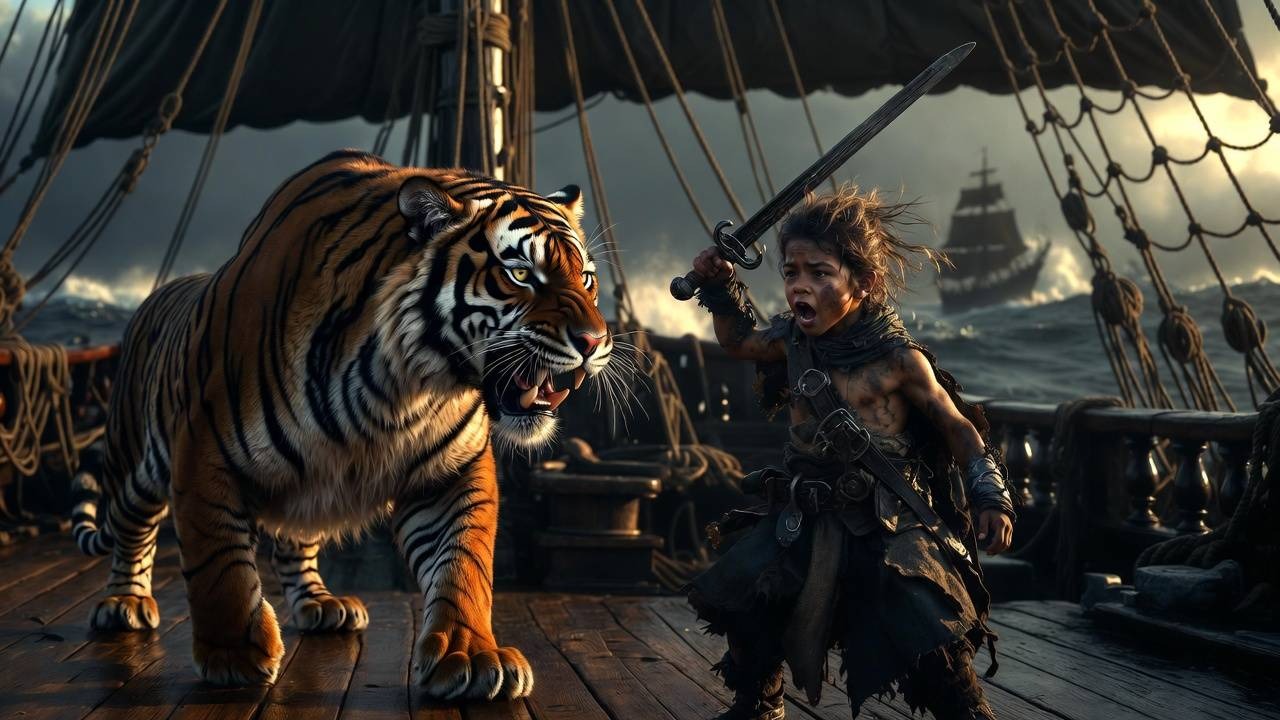
I reached the shore, and a small boat was waiting to take me out to the flagship. I stepped onto the wood, the boat rocking gently, and felt the familiar sway of the ocean. For the first time in my life, I wasn’t afraid of the water. I wasn’t afraid of the dark.
I looked back at the village one last time. It looked small. It looked fragile.
Bjorn was gone. The fear was gone.
As the boat pulled away from the shore, I clutched the pendant in my hand. It was cold, but it felt right.
I looked up at the Captain, who was steering the boat with steady, rhythmic strokes. “Where do we go from here?”
He smiled, a hard, weathered smile. “Wherever you lead us, my Lord. The sea is wide, and we have a throne to reclaim.”
I closed my eyes and let the salt spray wash over my face. The pain on my back was still there, but it was fading. The scars would remain, but they were no longer a mark of shame. They were a map. They were the story of how I had survived, how I had endured, and how I had emerged from the darkness to find my light.
The dawn was beginning to break on the horizon, a line of gold cutting through the blue-black sky. It was the first day of my life.
And for the first time in many years, nobody knelt on my back again.