CHAPTER 3
The sound of my own shallow breathing echoed in the narrow space between the stone railing and Commander Hekha’s advancing boots. The wind howling up from the Nile carried the scent of deep, ancient water and wet reeds, a cold contrast to the suffocating heat of the room. Behind me, the drop was absolute. A single misstep would send my fragile body crashing onto the jagged black rocks that guarded the base of the palace cliff.
“You should have died ten years ago, Maako,” Hekha growled, his voice a low, guttural rasp that seemed to vibrate through the heavy bronze of his armor. He raised the curved khopesh sword, the metal catching the flickering orange glow of the wall torches. “Your father was a fool who thought honesty could protect a bloodline. He thought the Pharaoh would choose a brother’s word over a commander’s loyalty. I corrected his mistake then, and I will correct it now.”
I wanted to speak. I wanted to scream for the guards, to cry out for the Pharaoh, to tell this monster that the blood of the desert kings ran through my veins. But my throat remained a dry, silent desert of its own. No sound came. Only a desperate, ragged gasp escaped my lips. I clutched at my chest, my fingers digging into the fine white linen the servants had given me—a royal garment that now felt like a burial shroud.
Beside the wall, old Ameni groaned, his blind eyes covered in stained linen as he tried to push his frail body off the floor. His hands scrambled against the polished stone, searching for the heavy wooden staff he had dropped. “Run, Maako!” the old man cried out, his voice cracking with panic. “Do not let him silence the truth! The gods are watching!”
“The gods are dead to street rats,” Hekha sneered, taking another step forward. His massive frame blocked the light from the doorway, casting a long, monstrous shadow over me. “And tomorrow, the Pharaoh will find his long-lost nephew drowned in the sacred river. A tragic accident. A boy who simply couldn’t handle the weight of a crown he never belonged to.”
He lunged.
The bronze blade sliced through the air with a terrifying whistle. Instinct, honed by years of dodging angry merchants and feral dogs in the dark alleys of the lower city, took over my limbs. I didn’t try to fight. I didn’t try to stand. I threw myself flat onto the stone floor, rolling violently to the left.
The heavy khopesh struck the stone railing where I had been standing a split second before, sending a shower of sharp stone chips into the air. One of the fragments sliced across my cheek, leaving a thin, burning line of blood, but I barely felt it. The sheer adrenaline coursing through my veins drowned out the pain.
Hekha cursed, the weight of his heavy armor making him clumsy as he tried to adjust his balance. Before he could turn, I scrambled along the floor like a hunted animal, my hands finding the heavy wooden staff that Ameni had lost. My fingers wrapped around the smooth, aged wood. It was heavy, far too heavy for a starving boy, but it was the only weapon I had.
As Hekha spun around, his face twisted in a mask of pure fury, I swung the staff with every ounce of strength hidden within my small frame. I didn’t aim for his chest or his head—the bronze plate armor would have shattered the wood instantly. Instead, I swung low, targeting his exposed ankle just above his leather sandals.
Crack.
The wood struck the bone with a solid, sickening thud. Hekha roared in pain, his leg buckling beneath him. The sudden loss of balance sent him stumbling backward against the very bed he had destroyed moments earlier. The heavy commander fell hard, his bronze armor clattering loudly against the wooden frame of the bed.
“Guards!” Hekha screamed, his voice filled with rage as he clutched his injured ankle. “In here! Kill the boy!”
The two giant mercenaries standing at the doorway, who had been watching with cruel amusement, instantly straightened. Their faces turned cold as they raised their long bronze-tipped spears and stepped into the room. They moved with the synchronized, lethal precision of men who killed for silver, their eyes locked onto my small, trembling target.
I backed away toward the balcony again, the staff trembling in my hands. My back hit the cold stone railing. There was nowhere left to roll. Nowhere left to hide. The mercenaries advanced, their spears pointed directly at my chest, their heavy steps closing the distance between life and death.
“Stop right there!” a voice boomed from the corridor.
The sound didn’t come from Hekha, and it didn’t come from the mercenaries. It was a voice that held the authority of the sun itself.
The High Priest stepped through the shattered doorway, his long white robes flowing around him, his face pale with shock. Behind him stood a dozen royal shields—the Pharaoh’s personal executioners—their heavy golden armor gleaming under the torches, their curved swords drawn and ready for blood.
“What is the meaning of this, Commander?” the High Priest demanded, his dark eyes sweeping over the wrecked room, the blood on my cheek, and Hekha holding his sword. “The Pharaoh commanded that the boy be protected under penalty of death. Why are your men inside the royal quarters with drawn steel?”
Hekha, showing the terrifying cunning that had kept his crimes hidden for ten years, immediately changed his expression. He dragged himself to his feet, wincing in pain, and dropped his sword to the floor. He fell to his knees, his hands raised in a gesture of false humility.
“High Priest! Thank the gods you have arrived!” Hekha cried out, his voice suddenly thick with manufactured terror. “The old man… the blind servant Ameni… he is a traitor! He sneaked into the room with a weapon, trying to murder the boy to protect the thieves of the lower districts! I heard the struggle from the hallway and rushed in to save the child! Look at the room! Look at the damage the old man caused!”
I stared at him in utter disbelief. My chest heaved as I looked from Hekha to the High Priest. The lie was so smooth, so perfectly delivered, that for a terrifying second, I thought the priest would believe it. To the court, I was a mute beggar who couldn’t defend myself, and Ameni was a forgotten relic of a dead household. Who would believe a street rat over the Commander of the Guard?
The High Priest looked at Hekha, then at the mercenaries, and finally at me. He saw the blood dripping down my cheek, the heavy staff still held tightly in my small, white-knuckled hands.
“The Pharaoh will judge the truth of this matter,” the High Priest said, his voice cold and unreadable. He turned to the royal shields. “Disarm the mercenaries. Take Commander Hekha to the lower holding cells. And bring the boy, the blind man, and the Royal Ledger of Births to the High Court immediately. The night is old, but justice will not wait for the sun.”
Hekha didn’t fight as the royal shields stripped him of his bronze armor and his weapon. He let them lead him away, but as he passed me, his eyes locked onto mine. There was no fear in his gaze. There was only a cold, promise of death. He believed that even in the High Court, his wealth, his influence, and his lies would protect him. He believed he was untouchable.
CHAPTER 4
The High Court of the Pharaoh was bathed in the eerie, flickering light of a hundred massive oil lamps. The great stone columns rose into the darkness like the legs of giant gods, their surfaces carved with the history of dynasties long gone. Although it was the middle of the night, the hall was packed. Word of the midnight trial had spread through the palace like wildfire, and the wealthy nobles who had mocked me hours earlier now stood in tight, whispering groups, their eyes glittering with malice and curiosity.
The Pharaoh sat upon his great black diorite throne, his face carved from the same hard stone as the seat beneath him. He wore the double crown of Egypt, the golden cobra on his brow gleaming in the lamplight. Beside him sat the High Priest, holding a massive, ancient scroll bound in cracked leather—the Royal Ledger of Births.
I stood in the center of the vast floor, feeling incredibly small. The fine white linen I wore was stained with my own blood from the cut on my cheek. Beside me sat old Ameni on a wooden stool, his frail hands resting on his knees, his blind face turned upward toward the throne.
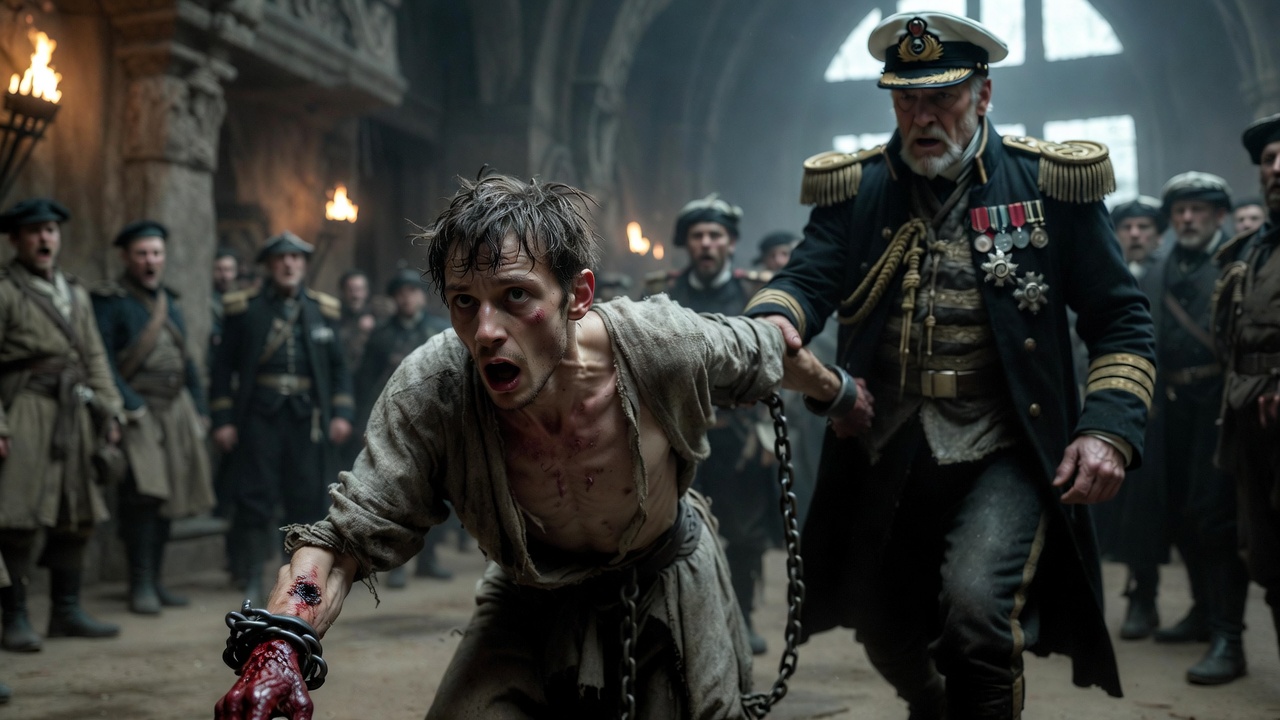
On the opposite side of the floor stood Commander Hekha. Even without his armor, dressed only in a simple white tunic, he stood tall and proud. His hands were bound in heavy bronze chains, but he held his head high, a confident smile playing on his lips. He looked around at the nobles, nodding to those he had bribed over the years, reminding them of his power.
“We are here to determine the fate of a empire,” the Pharaoh’s voice echoed through the silent hall, deep and heavy with grief. “A boy has emerged from the dust of the lower city, carrying the sacred birthmark of the Falcon bloodline. Commander Hekha claims the boy is an impostor, a thief who branded himself to steal a legacy. Hekha further claims he entered the royal quarters tonight to save the child from a traitorous servant.”
The Pharaoh looked down at me, his eyes softening for a brief second before turning ice-cold as he looked at Hekha. “Let the evidence be brought forth. High Priest, read from the sacred ledger.”
The High Priest stepped forward, unrolling the heavy leather scroll. The parchment was yellowed with age, covered in the precise, elegant script of the royal scribes.
“Ten years ago,” the High Priest read, his voice filling the room, “the household of Prince Kaelen, younger brother to the Pharaoh, was destroyed by fire. The ledger records the deaths of the Prince, his wife Princess Teya, and their only son, Prince Maako. However, the record notes a specific detail regarding the young prince’s birth.”
The High Priest paused, looking directly at Hekha. “The young Prince Maako was born during a solar eclipse, a sign from Ra. Because of this, the sacred falcon birthmark on his left wrist was accompanied by another unique mark—a small, crescent-shaped scar near the bone, caused by the royal midwife’s golden instrument during a difficult delivery. It was recorded that this scar would remain for the rest of his life.”
A collective gasp went through the crowd of nobles.
Hekha’s confident smile faltered for a fraction of a second, his eyes darting toward my left wrist. He hadn’t known about the scar. In his haste to burn the house and erase the bloodline, he had never looked closely at the infant he thought had died in the flames.
“Let the royal physician examine the boy,” the Pharaoh commanded.
An old man with a shaved head and long white robes stepped forward from the shadows of the throne. He walked to me gently, taking my left hand in his soft, steady fingers. He wiped away the remaining dried sweat and dirt, exposing the skin to the bright light of the oil lamps.
The physician took a small magnifying glass made of polished quartz and held it over my wrist. The entire hall held its breath. The silence was so profound that I could hear the distant lapping of the Nile against the palace walls.
“The birthmark is natural, born of the flesh,” the physician announced, his voice steady and clear. “And directly beside the bone, there lies a crescent-shaped scar, deep within the tissue. It matches the description in the ledger perfectly. This is no brand, Your Majesty. This is the flesh of Prince Kaelen’s son.”
The crowd erupted into a storm of whispers and gasps. Nobles pointed at me, their faces filled with sudden awe and terror. The street rat they had mocked, the boy they had wanted to throw to the shadow-beasts, was the rightful heir to the secondary throne of Egypt.
“It is a lie!” Hekha roared, his chains rattling violently as he stepped forward, his face turning purple with rage. “The physician has been bribed! The old man Ameni has coached this boy! Even if he has the marks, he cannot prove he is the prince! He is mute! He cannot answer the royal questions! He is a broken tool used by my enemies to destroy my reputation!”
The Pharaoh raised his hand, and the room instantly fell silent again. He looked at me, his eyes filled with a deep, aching sadness. “My nephew was not born mute, Commander. I remember his laughter when he was an infant. If this boy is indeed Maako, why can he not speak?”
Old Ameni stood up from his stool, his voice ringing out clear and strong. “Because on the night of the fire, Your Majesty, Commander Hekha didn’t just burn the house. He caught the Princess Teya as she tried to run with the child. I hid in the shadows and saw it all. Hekha struck the princess down, and before he threw the infant into the smoke, he forced a burning ember from the hearth into the child’s throat to ensure he could never cry out for help or tell the world who had betrayed his family. The gods saved the boy’s life, but the fire took his voice.”
A wave of horror washed over the court. The cruelty of the act was too much even for the hardened nobles of the palace. They looked at Hekha with newfound disgust, the men who had supported him now stepping away, leaving him standing entirely alone in the center of the hall.
Hekha laughed, a wild, desperate sound that echoed unnaturally against the stone. “You have no proof, old man! Your eyes are blind, and your words are nothing but the ramblings of a dying servant! The Pharaoh demands absolute proof to condemn a Commander of the Empire!”
I stood there, watching the man who had murdered my family, the man who had stolen my voice, the man who had forced me to live like a dog in the dirt, still trying to lie his way out of justice. A sudden, deep warmth began to spread through my chest, burning hotter than the ember he had forced down my throat so many years ago. It wasn’t fear anymore. It was the ancient, dormant blood of my ancestors, rising up to demand vengeance.
I stepped forward, moving past the physician, past Ameni, until I stood directly in front of the Pharaoh’s throne. I looked up at my uncle, the ruler of Egypt, and then I turned to face Hekha.
I raised my left hand, pointing my finger directly at the commander’s face.
I opened my mouth. I didn’t try to form words. I didn’t try to speak the language of men. Instead, I took a deep breath, reaching deep into the empty, silent void that had lived inside my chest for ten years, and I pushed.
A sound tore from my throat. It wasn’t a word, but it wasn’t a wheeze either. It was a sharp, high-pitched, piercing cry that vibrated through the entire stone hall. It was the exact imitation of a hunting falcon striking its prey—the ancient battle cry of my father’s regiment, a sound he had taught me to mimic when I was a baby sitting on his shoulders.
The sound cut through the darkness like a bronze sword.
The Pharaoh froze, his eyes widening to their absolute limits. He collapsed back into his throne, his hand clutching his chest as tears finally streamed down his face. He recognized the sound. It was the same cry his brother had used when they fought together in the southern wars.
Hekha’s face drained of all color. His knees trembled, and his heavy khopesh sword, which had been placed on the evidence table nearby, seemed to gleam with a judgmental light. He knew he was finished. The silent boy had finally spoken, and the entire kingdom had heard the truth.
“Guards,” the Pharaoh whispered, his voice shaking with a terrifying, absolute fury that made the entire room tremble. “Strip Hekha of his name, his lands, and his titles. He has spilled the blood of the royal house, and he has lied to the living god of Egypt.”
The royal shields closed in around Hekha, their heavy spears locking together around his neck. The commander fell to his knees, his arrogance completely shattered, his face pressed into the very dust where I had knelt hours before.
“The judgment for treason against the bloodline is clear,” the Pharaoh announced, standing up and looking down at the broken commander. “You wished to throw this child to the shadow-beasts of the desert arena to hide your crimes. Therefore, you shall take his place. Tomorrow, at sunrise, you will be thrown into the pit before the eyes of the entire city you betrayed. Let the beasts have the flesh of the man who had no soul.”
Hekha screamed for mercy, his voice cracking with the same terror he had inflicted on my family, as the guards dragged him roughly out of the hall, his chains clanking against the stone until the sound faded into the deep corridors below.
The Pharaoh stepped down from his high throne, walking past the nobles, past the priests, until he stood directly in front of me. He knelt down once more, not as a king to a subject, but as a man to his brother’s son. He wrapped his powerful arms around my small, trembling body, pulling me into a fierce, protective embrace.
“Welcome home, Maako,” my uncle whispered into my hair, his tears wetting my shoulder. “The shadows have lost, and the falcon has finally returned to his nest.”
I closed my eyes, burying my face in his royal robes. For the first time in ten long years, the desert wind outside didn’t feel cold, and as I looked out at the rising sun painting the Nile in shades of brilliant gold, I knew that the silence was finally over.