Chapter 5
The walk home felt like dragging a heavy chain through deep water. I didn’t take the bus; I couldn’t bear the thought of sitting in a confined space, smelling like a five-hundred-dollar bottle of scotch and the copper tang of adrenaline. I walked through the humid Chicago night, my right knee clicking with every step, a sharp, rhythmic reminder that I wasn’t twenty-two anymore and that the three-beat combo I’d delivered to Brock Harrison had come at a steep physical price.
My apartment was a third-floor walk-up in a brick building that had been tired since the seventies. By the time I reached my door, my hands weren’t just trembling; they were shaking with a violent, rhythmic intensity that made it nearly impossible to fit the key into the lock. It was the Agent Orange—the “gift” that kept on giving. Stress always acted as a catalyst, turning the low-grade tremors into a full-blown rebellion of the nervous system.
I finally stumbled inside and didn’t bother with the lights. I sat on the edge of my narrow bed, the scotch-soaked shirt cold and heavy against my skin. The room smelled of old paper and the liniment I used for my joints. I reached for the plastic vial on my nightstand, my fingers fumbling with the child-proof cap. I needed the medication—the stuff the club’s insurance paid for. Without it, the tremors would move to my legs, and I’d be horizontal for the next forty-eight hours.
I managed to get two pills down, swallowing them dry. I leaned back, staring at the ceiling where a water stain looked vaguely like the map of the Central Highlands.
I’d done it. I’d broken the silence. After twenty years of being a ghost, I’d made myself visible in the most violent way possible. And as the adrenaline finished its slow retreat from my system, the weight of the consequences began to settle in.
I was sixty years old. I had no savings, a body that was failing me, and I had just physically assaulted the son of the most powerful man in the club. The insurance was gone. The job was gone. My invisibility, my only shield, had been shattered.
Around 2:00 AM, my phone—a burner I kept mostly for emergencies—started buzzing on the dresser. I ignored it. Then it buzzed again. And again. Finally, I reached out and flipped it over.
It was Leo.
“Silas, you there? Pick up, man.”
I hit the speakerphone. “I’m here, Leo.”
“Jesus, Silas. Where are you? Are you home?” His voice was frantic, pitched higher than usual.
“I’m home. What’s going on?”
“The video, Silas. It’s… it’s everywhere. One of those frat kids, the one with the glasses? He posted it to a private group, but someone leaked it to a local news aggregate. It’s got half a million views already. People are calling you the ‘Janitor John Wick.'”
I closed my eyes. That was the one thing I hadn’t fully calculated—the digital permanence of the humiliation. “And the club?”
“Gable is losing her mind,” Leo said, his voice dropping to a whisper. “The Board had an emergency call at midnight. Brock’s face is a mess, Silas. He’s got a fractured sternum and a concussion. The Harrisons are talking about filing a police report for aggravated assault. The General… he’s already called the Commander of the local precinct.”
“I figured as much,” I said. My voice was surprisingly calm. The pills were starting to work, the tremors subsiding into a dull, manageable hum.
“Silas, you need to get out of there for a few days,” Leo urged. “The press is going to find your address. Gable gave your file to the police. They’re coming to talk to you.”
“Let them come,” I said. “I’m not running, Leo. I’m too tired to run.”
After I hung up, I sat in the dark for another hour. I thought about the jungle. I thought about the way the light filtered through the canopy, and the way the air felt right before a storm. I thought about Howard Harrison, huddled in that mud-slicked trench, his eyes wide and vacant, his hands clawing at his own chest as if trying to keep his heart from leaping out. I’d saved him not because he was a good man, but because he was my man. That was the code. You didn’t leave anyone behind, even the cowards.
I’d kept that code for thirty years. But Brock Harrison had stepped on my jacket. He’d stepped on the memory of the men who hadn’t made it back—the ones who didn’t get their names on bronze plaques or have sons in tailored tuxedos.
A soft knock at the door startled me. I stood up, my knee screaming in protest, and moved to the door. I didn’t look through the peephole. I already knew it wasn’t the police. The police wouldn’t knock that softly.
I opened the door to find Clara. She was still in her waitress uniform, but she’d thrown a denim jacket over it. She looked exhausted, her eyes rimmed with red.
“You okay?” she asked, stepping inside without waiting for an invitation.
“I’ve been better,” I said.
She looked around the small apartment—the single chair, the stack of letters on the desk, the tattered American flag neatly folded on the dresser. She didn’t say anything about the Scotch smell or the way I was favoring my leg. She just reached into her bag and pulled out a manila envelope.
“Leo gave this to me,” she said. “It’s a copy of the incident report Gable filed. And something else. He went into the archives tonight. The restricted files.”
I took the envelope, my hands still slightly unsteady. Inside were photocopies of old documents—Army service records, dated 1969.
“Why are you doing this, Clara?” I asked.
“Because my grandfather died in a VA hospital waiting for a doctor who never came,” she said, her voice fierce. “And because I watched that kid pour a bottle of scotch on you while his friends laughed. I’m tired of the wrong people winning, Silas.”
She sat on my only chair, leaning forward. “The video is being framed as an unprovoked attack by a ‘troubled’ veteran. The Harrison lawyers are already drafting a statement. They’re going to paint you as a monster, Silas. They’re going to use your medical history—the tremors, the ‘instability’—to say you snapped.”
“I did snap,” I said.
“No,” she countered. “You stood up. There’s a difference.”
She pointed to the records in my hand. “Leo found the original casualty list from Hill 937. The one before it was ‘corrected’ by the CO’s office. Your name was on the list for the Distinguished Service Cross. It was crossed out. And Howard Harrison’s name was written in for the Silver Star on the same day.”
I looked at the grainy photocopy. It was all there. The paper trail of a lie that had lasted three decades. Howard hadn’t just taken the credit; he’d actively erased the evidence of my service to bolster his own. He’d stolen my history to build his future.
“They’re going to try to crush you, Silas,” Clara said softly. “But you have something they don’t. You have the truth. And now, you have witnesses.”
“Witnesses don’t matter in a club like that, Clara. They’ll all fall in line. They won’t risk their memberships for a janitor.”
“Maybe not the members,” she said. “But the staff? We’ve all been recording, Silas. Not just tonight. We’ve been recording the way they treat us for months. Brock isn’t the only one who’s been crossing lines. We have a whole folder of it.”
She stood up and walked to the window, looking out at the street. “You’re not alone in this. Even if it feels like it.”
Before I could respond, my phone buzzed again. This time, it wasn’t Leo. The caller ID was a number I hadn’t seen in five years, but I knew it by heart.
I looked at Clara. She saw the look on my face and stepped back toward the door. “I’ll leave you to it. But Silas? Don’t apologize. Not to anyone.”
She slipped out, and I hit the green button.
“Hello?” I said, my voice cracking.
“Dad?”
It was Sarah. Her voice sounded small, stripped of the anger that had defined our last conversation.
“I’m here, Sarah.”
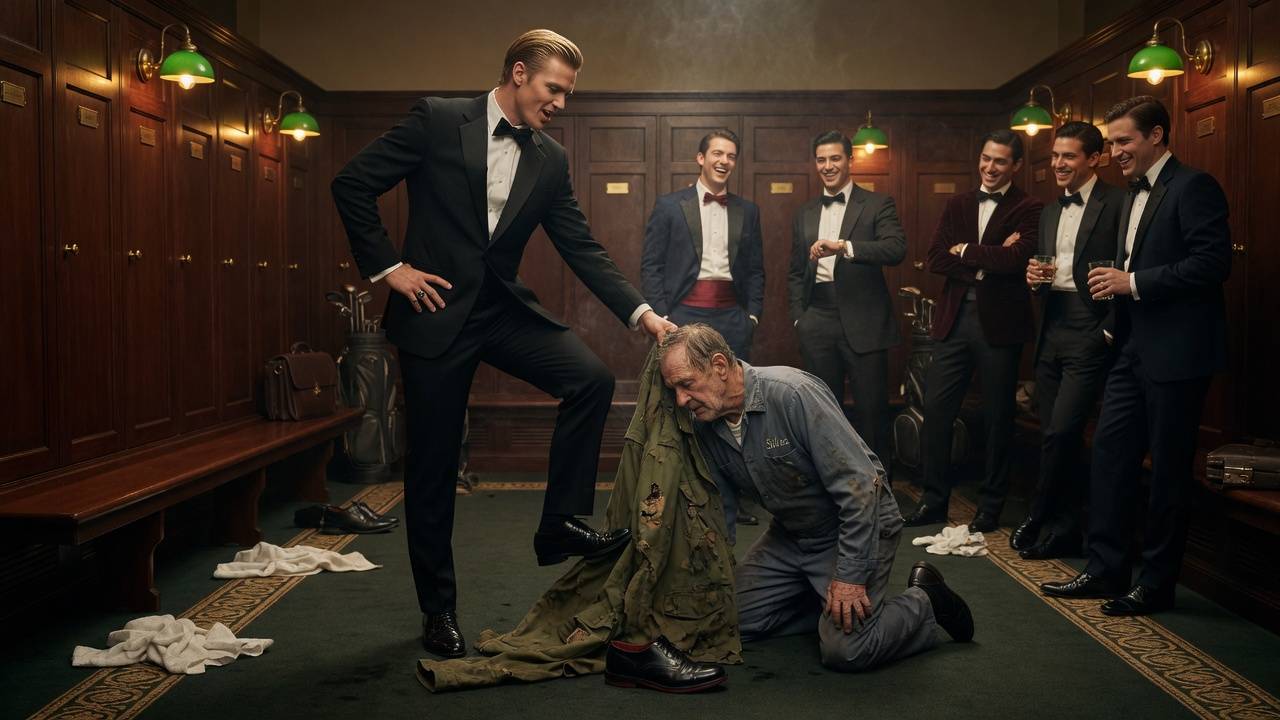
“I saw the video,” she said. There was a long pause, the kind of silence that usually preceded a lecture or a goodbye. “I saw what he did to you. With the bottle.”
“I’m sorry you had to see that,” I said.
“Don’t you dare,” she snapped, her voice suddenly sharp. “Don’t you dare apologize for being treated like that. I’ve spent years being angry at you for being a ‘ghost,’ Dad. For letting life just happen to you while you cleaned up after people who didn’t care if you lived or died.”
I sat back down on the bed, my eyes stinging. “I needed the insurance, Sarah. I needed to stay upright so I could see you again.”
“I don’t care about the insurance!” she cried. “I care about the man who taught me how to ride a bike. The man who used to tell me that the most important thing a person has is their name. I saw that man tonight, Dad. In that lounge. I saw him stand up.”
“He’s going to sue me, Sarah. The police are probably on their way.”
“Let them sue,” she said, and I could hear the pride in her voice, a sound I’d forgotten existed. “I’m a paralegal at one of the biggest firms in the city, remember? You might have been a janitor for twenty years, but you raised a fighter. I’m coming over. We’re going to handle this.”
“Sarah, you don’t need to get involved in this mess.”
“I’ve been involved since the day I was born, Dad. I’m coming home. Stay put.”
She hung up, and for the first time since I’d walked out of the North Shore Country Club, the coldness in my chest began to thaw. I looked at the tattered flag on my dresser. I’d spent so long trying to protect the “hero” reputation of a man who didn’t deserve it, thinking I was doing it for the sake of the service, for the sake of the flag.
But the flag didn’t belong to Howard Harrison. It didn’t belong to the club. It belonged to the men who bled for it, and the daughters who were willing to fight for their fathers.
I stood up, my knee clicking, my hands steadying. I walked to the bathroom and started the water. I needed to wash the smell of scotch off my skin. I needed to be ready.
Because the war wasn’t over. It had just moved from the jungle to the city, and this time, I wasn’t going to be the one hiding in the shadows.
Chapter 6
The morning light in Chicago is never soft; it’s a harsh, grey intrusion that exposes every crack in the sidewalk and every wrinkle in the skin. By 8:00 AM, the hallway outside my apartment smelled of burnt coffee and the impending arrival of trouble.
Sarah had arrived at 3:00 AM. She’d spent the rest of the night sitting at my small kitchen table, her laptop open, her face illuminated by the blue light of the screen as she sifted through the documents Clara had left and the legal threats already blooming on the internet. She looked so much like her mother—the same stubborn set to her jaw, the same way she tucked a stray lock of hair behind her ear when she was focused.
“They’re trying to file for a permanent restraining order,” Sarah said, not looking up. “And the Harrison family lawyer, a man named Sterling, has already contacted the DA’s office about ‘hate crime’ enhancements, claiming you targeted Brock because of his family’s military status.”
I let out a short, dry laugh. “That’s rich. Targeting him because of his military status. The kid wouldn’t know a drill sergeant from a doorman.”
“It doesn’t have to be true, Dad. It just has to be loud. They’re trying to drown out the video of him pouring the scotch. They want the narrative to be about a ‘deranged vet’ attacking a ‘prominent citizen.'”
She finally looked at me, her eyes tired but sharp. “But we have the Army records. And I’ve been talking to Clara on the phone. She’s getting statements from four other staff members who witnessed the whole thing. If they push this to court, we’re going to turn it into a trial of Howard Harrison’s entire career.”
“I don’t want a trial, Sarah,” I said. “I just want my life back.”
“Your old life is gone,” she said gently. “But maybe the one that comes next will be better.”
A heavy knock thudded against the door—three slow, deliberate strikes. Not the frantic banging of the press, and not the sharp, authoritative rap of the police. It was the sound of a man who expected doors to open for him.
I stood up, smoothing my clean shirt. “That’s him.”
“How do you know?” Sarah asked, standing up beside me.
“I know the rhythm,” I said. “He’s been knocking on doors like that for thirty years.”
I opened the door. Howard Harrison stood in the hallway. He wasn’t in a tuxedo today. He was wearing a charcoal-grey suit that cost more than my car, and a cashmere overcoat despite the humidity. He looked older than he did on the bronze plaque, his face sagging with the weight of too many steak dinners and a secret that was finally starting to rot.
He didn’t wait for an invitation. He stepped into the room, his eyes scanning the small apartment with a mixture of pity and distaste. He looked at the folded flag, the letters, the mismatched furniture.
Then his eyes landed on Sarah.
“You must be the daughter,” Howard said. His voice was still deep, still carrying that practiced command, but I could hear the tremor in it. A different kind of tremor than mine.
“I’m his lawyer,” Sarah said, her voice like a whip. “And you’re trespassing.”
Howard ignored her, turning his attention to me. “Silas. It’s been a long time.”
“Not long enough, Howard,” I said. “I saw your son last night. He’s got your eyes. And your character.”
Howard’s face tightened. “Brock is in the hospital. He has a cracked sternum. He’s going to need surgery.”
“He should have kept his hands off me,” I said. “And his feet off my jacket.”
Howard took a breath, trying to regain his composure. He reached into his coat pocket and pulled out a thick envelope. He set it on the table next to Sarah’s laptop.
“There’s fifty thousand dollars in there,” Howard said. “Cash. It’s enough to get you through the next year. It’s enough to pay for your treatments, and to move into a place that doesn’t smell like a basement.”
“And what do you want for it?” Sarah asked, her hands hovering over the envelope as if it were radioactive.
“I want the video taken down,” Howard said. “I want a signed statement from Silas saying he was intoxicated and that the encounter was a misunderstanding. And I want the records you took from the club’s archive returned. All of them.”
He looked back at me, his eyes pleading now. “Silas, be reasonable. You’re an old man. You’re sick. What do you gain from dragging this into the mud? It’ll ruin Brock’s future. It’ll ruin my legacy.”
“Your legacy is a lie, Howard,” I said. I walked over to the table and picked up the envelope. I felt the weight of it. It was the weight of twenty years of cleaning toilets. It was the weight of the insurance policy I’d been so afraid to lose.
I looked at Sarah. She was watching me, her breath held. She didn’t tell me what to do. She was letting me be the man she’d seen in the video.
I turned back to Howard and dropped the envelope into the kitchen trash can.
“I’ve spent thirty years protecting you,” I said. “I did it because I thought the ‘hero’ was more important than the truth. I thought the Army needed you more than it needed me. But I was wrong. The Army didn’t need a liar. And my daughter didn’t need a ghost.”
“Silas, don’t be a fool,” Howard hissed. “I can have the police here in ten minutes. I can have you evicted by noon. I own the people who make those decisions.”
“You don’t own me,” I said. “Not anymore. I’m not the sergeant who dragged you out of that hole, Howard. I’m just a man who’s tired of cleaning up after you.”
I reached into the manila envelope Clara had given me and pulled out the original casualty report. I held it up so he could see the red ink, the names crossed out, the theft written in plain sight.
“Sarah has already digitalized this,” I said. “And Clara has the statements from the staff. If you send the police, if you file that lawsuit, this goes to the Tribune. It goes to the VA. It goes to every man who served in the 101st who’s still alive.”
Howard’s face went pale—not just pale, but a sickly, grey color. The command in his posture evaporated. He looked like he was back in that mud-slicked trench, the world crashing down around him.
“You’d destroy everything?” he whispered.
“No,” I said. “I’m just going to let the truth do its job. It’s the one thing I haven’t tried yet.”
I walked to the door and held it open. “Get out of my house, Howard. And tell your son that if I ever see him again, I won’t be so gentle.”
Howard Harrison stood there for a long moment, looking like a man who had just realized the floor beneath him was made of glass. He didn’t say another word. He turned and walked out, his footsteps heavy and uneven in the hallway.
I closed the door and leaned against it, my eyes closing. The tremors were back, but they were light—a gentle vibration, like a motor idling after a long race.
“Dad?”
I looked up. Sarah was standing by the table. She walked over and put her arms around me, holding me tight. I buried my face in her shoulder, and for the first time since 1969, I let the tears come. They weren’t tears of shame or anger. They were tears of relief.
“What now?” she asked after a while.
“Now,” I said, “I think I’m going to go get a cup of coffee. A real cup of coffee. Not the stuff from the club breakroom.”
“I know a place,” she said, smiling through her own tears. “It’s a bit of a drive, but it’s worth it.”
Two hours later, I was sitting in a diner on the outskirts of the city. The sun was out, a bright, unapologetic blue. I was wearing my old olive-drab field jacket—the one Clara had cleaned for me. It still smelled faintly of the scotch, but the stains were gone.
The video was still viral, but the narrative was shifting. People were starting to ask questions. They were looking at the General’s record. They were looking at the club.
I didn’t care about the news anymore. I looked across the table at my daughter. She was telling me about her job, about her life, about all the things I’d missed while I was busy being invisible.
“You know, Dad,” she said, reaching across the table to take my hand. My hand was steady. “You never did get your medication.”
“I don’t think I need it today,” I said.
I looked out the window at the American flag flying over the gas station across the street. It was tattered at the edges, worn by the wind and the sun, but it was still up there. It was heavy, but it was flying.
And for the first time in a long, long time, I didn’t feel the weight. I just felt the wind.
I reached for my coffee, my grip firm, my name finally my own again. The night janitor was gone. Silas was back. And he wasn’t going anywhere.