CHAPTER 3
The bronze blade froze exactly three inches from my throat.
Commander Haremhab’s face was no longer human. It was a twisted, trembling mask of raw panic and homicidal desperation, the veins in his neck bulging like thick ropes as he threw the entirety of his massive weight into the strike. He was a seasoned warlord, a man who had cut down hundreds of enemies on the bloody battlefields of the Levant, and his movements were blindingly fast. To the horrified noble lords lining the stone walls, it looked like my life would end before anyone could draw a breath.
But Haremhab had forgotten one crucial detail. He was no longer the highest authority in Egypt.
A deafening, metallic crash echoed through the reception hall, so loud it caused the oil inside the bronze braziers to spill onto the stone floor.
It was the heavy, gold-capped spear shaft of the Chief Royal Guard. With a fraction of a second to spare, the elite warrior had lunged forward from the base of the throne steps, slamming his weapon against Haremhab’s forearm with bone-shattering force. The wicked bronze dagger slipped from the commander’s trembling fingers, clattering loudly across the polished green serpentine floor until it stopped right at my bare, bleeding feet.
“Seize him!” the High Pharaoh roared, his voice no longer that of a grieving father, but of an enraged king whose divine authority had been brutally insulted in his own home. “Seize the traitor!”
Before Haremhab could recover his balance or reach for the short sword strapped to his hip, six massive royal guards threw themselves upon him. They were the Pharaoh’s personal executioners, men chosen for their immense strength and absolute loyalty to the crown. They grabbed Haremhab’s bronze shoulder plates, kicking the back of his knees with their heavy leather sandals, forcing the mighty commander down into the dirt.
Haremhab thrashed like a wild, trapped desert jackal. He spat blood onto the green stone, his eyes wide and bloodshot as he glared at the guards who held him.
“Release me!” Haremhab bellowed, his voice cracking with a terrifying mixture of rage and fear. “I am the Commander of the Imperial Army! I have bled for this kingdom! I have conquered the red lands of the east while you sat on your golden throne! You would take the word of a filthy, matted quarry slave and a nameless river rat over the man who keeps your empire alive?”
The Pharaoh did not answer him. He didn’t even look at the man who had served as his right hand for two decades. Instead, the king kept his eyes fixed entirely on my left wrist, his breathing shallow and heavy as he reached down and gently lifted my arm into the warm sunlight.
His old, calloused fingers brushed over the small, raised birthmark near my pulse. The Falcon of Horus. It was perfectly shaped, dark against my sun-darkened skin, exactly as it had been on the day I was born in the royal chambers.
“Twenty years,” the Pharaoh whispered, his voice trembling so violently it shook his entire frame. “For twenty years, I was told the gods had cursed me. I was told the fire had consumed everything I loved. I built monuments to a ghost, while my own flesh and blood was begging for stale barley bread in the mud of the slums.”
He looked up at my mother, who remained on her knees, her forehead touching his royal sandals. The king reached down and gently took her raw, blistered hands, forcing her to stand before the entire court.
“Rise, Merit,” the Pharaoh commanded softly, tears cutting clean lines through the powder on his aging face. “You are no longer a slave. You are the savior of the United Kingdom of Egypt. Tell the court everything. Let the pillars of this palace hear the crimes that have been hidden in the dark.”
My mother stood as straight as her broken, aching back would allow. She turned her body toward the crowded rows of noble lords and high priests, her voice clear, sharp, and filled with a cold, terrifying strength that she had hoarded over twenty long years of silence.
“On the night of the Great Eclipse,” my mother began, her eyes locked onto Haremhab’s pale face, “when the sky turned black as pitch, Commander Haremhab entered the royal nursery. The Pharaoh was away at the temple of Amun, praying for the health of the realm. The palace guards had been heavily drugged with spiced wine, leaving the infant prince completely defenseless.”
The noble lords leaned forward, their expensive linen robes whispering in the dead silence of the hall.
“I was hiding behind the heavy linen curtains,” my mother continued, her voice growing louder, vibrating with the memory of that horrific night. “I saw Haremhab enter with three of his most trusted mercenaries. He did not come to protect the child. He carried a vessel of black river oil. I watched in horror as his men poured the oil over the silk sheets of the royal cradle, preparing to burn the future king alive.”
“You lie, witch!” Haremhab shrieked, struggling against the heavy arms of the guards who held him pinned to the stone floor. “You were a servant! A nobody! Your mind is rotted by the heat of the quarries!”
“I do not lie!” my mother snapped back, her eyes flashing with a fierce dignity. “Before the torch could be dropped, I slipped behind the cradle. The gods gave me the strength of a lioness that night. I snatched the infant Prince Amenhotep from the silk blankets, hiding him beneath my tattered servant’s cloak. As I scrambled out through the secret servant’s passage, I saw Haremhab drop the flame. The nursery exploded into a wall of fire, consuming the two infant slave children he had placed in the cradle to act as the prince’s remains.”
A wave of absolute horror swept through the throne hall. The high priests tore the edges of their white linen robes, a traditional sign of deep mourning and spiritual shock. To kill a royal child was a crime against the state; to burn innocent children to cover up the murder was an abomination that threatened the very balance of Ma’at, the divine order of the universe.
“I ran,” my mother wept, her voice softening as she looked down at me. “I ran into the deep, trackless sands of the western desert. I knew that if Haremhab found out the prince was alive, he would hunt us to the ends of the earth. I changed his name to Kenamun. I hid him in the poorest, most miserable mud-brick village I could find, where the soldiers never bothered to look. I worked until my fingers bled, washing the clothes of the wealthy, just to buy him a handful of grain each day.”
She reached out and touched the heavy gold signet ring that still hung around my neck.
“The night I fled, I managed to snatch the Pharaoh’s personal signet ring from the Queen’s bedside table,” she explained to the listening court. “I knew that one day, if the gods were merciful, the boy would need to prove who he was. I made him swear a sacred oath to never take it off, to keep it hidden beneath his rags until the day his life depended on it. And today, the gods of Egypt have demanded the truth.”
The Pharaoh turned his head slowly toward Haremhab. The sorrow in his eyes had completely vanished, replaced by a cold, calculated vengeance that had been building for two decades. The king walked slowly toward the kneeling commander, his heavy gold-embroidered sandals clicking sharply against the green serpentine stone.
“You told me the nomads had done it,” the Pharaoh said, his voice deadly quiet, echoing like the distant rumble of a desert storm. “You came to my chambers covered in soot and blood, pretending to weep for my lost son. You volunteered to lead the army into the eastern lands to avenge his death. I gave you gold. I gave you land. I made you the highest commander in the empire because I believed you were the only one who cared for my grief.”
Haremhab spat a mouthful of dark blood onto the floor, realizing that no amount of lying could save him now. A cruel, defiant sneer spread across his face as he looked up at the king.
“And I would have succeeded,” Haremhab hissed, his voice dripping with pure malice. “If it weren’t for this pathetic old woman and her rat of a son. Look at him, Pharaoh! Look at your great heir! He is a beggar. He has spent his life crawling in the dirt, eating scraps from the tables of my soldiers. He doesn’t know how to hold a sword. He doesn’t know how to speak to kings. He is a broken creature from the slums, and he will never be fit to wear the double crown of Egypt!”
The Pharaoh stood over him, his face an unreadable mask of absolute majesty. He didn’t yell. He didn’t strike the traitor. He simply looked down at him with an expression of supreme disgust.
“He survived the slums, Haremhab,” the Pharaoh said softly. “He survived the hunger, the heat, and the cruelty of your soldiers. He possesses a strength you will never understand—the strength of a survivor. And today, he will watch you fall into the very darkness you created.”
The king raised his hand, signaling the Chief Royal Guard.
“Strip him of his bronze armor,” the Pharaoh commanded, his voice echoing through every corner of the vast hall. “Strip him of his titles, his lands, and his gold. He is no longer a commander of Egypt. He is a traitor to the divine throne.”
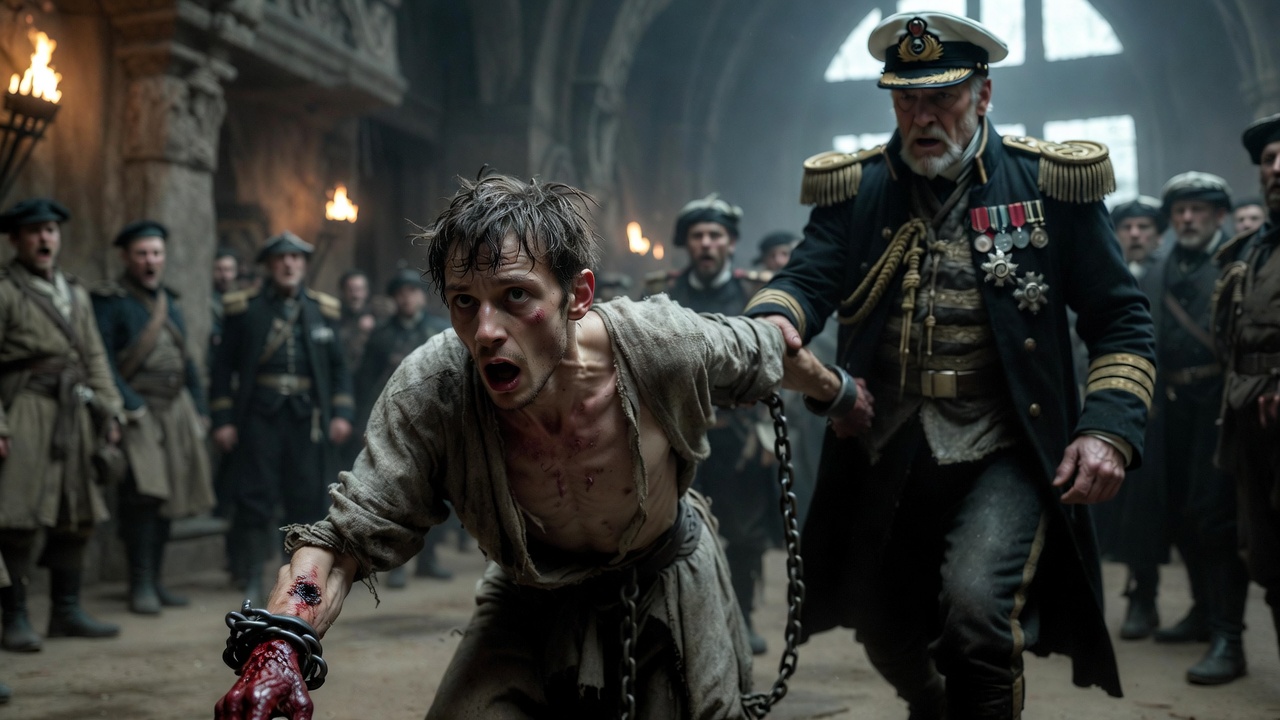
The guards immediately fell upon Haremhab, violently ripping the polished bronze chest plate from his torso, tearing away the purple silk cape that signified his high military rank. They tossed the expensive armor onto the stone floor, where it landed with a hollow, pathetic clang. Haremhab was left standing in nothing but a plain linen tunic, his chest heaving, his powerful frame looking suddenly small and vulnerable without the symbols of his immense authority.
“But we are not finished,” the Pharaoh continued, turning his eyes toward me and my mother. “The crime was committed in public. The humiliation of my son was done before the entire kingdom in the grand desert arena. Therefore, the justice of the Pharaoh will be executed in the exact same spot.”
The king walked back to me, his hand resting firmly on my trembling shoulder. He looked into my eyes, his gaze filled with a fierce, protective pride that made the lingering fear in my chest melt away.
“Call the priests,” the Pharaoh ordered the scribes. “Assemble the army. Reopen the gates of the grand arena. The people of Thebes came to see an execution today… and they will not be disappointed.”
The royal guards grabbed Haremhab by his arms, dragging him out of the reception hall. The former commander fought back, his leather sandals scraping against the green stone, but his strength was gone. He was no longer a feared warlord; he was a condemned criminal being led to his own judgment.
I looked at my mother, who was tears openly, her thin arms reaching out to hold me tight against her chest. For three long years, I had searched for her in the white dust of the quarries, believing I was entirely alone in a cruel, merciless world. Now, as I held her frail body close, I realized that the nightmare was finally over. We were no longer the hunted. We were no longer the forgotten.
“Come, my son,” the Pharaoh said gently, holding out his hand to guide us toward the royal balcony that overlooked the vast desert arena. “Let us show Egypt that the line of the true kings can never be broken by the hands of traitors.”
As we walked through the long, shadowed corridors of the palace toward the blinding light of the arena, the sound of thousands of voices began to rise once more, a deafening roar of anticipation that shook the limestone walls. The crowd was waiting. The kingdom was waiting. And the ultimate twist was about to unfold before the eyes of the entire world.
CHAPTER 4
The iron gates of the grand desert arena did not just open; they were hurled back by the frantic hands of royal guards who were terrified for their own lives.
The blistering afternoon heat rushed into the tunnel mouth, carrying with it the heavy, suffocating scent of sun-baked sand, wild animal sweat, and the electric, volatile energy of thousands of waiting spectators. The roaring crowd on the limestone terraces had not diminished during the hours we spent locked away in the palace throne hall. If anything, the whispers had grown into a deafening, chaotic tempest of rumors. They had seen the ruthless Commander Haremhab humiliate a ragged, nameless boy. They had seen the High Pharaoh freeze, shout a command that stopped a raging river beast, and throw the entire kingdom into absolute silence.
Now, they wanted answers. They wanted blood. They wanted to see how this impossible day would end.
I walked out of the dark stone tunnel first, my bare feet sinking into the scorching, white-hot sand of the arena floor. The pain of my blisters was gone, replaced by a strange, icy numbness that ran through my veins. I was no longer the trembling orphan who had scrambled backward in terror from a starving hippopotamus. I stood tall, my thin shoulders squared, the heavy gold signet ring resting openly against my bare, scarred chest. The sweat-stained leather cord looked completely out of place against the brilliant, blinding ray of sunlight that caught the polished metal, flashing a warning across the entire stone stadium.
Right behind me walked my mother. She was no longer wearing the filthy, matted rags of the limestone quarries. The Pharaoh’s personal servants had washed the white stone dust from her skin, treating her raw, bleeding fingers with soothing oils of myrrh and lotus. They had dressed her in a simple but clean white linen gown, her long silver hair braided neatly down her back. She walked with her head held high, her eyes locked onto the front row of the lower terrace where her wooden execution post still stood empty. She had spent twenty years in hiding, living like a hunted animal in the mud-brick slums of the Nile, but today, she walked with the quiet, unbreakable dignity of a woman who had saved an empire.
And then came the High Pharaoh.
The crowd erupted into a chaotic, confused roar as the sovereign stepped onto the arena sand, surrounded by a wall of fifty elite warriors carrying long bronze spears and heavy wooden shields. The king wore his majestic double crown of Upper and Lower Egypt, his white linen robes embroidered with threads of pure gold that shimmered like a fire under the merciless sun. He did not ascend to his high, shaded royal balcony. He walked directly onto the hot dirt of the courtyard, choosing to stand on the exact same level as the poorest beggar in the city.
But it was the figure dragged behind the guards that caused the thousands of voices on the terraces to instantly die, plunging the entire stadium into a suffocating, breathless silence.
It was Commander Haremhab.
The man who had ruled the imperial army with an iron fist, the man whose very name caused the village elders along the Nile to tremble in fear, was completely unrecognizable. The guards had stripped him of his polished bronze chest plate. They had torn away his flowing purple silk cape, his engraved shin guards, and his heavy leather sandals. He was dragged through the sharp gravel in nothing but a torn, sweat-stained linen tunic, his thick arms bound tightly behind his back with heavy, braided hemp ropes. His face was a mask of dark, venomous fury, his lips pulled back over his teeth in a silent, snarling rage as the hot sand burned his bare feet.
The noble lords in their shaded luxury boxes leaned over the wooden railings, their faces pale with absolute shock. The wealthy merchants dropped their clay cups of sweet wine, staring down in disbelief at the man who had been the most powerful warlord in the kingdom, now reduced to a common captive in the dirt.
The Pharaoh halted in the very center of the arena, precisely where I had stood hours earlier when the iron cage of the river beast had been lifted. The king raised his golden staff high into the blue sky, his voice booming across the limestone terraces like a clap of thunder from a clear sky.
“People of Thebes!” the Pharaoh bellowed, his voice vibrating with a raw, ancient power that commanded absolute obedience from every soul in the city. “Look upon the man you once called a hero! Look upon the commander who claimed to protect the sacred borders of Egypt! Today, the gods have torn away his mask of honor, and his crimes have been dragged out of the dark!”
A murmur of confusion ran through the crowd, thousands of people leaning forward, trying to understand what the living god was saying.
“Twenty years ago,” the Pharaoh continued, his eyes flashing with a terrifying, righteous anger, “the royal nursery was consumed by a horrific fire. I was told by this very man that an army of eastern nomadic invaders had breached our walls and murdered my infant son, Prince Amenhotep, in his cradle. I wept for my child. I built monuments to his memory. And I gave Haremhab total control of my armies to avenge the blood of my house!”
The king pointed his golden staff directly at the bound, kneeling figure of Haremhab.
“But it was a lie!” the Pharaoh’s voice rose to a shattering roar. “The invaders never touched the palace! It was Haremhab who poured the black river oil over the silk blankets! It was Haremhab who dropped the torch! He sought to butcher my only son, to erase the divine bloodline of the Pharaohs, so that when I passed to the afterlife, there would be no heir to stop him from seizing total control of the throne of Egypt!”
The stadium erupted into a wild, furious tempest of shouts and screams. The citizens who had laughed at me hours earlier were now shaking their fists at the fallen commander. The betrayal was too massive, too horrific for them to comprehend. To strike at the royal bloodline was to attack the very heart of Egypt itself.
“He lies!” Haremhab suddenly shrieked, his voice desperate, cracking with a wild, animalistic panic as he struggled against the heavy hands of the guards holding him down. “He is a senile old king listening to the stories of a mad slave woman! I am your commander! I am the one who kept you safe! This boy is nothing but a river rat who stole a royal ring from a tomb! Do not let them destroy the army for the sake of an imposter!”
The Pharaoh turned his head slowly toward the shouting traitor, his face an unreadable mask of absolute majesty. He did not argue. He did not yell. He simply reached out and took my left hand, lifting my wrist high into the bright, blinding afternoon sunlight.
“The truth does not lie in the words of men, Haremhab,” the Pharaoh said, his voice quiet but carrying easily through the sudden silence. “The truth is written by the hands of the gods themselves.”
The king pointed to the small, raised birthmark near my throbbing pulse. In the harsh, direct rays of the sun, the Falcon of Horus was perfectly visible, dark and unmistakable against my skin.
“Behold your prince!” the Pharaoh shouted to the thousands of spectators. “Behold Prince Amenhotep, the son who was pulled from the burning nursery by a faithful servant, the boy who survived the hunger of the slums and the cruelty of the desert, preserved by the gods to bring justice to this kingdom!”
For a single, breathless second, nobody moved. Then, like a wave crashing against the banks of the Nile, the entire arena fell to its knees. The noble lords in their fine linen, the wealthy merchants, the stonecutters from the quarry, and the royal guards themselves all pressed their faces into the hot sand, bowing low before the boy they had mocked just hours before. The roar of thousands of voices calling out my royal name shook the very foundations of the limestone walls.
I looked at Haremhab. The ruthless commander’s eyes were wide, staring at my wrist with an expression of pure, unadulterated horror. His final defense was completely dead. The arrogance that had defined his face for twenty years cracked, leaving behind nothing but the pathetic, shivering features of a trapped murderer.
The Pharaoh lowered his hand, his eyes locking onto the two guards who stood behind Haremhab.
“Haremhab believed that the powerless could be crushed without consequence,” the king declared, his voice cold as a tomb. “He threw my son into this sand to be executed for the amusement of the court. He chained a faithful servant to a wooden post to watch her child die. Therefore, his punishment will match his cruelty.”
The Pharaoh signaled the guards at the far side of the arena. With a loud, metallic screech, the heavy iron gates rose once more. The massive river beast, the towering hippopotamus that had been kept in the dark and driven into a frenzy of hunger, emerged into the bright sunlight, its red eyes locking instantly onto the scent of blood and sweat in the center of the courtyard.
But this time, the beast did not look at me. It looked at the bound, armorless man kneeling in the sand.
“No!” Haremhab screamed, his voice rising into a high, pathetic shriek as he tried to scramble backward on his knees, his bare skin tearing against the sharp gravel. “My Sovereign! Please! I beg for your mercy! I served you for twenty years! Do not leave me to the beast!”
The Pharaoh turned his back on the traitor, walking toward the palace entrance with my mother and me by his side. He did not look back even once.
“The mercy you showed to my infant son is the mercy you shall receive today, Haremhab,” the Pharaoh’s final words echoed across the arena floor.
As we stepped into the cool, columned shadow of the royal palace, the heavy iron gates slammed shut behind us, cutting off the final, agonizing screams of the man who had tried to erase our names from history, leaving his memory to be consumed by the very desert sands he had stained with the blood of the innocent.