Chapter 5: The Shattered Glass
The walk to the caddie shack felt like a mile under a spotlight. Every head on the clubhouse patio had turned. The clink of silver on china had stopped, replaced by a low, buzzing murmur that followed Leo like a swarm of hornets. He didn’t run. He didn’t even pick up his pace. He walked with the heavy, rhythmic gait of someone who had already accepted the house was burning down and was simply looking for the exit.
Inside the shack, the air was thick with the smell of old leather and cheap floor cleaner. Gus, the head caddie-master, was standing behind the high wooden counter, his face pale as he stared at a tablet. He looked up when Leo walked in.
“Leo,” Gus said, his voice barely a whisper. “What did you do?”
Leo didn’t answer. He reached for the Velcro straps of the white bib, the one with the Oakhaven crest over the heart. He ripped it off. The sound of the Velcro was loud in the small room. He folded the bib with precise, trembling hands and laid it on the counter.
“I’m done, Gus,” Leo said.
“Done? Leo, Sterling’s father is already on the phone with the President. They’re calling the police. They’re saying you assaulted him. They’re saying you went crazy.” Gus leaned over the counter, his eyes darting to the door. “You need to leave. Now. Go out the back through the maintenance gate. Don’t go to the bus stop.”
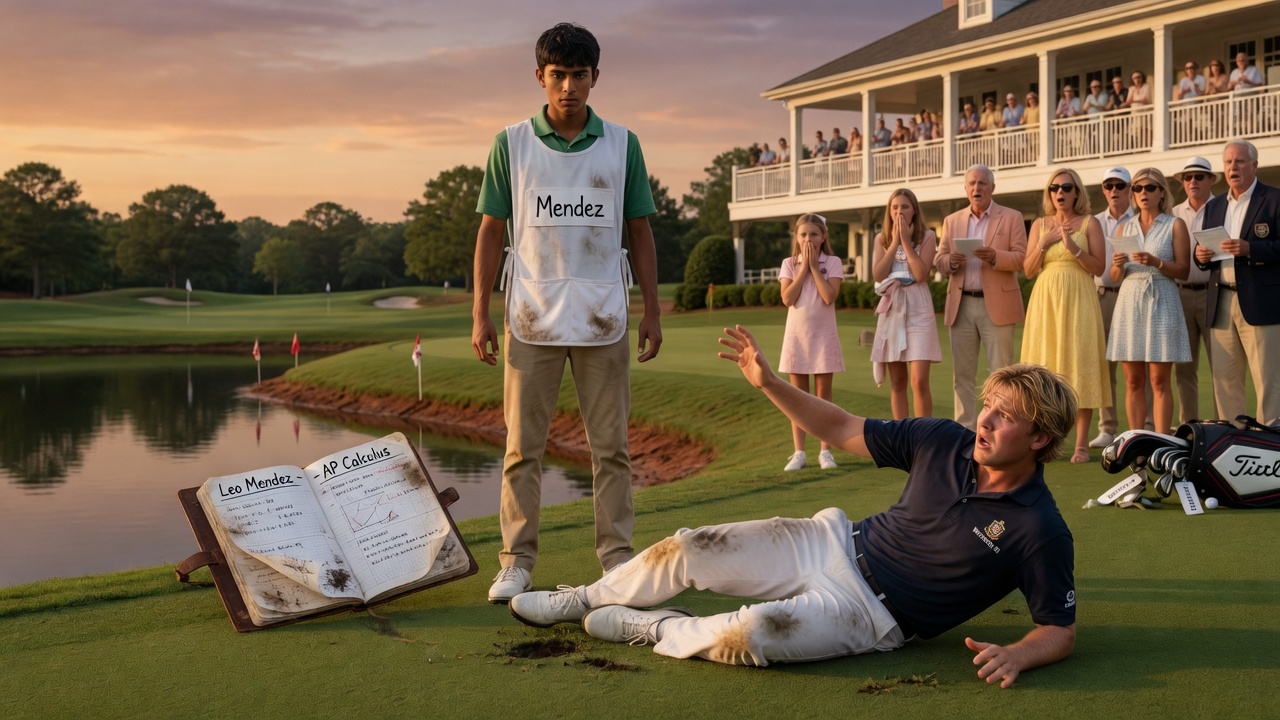
Leo looked at the mud-stained notebook in his hand. The leather was damp, the edges of the pages curling. “I didn’t go crazy. He stepped on my father’s book.”
“It doesn’t matter what he did!” Gus hissed, his frustration finally breaking through. “He’s a Whitmore. You’re a caddie. You just ended your life, kid. That scholarship? Gone. Your mother’s jobs? They’ll come for those next. Do you have any idea how much weight that family carries in this county?”
“I know exactly how much they weigh,” Leo said, thinking of the way Sterling had felt when his air left him. “Not as much as they think.”
He turned and walked out the back door before Gus could respond. He didn’t head for the gate. He headed for the far end of the gravel lot, where a rusted black SUV sat under a weeping willow. It belonged to Mr. Henderson. The reclusive billionaire was leaning against the hood, a cigar unlit in the corner of his mouth. He was watching the clubhouse with a look of profound boredom.
“Nice sweep,” Henderson said as Leo approached. “Clean. Efficient. You didn’t over-rotate the hip, which is where most people mess up a knockdown.”
Leo stopped. “You saw it?”
“Hard not to. I was on the 17th green. You made more noise with that palm strike than Sterling’s made with his driver all season.” Henderson straightened up, his joints popping. “You’re in deep, kid. The Board is meeting in twenty minutes. They aren’t just going to fire you. They’re going to erase you.”
“I’m going home to see my mother,” Leo said, his voice finally cracking. The adrenaline was fading, replaced by a cold, hollow dread. “She can’t find out from the news.”
“She won’t,” Henderson said, tossing a set of keys into the air and catching them. “Because you’re not going home yet. You’re going to the basement of the pro shop. The accounting office. You’ve been in those books, haven’t you?”
Leo stiffened. He hadn’t told anyone. He’d found the errors months ago while doing extra chores for Gus—discrepancies in the irrigation contracts, “management fees” that didn’t go to management.
“I don’t know what you’re talking about,” Leo lied.
“Don’t bullshit a bullshitter, Mendez. I’ve seen the way you look at the ledger when Gus leaves it out. You’re a math genius. You see patterns where other people see noise.” Henderson opened the driver-side door. “The Whitmores have been bleeding this club dry for five years to cover their failing textile mills. If you want to keep your head out of a noose, you better have those numbers ready. Because in twenty minutes, they’re going to ask for your soul.”
The apartment was quiet when Leo finally arrived, though he knew the peace was an illusion. His mother, Elena, was in the kitchen, her back to him as she folded a mountain of laundry from her second job at the hotel. The television was on, the local news humming in the background.
“Leo? You’re early,” she said without turning. “Did the round finish fast?”
Leo stood in the doorway. He had tried to clean the mud off his clothes in the pro shop sink, but the stains remained—dark, jagged reminders of the 18th green.
“Mom,” he said.
She turned, a white towel in her hands. She saw his face first, then the ruined notebook he was clutching. Her eyes went wide. She knew that book. She knew what it represented.
“What happened? Are you hurt?” She dropped the towel and rushed to him, her hands hovering over his shoulders as if afraid he might shatter.
“I lost the job, Mom. And the scholarship.”
The silence that followed was heavier than the Georgia heat. Elena’s hands dropped. She looked at the floor, then back at him. “Why? Was it the boy? Sterling?”
“He stepped on Dad’s book. He told me to fetch it like a dog.” Leo’s voice was a whisper. “I told him to stop. He didn’t. He pushed me, Mom. I… I hit him.”
Elena let out a shaky breath, her hand flying to her mouth. “Oh, Leo. No. Not you. You were supposed to be the one who got away. You were supposed to be the one who didn’t fight.”
“I had to,” Leo said, his eyes burning. “If I let him do that, then everything Dad was, everything we’ve worked for… it wouldn’t mean anything. I’m not a dog.”
The phone on the counter began to vibrate. Then the landline. Then the chime of a text message on Leo’s own phone. It was happening. The video. The group chats. The Oakhaven social circle was a closed loop, and the “Prince” getting dropped was the biggest story in a decade.
Elena picked up the cell phone. She looked at the screen, her face draining of color. “It’s your aunt. She says… she says there’s a video. Leo, they’re calling you a thug. They’re saying you’re dangerous.”
“I’m going back there,” Leo said, his jaw tightening.
“No! You can’t go back there! They’ll have the police!”
“I have to go back, Mom. Mr. Henderson is waiting. He says I have a chance, but I have to face them.” Leo took her hands. They were calloused and thin from years of scrubbing other people’s floors. “I spent my whole life hiding so they wouldn’t notice us. But they noticed us anyway. They noticed us and they tried to crush us. I’m done hiding.”
He didn’t wait for her to argue. He grabbed his laptop, the one he’d bought with three summers of caddie tips, and headed back to the door. As he stepped out into the humid evening, he saw a black Mercedes parked across the street. A man in a suit was sitting inside, watching the apartment.
The Whitmores weren’t waiting for the morning. They were moving now.
Chapter 6: The Calculus of Justice
The Boardroom of the Oakhaven Country Club was a sanctuary of mahogany, leather, and old-money arrogance. A massive portrait of Sterling’s grandfather hung over the fireplace, looking down with cold, blue eyes that matched his grandson’s.
Leo sat at the end of the long table, feeling tiny in his cheap khakis and clean polo. Across from him sat the five members of the Board. Sterling’s father, Sterling Whitmore II, was at the center. He looked like a man who had spent his entire life expecting people to apologize for existing in his peripheral vision.
Sterling III was there, too, sitting in the corner with a bandage across his ribs and a look of pure, unadulterated hatred. He didn’t look like a prince anymore. He looked like a wounded animal.
“Mr. Mendez,” the Club President began, his voice dripping with forced civility. “We have reviewed the footage. We have heard the testimony of the members present. Your actions were not only a violation of the caddie code of conduct, but they were also a criminal assault. We have already moved to revoke your scholarship fund. We are currently debating whether to press formal charges.”
“He attacked me!” Sterling III burst out, his voice cracking. “I was just joking around, and he went psycho! Look at my chest! I can barely breathe!”
Leo didn’t look at him. He looked at the elder Whitmore. “Your son didn’t tell you the whole story, sir.”
“The ‘story’ is irrelevant,” Whitmore II snapped, slamming a hand on the table. “You laid hands on a member. You’re a charity case we allowed onto this property out of a misguided sense of community service. You are done. You’ll be lucky if you aren’t in a cell by midnight.”
“Is that so?”
The door at the back of the room swung open. Mr. Henderson walked in, carrying a stack of manila folders. He didn’t look like a billionaire; he looked like a man who had just finished gardening. He pulled out a chair next to Leo and sat down, uninvited.
“Henderson,” the President said, scowling. “This is a private disciplinary hearing. You have no standing here.”
“I have fifteen percent of the shares in this club, Arthur. That gives me standing to go to the bathroom in the middle of your speech if I feel like it,” Henderson said. He tossed a folder onto the center of the table. “But I’m not here for the boy. I’m here for the math.”
Whitmore II paled slightly. “What is this?”
“This is a forensic audit of the club’s capital improvement fund from 2022 to the present,” Henderson said, leaning back. “It’s fascinating stuff. It shows that Oakhaven paid four hundred thousand dollars for a drainage system that was never installed. It shows that the ‘management fees’ for the Whitmore Textile Group increased by twenty percent every time the club’s membership dues went up.”
“This is slander!” Whitmore II stood up, his chair screeching against the floor.
“No, it’s calculus,” Leo said, his voice finding its strength. He opened his laptop and turned it toward the Board. “I’ve been cross-referencing the club’s public filings with the internal ledgers I found in the pro shop. The numbers don’t lie, Mr. Whitmore. You’ve been using the scholarship fund as a personal line of credit. You didn’t want me to get that scholarship because you’d already spent the money.”
The room went dead silent. The other Board members looked at Whitmore II, their expressions shifting from indignation to suspicion.
“You think anyone is going to believe a caddie over me?” Whitmore II hissed, though his eyes were darting toward the door.
“They won’t have to,” Henderson said. “I’ve already sent the digital copies to the District Attorney. And to the regional press. The headline isn’t going to be ‘Caddie Hits Rich Kid.’ It’s going to be ‘Local Icon Embezzles Millions from Neighbors.'”
Henderson looked at Leo and smiled. It was a predatory, satisfied smile. “Now, here’s how this is going to go. You’re going to drop the charges against Leo. You’re going to issue a public apology for the ‘misunderstanding’ on the 18th green. And you, Whitmore, are going to resign from this Board and pay back every cent you stole, plus interest.”
“And the scholarship?” Leo asked.
“The scholarship is dead,” Henderson said, turning back to the Board. “Because Oakhaven doesn’t deserve to have its name on this kid’s resume. Instead, the Henderson Foundation is going to cover Leo’s full tuition at MIT. Along with a living stipend for his mother.”
Sterling III stood up, his face twisted. “You can’t do this! He’s nothing! He’s just a—”
“He’s the kid who dropped you in front of your whole world, Sterling,” Henderson interrupted. “Sit down before you embarrass yourself further.”
Leo looked at the notebook on the table. It was still stained with mud, but the equations inside were as clear as ever. He realized then that the reversal hadn’t happened on the 18th green. It had happened years ago, when he decided that his mind was a weapon they couldn’t take away.
“We’re done here,” Leo said.
He stood up, closed his laptop, and picked up his notebook. He walked past the Whitmores without a second glance. He walked through the clubhouse, past the trophies and the portraits of men who thought they owned the world.
As he stepped out onto the veranda, the sun was setting over the 18th hole. He saw Sarah standing by the fountain. She looked at him, then at the notebook in his hand. She didn’t say anything, but she nodded—a small, solemn acknowledgement of a survivor.
Leo kept walking. He reached the maintenance gate and didn’t look back. He had a bus to catch, a mother to hug, and a future to build. The rough waters of Oakhaven were behind him, and for the first time in his life, the horizon looked perfectly, mathematically clear.