Chapter 5
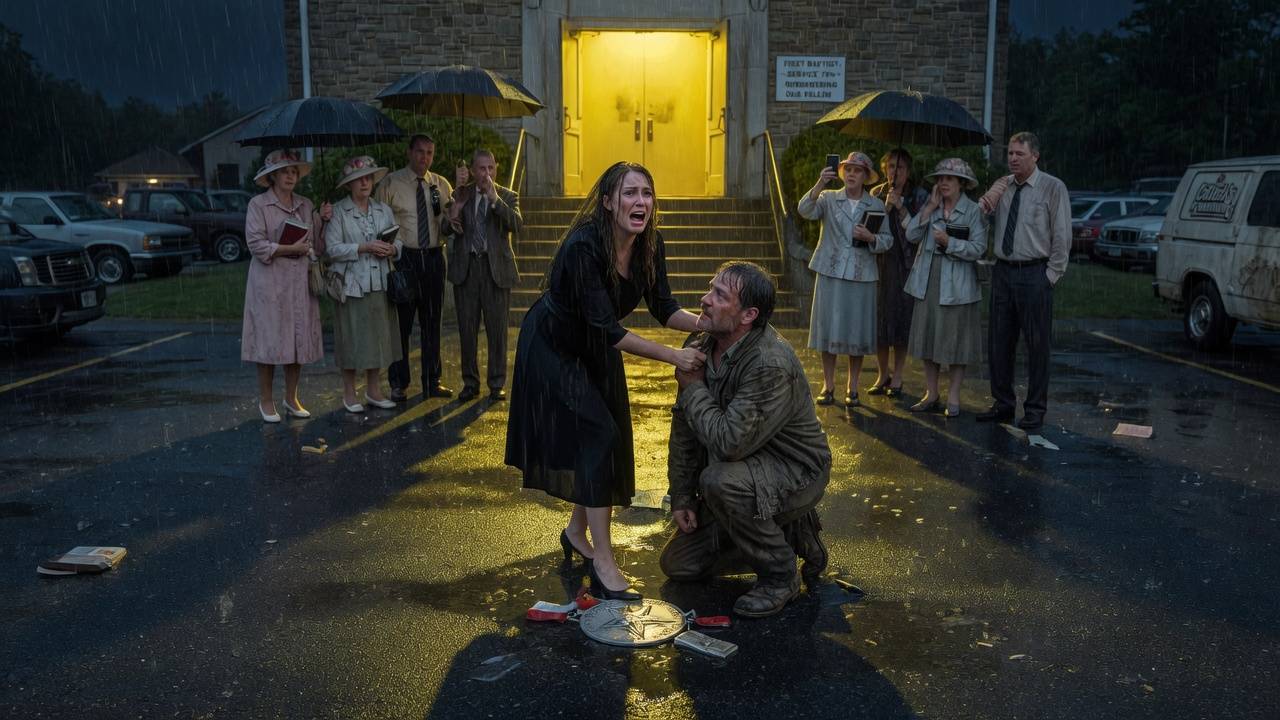
The aftermath of the church parking lot didn’t feel like a victory. It felt like a dam breaking, and Caleb was the one standing in the path of the flood.
He spent the night in his truck, parked on a logging road five miles outside Oakhaven. The rain hadn’t let up, a steady drumming on the roof that matched the pulsing in his hands. He hadn’t broken anything—his knuckles were bruised, the skin split across the palm of his left hand where he’d snapped Marcus’s arm away—but the adrenaline had left a bitter, metallic taste in his mouth. He looked at the letter in the passenger seat. It was damp, the ink of Miller’s confession beginning to bleed into the paper.
By 7:00 AM, the local Oakhaven Facebook group was a bonfire.
Caleb saw it when he stopped at a gas station for coffee. A grainy, ten-second video taken by one of the churchgoers had been uploaded three dozen times. It showed Marcus, the town’s golden-boy deputy, being dismantled in three seconds by the local “coward.” The comments were a war zone. Half the town was calling for Caleb’s head, demanding he be charged with assault on an officer. The other half—the quiet half that had grown tired of Marcus’s bullying and the Jenkins family’s untouchable status—was asking why a deputy had been putting his hands on a civilian in the first place.
When Caleb pulled into his shop, the sheriff’s cruiser was already there. Sheriff Halloway was leaning against the hood, a man who had been in Oakhaven long enough to see the truth through the layers of gossip.
“You look like hell, Caleb,” Halloway said, not moving.
“I’ve been better, Sheriff.” Caleb didn’t get out of the truck. “You here to take me in?”
“Marcus wants your heart on a plate. He’s at the hospital claiming you’ve got ‘special forces training’ and that you lured him into an ambush.” Halloway spit a stream of tobacco juice into the gravel. “Problem is, three people already sent me the video. It doesn’t look like an ambush. It looks like a man who was pushed until he stopped being a man and started being a Marine again.”
“He stepped on the medal, Sheriff.”
“I saw. And I saw him grab you first.” Halloway sighed, looking toward the church steeple visible in the distance. “But Marcus is still a deputy. And Sarah Jenkins is still the town’s widow. You’ve upset the order of things, Caleb. I can hold the warrant off for twenty-four hours because of the provocation, but after that, I have to act. Marcus is pushing for a felony. If that sticks, you’re looking at real time.”
“I’m not running,” Caleb said.
“I know you aren’t. That’s the problem.” Halloway stepped toward the truck window. “There’s a lot of talk about that letter Marcus was trying to grab. Sarah is telling people it’s a stolen document. Private military correspondence. She’s adding ‘theft’ to the charges.”
Caleb’s grip tightened on the steering wheel. “It’s not stolen. It was given.”
“Then you better figure out what you’re doing with it. Because by tomorrow morning, Oakhaven is going to decide who you are once and for all. I’d hate to see a man like you go down for protecting a ghost that doesn’t deserve it.”
Halloway left, the dust from his cruiser settling on Caleb’s boots. Caleb went inside the shop and locked the door. He didn’t work on pipes. He sat on a plastic crate and stared at the letter.
The pressure was different now. It wasn’t the internal weight of guilt; it was the external weight of a town trying to crush him to keep its illusions intact. He thought about the rescue force—Father Mike had tried, but a priest’s word wasn’t enough to stop a deputy’s rage. He thought about Lily, the little girl who called him “uncle.” If he went to prison, the payments to the hospital would stop. If he stayed out by using the letter, her father’s memory would be destroyed.
The door to the shop rattled. Someone was pounding on it.
“Caleb! Open the damn door!”
It was Marcus. He wasn’t in uniform. He had a bandage across his nose and a sling on his right arm, but his face was twisted with a desperate, frantic energy. He wasn’t alone; two of his friends from the high school football days were behind him, looking for the retribution the law was moving too slowly to provide.
Caleb didn’t move. He watched them through the small, reinforced window.
“You think you’re tough because you caught me off guard?” Marcus screamed, his voice cracking. “You’re a dead man in this town! I’ll burn this shop down with you in it!”
Caleb stood up. He didn’t feel fear. He felt a strange, cold clarity. He realized that as long as he kept the secret, he was giving Marcus and Sarah the power to destroy him. He was facilitating the very bullying that had led to the parking lot.
He walked to the door and unlocked it.
The three men surged forward, but Caleb didn’t retreat. He stood in the frame, his presence like a wall. Marcus flinched—the memory of the push-kick was still fresh in his nervous system.
“You want the letter, Marcus?” Caleb asked, his voice low and steady. “You want to know what Miller wrote?”
“I don’t care about your lies!” Marcus spat. “I want you gone!”
“Then read it,” Caleb said, holding the paper out. “Read it right here. If you can read it and still tell me I’m the one who should be leaving, I’ll pack my truck and never come back. I won’t even fight the charges.”
Marcus hesitated. His friends looked at each other, the bravado slipping.
“Read it, Marcus,” Caleb repeated. “Or go home and wait for the Sheriff to see it. Because one way or another, the silence is over.”
Marcus reached out with his good hand and snatched the paper. He began to read, his eyes moving fast, then slowing down as he hit the middle of the page. The color drained from his face. His hand began to shake.
“No,” Marcus whispered. “No, he wouldn’t… Miller was a hero.”
“He was a man, Marcus. A man who made a mistake and was too scared to fix it.” Caleb stepped forward, forcing Marcus to look at him. “I’ve been paying Sarah’s bills for five years to make up for what Miller did. Not because I killed those people, but because he was my brother and I didn’t want his daughter to grow up knowing her father was a liar.”
Marcus looked at the men behind him, then back at the paper. He looked small. The uniform, the status, the bullying—it all looked like a costume that no longer fit.
“Sarah can’t see this,” Marcus said, his voice breaking. “If she sees this, she loses the pension. She loses everything. They’ll take the house, Caleb.”
“I know,” Caleb said. “That’s why I stayed quiet. But you’re making it real hard to keep the lights on for her while you’re trying to put me in the ground.”
Marcus folded the paper, his fingers fumbling. He looked at Caleb—really looked at him—and for the first time, there was no contempt. Only a crushing, overwhelming shame.
“What are you going to do?” Marcus asked.
“I’m going to go to the church,” Caleb said. “I’m going to talk to Sarah. And you’re going to stay out of my way.”
Chapter 6
The Oakhaven cemetery sat on a hill overlooking the valley, the headstones glowing gray under the overcast sky. It was quiet here, a finality that usually brought Caleb peace. Today, it felt like a courtroom.
Sarah Jenkins was sitting on the stone bench near Miller’s grave. She wasn’t crying. she was just staring at the grass, her shoulders slumped in a way that made her look twenty years older. Lily was playing a few yards away, picking dandelions and stacking them on the flat markers of strangers.
Caleb approached slowly. He didn’t want to startle her, but he didn’t want to hide anymore either.
“Sarah,” he said quietly.
She didn’t look up. “Marcus told me. He came to the house an hour ago. He didn’t show me the letter, but he told me enough.”
Caleb stopped five feet away. “I’m sorry it came to this.”
“Why?” she asked, finally looking at him. Her eyes were hollow. “Why did you let me treat you like that? Why did you let me hate you for five years?”
“Because Miller was my friend,” Caleb said. “And because Lily needed a hero. I figured I was already broken. What was one more crack?”
Sarah stood up, her legs wobbly. She walked over to the headstone—Miller Jenkins: A Devoted Husband and American Hero. She touched the cold marble with a trembling hand.
“He lied to me every time he called,” she whispered. “Every letter, every phone call… he told me he was doing great things. He told me he was saving people.”
“He was trying to, Sarah. He just got lost in the noise. It happens over there. The lines get blurred.”
“And the money? The hospital bills?” She looked at Caleb, a tear finally tracking through the makeup on her cheek. “I called the bank. They wouldn’t give me names, but they confirmed the transfers came from an account tied to your shop. You were working eighteen-hour days to pay for my daughter’s medicine while I was calling you a coward in the grocery store.”
Caleb looked at Lily, who was currently trying to balance a dandelion on her nose. “She’s a good kid, Sarah. She deserves the best care.”
“You should have told me,” Sarah said, her voice rising with a flash of the old anger, but it died quickly. “You should have let me be mad at him. Instead, you let me be a monster to you.”
“I wasn’t doing it for you, Sarah. I was doing it for Miller. And for me.” Caleb looked at his hands. “I needed to feel like I could fix something that stayed fixed.”
The silence between them stretched out, heavy with five years of resentment and the sudden, jarring arrival of the truth. It wasn’t a clean moment. There was no grand apology that could undo the things said in the church parking lot or the years of isolation Caleb had endured.
“What happens now?” Sarah asked. “The Sheriff… Marcus said he was going to try to fix the charges, but the video is out there. People know you fought a deputy.”
“I’ll deal with the Sheriff,” Caleb said. “But the letter… it’s yours. If you want to take it to the VA, if you want to set the record straight, that’s your choice. But you should know that if the truth comes out officially, the pension stops. The legacy stops.”
He reached into his pocket and pulled out the folded paper. He held it out to her.
Sarah looked at the letter like it was a live grenade. She reached out, her fingers brushing Caleb’s as she took it. She didn’t open it. She just held it against her chest.
“I’m moving,” she said. “My sister has a place in Richmond. I can’t stay here, Caleb. Not with everyone looking at me, waiting for me to be the ‘hero’s widow’ I’m not anymore.”
“Richmond is a good city,” Caleb said. “Good hospitals.”
“I want to pay you back. Every cent.”
“No. That money is spent. It did what it was supposed to do.” Caleb turned to walk away, but Sarah caught his sleeve.
“Wait.” She looked toward Lily. “Lily! Come here, baby.”
The little girl ran over, her face bright with the simple joy of a child who didn’t understand the ruins around her. She looked at Caleb and beamed.
“Hi, Uncle Caleb! Did you fix the pipes?”
Caleb felt a lump in his throat that no amount of stoicism could swallow. He knelt down so he was eye-level with her. “All fixed, Lily. Everything’s going to be just fine.”
Sarah looked at Caleb, then at her daughter. She didn’t say thank you. The word was too small, too inadequate for the debt she now realized she owed. Instead, she just nodded—a slow, somber acknowledgment of the man he was, rather than the ghost the town had made him.
Caleb walked back to his truck. He saw Marcus sitting in his own car at the edge of the cemetery, watching. Marcus didn’t get out. He just gave a short, sharp nod—a gesture of respect that carried the weight of a surrender.
As Caleb drove down the hill, he passed the church. Father Mike was outside, changing the sign on the lawn. It read: The Truth Shall Set You Free.
Caleb didn’t know if he felt free. He felt tired. He felt the ache in his ribs and the sting in his knuckles. But for the first time in five years, when he looked in the rearview mirror, he didn’t see a coward or a murderer. He just saw a man who had finally finished a very long, very difficult job.
He pulled into his shop and looked at the red paint on the door. He picked up the scrub brush. There was still a lot of work to do, but for the first time, he wasn’t doing it in the dark. The silence was over, and while the truth was loud and messy, it was finally holding the weight.