Chapter 5
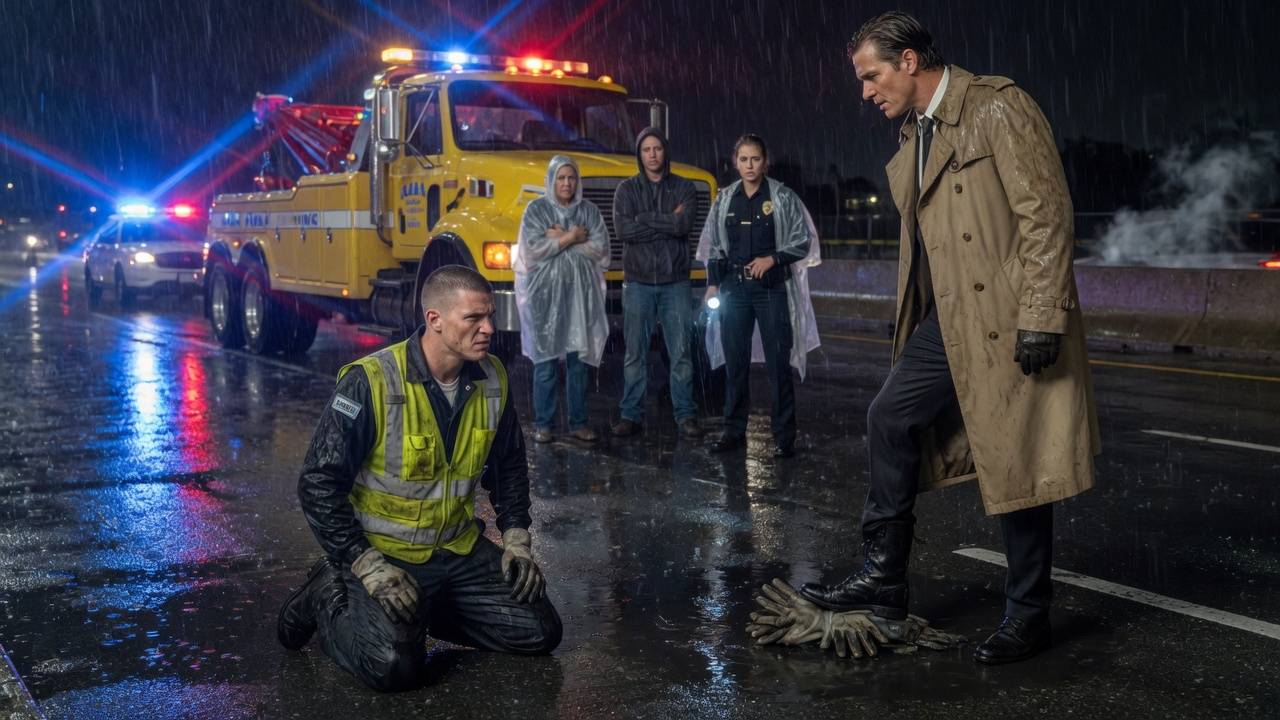
The silence that followed the roar of the highway was worse than the noise. Gabe stood over Donovan Duke, his breath hitching in his chest, the phantom fingers on his left hand screaming with a cold, electric fire. Donovan was still on the ground, his tan trench coat a ruin of mud and oil, his face contorted in a look of such pure, infantile shock that Gabe almost felt a flicker of pity. But then he looked at his own work glove, lying discarded in the muck, and the pity died a cold death.
“You’re dead, Lawson,” Martin Miller hissed. The lawyer hadn’t moved from under his umbrella, but his voice was a jagged blade. “You just assaulted the son of a United States Senator in front of twenty witnesses. You’re not going to the impound lot. You’re going back to the state penitentiary for the next decade.”
Gabe didn’t look at him. He looked at Officer Vance. She was standing frozen, her hand hovering over her radio, her eyes darting between Gabe and the girl being loaded into the ambulance. The blue and red strobes made her face look like a series of static images—fear, duty, indecision.
“Vance,” Gabe said, his voice sounding like it was coming from the bottom of a well. “Tell the Sergeant I’m taking the Honda. It’s an impound order for a felony hit-and-run.”
“Gabe, don’t,” Elias whispered, stepping into the light. The old tow driver looked like he’d aged twenty years in five minutes. “Just… leave it. Give them the card. Give them the card and maybe I can talk the Senator out of pressing charges. I’ll tell them you were in shock. I’ll tell them you’re having a breakdown.”
“I’m not having a breakdown, Elias,” Gabe said, turning toward his truck. “I’m having a moment of clarity.”
He climbed into the cab of the Peterbilt. The interior smelled of stale coffee and the pine-scented air freshener Sarah had hung from the mirror. He watched through the windshield as Miller helped Donovan up. Donovan was shaking, his designer shoes slipping on the wet road. He looked at Gabe’s truck, and for a second, the fear in his eyes was replaced by a simmering, poisonous rage. He said something to Miller, gesturing toward his phone, and the lawyer nodded, his face a mask of professional cruelty.
Gabe engaged the PTO. The hydraulic whine of the winch was the only sound in the night. He worked the levers with his right hand, his left tucked into the pocket of his jumpsuit, hiding the stump. He hooked the mangled Honda Civic with a practiced, mechanical efficiency that felt like the only thing keeping him tethered to reality. Every clank of the chain was a nail in the coffin of his future.
As he pulled the Honda onto the bed, a second patrol car screamed up the shoulder, followed by a black SUV with government plates. The Sergeant—a man named Halloway who Gabe knew had been on the Duke payroll since he was a deputy—stepped out. He didn’t even look at the wreck. He walked straight to Donovan.
“Mr. Duke,” Halloway said, his voice full of a practiced, subservient concern. “Are you alright?”
“He attacked me!” Donovan screamed, pointing a trembling finger at Gabe’s truck. “He’s a convict! Look at my face! He tried to kill me!”
Halloway turned toward Gabe. His hand went to his holster. “Lawson! Out of the truck! Now!”
Gabe felt the familiar, cold weight of the “violent offender” tag settling around his neck. He looked at Vance. She was standing by the ambulance, her jaw set. She stepped forward, her boots splashing in the puddles.
“Sergeant,” she said, her voice steadying. “Mr. Lawson was defending himself. Donovan Duke initiated physical contact. He grabbed Lawson and shoved him. I have it on my bodycam.”
Halloway’s head snapped toward her. The look he gave her was one of pure, unadulterated warning. “Vance, go check on the driver of the Ferrari. I’ll handle this.”
“The Ferrari is gone, Sergeant,” she said. “And I’m not leaving the scene of an assault I witnessed.”
“You’re a trainee, Vance,” Halloway growled, stepping closer to her. “If you want to make it through your probationary period, you’ll remember who signs your checks. Now go.”
Gabe watched the exchange through the glass. He could see the moment Vance’s career died. She looked at Gabe, then back at Halloway, and then she slowly turned and walked toward the ambulance. She didn’t look back.
Halloway turned to Gabe. “Last time, Lawson. Get out.”
Gabe didn’t get out. He put the truck in gear. “I have a legal impound order from Officer Vance, Sergeant. I’m completing my contract. If you want to arrest me for doing my job, you can do it at the station.”
He didn’t wait for an answer. He floored it. The Peterbilt roared, the heavy tires churning through the mud and oil, the mangled Honda Civic swaying on the bed. He drove past the strobe lights, past the gawkers with their phones, past the Senator’s son who was screaming into the rain.
He drove until the lights of the Grapevine were a dull, hazy glow in his mirrors. He drove until his hands stopped shaking.
He didn’t go to the impound lot. Not yet. He drove to a 24-hour diner three miles off the main road, parked the rig in the back of the lot where the shadows were deepest, and sat in the dark.
He pulled the SD card from his pocket. It was small, a sliver of plastic that held the power to destroy a dynasty or bury a man. He thought of Sarah, sleeping in their small apartment, her hand resting on the swell of her stomach. He thought of the nursery, the crib, the life they’d scraped together from the ruins of his service.
He was a violent offender. He was a grease monkey. He was a man with three missing fingers and a past that followed him like a shadow.
He reached into the glove box and pulled out a burner phone he kept for work. He dialed Sarah’s number, then stopped. He couldn’t tell her. Not yet. He couldn’t tell her that he’d just thrown a match into a lake of gasoline.
Instead, he dialed a number he’d memorized ten years ago. A number for a man named Miller—not the lawyer, but a man who had served with him in Iraq, a man who now worked as a private investigator in Los Angeles.
“Yeah?” the voice was gruff, sleepy.
“It’s Gabe,” he said.
There was a long pause. “Gabe Lawson? You haven’t called since the Bakersfield incident.”
“I need a copy made,” Gabe said, his voice steady. “And I need it kept in a vault. I have footage of a Senator’s son killing a girl in a hit-and-run.”
“Gabe, listen to me,” the voice said, suddenly sharp. “If you have that, you don’t need a copy. You need a hole to hide in. The Dukes don’t play fair.”
“I know,” Gabe said, looking at his work glove sitting on the passenger seat. “But I’m done playing by their rules.”
He hung up and looked out at the rain. It was four in the morning. The world was grey and cold, and the reckoning he’d started was only just beginning to wake up.
He made it home at six. The apartment was quiet, the only sound the low hum of the refrigerator. He stripped off his soaked jumpsuit in the entryway, the heavy fabric hitting the floor with a wet thud. He stood in his boxers in the dim light of the kitchen, his body aching, the phantom itch in his hand more persistent than ever.
He walked into the bedroom. Sarah was asleep, her hair a messy halo on the pillow. He sat on the edge of the bed, the mattress creaking. She stirred, her eyes fluttering open.
“Gabe?” she whispered, reaching out for him. “You’re home late.”
“Yeah,” he said, taking her hand. “Long night.”
She sat up, her eyes narrowing as she looked at his face. He had a small cut on his cheek from when Donovan had grabbed him, a thin red line that stood out against his pale skin.
“What happened?” she asked, her voice rising with a sudden, sharp edge of panic. “Gabe, what happened to your face?”
“It’s nothing,” he said, but he couldn’t look her in the eye. “Just a scuffle at the scene. One of the drivers was being difficult.”
“A scuffle?” She grabbed his arm, her fingers digging into his skin. “Gabe, you’re on parole. You can’t be having scuffles. Who was it?”
He hesitated. He wanted to lie. He wanted to tell her it was some drunk at a bar, some nobody who didn’t matter. But he saw the way she looked at him—with a mixture of love and a fear so deep it broke his heart.
“Donovan Duke,” he said.
The name hit the room like a physical blow. Sarah went pale, her hand dropping from his arm. “The Senator’s son? Gabe, no. Tell me you didn’t.”
“He hit a girl, Sarah. He almost killed her. And then he tried to bribe me to cover it up. He stepped on my glove. He called me… he called me trash.”
“So you hit him?” she whispered, tears welling in her eyes. “You hit the son of the most powerful man in the county? Gabe, we have a baby coming. We have a life. Why can’t you just… why can’t you just let it go?”
“Because he wouldn’t let me!” Gabe shouted, the frustration finally boiling over. He stood up, pacing the small room. “He wouldn’t let me just be a man. He had to make me a servant. He had to make me a ghost. I’m tired of being a ghost, Sarah. I’m tired of people looking at this hand and thinking I’m broken.”
“You are broken, Gabe!” she cried, the tears finally falling. “We’re both broken! But we were fixing it! We were building something! And now you’ve thrown it all away for what? Pride?”
“For the truth,” he said, but it sounded hollow even to him.
He walked back to the kitchen and sat at the table. He could hear her crying in the bedroom, a low, rhythmic sound that matched the beat of the rain against the window. He felt a wave of shame so heavy it threatened to pull him under. He had done the right thing, hadn’t he? He had protected the girl. He had stood his ground.
But as he looked at the burner phone sitting on the table, he realized that in the world of the Dukes, the right thing was often the most dangerous thing you could do.
The sun began to rise, a pale, sickly light that filtered through the smog. The morning news came on the small TV in the corner. He didn’t turn it on, but he could imagine the headlines. Convicted Felon Attacks Senator’s Son. Tragic Accident Twisted by Violent Mechanic.
He was already losing. Before the first punch had even landed in the court of public opinion, he was already the villain.
He heard a knock at the door. It wasn’t the police. It was too soft for that. He walked to the door and looked through the peephole.
It was Elias.
Gabe opened the door. The old man looked like he hadn’t slept at all. He was still wearing his reflective vest, the neon yellow glaring in the morning light.
“Gabe,” he said, stepping inside. “I’m sorry.”
“For what?” Gabe asked, though he already knew.
“The shop,” Elias said, looking at his boots. “The Senator’s office called. They said if I didn’t fire you, they’d pull the city contract. They said they’d have the insurance board audit my books. I have three other drivers, Gabe. I have a mortgage.”
Gabe felt the final thread snap. He nodded slowly. “I understand.”
“I’ll pay you out for the week,” Elias said, reaching into his pocket and pulling out an envelope. “And Gabe… the police are coming. Halloway is looking for that SD card. He says if you hand it over now, they might be able to talk the DA into a misdemeanor assault charge. No jail time.”
Gabe looked at the envelope. It was thin, a few hundred dollars. The price of his silence. The price of his future.
“Tell Halloway I don’t have the card,” Gabe said, his voice cold. “Tell him I lost it in the rain.”
Elias looked at him for a long moment, a flash of something like respect—or maybe just pity—in his eyes. “You’re a good man, Gabe Lawson. But in this town, that’s just another way of saying you’re a dead man.”
He turned and walked away, leaving the door open. Gabe stood in the doorway, the envelope in his hand, watching the old man disappear into the grey morning. He felt a sudden, sharp kick in his gut—not from a bully, but from his own child, moving in Sarah’s womb.
He closed the door and locked it. The reckoning was here. And for the first time in his life, he wasn’t afraid of the fight. He was afraid of winning.
Chapter 6
The arrest happened at noon.
They didn’t come with sirens. They came with four black-and-whites and a tactical team that acted like they were raiding a cartel stash house. Gabe was sitting at the kitchen table, watching the viral video of the highway fight on his laptop. Some kid had uploaded it with the title “THREE-FINGERED FREAK ATTACKS BILLIONAIRE’S SON.” The comments were a sewer of class-based hatred and armchair legal expertise.
“Gabe Lawson!” Halloway’s voice boomed through a megaphone from the street. “Come out with your hands up!”
Gabe looked at Sarah. She was standing by the window, her face a mask of frozen terror. She didn’t scream. She didn’t cry. She just looked at him, and in her eyes, he saw the death of every dream they’d ever had.
“I have to go,” he whispered.
“I know,” she said, her voice barely audible.
He walked out onto the porch. The sun was out now, a blinding, white heat that reflected off the hoods of the police cars. He saw Halloway standing behind the door of his cruiser, his weapon drawn. He saw the neighbors peeking through their blinds, their faces full of a fearful curiosity.
“On your knees!” Halloway screamed.
Gabe knelt. He felt the hot asphalt through the knees of his jeans. He felt the cold steel of the handcuffs biting into his wrists. He felt the weight of the Sergeant’s knee in his back as he was pressed into the ground.
“Where’s the card, Gabe?” Halloway hissed into his ear.
“Go to hell,” Gabe gasped.
They didn’t take him to the local station. They took him to a regional holding facility three towns over, a place where the Dukes had even more influence. He was processed in silence, his mugshot taken with the same cold indifference as the thousands of other men who had passed through these halls.
He was put in a cell with two other men—a tired-looking drug dealer and a kid who looked like he’d been crying for days. Gabe sat on the thin mattress, his back against the cold concrete wall. He closed his eyes and tried to remember the smell of the rain on the highway. He tried to remember the weight of the winch remote in his hand.
Hours passed. Or maybe it was days. The time in a cell was like water in a leaking bucket—meaningless and impossible to hold onto.
Then, the door opened.
“Lawson. You have a visitor.”
Gabe expected Sarah. He expected Miller. He even expected the Senator himself, coming to gloat.
It was Officer Vance.
She wasn’t in uniform. She was wearing a plain grey hoodie and jeans, her hair pulled back in a tight ponytail. She looked exhausted, her eyes rimmed with red.
“They fired me,” she said, sitting across from him in the glass-walled visiting room. “Halloway said I was ‘unfit for duty.’ He said my report was ‘inconsistent with the physical evidence.’”
“I’m sorry,” Gabe said, his voice cracking.
“Don’t be,” she said, leaning in close to the glass. “I did what I had to do. And I did one more thing.”
She reached into her pocket and pulled out a small, silver thumb drive. “The girl in the Honda? Her name is Mia. She’s awake. And she’s talking.”
Gabe felt a surge of hope, a sharp, electric shock that made his heart race. “What did she say?”
“She said Donovan was racing. She said he’s been harassing her for weeks because she wouldn’t go out with him. This wasn’t an accident, Gabe. It was a targeted attack. He’d been stalking her.”
Gabe gripped the edge of the table. “Can she prove it?”
“She has the texts. She has the voicemails. But the Dukes are already at the hospital. They’re offering her parents a million dollars to move her to a private clinic in Switzerland. They want her gone, Gabe. And they want you in prison.”
“I have the footage,” Gabe whispered.
“I know,” Vance said. “And I know where you hid the copy. Miller told me.”
Gabe looked at her, a sudden flash of suspicion. “Why are you doing this, Vance? You’ve already lost your job. You could lose everything else.”
She looked at him, and for a second, the rookie cop was gone. In her place was a woman who had seen the gears of the world and decided she didn’t like the way they turned.
“Because my father was a cop,” she said. “A real one. And he told me that the only thing worse than a criminal is a man who uses the law to hide his crimes. I’m not letting them bury you, Gabe.”
She stood up. “The hearing is tomorrow morning. Be ready.”
The courtroom was packed. The air was thick with the scent of expensive perfume and the low, rhythmic murmur of the press. Donovan Duke sat at the prosecution table, looking every bit the victim in a navy blue suit and a neck brace that looked suspiciously new. His father, the Senator, sat in the front row, his face a mask of stoic, silver-haired authority.
Gabe sat at the defense table next to a court-appointed lawyer who looked like he’d rather be anywhere else. He was wearing his orange jumpsuit, the cuffs on his wrists a constant, cold reminder of where he stood in the room.
“All rise,” the bailiff droned.
The judge was a man named Thorne, a man whose career had been funded by the Duke family for twenty years. He looked at Gabe with a mixture of boredom and contempt.
“Mr. Lawson,” Thorne said, looking over his spectacles. “You are charged with felony assault, reckless endangerment, and tampering with evidence. Given your prior record, the prosecution is seeking a sentence of fifteen years. How do you plead?”
“Not guilty,” Gabe’s lawyer said, his voice flat.
The prosecution began their opening statement. It was a masterpiece of character assassination. They talked about Gabe’s “violent past.” They talked about his “mangled hand” as if it were a sign of moral decay. They showed the viral video—not the whole thing, but the three seconds where Gabe’s foot connected with Donovan’s chest. They made it look like a brutal, unprovoked attack by a man who had lost his mind.
Donovan took the stand. He played his part perfectly. He cried. He talked about his “fear for his life.” He talked about the “trauma” of being attacked by a man he was “only trying to help.”
Then, it was Gabe’s turn.
He stood up. He didn’t look at the judge. He didn’t look at the press. He looked at the Senator.
“I have a statement,” Gabe said.
“Mr. Lawson, your lawyer will—” Thorne started.
“No,” Gabe said, his voice booming through the room. “I want to say this. I’ve spent my life fixing things. I’ve fixed tanks in the desert. I’ve fixed cars on the side of the road. I’ve tried to fix my own life. But the one thing I can’t fix is a lie.”
He reached into his pocket. The bailiff stepped forward, his hand on his holster, but Gabe didn’t pull out a weapon. He pulled out a small, wrinkled piece of paper.
“This is a receipt,” Gabe said. “From a diner three miles from the Grapevine. It’s dated 4:15 AM on the night of the accident. And it’s signed by a man named Martin Miller.”
The room went silent. Miller, sitting at the prosecution table, went pale.
“Mr. Miller wasn’t at the diner to eat,” Gabe continued. “He was there to meet me. He offered me fifty thousand dollars to hand over the dashcam footage of Donovan Duke racing that girl. He told me that if I didn’t take the money, I’d never see my child born.”
“Objection!” the prosecutor screamed. “This is hearsay! This is unsubstantiated!”
“It’s not unsubstantiated,” a voice called out from the back of the room.
Officer Vance walked through the double doors. She was holding a stack of folders. Behind her, a woman in a wheelchair was being pushed by a man who looked like he hadn’t slept in weeks.
It was Mia.
The courtroom exploded. The press surged forward, cameras flashing like a summer storm. The Senator stood up, his face turning a deep, bruised purple.
“Sit down!” Thorne screamed, banging his gavel. “Order! I will have order!”
But the order was gone. Mia was speaking now, her voice thin but clear through the microphone Vance held for her. She told the room about the stalking. She told the room about the race. She told the room how Donovan had laughed as he hit her.
And then, Vance held up the thumb drive.
“This is the full footage,” she said. “Including the audio. Including the moment Donovan Duke stepped on Gabe Lawson’s glove and told him that his life didn’t matter because he was just a ‘grease monkey.’”
The video began to play on the large monitors in the courtroom. It wasn’t the edited version. It was the raw, brutal truth. The room watched as Donovan humiliated Gabe. They watched as Gabe warned him. They watched the 3-beat combo that had sent the Senator’s son to the ground.
But they also saw what happened after. They saw Halloway arrive and ignore the victim. They saw Miller offer the bribe. They saw the systemic, calculated cruelty of a family that thought the world was their playground.
The silence that followed the video was different from the silence on the highway. This was the silence of a tomb.
Judge Thorne looked at the Senator. He looked at the press. He looked at Gabe. He knew that even he couldn’t bury this. Not now. Not with the whole world watching.
“Charges against Gabriel Lawson are dismissed,” Thorne said, his voice sounding like it was being squeezed out of a vise. “The court will take a recess to consider the evidence against Donovan Duke.”
Gabe didn’t wait for the recess. He walked out of the courtroom, the bailiff barely having time to unlock his cuffs. He walked past the Senator, who was staring at the floor. He walked past Donovan, who was sobbing into his hands.
He walked out into the sunlight.
Sarah was waiting for him on the steps. She didn’t say anything. She just ran to him, her arms wrapping around his neck, her face buried in his chest. He held her with his right hand, and for the first time, he didn’t hide his left. He rested his stump on her shoulder, the three missing fingers a badge of a different kind of service.
“Is it over?” she whispered.
“No,” Gabe said, looking out at the city. “But it’s a start.”
He wasn’t a hero. He was still a man with a record. He was still a man without a job. He was still a man who would wake up every morning with a phantom itch in his hand.
But as he walked down the steps, he felt the weight of the nursery crib—not the one Elias had offered to buy, but the one he would build himself, with his own hands, however many fingers they had left.
The road ahead was long, and the Dukes would surely try to strike back from the shadows. But for now, the rain had stopped. The sun was out. And the three-fingered grease monkey was going home.
He looked at his hand one last time before tucking it into his pocket. It wasn’t broken. It was just different. And like the life he was about to build, it was enough.