Chapter 5
The silence in the elevator on the way down from the 80th floor was heavy enough to make Bennett’s ears pop. He stood in the center of the car, his breathing finally beginning to level out. He could still feel the vibration of the impact in his palm, the solid resistance of Thorne’s sternum when he’d driven the billionaire back. It was a sensation he hadn’t felt in years—the focused, surgical application of violence.
The two guards who had escorted him down stood at the back of the car. They weren’t filming anymore. They weren’t laughing. They kept their eyes on the floor, their postures stiff and wary. They had seen the man behind the jumpsuit, and they didn’t know what to do with the information.
When the doors opened in the lobby, Bennett walked straight to the locker room. He didn’t wait for Miller to ask questions. He didn’t wait for HR to hand him a pink slip. He grabbed his bag, stuffed his bent silver wings into his pocket, and walked out the front door into the humid chaos of Midtown.
He was halfway to the subway when his phone began to vibrate. He pulled it out, expecting a call from Thorne’s lawyers or perhaps the police.
Instead, it was a link to a video.
The title was “Billionaire vs. Window Washer: 80 Floors Up.”
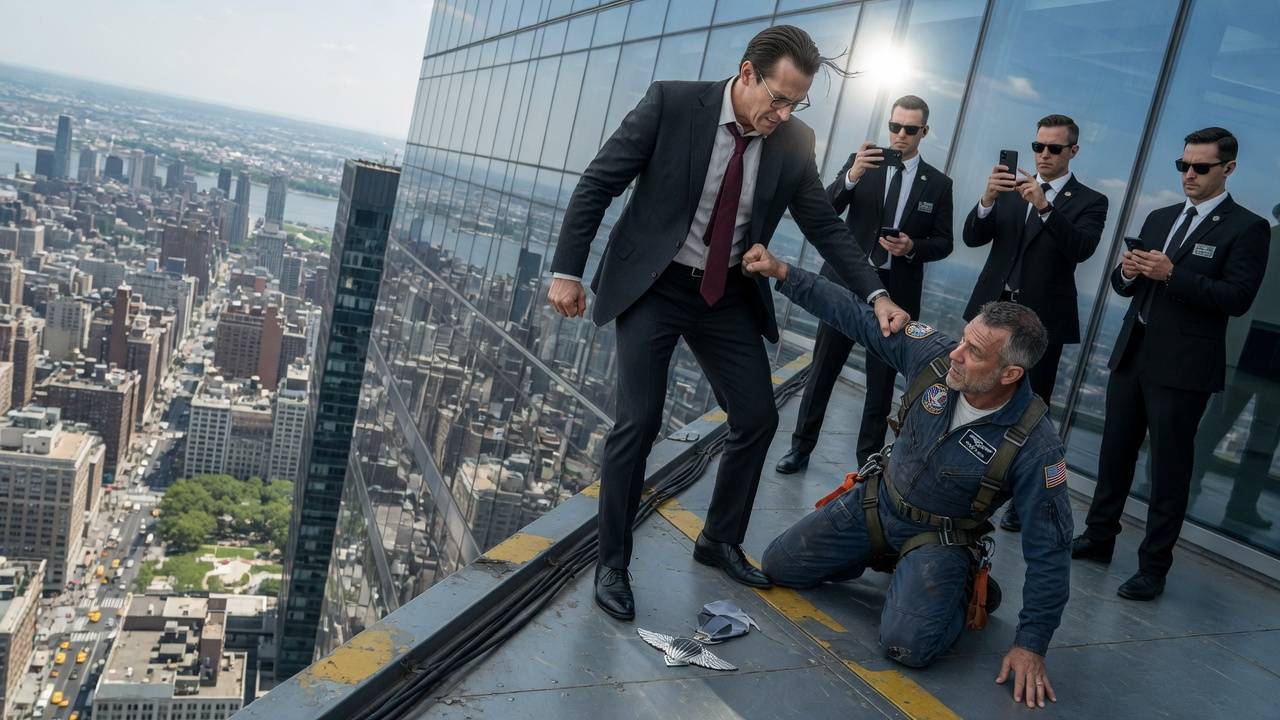
One of the guards had already posted it. It was raw, shaky footage, but the resolution was high enough to capture every second of Thorne’s humiliation. It showed Thorne’s polished shoe on the medal. It showed the sneer on his face. And then, it showed the blur of Bennett’s movement—the clinical efficiency of the counter-attack that had left the most powerful man in the city begging on the cold steel.
By the time Bennett reached his apartment in Queens, the video had three million views.
He sat on his couch, the silver wings resting on the coffee table in front of him. His hand was still trembling, but not from fear. It was the adrenaline withdrawal, the slow realization that he had just burned his entire life to the ground.
There was a knock on the door. Not a polite knock—a series of heavy, rhythmic thuds that suggested authority.
Bennett didn’t reach for a weapon. He didn’t have any left. He just walked to the door and opened it.
Sarah Vance was standing in the hallway. She looked different in her detective’s blazer than she had in her ACUs, but her eyes were the same—sharp, tired, and deeply cynical.
“Nice footwork, Bennett,” she said, nodding toward the phone in her hand. “But you always did have a problem with authority.”
“He killed a man, Sarah,” Bennett said, stepping aside to let her in. “In that office. I saw it through the glass.”
Sarah walked into the small living room and picked up the silver wings. She ran her thumb over the bent metal. “I know. We’ve been looking for that ‘man’ for three days. A corporate whistleblower named Julian Hess. He vanished after a meeting with Thorne. We had no proof. No witness.”
“You have one now,” Bennett said.
“No,” Sarah said, turning to face him. “I have a viral video of a window washer assaulting a billionaire. Thorne’s lawyers are already at the 19th Precinct. They’re filing charges for assault, attempted murder, and corporate espionage. They’re claiming the whole thing was a setup to tank Thorne’s stock.”
“They have the GoPro,” Bennett said. “I left it in the gear bag.”
Sarah shook her head. “Thorne’s head of security handed over the bag two hours ago. The camera was inside. The SD card was missing.”
Bennett felt a cold pit open in his stomach. He’d known Thorne would play dirty, but he hadn’t expected the speed of the counter-move. He’d won the fight on the ledge, but he was losing the war.
“What about the guards?” Bennett asked. “They saw it.”
“The guards work for Thorne,” Sarah said. “They’re already signing statements saying you attacked him unprovoked. That you tried to throw him over the edge.”
She looked around the room—at the photos of Leo, at the humble life Bennett had built out of the wreckage of his service. “They’re going to bury you, Ben. Unless we find that body. And we need to find it tonight, before Thorne’s ‘cleanup crew’ finishes the job.”
“I know where they took him,” Bennett said. “They brought in a rug. They didn’t take him out through the lobby. There’s a private freight elevator that goes to the sub-basement parking.”
“Thorne owns the parking garage, Ben. We can’t get a warrant on ‘I saw a rug’ through a tinted window.”
“Then don’t get a warrant,” Bennett said. He picked up the silver wings and tucked them into his pocket. “I’m already a criminal, remember? Attempted murder. Assault. I might as well add breaking and entering to the list.”
“You’re not going back there,” Sarah said, her voice dropping an octave. “Thorne’s turned that building into a fortress. He knows you’re coming.”
“He thinks I’m coming for him,” Bennett said. “He’s wrong. I’m coming for the truth. And Thorne is too arrogant to realize that for a paratrooper, the hardest part isn’t getting in. It’s getting out.”
Bennett walked to the closet and pulled out his old rucksack. It was dusty, smelling of canvas and old deployments. Inside was a coil of high-tensile nylon rope, a pair of tactical gloves, and the GoPro he’d kept as a backup.
“Stay out of my way, Sarah,” he said, not looking back. “If I find him, I’ll call. If I don’t… make sure Leo gets my pension.”
He didn’t wait for her to agree. He walked out of the apartment, the ghost of the 80th floor already calling him back.
The night was heavy with rain by the time Bennett reached Thorne Plaza. The building looked different in the dark—a jagged, black tooth biting into the clouds. The lobby was swarming with police and private security, but Bennett wasn’t looking at the lobby.
He was looking at the service entrance three blocks away.
He moved through the shadows with the practiced ease of a man who had spent his youth in the dark. He knew the building’s rhythms. He knew the blind spots of the cameras. And most importantly, he knew that the penthouse wasn’t the only place Thorne hid his secrets.
He found the access hatch for the ventilation system in the alley. It was a tight squeeze, the metal cold and smelling of grease. He hauled himself up, his injured hip screaming at the effort. Every movement was a struggle, a battle against the gravity that had once tried to kill him.
He crawled through the ducts for what felt like miles, the sound of his own breathing echoing in the narrow space. He reached the junction above the sub-basement.
Below him, through the grate, he saw the freight elevator.
Two men were standing by a black SUV. They were the same guards from the ledge. They weren’t filming now. They were loading a heavy, plastic-wrapped bundle into the back of the vehicle.
The rug.
Bennett felt a surge of cold fury. He reached for his phone to call Sarah, but then he saw the man step out of the shadows.
It wasn’t Thorne. It was Miller.
The floor manager looked pale, his hands shaking as he directed the guards. “Hurry up,” he hissed. “The police are already asking about the freight logs. We need to get this to the incinerator before dawn.”
Bennett froze. Miller. The man who had given him the job. The man who had been his only friend in the city. He’d been on the payroll the whole time.
He pulled out the backup GoPro and hit record. He didn’t need a confession. He just needed the body.
He shifted his weight to get a better angle, but his hip gave out. His boot kicked the side of the duct—a sharp, metallic clang that echoed through the silent garage.
Below him, the guards froze. They looked up.
“In the vents!” one of them shouted.
Bennett didn’t wait for them to start shooting. He kicked the grate open and dropped.
He hit the concrete hard, the impact jarring his spine. He didn’t roll; he came up swinging. The first guard lunged at him with a baton, but Bennett was already inside his guard. He snapped the man’s wrist, pivoted, and drove a knee into his ribs.
The second guard pulled a weapon, but Bennett didn’t give him the chance to aim. He grabbed a heavy metal fire extinguisher from the wall and hurled it. The canister caught the guard in the chest, sending him sprawling.
Bennett turned to Miller. The manager was cowering behind the SUV, his eyes wide with terror.
“Ben, listen,” Miller stammered. “I didn’t have a choice. Thorne… he has my daughter’s student loans. He has my pension. He’ll kill me if I don’t help.”
“He’s already killed you, Miller,” Bennett said, his voice like ice. “You just haven’t realized it yet.”
Bennett walked to the back of the SUV and pulled back the plastic.
Julian Hess’s face was blue, his eyes staring at nothing. The crystal spire wound was visible on his temple.
Bennett looked at the GoPro in his hand. He had the proof. He had the body.
But then, the garage doors began to slide shut.
Alistair Thorne stepped out of the elevator, a sleek, black handgun in his hand. He wasn’t smiling anymore. He looked tired. He looked like a man who was out of options.
“You really are a persistent bug, Bennett,” Thorne said, raising the weapon. “But this is where the cleaning stops.”
Bennett looked at the closing doors. He looked at Thorne. He knew he couldn’t outrun a bullet. But he also knew something Thorne didn’t.
He knew the building.
“You think you own this place, Alistair,” Bennett said, stepping back toward the service elevator. “But you only own the deeds. I own the bones.”
Bennett slammed his fist into the emergency fire alarm. The garage was instantly filled with the deafening roar of sirens and the hiss of the overhead sprinkler system.
In the chaos, Bennett dived for the elevator.
He hit the button for the 80th floor.
Chapter 6
The ride up felt like an eternity. The elevator was filled with the smell of wet wool and the rhythmic ticking of the floor counter. 8… 15… 32…
Bennett leaned against the wall, his chest heaving. He was bleeding from a cut on his forehead, and his hip felt like it was being held together by rusted wire. He looked at the GoPro in his hand. The light was still red. Still recording.
He knew Thorne was coming for him. He knew the guards would be waiting at the top. But he also knew that the only way to win this fight wasn’t on the ground. It was in the sky.
The doors opened on the 80th floor.
The office was empty, bathed in the flickering orange light of the emergency strobes. The silence was absolute, broken only by the distant wail of sirens from the street below.
Bennett walked to the window. He looked out at the city. The rain was coming down in sheets now, blurring the lights of Broadway into a smeared, neon mess.
“I knew you’d come back here,” Thorne’s voice echoed from the doorway.
The billionaire was standing there, his suit ruined by the sprinklers, his silver hair plastered to his forehead. He looked human for the first time—small, desperate, and dangerous.
“The ledge,” Thorne said, walking into the room. “The scene of your greatest triumph. You wanted to finish it where it started, didn’t you? Very poetic.”
“I wanted you to see the view one last time,” Bennett said. He didn’t turn around. He just watched Thorne’s reflection in the glass.
“You have the camera,” Thorne said, gesturing to the GoPro. “Give it to me, and I’ll make sure your son is taken care of. A full scholarship. A job at the firm. A life he doesn’t have to scrape for.”
“My son doesn’t want your money, Alistair. He wants a father who can look him in the eye.”
“A father who’s in prison?” Thorne laughed. “Because that’s where you’re going, Bennett. My lawyers will turn that footage into a work of fiction before the sun comes up. You’re a disgruntled employee with a history of mental instability. Who do you think they’ll believe?”
“It’s not about who they believe,” Bennett said.
He turned around. In his hand, he wasn’t holding the GoPro. He was holding his silver jump wings.
“It’s about what they see.”
Bennett walked toward the side door—the door to the maintenance ledge.
“What are you doing?” Thorne asked, his hand tightening on the gun.
“Opening the window,” Bennett said.
He threw the door open. The wind slammed into the room, a violent, invisible hand that sent Thorne’s papers flying. The rain hissed against the carpet.
Bennett stepped out onto the ledge.
He wasn’t afraid. For the first time since the night in Kandahar, the height didn’t feel like an enemy. It felt like an old friend.
“Come out here, Alistair,” Bennett called over the roar of the wind. “Come out and finish it. Or are you afraid of the drop?”
Thorne’s face twisted. His pride, his absolute need to be the predator, overrode his common sense. He stepped out onto the ledge, the gun aimed at Bennett’s heart.
“You think this changes anything?” Thorne shouted. “One bullet, and you’re just another statistic.”
“You’re right,” Bennett said. “But look up.”
Thorne hesitated. He looked up.
High above them, silhouetted against the dark clouds, was a black shape. A helicopter.
But it wasn’t a news chopper. It was a police bird.
And Bennett wasn’t just standing there. He had his phone held high, the screen glowing. He had been broadcasting the entire encounter live on the same viral link the guards had used to humiliate him.
The three million viewers weren’t just watching a fight anymore. They were watching a murder confession.
“Sarah was right,” Bennett said, his voice calm despite the gale. “You do have friends in the precincts. But you don’t have friends on the internet. And you definitely don’t have friends in the sky.”
Thorne looked at the helicopter. He looked at the phone. The realization hit him like a physical blow. He lunged forward, the gun raised, but the wind caught him.
His polished shoes, the same ones that had crushed Bennett’s wings, slipped on the wet steel.
Thorne’s arms windmilled. He dropped the gun, the weapon vanishing into the abyss. He grabbed for the railing, but his fingers were slick with rain.
He began to slide.
“Bennett! Help me!” Thorne screamed, his voice cracking with a terror that no amount of money could silence.
Bennett didn’t move. He stood there, rooted to the ledge, his eyes fixed on the man who had tried to break him.
He reached out his hand.
Thorne’s fingers brushed against his. For a second, their eyes met—the billionaire and the window washer, the master and the bug.
Bennett’s grip tightened. He pulled Thorne back from the edge, hauling him onto the solid steel of the maintenance platform.
Thorne collapsed, gasping, his face buried in the wet metal. He was sobbing, a broken, pathetic sound that was drowned out by the roar of the helicopter overhead.
The police breached the office a minute later. Sarah Vance was the first one through the door, her weapon drawn.
She saw Thorne on the ground. She saw Bennett standing by the railing, his face turned toward the rain.
“Is it over?” she asked, her voice tight.
Bennett didn’t answer at first. He reached into his pocket and pulled out the silver wings. He looked at the bent metal, the scars of the struggle. They were ruined, but they were still his.
“Yeah,” he said, finally turning to face her. “The glass is clean.”
The aftermath was a whirlwind of lawyers, depositions, and news cameras. But for Bennett, it was surprisingly quiet.
He lost his job, of course. Thorne’s empire crumbled, but the building was tied up in litigation for years. It didn’t matter. Bennett didn’t want to clean windows anymore.
He moved back to a small town in upstate New York, near the jump zones where he’d first learned to fly. He opened a small shop, fixing things that people thought were broken beyond repair.
A month after the trial, a package arrived at his door.
Inside was a small velvet box. No note. Just a new pair of silver paratrooper wings. They were pristine, the metal gleaming in the morning sun.
Bennett took them to the local airfield. He watched the young soldiers boarding the C-130, their faces tight with the same controlled fear he’d carried for twenty years.
He didn’t join them. He didn’t need to.
He just stood on the tarmac, the wind on his face, and for the first time in his life, he didn’t look at the sky.
He looked at the ground. And he wasn’t afraid of the landing.
He walked back to his car, the silver wings pinned to his jacket, the weight of the past finally light enough to carry. The truth had a way of doing that. It didn’t fix the world, and it didn’t heal the scars.
But it made the view a whole lot clearer.