Chapter 5
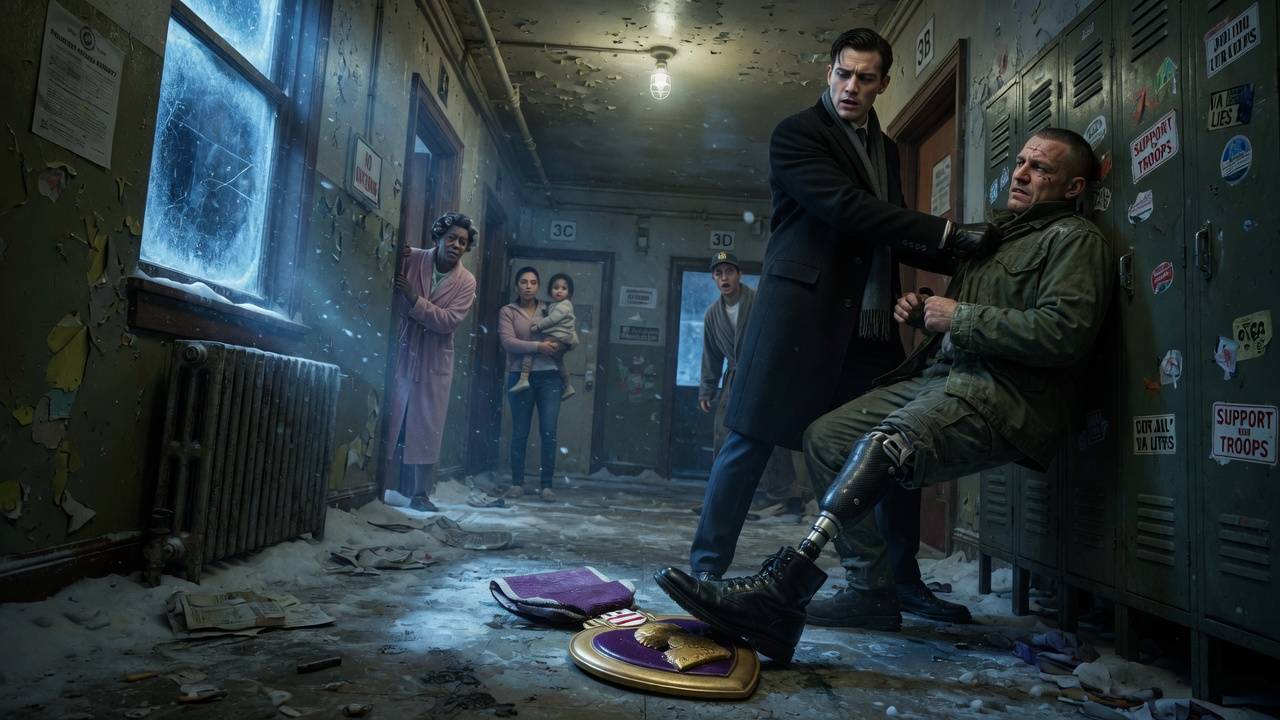
The silence that followed Leo Thorne’s frantic retreat from the hallway was heavier than the noise of the confrontation. Wyatt stood in the center of the linoleum, the rusted Purple Heart clutched so tightly in his palm that the sharp edges of the metal star bit into his skin. He didn’t feel the pain. He only felt the hollow, vibrating roar of adrenaline receding, leaving behind a cold, crystalline clarity.
Around him, the building seemed to breathe again. Doors that had been cracked open for the spectacle now clicked shut, one by one. Mrs. Gable was the last to retreat, her eyes wide as she clutched her phone to her chest. She didn’t offer a word of thanks or a nod of solidarity. She looked at Wyatt with the same expression people use when they watch a controlled demolition—a mixture of awe and the sudden, desperate need to be somewhere else when the dust settles.
“Come on, Barnaby,” Wyatt rasped. His voice sounded like it had been dragged over gravel.
The dog nudged Wyatt’s prosthetic, his tail tucked low. Barnaby knew the difference between a hunt and a fight, and he didn’t like the smell of the latter. Together, they navigated the debris of Wyatt’s life. The movers had left most of his boxes stacked haphazardly near the service elevator. Wyatt found a crumpled roll of packing tape and began to seal a box of old manuals, his movements mechanical.
He had won the hallway, but he was losing the war. He knew how the world worked now. Leo Thorne wasn’t just a man; he was a signature on a corporate ledger. Men like that didn’t go away because they got hit; they went away and came back with paperwork, police, and a renewed sense of victimhood.
An hour later, the first wave of the backlash arrived.
Wyatt was sitting on his rolled-up mattress, trying to stop the tremors in his hands, when his burner phone buzzed. It was Sarah, the freelance reporter who had been sniffing around the Thorne Development projects for weeks.
“Wyatt, tell me you’re seeing this,” she said, her breath coming in short, jagged bursts.
“Seeing what, Sarah? I’m a little busy being homeless.”
“The video, Wyatt. Someone in your building—I think it’s a woman named Gable—just posted the whole thing to a local neighborhood watch group. It’s already been shared four thousand times. The headline says ‘Local Hero Snaps, Attacks Young Developer.'”
Wyatt closed his eyes. The “Hero” brand. It was a double-edged sword he’d tried to bury for a decade. When people called you a hero, they expected a statue. When a statue starts hitting people, it becomes a monster.
“Leo’s office just put out a statement,” Sarah continued, her voice dropping into a professional, urgent tone. “They’re claiming he was there personally to offer you a relocation stipend and that you ‘brutally assaulted’ him without provocation. They’re calling for the DA to file aggravated assault charges. Because of your… military background, they’re pushing the ‘trained weapon’ angle.”
“He stepped on my medal, Sarah. He threw my leg into the snow.”
“I know that, and I can see it in the video, but people are only seeing the kick. They’re seeing a man with a prosthetic leg take down a billionaire’s son. To half the internet, you’re a vigilante. To the other half, you’re a ticking time bomb the VA failed to defuse.”
“I’m just a man who wants to keep his dog warm,” Wyatt said, the exhaustion finally hitting him like a physical blow.
“Stay put,” Sarah said. “The police will be there soon. Don’t resist. I’m calling a friend of mine, a civil rights attorney. If Leo wants to make this a public execution, we’re going to give him a public trial.”
Wyatt hung up and looked at Barnaby. The dog was resting his chin on Wyatt’s good knee. “I think we’re in trouble, old man.”
The police arrived twenty minutes later. There were four of them, and they didn’t come with the casual boredom of a noise complaint. They came with their hands on their holsters, their faces set in the grim masks of men expecting a “combat-trained” threat.
“Wyatt Vance? Hands where I can see them,” the lead officer, a man with a thick neck and a name-tag that read Miller, commanded.
Wyatt didn’t struggle. He sat on the crate, his hands raised, his Purple Heart sitting on the nightstand next to him. “The dog is old. He’s not a threat. Please don’t scare him.”
As Miller stepped forward to cuff him, he glanced at the medal. For a second, his professional veneer flickered. He looked at Wyatt’s leg, then back at the medal.
“Thorne’s at the hospital,” Miller said quietly as the steel ratcheted shut around Wyatt’s wrists. “He’s claiming a concussion and three cracked ribs. The kid’s father is calling the commissioner every ten minutes. I’m sorry, Sarge. This isn’t how I wanted my shift to go.”
“Just take care of the dog,” Wyatt whispered.
They led him out through the lobby. A small crowd had gathered on the sidewalk. Some held phones, their faces illuminated by the blue and red strobes of the cruisers. Wyatt kept his head down, but he could feel the shift in the air. The pity was gone, replaced by a sharp, jagged curiosity. He was no longer the quiet veteran in 4B; he was a news cycle.
As the cruiser pulled away from the curb, Wyatt saw a black SUV parked across the street. Behind the tinted glass, he caught the glint of a camera lens. Leo’s father, or maybe Leo himself, watching the harvest.
The night in the holding cell was a blur of fluorescent lights and the smell of industrial bleach. Wyatt’s leg was taken from him—”safety protocol”—leaving him slumped on a concrete bench, feeling lopsided and discarded. The cold from the floor seeped into his bones, a familiar ache that took him back to the winter of 2011, when he had lain in the mud of a ditch, holding a child’s hand and waiting for a medevac that felt a lifetime away.
He realized then that Leo hadn’t just taken his home. He had taken the one thing Wyatt had fought to maintain: his peace. By forcing Wyatt to use his hands, Leo had dragged him back into the violence he’d tried to leave in the sand.
The next morning, Sarah appeared at the visitor’s glass. She looked like she hadn’t slept either.
“The lawyer is working on bail, but Thorne Senior is fighting it. They want a high bond to keep you off the streets while they ‘assess the danger to the community.’ But Wyatt, I found something.”
She pressed a tablet against the glass. It was an old hospital record from Germany, dated two weeks after Wyatt was injured.
“The boy you saved. The one in the photo. The military didn’t just fly him to a local clinic. He was medevacked to Landstuhl because his father pulled strings with the State Department. That boy was Leo. His father was an attaché back then. They wiped the records of the civilian rescue to avoid a scandal about why a high-level official’s son was in a restricted zone.”
“I know it was him, Sarah. I’ve always known.”
“But did you know why they were there? Leo’s father wasn’t just an attaché. He was a consultant for the very firm that’s now financing Thorne Development. They’re building lofts on the same kind of ‘reclaimed’ land Leo’s father was scouting in Afghanistan. This isn’t just a landlord-tenant dispute, Wyatt. This is a pattern. They use people, they get rescued by people, and then they pave over the people who saved them.”
“It doesn’t matter,” Wyatt said, leaning his forehead against the glass. “He’s the victim now. Look at the news.”
“Not for long,” Sarah said, her eyes flashing. “The neighbors are talking. Mrs. Gable? She didn’t just post the fight. She has four years of door-cam footage of Leo Thorne harassing the elderly tenants in that building. She was just too scared to use it until she saw you stand up. You didn’t just hit him, Wyatt. You broke the spell.”
As Sarah left, Wyatt looked down at his empty pant leg. He thought about the boy in the fire. He remembered the way Leo’s small, soot-covered hand had gripped his thumb. He had risked everything for that boy. Not for the man Leo became, but for the possibility of a life.
He realized then that his moral choice wasn’t about whether to use the secret to save his home. It was about whether he could forgive himself for saving someone who had turned out to be a monster. And as the steel door of the visiting room hummed open, he knew the answer. He would do it again. Not for Leo, but for the soldier he used to be.
Chapter 6
The release happened at 2:00 PM on a Tuesday, under a sky the color of a wet sidewalk. The charges hadn’t been dropped, but the bond had been lowered to a “signature” release after the video of Leo napping the Purple Heart went viral on a veteran-advocacy site. The public tide had turned with the violent unpredictability of a flash flood.
Wyatt stood on the steps of the courthouse, his prosthetic leg clicking as he adjusted his balance. Sarah was there, along with an older man in a faded field jacket—the veteran from the street corner Wyatt had often shared his coffee with.
“Where’s Barnaby?” Wyatt asked immediately.
“He’s with Mrs. Gable,” Sarah said, stepping forward to hand him a coat. “She’s been feeding him steak. I think he’s forgotten you exist.”
Wyatt felt a ghost of a smile, but it vanished as he saw the black SUV idling at the curb. The door opened, and Leo Thorne stepped out.
He didn’t look like the predatory developer from the hallway. He wore a neck brace, and a large white bandage was taped over his brow. His movements were stiff, and he walked with a cane. But it was his eyes that had changed. The icy arrogance had been replaced by a frantic, cornered rage.
“You think you won?” Leo called out, his voice cracking. He stayed behind the safety of his vehicle’s door. “My father is suing the city. He’s suing the woman who posted that video. You’re going to spend the rest of your life in civil court, Vance. I’ll take every cent of your pension. I’ll make sure no VA facility in the country touches you.”
Wyatt walked down the steps, his gait slow and deliberate. He stopped five feet from Leo. The reporters nearby began to swarm, but Wyatt didn’t see them. He only saw the birthmark on Leo’s neck, the one he’d memorized while shielding the boy from falling timber.
“I didn’t save you for your money, Leo,” Wyatt said quietly.
Leo froze. The rage in his face faltered for a fraction of a second. “What are you talking about?”
Wyatt reached into his pocket and pulled out the old, singed photograph. He didn’t hand it over. He held it up so Leo could see the younger version of himself, screaming in the arms of a man whose face was masked by blood and dust.
“August 14th, 2011. Outside the Shura hall in Kandahar,” Wyatt said. “Your father told the press you were at a private school in Switzerland. But you were there, in the back of a Land Rover, because he wanted to show you how ‘business’ was done in a war zone. When the first IED went off, he ran for the armored transport. He left you.”
Leo’s face went gray. The cane in his hand trembled. “That’s… that’s a lie. My father saved me.”
“Your father paid to have the story changed,” Wyatt said, stepping closer. “I’m the one who reached into the fire. I’m the one who stayed in that ditch for three hours while the insurgents moved in, keeping your mouth shut so they wouldn’t hear you crying. I lost my leg because I wouldn’t let go of you to climb the wall faster.”
The cameras were clicking furiously now, but the circle of people had gone silent. Even the wind seemed to hold its breath.
“I kept that secret for fifteen years,” Wyatt continued, his voice steady. “Not because I wanted a reward, but because I wanted to believe that the boy I saved was worth the price I paid. I wanted to think that somewhere out there, there was a life being lived that was better than the one I had left.”
Wyatt looked at the bandage on Leo’s head, then at the expensive car.
“But you’re just a man who steps on medals in the snow. You’re a man who evicts grandmothers to build lofts for people who don’t care about your name. You’re the only thing I ever did that I truly regret.”
Leo opened his mouth to speak, to lash out, to deny—but nothing came out. He looked at the photo, then at Wyatt’s prosthetic, and then at the crowd. He saw the way the reporters were looking at him—not as a victim of assault, but as a ghost of a scandal that was about to break his father’s empire.
“Keep the building, Leo,” Wyatt said, his voice ringing out. “Pave it over. Put your name on it in gold letters. But every time you walk through those doors, you’re going to remember that you’re standing on the ground I gave you. And you’re going to know that you’re not a self-made man. You’re just a debt that was never paid.”
Wyatt turned his back on the SUV. He didn’t look back when he heard the car door slam or the tires screech as Leo fled the scene.
He walked toward Sarah and the old veteran.
“What now?” Sarah asked, her hand on his arm.
“Now I go get my dog,” Wyatt said.
Three days later, the “Thorne Lofts” project was officially suspended pending an investigation into the 2011 Kandahar incident and a string of building code violations Sarah had finally pushed into the light. Leo Thorne vanished from the public eye, rumored to be in a private facility in Upstate New York, while his father’s firm began the slow, messy process of liquidation.
Wyatt didn’t stay to watch the collapse. He found a small cottage in the outskirts of the city, near a park where the trees actually turned gold in the fall. It wasn’t luxury, but it was warm, and the landlord was an ex-Navy medic who didn’t mind a dog with a loud bark.
On a quiet Tuesday evening, Wyatt sat on his new porch, Barnaby curled at his feet. The Purple Heart sat on the small table next to him. It was still bent, the ribbon still stained, but the gold face of Washington caught the light of the setting sun.
He picked up a pen and a piece of paper. He had one last thing to do. He wrote a short note, folded it, and placed it in an envelope addressed to the VA’s prosthetic department. He wasn’t asking for a new leg or a faster transition. He was simply letting them know he was still here.
He looked out at the horizon, where the city lights were starting to flicker on like distant stars. He still had the nightmares sometimes. He still felt the itch in the leg that wasn’t there. But as he reached down to scratch Barnaby behind the ears, Wyatt realized that he didn’t need the building or the apology or the “hero” title.
He had his dignity. He had his dog. And for the first time in fifteen years, he didn’t feel like a man who had left half of himself in the sand. He felt whole.
The snow began to fall again, light and silent, covering the world in a clean, white sheet. Wyatt watched it for a long time before he finally went inside, closing the door firmly against the cold.