Chapter 5
The silence of the Topanga canyon was usually a balm, but today it felt like the breath held before a scream. Miller sat on his porch, a mug of black coffee cooling in his hands, watching the morning mist cling to the oak trees. His head felt heavy, the “static” replaced by a low-frequency thrum that vibrated in his teeth.
He hadn’t checked his phone in twelve hours. He didn’t need to. He knew exactly what was on it.
The door behind him creaked, and Sarah stepped out, her face a mask of controlled worry. She was wearing her scrubs; she had a shift at the clinic in an hour, but she wasn’t leaving until she’d had her say. She sat in the weathered wicker chair next to him, placing her own phone on the small table between them. The screen was dark, but the ghost of the video was still there, hovering in the air.
“Leo sent it to me,” she said quietly. “Before the lawyers told him to take it down.”
Miller stared at a hawk circling high above the canyon. “He shouldn’t have filmed it.”
“He’s twenty-two, Miller. Everything is a movie to them,” Sarah replied. She leaned forward, trying to catch his eyes. “But that’s not the point. The point is what happened. Are you okay? Did the… did the glitch happen?”
“It happened,” Miller said, his voice flat. “Right before I hit him. For a second, the room wasn’t the house. It was a breach. My hands knew what to do before my head could tell them no.”
Sarah sighed, a long, shaky sound. “I saw the hits. That wasn’t a ‘glitch’ reaction, Miller. That was a controlled neutralization. You didn’t lose it. You found it. That’s what scares me. Dr. Aris says stress-induced regression can lead to—”
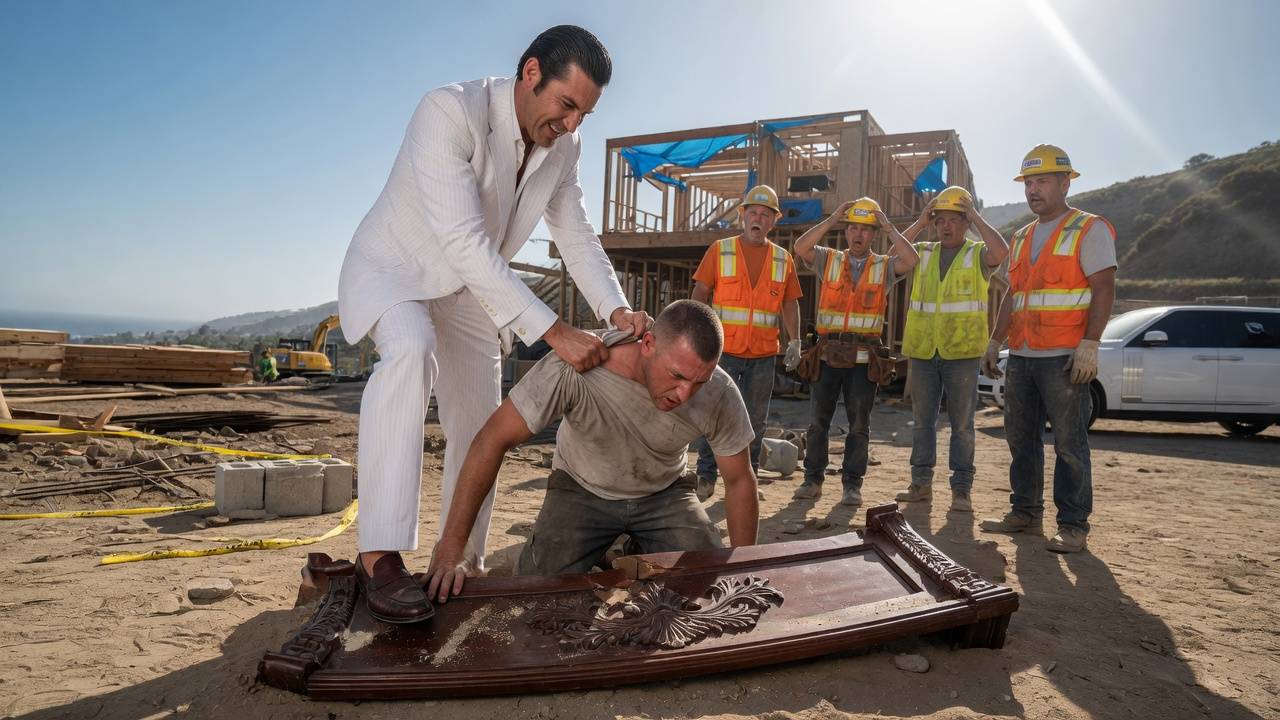
“I know what the doctor says, Sarah,” Miller interrupted. He finally looked at her, and the exhaustion in his eyes made her flinch. “I’m tired of being a patient. I’m tired of people looking at me like I’m a bomb with a faulty timer. Alistair Thorne pushed me until there was nothing left to push. He broke the carving. He mocked the TBI. He put his hands on me.”
“And now he’s going to use all of that to ruin you,” she said, her voice rising. “I got a call from a firm in Century City this morning. They’re representing Thorne. They’re talking about assault, battery, intentional infliction of emotional distress, and ‘catastrophic damage to a professional reputation.’ They’re going for everything, Miller. The shop, the truck… the treatment fund.”
Miller felt a cold spike of clarity. “Let them try. Thorne doesn’t want a courtroom. In a courtroom, the discovery process would show his incompetence. It would show that he asked me to compromise the structural integrity of a load-bearing beam. Elias has the logs.”
“Elias is an architect, Miller. He works for the Vances. He’s not going to fall on a sword for a carpenter who just put a world-famous designer in the hospital.”
“He’s not in the hospital,” Miller grunted. “He has a bruised sternum and a shattered ego. I didn’t break anything but his pride.”
“Tell that to the video,” Sarah said, tapping her phone. “It’s gone viral on the ‘Malibu Construction’ boards. People are calling you ‘The Ghost Carpenter.’ Half the guys are cheering, but the other half—the ones who sign the checks—are terrified of you. You’re a liability now.”
She reached out and took his hand. Her palm was warm, a sharp contrast to the cold ceramic of his mug. “Come stay at my place for a few days. Get away from the canyon. If Thorne’s people find out where you live—”
“No,” Miller said, his voice firming. “I’m staying here. I have work to do.”
“What work? You’re fired!”
“The Vances haven’t fired me,” Miller said. “Thorne fired me. There’s a difference.”
As if on cue, his phone buzzed on the table. It was a text from an unknown number. Miller. It’s Elias. We have a problem at the site. The Vances are here. They saw the video. They also saw the mantel. Mr. Vance wants to see you. Alone. 10:00 AM.
Sarah read the text over his shoulder. “Don’t go. It’s a trap. They’ll have the cops waiting.”
“Vance doesn’t need the cops to handle his problems,” Miller said, standing up. “He’s a data guy. He likes facts. And the fact is, the house is currently a death trap because Thorne doesn’t understand physics.”
“Miller, please—”
“I’m going, Sarah. I’m not hiding in a cellar like I’m ashamed of what I am.”
The drive back to Malibu was a blur of Pacific Coast Highway blue and the persistent throb in his temple. When he pulled through the gates of the mansion, the security guard—a guy named Mike who usually gave him a friendly nod—looked at the ground as he waved him through. The site was eerily quiet. The drywallers were gone. The plumbers’ trucks were missing.
Miller walked into the great room. The mahogany mantel was still there, the heartwood glowing in the morning light like an open wound. Standing in front of it was Arthur Vance. He was a small man, dressed in a grey sweater that probably cost more than Miller’s truck, his eyes fixed on the wood.
“It’s a beautiful piece of work, Miller,” Vance said without turning around.
“Thank you, sir,” Miller replied, stopping at the edge of the polished concrete.
Vance turned. He didn’t look angry. He looked clinical. “I’ve seen the video. My PR team is currently playing whack-a-mole with it on four different platforms. Alistair is currently at a private clinic in Beverly Hills, claiming he has a concussion and ‘severe psychological trauma.'”
“He doesn’t have a concussion,” Miller said. “I controlled the impact.”
“I know you did,” Vance said, walking toward him. “I watched it in frame-by-frame. You didn’t strike to kill. You struck to displace. It was remarkably precise. Almost… surgical.”
Vance stopped three feet away. “I did a deep dive on your record, Miller. Most of it is redacted, but the parts that aren’t… well, they tell a story of a man who is very good at maintaining order in chaos. Which brings me to the problem.”
Vance gestured toward the library. “Alistair insisted on an electronic locking system for the safe room. He wanted it integrated with the ‘smart home’ hub. He said mechanical overrides were ‘clunky.’ My security team just informed me that the system has suffered a catastrophic logic failure. The door is locked. My wife’s jewelry, my hard drives, and unfortunately, my dog’s medication are all inside. And the system won’t recognize the bypass codes.”
Miller felt a grim sense of satisfaction. “The digital interface Thorne insisted on wasn’t shielded against the power surges from the cliffside transformers. I told him that three weeks ago.”
“I know you did,” Vance said, his eyes narrowing. “I found the email you sent to his assistant. The one he never showed me.”
Vance leaned in, his voice dropping. “Alistair Thorne is a fraud, Miller. He’s a decorator who thinks he’s an engineer. But he has a very loud voice and a very expensive legal team. He’s demanding I release your bond and support his civil suit.”
“And are you?”
“I’m a businessman,” Vance said. “I support the person who provides the most value. Right now, that’s not the man crying in Beverly Hills. It’s the man who built the door.”
Vance checked his watch. “The safe room is currently a thirty-ton steel box that I can’t get into. If you can open it—without destroying the facade Alistair spent half a million dollars on—I’ll consider the incident yesterday a ‘workplace safety demonstration’ and keep the lawyers off your back.”
“I can open it,” Miller said. “But I don’t work for free anymore. And I don’t work with Thorne.”
“Thorne is being ‘transitioned’ out of this project as we speak,” Vance said with a cold smile. “Get that door open, Miller. Show me that technical precision everyone is talking about.”
Miller walked toward the library, but as he passed the great room’s glass wall, he saw a black SUV pull into the driveway. Alistair Thorne stepped out, wearing a neck brace and leaning on the arm of a sleek-looking woman in a charcoal suit.
“It seems our ‘victim’ has arrived to witness his own obsolescence,” Vance murmured.
The thrum in Miller’s head intensified. This wasn’t over. Not by a long shot. He could feel the static beginning to spark at the edges of his vision. He had to focus. He had to be the hammer, but this time, he had to be the one who chose where the nail went.
He entered the library, the scent of expensive leather and fresh paint thick in the air. The safe room door was a seamless panel of walnut, indistinguishable from the surrounding shelves. To anyone else, it was an unbreakable wall. To Miller, it was a puzzle he had designed the solution for.
He knelt by the baseboard, his fingers searching for the hidden seam. He could hear Alistair’s voice in the hall—shrill, demanding, performing for the lawyer at his side.
“I want him arrested, Arthur! He’s a danger to society! He’s a weapon that hasn’t been decommissioned!”
Miller closed his eyes. He blocked out the voice. He blocked out the static. He focused on the cold metal hidden behind the wood. He found the secondary pin—the one he’d installed without Thorne’s knowledge.
He felt the click. It was a small sound, but in the silence of the library, it sounded like a gunshot.
“Door’s primed,” Miller whispered to himself.
But as he stood up, the room tilted. The static flared into a blinding white light, and for a heartbeat, he forgot where he was. He reached out to steady himself against the walnut panel, his breath coming in ragged gasps.
One. Two. Three.
He counted. He fought for the numbers. He couldn’t lose time. Not now. Not with the wolf at the door and the lion in the hall. He had to be Miller the carpenter. Miller the SEAL. Miller the man who didn’t break.
He straightened his shirt, wiped the sweat from his brow, and turned to face the door just as Alistair Thorne burst into the room.
Chapter 6
Alistair Thorne looked like a man who had been told he was the lead in a tragedy and was determined to overact. The neck brace was pristine white, contrasting sharply with his charcoal designer shirt. He stopped dead when he saw Miller standing by the bookcase, his eyes flaring with a mixture of genuine fear and performative outrage.
“What is he doing here?” Alistair shrieked, pointing a trembling finger. “Arthur, I told you! I will not be in the same zip code as this… this animal!”
Arthur Vance walked in behind him, followed by the woman in the charcoal suit. “Calm down, Alistair. Mr. Miller is here at my request. He’s the only one who can fix the mess you made with the security interface.”
“The mess I made?” Alistair’s voice hit a glass-shattering register. “I followed the manufacturer’s specifications to the letter! It’s the wiring in this house! It’s the incompetent contractors you’ve hired!”
The lawyer stepped forward, her voice a cool, professional blade. “Mr. Vance, my client is currently suffering from a documented spinal injury and acute PTSD following an unprovoked assault. Having the assailant on-site is a violation of—”
“It wasn’t unprovoked,” Vance said, his voice dangerously quiet. “I’ve seen the raw footage, Elena. Not the edited clip that went viral. The whole thing. I saw Alistair destroy a month’s worth of craftsmanship. I saw him initiate physical contact. And I’ve spent the last hour reviewing the logs of the security system.”
Vance turned to Alistair. “You bypassed the surge protectors to save four thousand dollars on the final invoice, didn’t you? You wanted to pad your ‘design fee’ before the move-in date.”
Alistair’s face went from pale to a mottled purple. “That’s… that’s an outrageous accusation! I am an artist! I don’t concern myself with—”
“You don’t concern yourself with reality,” Miller said, stepping forward.
Alistair flinched, stepping back so quickly he bumped into his lawyer. The bravado vanished, replaced by the same raw terror Miller had seen in the dust the day before.
“The system is dead, Alistair,” Miller said, his voice low and steady. “The digital locks are fused. The only way in now is mechanical. And since you told the Vances that the mechanical override was ‘a security risk’ and had it removed from the final plans… well, I guess we’re stuck.”
“You… you told me it was removed!” Alistair spat, looking at Vance. “He said he took it out!”
“I said I would,” Miller replied. “But I don’t take orders from people who don’t know how to read a blueprint.”
Miller turned to Vance. “The door is primed. I can open it. But I want a signed release from Mr. Thorne. No civil suit. No ‘spinal injuries.’ He walks away from this project, and he walks away from me.”
“You can’t blackmail me!” Alistair yelled. “Elena, tell him!”
The lawyer looked at the bookcase, then at the cold, calculating expression on Arthur Vance’s face. She knew which way the wind was blowing. “Alistair, if the system failure is due to a surge protector bypass that wasn’t in the approved plans… the Vances have grounds for a massive counter-suit. Not to mention the insurance fraud implications.”
Alistair looked like he was about to faint. He looked at the walnut panel—the door to the room that held the Vances’ most private possessions. He looked at Miller, the man he’d called a ‘tool.’
“Fine,” Alistair hissed. “Sign it. Just get me out of here.”
The next ten minutes were a flurry of digital signatures and whispered legal counsel. Miller waited, leaning against a mahogany desk, his eyes on the walnut panel. The static in his head was still there, but he’d pushed it into a corner. He was in the “green zone” now—the place where the mission was the only thing that mattered.
Once the documents were confirmed, Miller walked to the bookcase. He didn’t use a key. He didn’t use a code. He reached into his pocket and pulled out a small, high-powered magnet he’d scavenged from an old speaker.
He moved the magnet in a specific pattern over a section of the walnut grain—the “whisper” Alistair had mocked.
Clack. Thrum. Hiss.
The heavy door swung outward with a whisper of hydraulic fluid. The safe room was revealed—a sleek, stainless steel vault that looked like the bridge of a starship.
“Incredible,” Mrs. Vance whispered, appearing in the doorway. “It’s… it’s like magic.”
“It’s not magic,” Miller said, stepping back. “It’s physics. Wood meets steel. Truth meets pressure.”
Vance walked into the room, checking the cabinets. He came back out a moment later, clutching a small medical bag. “Thank you, Miller. You’ve saved us a great deal of trouble.”
Vance looked at Alistair, who was standing by the window, looking out at the ocean as if he could drown himself in it. “Alistair, your things will be sent to your office. Do not return to this property. Elena, I believe you have everything you need for the settlement.”
The room cleared quickly after that. Alistair didn’t look at Miller as he left. He walked with a stiff, humiliated gait, his “spinal injury” seemingly forgotten in his haste to escape the scene of his professional execution.
Miller was left alone in the library with Arthur Vance. The billionaire looked at him for a long time, his gaze assessing.
“You’re a strange man, Miller,” Vance said. “You have the hands of an artist and the soul of a centurion. It’s a volatile mix.”
“It’s just work, Mr. Vance,” Miller said.
“Is it? I don’t think so. I think that mahogany mantel is the only thing keeping you tethered to this world.” Vance walked over and touched the walnut door. “I want you to finish the house. Not just the carpentry. I want you to act as the project lead for the interior completion. Elias says he’ll work with you. The pay will be… substantial.”
Miller thought about the clinic. He thought about Sarah. He thought about the static that would never truly go away.
“I’ll finish the wood,” Miller said. “But I’m not a lead. I don’t want to manage people. I just want to make things that don’t break.”
“A fair compromise,” Vance nodded. “Start tomorrow. And Miller? The video… it’s been taken down. But I kept a copy. It’s a good reminder that sometimes, the hammer is the most important part of the house.”
Miller walked out of the mansion and into the bright Malibu sun. He drove back up to the canyon, the salt air cooling his skin. When he got home, the truck’s engine ticking in the driveway, he saw Sarah’s car was gone. She’d left a note on the door. Call me. Tell me you’re not in jail.
He went into his shop. He walked over to the workbench and ran his fingers over the Trident insignia he’d carved years ago. It felt solid. It felt real.
He picked up a fresh piece of mahogany. It was a small scrap, left over from the mantel. He took his finest chisel and began to work. He didn’t have a plan. He just let his hands find the grain.
Hours passed. The sun dipped below the canyon wall, casting long, purple shadows across the shop floor. The static in his head was gone, replaced by the rhythmic shhh-shhh of the blade against the wood.
When he finally looked down, he saw what he’d made. It was a bird. A mahogany bird, identical to the one Alistair had crushed. But this one was different. He’d carved it from the heartwood—the darkest, densest part of the beam.
He held it up to the light. It wasn’t “ethereal.” It wasn’t a “whisper.” It was heavy. It was strong. It was a piece of the truth, carved into a shape that could fly.
He placed the bird on the workbench, right over the Trident. He sat down and closed his eyes, listening to the silence of the canyon. He wasn’t the man he used to be. He wasn’t the man Alistair Thorne wanted him to be.
He was Miller. And for today, that was enough.
The next morning, he would go back to the glass-and-steel house on the cliff. He would finish the work. He would build the sanctuary Vance wanted. But he would do it his way. He would build it with the heartwood. Because he knew now that the only thing that lasts—the only thing that can truly weather the storm—is the grain of truth hidden beneath the surface.
He picked up his phone and dialed Sarah’s number.
“Hey,” he said when she picked up. “I’m okay. I’m just… I’m finishing a piece.”
“Miller? You sound… clear.”
“I am,” he said, looking at the mahogany bird. “I’m very clear.”
He hung up, turned off the shop lights, and walked toward the cottage. Behind him, in the dark, the mahogany bird sat on the workbench, its wings spread, ready for whatever wind came off the ocean tomorrow. The static was gone. The world was quiet. And Miller, for the first time in a very long time, remembered exactly who he was.