Chapter 5
The holding cell at the county substation smelled of industrial-grade citrus and the sour, sharp tang of unwashed fear. It was a smell Dutch had spent twenty years trying to scrub out of his pores, and here it was again, clinging to the damp fabric of his denim vest.
He sat on the narrow metal bench, his back against the cinderblock wall. The cold seeped through his shirt, finding the old fractures in his spine. He’d called the police himself, standing over a wheezing Leo Thorne while Miller stared at him like he’d just seen a ghost walk out of a graveyard. He’d known exactly what would happen. You don’t put a man like Leo Thorne in the dirt while you’re on lifetime parole and expect to go home for dinner.
The heavy steel door at the end of the corridor groaned open. The rhythmic slap of leather soles echoed on the concrete.
Bill Vance stopped in front of the bars. He didn’t have his clipboard this time. He had his hands jammed into his pockets, and his face was the color of a bruised plum. He stood there for a long minute, just looking at Dutch.
“You really did it, didn’t you?” Bill said, his voice unusually soft.
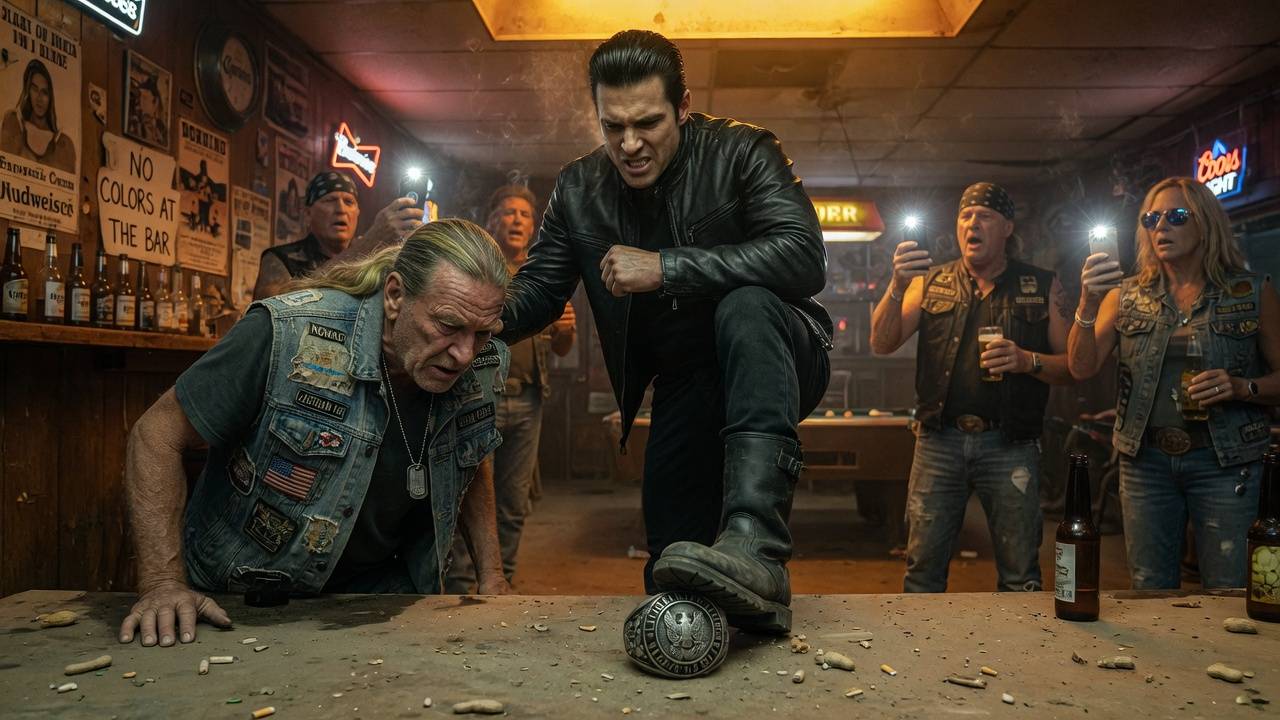
“He wouldn’t pick up the ring, Bill,” Dutch said.
“The ring? You’re telling me you threw away your life over a piece of pewter?” Bill shook his head, a gesture of profound, weary disappointment. “I stood up for you, Dutch. I told the board you were the one success story I had left. I told them you were a man of discipline.”
“I am a man of discipline,” Dutch replied. “Discipline doesn’t mean letting a man walk on your face. That’s just being a dog.”
Bill stepped closer to the bars. “The video is everywhere. Sarah showed it to me. Some kid with a phone caught the whole thing. It’s got three million views already. People are calling you a hero, but the DA doesn’t care about ‘hero.’ They care about a violent offender with a RICO history committing a second-degree assault on a prominent local businessman. Thorne’s people are pushing for the maximum. They’re talking about ‘aggravated circumstances’ because of your training.”
Dutch looked at his hands. They were steady. The knuckles were a little swollen, the skin split across the middle of his right hand where he’d driven the palm-heel home, but the tremors were gone. For the first time in years, he didn’t feel like he was waiting for the world to end. It had already ended.
“How’s the boy?” Dutch asked.
“Thorne? Cracked sternum, two broken ribs, and a collapsed ego. He’s in the hospital, and he’s got a team of lawyers drafting a civil suit that’ll take everything Miller owns just to settle. They’re coming for the Hub, Dutch. This didn’t save the bar. It gave Thorne the leverage to burn it down.”
Dutch felt a cold needle of doubt prick at his chest. He’d acted on instinct, on the old code that demanded respect, but he hadn’t considered the paperwork. He’d forgotten that in the modern world, a fist didn’t settle a debt; it just created a new one with interest.
“Sarah’s outside,” Bill said. “They’re giving her ten minutes. I shouldn’t even be doing this, but… God help me, I watched that video. He had it coming. I can’t say that in court, and I’ll testify against you because it’s my job, but he had it coming.”
Bill stepped aside, and Sarah walked in. She looked like she hadn’t slept in a week. Her nursing scrubs were wrinkled, and her eyes were rimmed with red. She didn’t look angry, though. She looked terrified.
She sat on the edge of the bench across from the bars, her fingers interlaced so tightly her knuckles were white. “Dad’s a wreck, Dutch. He’s been at the bar all night, just sitting in the dark. He thinks he failed you.”
“Tell him he didn’t,” Dutch said. “He gave me five years of being a person again. That’s more than most get.”
Sarah leaned forward, her voice dropping to a harsh whisper. “The lawyers were at the house this morning. Thorne’s lawyers. They offered a deal. If Dad signs the deed over to Thorne for zero dollars, Thorne will decline to press charges and he’ll drop the civil suit against you. He wants you to walk, Dutch, but only if he gets the land. He’s using your freedom as a bargaining chip to rob my father.”
Dutch felt the familiar rage rising, but he pushed it down. He needed to think. Leo wasn’t just a bully; he was a businessman. He knew that Dutch’s parole violation was a lock, but he also knew that Miller was the only obstacle to the highway development money.
“Don’t let him sign,” Dutch said.
“If he doesn’t, you go back to prison for the rest of your life. You’re sixty-five, Dutch. You won’t survive another ten years in Lovelock.”
“I said don’t let him sign, Sarah.” Dutch stood up and walked to the bars. He looked around to make sure Bill was out of earshot. “Listen to me. Remember what I told you about the old days? About Silas?”
Sarah nodded slowly.
“I lied to you. I didn’t just know where the money went. I have it.”
The silence that followed was heavy, filled only with the hum of the overhead fluorescent lights. Sarah’s eyes widened, her mouth parting in a small gasp.
“I buried it in the Valley of Fire. Two hundred thousand. It’s been sitting there for twenty years, waiting for a reason to exist. I went out there two nights ago. I took five thousand to help with the taxes, but it’s all there. The coordinates are on a map in the lining of my riding boots. The ones in my trailer.”
“Dutch… that’s… that’s evidence. If you use that money, they’ll link it to the RICO case. They’ll add twenty years to your sentence before you even get to the assault charge.”
“Maybe,” Dutch said. “But that money doesn’t belong to the state. It belongs to the club. And the club is gone. If I use it to buy the Hub’s debt, the bank gets paid. Once the lien is cleared, Thorne has no standing. He can’t sue for a property he doesn’t have a legal claim on. Miller keeps the bar. You keep your inheritance.”
“And you?” Sarah’s voice was trembling now. “What happens to you?”
Dutch smiled, and it was a tired, honest thing. “I’m an antique, Sarah. I’m out of time anyway. But I’m not going to let a man like Thorne win. He thinks everything has a price. He thinks respect is something you buy in a catalog. I want him to know that there are things he can’t touch, no matter how many lawyers he hires.”
“Dutch, please. We can find another way.”
“There is no other way. You take the map. You go to Jax—the kid who was at the bar. He’s a prospect, but he’s got his head on straight. He’ll help you dig it up. You take the cash to a lawyer I know in Vegas—a man named Goldberg. He used to represent the club. He knows how to make money look like a private loan from an anonymous donor. He’ll take a cut, but he’ll make it legal enough to satisfy the bank.”
Sarah stood up, her hand reaching through the bars to touch his arm. “You’re throwing yourself away for a bar, Dutch.”
“No,” Dutch said, his voice firm. “I’m keeping a vow. And I’m making sure that when I’m gone, there’s still one place in this desert that smells like grease and beer instead of perfume and lies.”
The door opened again. “Time’s up,” Bill called out.
Sarah looked at Dutch one last time. She saw the set of his jaw, the hard, clear light in his eyes. She nodded once, a sharp, quick movement, and then she turned and walked away.
Dutch sat back down on the metal bench. He closed his eyes and imagined the wind on the highway, the way the Ghost felt when you opened the throttle and the world became nothing but speed and vibration. He wasn’t afraid of the box. He’d lived in a box his whole life. This time, at least, he was the one who’d chosen the lock.
Chapter 6
The courtroom was smaller than Dutch remembered. It didn’t have the grand, vaulted ceilings of the federal buildings in Vegas. It was a local circuit court in Pahrump, a place of beige carpets and wood-veneer tables, where the air was thick with the scent of floor wax and the low-level anxiety of people fighting over small-town grievances.
Dutch sat at the defense table, his hands cuffed to a chain around his waist. He was wearing a cheap, ill-fitting suit that Miller had dug out of a closet somewhere. It felt like a costume. He felt much more naked in the suit than he ever had in his faded denim vest.
Leo Thorne was there, sitting in the front row of the gallery. He was wearing a neck brace and had his arm in a sling, looking for all the world like a man who had survived a plane crash. He had two men in suits flanking him—lawyers, not bikers. The “posers” were nowhere to be seen. The viral video had been a double-edged sword for Leo; it had made him a victim, but it had also made him a laughingstock in the biker community. A man who gets put down by a sixty-five-year-old barback doesn’t carry much weight in a leather jacket.
The judge, a woman named Henderson who looked like she’d heard every lie in the state of Nevada twice over, peered over her glasses at the paperwork.
“This is a parole revocation hearing for Mr. Dutch McCallister,” she began, her voice a dry rasp. “The underlying incident is a physical altercation at the Iron Hub bar. Mr. Thorne, the complainant, is alleging unprovoked assault.”
Dutch’s lawyer, a young public defender named Marcus who looked like he’d just graduated and was already regretting it, stood up. “Your Honor, we have submitted the video evidence. The footage clearly shows Mr. Thorne physically escalating the situation. He grabbed Mr. McCallister by the collar and forced him into a submissive position while standing on his property. Mr. McCallister’s response was a measured act of self-defense.”
“Measured?” Thorne’s lawyer interrupted, his voice booming. “He broke my client’s ribs! He used military-grade combat techniques on a civilian! This isn’t self-defense; it’s an execution.”
The judge tapped her gavel, a sound like a dry branch snapping. “Quiet. I’ve seen the video. Mr. Thorne’s behavior was… regrettable. However, Mr. McCallister is a convicted felon on lifetime parole for violent offenses. He is prohibited from engaging in any form of physical altercation. The threshold for him is not the same as it is for a regular citizen. He knows the rules.”
Dutch looked at Miller, who was sitting behind him. Beside Miller sat Sarah. She looked pale, but she gave Dutch a small, almost imperceptible nod.
Goldberg had done his work. The bank had received a full payout on the Iron Hub’s debt two days ago. The “anonymous loan” had been processed through a series of shell companies that Goldberg had kept on ice since the eighties. On paper, Miller was now the sole, debt-free owner of the land. Thorne’s leverage was gone. The only thing left was the pound of flesh Leo wanted from Dutch.
“Your Honor,” Marcus said, “before we proceed to sentencing on the violation, there is the matter of the property dispute. We have documentation showing that the Iron Hub’s debts have been settled in full. Mr. Thorne’s claim to the land is void. This entire confrontation was born of Mr. Thorne’s attempt to illegally coerce my client and his employer.”
The judge frowned, looking at the new documents Marcus handed up. She spent several minutes reading, the silence in the room growing heavier with every second. Thorne was shifting in his seat, his face turning a dark, angry red.
“This seems in order,” Judge Henderson said eventually. “The lien is cleared. Mr. Thorne, your standing as a creditor in this matter appears to have evaporated. Which brings us back to the assault.”
She looked at Dutch. “Mr. McCallister, you have a long history. You’ve spent more of your life inside a cell than out of it. By all accounts, you were doing well. Miller speaks highly of you. Sarah Vance speaks highly of you. Even your parole officer, Mr. Vance, admits that you were provoked beyond what most men could endure.”
She paused, her gaze hardening. “But the law doesn’t care about ‘most men.’ It cares about the terms of your release. You broke them. You used violence to settle a dispute. If I let you walk, I’m telling every man on parole that they can take the law into their own hands if they feel insulted.”
“I wasn’t insulted, Your Honor,” Dutch said. His voice was quiet, but it filled the room. It was the first time he’d spoken.
“Oh? Then what was it?”
“He stepped on the ring,” Dutch said. “That ring doesn’t belong to me. It belongs to the men who didn’t come back. I was just holding onto it for them. When he put his boot on it, he wasn’t just hitting me. He was hitting them. And I’ve spent twenty years regretting that I couldn’t protect my brothers. I wasn’t going to let it happen again.”
The judge stared at him for a long beat. There was no sympathy in her eyes, but there was a flicker of something else—recognition, maybe. She was old enough to remember the war Dutch had come home from.
“Sentencing on the parole violation is as follows,” she said, her voice echoing in the small room. “Dutch McCallister, your parole is revoked. You will be remanded to the custody of the Department of Corrections to serve the remainder of your original sentence.”
A low groan went up from Miller. Sarah put her face in her hands.
“However,” the judge continued, silencing the room with a glare, “given the extreme provocation, the lack of previous violations over a five-year period, and the fact that the complainant entered the defendant’s workspace to initiate the conflict, I am recommending a minimum-security placement with a review for re-parole in eighteen months. Furthermore, I am dismissing the secondary assault charges. The state has enough to deal with without adjudicating a bar fight that Mr. Thorne started.”
Eighteen months. It wasn’t freedom, but it wasn’t a death sentence.
Leo Thorne stood up, his face contorted. “This is a joke! He’s a criminal! He’s a thug!”
“Sit down, Mr. Thorne,” the judge said, her voice cold as ice. “Or you can join him in the holding cell for contempt. You got exactly what you deserved. You tried to bully a man who had nothing left to lose, and you found out that’s a dangerous game. This court is adjourned.”
The bailiffs stepped forward to lead Dutch away. He turned back to look at Sarah and Miller.
“The Ghost,” Dutch said to Miller. “Keep her under a tarp. Don’t let the battery go dry.”
“She’ll be waiting for you, Dutch,” Miller said, his voice cracking. “The Hub will be waiting, too. We’re putting your name on the deed, Dutch. You’re a partner now.”
Sarah stepped forward, touching the sleeve of his suit. “We found the rest of it, Dutch. The map was where you said. The bar is safe. Leo can’t touch us.”
“Good,” Dutch said. “That’s good.”
As they led him through the side door and back into the world of concrete and steel, Dutch felt a strange sense of peace. He had lost his freedom again, but for the first time in his life, he knew exactly what it had bought. He’d traded eighteen months of his life for the only home he had left. He’d kept his vow to Silas, and he’d kept his pride.
Two hours later, he was in the back of a transport van, his wrists shackled, his eyes fixed on the desert through the small, grated window.
He saw the turnoff for the Iron Hub. He saw the weathered sign creaking in the wind. And just for a second, he saw a young man on a bike—Jax, the prospect—pulling into the lot, a new generation coming to sit in the shadows and hear the stories.
The van hit a bump, and the pewter ring in Dutch’s pocket rattled against his hip. It was a small sound, but it was enough. The war was over, and for once, Dutch wasn’t the one who had retreated.
He leaned his head against the cold metal wall of the van and watched the desert sun dip below the horizon, painting the world in shades of fire and iron. He was sixty-five, his back was a mess, and he was headed for a cage. But as the desert air whistled through the cracks in the door, Dutch McCallister closed his eyes and felt like he was finally, truly, on the road.