Chapter 5
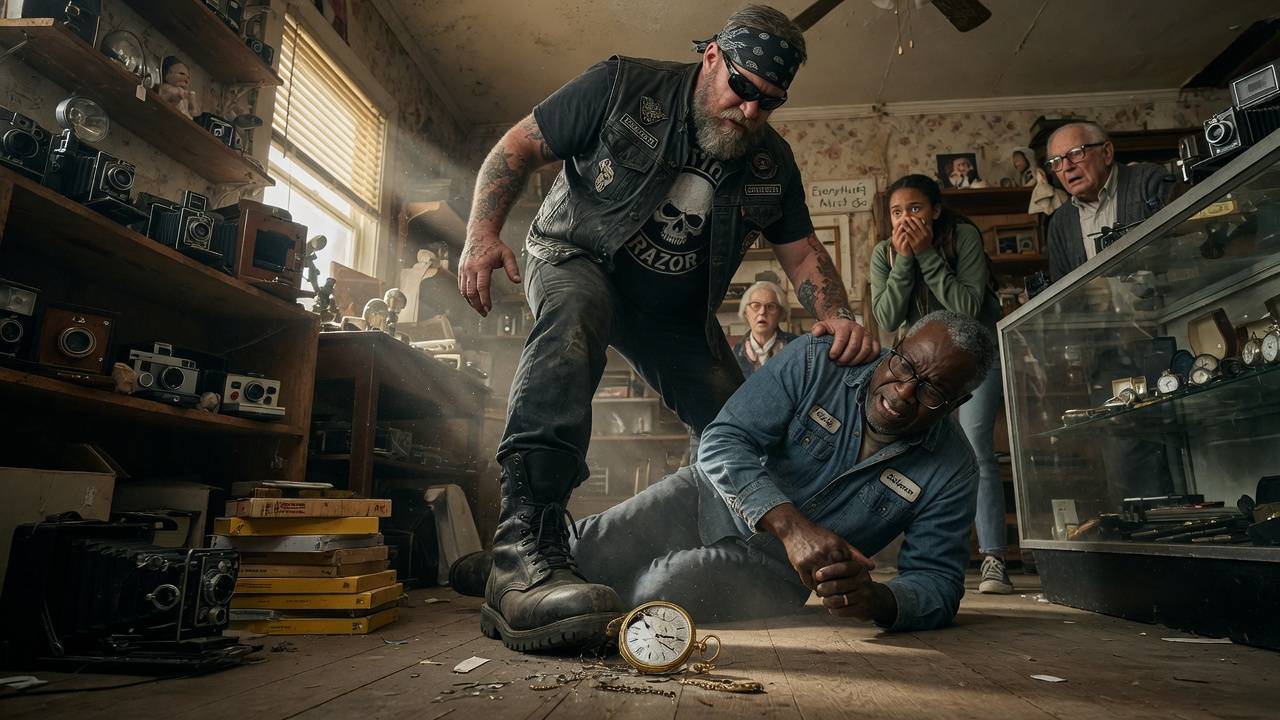
The aftermath of the fight in the antique shop didn’t feel like a victory. It felt like the air had been sucked out of the room, leaving only the smell of ozone and the high-pitched ringing in Solomon’s ears. Razor lay in the ruins of the display table, his breathing shallow and hitched, his face a mask of shock that he hadn’t yet processed. The two lieutenants at the door were frozen, their hands hovering near their belts, caught in the sudden, violent shift of the room’s gravity.
“Outside,” Solomon said. His voice wasn’t loud, but it carried a weight that made the bikers flinch. “Get him out of my shop.”
The wiry one with the facial scar looked at Razor, then at Solomon. He saw the way Solomon held himself—the loose, ready stance of a man who hadn’t even broken a sweat. He saw the coldness in Solomon’s eyes, a void that was far more terrifying than the rage they were used to dealing with. Without a word, the two men scrambled forward, grabbed Razor by the armpits, and dragged him out the door. The sound of his heels scraping across the threshold was the only noise until the roar of the motorcycles erupted, fading into a distance that felt far too short.
Solomon stood in the center of the debris. He looked down at the gold pocket watch. It was a jagged scrap of metal now, the internal gears scattered like tiny, broken teeth across the floor. He knelt, his knees cracking in the silence, and began to pick up the pieces.
“Solomon?”
He looked up. The young couple was still huddled by the door. The girl was shaking, her eyes wide as she looked at him as if he were a ghost that had suddenly put on skin. The elderly man, Mr. Henderson from three blocks over, was standing by the shelf of old cameras, his hand trembling as he gripped his cane.
“Are you… are you okay?” the girl whispered.
Solomon didn’t answer for a long moment. He looked at the ruined watch in his palm. “I’m fine,” he said finally. “The shop is closed. Please. Go home.”
They didn’t need to be told twice. As they scurried out, Solomon heard the first distant wail of a siren. Someone had called it in. Probably a neighbor who had seen the Skulls line up outside. He didn’t move. He sat on the floor among the broken glass and the dust of a hundred forgotten lives, and he waited.
Detective Joe Miller arrived ten minutes later. He didn’t come in with his gun drawn. He walked in slowly, his hands in his pockets, his eyes scanning the carnage with a weary, practiced ease. He looked at the shattered table, the blood on the floor where Razor had hit, and finally at Solomon, who was still sitting by the counter, cradling the remains of the watch.
“You did it, Sol,” Miller said, pulling a chair from a nearby desk and sitting down. “You finally pushed back.”
“He stepped on the watch, Joe,” Solomon said, his voice flat.
“I know. I heard.” Miller leaned forward, his face shadowed by the dim light of the shop. “I also heard what he said. About Highway 12. The witnesses… they’re talking, Solomon. The whole town is going to be talking by tomorrow morning.”
“Good. Let them talk.”
“It’s not good,” Miller snapped. “The Skulls aren’t a street gang, Sol. They’re a business. And you just humiliated their Vice President in front of a crowd. They can’t let that stand. Not if they want to keep collecting ‘insurance’ from everyone else.”
Solomon looked up. “I’m not afraid of them, Joe. I stopped being afraid a long time ago.”
“Maybe you should be. Because I can’t protect you. Not after this. The Captain is already breathing down my neck to bring you in for assault. He’s looking for any excuse to bury this so the Skulls stay happy.”
“Then bring me in,” Solomon said, standing up. “Let’s go to the station. Let’s put it all on the record. What Razor said about my wife and daughter. What he admitted to.”
Miller looked away. “His word against yours, Sol. And the witnesses? They’re terrified. By the time they get to a deposition, they’ll remember a ‘misunderstanding.’ They won’t remember a confession.”
Solomon felt a familiar, bitter coldness settling into his bones. He walked over to the wall and took down the leather jacket. He ran his hand over the worn hide, the scent of vanilla and road salt still faintly clinging to it.
“They’re at the old logging camp, aren’t they?” Solomon asked.
Miller froze. “Solomon, don’t.”
“You know where they put the bodies, Joe. I’ve seen you out there. I’ve seen the way you look at the North Ridge when you think no one’s watching. You’ve known for years.”
“I couldn’t prove it!” Miller stood up, his face flushed. “Every time I tried to get a warrant, it was blocked. Every time I went out there alone, I found nothing but dirt and trees. They’re smart, Sol. They don’t leave markers.”
“I don’t need a warrant,” Solomon said. He reached into the pocket of the jacket and pulled out a small, laminated map. It was the one he’d been working on for months, covered in red ink and careful notations. He laid it on the counter. “Razor is going to try to kill me tonight. He has to. To save face. He’ll come here, or he’ll go to Maya’s.”
Miller’s eyes widened. “The girl?”
“They’ve already threatened her mother. They think she’s my weakness. They think I’ll trade the truth for her safety.” Solomon looked Miller dead in the eye. “I need you to get her and her mom out of town. tonight. Take them to your sister’s place in the next county. Don’t tell anyone where they are.”
“And what are you going to do?”
Solomon picked up the heavy steel axle from the counter. He looked at his reflection in the glass of a nearby display case—a middle-aged man who had spent ten years pretending to be dead. The pretension was over.
“I’m going to finish the conversation Razor started,” Solomon said.
Miller stared at him for a long time. He looked at the map, then at the man he’d known for a decade as a quiet, broken shadow. Finally, he reached into his jacket and pulled out a heavy set of keys. He dropped them on the counter.
“That’s the key to the evidence locker at the old substation,” Miller whispered. “There’s a bag in there. From the Highway 12 scene. We ‘lost’ it in the paperwork ten years ago. It’s got the forensic photos of the bike. And a piece of chrome that didn’t belong to your Harley.”
Solomon picked up the keys. They felt heavy, like a promise kept too late. “Why now, Joe?”
“Because I’m tired of being a ghost too,” Miller said. He turned and walked out of the shop, his shoulders slumped, leaving Solomon alone in the silence.
Solomon didn’t waste time. He went to the basement. Behind a false wall of old crates, he opened a heavy locker. Inside wasn’t the gear of a shopkeeper. It was the kit of a man who had spent three tours in the mountains of Afghanistan. A tactical vest. A suppressed sidearm. A combat knife with a blackened blade.
He dressed with a methodical, terrifying calm. He checked the action on the pistol. He sharpened the edge of the knife. He didn’t feel rage. He didn’t feel the heat of revenge. He felt the cold, sharp focus of a mission.
As he climbed the stairs back into the shop, his phone buzzed. It was a text from an unknown number. Just a picture. A photo of Maya’s front door with a silver skull painted on it in what looked like fresh blood.
Solomon didn’t reply. He walked to the front door, flipped the sign to Closed, and locked it. He didn’t look back at the antiques, the clocks, or the broken watch. He walked out the back alley to where his old truck was parked, the engine turning over with a low, predatory growl.
The hunt had moved from the shop to the shadows. And Solomon was the only one who knew the terrain.
Chapter 6
The North Ridge logging camp was a place where the sun seemed to die early. The trees were thick, choked with vine and shadow, and the air held a damp, heavy stillness that felt like a held breath. Solomon parked his truck a mile out, moving through the underbrush with a ghost-like silence that the Iron Skulls would never have expected from “the old man.”
He saw the campfire before he heard the voices. They weren’t hiding. They were celebrating. The roar of engines and the harsh, braying laughter of men who thought they were untouchable echoed through the clearing. In the center of the camp, Razor was sitting on a fallen log, a bandage wrapped around his chest, a bottle of bourbon in his hand.
“He’s coming,” Razor was saying, his voice thick with malice. “He thinks he’s some kind of hero. He’ll come for the girl, and we’ll bury him right next to the others. It’ll be poetic.”
Solomon watched from the edge of the light. He counted six of them. Two were by the bikes, three were around the fire with Razor. The sixth was by a small, dilapidated shack at the edge of the clearing. Through the cracked window, Solomon saw a flicker of movement—Maya. She was tied to a chair, her eyes wide with a terror that made Solomon’s blood turn to ice.
He didn’t rush in. He moved to the bikes first. With a quick, practiced motion, he sliced the fuel lines on all six machines. He didn’t want them running. He wanted them trapped.
Then, he moved toward the shack. The guard was a young kid, barely twenty, leaning against the door with a shotgun held loosely in his arms. Solomon came up behind him like a shadow. One hand over the mouth, one sharp, precise strike to the base of the skull. The kid went down without a sound. Solomon eased him to the ground and stepped into the shack.
Maya gasped, her muffled scream dying in her throat as she saw him.
“Shhh,” Solomon whispered, pulling the tape from her mouth. “I’ve got you. Miller is waiting at the trailhead. You’re going to run, Maya. You’re going to run and you’re not going to look back.”
“Solomon, they have guns,” she sobbed, her voice a thin, broken thread. “They said… they said they were going to kill us both.”
“They say a lot of things,” Solomon said, cutting her zip-ties with his combat knife. He handed her a small flashlight. “Go. Now.”
He watched her vanish into the dark, her footsteps light and frantic. Only when he was sure she was clear did he step back into the clearing.
He didn’t use the gun. Not yet. He picked up a heavy length of chain from the guard’s bike and walked into the firelight.
“Razor!” Solomon shouted.
The men around the fire scrambled for their weapons, but they were slow, hampered by booze and the sudden, jarring shock of his presence. Solomon didn’t give them time to think. He swung the chain, the heavy links catching the first man across the jaw with a sickening crunch. The second man reached for a pistol, but Solomon was already inside his guard, the combat knife flashing in the firelight. A quick, non-lethal strike to the shoulder sent the man screaming to the dirt.
Razor stood up, his face contorted with a mixture of rage and genuine fear. He reached for his waistband, but Solomon was on him, the momentum of his movement carrying them both into the dirt.
They rolled in the ash and the mud, a primal, ugly struggle. Razor was bigger, stronger, but Solomon was a machine built for this. He used his knees, his elbows, his weight. He caught Razor in a clinch, driving his thumb into the nerve cluster behind the man’s ear.
Razor shrieked, his grip loosening. Solomon pinned him to the ground, his forearm pressed hard against Razor’s throat.
“Where are they?” Solomon hissed. “The exact spot, Razor. Tell me, or I swear to God I will leave you in pieces for the wolves.”
“Go to hell!” Razor spat, blood bubbling at the corner of his mouth.
Solomon increased the pressure. “Ten years. Ten years I sat in that shop, dying a little more every day because I didn’t know where my family was. You took their lives. You took their future. But you are not taking their rest.”
He pulled the suppressed sidearm and pressed the cold muzzle against Razor’s forehead. The click of the safety being disengaged was the only sound in the clearing. The other bikers had fled into the woods, terrified by the silent, efficient violence they had just witnessed.
Razor’s bravado finally broke. He looked into Solomon’s eyes and saw the absolute absence of mercy.
“The… the old well,” Razor wheezed. “Past the logging road. Two miles north. Under the stone cairn. Please… just don’t…”
Solomon stared at him for a long, agonizing moment. He thought about the watch. He thought about the smile on his wife’s face. He thought about the way his daughter used to hold his hand. He could pull the trigger. He could end it right here, and no one would ever know.
But then he heard Miller’s voice in his head. I’m tired of being a ghost too.
Solomon didn’t pull the trigger. Instead, he brought the butt of the pistol down hard against Razor’s temple. The man went limp.
Solomon stood up, his chest heaving, his body aching with a exhaustion that went deeper than bone. He looked around the silent camp. He felt the weight of the last ten years finally starting to shift, not disappearing, but changing into something he could carry.
He walked to his truck and drove to the substation. He used the keys Miller had given him. Inside the evidence locker, he found the bag. He looked at the forensic photos—the twisted metal of his bike, the debris on the road. And there, in a small plastic envelope, was a jagged piece of chrome with a silver skull etched into it.
Evidence. Real, undeniable evidence.
The sun was just beginning to touch the horizon when Solomon reached the old well. It was a desolate spot, overgrown with weeds and forgotten by time. He found the stone cairn, a simple pile of rocks that looked like a natural formation.
He didn’t use a shovel. He used his hands. He cleared away the stones, his fingers bleeding, his heart hammering in his chest. And then, he saw it. A piece of fabric. Blue denim, the same color as the shirt he was wearing.
Solomon sank to his knees. He didn’t cry. He didn’t scream. He just sat there in the early morning light, the silence of the North Ridge finally feeling like peace instead of a tomb.
A week later, the shop was different. The dust was gone. The windows were clean. The “Closed” sign had been replaced with one that said For Sale.
Solomon stood at the counter, packing the last of the Victorian dressers into a crate. Maya was helping him, her movements cautious but her eyes brighter than they had been in months. Her mother was waiting in a car outside, their belongings packed, ready for a fresh start in a town where no one knew the name “Iron Skulls.”
Detective Miller walked in, his suit looking a little less wrinkled, his eyes a little clearer. He held a newspaper. The headline was small, buried on the third page: Local Biker Club Members Arrested in Cold Case Disappearance.
“The Captain is gone, Sol,” Miller said. “Internal Affairs had a field day with those files we found. Razor and his boys are going away for a long, long time.”
“Good,” Solomon said, taping the crate shut.
“Where are you going?”
Solomon looked at the wall where the leather jacket had hung. It was gone now, buried in a small, quiet cemetery next to a gold pocket watch that had been painstakingly repaired, its gears finally turning again.
“I think I’ll take a ride,” Solomon said. “The road is long, Joe. I’d like to see where it goes when it’s not raining.”
He walked out of Ashes and Chrome for the last time. He didn’t look back at the broken things. He looked ahead, at the chrome of his new bike glinting in the sun, and for the first time in ten years, Solomon started the engine and rode toward the light.