Chapter 5
The handcuffs were cold, a sharp contrast to the baking Nebraska heat that still radiated off the dirt of the cornfield. Sheriff Miller—no relation, a man whose family had been in Oconto as long as Caleb’s but whose loyalties had shifted with the wind—didn’t look Caleb in the eye as he ratcheted the steel against his wrists. He did it with a professional tightness, the kind that spoke of a man following a script written by someone else.
“I told you not to make a scene, Caleb,” the Sheriff muttered, his voice low enough that Caleb only caught the vibration of it.
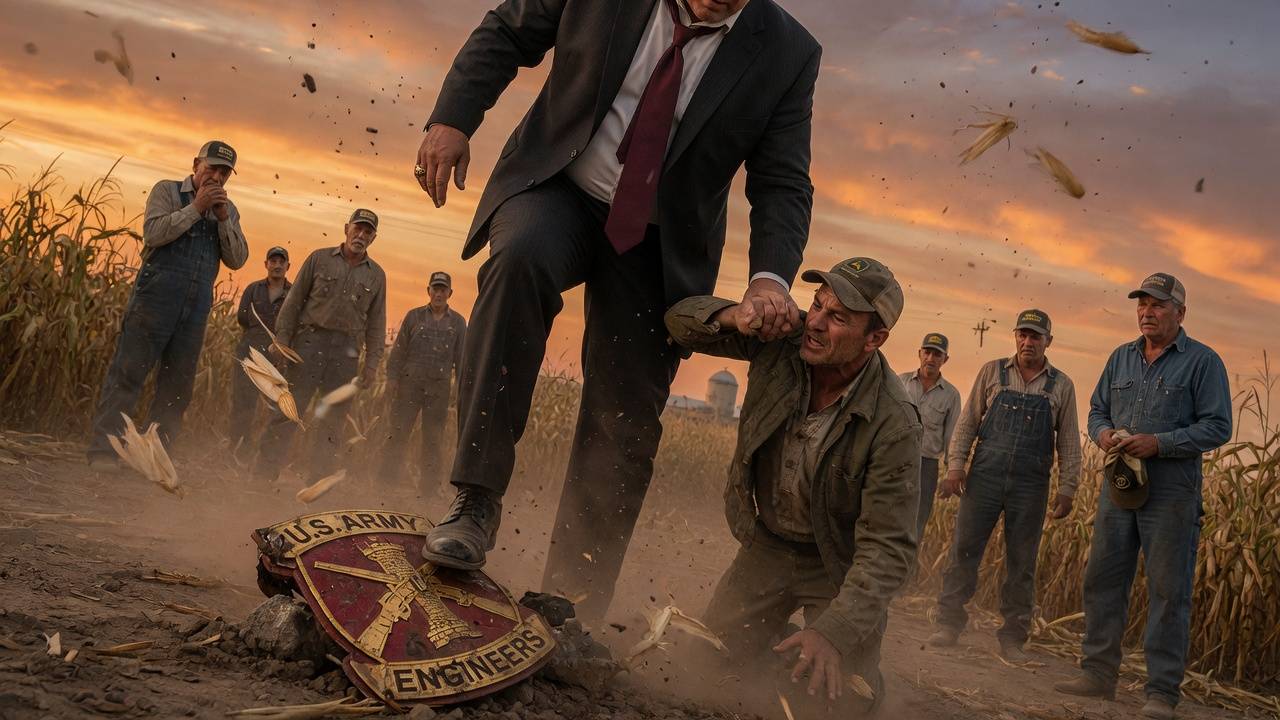
Caleb didn’t fight. He didn’t even speak. He stood with his back straight, the rusted Engineer unit crest tucked into his palm inside his closed fist. Behind him, Sterling Graves was being hauled to his feet by his Project Manager. Graves was a mess—his charcoal suit was stained with the grey-brown dust of the field, his silk tie was skewed like a broken wing, and his face was a mottled, angry red. He was gasping, clutching his chest where Caleb’s heel had landed, his eyes darting around at the silent crowd of farmers.
The silence was the most heavy thing in the field. Fifty men and women, people Caleb had gone to school with, people who had watched his father decline, were all holding their phones. They weren’t cheering. They weren’t jeering. They were witnessing. And in rural Nebraska, being witnessed was a power all its own.
“Get him out of here,” Graves wheezed, pointing a shaking finger at Caleb. “I want him charged with everything. Assault, battery, interfering with a legal auction. I want him buried!”
The Sheriff led Caleb toward the cruiser. Sarah Jenkins stepped into their path, her face a mask of controlled legal fury. She had her briefcase in one hand and her phone in the other, already on a call.
“He’s not saying a word, Sheriff,” Sarah said, her voice cutting through the humid air. “And you’re going to want to be very careful about how you process this. I have the video. I have twenty witnesses who saw Graves grab him first. This was self-defense against a physical escalation.”
“He kicked a man into the dirt, Sarah,” the Sheriff said, opening the back door of the cruiser. “That’s more than self-defense where I come from.”
“Where you come from used to be a place that respected a man’s right to stand on his own land,” Caleb said, his voice level. It was the only thing he said before he ducked his head and slid into the cramped, plastic-smelling back seat of the car.
The drive to the county seat in Broken Bow took forty minutes. Caleb spent it staring out the window at the passing miles of parched corn and sun-bleached barns. He watched the way the heat shimmered off the blacktop, thinking about the structural integrity of the bridge in Helmand. He’d always been good at seeing the weak points, the places where a little bit of pressure would cause a total collapse. Graves was a massive structure, but he was built on a foundation of debt and intimidation. He was hollow.
The jail was a small, brick building that smelled of floor wax and old coffee. They processed him in a blur of fluorescent lights and muffled questions. Caleb struggled to follow the rhythm of the booking officer’s speech, the high-pitched whine in his ear making the room feel like it was vibrating. He was stripped of his belt, his laces, and his unit crest. Seeing the silver medal placed into a plastic evidence bag felt like losing a piece of his skin.
“One phone call,” the officer said, sliding a heavy desk phone across the counter.
Caleb called the farmhouse. It took four rings before his father picked up.
“Caleb? Is that you?” Henry’s voice was thin, echoing with a confusion that twisted Caleb’s gut. “Where are you, son? The sun’s going down and the cattle haven’t been checked.”
“I’m delayed in town, Pop,” Caleb said, leaning his forehead against the cool plexiglass of the booth. “Jerry Vance is coming over to sit with you. He’ll help with the chores. You just stay inside, okay? Don’t open the door for anyone but Jerry.”
“Is it the rain?” Henry asked. “Is it finally coming?”
“Not yet, Pop. But soon.”
Caleb hung up and was led to a holding cell. It was a concrete box with a stainless steel toilet and a thin, vinyl-covered mat. He sat on the mat and closed his eyes. In the silence of the cell, the ringing in his ear was a roar. He thought about the soil samples Sarah had. He thought about the way Graves had looked on the ground—not like a mogul, but like a scared child.
Hours bled into each other. He could hear the distant murmur of the deputies in the front office, the occasional clink of keys. He calculated the weight of the debt against the value of the land. He knew the auction had been halted, but that didn’t mean the bank was gone. It just meant the clock had paused.
Around 9:00 PM, the cell door buzzed. Sarah was standing there, looking exhausted but electrified. She was holding a stack of papers and a tablet.
“You’re out on your own recognizance,” she said, her voice echoing in the small space. “The DA saw the video. Graves is screaming for blood, but the video is already at fifty thousand views on Facebook. The town is up in arms. People are calling the bank, threatening to pull their accounts if they follow through with the foreclosure under these circumstances.”
Caleb stood up, his joints popping. “The video won’t pay the mortgage, Sarah.”
“No, but this will,” she said, turning the tablet toward him. It was a news report from a station in Lincoln. The headline read: LOCAL FARMER EXPOSES POSSIBLE TOXIC DUMPING SITE IN CUSTER COUNTY.
“I sent the soil reports and the video of the confrontation to the EPA and the state attorney general,” Sarah said. “They’re sending a team out tomorrow morning. If they find what I think they’ll find, Graves’s development permits will be pulled and the land will be designated a federal investigation site. The bank can’t foreclose on land that’s under a federal environmental hold. It freezes everything.”
Caleb walked out of the cell, his mind already moving to the next phase of the demolition. “Graves won’t go quietly. He’s got too much money buried in that dirt to let a team of suits from DC dig it up.”
“He’s already moving,” Sarah said as they walked toward the exit. “Jerry Vance called me. Graves is at the development site right now. He’s got crews moving dirt, trying to cover the primary entry points before the EPA gets there at dawn. He’s panicked, Caleb.”
They stepped out into the night air. It was cooler now, a light breeze stirring the dust. Sarah’s car was idling at the curb.
“I have to go back to the farm,” Caleb said.
“Caleb, you have a restraining order. If you go near Graves or the development site tonight, you’ll be back in that cell before midnight.”
“I’m not going to the site,” Caleb said, looking toward the dark horizon where his father was waiting. “I’m going home. But Graves has to pass my fence line to get his heavy equipment out of there. And I still have my grandfather’s old welder and a lot of scrap metal.”
Sarah looked at him, her eyes searching his face. She saw the Army Engineer, the man who knew how to turn a bridge into a barrier. “Just don’t do anything that makes me have to bail you out twice in one day.”
“I’m just protecting my property, Sarah,” he said, sliding into the passenger seat.
They drove back to Oconto in a heavy silence. The town was dark, the only lights coming from the gas station and the flickering sign of the VFW. As they approached the Miller farm, Caleb saw the lights of the Escalade and several work trucks about a mile down the road, at the edge of Graves’s property. The yellow glow of floodlights cut through the dark, and the low rumble of machinery vibrated through the floorboards of the car.
Sarah dropped him off at the end of his driveway. Jerry Vance’s truck was parked near the house. Jerry was sitting on the porch steps, a shotgun resting across his knees. He stood up as Caleb approached.
“He’s trying to bury it, Caleb,” Jerry said, his voice thick with shame. “I saw the tankers. They’re dumping lime and fresh topsoil over the pits. They’re gonna hide it all before morning.”
“Not all of it,” Caleb said. He looked at the barn, then at the ruined John Deere sitting on the trailer where Graves had left it as a taunt.
Caleb walked to the barn and flipped the lights. The old welder sat in the corner, a hulking piece of cast iron that had belonged to his father. He looked at Jerry.
“You still got that old flatbed trailer, Jerry? The one with the broken axle?”
Jerry nodded. “Yeah. It’s in the weeds behind my shed.”
“Go get it,” Caleb said. “And bring every piece of heavy-duty chain you own. We’re going to build a bridge.”
“A bridge to where?” Jerry asked.
Caleb looked out at the road, his eyes narrowing. “A bridge to the end of Sterling Graves.”
For the next four hours, the smell of ozone and burning metal filled the Miller barn. Caleb worked with a frantic, precise energy. He wasn’t thinking about the law or the debt. He was thinking about the “crumbs” Graves had tried to leave him. He was thinking about the silver crest.
He welded the scrap metal into a series of jagged, heavy-duty “caltrops”—devices designed to stop heavy machinery in its tracks. He reinforced the frame of Jerry’s old trailer with steel beams, turning it into a mobile blockade. He was an engineer again, calculating load-bearing weights and points of impact.
Around 3:00 AM, the sound of the machinery down the road changed. The heavy thrum of the bulldozers faded, replaced by the high-pitched whine of transport trucks. They were moving out.
Caleb wiped the sweat and soot from his face. He looked at Jerry, who was standing by the barn door, watching the lights on the horizon.
“Is the old man asleep?” Caleb asked.
“Out like a light,” Jerry said. “He thinks it’s 1994 and the harvest is over. He’s happy, Caleb.”
“Good,” Caleb said. He climbed into his Chevy and backed it up to the trailer. “Let’s go.”
They moved the blockade to the narrowest part of the county road, right where the Miller property line met the bridge over the dry creek. It was a bottleneck, the only way out for the heavy tankers without going ten miles out of the way through the mud of the valley.
Caleb positioned the trailer across the road and chained it to the massive oak trees on either side. He scattered the caltrops in the shadows of the bridge. Then, he sat on the hood of his truck and waited.
The first truck appeared twenty minutes later. It was a white tanker, its engine straining under the weight of whatever poison it was carrying. The headlights swept across the road, catching the glint of the chains. The driver slammed on the brakes, the tires screaming against the gravel.
A second truck pulled up behind it, then the black Escalade.
Sterling Graves stepped out of the car. He looked like a man who hadn’t slept in a century. His suit was gone, replaced by a windbreaker, but his face was still the same mask of entitlement. He walked toward the blockade, his breath coming in short, ragged bursts.
He saw Caleb sitting on the hood of the Chevy, a silhouette against the pre-dawn sky.
“Miller!” Graves screamed, his voice cracking. “Move this junk! Now! I have a court order for transport!”
Caleb didn’t move. He reached into his pocket and pulled out a small, handheld radio Sarah had given him.
“You don’t have a court order for what’s in those trucks, Sterling,” Caleb said.
From the darkness of the trees, a set of blue and red lights flickered to life. Not the Sheriff this time. These were state troopers, followed by two dark SUVs with federal plates.
Sarah Jenkins stepped out of the first SUV. She was holding a folder.
“Mr. Graves,” she called out. “I believe you’re looking for these.”
She held up the federal warrants.
Graves looked at the trucks, then at the troopers, then at Caleb. The structural collapse was complete. He slumped against the side of his Escalade, the weight of his own building finally crushing him into the dirt.
Caleb stood up and walked toward the bridge. He looked at the silver crest in his hand, then at the first light of the Nebraska sun hitting the tops of the corn.
The rain still hadn’t come. But as he looked at the parched earth, Caleb felt the first drop of something cool on his cheek. It wasn’t much. Just a promise. But for the first time in ten years, it was enough.
Chapter 6
The federal investigation moved with a cold, grinding efficiency that made the local bank’s foreclosure attempts look like a playground dispute. For three weeks, the Miller farm was the epicenter of a storm. Men in white Tyvek suits crawled over the adjacent land like ghosts, pulling core samples and mapping the subterranean flow of the groundwater. The black Escalade was gone, replaced by the white vans of the EPA and the dark sedans of the Department of Justice.
Caleb watched it all from his porch. He had been cleared of the assault charges—the viral video and Graves’s subsequent federal indictment for environmental racketeering had made the DA drop the case faster than a hot coal. The town’s attitude had shifted, too. The men at the VFW who had once looked away when Caleb walked in now nodded with a grim sort of respect. He was the man who had stood his ground when the world tried to pave him over.
But the victory felt quiet. It felt heavy.
Sarah Jenkins visited every evening. She brought paperwork, news from the city, and sometimes a bag of groceries. She sat on the porch with Caleb, watching the sun dip below the horizon. The drought had finally broken, a week of steady, soaking rain turning the dust back into the rich, dark Nebraska loam.
“Graves is taking a plea deal,” Sarah said one Tuesday, leaning back in the wicker chair. “He’s naming names. The bank executives, the county board members who fast-tracked his permits. It’s a massacre, Caleb. The whole system is being gutted.”
Caleb nodded, his eyes on the corn. The stalks were greening up, but it was too late for a full harvest. Most of it would be silage this year. “What about the land?”
“The EPA is seizing the development site for remediation. They’re going to spend the next five years cleaning up the sludge Graves buried. Your property is safe, though. The flow didn’t reach the Miller well. You’re sitting on the only clean dirt for three miles.”
“The only clean dirt,” Caleb repeated. The words felt like an epitaph.
“The bank has dropped the foreclosure,” Sarah continued, her voice softening. “Between the legal pressure and the public relations nightmare, they’ve agreed to a restructuring. You’ll have twenty years to pay off the remaining debt at a zero-percent interest rate. You won’t lose the farm, Caleb.”
Caleb looked at her. He saw the woman she had become—sharp, tireless, and still carrying the same spark he’d remembered from high school. “Thank you, Sarah. I know what this cost you. The late nights, the favors you had to pull.”
“It didn’t cost me anything I wasn’t willing to spend,” she said. She reached out and took his hand. Her skin was warm, a solid reality in his quiet world. “What are you going to do now?”
“I’m going to farm,” Caleb said. “And I’m going to take care of my father.”
The mention of Henry brought a shadow to the porch. Caleb’s father had been slipping further into the fog of 1994. The excitement of the investigation, the sirens, the trucks—it had all been too much for his fractured mind to process. He spent most of his days now in his bedroom, listening to old radio broadcasts and asking for his wife, who had been gone for fifteen years.
Caleb walked Sarah to her car. As she pulled away, he stood in the driveway, the smell of damp earth filling his lungs. It was a good smell. It was the smell of a future, even if it was a hard one.
He went inside the house. It was quiet, the only sound the rhythmic tick-tock of the grandfather clock in the hall. He walked to his father’s room and pushed the door open.
Henry was sitting by the window, a quilt draped over his knees. He looked small, his skin like parchment paper. He turned as Caleb entered, a flicker of recognition in his eyes that hadn’t been there all day.
“Caleb?”
“Yeah, Pop. It’s me.”
“Did we get the crop in? I heard the rain.”
Caleb sat on the edge of the bed and took his father’s hand. “We got it in, Pop. The land is ours. Nobody’s taking it.”
Henry smiled, a slow, trembling movement of his lips. “Good. Your mother… she wanted to make sure the boy had a place to come back to. She was always worried about the world being too loud for you.”
Caleb felt a lump form in his throat, a thickness that made it hard to breathe. “The world is quiet enough tonight, Pop. It’s just us.”
Henry closed his eyes, his breathing slowing as he drifted back toward the shadows. Caleb stayed there for a long time, holding the hand that had taught him how to steer a tractor and how to hold a rifle. He thought about the bridge in Afghanistan, the one he’d blown up to save his unit. He’d spent so much of his life tearing things down. He wondered if he had enough time left to build something that would last.
Two months later, the Miller farm was a different place. The yellow tape of the EPA was still visible on the horizon, but the immediate yard had been cleared of the auctioneer’s debris. Caleb had used the last of his savings to buy a used tractor—not as fancy as the John Deere, but it ran.
Jerry Vance had come over to help him clear the caltrops from the bridge. They worked in a comfortable silence, two men who had almost lost everything and had found a way to bridge the gap between them. Jerry didn’t talk about Graves, and Caleb didn’t ask. They just worked.
On a crisp October afternoon, Caleb stood in the middle of the field where the confrontation had happened. The soil was firm under his boots. He reached into his pocket and pulled out the silver Engineer unit crest. He’d had a local jeweler in Broken Bow straighten it out and polish the silver. It caught the light, the eagle’s wings reflecting the wide, blue Nebraska sky.
He walked to the old oak tree at the edge of the property, the one his grandfather had planted when he’d first cleared the land. Caleb took a hammer and a single, long nail from his tool belt. He positioned the crest against the rough bark of the tree, right at eye level.
He hammered the nail home. Clang. Clang. Clang.
The sound echoed across the empty field, a sharp, metallic rhythm that Caleb could feel in his good ear. It was a marker. A boundary. A reminder of what had been defended.
He stepped back and looked at the tree. The silver crest looked like it belonged there, a part of the landscape. It was no longer a piece of a ruined tractor or a relic of a war in a far-off land. It was the heart of the Miller farm.
Caleb turned and walked back toward the house. He could see the light in the kitchen window, the silhouette of his father sitting at the table. He could hear the low rumble of a truck coming down the county road—Sarah’s truck.
He didn’t look back at the EPA site or the empty fields of his neighbors who had sold out. He looked at the porch. He looked at the door.
He walked up the steps, his boots heavy with the dirt of a place that was finally, truly his. He opened the door and stepped inside, leaving the silence behind him. The world was still quiet, but as he closed the door, Caleb Miller realized he didn’t need to hear the world to know he was home.
The soil was clean. The debt was managed. And for the first time in his life, the man who had built bridges under fire was standing on one that wasn’t going to break.