Chapter 5
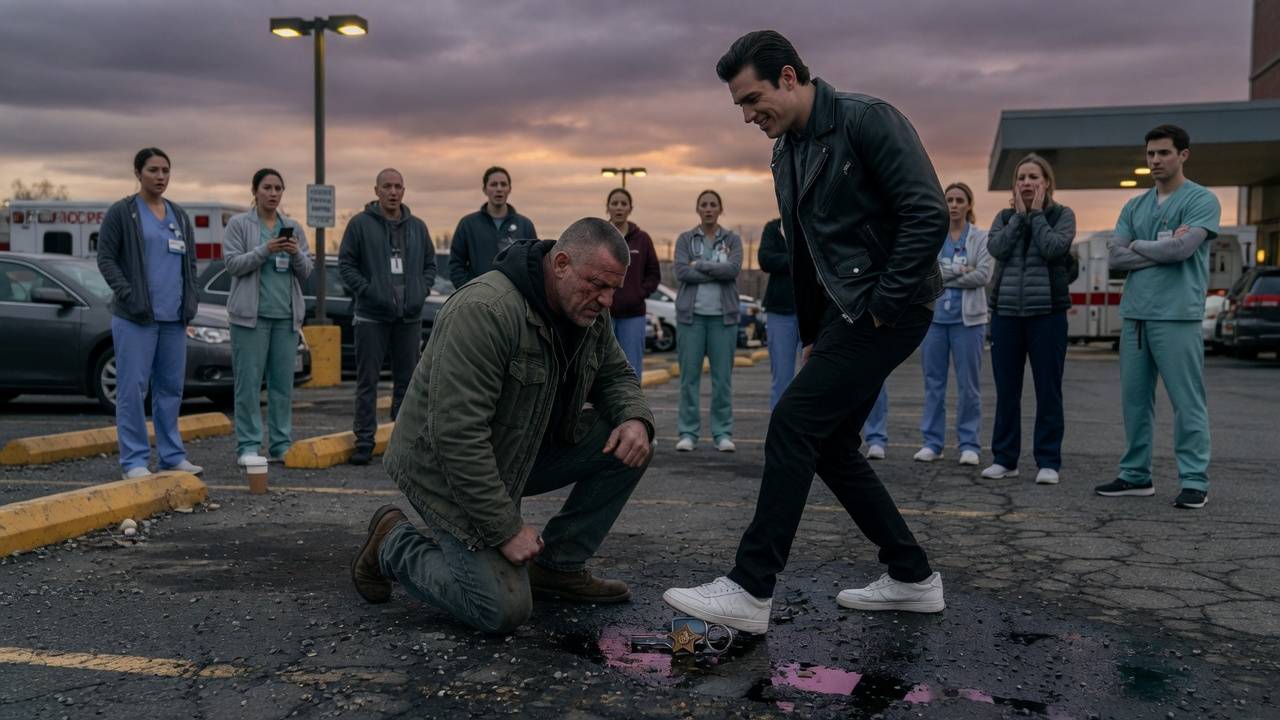
The silence that followed the crack of Trent’s body against the asphalt was the loudest thing Marcus had ever heard. It wasn’t the peaceful silence of the woods or the respectful silence of a chapel; it was the vacuum that forms right before a storm breaks. Marcus stood over Trent, his chest rising and falling in a slow, tectonic rhythm. He felt the phantom vibration in his palm from the strike, a sensation he hadn’t felt in nearly a decade.
For a few seconds, the world was a series of still images. The nurses with their mouths open, hands frozen over their mouths. The rich kids, suddenly stripped of their snark, looking like children who had just seen a magic trick go horribly wrong. And Trent—Trent was the center of it all, a broken pile of expensive leather and bruised ego, gasping for air that his lungs seemed to have forgotten how to process.
Marcus reached down and picked up his grandfather’s medal. The bronze felt hot against his skin. He didn’t look back at the crowd. He didn’t look at the security guards who were now running toward the scene, their radios crackling with urgent, distorted voices. He walked toward his Harley, his boots sounding like hammer blows on the wet pavement.
“Hey! Don’t move! Stay where you are!”
The voice belonged to a hospital security guard, a man named Miller who Marcus recognized from his daily visits. Miller was out of breath, his hand resting tentatively on his belt. He looked at Trent, then at Marcus, and his eyes were filled with a mixture of professional duty and personal terror.
Marcus didn’t stop. He swung his leg over the bike and thumbed the starter. The engine roared to life, a deep, guttural growl that seemed to vibrate in Marcus’s very bones.
“Marcus, man, just wait,” Miller shouted, his voice cracking. “I saw what happened. He started it, okay? I saw him step on the thing. But you can’t just leave.”
Marcus looked at Miller. “My mother is in room 312,” he said, his voice as cold and hard as the bike’s frame. “Tell the police they can find me there when visiting hours are over. But if anyone touches my bike, I’m coming back down.”
He didn’t wait for an answer. He throttled the bike and pulled away, the tires kicking up a spray of oily water that hit the front of Trent’s Ducati. He parked in the overflow lot, far from the neon bikes and the prying eyes of the crowd, and walked back into the hospital through the side entrance.
The hallway felt different now. The fluorescent lights were too bright, the smell of bleach too sharp. He felt the weight of the cameras following him. He knew the video was already being uploaded, shared, and dissected. By tomorrow, he wouldn’t be just a veteran or a son; he would be a viral monster, the “Old Man Who Snapped.”
He entered Martha’s room and closed the door, leaning his back against it. The room was dim, the only light coming from the monitors that tracked his mother’s fragile life. He stood there for a long time, watching the green line of her heartbeat pulse across the screen.
“Marcus?”
Her voice was weaker than it had been an hour ago. He walked to the bedside and took her hand. It was cold.
“I’m here, Ma.”
“You… you smell like the rain,” she whispered. She opened her eyes, and for a moment, they seemed clear, the fog of the morphine lifting just enough for her to really see him. She looked at his face, at the tightness in his jaw, at the way his hands were still shaking with adrenaline. “What happened?”
“Nothing,” he said, his voice thick. “Just a disagreement in the parking lot. Nothing for you to worry about.”
“You were always a terrible liar,” she said, a ghost of a smile touching her lips. “Even when you were five and tried to hide the broken vase. You have that look in your eye. The soldier look.”
Marcus squeezed her hand. “I’m just tired, Ma. It’s been a long day.”
“They’re going to come for you, aren’t they?” she asked. It wasn’t a question of if, but when. She knew the world Marcus lived in, a world where men like him were only tolerated as long as they stayed in their cages.
“I’m not going anywhere until you’re better,” he promised, though he knew it was a lie they both needed to hear.
The door opened behind him, and Leo, the salvage yard owner, stepped inside. His face was grim, his grease-stained cap pulled low over his eyes. He didn’t say a word; he just handed Marcus a phone.
The video was already on the local news site. The title was a scream: VETERAN ATTACKS SON OF MAYORAL CANDIDATE AT REGIONAL HOSPITAL.
The footage was grainy, but Marcus’s face was unmistakable. The comments were a battlefield. Some were calling him a hero, but most were calling for his head. Trent’s father, Richard Vaughn, was already on screen in a pre-recorded clip, his face a mask of righteous fury.
“This wasn’t a fight,” Vaughn was saying, his voice booming through the phone’s small speaker. “This was a calculated assault on a young man who was simply trying to clear a path for emergency vehicles. This man is a violent felon with a history of instability. We will be pursuing the maximum charges.”
Leo took the phone back. “They’re downstairs, Marcus. Two cruisers. And Vaughn’s lawyer is with them. They aren’t waiting for visiting hours to end.”
Marcus looked at his mother. She had closed her eyes again, her breathing becoming shallow and ragged. The monitor beeped—a steady, rhythmic reminder of the clock that was ticking down for both of them.
“I can’t go back to jail, Leo,” Marcus whispered. “If I go, she’s got nobody. Vaughn will have her moved to the county home by morning just to spite me.”
“I know,” Leo said. He reached into his pocket and pulled out a set of keys. “Take my truck. It’s in the loading dock. I’ll stay with her. I’ll call my sister, she’s a head nurse in Montgomery. We’ll get her moved before the paperwork catches up. But you gotta go now.”
“I’m not leaving her.”
“Marcus, look at me,” Leo said, grabbing him by the shoulders. “If they arrest you here, you’re done. You can’t help her from a cell. If you leave, you have a chance to find the truth about why you were kicked out. I found something in the old files at the yard, Marcus. Records from the base. Your old Colonel… he wasn’t just hiding a mistake. He was running a kickback scheme on the equipment. That’s why you had to go. You knew too much.”
The secret. The old wound that had never stopped bleeding. Marcus felt the pieces shifting in his mind. He wasn’t just a victim of bad luck; he was a loose end that had been tucked away.
The sound of heavy boots echoed in the hallway. A radio squawked just outside the door.
Marcus looked at Martha one last time. He leaned down and whispered into her ear, “I’ll be back for you, Ma. I promise.”
He slipped out the door just as the elevator doors at the end of the hall opened. He didn’t run; he moved with the practiced stealth of a man who had spent his youth in the shadows of the Appalachian hills. He made it to the loading dock, the cool night air hitting him like a physical blow.
Leo’s truck was an old Chevy, rusted and loud, but the engine turned over on the first try. As Marcus pulled out of the hospital gates, he saw the red and blue lights flashing in his rearview mirror. They weren’t behind him yet, but the hunt had begun.
He drove toward the state line, his mind racing. He had no money, no plan, and a target on his back. But for the first time in years, he didn’t feel like a dog being kicked. He felt like a man with a mission. He had the medal in his pocket, the truth in his reach, and the memory of Trent’s terror to keep him warm.
The peace he had been looking for in the chrome and the grease was gone. In its place was a cold, hard clarity. He was going back to the beginning. He was going to find the Colonel, and he was going to make sure the next person who stepped on his honor realized exactly what kind of monster they were waking up.
Chapter 6
The drive to Fort Benning took four hours Marcus didn’t have. He stayed off the interstates, threading the old Chevy through the backroads of Alabama and into the Georgia pines. The rain had turned into a thick, clinging mist that blurred the edges of the world, making the headlights look like dying stars.
He was running on coffee and adrenaline, the kind that leaves a metallic taste in the back of your throat. Every time he passed a local deputy, he felt his heart hammer against his ribs, but the old truck was invisible, just another piece of rural machinery moving through the dark.
He pulled into a truck stop twenty miles outside the base and used the payphone. He didn’t want to use his own cell; he knew they’d be tracking the pings the second Vaughn’s lawyers got the warrant signed.
“Leo? It’s me.”
“Marcus, thank god,” Leo’s voice was strained, the sound of a man who had spent the night in a hospital chair. “The police were all over the room ten minutes after you left. They didn’t find anything, but they’re pissed. Vaughn’s on every news channel. He’s calling for a task force. He’s making this his campaign platform—’Clean Up the Streets.'”
“How’s Ma?”
There was a long pause, the kind of silence that tells a story before the words do. “She’s stable, Marcus. But she’s confused. She keeps asking why you’re not there. I told her you had to go get some parts for the bike. My sister… she’s working on the transfer. We’re moving her at 4:00 AM. They won’t look for her in Montgomery for at least a day.”
“I found the Colonel’s address, Leo. He’s not at the base. He’s retired. He’s got a big place on the lake in Eufaula. I’m going there.”
“Marcus, don’t,” Leo urged. “If you go there, you’re giving them everything they need to bury you. Just stay low. We’ll get a lawyer. We’ll fight the Trent thing.”
“It’s not about Trent anymore,” Marcus said, looking at his reflection in the greasy glass of the phone booth. He looked older, grimmer, but the slouch was gone. “Trent was just the crack in the dam. If I don’t fix the reason I’m a ‘disgraced veteran,’ they’ll use it to take her away from me every time I try to stand up. I’m tired of being the dog, Leo. I’m going to the source.”
He hung up before Leo could argue.
The house in Eufaula was a sprawling colonial, all white pillars and manicured lawns that rolled down to the black water of the lake. It was the kind of house a man buys when he’s spent his life taking more than his share.
Marcus parked the truck a mile away and walked the rest. The ground was soft, the pine needles muffling his steps. He didn’t have a weapon. He didn’t need one. He had twenty years of muscle memory and a debt that was ten years past due.
He saw the Colonel through the wide windows of the study. Colonel Harrison was older now, his hair a shock of white, but he still carried himself with that same unearned arrogance. He was sitting in a leather chair, a glass of scotch in one hand and a cigar in the other. He looked like a man who slept very well at night.
Marcus didn’t knock. He walked to the back patio, found the sliding door unlocked—men like Harrison always think they’re untouchable—and stepped into the room.
The Colonel didn’t even turn around. “I told you I was finished with the paperwork, Diane. Bring me the file on the—”
He stopped. He’d smelled the rain, the grease, and the cold air. He turned slowly, his eyes narrowing as he took in the man standing in his study.
“Marcus,” he said, his voice dropping an octave. He didn’t look afraid; he looked annoyed. “I heard you were making a name for yourself in Birmingham. Attacking a politician’s son? You always were a blunt instrument.”
“I’m not here for the boy,” Marcus said. He walked to the center of the room, his boots leaving dark smudges on the cream-colored rug. “I’m here for the file, Harrison. The one Leo found. The kickback records. The ones you used to buy this house while I was working for five dollars an hour in a scrap yard.”
Harrison laughed, a dry, dusty sound. “You’re a felon, Marcus. Even if you found a piece of paper, who would believe you? You’re a violent, unstable man who just beat a kid half to death on camera. You’re a liability.”
“I was a liability because I wouldn’t take the bribe,” Marcus countered. “Now I’m a liability because I have nothing left to lose. My mother is dying, Harrison. And your friend Vaughn is trying to use my life to win an election. I’m done being the fall guy.”
Marcus reached into his pocket and pulled out the medal. He set it on the mahogany desk between them.
“My grandfather earned this,” Marcus said quietly. “You stole the name that went with it. I want a signed confession. I want the records of the procurement fraud. And I want them tonight.”
Harrison stood up, his face reddening. “You’re delusional. Get out of my house before I call the sheriff. I’ll have you in a cage by midnight.”
He reached for the phone on the desk, but Marcus was faster. He didn’t hit him. He simply placed his hand over Harrison’s, his grip like a steel vise.
“You think I’m afraid of a cage?” Marcus asked, leaning in until his face was inches from the Colonel’s. “I’ve been in a cage for ten years. The cage of your lies. The cage of poverty. The cage of watching my mother fade away because I couldn’t afford the doctors you can buy with your scotch money. I’m not leaving without the truth.”
The two men stared at each other for a long minute. The silence was heavy, the air thick with the history of a betrayal that had shaped both their lives. Then, slowly, Marcus felt the tension leave Harrison’s hand. The Colonel looked at the medal, then back at Marcus.
“You think this changes anything?” Harrison whispered. “Even if I give you what you want, you’re still a marked man.”
“Maybe,” Marcus said. “But the mark will be on both of us.”
Two hours later, Marcus was back in the truck. In his lap was a thick manila folder, the pages filled with the dates, names, and dollar amounts of a decade of corruption. It wasn’t just Harrison; it was a network. And at the bottom of the list, as a silent partner in the shipping company, was the name Richard Vaughn.
Marcus felt a cold, sharp sense of victory. It wasn’t the kind of victory that makes you want to cheer. it was the kind that makes you want to sleep for a week.
He drove back toward Birmingham, the sun starting to bleed over the horizon in shades of bruised purple and orange. He stopped at a diner on the outskirts of town and used the Wi-Fi to send the documents to every news outlet in the state, including the one that had aired the video of the fight.
He then called Leo.
“Is she moved?”
“She’s in Montgomery, Marcus,” Leo said, his voice sounding lighter than it had in days. “She’s safe. And Marcus… have you seen the news?”
“Not yet.”
“Vaughn just pulled out of the race. He’s ‘handling a family crisis.’ And Harrison… Harrison’s house is surrounded by the FBI. I don’t know what you did, man, but you did it.”
Marcus leaned his head against the steering wheel. The weight he’d been carrying for a decade didn’t disappear, but it shifted. It became manageable.
“I’m coming in, Leo. I’m going to turn myself in for the Trent thing. I’ll take the assault charge if I have to. But tell Ma… tell her the bike is fixed. I’m coming home.”
He pulled the Harley’s keys out of his pocket. The medal was back on the ring, the bronze shining in the early morning light. He walked out of the diner and saw a police cruiser pulling into the lot.
Marcus didn’t run. He didn’t reach for his pockets. He simply stood by the truck, his hands visible, his head held high. As the officer stepped out of the car, his hand on his holster, Marcus looked at the sky.
The rain had stopped. The air was clear.
“Marcus Thorne?” the officer asked, his voice cautious.
“That’s me,” Marcus said. He felt the cold metal of the handcuffs click around his wrists, but for the first time in ten years, he didn’t feel like a prisoner. He felt like a man who had finally found the peace he was looking for, not in the silence of the woods, but in the heat of the truth.
As they led him toward the car, he looked at his grandfather’s medal one last time. It was scratched, tarnished, and had spent the night in the dirt. But it was his. And as long as he had it, he knew he would never have to bark for anyone ever again.