Chapter 5
The silence that followed the slamming of the library’s heavy oak doors was more deafening than the confrontation itself. Jude stood in the center of the lobby, his chest heaving with a rhythm he hadn’t felt in fifteen years—the steady, cold thrum of a soldier who had just stepped out of the wire. His knuckles were white, the skin split across the joint of his right hand where it had connected with Sterling’s sternum.
Behind him, the teenagers were frozen. Sarah was clutching a stack of memoirs so tightly the dust jackets were beginning to tear. Leo was the first to move, lowering his phone, his eyes wide and shimmering with a mixture of terror and awe.
“You… you k-k-killed him,” Leo whispered.
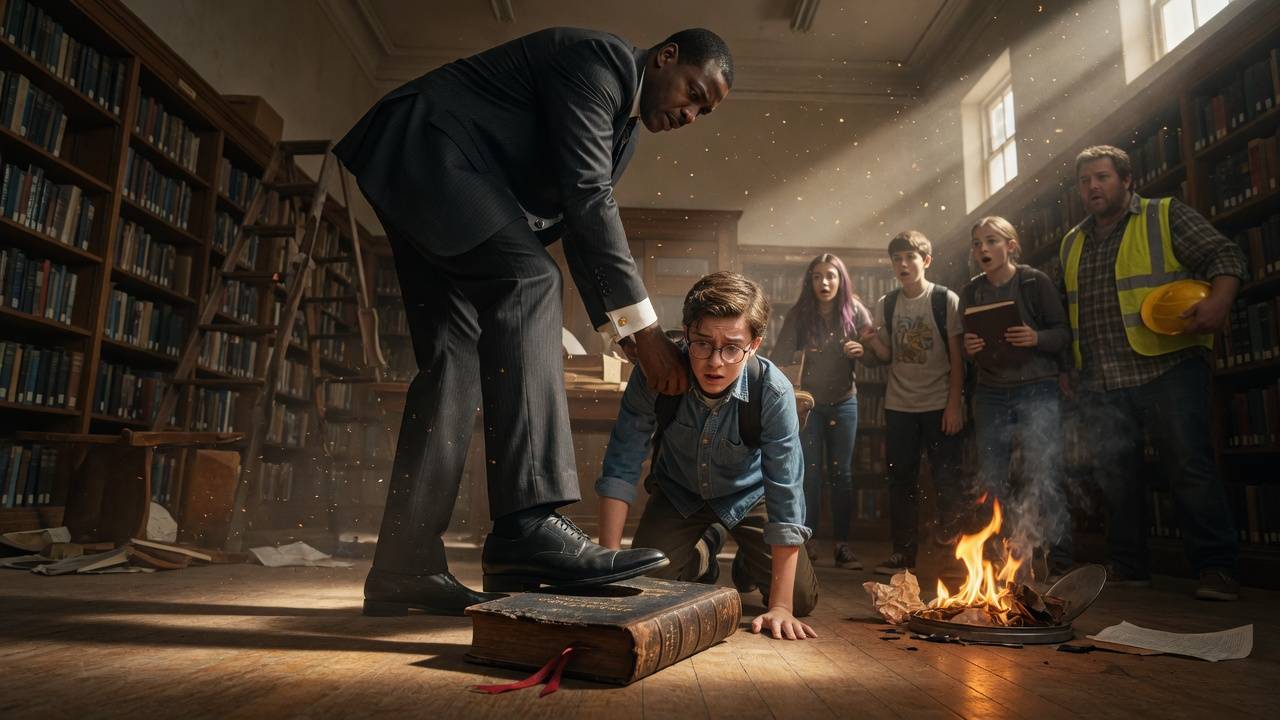
“He’s breathing, Leo,” Jude said, his voice sounding like it was coming from the bottom of a well. He looked at the floor—at the wreckage of his mother’s magnifying glass. The brass rim was twisted, the glass ground into fine, sparkling sand. The loss of it felt like a fresh wound, a physical ache in his solar plexus that far outweighed the sting in his hand.
“Jude,” Sarah breathed, stepping forward. “The police. They’re going to come. He’s going to call them.”
“I know,” Jude said. He turned to her, and the look in his eyes made her flinch. It wasn’t malice; it was the look of a man who had already calculated the trajectory of his own ruin. “Sarah, take the kids out the back. Go home. Don’t talk to anyone. If the police stop you, tell them you were in the stacks and didn’t see anything. Leo, give me the phone.”
Leo hesitated, then handed over the device. Jude deleted the local file, but he knew it didn’t matter. The boy had already hit ‘upload.’ Within minutes, the digital ghost of Jude’s past would be screaming across the local servers.
By the time the sirens began their low, mournful wail from three blocks away, Jude was sitting behind the circulation desk. He had swept the glass into a neat pile. He had straightened his cardigan. He looked, for all the world, like a librarian waiting for a late return.
The doors burst open. It wasn’t the local deputies. It was three men in tactical vests, their movements synchronized and silent in a way that screamed federal oversight. Behind them came Sterling Graves, his charcoal suit jacket gone, his white shirt torn and stained with floor wax. He held a bag of ice to his chest, his face a mask of purple-bruised fury.
“That’s him,” Graves hissed, pointing a trembling finger. “That’s the psychopath. He attacked me. I have witnesses.”
The lead officer, a man with the kind of anonymous face Jude had seen in a thousand briefings, didn’t draw a weapon. He just stared at Jude. “Jude Miller? Or should I say, Marcus Thorne?”
Jude didn’t flinch. He didn’t deny it. The name Thorne felt like a heavy coat he hadn’t worn in a long time. “Thorne was a traitor, according to your paperwork. I’m just a librarian.”
“Search the Rare Books room,” the lead officer commanded, ignoring Jude. “Check the botanical journals. Page by page.”
Graves stepped forward, sensing the shift in power. He walked around the desk, leaning over the counter until he was inches from Jude’s face. The ice bag dripped onto the mahogany. “You think you won because you landed a lucky kick? I own the sheriff. I own the judge. And it turns out, I’m working with people who make me look like a saint. You’re going to a black site, Thorne. And I’m going to watch the bulldozers turn this place into a parking lot before the sun goes down tomorrow.”
Jude looked at him. He didn’t see a developer anymore. He saw a man who had no idea he was standing on a landmine. “You shouldn’t have brought them here, Sterling. They don’t share. Once they have what’s in those books, you’re just a witness to a federal seizure. Do you think they’re going to let you build a casino on top of a national security breach?”
Graves’s smirk wavered. He looked at the federal agents, who were already pulling 19th-century volumes off the shelves with reckless disregard for the spines. They weren’t looking for building violations. They were looking for the Archive.
“Shut up,” Graves snapped, but the confidence was leaking out of his voice. He reached out to shove Jude’s shoulder, a reflex of his bullying nature, but he stopped six inches short, his hand shaking. The memory of the palm-heel strike was still written in his nervous system.
The lead agent walked back into the lobby, holding a copy of The Flora of the Ohio Valley. He had a handheld scanner in his other hand. He clicked it. A green light washed over a woodcut of a Lady’s Slipper. The scanner chirped.
“Encrypted micro-dots,” the agent said. “He’s been sitting on the whole liquidation list for fifteen years.” He looked at Jude with a grim sort of respect. “How did you think this would end, Thorne? You thought you could just hide in a town with one stoplight and read poetry until you died?”
“I thought people deserved to be remembered,” Jude said.
“They were erased for a reason,” the agent replied. He signaled to his men. “Cuff him. Clear the building. Bring the contractor in. I want the structural integrity compromised before the town council can file an injunction. We’ll call it a safety demolition due to the ‘altercation.'”
As they pulled Jude from his chair, Graves followed them toward the door, his voice rising in a desperate attempt to reclaim the lead. “Wait, the demolition! My crew is already outside. We can start now! Miller—I mean Thorne—you see that? You see the trucks?”
Jude was led past the front windows. Outside, a crowd of townspeople had gathered behind the police tape. He saw Sarah crying. He saw Leo standing with his father, holding his phone up like a shield.
“The truth is already out, Sterling,” Jude said as they shoved him into the back of a black SUV. “Check your phone.”
Graves pulled his device from his pocket. His face went gray. The video of the humiliation—the glass breaking, the grab, the warning, and then the devastatingly professional takedown—was trending. But it wasn’t just the fight. Leo had included a caption Jude hadn’t expected: THE LIBRARIAN IS PROTECTING THE NAMES. SEARCH ‘ARCHIVE OHIO’.
The digital trail was live. The secret Jude had spent a decade hiding was no longer a secret. It was a movement.
Chapter 6
The holding cell in the county basement smelled of damp concrete and old cigarettes. Jude sat on the bench, his hands cuffed to a rail. He wasn’t afraid. For the first time since he’d walked out of D.C., the weight in his chest was gone. He had traded his safety for the truth, and the bargain felt clean.
The door opened. It wasn’t the federal agent. It was Senator Thomas Vance—his foil, his mirror, the man who had been his commanding officer the night the data was supposed to be deleted. Vance looked older, his skin sallow under the fluorescent lights, his expensive suit seemingly the only thing holding his posture together.
“You always were a stubborn son of a bitch, Marcus,” Vance said, leaning against the cell bars.
“And you always were a coward, Tom,” Jude replied. “How much did Graves pay you to look the other way on the library’s historic status?”
Vance sighed, a long, rattling sound. “It wasn’t about the money. It was about the silence. If that library stayed, those books stayed. If those books stayed, eventually someone with a magnifying glass and too much time would find what you did. I needed that building gone as much as Graves did.”
“Except Sterling got greedy,” Jude said. “He made it personal. He humiliated the wrong man in front of a generation of kids who know how to use the internet better than you do.”
Vance looked at a tablet on the small table. “The video has four million views, Marcus. People are asking what ‘The Names’ are. The DOJ is breathing down my neck. They can’t just make you disappear now. Not with the whole world watching the ‘Warrior Librarian’ get hauled off in chains.”
“So what happens now?”
“Now,” Vance said, his voice dropping to a whisper, “the federal team is scrubbing the Rare Books room. They’re taking the journals. But Graves… Graves is finished. The town council saw the video of him attacking a fifty-year-old man and crushing a family heirloom. They’ve revoked his development permits on moral turpitude grounds. The library is being boarded up, but it won’t be torn down. Not today.”
Jude closed his eyes. The library is safe.
“And me?”
“You’re going to a high-security facility while they decide if they want to risk a public trial where you’ll testify about the liquidation lists,” Vance said. He looked at Jude with a sudden, sharp envy. “You won, you idiot. You’re going to spend the rest of your life in a cage, but those people… those ten thousand names… they’re in the cloud now. You grew a forest in a dusty room, and now it’s too big to cut down.”
Two hours later, Jude was led out of the precinct to a transport van. The sun was setting, casting long, amber shadows across the town square. As he stepped onto the sidewalk, he saw them.
Hundreds of people.
They weren’t shouting or throwing rocks. They were standing in silence. Every single one of them—Sarah, Leo, the grocery store clerks, the mechanics from the garage—was holding a book. Some held bibles, some held battered paperbacks, some held school textbooks.
As Jude was led toward the van, Leo stepped forward. The police moved to block him, but the boy didn’t run. He held up a new magnifying glass—a simple, plastic thing from the pharmacy—and set it on the hood of the police car.
“We r-r-read them, Mr. Jude,” Leo called out, his voice cracking but clear. “We’re r-reading all of them.”
Jude stopped. He looked at the boy, then at the town he had tried to remain invisible in. He realized that the residue of his confrontation wasn’t just the bruise on Graves’s chest or the cuffs on his own wrists. It was the awakening of a town that had forgotten it had a heart.
He climbed into the van. The door slammed shut, plunging him into darkness. As the vehicle pulled away, Jude leaned his head against the cold metal wall.
He thought about the Rare Books room, now empty of its secret treasure. He thought about his mother’s voice, telling him that a library was the only place where the small and the forgotten could be giants.
He had lost his name, his home, and his freedom. But as the van turned the corner and the town of West St. faded into the rearview, Jude Miller smiled. The truth didn’t need a building anymore. It had a heartbeat.
And in the silence of the van, Jude finally let go of Marcus Thorne. He was just a man who had protected the books. And that was more than enough.