Chapter 5: The Aftermath of Highway 49
The silence that followed the departure of the Highway Patrol was heavier than the roar of the milling machine had ever been. Silas stood in the center of the construction zone, the neon orange of his vest now stained with mud and the champagne Colton had sprayed. The amber floodlights continued to pulse, but the stage was empty. Colton had been taken away in the back of a cruiser, sobbing and clutching his chest, while his friends had been led to a separate vehicle, their silence finally total.
Silas looked down at his hands. They were steady, but he could feel the ghost of the impact in his palms—the solid, unforgiving resistance of Colton’s sternum. It was a familiar sensation, one he had spent three years trying to forget. He had promised Maya he wouldn’t be that man anymore. He had promised himself that the “Sarge” was dead, buried under layers of civilian paperwork and the quiet routine of fatherhood.
“Sarge?”
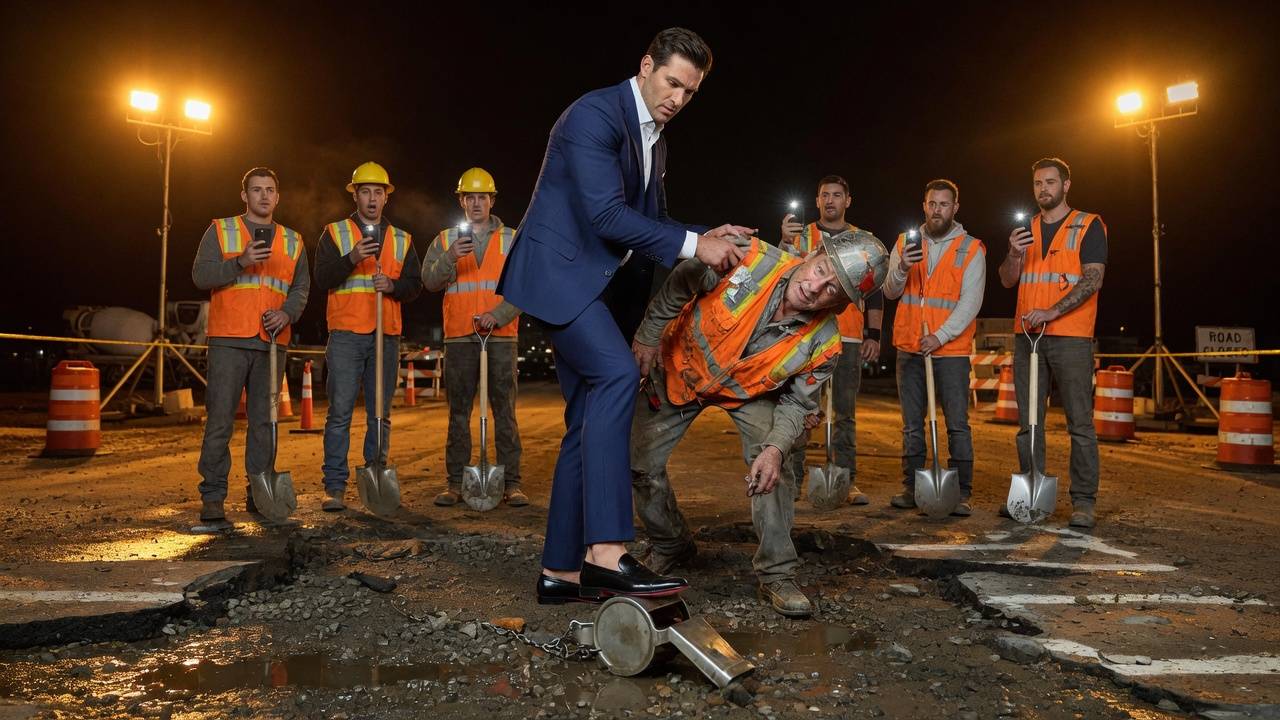
It was Miller. The kid was standing a few feet away, his shovel leaning against his leg. He looked at Silas with a mixture of awe and something that looked like fear. The rest of the crew was huddled near the supervisor’s truck, their whispers carrying on the humid night air. They weren’t looking at Silas the flagger anymore. They were looking at the man who had just dismantled a Sterling.
“The Foreman wants to see you,” Miller said, his voice dropping. “He’s on the phone with the main office. They’re saying the Sheriff already called the super. They’re saying you’re a liability, Silas.”
Silas nodded, wiping a smear of grease from his forearm. He wasn’t surprised. In a county like this, justice wasn’t a blindfolded woman with a scale; it was a ledger where the name at the top always won. He walked toward the supervisor’s trailer, his boots crunching in the gravel. Every step felt like he was walking back into a cage he had only just escaped.
Inside the trailer, the air was cold and smelled of stale coffee and blueprints. The Foreman, a man named Henderson who had spent thirty years avoiding conflict, was staring at a computer screen, his face pale in the blue light.
“Silas,” Henderson said, not looking up. “What the hell were you thinking?”
“He was drunk, Henderson. He hit someone at Mile 42. And he was harassing a witness.”
“I don’t care if he was the Zodiac Killer,” Henderson snapped, finally turning around. His eyes were wide with a frantic, desperate kind of panic. “That was Colton Sterling. Do you have any idea what his father is going to do to this company? We have three state contracts pending. If the Sterlings pull their support, we’re done. Two hundred men out of work because you couldn’t take a shove?”
“He stepped on my grandfather’s whistle,” Silas said, his voice low. “And he put his hands on me. I defended myself.”
“Defended yourself? You put him in the hospital! The paramedics are saying he might have a cracked sternum. They’re calling it aggravated assault, Silas. Because of your record.”
Henderson stood up, his hands shaking as he lit a cigarette. “The Sheriff is on his way back. He didn’t want to arrest you in front of the crew because he’s afraid of a riot, but he’s coming. He told me to tell you to wait here. But Silas…”
Henderson paused, looking at the door, then back at Silas. There was a flicker of something in his eyes—not quite guilt, but a recognition of the unfairness of the world they lived in.
“If I were you,” Henderson whispered, “I’d go see your daughter. Because after tonight, you might not see her for a long time.”
Silas didn’t say thank you. He didn’t say anything. He walked out of the trailer and back into the humid night. The girl from the shed was gone, taken to a safe house by the female deputy Silas had recognized—the one who had served under him in Garmis. She had looked at him before she left, a sharp, professional nod that said I’ve got her, Sarge. Now you take care of yourself.
Silas walked past Miller, past the staring crew, and toward his beat-up Ford F-150. He didn’t clock out. He didn’t put away his sign. He just drove.
The drive back to his apartment was a blur of dark pines and flashing yellow lights. His mind was racing, calculating the moves like he was back in a tactical operations center. The Sterlings would move fast. They’d have a lawyer at the jail before Colton was even processed. They’d have the dashcam footage suppressed or edited. And they’d go after Silas’s probation.
He pulled into the parking lot of the sagging apartment complex where he lived. The light in the front window was on. Maya was waiting for him.
He sat in the truck for a moment, his forehead resting against the steering wheel. He could still feel the silver whistle in his pocket, its edges sharp and broken. He had stood his ground. He had protected the witness. He had done the “right thing.” And now, he was going to lose the only thing that actually mattered.
He opened the door to the apartment. The air inside smelled like cinnamon and old carpet. Maya was curled up on the sofa, a book face-down on her chest, her small chest rising and falling in the rhythmic peace of childhood.
Silas knelt beside her, his hand trembling as he brushed a stray hair from her forehead. He was still wearing the orange vest. He looked like a neon warning sign in the middle of her quiet world.
“Daddy?” she whispered, her eyes fluttering open. She sat up, rubbing her eyes. “You’re early.”
“Shift ended a bit fast, bug,” Silas said, forcing a smile that didn’t reach his eyes.
She looked at his vest, then at the dirt on his face. “You look tired. Did something happen?”
Silas pulled the crushed silver whistle from his pocket and held it out to her. She took it, her small fingers tracing the flattened metal.
“Is this… Grandpa’s?” she asked, her voice hushed.
“Yeah. It got caught in some machinery. I’m sorry, Maya. I know how much you liked the sound it made.”
She looked at the whistle, then up at him, her eyes wise beyond her seven years. “Did you use it to help someone, Daddy? Like the stories?”
Silas felt a lump in his throat that he couldn’t swallow. “I tried, Maya. I really tried.”
He spent the next hour packing a small bag for her. He told her she was going to stay with her aunt in Memphis for a few days—a “surprise vacation.” He didn’t tell her that the Sheriff was currently speeding toward their door. He didn’t tell her that his “integrity” had just cost them their life.
As he was zipping the bag, there was a heavy knock at the door. Not the rhythmic knock of a neighbor. The rhythmic, authoritative thud of the law.
“Silas Vance! Open the door! It’s the Sheriff’s Department!”
Maya looked at the door, her face turning pale. “Daddy? Why are they here?”
Silas knelt down and took her by the shoulders. “Listen to me, Maya. I need you to go into your bedroom and lock the door. Don’t come out until your aunt gets here. I’ve already called her. Do you understand?”
“But Daddy—”
“Do you understand, Maya?”
She nodded, tears welling in her eyes. She grabbed the crushed whistle and ran into her room. Silas heard the click of the lock. It was the hardest sound he had ever heard.
He stood up, straightened his orange vest, and walked to the door. He didn’t feel like a victim. He didn’t feel like a flagger. He felt like a soldier who had completed his final mission.
He opened the door. Sheriff Miller—no relation to the kid on the crew—was standing there, his hand on his holster, two deputies behind him with their tasers drawn.
“Silas Vance,” the Sheriff said, his face a mask of bureaucratic indifference. “You’re under arrest for aggravated assault and violation of probation. Hands behind your head. Now.”
Silas didn’t resist. He turned around, interlacing his fingers behind his head. As the cold steel of the handcuffs clicked shut around his wrists, he looked through the window at the dark Mississippi sky. He had lost the battle, but he knew the war was just beginning.
Chapter 6: The Final Guard
The jail cell smelled of industrial bleach and old sweat. Silas sat on the thin mattress, his back against the cold concrete wall. It had been forty-eight hours since the night on Highway 49. In that time, the Sterling machine had worked with terrifying efficiency.
The local news had run a story about a “disturbed veteran” attacking the son of a prominent citizen. Colton was being portrayed as a victim of a “random act of violence” by a man with a history of disciplinary issues. There was no mention of the hit-and-run at Mile 42. There was no mention of the witness in the shed.
His lawyer—a public defender named Sarah who looked like she hadn’t slept since the nineties—had visited him that morning.
“It’s not good, Silas,” she’d said, leaning over the plexiglass. “The Sterlings are pushing for the maximum. Ten years, no parole. They’ve already moved Colton to a private clinic in Jackson, claiming ‘neurological trauma.’ And the dashcam footage from the construction site? It’s ‘missing’ due to a technical error.”
“What about the witness?” Silas had asked. “The girl?”
Sarah had sighed, her eyes full of a tired kind of sympathy. “She’s disappeared. The deputy who took her says she dropped her off at a shelter, but the shelter has no record of her. Silas… you’re on your own here.”
But Silas knew something Sarah didn’t. He knew that Colton Sterling was a coward. And cowards always make mistakes when they think they’ve won.
That afternoon, Silas was led into an interrogation room. He expected the Sheriff or the DA. Instead, he found a tall, silver-haired man in a suit that cost more than Silas had made in his entire life. Senator Sterling.
The Senator sat across from him, his expression one of bored contempt. He didn’t look like a grieving father. He looked like a man who was annoyed by a smudge on his shoe.
“Mr. Vance,” the Senator said, his voice a smooth, practiced baritone. “I’m a busy man. So I’ll make this simple. You sign a confession admitting you initiated the assault. You apologize to my son in open court. In exchange, I’ll ensure your sentence is suspended, and you can leave the state. With your daughter.”
Silas looked at the man. He saw the same arrogance he’d seen in Colton’s eyes. The same belief that the world was a collection of things to be bought or broken.
“And what about the hit-and-run?” Silas asked.
The Senator leaned forward, his eyes darkening. “There was no hit-and-run. My son hit a deer. The blood on the dash was from the animal. Any suggestion otherwise is slander. Do we understand each other?”
Silas leaned back, a small, cold smile playing on his lips. “You forgot one thing, Senator.”
“And what’s that?”
“The crew. There were six men out there that night. They all have phones. They all saw what happened. You can buy the company, and you can buy the Sheriff. But you can’t buy the internet.”
The Senator laughed, a dry, dismissive sound. “We’ve already served every one of those men with non-disclosure agreements. We’ve offered them ‘retention bonuses’ that are larger than their annual salaries. Not a single one of them is going to talk.”
“I wasn’t talking about the crew,” Silas said.
He reached into the pocket of his orange vest—the one they’d allowed him to keep in his personal belongings bag—and pulled out a small, rectangular object. It was a thumb drive.
The Senator froze.
“When Colton was humiliating me,” Silas said, his voice dropping to a deadly whisper, “he was so busy looking at the crowd that he didn’t notice Miller—the kid on the crew. Miller wasn’t just recording for social media. He was streaming. Direct to a cloud server I’d set up for the construction company’s security protocols.”
Silas leaned forward, his eyes locked onto the Senator’s. “It’s all there. The hit-and-run confession. Colton stepping on the whistle. The assault. And most importantly… the part where Colton mentions the girl in the shed. The girl your son kidnapped.”
The Senator’s face had turned a sickly shade of grey. “You’re lying.”
“Check the server, Senator. It’s been viewed a hundred thousand times already. The Highway Patrol in the next county over? They’ve already seen it. They’re the ones who found the girl. She’s at a federal facility now. Out of your reach.”
Silas stood up, the handcuffs clinking. He felt a sudden, profound sense of lightness.
“You thought you were breaking a flagger,” Silas said. “But you were just reminding a soldier how to fight.”
The aftermath was a whirlwind. The Senator tried to pull the plug, but the video had gone viral in a way that even the Sterling money couldn’t stop. The public outcry was deafening. The “disturbed veteran” became a national hero. The “privileged son” became a pariah.
Three weeks later, the charges against Silas were dropped. Colton Sterling was indicted on multiple counts of vehicular manslaughter, kidnapping, and witness tampering. His father resigned from the Senate shortly after.
Silas stood on the front porch of his apartment, the morning sun warming his face. He wasn’t wearing an orange vest anymore. He was wearing a clean white shirt, his hair neatly trimmed.
The door opened, and Maya stepped out, holding her backpack. She looked up at him, her eyes bright and clear.
“Ready for school, bug?” Silas asked.
“Ready,” she said. She reached into her pocket and pulled out the silver whistle. It had been repaired—not perfectly, the silver still showed the scars of Colton’s shoe—but it worked.
She blew it. A sharp, clear note that rang out over the quiet neighborhood, cutting through the morning air like a signal.
Silas took her hand as they walked toward the car. He still didn’t have a pension. He still didn’t have a fancy job. But as he looked at his daughter, he knew he had something the Sterlings would never understand.
He had his name. And he had his honor.
And on Highway 49, the lights were finally turning green.